


Under Nicolas Maduro, a status quo prevailed among Venezuela’s powerful armed factions: Paramilitary cells enforced the government’s priorities. Ever-expanding crime syndicates, deep-pocketed prison gangs and combat-tested Colombian rebels often colluded with local officials or the federal government.
But with Mr. Maduro gone, and allies and opponents competing to fill the power vacuum at Venezuela’s center, there are many forces — or breakaway groups within them — that could frustrate the ambitions of whoever governs the country.
For now, Delcy Rodríguez, a Maduro ally who led the stabilization of Venezuela’s economy after a harrowing crash, has emerged as the Trump administration’s choice to lead the country. Ms. Rodríguez, the administration determined, has a firmer grip than the political opposition on Venezuela’s many security forces and intelligence agencies, and their paramilitary offshoots.
But the transition from Mr. Maduro’s authoritarian rule is just starting. The huge investments Venezuela will need to revive its vital oil industry, and the broader economy, require at least a semblance of stability.
That means the central government has to assert authority over areas of the country where well-armed crime syndicates or paramilitary agents hold sway, choking off their revenue streams from illegal activities, including extortion, drug smuggling and kidnapping. But that could upset the power dynamics Mr. Maduro used to cement control.
Rebecca Hanson, a sociologist at the University of Florida and an expert on Venezuela’s security landscape, said that suddenly reducing the access to illicit markets and extortion rackets that criminal groups now enjoy is a recipe for turmoil.
“That invariably results in the perfect cocktail of increased conflict, both between criminal armed groups, and between criminal groups and the state,” Ms. Hanson said.
The new dynamic does not mean a full-blown civil war is on the horizon, security experts said. But pockets of civil strife could materialize under different circumstances. These include pushback from factions in the armed forces against Venezuela’s submission to the Trump administration, or a purge of security forces and intelligence agencies by an opposition-led government, potentially flooding the country with thousands of armed individuals with an ax to grind.
But there are more immediate security challenges. One involves the colectivos, the armed civilian cells that function as paramilitary enforcers for the government.
These groups generally operate in cities where they control small but strategically important swaths of territory. In Caracas, they are based in strongholds like 23 de Enero, an area of decaying modernist apartment blocks under a mile from the Miraflores presidential palace.
What colectivos look like in the streets of Caracas
Some colectivos there are more ideologically aligned with Chavismo, the socialist-inspired movement forged by Hugo Chávez. Others hew to their own mercenary ideals, relying on government payouts and small-scale criminal activities to stay afloat.
Some colectivos have been seen on the streets of Caracas since Mr. Maduro’s capture. Valentín Santana, the leader of one of the oldest colectivos, La Piedrita, suggested that unnamed elements within the government had been colluding with the United States prior to Mr. Maduro’s capture, revealing fissures within Venezuela’s power structures.
“They betrayed our president, Nicolás Maduro, but history will make them pay,” Mr. Santana said in a video made after Mr. Maduro’s capture.
Should even a small number of individuals from such groups mount armed challenges to the established order, Caracas offers multiple options for refuge with its labyrinthine squatter settlements, sprawling apartment blocks, abandoned high-rises and hilly topography.
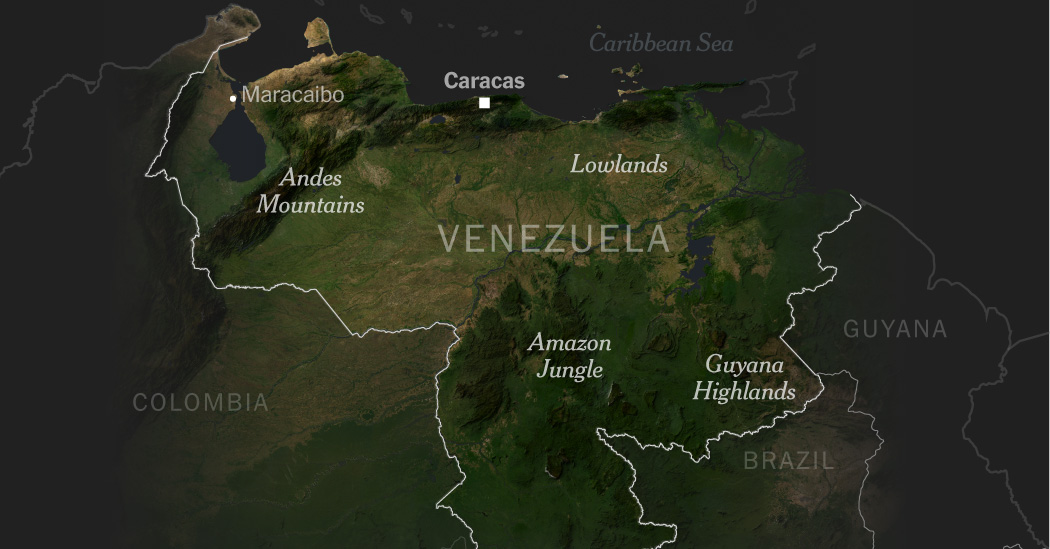
Outside Caracas, security challenges also abound. Unlike the colectivos, some armed groups in rural areas are already battle-tested against well-trained adversaries. These include Colombian guerrillas with thousands in their ranks, often operating from Venezuelan territory.
These rebel groups, the National Liberation Army, or E.L.N., and splinter cells from the demobilized Revolutionary Armed Forces of Colombia, or FARC, no longer have realistic chances of seizing control of a central government.
But their numbers are resurging as they vie for control over drug smuggling routes and extortion rackets, while still relying on other illicit revenue streams like abducting oil workers.
Venezuela’s mineral deposits are another potential source of instability, notably in the gold-rich state of Bolívar. Las Claritas Sindicato, one of the most powerful criminal groups engaged in illegal mining, is deeply rooted there.
Las Claritas, like similar groups, applies taxes on miners and traders, and exerts strict control over outposts where it imposes its own laws and punishments for scofflaws, according to InSight Crime, a research group focused on organized crime.
Venezuela’s leadership faces not only challenges from illegal armed groups, but also potential defiance from within governing circles.
At the moment, there is a fragile alliance between civilian factions, led by Ms. Rodríguez and her brother, Jorge Rodríguez, the head of the National Assembly; and military factions led by Interior Minister Diosdado Cabello and Defense Minister Vladimir Padrino López.
But an open rupture between these camps over a contentious issue like U.S. meddling in Venezuela could open up other chances for conflict, warned Ms. Hanson, the sociologist.
Security forces and intelligence agencies are more closely aligned with the military faction, potentially threatening the stability of a civilian government whether it is led by a Chavista, like Ms. Rodríguez, or an opposition leader, like Maria Corina Machado, the recipient of last year’s Nobel Peace Prize.

