


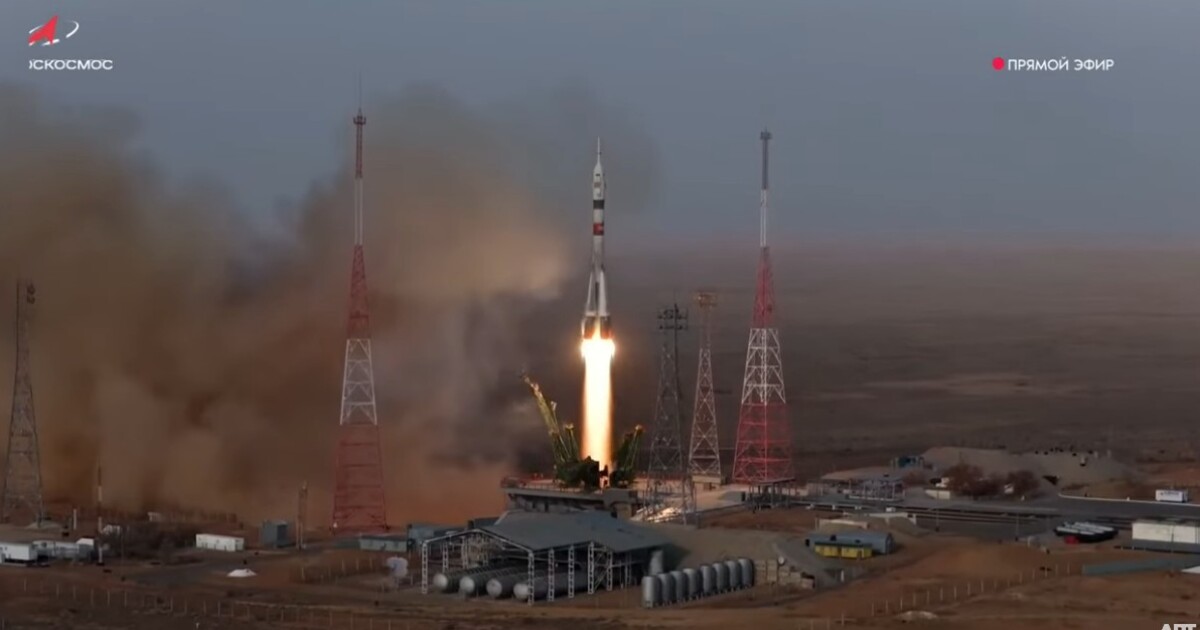
Russia has suffered a major setback after the launch of its Soyuz MS-28 mission ferrying astronauts to the International Space Station (ISS) caused severe damage to the country’s only pad capable of handling crewed boosters.
Space launches have become so routine these days that they’re about as worthy of reporting as a transatlantic passenger plane taking off. However, sometimes mishaps happen and some of these can have major implications.
Launched on November 27, 2025, MS-28 was a routine mission to send Roscosmos cosmonauts Commander Sergey Kud-Sverchkov and Flight Engineer Sergei Mikaev, and NASA astronaut Flight Engineer Christopher Williams to the ISS aboard a Soyuz spacecraft launched atop a Soyuz 2.1a rocket.
The launch was almost boringly routine except for what happened to the launch pad. Built in the early 1960s, Site 31/6 at the Baikonur Cosmodrome includes an essential piece of equipment used to prepare the rockets for launch. Called the 8U216 Maintenance Cabin, it’s a mobile metal platform designed to provide technicians with pre-launch access to the lower section of the rocket, including the first- and second-stage engines. When it has completed its job, the cabin is lowered into the blast deflection pit and slid sideways into a protective alcove sealed by a metal screen.
MS-28
Normally, with the cabin safely tucked away, the exhaust from the rocket shoots by it harmlessly, but on the latest launch the cabin either broke loose from its mooring or was never properly locked down. As a result, the one million pounds of thrust from the Soyuz pulled the 144-tonne cabin out and tossed it into the blast pit 20 m (66 ft) below, where it was catastrophically damaged.
That’s bad enough, but Site 31/6 is Russia’s only launch pad capable of handling manned launch missions to the ISS, and without the cabin, it is out of commission. How long this will last is unclear with Roscosmos saying, “All necessary spare components are available for repair, and the damage will be repaired shortly.” Meanwhile, other sources state that it could take as long as two years to complete the repairs.
The incident is ironic because it reverses the situation in 2011 when the American Space Shuttle was retired, leaving the Russian Soyuz as the only means of reaching the ISS until the SpaceX Crewed Dragon became operational. Now, Russia is out of business and the US has the launch monopoly. At the very least, this highlights the need for redundancy if a human orbital presence is to remain permanent.
Source: Roscosmos

