


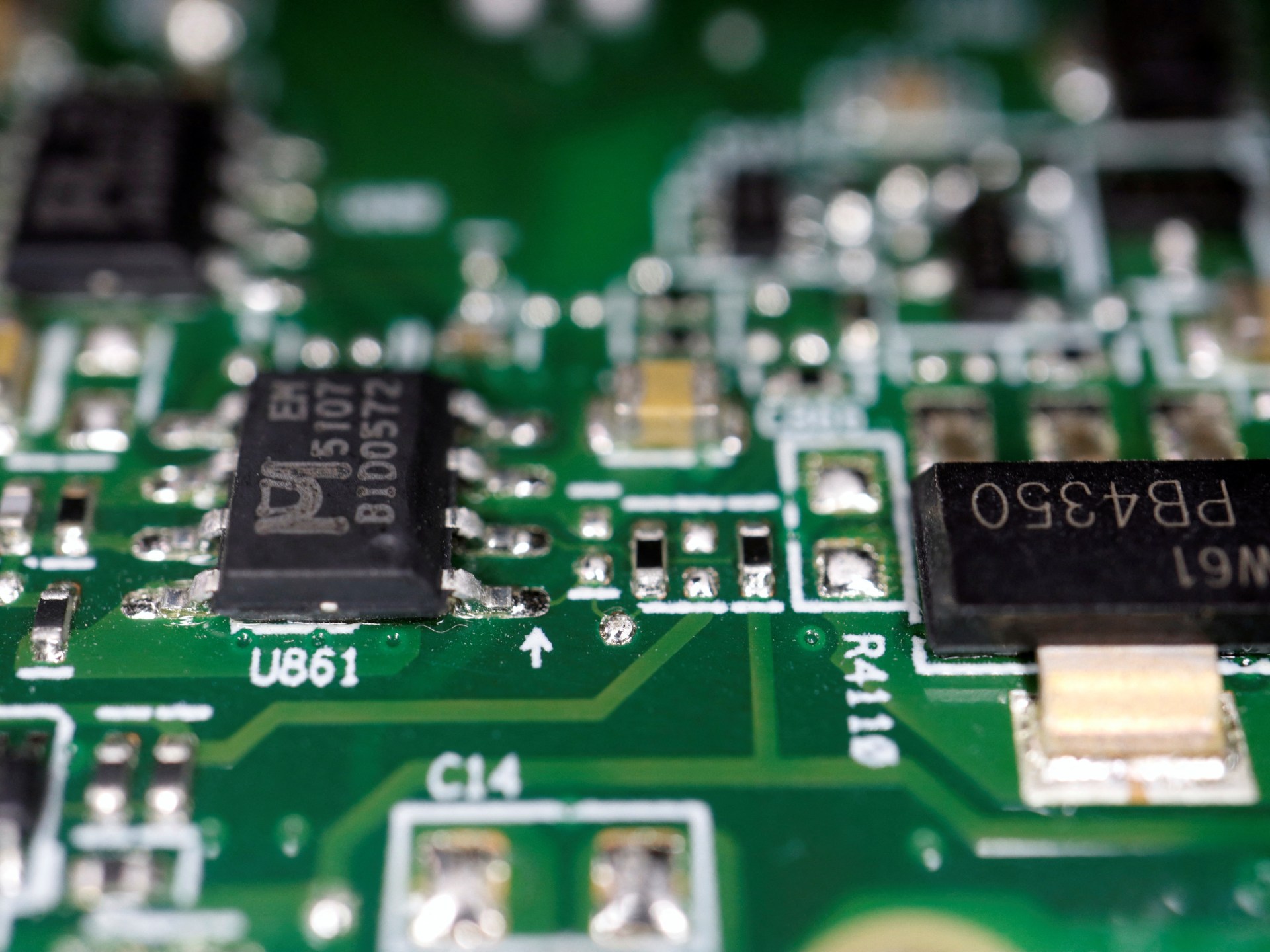
In October, a small electronics manufacturer in the western Indian state of Gujarat shipped its first batch of chip modules to a client in California.
Kaynes Semicon, together with Japanese and Malaysian technology partners, assembled the chips in a new factory funded with incentives under Indian Prime Minister Narendra Modi’s $10bn semiconductor push announced in 2021.
Modi has been trying to position India as an additional manufacturing hub for global companies that may be looking to expand their production beyond China, with limited success.
One sign of that is India’s first commercial foundry for mature chips that is currently under construction, also in Gujarat. The $11bn project is supported by technology transfer from a Taiwanese chipmaker and has onboarded the United States chip giant Intel as a potential customer.
With companies the world over hungering for chips, India’s entry into that business could boost its role in global supply chains. But experts caution that India still has a long way to go in attracting more foreign investment and catching up in cutting-edge technology.
Unprecedented momentum
Semiconductor chips are designed, fabricated in foundries, and then assembled and packaged for commercial use. The US leads in chip design, Taiwan in fabrication, and China, increasingly, in packaging.
The upcoming foundry in Gujarat is a collaboration between India’s Tata Group, one of the largest conglomerates in the country, and Taiwan’s Powerchip Semiconductor Manufacturing Corporation (PSMC), which is assisting with the plant’s construction and technology transfer.
On December 8, Tata Electronics also signed an agreement with Intel to explore the manufacturing and packaging of its products in Tata’s upcoming facilities, including the foundry. The partnership will address the growing domestic demand.
Last year, Tata was approved for a 50 percent subsidy from the Modi government for the foundry, along with additional state-level incentives, and could come online as early as December 2026.
Even if delayed, the project marks a pivotal moment for India, which has seen multiple attempts to build a commercial fab stall in the past.
The foundry will focus on fabricating chips ranging from 28 nanometres (nm) to 110nm, typically referred to as mature chips because they are comparatively easier to produce than smaller 7nm or 3nm chips.
Mature chips are used in most consumer and power electronics, while the smaller chips are in high demand for AI data centres and high-performance computing. Globally, the technology for mature chips is more widely available and distributed. Taiwan leads production of these chips, with China fast catching up, though Taiwan’s TSMC dominates production for cutting-edge nodes below 7nm.
“India has long been strong in chip design, but the challenge has been converting that strength into semiconductor manufacturing,” said Stephen Ezell, vice president for global innovation policy at the Washington, DC-based Information Technology and Innovation Foundation (ITIF).
“In the past two to three years, there’s been more progress on that front than in the previous decade – driven by stronger political will at both the central and state levels, and a more coordinated push from the private sector to commit to these investments,” Ezell told Al Jazeera.
Easy entry point
More than half of the Modi government’s $10bn in semiconductor incentives is earmarked for the Tata-PSMC venture, with the remainder supporting nine other projects focused mainly on the assembly, testing and packaging (ATP) stage of the supply chain.
These are India’s first such projects – one by Idaho-based Micron Technology, also in Gujarat, and another by the Tata Group in the northeastern Assam state. Both will use in-house technologies and have drawn investments of $2.7bn and $3.3bn, respectively.
The remaining projects are smaller, with cumulative investments of about $2bn, and are backed by technology partners such as Taiwan’s Foxconn, Japan’s Renesas Electronics, and Thailand’s Stars Microelectronics.
“ATP units offer a lower path of resistance compared to a large foundry, requiring smaller investments – typically between $50m and $1bn. They also carry less risk, and the necessary technology know-how is widely available globally,” Ashok Chandak, president of the India Electronics and Semiconductor Association (IESA), told Al Jazeera.
Still, most of the projects are behind schedule.
Micron’s facility, approved for incentives in June 2023, was initially expected to begin production by late 2024. However, the company noted in its fiscal 2025 report that the Gujarat facility will “address demand in the latter half of this decade”.
Approved in February 2024, the Tata facility was initially slated to be operational by mid-2025, but the timeline has now been pushed to April 2026.
When asked for reasons behind the delays, both Micron and Tata declined to comment.
One exception is a smaller ATP unit by Kaynes Semicon, which in October exported a consignment of sample chip modules to an anchor client in California – a first for India.
Another project by CG Semi, part of India’s Murugappa Group, is in trial runs, with commercial production expected in the coming months.
The semiconductor projects under the Tata Group and the Murugappa Group have drawn public scrutiny after Indian online news outlet Scroll.in reported that both companies made massive political donations after they were picked for the projects.
As per Scroll.in, the Tata Group donated 7.5 billion rupees ($91m) and 1.25 billion rupees ($15m), respectively, to Modi’s Bharatiya Janata Party (BJP) just weeks after securing government subsidies in February 2024 and ahead of national elections. Neither group had made such large donations to the party before. Such donations are not prohibited by law. Both the Tata Group and the Murugappa Group declined to comment to Al Jazeera regarding the reports.
Meeting domestic demand a key priority
The upcoming projects in India – both the foundry and the ATP units – will primarily focus on legacy, or mature, chips sized between 28nm and 110nm. While these chips are not at the cutting-edge of semiconductor technology, they account for the bulk of global demand, with applications across cars, industrial equipment and consumer electronics.
China dominates the ATP segment globally with a 30 percent share and accounted for 42 percent of semiconductor equipment spending in 2024, according to DBS Group Research.
India has long positioned itself as a “China Plus One” destination amid global supply chain diversification, with some progress evident in Apple’s expansion of its manufacturing base in the country. The company assembles all its latest iPhone models in India, in partnership with Foxconn and Tata Electronics, and has emerged as a key supplier to the US market this year following tariff-related uncertainties over Chinese shipments.
Its push in the ATP segment, however, is driven largely by the need to meet the growing domestic demand for chips, anticipated to surge from $50bn today to $100bn by 2030.
“Globally, too, the market will expand from around $650bn to $1 trillion. So, we’re not looking at shifting manufacturing from China to elsewhere. We’re looking at capturing the incremental demand emerging both in India and abroad,” Chandak said.
India’s import of chips – both integrated circuits and microassemblies – has jumped in recent years, rising 36 percent in 2024 to nearly $24bn from the previous year. An integrated circuit (IC) is a chip serving logic, memory or processing functions, whereas a microassembly is a broader package of multiple chips performing combined functions.
The momentum has continued this year, with imports up 20 percent year-on-year, accounting for about 3 percent of India’s total import bill, according to official trade data. China remains the leading supplier with a 30 percent share, followed by Hong Kong (19 percent), South Korea (11 percent), Taiwan (10 percent), and Singapore (10 percent).
“Even if it’s a 28 nm chip, from a trade balance perspective, India would rather produce and package it domestically than import it,” Ezell of ITIF said, adding that domestic capability would enhance the competitiveness of chip-dependent industries.
Better incentives needed
The Modi government’s support for the chip sector, while unprecedented for India, is still dwarfed by the $48bn committed by China and the $53bn provisioned under the US’s CHIPS Act.
To achieve scale in the ATP segment for meaningful import substitution – and to advance towards producing chips smaller than 28nm – India will need continued government support, and there is a second round of incentives already in the works.
“The reality is, if India wants to compete at the leading edge of semiconductors, it will need to attract a foreign partner – American or Asian – since only a handful of companies globally operate at that level. It’s highly unlikely that a domestic firm will be competitive at 7nm or 3nm anytime soon,” Ezell said.
According to him, India needs to continue focusing on improving its overall business environment – from ensuring reliable power and infrastructure to streamlining regulations, customs and tariff policies.
India’s engineers make up about a fifth of the global chip design workforce, but rising competition from China and Malaysia to attract multinational design firms could erode that edge.
In its latest incentive round, the Indian government limited benefits to domestic firms to promote local intellectual property – a move that, according to Alpa Sood, legal director at the India operations of California-based Marvell Technology, risks driving multinational design work elsewhere.
“India already has a thriving chip design ecosystem strengthened by early-stage incentives from the government. What we need, to further accelerate and build stronger R&D muscle – is incentives that mirror competing countries like China [220 percent tax incentives] and Malaysia [200 percent tax incentives]. This will ensure we don’t lose the advantage we’ve built over the years,” Sood told Al Jazeera.
Marvell’s India operations are its largest outside the US.
The Trump effect
India’s upcoming chip facilities, while aimed at meeting domestic demand, will also export to clients in the US, Japan, and Taiwan. Though US President Donald Trump has threatened 100 percent tariffs on semiconductors made outside the US, none have yet been imposed.
A bigger concern for India-US engagement – so far limited to education and training – is Washington’s 50 percent tariff on India over its Russian crude imports. Semiconductors remain exempt, but the broader trade climate has turned uncertain.
“Over half the global semiconductor market is controlled by US-headquartered firms, making engagement with them crucial,” Chandak said. “Any alignment with these firms, either through joint ventures or technology partnerships – is a preferred option.”
The global chip race is accelerating, and India’s policies will need to keep pace to become a serious player amid growing geo-economic fragmentation.
“These new 1.7nm fabs are so advanced they even factor in the moon’s gravitational pull – it’s literally a moonshot,” Ezell said. “Semiconductor manufacturing is the most complex engineering task humanity undertakes – and the policymaking behind it must be just as precise.”

