



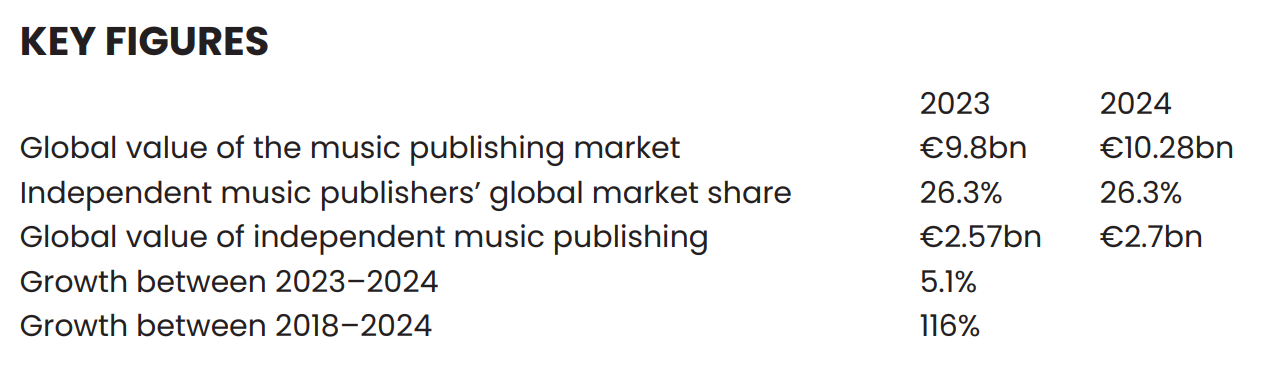
The world’s independent music publishers saw a 5.1% year over year increase in revenue in 2024, according to a new report from the Independent Music Publishers Forum (IMPF).
The IMPF’s Global Market View report, released on Wednesday (December 17), found indie publishers collected EUR €2.7 billion globally in 2024, or USD $2.9 billion at the average exchange rate for the year.
By comparison, the global recorded music market grew 4.8% YoY in 2024, according to data from IFPI, reaching $29.6 billion. Music publishing revenues in the US – including majors and indie publishers – grew 13.4% YoY in 2024 to $7 billion, according to data from the RIAA.
The IMPF, which represents more than 300 indie music publishers worldwide, based its estimates for indie publisher revenue on data from CISAC, noted music industry economist Will Page, and Music & Copyright.
Indie music publishers have seen overall revenue growth every year since IMPF started tracking the data in 2018. In that time, overall revenue grew 116%, the report found.
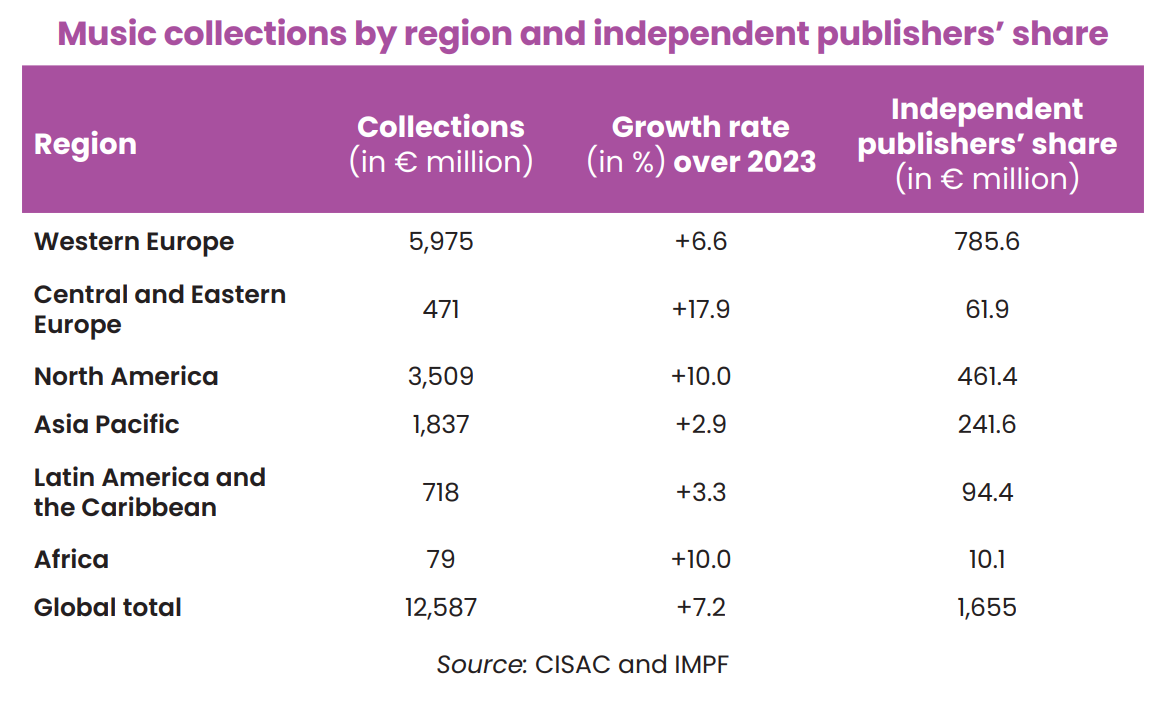
Europe remains the largest source of indie music publisher revenue, accounting for 51.2% of global collections in 2024, with €847.5 million ($917.2 million) going to indie publishers. The vast majority of that (€785.6 million, or $850.2 million) came from Western Europe, with Central and Eastern Europe bringing in €61.9 million ($67.0 million). However, the CEE region had “by far” the highest growth rate in collections, up 17.9% YoY, the IMPF report noted.
Far behind in second place is North America (the US and Canada), delivering €461.4 million ($499.4 million) to indie publishers.
“Europe’s position as the world’s leading region for music royalties is no coincidence. It is the result of strong copyright protection, robust licensing frameworks and well-developed collective management infrastructures that ensure creators and rightsholders are properly rewarded,” said Claudia Mescoli, General Manager at Edizioni Curci and an IMPF Board member.
“This foundation allows European repertoire to thrive at home and around the world, giving independent publishers and songwriters the confidence to invest, innovate and grow. Europe shows what is possible when the value of creativity is backed by a solid and reliable rights ecosystem.”
Marta Zgrzywa, COO, Schubert Music Publishing, noted that Eastern Europe “is becoming one of the most exciting regions for independent music publishers. We are seeing rapid growth, stronger local markets and a new generation of creators who are ready to reach global audiences.”
She added: “With improving licensing structures and increasing professionalism across societies, the region is finally unlocking the value of its incredible repertoire. For independents, Eastern Europe represents both opportunity and momentum, a place where investment, collaboration and long-term commitment can make a real difference.”
Other parts of the world are showing notable improvement in publishing royalty collection, with the report singling out India.
“The dramatic transformation of IPRS [the Indian Performing Right Society], now surpassing €80 million in annual collections, is a case study in how improved licensing conditions, data accuracy, governance and international cooperation can rapidly increase income for publishers and songwriters,” the IMPF report stated.
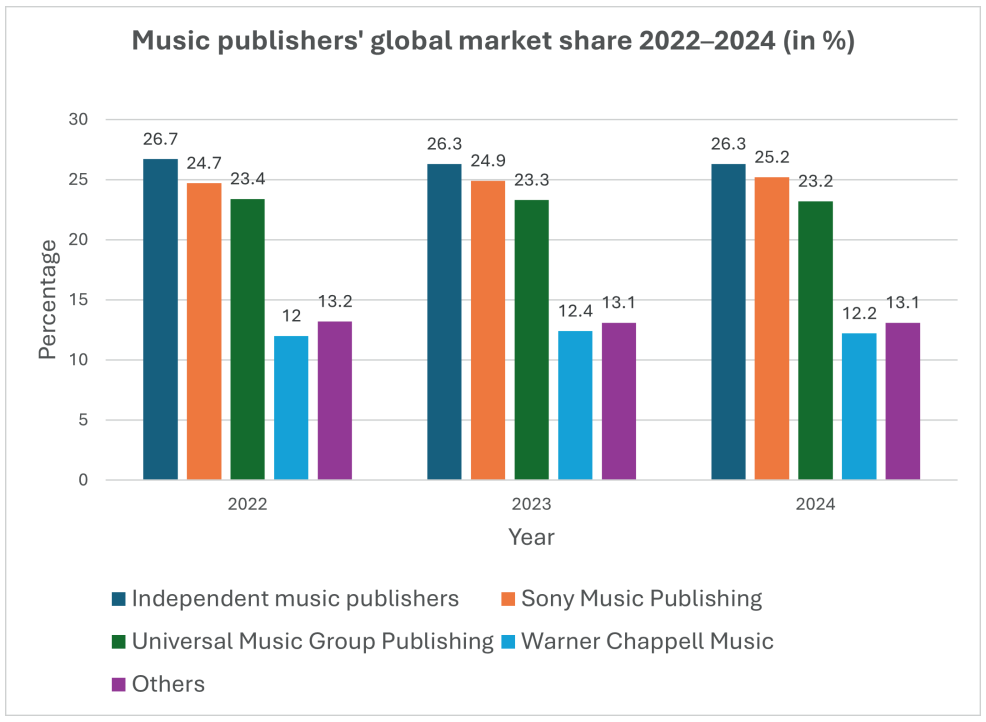
In terms of market share, indie music publishers held steady at 26.3% of global music publisher revenues. That excludes indie publishers with more than 5% market share, namely BMG and Kobalt.
“Taken collectively, the independent music publishing community is still larger than the biggest major music publisher,” noted Annette Barrett, President of IMPF and an executive at Reservoir, in her preamble to the report.
Barrett was referring to Sony Music Publishing, which slightly increased its market share in 2024 to 25.2% from 24.9% a year earlier. That places Sony ahead of its major competitors, Universal Music Publishing Group and Warner Chappell Music, with the three major publishers combined holding 60.6% of the global music publishing market in 2024.

Indie music publishers have had a larger market share than the largest of the majors for the entire time that data has been tracking the data, Music & Copyright Editor Simon Dyson said.
“The sector topped the 40% mark in 2015 and stayed above this level until 2023. However, the tussle at the top between Sony and Universal has put the squeeze on the independents,” he said.
“Moreover, smaller publisher acquisitions by the majors will almost certainly see the gap narrow further. The bigger indies like Kobalt and BMG have held steady, but there are concerns for the smaller players, particularly given the increasing dominance of digital.”
“Europe’s position as the world’s leading region for music royalties is no coincidence. It is the result of strong copyright protection, robust licensing frameworks and well-developed collective management infrastructures that ensure creators and rightsholders are properly rewarded.”
Claudia Mescoli, Edizioni Curci
Tatjana Bukvic, Managing Director at Tin Drum Music and an IMPF Board member, said indie publishers managed to maintain their market share “despite strong competition for catalogs and ongoing waves of acquisitions.”
After three years of declining market share, the steady print in 2024 “says a lot about the spirit of entrepreneurship of IMPF’s membership and the hard work put into their businesses by publishers around the world,” she added.
The report also focused on what it sees as a risk to songwriters’ and music publishers’ revenues from the proliferation of AI. The report cited recent studies from SGAE in Spain and KODA in Denmark, which backed up earlier reports that a quarter or more of music revenue could dry up in the age of AI. SGAE’s study specifically estimated that around 28% of copyright revenues in Spain will be at risk from generative AI by 2028.
“Extrapolating these figures from the global market value in 2024, this would mean that €3.5 billion in collections could be at risk, of which €465 million would directly come out of the revenues of independent publishers,” the IMPF report stated.
“If the balance tips too far towards non-human outputs, we risk ending up in a music landscape none of us would wish to be part of.”
Annette Barrett, IMPF
IMPF is “fully alert to this challenge,” Barrett wrote in the report.
“Together with creators and rightsholder organizations, we are pressing policymakers to recognize that unlicensed AI use can have a devastating impact on our livelihoods. Without proper protection, transparency and compensation, a human-centered music ecosystem could quickly erode.”
She added: “As publishers, we believe deeply in human creativity and in the relationships we build with our authors and composers. This relationship is not just the foundation of our business; it is the heart of it. We can embrace innovation while defending the essential role of human creation. But if the balance tips too far towards non-human outputs, we risk ending up in a music landscape none of us would wish to be part of.”
Chartmetric is the all-in-one platform for artists and music industry professionals, providing comprehensive streaming, social, and audience data for everyone to create successful careers in music.Music Business Worldwide

