


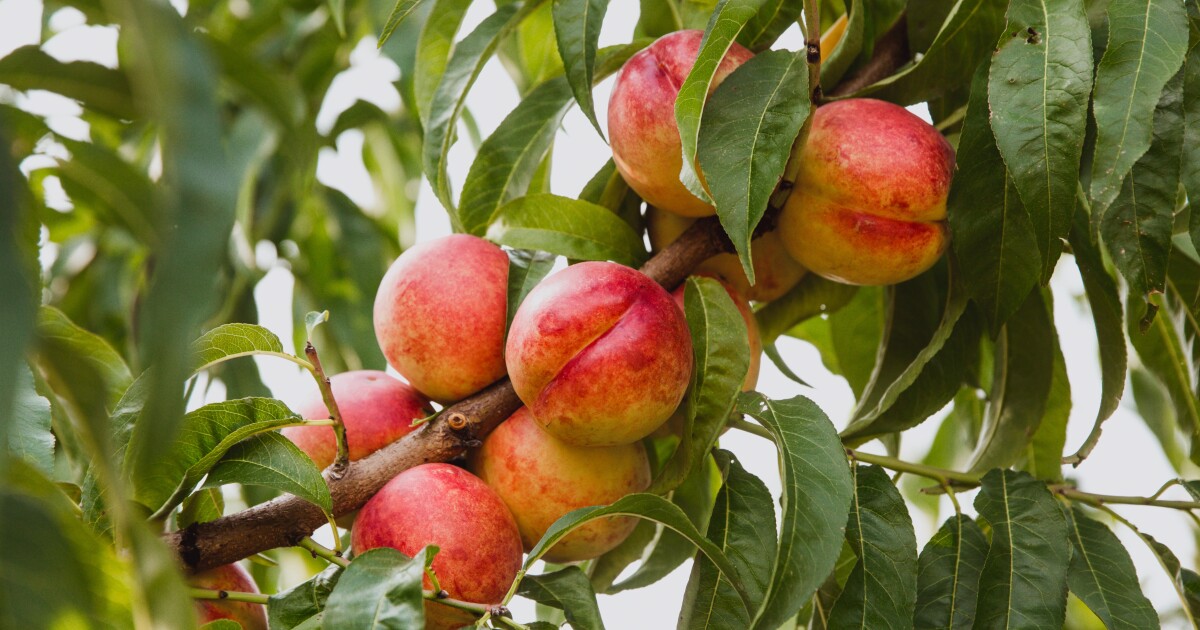
It’s ironic … in order for farmers to know if their fruit is ripe, they regularly have to pick and analyze pieces of that fruit, reducing their yields. Utilizing a new technique, however, they could soon leave all the fruit intact, analyzing the leaves beside it instead.
The process is currently being developed by scientists at Spain’s Universitat Rovira i Virgili, and was tested over the course of 11 weeks on 12 nectarine trees in a commercial orchard.
In its present form, the technology utilizes two spectrometers to perform near-infrared and mid-infrared scans of the top surfaces and undersides of leaves immediately adjacent to the fruits. The manner in which the leaves absorb or reflect light emitted by each spectrometer reliably indicates the current ripeness of the fruit.
“The leaves undergo physiological and biochemical changes as the fruit ripens, due to the direct connection between the metabolism of the leaves and that of the fruit,” says team member Dr. Daniel Schorn. “These changes are reflected in their spectral fingerprint.”
The technique has so far proven to be a particularly accurate indicator of fruit weight and firmness. Other ripeness-related fruit properties – such as sugar content, pH, and acidity – aren’t as precisely indicated, although that could change as the system is developed further.
Universitat Rovira i Virgili
It should be noted that ripeness can also be assessed by directly scanning a piece of fruit with a spectrometer, although doing so often leaves a mark on the skin, lowering the fruit’s market value.
The researchers hope that the technique will ultimately be carried out in the field using portable scanners. Not only could it indicate the ripeness of entire crops via representative pieces of fruit, it could even allow farmers to selectively pick only the ripe fruits from individual trees, leaving the rest to ripen over time.
The study is described in a paper that was recently published in the journal ACS Agricultural Science & Technology.
Source: Universitat Rovira i Virgili

