


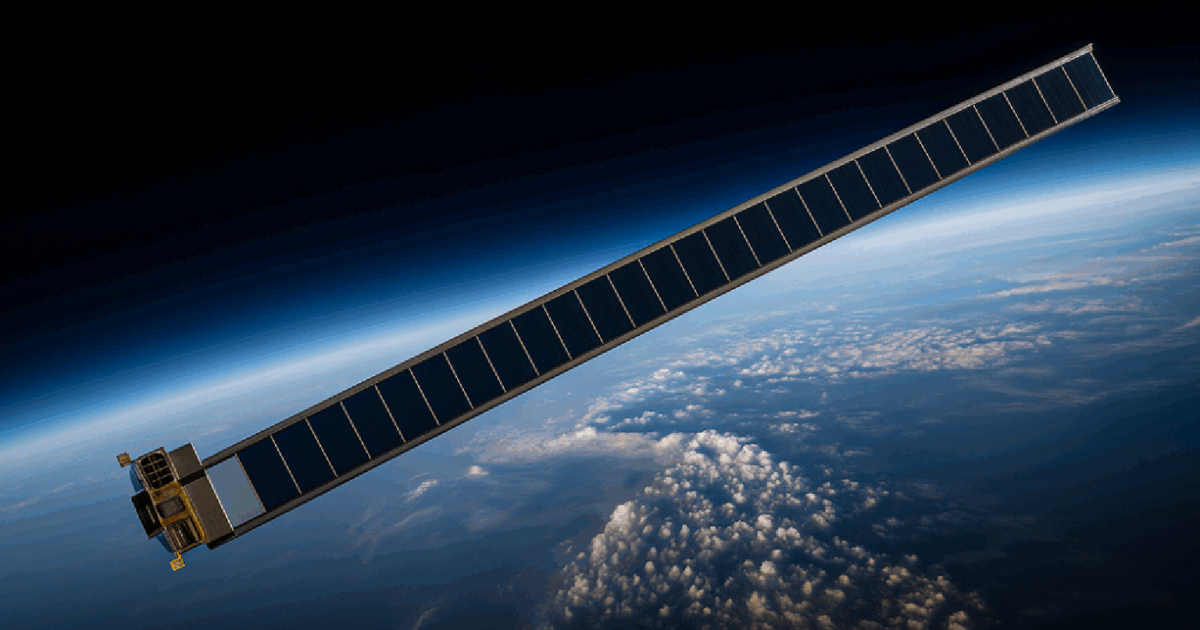
Commercial spaceflight is booming and looks to go into full-on kaboom stage in the near future, sparking the need for an ever-increasing supply of solar panels. To fill this need, Dcubed is developing its ARAQYS system to directly manufacture arrays in orbit.
Aside from a few nuclear power systems in military and research satellites, solar panels are the overwhelming choice for powering spacecraft in Earth orbit. Given all that sunlight unimpeded by atmosphere, weather, or the aggravatingly regular occurrence of night, the Sun makes perfect sense as a power source.
However, there is a problem: solar panels and their support structures tend to be a bit on the heavy side and they have to be packed away during transportation and launching. This results in two major drawbacks. First, the panels need a mechanism to unfold them in orbit, which adds weight and volume. Second, this mechanism must be capable of withstanding the acceleration forces, vibrations, and acoustic stresses of a rocket launch.
All of that ups the costs while detracting from the available payload volume and mass.
Dcubed hopes to skirt these problems this with its new ARAQYS system, which doesn’t deploy solar panels. It manufactures them in space with what the company claims is a significant reduction in cost per kilowatt.
The system is based on a highly compact and flexible ultrathin soft solar blanket that acts as the collection panel and can unroll once the satellite reaches orbit. As it does so, a 3D printer system prints a rigid back structure to the blanket array membrane. As it does so, the hard UV radiation of space rapidly cures the resin, making it hard. This means a reduction of costs that a company spokesman estimates to be in orders of magnitude.
The current plan is to launch a series of demonstration missions into orbit, with the first one aimed at constructing a 60-cm (2-ft) boom later this year. This will be followed by a more ambitious 1-m (3-ft) version and an operational 2-kW demo in 2027. From there, commercial products are expected to go on sale.
Once the technology has matured, it will have a wide variety of satellite applications, including power-beaming arrays, space tugs, and data processing constellations.
“Dcubed is fully committed to leading the next frontier: power generation in orbit,” said Dr. Thomas Sinn, CEO of Dcubed. “My involvement in a NASA NIAC study on space-based solar power more than 15 years ago set this journey in motion. Since then, we’ve been steadily developing the technologies required to make in-space energy a practical reality. With ARAQYS, we’re now combining those years of innovation into affordable large-scale power solutions designed to meet the demands of the rapidly growing space economy.”
Source: Dcubed

