


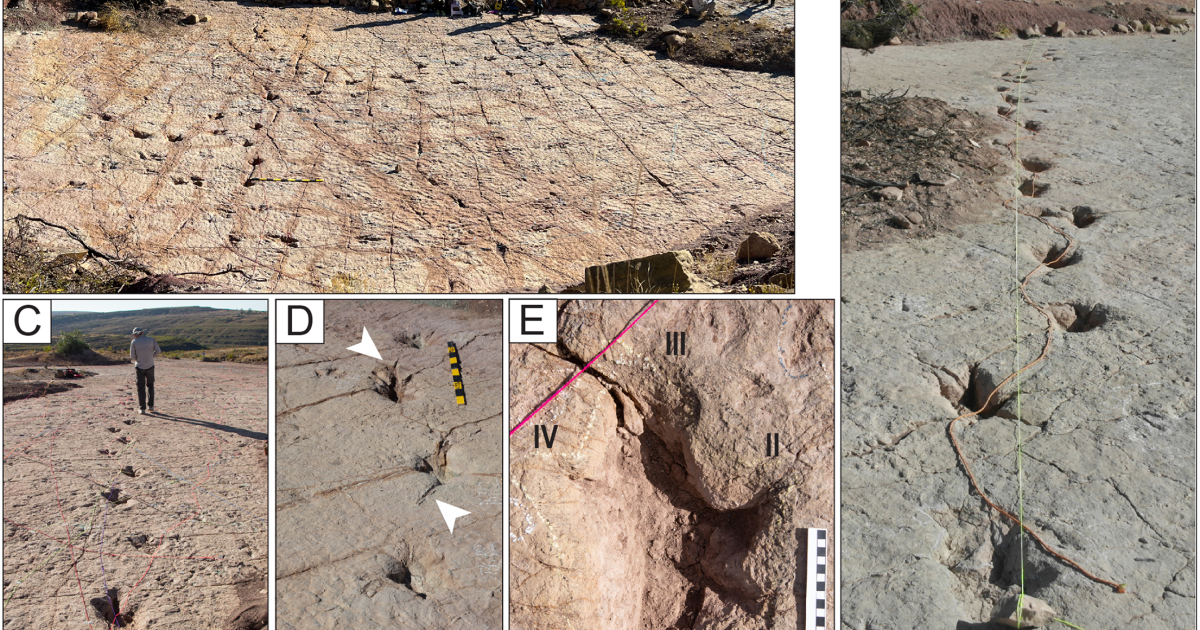
The extent of an incredible dinosaur highway has been revealed in Bolivia, a country where actual skeletal fossils are rare. More than 16,000 footprints, along with tail impressions from creatures of all sizes, have been fully documented – and the scale of theropod activity alone is unlike anything that’s been seen before.
A team of scientists including Raúl Esperante from California’s Geoscience Research Institute has released its documentation of this new global megasite, the Carreras Pampas trackway, on a single Cretaceous mudflat in Torotoro National Park, Bolivia. Here, the scientists detail nine separate sites, each housing an unprecedented number and variety of tracks that reveal fascinating insight into not just species diversity but their behavior.
Earlier research had identified the area as a hotspot for historical tracks, but the extent of it has been unknown until now.
“This site is a stunning window into this area’s past,” Esperante said. “Not just how many dinosaurs were moving through this area, but also what they were doing as they moved through.”
Unlike typical trackways that accumulate across multiple layers and detail different periods of time, this one is a single stretch of sediment covering about 7,500 m² (1.85 acres), with dinosaurs of all sizes crisscrossing it within what may have been a period of only hours. Researchers counted 1,321 trackways, 289 isolated prints, hundreds of continuous swim traces, several tail-drag marks and a scattering of bird footprints, all preserved under near-ideal geological conditions.
While it may seem far-fetched to think the site had all this foot traffic and then none – the prints suggest this was the case. All the activity happened perhaps within hours, and once the dinosaurs left, no more animals came across that surface before it began drying. This explains why there are so many overlapping trackways but almost no evidence of later trampling. As for the rest of the story, that’s not entirely clear.
What the discovery has revealed is that it appears the area formed part of a tidal mudflat, and ripple marks in the preserved sediment suggest most of the foot traffic was close to the water’s edge. The vast majority of the tracks belong to theropods – ranging from bird-sized to large, predatory individuals – with around 16,600 prints preserved. Smaller prints, some just an inch or two long, show tiny animals trotting or darting across the mud, while mid-sized carnivores left their three-toed marks complete with claw indentations. Meanwhile, larger theropods left broad, deep tracks with long strides, including sections that suggested short bursts of running or sprinting.
One of the most extraordinary findings is the section of swim trackways – the highest number documented to date. These impressions show spaced-out toes marks, indicative of a buoyant animal only touching the sediment intermittently. Some show spaced-out “punting” where the dinosaur briefly contacted the bottom before floating again. Together, they capture rare evidence of how dinosaurs moved in shallow water.
“Swim tracks are abundant at the tracksite, with many forming trackways consisting of sets of 1–3 scratches that alternate between right and left with regular spacing,” the researchers noted. “The traces are in excellent preservation condition, and we identified three different morphotypes. Some swim tracks cross-cut walking tracks, and most swim trackways are oriented toward the SSE. The swim tracks are tentatively assigned to the ichnotaxon Characichnos based on their morphological traits.”

Equally striking are several tail-drag marks that leave no guesswork as to what they are – because they appear behind distinctive footprints. Clear tail drags are extremely rare in the fossil record and often disputed, because of how open to interpretation partial marks are – unlike here. Mixed among the dinosaur traffic are small, thin-toed impressions suggesting shorebird-like foragers were also present.
“The tail traces suggest that dinosaurs exhibited some form of locomotive behavior in response to sinking into soft substrate, which resulted in their tails coming into contact with the surface,” the researchers noted. “However, the presence of tail traces associated with shallow tracks indicates that some mechanism, aside from sinking into the substrate, also contributed to the formation of tail traces in certain instances.”
Curiously, some of the footprints contain small “rosette” burrows made later by invertebrates tunneling through the drying mud. Because those burrows sit inside the dinosaur tracks, they confirm the prints are genuine surface impressions rather than deeper tracks created by pressure alone.
In addition to this, most of the tracks are oriented roughly northwest to southeast, with ripple marks preserved in the sediment, suggesting these dinosaurs were roaming alongside an ancient shoreline. Many dinosaurs moved roughly parallel to the water, suggesting a natural travel corridor used by many species. The density of these prints also tell of a snapshot in time, but one with sustained foot traffic.

“Aside from tracksites with very small vertebrate footprints and miniature dinosaur tracks, the Carreras Pampa tracksite may boast one of the highest densities of theropod tracks known worldwide,” the researchers wrote. “The abundant parallel and subparallel trackways, along with the bimodal orientation, strongly suggest the presence of some form of group behavior. The overlapping and crossing of trackways indicate that groups of theropods walked at different times in both preferred orientations.”
As we noted, dinosaur bones are rare in Bolivia – much of the country’s paleobiology is in the form of trace fossils. However thanks to the Carreras Pampa discovery, scientists now have an enormous snapshot of a thriving hub of activity to study further. This makes Torotoro National Park one of the world’s most important windows into dinosaur life and behavior.
“It’s amazing working at this site, because everywhere you look, the ground is covered in dinosaur tracks,” Esperante added.
The research was published in the journal PLOS One.
Source: Geoscience Research Institute via Scimex

