


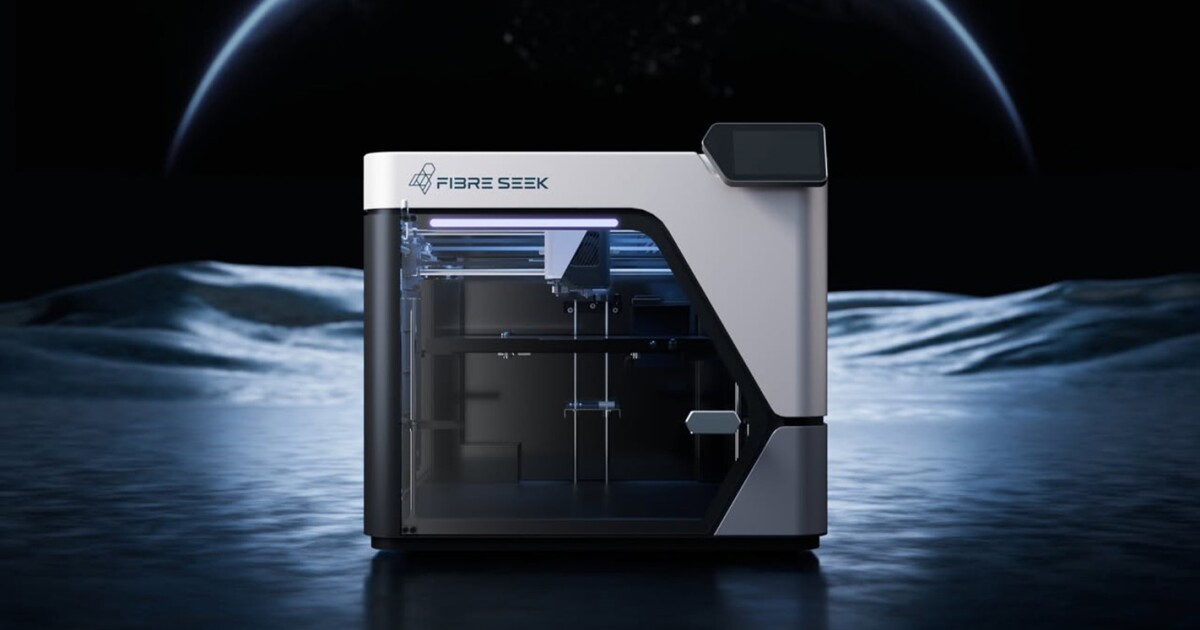
Anyone who’s mucked about with consumer-grade 3D printers knows that it’s infinitely cool to create stuff with them, but you can’t realistically expect those products to be particularly durable.
If you want to make something that can hold weight, take a beating, and last a long time, you’d usually have to book time with a more expensive composite 3D printer – the sort that can cost upward of US$15,000 and support continuous fibers of material like carbon fiber and fiberglass for added strength.
Hong Kong-based FibreSeek hopes to make that a lot more accessible to hobbyists. Its FibreSeeker 3 desktop machine uses a dual-extruder system that works with continuous fibers and comes with the necessary slicing software to make and print parts that are way stronger than conventional 3D printers’ results, at a fraction of the price.
FibreSeeker 3 – The First Consumer Continuous Fiber 3D Printer
The FibreSeeker 3 has a build volume of 300 mm x 300 mm x 245 mm, and features dual heads for composite fiber co-extrusion. One handles a range of regular thermoplastic filaments, and the other works with continuous fibers including the company’s own carbon fiber filament that promises high tensile strength fabrication: we’re talking up to 900 MPa, significantly more than aluminum.
FibreSeek
With this co-extrusion tech, the plastic filament can serve as as a binding agent when you’re creating carbon fiber parts. The 0.7-mm continuous fiber nozzle gets up to 662 °F (350 °C), which should make for increased strength.

FibreSeek
It runs in three modes:
- High-speed mode uses filaments like PLA, PETG, and ABS to print at up to 500 mm/s with just the Fused Filament Fabrication (FFF) nozzle, which is handy for prototyping.
- High-strength mode engages the 0.7-mm Composite Fiber Coextrusion (CFC) + FFF nozzles simultaneously, so you’ll get a carbon fiber skeleton embedded in your prints. This is slower, but will result in stronger parts.
- Hyper-strength mode engages just the CFC nozzle for when you want to print using just continuous fiber, making for a much stronger and stiffer product that’s a lot lighter than you’d expect.
There’s a 5-inch color touchscreen to track progress and speed, and adjust settings; the FibreSeeker 3 also automatically handles leveling and calibration, and uses an AI-powered camera to monitor prints and avoid errors. The printer runs on open-source Klipper firmware, along with the company’s proprietary slicing software that’s designed to handle continuous fiber-based projects.

FibreSeek
FibreSeek has a number of demo videos showcasing the tensile strength of parts printed using its machine, like this one below:
FibreSeeker 3 Demo Video:1.5 Tons Holding Test
For a simpler real-world comparison, YouTuber YGK3D’s review tested a 3D-printed PTG plastic hook against a carbon fiber hook, also made with the FibreSeeker 3. While the PTG hook held up a weight of 145 lb (65 kg), the carbon fiber hook managed 235 lb (106.5 kg) before breaking, which is quite a step up.
The FibreSeeker 3 is expected to retail at $5,000. It’s currently crowdfunding on Kickstarter, where the 3D printer is discounted down to as little as $2,699 for early backers. FibreSeek’s spools of 500-m (1,640-ft) carbon fiber filament can be had at $39 each through the campaign, which is 20% below its MSRP.

FibreSeek
All crowdfunding campaigns carry an element of risk, and this appears to be FibreSeek’s first project. For what it’s worth, the company notes its team comprises veterans from the 3D-printing industry, and has in-house production lines to manufacture the FibreSeeker 3. The campaign has vastly exceeded its funding goal with more than a thousand backers on board.
If all goes to plan, FibreSeeker 3 orders are slated to ship worldwide in January 2026, and delivery costs, as well as VAT and customs duties, are included in the pledge.
Check out the FibreSeeker over on Kickstarter.

