
8.7 C
New York
Monday, March 30, 2026
Home Blog Page 672

Continuing the Journey: Taking Electric Car Batteries Off-Road

0

Electric vehicles have become a common sight on roads, both in urban areas and on highways. Their increasing popularity is largely driven by ongoing advancements in battery technology. Each year, manufacturers introduce models with extended ranges and faster, more efficient charging systems. However, this shift also presents challenges, particularly in managing batteries at the end of their lifecycle. Fortunately, innovative technologies are emerging to repurpose these batteries, offering them a second life.

In this article, we will explore:

Advances in electric car batteries and their lifespan​

Electric car batteries are the heart of these vehicles, determining key aspects such as range, charging speed, and overall durability. Over the past decade, battery technology has advanced significantly. Today’s batteries are lighter, more efficient, and have higher energy density, enabling vehicles to achieve ranges of over 400 to 500 kilometres. These improvements have alleviated “range anxiety,” a common concern among potential EV buyers, and have contributed to wider acceptance of electric vehicles.

Main types of batteries in use today

Dada la importancia de la composición química y la arquitectura interna de las baterías, resulta fundamental conocer los principales tipos que se utilizan actualmente. A grandes rasgos, podemos clasificarlas de la siguiente forma:

  • Baterías de iones de litio (Li-ion). Son las más comunes en la mayoría de los vehículos eléctricos actuales. Destacan por su alta densidad energética y buen rendimiento a distintas temperaturas.
  • Baterías de polímero de litio (LiPo). A diferencia de las Li-ion, emplean un polímero sólido o semisólido como electrolito. Son más ligeras y flexibles, por lo que se suelen usar en drones y equipos electrónicos, aunque también tienen su espacio en la movilidad.
  • Baterías de estado sólido. Se consideran la gran revolución pendiente en el sector. Sustituyen el electrolito líquido por uno sólido, lo que mejora la seguridad y aumenta la densidad energética.
  • Baterías de níquel e hidruro metálico (NiMH). Se utilizaron en los primeros híbridos, pero han ido cayendo en desusos con la llegada de las Li-ion.

Recycling applications for electric vehicle batteries

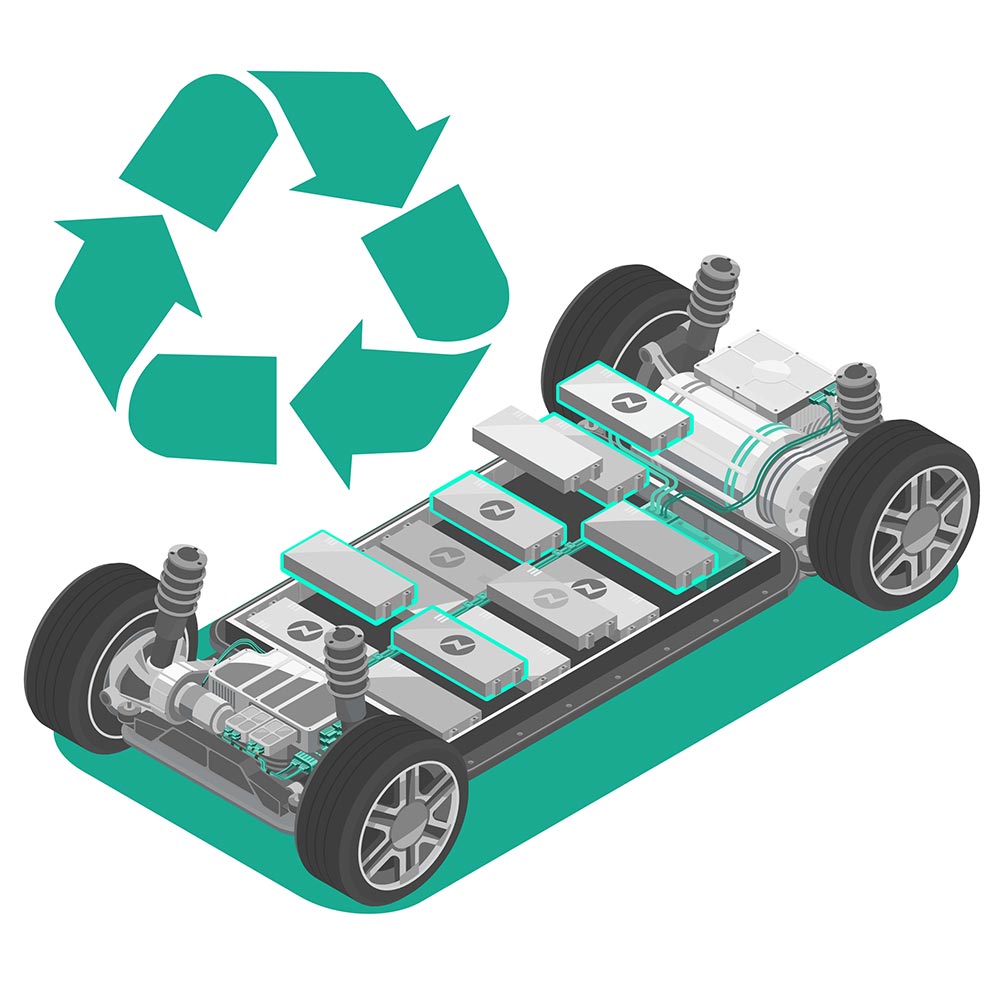
The recycling of electric vehicle batteries has become a critical issue for the electric mobility industry and environmental regulators worldwide. Recycling seeks to reduce the environmental impact of battery waste while recovering valuable materials, such as scarce metals and minerals. These materials can then be reused, decreasing reliance on raw material extraction and supporting the circular economy. Below are some of the most common recycling applications:

Stationary energy storage for solar panels

One of the most prominent alternatives for batteries that have lost capacity after thousands of charging cycles is their reuse in stationary energy storage systems, often referred to as their “second life.” This approach has gained particular relevance with the growth of renewable energy sources like solar and wind, which require reliable storage solutions to manage production variability.

Second-life electric car batteries are commonly used to store energy generated by solar panels in residential settings or for applications like campsites. However, larger-scale projects are also being developed. One example is ACCIONA Energía’s project in Extremadura, Spain.

This initiative involves a storage system at the Extremadura I-II-III photovoltaic plant near Almendralejo, using batteries mainly sourced from electric motorcycles. Notably, the site also coexists with an important archaeological area.

The storage system, classified as a Battery Energy Storage System (BESS), consists of two containers housing retired batteries with a total capacity of 2 MW/5 MWh. This system stores a portion of the energy generated by the plant and improves its integration into the power grid. As part of this pilot project, the performance and reliability of batteries from different sources are also being evaluated.

Integration in shared mobility projects

Another application for second-life EV batteries involves their use in fleets of smaller, lower-powered vehicles, such as golf carts, scooters, and electric bicycles, as well as in shared mobility initiatives in urban areas. Since these lighter vehicles have lower energy demands, batteries can remain functional for several years despite their reduced capacity.

This approach offers significant cost savings while also reducing the carbon footprint of the micro-mobility sector. Several startups and small companies are experimenting with this technology, particularly for last-mile delivery and urban transportation services. For instance, a delivery operator in Barcelona is using second-life batteries in its cargo bicycles, providing a practical example of how these systems can work in real-world settings.

Recycling processes for metal recovery

When batteries degrade to the point where they can no longer power lower-demand vehicles or be used in stationary systems, they are recycled. Recycling involves disassembling the battery modules, separating the components, and extracting valuable metals and materials through chemical or mechanical processes

In Europe, regulations set specific recycling targets. By 2025, manufacturers must recover at least 65 percent of battery materials, including 50 percent of lithium and 10 percent of cobalt. These regulations aim to reduce reliance on raw material extraction and improve the sustainability of battery life cycles.

The Battery Passport is a digital traceability system that has emerged as a valuable tool in this context. It tracks the lifecycle of batteries, providing detailed information on their composition and condition. This facilitates efficient recycling and ensures the recovery of critical materials like lithium, cobalt, and nickel.

Innovative companies, such as the Canadian firm Li-Cycle, are developing advanced recycling processes. These methods achieve recovery rates of over 90 percent, demonstrating the potential to significantly enhance the sustainability of battery production and use.
The future of battery recycling

The recycling of electric car batteries is becoming a cornerstone of the energy transition and the circular economy. As the number of electric vehicles increases and their batteries reach the end of their useful life, developing effective and responsible waste management solutions is essential.

The environmental impact of extracting metals like lithium and cobalt, combined with the growing demand for new batteries, makes the recovery and reuse of these materials critical for the sector’s long-term sustainability.

For more information on large-scale energy storage and Battery Energy Storage Systems (BESS), you may find this article discussing key developments in the field insightful.


Source:

After tensions escalated, U.S. and China agree to resume trade truce

0

The United States and China agreed to roll back some of the punitive measures they had taken against each other’s economies and return to a trade truce reached in May, officials from both countries said on Tuesday.

After two days of marathon negotiations in London, top economic officials from the United States and China are now expected to present the new “framework agreement” to their leaders, President Trump and China’s top leader, Xi Jinping, for final approval.

The agreement, the full details of which were not immediately released, is intended to return the relationship to the terms that the United States and China reached in Switzerland last month. That deal had unraveled in recent weeks, after China continued to restrict shipments of valuable rare earth minerals and magnets needed by U.S. manufacturers.

Commerce Secretary Howard Lutnick, who was part of the negotiating team, told reporters gathered in London after the talks that American concerns over China’s restrictions on exports of minerals and magnets had been resolved. He also said that the measures that the United States had taken in response to those Chinese restrictions would be reversed “in a balanced way.”

U.S. officials had tried to put pressure on China in recent weeks by clamping down on exports of American products and technology, including chemicals, airplane parts and software, as well as proposing barring Chinese students from enrolling in universities in the United States.

A person familiar with the negotiations who was not authorized to speak publicly said the Chinese side had agreed to begin sending the United States rare earths, while the United States would roll back export controls implemented on Chinese products since the meeting in Geneva, and that both efforts would happen simultaneously.

Mr. Lutnick, along with Jamieson Greer, the U.S. trade representative, and Scott Bessent, the treasury secretary, will brief Mr. Trump on the deal on Wednesday, the person said.

“We do absolutely expect the topic of rare earth minerals and magnets with respect to the United States of America will be resolved in this framework implementation,” Mr. Lutnick said.

Mr. Greer, who took part in the discussions, said the two sides would remain in regular contact as they tried to work through their economic disagreements, a point both sides had also agreed to after the Geneva talks. But he said that another meeting had not yet been scheduled.

Officials had met at Lancaster House in London, adjacent to St James’s Palace, to try to restore their truce. The talks continued late into the night, at times growing tense and seeming as if they might fall apart, the person familiar with the negotiations said.

Last week, Mr. Trump held a 90-minute phone call with Mr. Xi — the first time the two heads of state had spoken directly since Mr. Trump returned to office in January.

A 90-day pause on some tariffs, which the countries agreed to in Geneva, is scheduled to expire in August. Mr. Greer said that both sides were “motivated,” but that it would be up to Mr. Trump to decide if the pause would be extended as additional negotiations proceeded.

Mr. Greer also said that the topic of a broader trade deal had come up, but that the current meetings were focused on implementing the agreements reached in Geneva and by the two leaders in their call.

China’s official Xinhua news agency issued a cautious statement, saying the two sides had agreed “in principle” — a term used by state media and diplomats to indicate that details have not been worked out. According to Xinhua, the discussions were “professional, rational, in-depth and candid.” Chinese state media often uses the term “candid” when there have been considerable disagreements.

The countries made the announcement shortly before the Trump administration attained an early yet important win in a fight over the legality of its tariffs.

In Washington, a federal appeals court agreed on Tuesday to allow Mr. Trump to maintain many of those import duties, which a lower court declared to be illegal in late May. The stay will preserve the centerpiece of the president’s trade agenda while federal lawyers battle with states and businesses that say they were harmed by tariffs that Mr. Trump had no authority to issue.

U.S. officials said that the court rulings on tariffs had not come up in the discussions with the Chinese.

Mr. Bessent, who had led the American delegation, left the talks late Tuesday to return to Washington for congressional hearings on Wednesday. On the Chinese side, the negotiations were led by He Lifeng, the vice premier in charge of economic policy.

American dependence on China for rare earth metals and rare earth magnets has given Beijing a formidable tool for putting pressure on the American economy. After Mr. Trump ratcheted up tariffs on Chinese goods in April, Beijing clamped down on exports of critical minerals and magnets, threatening to shut down operations by American manufacturers, defense contractors and others.

The United States has a single rare earth mine in Mountain Pass, Calif., and has very little capacity to process rare earths into needed chemicals and then into magnets. The rare earth restrictions motivated the U.S. side to meet with Chinese officials in Geneva last month.

But after that meeting, Trump administration officials were dismayed when Chinese shipments of the rare earth minerals, and the magnets made with them, remained infrequent. They accused China of violating the Geneva agreement.

In an effort to pressure China to lift its curbs, U.S. officials clamped down on exports of some American products and technology to China, including software for making semiconductors, gases like ethane and butane, and nuclear and aerospace components. U.S. officials also proposed the ban on enrolling Chinese students.

It remains unclear whether the latest framework will hold, and analysts were skeptical that a broader pact was imminent.

“Two days of negotiations are better than none, but frankly, we’ve seen these extended negotiations in the past,” Henrietta Treyz, director of economic policy at Veda Partners, wrote in a research note. “There’s a lot of time spent translating, confirming meaning and reiterating framing that goes on in these negotiations that make them time consuming but ultimately keep a lot of the status quo, which appears to be what’s come out of London.”

Keith Bradsher contributed reporting from Beijing, and Tony Romm from Washington.

Reeves Reveals Labour’s Spending Review Plans

0

UK Chancellor Rachel Reeves has unveiled a 3 per cent funding increase for the National Health Service in a spending review that Labour intends as a platform for the next election.

Reeves said she would make a “record cash investment” into the NHS, increasing real terms spending in every year of the review period.

The chancellor’s plans have caused disputes within the government over squeezing many areas while the Conservative opposition warns that the review will lead to tax rises.

Reeves confirmed that total departmental budgets will rise by 2.3 per cent a year in real terms over the three years of the spending review to 2028-29.

Much of the boost is set to go to defence-related expenditure, which is set to rise to 2.6 per cent of GDP from 2027, as well as health, leaving other departments facing real-terms cuts.

Reeves also announced a £39bn investment for “affordable” homes over 10 years, and an additional £10bn to help “crowd in” private sector investment in housebuilding.

The affordable homes plans are part of a borrowing-fuelled spending spree on capital projects, including £113bn of extra cash over the current parliament.

The chancellor added that the government was investing in “the biggest rollout of nuclear power for half a century”.

Reeves sought to draw a contrast with the previous Conservative policy of austerity, which she labelled as “a destructive choice”. She added that her fiscal rules were “non-negotiable and . . . the foundation of stability and investment”.

Mikhail Gorbachev, the Leader Who Transformed the Soviet Union and Ended the Cold War, Passes Away

0

His democratizing drive made him the toast of diplomatic circles and a cult hero in the West, the Soviet Union’s adversary in the Cold War.


View Entire Post ›

Iran warns of attacking US bases in the region in the event of military conflict

0

Iran threatens to strike US bases in region if military conflict arises

EU Scientists Report that May was the Second-Warmest Month on Record

0

The biggest temperature increases were recorded in the Middle East, West Asia, northeast Russia, and north Canada.

This year, the world experienced its second-warmest month of May since records began, the European Union’s Copernicus Climate Change Service (C3S) has said in a monthly bulletin.

Global surface temperatures last month averaged 1.4 degrees Celsius (2.5 degrees Fahrenheit) higher than in the 1850-1900 pre-industrial period, when humans began burning fossil fuels on an industrial scale, C3S said.

The latest data comes amid mixed momentum on climate action globally, with China and the EU reducing emissions as the Trump administration and technology companies increase their use of fossil fuels.

“Temperatures were most above average over western Antarctica, a large area of the Middle East and western Asia, northeastern Russia, and northern Canada,” the C3S bulletin added.

At 1.4C above pre-industrial levels, May was also the first month globally not to go over 1.5C (2.7F) in warming in 22 months.

“May 2025 breaks an unprecedentedly long sequence of months over 1.5C above pre-industrial,” said Carlo Buontempo, director of C3S.

“Whilst this may offer a brief respite for the planet, we do expect the 1.5C threshold to be exceeded again in the near future due to the continued warming of the climate system,” Buontempo said.

The city of Lyon was covered in heavy smoke from intense wildfires in Canada, which reached France on Tuesday, according to Meteo France [Jeff Pachoud/AFP]

The increased temperatures were particularly felt in Pakistan’s Jacobabad city in Sindh province, where residents grappled with extreme temperatures in the high 40s, which sometimes reached 50C (122 F).

The soaring temperatures followed another heatwave last June that killed more than 560 people in southern Pakistan.

“While a heatwave that is around 20C might not sound like an extreme event from the experience of most people around the world, it is a really big deal for this part of the world,” Friederike Otto, associate professor in climate science at Imperial College London, told reporters.

“It affects the whole world massively,” Otto added. “Without climate change, this would have been impossible.”

In a separate report released on Wednesday, the World Weather Attribution (WWA) research collaboration said Greenland’s ice sheet melted 17 times faster than the past average during a May heatwave that also hit Iceland.

Mixed momentum on climate action

The latest data comes amid mixed progress on climate change action.

United States President Donald Trump has promised to “drill, baby, drill” during his presidency, even as his country faces increasingly severe weather events, like the fires that tore through California’s capital, Los Angeles, late last year. Emissions from technology companies are also surging, as expanding use of artificial intelligence (AI) and data centres drives up global electricity demand, according to a recent report from the United Nations International Telecommunication Union (ITU).

New analysis by the climate reporting site Carbon Brief found that China’s emissions may have peaked, as the country increased electricity supplies from new wind, solar, and nuclear capacity and reduced its reliance on coal and other fossil fuels.

“China’s emissions were down 1.6 percent year-on-year in the first quarter of 2025 and by 1 percent in the latest 12 months,” Carbon Brief reported last month.

“If this pattern is sustained, then it would herald a peak and sustained decline in China’s power-sector emissions,” it added.

The EU also announced last week that its 27 member states are well on track to meet their goal of a 55 percent reduction in greenhouse gas emissions by 2030.

“Emissions are down 37 percent since 1990, while the economy has grown nearly 70 percent — proving climate action and growth go hand in hand,” said Wopke Hoekstra, the EU’s commissioner for climate, net zero and clean growth.

In the Caribbean, leaders met recently to plan ways to restore the region’s mangrove forests, which help prevent climate change and protect from rising sea levels and intensifying storms.

Federal appeals court rules that Trump administration can continue collecting tariffs during ongoing legal challenges

0

A federal appeals court agreed Tuesday to let the government keep collecting President Donald Trump’s sweeping import taxes while challenges to his signature trade policy continue on appeal.

The decision by the U.S. Court of Appeals for the Federal Circuit extends a similar ruling it made after another federal court struck down the tariffs May 28, saying Trump had overstepped his authority. Noting that the challenges to Trump’s tariffs raise “issues of exceptional importance,” the appeals court said it would expedite the case and hear arguments July 31.

The case involves 10% tariffs the president imposed on almost every country in April and bigger ones he imposed and then suspended on countries with which the United States runs trade deficits. It also involves tariffs Trump plastered on imports from China, Canada and Mexico to pressure them to do more to stop the illegal flow of immigrants and synthetic opioids across the U.S. border.

In declaring the tariffs, Trump had invoked emergency powers under a 1977 law. But a three-judge panel of the U.S. Court of International Trade ruled he had exceeded his power.

The tariffs upended global trade, paralyzed businesses and spooked financial markets.

This story was originally featured on Fortune.com

LA protesters demonstrate the importance of their cause on the streets

0

Protests against immigration raids have continued in Los Angeles, California on Tuesday, with similar demonstrations happening in other major US cities.

US President Donald Trump says the protests are an “assault on peace and public order”. Los Angeles Mayor Karen Bass says the way to dismantle protests is to end the raids.

In Chicago, Illinois, protesters clashed with police on Tuesday.

Marty Robbins song catalog acquired by Anthem Music Publishing

0

Anthem Music Publishing has acquired the song catalog of the late country singer-songwriter Marty Robbins.

Financial terms of the deal were not disclosed. The acquisition covers Robbins’ hits from a career that spanned the late 1940s through the early 1980s, including more than 500 songs released across 72 albums.

The catalog includes Big Iron, which climbed to No. 5 on the US Country chart in 1960 and peaked at No. 26 on the Billboard Hot 100. The song was featured in the 2010 video game Fallout: New Vegas. The Western Writers of America ranked it 11th among Western songs of all time.

El Paso, which was released via Columbia Records in 1959, is also part of the Anthem acquisition. The song reached No. 1 on both the Billboard Hot 100 and Country charts, and earned Robbins a Grammy Award for Best Country & Western Recording in 1961. Artists including Keith Urban and the Grateful Dead have covered El Paso, with the latter performing it live more than 380 times.

“Marty Robbins was a towering figure in American music – an artist whose storytelling transcended genre and era.”

Jason Klein, Anthem Music Group

Robbins, who died in 1982, was inducted into the Grammy Hall of Fame in 1998. He was also inducted into both the Country Music Hall of Fame and the Nashville Songwriters Hall of Fame.

Another track from the catalog, My Woman, My Woman, My Wife, topped the US Country chart and reached No. 42 on the Billboard Hot 100, earning Robbins his second Grammy in 1970.

Jason Klein, CEO of Anthem Music Group, said: “Marty Robbins was a towering figure in American music – an artist whose storytelling transcended genre and era. His songs are woven into the fabric of country and western music heritage, and continue to influence artists and resonate with fans to this day.”

“We’re confident that Anthem will not only preserve Marty’s legacy, but elevate it – introducing his work to new audiences while honoring the timeless spirit of the originals.”

Marty Robbins Estate

The Marty Robbins Estate added: “We’re honored to see Marty’s music find a new home with Anthem Music Publishing. His songs have stood the test of time, captivating generations with their vivid storytelling and emotional depth. We’re confident that Anthem will not only preserve Marty’s legacy, but elevate it – introducing his work to new audiences while honoring the timeless spirit of the originals.”

“Marty’s music has always belonged to the people, and we believe Anthem shares that same dedication to keeping it alive for generations to come.”

In addition to being a singer, songwriter, multi-instrumentalist, Robbins is also a NASCAR driver. The Academy of Country Music named Robbins its first Artist of the Decade for the 1960s.

For Anthem Music Publishing, the Robbins catalog further expands its portfolio of music rights. The company operates as the publishing arm of the Anthem Music Group, working alongside Anthem Records.

Over the past year, Anthem has acquired the catalogs of Nashville hitmaker Matt Alderman, Puerto Rican rapper Darell, and singer-songwriter Chantal Kreviazuk.

Music Business Worldwide

All-Region Teams for New Jersey in 2024

0

LILLY MCMAHON
Oak Knoll School
Junior – Midfield/Forward

7 goals, 7 assists, Captain, Varsity MVP
First Team All-State, Non-Public First Team
Essex/Union Red Division First Team
All-North Jersey Non-Public First Team
All-Union County First Team
NFHCA Third Team All-American
NFHCA All-New Jersey First Team
MAXFH HSNI Additional Top Performer
MAXFH Preseason Player to Watch