Hollywood talent giant Wasserman has promoted Shelley Pisarra to the role of Chief Insights and Innovation Officer.
Pisarra previously served as Executive Vice President, Global Insights.
The exec will report to Wasserman’s Chief Operating Officer, Darrell Coetzee.
A 2020 Sports Business Journal ‘Game Changer’ honoree, Pisarra co-founded the Women in Sports and Events (WISE) Multiplier Summit in 2022, and has partnered on programming with the MIT Sloan Sports and Analytics Conference since 2016.
In her new role, Pisarra will “develop strategies and platforms that will accelerate growth across the sports, music and entertainment landscape,” according to Wasserman.
Specific initiatives Pisarra will work on include the “continued expansion of Wasserman’s product and innovation work”.
Pisarra will also work on “developing proprietary commercial capabilities that unlock revenue opportunities for op talent, brands, and rights holders”.
Commenting on her new role, Pisarra, said: “I’m thrilled to step into this role, as Wasserman continues to demonstrate our commitment to putting insights to work to best serve our clients, while anticipating what’s next for the fan at the intersection of sports, music, and entertainment.”
“I’m thrilled to step into this role, as Wasserman continues to demonstrate our commitment to putting insights to work to best serve our clients.”
Shelley pisarra
News of Pisarra’s promotion comes during a busy period of expansion for Wasserman Music and the wider Wasserman group, after the company appointedSteveMurray as its new Executive Vice President of Mergers & Acquisitions and Strategy in July 2024.
Notably, Murray played a key role in Providence’s strategic investment in Wasserman back in November 2022, which the company said fueled its expansion efforts.
There have also been several music-related hires at Wasserman this year. Last month, Wasserman Music made two new hires to bolster its New York-based Hip-Hop/R&B division. Jazmyn Griffin joined as a New York-based Director on the Global Festivals team.
Tessie Lammle also joined the company as a Los Angeles-based Director and agent focused on hip-hop and R&B artists.
Meanwhile, back in January 2025, Wasserman Music appointed three executives from rival William Morris Endeavour (WME) to its leadership team.Music Business Worldwide
Dozens of people were killed in South Africa, including several children whose school bus was swept away by flash floods, as unusually heavy rain, snow and wind pummeled parts of the country’s Eastern Cape Province this week.
A slow-moving storm raged over the largely rural province on Monday and Tuesday, drowning homes and leaving thousands of residents displaced, without water or electricity, according to local officials and the national power utility.
On Wednesday, the authorities were still searching for four children who had been on the school bus. Eleven children had been riding the bus on Tuesday, when it was swept off a bridge in the town of Mthatha. Three children from the bus were rescued after they clung to trees for hours, while four others and two adults were killed, local officials said.
As of Wednesday afternoon, the province’s premier, Oscar Mabuyane, said 49 people had been killed. While the worst of the weather has passed, officials said, they fear the toll could rise as many people remain unaccounted for.
“Disasters have hit our province, but we have never experienced this combination of torrential rain and snow,” Mr. Mabuyane said.
This extreme winter weather came as a cold front crawled across the country, driven by a phenomenon called a cutoff low. A cutoff low is a storm system that becomes detached from the fast-moving air currents that usually guide weather systems. As a result, it becomes slow-moving and can linger over one area for several days. (A cutoff low was similarly involved in the devastating rainfall that flooded the province of Valencia, Spain, to deadly effect last fall.)
“This type of anomaly is not abnormal for us, where we have a single event that is producing more rainfall and then becoming drier for a longer time,” said Tokelo Chiloane, a senior weather forecaster at the South African Weather Service.
But this week’s storm drenched the province with an unusual amount of precipitation. One weather station in the Eastern Cape region recorded 9.4 inches of rain over a 24-hour period Monday night into Tuesday. That’s about twice the average total rainfall that the province typically gets from June through August, Ms. Chiloane said.
In Mthatha, hundreds have been displaced and are being housed in community halls, according to local officials.
Rescue teams have been dispatched from surrounding areas to reinforce emergency operations in the most heavily affected places.
Speaking to reporters on Wednesday, Mr. Mabuyane said critical resource shortages continued to compromise emergency-response capabilities in the region.
“It’s a question that we’ve been reporting every time we experience disasters,” he said. “We now know, at least for the last two years or so, that we are a disaster-prone province. The area that is under-resourced is the eastern part of the province.”
Aerial surveillance and aquatic search teams, including divers, are combing the areas hit by floods. In those most affected, water levels were almost 10 feet high, flowing over the rooftops of big houses, Mr. Mabuyane said.
“It’s bad,” he said. “It is terrible.”
Nazaneen Ghaffar contributed reporting from London.
The Pentagon has launched a review of the 2021 Aukus submarine deal with the UK and Australia, throwing the security pact into doubt at a time of heightened tension with China.
The review to determine whether the US should scrap the project is being led by Elbridge Colby, a top defence department official who previously expressed scepticism about Aukus, according to six people familiar with the matter.
Ending the submarine and advanced technology development agreement would destroy a pillar of security co-operation between the allies. The review has triggered anxiety in London and Canberra.
While Aukus has received strong support from US lawmakers and experts, some critics say it could undermine the country’s security because the navy is struggling to produce more American submarines as the threat from Beijing is rising.
Australia and Britain are due to co-produce an attack submarine class known as the SSN-Aukus that will come into service in the early 2040s.
That commitment would almost certainly lapse if the US pulled out of Aukus.
Last year, Colby wrote on X that he was sceptical about Aukus and that it “would be crazy” for the US to have fewer nuclear-powered attack submarines, known as SSNs, in the case of a conflict over Taiwan.
In March, Colby said it would be “great” for Australia to have SSNs but cautioned there was a “very real threat of a conflict in the coming years” and that US SSNs would be “absolutely essential” to defend Taiwan.
Sceptics of the nuclear technology-sharing pact have also questioned whether the US should help Australia obtain the submarines without an explicit commitment to use them in any war with China.
Kurt Campbell, the deputy secretary of state in the Biden administration who was the US architect of Aukus, last year stressed the importance of Australia having SSNs that could work closely with the US in the case of a war over Taiwan. But Canberra has not publicly linked the need for the vessels to a conflict over Taiwan.
The review comes amid mounting anxiety among US allies about some of the Trump administration’s positions. Colby has told the UK and other European allies to focus more on the Euro-Atlantic region and reduce their activity in the Indo-Pacific.
Jeanne Shaheen, the top Democrat on the Senate foreign relations committee, told the FT that news of the administration backing away from Aukus would “be met with cheers in Beijing, which is already celebrating America’s global pullback and our strained ties with allies under President Trump”.
“Scrapping this partnership would further tarnish America’s reputation and raise more questions among our closest defence partners about our reliability,” Shaheen said.
“At a moment when we face mounting threats from China and Russia, we should be encouraging our partners to raise their defence spending and partnering with them on the latest technologies — not doing the opposite.”
One person familiar with the debate over Aukus said Canberra and London were “incredibly anxious” about the Aukus review.
“Aukus is the most substantial military and strategic undertaking between the US, Australia and Great Britain in generations,” Campbell told the Financial Times.
“Efforts to increase co-ordination, defence spending and common ambition should be welcomed. Any bureaucratic effort to undermine Aukus would lead to a crisis in confidence among our closest security and political partners.”
The Pentagon has pushed Australia to boost its defence spending. US defence secretary Pete Hegseth this month urged Canberra to raise spending from 2 per cent of GDP to 3.5 per cent. In response, Australian prime minister Anthony Albanese said: “We’ll determine our defence policy.”
“Australia’s defence spending has gradually been increasing, but it is not doing so nearly as fast as other democratic states, nor at a rate sufficient to pay for both Aukus and its existing conventional force,” said Charles Edel, an Australia expert at the CSIS think-tank in Washington.
John Lee, an Australia defence expert at the Hudson Institute, said pressure was increasing on Canberra because the US was focusing on deterring China from invading Taiwan this decade. He added that Australia’s navy would be rapidly weakened if it did not increase defence spending to 3 per cent of GDP.
“This is unacceptable to the Trump administration,” said Lee. “If Australia continues on this trajectory, it is conceivable if not likely that the Trump administration will freeze or cancel Pillar 1 of Aukus [the part dealing with submarines] to force Australia to focus on increasing its funding of its military over the next five years.”
One person familiar with the review said it was unclear if Colby was acting alone or as part of a wider effort by Trump administration. “Sentiment seems to be that it’s the former, but the lack of clarity has confused Congress, other government departments and Australia,” the person said.
A Pentagon spokesperson said the department was reviewing Aukus to ensure that “this initiative of the previous administration is aligned with the president’s ‘America First’ agenda”. He added that Hegseth had “made clear his intent to ensure the [defence] department is focused on the Indo-Pacific region first and foremost”.
Several people familiar with the matter said the review was slated to take 30 days, but the spokesperson declined to comment on the timing. “Any changes to the administration’s approach for Aukus will be communicated through official channels, when appropriate,” he said.
A British government official said the UK was aware of the review. “That makes sense for a new administration,” said the official, who noted that the Labour government had also conducted a review of Aukus.
“We have reiterated the strategic importance of the UK-US relationship, announced additional defence spending and confirmed our commitment to Aukus,” the official added.
The Australian embassy in Washington declined to comment.
Taking on a dual role may become the norm for chief financial officers—especially those who are also chief operating officers—as companies face increasing complexity.
There’s an increasing trend of CFOs taking on the COO role, and some large companies are combining the functions to create a hybrid position. For Block’s Amrita Ahuja and Hasbro’s Gina Goetter, who both hold COO and CFO titles, it isn’t just about managing numbers—it’s about shaping the future of their companies.
Hasbro, the largest publicly traded toymaker in the U.S. and one of the largest in the world, has a significant manufacturing footprint. Every decision is inherently operational or financial, Goetter said during a panel session at Fortune’s COO Summit on Tuesday with Ahuja and moderated by Next to Lead Editor Ruth Umoh.
“It’s very blended,” Goetter explained. “You can’t do one without the other, and I find combining them actually creates a lot of simplicity across the organization.”
As a CFO, you have the vantage point of the entire company strategy, Goetter explained. The finance chief is one of the few individuals who can connect all the pieces together in both strategy and execution. That strategy is deeply embedded in operations, she said.
Block, a Fortune 500 fintech company, offers customers financial options such as payment plans through Afterpay, various lending choices for Square sellers, and the ability for Cash App users to split paycheck deposits between cash, bitcoin, or stocks. Ahuja provided an example of the value of having the dual CFO-COO role.
She is leading automation efforts, using generative AI and shared platforms to streamline everything from contract management to financial forecasting. “Because our teams are together, we can share infrastructure and insights across the organization,” Ahuja said.
Goetter, who joined Hasbro in 2023, pointed to navigating tariffs and macro uncertainty. By overseeing both operations and finance, she can balance day-to-day supply chain and customer management with the company’s financial health. This helps her make practical, “no regret” decisions—avoiding over-analysis—while ensuring Hasbro doesn’t end up with excess inventory in the wrong places, as happened after COVID.
“I’m confident that we’re not going to be in the same position we were coming out of COVID, where we’re sitting with action figures all over the world,” Goetter said.
But the dual CFO-COO role can be complex. “The tension in the role is aspiration and discipline,” Ahuja noted. As CFO, you advocate for growth while ensuring responsible capital allocation, she explained. As COO, you enable the business to move quickly but responsibly. She added: “No COO role is alike.” At Block, in addition to overseeing finance, she leads the legal and people functions, oversees communications and policy, and serves as chairperson of Square Financial Services, the company’s industrial bank.
Goetter emphasized the importance of finance as an enabler, not a limiter: “We want to build the business.” Wearing both hats actually makes it easier to connect strategy and execution, she said.
Finance is often viewed as the red tape you have to get through before everyone can achieve their hopes and dreams, Goetter commented. It’s unfair to characterize finance as the “‘no people’,” she added.
Fitter and Faster Swim Camps is the proud sponsor of SwimSwam’s College Recruiting Channel and all commitment news. For many, swimming in college is a lifelong dream that is pursued with dedication and determination. Fitter and Faster is proud to honor these athletes and those who supported them on their journey.
Nicholas Kwan from Jacksonville, Florida has announced his commitment to continue his academic and athletic careers at Georgia beginning in fall 2026.
Kwan swims for Bolles School Sharks out of Florida. In December, he swam at Winter Juniors East, finishing 35th in the 200 free in a 1:39.00. That marked a lifetime best. He also was 49th in the 200 fly (1:50.66) and 70th in the 500 free (4:33.44).
In March, he swam to another personal best in the 200 free as he posted a 1:37.85 at the Florida State Championships. He also swam to a lifetime best of a 1:48.58 200 fly and 4:00.71 400 IM.
So far this summer, he swam a lifetime best 52.27 100 free at the Pro Series stop in Fort Lauderdale. He swam even faster in the event in Singapore at the 20th Singapore National Swimming Championships posting a 51.98 in prelims.
Kwan’s Best SCY Times are:
100 free: 45.49
200 free: 1:37.85
500 free: 4:30.85
100 fly: 50.30
200 fly: 1:48.58
400 IM: 4:00.71
The Georgia men finished 4th at the 2025 SEC Championships and went on to finish 7th at NCAAs. Luca Urlando led the way at NCAAs with an NCAA record 200 butterfly and scored a total of 45 individual points.
Based on his best times, Kwan will look to improve to make a final at SECs. It took a 1:44.30 200 fly, 1:34.99 200 free, and a 4:18.24 500 free to earn a second swim.
Kwan will arrive next fall as a member of the class of 2030 along with Sam Lofstrom. Lofstrom hails from Colorado and primarily swims sprint free.
If you have a commitment to report, please send an email with a photo (landscape, or horizontal, looks best) and a quote to [email protected].
About the Fitter and Faster Swim Tour
Fitter & Faster Swim Camps feature the most innovative teaching platforms for competitive swimmers of all levels. Camps are produced year-round throughout the USA and Canada. All camps are led by elite swimmers and coaches. Visit fitterandfaster.com to find or request a swim camp near you.
Students were sitting in their classrooms at a secondary school in Graz when a 21-year-old Austrian man shot dead nine people, before killing himself.
Twelve people were injured in Tuesday morning’s violence, with one person dying hours later in hospital from their injuries.
The incident was the deadliest mass shooting in Austria’s recent history and the country has declared three days of mourning.
Police are still investigating why the gunman – a former student who did not graduate – carried out the attack.
Here is what we know so far.
What happened?
The first shot echoed through Dreierschützengasse secondary school, in the north-west of Graz, close to the main train station, at about 10:00 local time (09:00 BST), initially sparking confusion as to what was happening.
“Was that a shot? That can’t be true. Something must have fallen at the construction site across the street,” a 17-year-old student, identified as F, said to his friends, according to the Kleine Zeitung newspaper.
One student told Die Presse that when shots rang out, his teacher immediately locked the classroom.
Another student told the paper that at first she thought the shots were firecrackers, but “then there was screaming, and we ran”.
Paul Nitsche, a religious studies teacher at the school, told the AFP news agency he was in a classroom when he heard a “bang” followed by the sound of bullet casings hitting the floor of the corridor.
“Something snapped inside me, I jumped up, and decided to run,” he said.
As he fled, he caught a glimpse of the shooter. “As I ran down the stairs, I thought to myself, ‘This isn’t real”.
He said he realised what had happened when he “saw a student lying on the floor and a teacher was there”.
Local resident Astrid, who lives in a building next to the school, told the BBC she heard 30 or 40 shots. Her husband Franz called the police.
“We saw one pupil at the window – it looked like he was getting ready to jump out… but then he went back inside,” Franz said.
The couple later saw the students had “got out of the school on the ground floor, from the other side” where they “gathered on the street”, Franz said.
The shooter took his own life in a school bathroom shortly after the gun attack, the authorities said.
The first emergency calls reached police at exactly 10:00, with the first patrol arriving on scene at 10:06, police said on Wednesday. Shortly after, a Cobra tactical unit, which handles attacks and hostage situations, and other specialist units arrived.
Police brought the situation under control in 17 minutes. More than 300 police in total were deployed to the school.
Gunshots heard and students evacuate in videos filmed at Austrian school
Who are the victims?
Nine students – six girls and three boys – between the ages of 14 and 17 were killed in the shooting, police said. A teacher died of her injuries in hospital.
All were Austrian citizens, except for one Polish citizen.
The victims have not yet been named by the authorities.
One woman, Tores, told BBC News in Graz’s main square on Wednesday that she knew one of the boys who had died. He was 17.
“I’ve know this family for a long time, including the son of the family, and knew that he attended that school. I rang immediately, to ask if everything is OK. Then they let me know at midday, that the boy was one of those slaughtered,” she said.
“What happened yesterday is completely awful, the whole of Austria is in mourning,” she said. “This is terrible for the whole of Austria.”
The other eleven injured people are currently out of danger, police said on Wednesday. They are between the ages of 15 and 26. Eight are from Austria, two from Romania and one from Iran.
Getty Images
What do we know about the shooter?
The 21-year-old, who has not yet been named, was an Austrian man from the wider Graz region who acted alone, police said.
He lived with his single mother, who is also Austrian, in the Graz-Umgebung district, police said in a press release on Wednesday.
His father, who is originally from Armenia, had not lived in the same household since their separation.
He was a former Dreierschützengasse student who did not graduate from the school, Interior Minister Gerhard Karner told a news conference on Tuesday.
In a statement on Wednesday, police said they found a “farewell letter”, “farewell video”, a non-functional pipe bomb and apparently abandoned plans for a bomb attack during a search of the suspect’s home.
He legally owned the pistol and shotgun used in the attack, police added.
Police said they are still investigating a possible motive.
What are Austria’s gun laws?
Austria has one of the most heavily armed civilian populations in Europe, with an estimated 30 firearms per 100 persons, according to the Small Arms Survey, an independent research project.
Machine guns and pump action guns are banned, while revolvers, pistols and semi-automatic weapons are allowed only with official authorisation. Rifles and shotguns are permitted with a firearms licence or a valid hunting licence, or for members of traditional shooting clubs.
School shootings are rare. There have been a few incidents over the years that have involved far fewer casualties:
In 2018, a 19-year-old was shot by another youth in Mistelbach, north of Vienna
In 2012 in St Pölten, a pupil was shot dead by his father
In 1997, in Zöbern, a 15-year-old killed a teacher and seriously injured another
In 1993, a 13-year-old boy in Hausleiten seriously injured the head teacher and then killed himself
Austria’s most violent gun attack in recent years took place in the heart of Vienna in November 2020. Four people were killed and 22 injured when a convicted jihadist ran through the centre of the city opening fire, before he was eventually shot by police.
Tuesday’s shooting took place almost a decade after three people were killed when a man drove his car into crowds in Graz on 20 June 2015.
Fanny Gasser, a journalist for the Austrian daily newspaper Kronen Zeitung, told BBC News the school was likely unprepared for the possibility of an attack.
“We are not living in America, we are living in Austria, which seems like a very safe space.”
MBW Reacts is a series of analytical commentaries from Music Business Worldwide written in response to major recent entertainment events or news stories. Only MBW+ subscribers have unlimited access to these articles.The below article originally appeared in Tim Ingham’s latest MBW+ Review email, issued exclusively to MBW+ subscribers this week.
To understand how clever Taylor Swift’s team is, fire up Google.
For my money, Swift has only made one major career blunder over the past six years: her starring role in the 2019 Hollywood stinker Cats. A film so bad, Ricky Gervais memorably called it “the worst thing to happen to cats… since dogs”.
Yet plonk “Taylor Swift Cats” into the globe’s favorite search engine today and you’ll struggle to spot any evidence that this much-maligned movie ever existed.
Instead, you’ll find multiple SEO-dominant press articles (People, Cosmopolitan, US Weekly), plus one prominent Reddit forum, all focused on the trio of domestic felines that Taylor keeps as pets.
You’ll even find, on page one of Google, a handsomely furnished Wikipedia page for one of Swift’s moggies, Olivia Benson.
Forget ‘Taylor Swift in Cats’. Did you mean ‘Taylor Swift’s cats’?
You can’t convince me that any of this is coincidence.
To my mind, it’s perfect/purrfect evidence that Swift and her self-run organization can exert more influence on the internet, and its consumers, than most corporations could ever dream of.
She’s capable of globally exploding her proudest and most lucrative moments (see: Eras tour ticket sales). And, like a Mr Wolf of the internet, she and her media acolytes can largely wipe clean her mistakes – as if they never happened.
This all provides a sensible justification as to why Swift just spent hundreds of millions of dollars buying the master rights to her first six albums from Shamrock Holdings.
The logic: By leveraging her own peerless fan-activating channels, Swift can trigger more interest in these records than arguably any other entity on earth. Especially a publicity-shy private equity firm with no real ability to directly persuade or motivate consumers.
We don’t need to re-live the full extent of the Swift masters saga here. But according to MBW’ssources, Shamrock paid Scooter Braun a total of $405 million for the masters to Swift’s first six albums via a 2020 deal. That price included $360 million upfront plus a subsequent $45 million earn-out based on performance.
Reading between the lines of various recent media reports, it seems Shamrock may just have sold Swift her masters for a similar fee to the $405 million it paid to get them.
This would certainly explain Swift’s enthusiasm for Shamrock’s behavior during the process. (Swift wrote the other week: “This was a business deal to [Shamrock], but… I am endlessly thankful. My first tattoo might just be a huge shamrock in the middle of my forehead.”)
If Shamrock didn’t make a bundle of profit from the sale, don’t let your heart bleed. Remember that the firm has absorbed almost five solid years of royalty cash-flow from these assets, during a period when Swift has ascended to never-before-seen commercial heights.
Yet, over and above the appeal of a quiet PE firm retreating from all the Swiftian drama (Taylor’s Versions et al), you have to wonder whyShamrock and its music heads (including the well-liked Patrick Russo) decided to flip these assets of the world’s biggest megastar… now.
One theory: it’s all about Shamrock’s awareness of the future of the music rights business – and how essential the ‘portfolio effect’ will be for anyone looking to claim a sizable chunk of it in the years ahead.
According to the IFPI, Taylor Swift’s recorded music has generated more than any other artist on the planet for the past three years in a row.
But here’s the thing about being the world’s biggest megastar in 2025: your dominance of the overall market, just like that of a major record company, is continually being nibbled into by an endless stream of music you don’t own.
Firstly, there’s the continuing wave of self-uploading artists to consider – a key factor in the addition of around 99,000 tracks per day onto streaming services.
There’s also the incoming tsunami of AI-generated music from the likes of Suno and Udio. (Did you see that ‘Masters Of Prophecy’ – a hub for AI-made Musak – reportedly just overtook Mr. Beast to become YouTube‘s fastest-growing channel?)
Finally, and most importantly, there’s the rise of what might once have been termed ‘regional’ music – and its increasing impact on global charts.
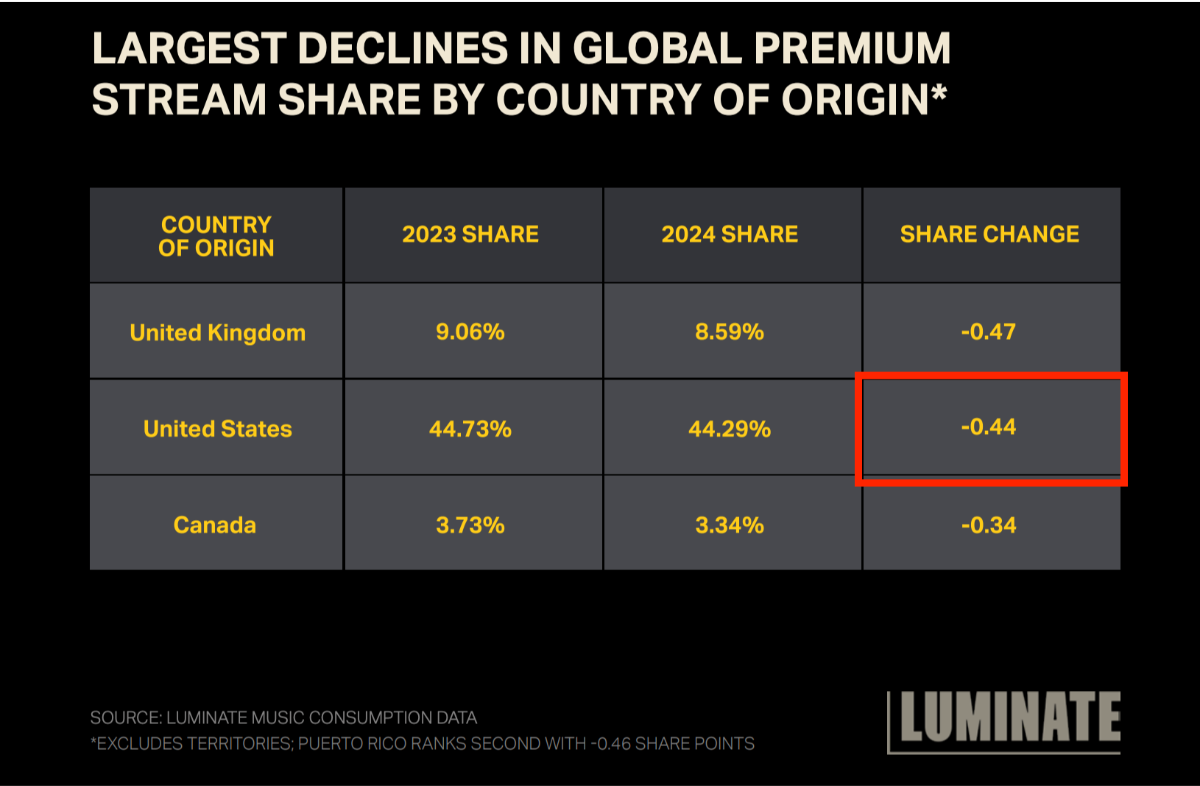
From Luminate‘s 2024 annual report: “English-speaking markets are losing local share to non-English language imports…while many non-English speaking markets show local content gaining share.”
Artists from the United States lost 0.20% market share of premium streams in the US last year; globally, they lost 0.44%.
Despite Swift’s massive popularity, as a market share proposition, even she is being affected by these trends.
According to my reading of Luminate data, Swift claimed approximately 0.9% of the 1.4 trillion total on-demand audio streams in the United States last year.
In industry parlance, Swift is (in and of herself) a very significant independent label.
But it would be a shock if her share of global streams (and therefore her share of streaming’s revenue ‘pie’) didn’t continue declining in the years ahead.
This brings us to the ‘portfolio effect’.
Companies like Universal Music Group have grown used to seeing artists like Taylor Swift negotiate deals under which they keep ownership of their copyrights – and receive higher royalty margins than they once did.
UMG is therefore adjusting to a lower-margin reality when it comes to frontline music in 2025.
Yet, simultaneously, major music companies are working hard to avoid being overly exposed to the fortunes of any one artist.
Indeed, UMG’s Top 50 artists only accounted for 24% of its recorded music revenue in 2024.
In its latest annual report, the company wrote, “Our extraordinarily diverse roster of artists… means that our business’ success is not reliant on one artist or even a small number of artists.”
Like its fellow majors, UMG faces its own market share challenges from (a) the endless influx of music onto streaming services and (b) the changing listening patterns of global music fans.
This is partly why Universal is investing $775 million to buy Downtown — to bolster its market share across publishing and records, while further lessening its reliance on the superstar economy.
In contrast, for a passive investor like Shamrock, betting everything on a single megastar, however dominant, is a dangerous gamble. As musical attention becomes increasingly democratized, even the mightiest individual catalog faces structural headwinds.
In terms of her own legacy, then, Taylor Swift has just reclaimed control. But she’s done so in a marketplace where ‘control’ is an increasingly foreign concept.Music Business Worldwide