Fitter and Faster Swim Camps is the proud sponsor of SwimSwam’s College Recruiting Channel and all commitment news. For many, swimming in college is a lifelong dream that is pursued with dedication and determination. Fitter and Faster is proud to honor these athletes and those who supported them on their journey.
Jake Nowoswiat from Newtown Square, Pennsylvania has announced his commitment to continue his academic and athletic careers at Bucknell beginning in fall 2025.
“I am excited to announce my verbal commitment to continue my academic and athletic career at Bucknell University! I’d like to thank God,family,friends and coaches for the support. #rayBucknell”
Nowoswiat swims for Suburban Seahawks Club and just finished his senior year at Malvern Preparatory School in the suburbs of Philadelphia. He was a dual sport athlete in high school as he also played water polo.
In April 2024, Nowoswiat swam to numerous lifetime best times at Y-Nationals. He finished 13th in the 400 IM in a 4:02.11 and 21st in the 200 breast in a 2:04.74.
Most recently, Nowoswiat swam at the 2025 Middle Atlantic Championships in March. There he finished 3rd in the 400 IM (4:05.97), 8th in the 200 breast (2:07.54), and 19th in the 100 breast (58.74). He also swam to a lifetime best 52.61 in the 100 back for 22nd.
Nowoswiat’s Best SCY Times Are:
100 breast: 58.72
200 breast: 2:04.74
200 IM: 1:52.75
400 IM: 4:01.36
The Bucknell men finished 4th out of 10 teams at the 2025 Patriot League Championships with 952.5 points. Loyola Maryland was 3rd with 1213 points.
Based on his best times, Nowoswiat is on the border of the ‘B’ and ‘C’ final in the 200 breast while his 400 IM would have made the ‘C’ final. The team was thin in the 200 breaststroke with only one ‘A’ finalist and one ‘B’ finalist.
Nowoswiat will arrive this fall as a member of the class of 2029 along with Finn Lukens, Evan Hepburn, Drew Davis, and Jason Kellerman.
If you have a commitment to report, please send an email with a photo (landscape, or horizontal, looks best) and a quote to [email protected].
About the Fitter and Faster Swim Tour
Fitter & Faster Swim Camps feature the most innovative teaching platforms for competitive swimmers of all levels. Camps are produced year-round throughout the USA and Canada. All camps are led by elite swimmers and coaches. Visit fitterandfaster.com to find or request a swim camp near you.
Atmospheric water harvesting technologies have been a focal point of innovation in addressing water scarcity. Current methods often utilize hydrophilic gels or absorbent materials to capture atmospheric moisture, while others depend on condensation systems. Many of these approaches, however, require energy inputs to complete the process of producing potable water—an enduring challenge that impacts millions of people worldwide. A novel strategy, inspired by organisms such as beetles and lizards that inhabit arid ecosystems, could revolutionize this process by achieving unprecedented efficiency without external energy.
This cutting-edge approach has been proposed by researchers at New York University, in collaboration with scientists from Abu Dhabi and China. The technology, named “Janus crystals,” operates without the need for external power sources and holds significant promise for sustainable water harvesting.
Current strategies for extracting water from the atmosphere
Before delving into the specifics of Janus crystals, it is essential to review existing techniques for atmospheric water harvesting, especially in regions facing water scarcity, aridity, or drought. Atmospheric water generators (AWGs) typically employ one of the following strategies:
Passive condensation. This technique harnesses the temperature gradient between the air and a cooler surface to condense atmospheric moisture. Examples include fog-catching systems, which utilize specialized meshes to capture water droplets in arid regions with high fog density.
Active condensation. This method involves cooling air to its dew point using energy, causing water vapor to condense. Atmospheric water generators that mimic dehumidifiers are a key example of this approach.
Hygroscopic materials. These systems rely on materials such as silica gels or salt solutions that absorb water vapor directly from the air. The absorbed water is released by heating the materials, enabling water recovery.
Solar-based systems. Solar-powered technologies use sunlight to release water trapped in absorbent materials or to power condensation devices. These systems are particularly beneficial in remote areas due to their minimal reliance on external energy sources.
Advanced membranes for direct capture. These technologies incorporate membranes engineered with specific properties to trap and release water based on humidity levels. Examples include polymeric membranes and nanomaterials optimized for arid conditions.
Biomimetic technologies. Inspired by natural mechanisms, these systems replicate features observed in desert-dwelling organisms such as beetles and plants. Textures and surface chemistries are designed to enhance condensation and water collection efficiency.
Hybrid systems with renewable energies. These systems integrate active condensation methods with renewable energy sources, such as solar or wind, to enhance sustainability and minimize environmental impact.
Janus crystals: inspired by desert organisms
The water harvesting system developed by researchers at New York University falls within the realm of biomimetic technologies. Inspired by strategies used by desert organisms, the system mimics the interplay of hydrophilic and hydrophobic surfaces, which are critical for trapping and transporting atmospheric water. Hydrophilic regions capture water vapor, while hydrophobic areas facilitate the movement of collected water.
The researchers, whose findings were published in the Journal of the American Chemical Society, created a novel type of elastic organic crystal. Among these, Janus crystals exhibit exceptional efficiency due to their unique structure, which combines hydrophilic and hydrophobic properties. This dual functionality allows the crystals to capture water vapor and direct it toward a collector with minimal energy loss.
Remarkably, Janus crystals operate without requiring external energy. Their translucent and narrow design also enables real-time visualization of water droplet formation and transport under light exposure.
By leveraging these properties, Janus crystals have the potential to serve as the basis for next-generation atmospheric water harvesting systems. These systems could complement existing innovations, such as fog-catching harps, while offering greater efficiency and scalability for water extraction in arid regions.
For additional insights into water treatment technologies with larger daily production capacities, consider exploring reverse osmosis desalination, which extracts freshwater from seawater. This approach continues to address pressing global water challenges.
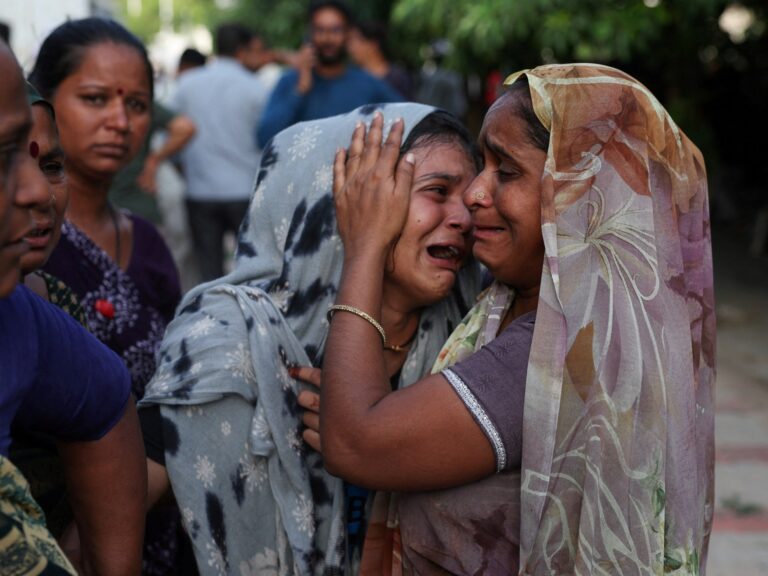
Rizwan Vahora lost three relatives on the Air India flight that crashed in Ahmedabad, India. His family was among the many grieving and waiting for answers.
As Israel prepares more waves of attacks on Iran that Donald Trump warned would be “even more brutal”, the Islamic Republic’s leaders have vowed to retaliate.
Major General Mohammad Pakpour, Iran’s commander of the Revolutionary Guards, who took office on Friday hours after the assassination of his predecessor, vowed to “open the doors of hell”.
But what can Iran do to significantly deter Israel? Tehran — strangled by years of sanctions, and with its main Shia proxies in the region severely weakened — stands in what it sees as an existential battle against a regional power buoyed by the latest western military kit and ample US support.
“The Iranians will struggle to muster a meaningful response,” said Dan Shapiro, former deputy assistant secretary of defence for the Middle East at the Pentagon.
Iran’s first salvo of drones was successfully intercepted. On Friday night Iran launched dozens of ballistic missiles, some of which penetrated Israel’s defences to hit buildings in urban areas. Scores were injured and some killed.
The bulk of the missiles were intercepted and the barrages were on a smaller scale than two Iranian retaliatory assaults last year in terms of numbers. But it appeared that Iran had shifted its tactics, launching in successive waves throughout the night and early morning, primarily targeting Tel Aviv, making them more destructive.
Rather than alter the calculus of the conflict, or deter further strikes, the assault prompted Israel to promise further escalation.
“The real dilemma for Iran will be whether to sprint to a nuclear breakout,” said Shapiro, who is also a former US ambassador to Israel. “They may calculate that will give them the deterrence to ensure regime survival — but that also runs the risk of drawing in the US.”
UN inspectors for years have diligently sought to monitor Iran’s nuclear programme and in particular its enrichment of uranium, which can produce both fuel and weapons-grade material. Iran has in recent years expanded its stockpile of near weapons-grade enriched uranium.
It has the capacity to produce sufficient fissile material for a nuclear weapon in less than two weeks, experts say.
The monitoring efforts make it unlikely — but not impossible — that Iran has already secreted away enough fissile material for a single, simple bomb, which would require less than 15kg of enriched uranium. Putting the uranium on a warhead and developing missile capacity are further challenges, but with enough fissile material, Tehran could in theory fashion a so-called “dirty bomb”.
Such drastic steps would have parallels with Israel’s own development of a secret nuclear arsenal, a “doomsday operation”, which evolved into the nuclear doctrine nicknamed the Samson Option.
During the 1967 war, Israeli officials had authorised a plan of last resort to detonate a hastily assembled nuclear device in the Sinai desert, with the aim of freezing the conflict before Arab armies crossed Israeli borders. (In the event, Israel won the war — the plan became public only in 2001.)
Other options are more traditional: attacking Israeli military facilities and diplomatic missions, or carrying out the threat, voiced by some commanders, of hitting US military targets in the Middle East.
Iranian forces could also turn to asymmetric warfare, attempting to shut off or disrupt the Strait of Hormuz, a key waterway separating Iran from the Gulf states, through which almost a third of all global seaborne oil exports flow.
Each carries great risks for Iran, including the potential for spectacular failure or further escalation, with the US stepping in substantially to aid Israel, said a former Israeli official who worked on similar assessments in the past.
Analysts and people familiar with Israel’s defence plans expect Iran to continue to try to overwhelm Israel’s multi-layered aerial defences with a massive wave of drones and missiles. Such attacks could target Israeli nuclear facilities, air bases and other critical infrastructure, such as ports and the airport in Tel Aviv.
That would force Israel to ration its limited supply of interceptor missiles, many of which have had to be replenished on an urgent basis after 20 months of war with Hamas in Gaza, Hizbollah in Lebanon and two barrages from Iran in April and October 2024.
Iran’s barrage on Friday and those two earlier assaults showed Iran’s best missiles could pierce Israeli air defences, even when they were bolstered by an emergency deployment of US and other warplanes intercepting missiles and drones far from Israeli airspace.
Some two dozen missiles landed inside the Nevatim Air Base in southern Israel, satellite images later showed. One landed near the Mossad headquarters in north Tel Aviv. Others hit a second air base.
But two people familiar with that assault said it had also shown the limits of Iran’s capabilities. The damage to the air bases was quickly repaired, no aircraft were damaged and Israeli radar operators trained their algorithms on reams of data gathered during the attack.
An Iranian missile barrage fired at Israel in October was the first time the country’s air defences were so thoroughly tested by a regional power, instead of Hamas’s rockets, which are easily intercepted by the Iron Dome system. But that assault was telegraphed at a time when Iran was seeking to avoid the full-blown conflict with Israel in which it now finds itself. And in both of last year’s attacks Tehran targeted military sites, while this time the targets are broader and across multiple cities and towns.
One of Iran’s goals last year, according to an analysis carried out after the event by Israel’s military intelligence directorate, was to see how successfully a “rapid saturation event” could overwhelm Israel’s defensive systems.
Israel’s military doctrine on rationing interceptors — how many it has at any time is a national secret — takes into account the nature of the attack and the target.
If running low on the missiles, protecting military targets is considered more important, in order to protect the ability to counter-attack, for instance. Fox News on Friday reported the US had replenished a significant amount of the Tamir interceptors Israel used, which are partially manufactured in the US.
Another factor has also constrained Iran: the disruption from the first wave of Israeli strikes, according to Israel. The Israeli Air Force on Friday night hit Iran’s surface-to-surface missile arrays, it said, aiming to blunt any possible counter-attack.
Sima Shine, a former official at Israel’s Mossad intelligence agency who had a focus on Iran, said that would have affected the scale at which Iran would be able to mount an immediate counter-attack.
Iran also needed to take time to take stock after the assassination of senior Iranian officials responsible for military strategy. The military officers were “very vital, very knowledgeable, and had been in their jobs for many years”, she said.
Destroying missile systems is not as complicated as destroying Iran’s underground nuclear facilities, said a former air force pilot who had been trained for similar missions about a decade ago.
“Missile systems require very complex mechanisms to work together,” he said. “To disable the system, you don’t have to destroy it, only hitting a single [crucial] component is enough — the radar, the transport system, even the mechanical systems that position the missile.”
Knowing their location is significantly more useful than the kind of armaments used, he said.
The Israeli air force is expected to make repeated bombing runs in the coming days, and has been destroying Iran’s aerial defences — some of them made locally, others procured from allies such as Russia — to maintain aerial superiority.
That would force Iran to allocate its limited missile systems defensively, said the former pilot, instead of using them to punish Israel.
“It is clear now that our [pilots] can strike at will in Iran,” he said. “This was not always true, and it changes the equation completely.”
Graphic illustrations by Ian Bott and Steven Bernard
Brittney Griner has written to President Joe Biden with an urgent plea: “Please don’t forget about me.”
The message from the WNBA star was delivered via a letter she handwrote from the Russian jail where she has been held since being arrested in February at a Moscow airport on drug charges. She faces up to 10 years in prison if convicted.
“As I sit here in a Russian prison, alone with my thoughts and without the protection of my wife, family, friends, Olympic jersey, or any accomplishments, I’m terrified I might be here forever,” Griner wrote.
Representatives for Griner shared sections of the letter with BuzzFeed News and other media outlets, but said the full message would be kept private between her and the president.
“On the 4th of July, our family normally honors the service of those who fought for our freedom, including my father who is a Vietnam War Veteran,” Griner wrote. “It hurts thinking about how I usually celebrate this day because freedom means something completely different to me this year.”
Griner, 31, also told Biden that her first-ever vote was for him in the 2020 presidential election.
“I realize you are dealing with so much, but please don’t forget about me and the other American Detainees. Please do all you can to bring us home,” she said. “I voted for the first time in 2020 and I voted for you. I believe in you. I still have so much good to do with my freedom that you can help restore.”
“I miss my wife! I miss my family! I miss my teammates!” Griner said. “It kills me to know they are suffering so much right now. I am grateful for whatever you can do at this moment to get me home.”
Adrienne Watson, a spokesperson for the National Security Council, said in a statement provided to BuzzFeed News that the White House was working “aggressively” to bring Griner home.
“We believe the Russian Federation is wrongfully detaining Brittney Griner,” Watson said. “President Biden has been clear about the need to see all US nationals who are held hostage or wrongfully detained abroad released, including Brittney Griner. The US government continues to work aggressively – using every available means – to bring her home.”
Watson also said top officials were in regular contact with Griner’s family and teammates.
But Griner’s wife, Cherelle, told CBS on Tuesday morning it was “very disheartening” that she was yet to hear from Biden about the letter.
Cherelle said they were disappointed they had not been able to meet personally with Biden.
“It kills me every time … when I have to write her, and she’s asking, ‘Have you met with him yet?’ And I have to say, ‘No.’ … I’m sure she’s like, ‘I’m going to write him and ask now, because my family has tried and to no avail. So I’m going to do it myself,'” Cherelle said.
Most bodies are charred or mutilated, and the local authorities are working to identify them by matching DNA samples.
At least 270 bodies have been recovered after a London-bound Air India plane crashed in the western Indian city of Ahmedabad, as a rescue team continues to search the site of India’s worst aviation disaster in three decades.
The Boeing 787 Dreamliner, with 242 people on board and 125,000 litres of fuel, lost altitude seconds after takeoff on Thursday and crashed into a residential area, killing all but one on board and at least two dozen others on the ground.
Dhaval Gameti, a doctor at Civil Hospital in Ahmedabad, told The Associated Press news agency on Saturday that they have received 270 bodies so far.
Most bodies were charred or mutilated, and the local authorities are working to identify them by matching DNA samples as their relatives waited to perform their last rites. Authorities said it normally takes up to 72 hours to complete DNA matching.
Nearly 10 bodies – not of the passengers – found at the crash site have been returned to their families after identification, a local official told Al Jazeera on condition of anonymity because he was not authorised to speak to the media.
Of the 242 passengers and crew on board the Air India plane, 169 were Indian nationals, 53 were British, seven were Portuguese, and one was Canadian.
The lone survivor, Vishwash Kumar Ramesh, 40, is under observation at the Civil Hospital for his impact wounds. Gameti said he was “doing very well and will be ready to be discharged any time soon”.
(Al Jazeera)
India’s Civil Aviation Minister, Ram Mohan Naidu Kinjarapu, said the flight’s digital data recorder, or the black box, was recovered from a rooftop near the crash site by the Aircraft Accident Investigation Bureau (AAIB), which is leading the investigation into the crash. He said the government will look into all possible theories of what could have caused the crash.
The AAIB said it was working with “full force” to extract the data, which is expected to reveal information about the engine and control settings. Meanwhile, forensic teams are still looking for a second black box.
Jeff Guzzetti, an aviation safety consultant and former crash investigator for both the US National Transportation Safety Board and Federal Aviation Administration, told the AP the investigators should be able to answer some important questions about what caused the crash as soon as next week as long as the flight data recorder is in good shape.
Guzzetti said the investigators are likely looking into whether wing flaps were set correctly, the engine lost power, alarms were going off inside the cockpit, and if the plane’s crew correctly logged information about the hot temperature outside, and the weight of the fuel and passengers. Mistakes in the data could result in the wing flaps being set incorrectly, he added.
There are currently about 1,200 of the 787 Dreamliner aircraft worldwide, and this was the first deadly crash in 16 years of operation, according to experts. The United States planemaker Boeing, whose planes have been plagued by safety issues on other types of aircraft, said it was in touch with Air India and stood “ready to support them” over the incident.
Residents of Venice, already fed up with crowds of tourists cramming into their canal city, now have one more gripe: Jeff Bezos.
The billionaire Amazon founder is due to marry journalist Lauren Sanchez in a celebration in Venice from June 24 to 26 that is expected to attract countless VIPs.
Not everyone is feeling the love though, with some residents hanging a huge banner with an X over Bezos’s name on a belltower overlooking the Venice lagoon before the sign was removed on Thursday.
“He’s not welcome, not in Venice, not anywhere!” wrote the “No Space for Bezos” collective on Facebook, which was responsible for the banner.
Bezos is also the owner of space travel company Blue Origin, whose all-female flight in April carrying Sanchez, pop star Katy Perry and four others met with a public backlash for its high cost and environmental impact.
The anti-Bezos group, whose posters and stickers have been seen in recent days across the city, has called a public assembly for Friday evening to drum up opposition.
The UNESCO-listed city, famous for its romantic gondolas and canals, is a favourite spot for lovers.
In September 2014, it was the backdrop for the wedding of Hollywood actor George Clooney and human rights lawyer Amal Alamuddin, a glamourous high-profile event that attracted countless tourists, fans and onlookers.
The atmosphere ahead of Bezos’s nuptials appeared more hostile.
“Venice is a living city, not a place to rent to the highest bidder,” the collective wrote on social media.
Venice’s mayor, Luigi Brugnaro, had welcomed the couple’s decision, however, saying in March that the wedding would bring in millions of dollars to the city.
City hall in March blasted “fake news” circulating about the wedding, saying that only 200 people were on the guest list and that the event would be “without any disruption whatsoever to the city, its residents and visitors”.
Local media say that five hotels have been reserved for the occasion, as well as an impressive fleet of water cabs and a mooring for Bezos’s megayacht.
It is unclear where exactly the marriage ceremony will take place.
Friday night saw Israel and Iran exchange a barrage of air strikes
For now the fighting between Israel and Iran seems restricted to the two nations. At the United Nations and elsewhere there have been widespread calls for restraint.
But what if they fall on deaf ears? What if the fighting escalates and expands?
Here are just a few possible, worst-case scenarios.
America gets dragged in
For all the US denials, Iran clearly believes American forces endorsed and at least tacitly supported Israel’s attacks.
Iran could strike US targets across the Middle East – such as special forces camps in Iraq, military bases in the Gulf, and diplomatic missions in the region. Iran’s proxy forces – Hamas and Hezbollah – may be much diminished but its supportive militias in Iraq remain armed and intact.
The US feared such attacks were a possibility and withdrew some personnel. In its public messaging, the US has warned Iran firmly of the consequences of any attack on American targets.
What might happen if an American citizen were killed, say, in Tel Aviv or elsewhere?
Donald Trump might find himself forced to act. Israel’s Prime Minister Benjamin Netanyahu has long been accused of wanting to drag the US into helping him defeat Iran.
Military analysts say only the US has the bombers and bunker-busting bombs that can penetrate the deepest of Iranian nuclear facilities, especially that of Fordow.
Trump promised his MAGA constituency he would not start any so-called “forever wars” in the Middle East. But equally many Republicans support both Israel’s government and its view that now is the time to seek regime change in Tehran.
But if America were to become an active combatant, that would represent a huge escalation with a long, potentially devastating consequential tail.
Gulf nations get dragged in
If Iran failed to damage Israel’s well-protected military and other targets, then it could always aim its missiles at softer targets in the Gulf, especially countries that Iran believes aided and abetted its enemies over the years.
There are lots of energy and infrastructure targets in the region. Remember Iran was accused of striking Saudi Arabia’s oil fields in 2019 and its Houthi proxies hit targets in the UAE in 2022.
Since then there has been a reconciliation of sorts between Iran and some countries in the region.
But these countries play host to US airbases. Some also – discreetly – helped defend Israel from Iranian missile attack last year.
If the Gulf were attacked, then it too might demand American warplanes come to its defence as well as Israel’s.
Reuters
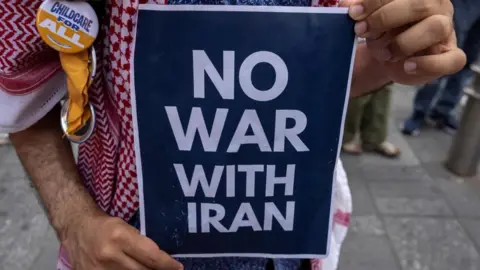
A demonstrator holds a sign during a protest against Israeli strikes on Iran in New York
Israel fails to destroy Iran’s nuclear capability
What if the Israeli attack fails? What if Iran’s nuclear facilities are too deep, too well protected? What if its 400kg of 60% enriched uranium – the nuclear fuel that is just a small step away from being fully weapons-grade, enough for ten bombs or so – is not destroyed?
It’s thought it may be hidden deep in secret mines. Israel may have killed some nuclear scientists but no bombs can destroy Iran’s knowhow and expertise.
What if Israel’s attack convinces Iran’s leadership that its only way of deterring further attacks is to race for nuclear capability as fast as it can?
What if those new military leaders round the table are more headstrong and less cautious than their dead predecessors?
At the very least, this could force Israel to further attacks, potentially binding the region into a continual round of strike and counter-strike. Israelis have a brutal phrase for this strategy; they call it “mowing the grass”.
There’s a global economic shock
The price of oil is already soaring.
What if Iran tried to close the Strait of Hormuz, further restricting the movement of oil?
What if – on the other side of the Arabian Peninsula – the Houthis in Yemen redouble their efforts to attack shipping in the Red Sea? They are Iran’s last remaining so-called proxy ally with a track record of unpredictability and high risk appetite.
Many countries around the world are already suffering a cost of living crisis. A rising price of oil would add to inflation on a global economic system already creaking under the weight of Trump’s tariff war.
And let’s not forget, the one man who benefits from rising oil prices is President Putin of Russia who would suddenly see billions more dollars flood into Kremlin coffers to pay for his war against Ukraine.
Iran’s regime falls, leaving a vacuum
What if Israel succeeded in its long term aim of forcing the collapse of the Islamic revolutionary regime in Iran?
Netanyahu claims his primary aim is to destroy Iran’s nuclear capability. But he made clear in his statement yesterday that his broader aim involves regime change.
He told “the proud people of Iran” that his attack was “clearing the path for you to achieve your freedom” from what he called their “evil and oppressive regime”.
Bringing down Iran’s government might appeal to some in the region, especially some Israelis. But what vacuum might it leave? What unforeseen consequences would there be? What would civil conflict in Iran look like?
Many can remember what happened to both Iraq and Libya when strong centralised government was removed.
So, much depends on how this war progresses in coming days.
How – and how hard – will Iran retaliate? And what restraint – if any – can the US exert on Israel?
On the answer to those two questions much will depend.
Delivered as part of Sony Group’s 2025 Business Segment Presentation for investors, Stringer covered Sony’s financial performance, catalog deals, distribution strategy, AI opportunities, music streaming subscription prices, and more. He also took part in a fireside chat with Justin Hill, Senior Vice President, Finance & Investor Relations, Sony Corporation of America.
“I will paint a vivid picture of how positive we are whilst achieving groundbreaking results,” Stringer told investors at the start of the presentation. “There is a dramatic amount of change in our industry happening, but we are well-placed to win.”
Stringer highlighted Sony’s creative and commercial successes, from Beyonce’s album of the year win at the Grammys, to Tyler the Creator, Tate McRae and Future No.1 albums.
He also gave shout-outs to superstar Latin Music artist Bad Bunny and songwriter Edgar Barrera, plus Sony Music Publishing-signed Chappell Roan and Charli XCX, who Stringer said, “became cultural icons through their hugely successful albums”.
According to Stringer, “this artistic progression is fueled by our desire to cultivate our rosters through more signings and acquisitions.”
And it was on that point about M&A, that Stringer revealed Sony “completed more than 60 investments in the past year alone” and spent “over $2.5 billion for frontline, catalog, as well as creative and service ventures with outside entrepreneurs across a vast number of territories.”
Stringer discussed Sony’s strategy in greater detail during the presentation and Q&A. Here are seven more things you should know…
1. Sony does not base its acquisition decisions on ‘random financial speculative tactics’
During the presentation, Stringer took aim at what he referred to as “periphery music and financial players”.
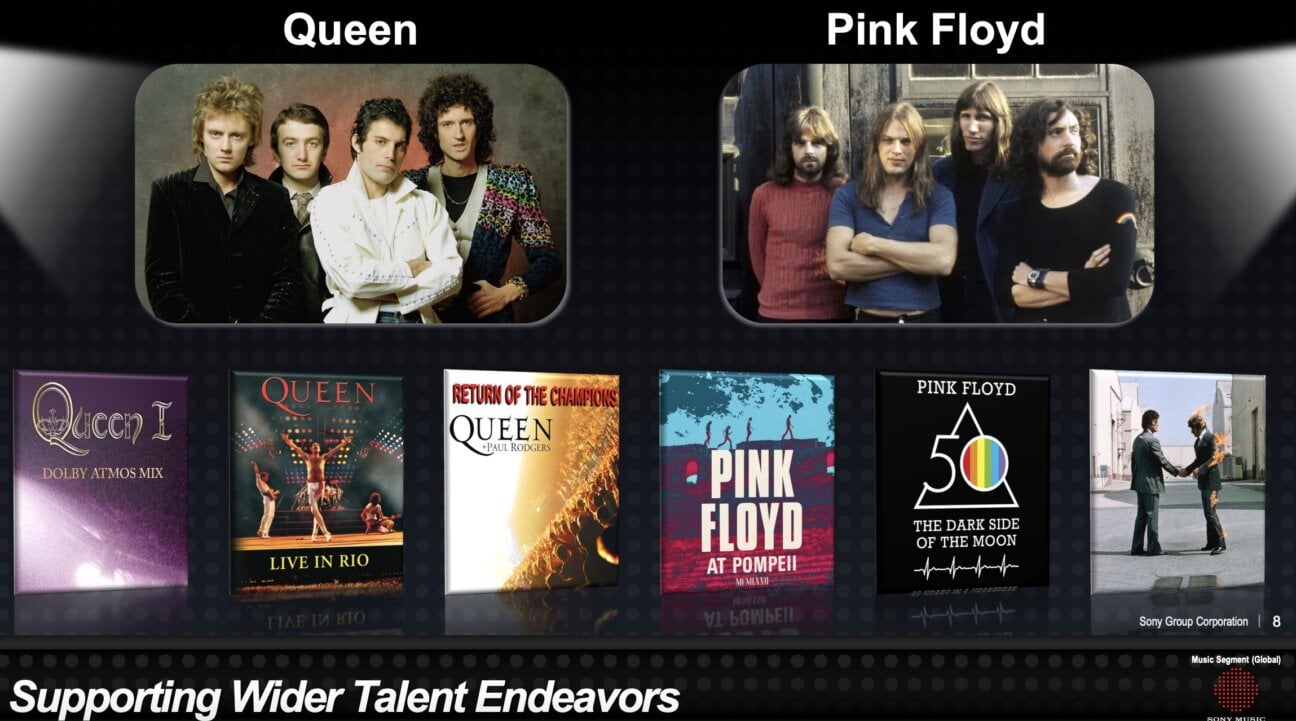
He noted that Sony’s acquisitions of catalogs of iconic artists like Queen and Pink Floyd “are based on significant inside track expertise on the history and therefore possibility of these artistic treasure chests”.
He added: “They are in no way based on random financial speculative tactics that periphery music and financial players may choose to employ. This is our lifeblood, and we are best placed to proceed boldly but wisely in developing this strategy.”
A slide from Stringer’s presentation
Addressing the Queen and Pink Floyd deals specifically, Stringer said: “You have read in recent months that we have purchased the recorded music of Queen and Pink Floyd and the publishing rights for the incredible library of songs for Queen, as well as the name, image and likeness rights which will present huge new promising revenue channels to us.”
Beyond the Pink Floyd and Queen deals, Stringer’s presentation also highlighted other “select investments” from Sony Music Group, listing logos for various labels, distro and merch companies, including:
Note ‘select investments’
2. Sony Music continues to be bullish on high-growth emerging markets
Next, Stringer turned his attention to Sony Music’s expansion in high-growth markets across Latin America, Asia, the Middle East, and Africa.
“In our central local companies, we have forged new ventures in the Czech Republic, Greece,Saudi Arabia, and all across Southeast Asia,” said Stringer.
He added: “Our appetite for this is endless in its potential.”
Stringer also told investors that “in the high-growth markets of Latin America, Asia, Eastern Europe, and the Middle East, all of which have bloomed at double-digit rates in the last three years’ growth, we have been vigorously targeting ways to better position Sony Music”.
According to Stringer: “In India and Latin America, we are still number one in recorded music.”
As you can see from the slide above, in the Latin American music space, Sony highlighted its recent partnership with Mexican American label Rancho Humilde.
In Europe, Sony pointed to its acquisition of Greece’s Cobalt Music and Supraphon, one of the Czech Republic’s longest-established record companies.
Also in Europe, Sony highlighted catalog acquisitions from Poland’s Catmood Records and superstar Polish-language rapper Tymek.
Meanwhile, in Africa and the Middle East, Sony highlighted its recent partnership with Saudi Arabia’s LuxuryKSA, and its acquisition of the recorded music catalog of Egyptian superstar artist Amr Diab.
For Asia, Sony highlighted its joint venture with a prominent Indian film production house Tiger Baby and other partnerships.
3. Sony is benefiting from older consumers’ adoption of streaming and consumption of catalog music
During the presentation, Stringer highlighted the rising opportunity in catalog music as streaming reaches the mainstream and is adopted by greater numbers of older consumers.
He noted that “in 2020, 24% of the Top 200 tracks were catalog songs,” while “in 2024, that percentage grew to about 50%”.
Stringer explained that “this trend is extremely beneficial to Sony Music given our rich, deep working content”.
He added: “We are of course perfectly placed to understand the data from this activity, and this has stimulated our desire to purchase full bodies of work of labels and iconic artists.”
Sringer discussed this consumption shift in more detail, noting that “as the streaming age matures, similarly the consumer does the same”.
He added: “A young lean-forwardcontemporary music fan of 2015 may well now be more of a lean-back one in 2025, listeningto hits from a decade ago.
“The wider diversity in offerings of digital providers from full-length clips to short visual clips has also allowed our library to be consumed in a plethora of ways, which is one of the key reasons why we see more of our catalog in the charts as every year passes.”
4. Sales flowing through Sony’s independent distribution businesses have ‘more than doubled’ over the last four years
Rob Stringer also provided an update on Sony Music’s label and artist services business, which includes prominent players like TheOrchard and AWAL, which it fully acquired in 2015 and in 2021, respectively.
He noted that The Orchard represents over 26,000 labels, while AWAL works with over 20,000 artists, noting that “none of our competitors come close to thatmagnitude of scale”.
Stringer also revealed: “In an environment where nearly half the marketplace is made up of the independent music sector, sales flowing through [Sony’s] independent distribution businesses more than doubled the last four years.”
Stringer also told investors: “We [via The Orchard] have minority interests in over half, at least, of the Orchard’s Top 20 clients, and it hasrecently formed a rapidly profitable admin initiative with our central Publishing Group.”
He added: “We recently concluded transactions with independents in Croatia, Ghana, India and South Korea to name but a few countries alongside what we’ve already done in our established English-speaking regions.
Sony’s Alamo Records division also plays a key role in its wider independent distribution business.
Stringer noted that it serves “as the umbrella group of Foundation distribution and Santa Anna’s incubator system,” which, he revealed, collectively represents another nearly 3,000 artists. Sony acquired a majority stake in Todd Moscowitz’s Alamo Records in 2021, paying €102 million ($123m) to buy Universal Music’s interest in the company.
5. Stringer wants to see more price increases at DSPs.
Addressing Sony’s relationship with streaming companies and the economics of the streaming business, Stringer said that in the past year, across the company’s recorded music and publishing activities, it “finalized hundreds of agreements and renewals, including with nearly every top DSP as well as brand new start-ups”.
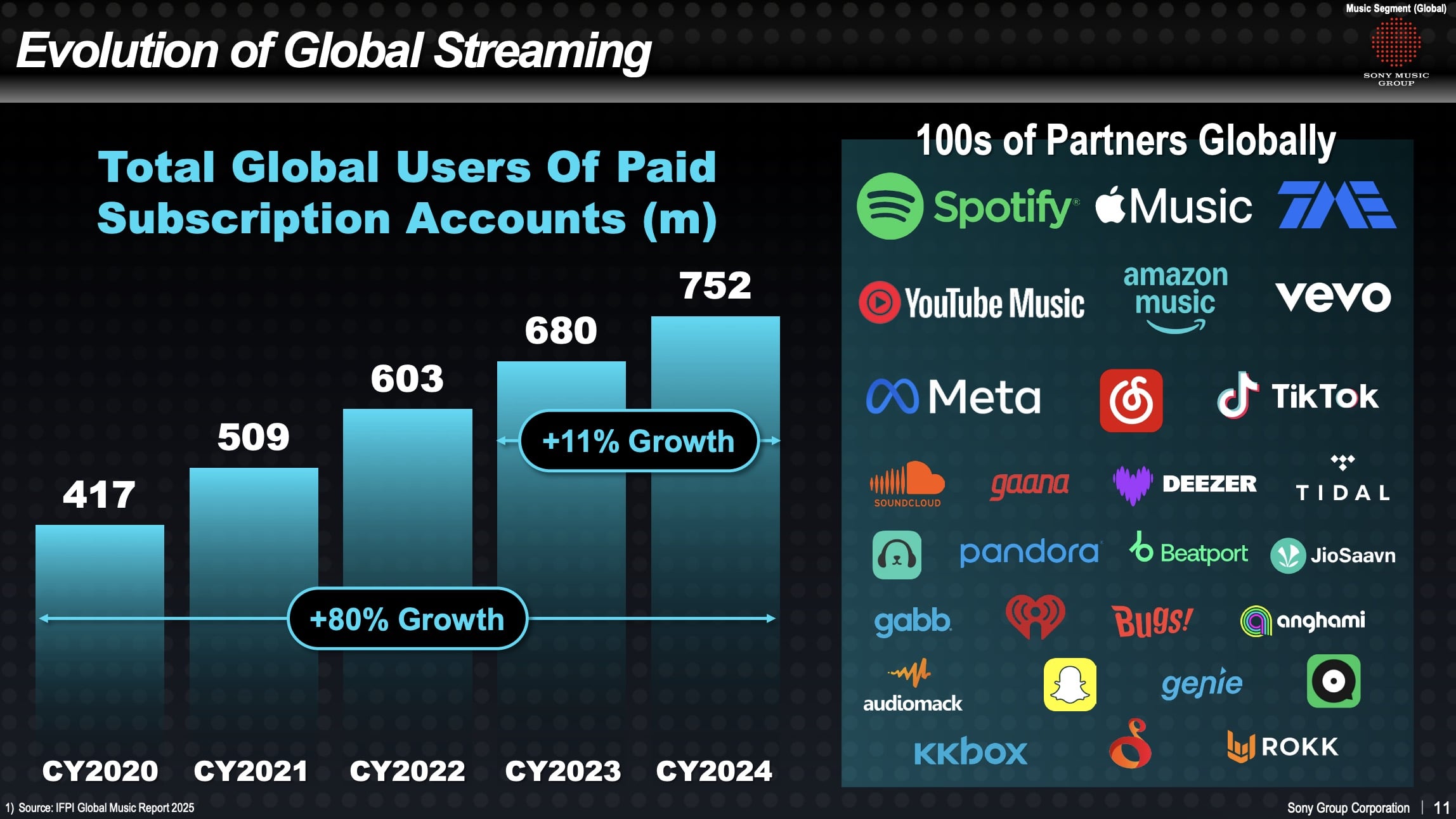
According to Stringer, “paid subscription remains the fulcrum of our business,” noting that the number of paid subscribers globally grewby 11% to over 752 million in 2024.
“These are part of our everyday activities, which is why we don’t highlight them often but weare constantly pushing to ensure audiences are getting an improved music experience,” he said.
Stringer cited Spotify CEO Daniel Ek‘s recent earnings call comment about “the relationship with [labels and DSPs being] better thanever.”
Stringer argued, however, that “there is room for additional upside for all of us if we work together even more closely”.
“Music should not be ‘free’ or a ‘cheap bargain’ still after a decade of such positive-value-for-money proof of concept in mature territories.”
Rob Stringer
Stringer told investors during the presentation that “there is a need for prices to rise and new tiers [to be] introduced that truly reflect the successful maturity of streaming, especially compared with what we see in SVOD services”.
He added: “Music should not be ‘free’ or a ‘cheap bargain’ still after a decade of such positive-value-for-money proof of concept in mature territories. And there should be flexible pricing structures that are appropriate for high growth countries — particularly if they are sometimes hampered by inflation or differing national economic transactional methods.”
During the Q&A segment, Stringer commented on monetization of ad-supported offerings ad streaming services. He said:“There hasn’t been a huge improvement in ad-supported revenue in the last few years on these DSP platforms.
“We’d obviously like to see that happen. We would like to see the free tier be more closely looked at in terms of whether there actually was a free tier in some of the more mature markets, or whether there was a different structuring of how we would get revenue from the free tier, not just via advertising, but also by hopefully trying to convince the consumer in those tiers to upgrade to a subscription.”
6. Superfan tiers at DSPs are still an ‘early-stages concept’.
Elsewhere during the Q&A, Stringer was asked about superfan tiers at streaming services.
According to reports, Spotify‘s long-touted superfan tier could launch this year. This tier would see the platform charge up to $5.99 more per month on top of a Premium subscription (around $18 in total) for access to various ‘superfan‘ perks.
On Spotify’s Q1 earnings call, CEO Daniel Ek indicated that the platform was still working on such a tier but that the streamer needs “partners to come to the table and be part of this journey”.
“There’s been a lot of conversation in the market about the DSPs launching new premium service tiers, which target super fans,” said Justin Hill, Senior Vice President, Finance & Investor Relations, Sony Corporation of America, during the fireside chat with Stringer. “How big is that opportunity when it comes to monetizing that new tier and will it have a major impact on ARPU growth?”
In Stringer’s view, “the super fan tier is an early development concept”. He added: “The DSPs almost have to define with us what that actually means.
“We are partners with our artists and creators, but we also don’t control every revenue stream. So, it would be a multi-revenue stream-based concept.”
According Stringer, given Sony is home to “some of the biggest artists in the world,” has “some of the biggest brands in the world,” plus, “own[s] name and likeness on some of those brands,” the comapny “will be very comfortable with there being a [superfan] tier that works”.
He added, however: “We’re in the early conceptualization of those stages, and we have to work together as with anything else.
“Exactly as we discussed with pricing, or as we discussed with even some of the elements of how well those platforms work, we have to work together. And I think it’s an early-stages concept.”
7. Sony has engaged with over 800 companies on AI-related activities, but slammed ‘the lack of recognition of copyright by much of the tech sector’
Sony Music Group’s Chairman dedicated a section of the presentation to the company’s activities in the field of AI.
Stringer revealed that Sony Music Entertainment has “actively engaged” with over 800 companies on “ethical product creation, content protection and detection, enhancing metadata and audio tuning and translation amongst many other shared strategies”.
He added: “AI will be a powerful tool in creating exciting new music that will be innovative and futuristic. There is no doubt about this.”
He argued, however, that “these positive steps are weighed down by the lack of recognition of copyright by muchof the tech sector and government policymakers in many countries and regions”.
Stringer continued: “The training of these models to allow such movement cannot simply be laissez-faire anddisrespectful to the fact that intellectual property has clear-cut rights. These should not beabused, and moving forward, a clear remuneration system should exist.”
Stringer revealed that Sony is “going to do deals for new music AI products this year with those that want toconstruct the future with us the right way”.
“We are going to do deals for new music AI products this year with those that want to construct the future with us the right way.”
He added: “New subscription ideas with fair revenue sharingarrangements will be further additive. Like anything new, it will start slowly and rapidly scale over time.
“Consistent with how we managed the shift from ownership to streaming, we will share allrevenues with our artists and songwriters whether from training or related to outputs, so they are appropriately compensated from day one of this new frontier.
“And with deals being carried out, it will be clear to governments that a functioning marketplace does exist so there is no need for them to listen to the lobbying from the tech companies so heavily.”
Stringer said that Sony Music is “encouraged by the U.S. Copyright Office’s recent position stating that, ‘making commercial use of vast troves of copyrighted works, especially where this is accomplished through illegal access, goes beyond established fair use boundaries’”.
“But so far, there is too little collaboration, with the exception of a handful of more ethically minded players.”