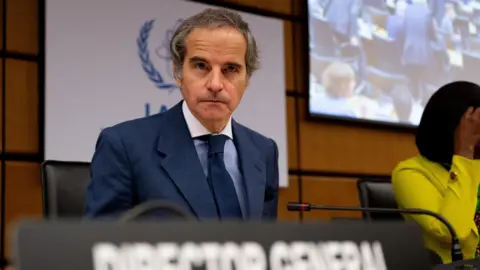
International Atomic Energy Agency (IAEA) chief Rafael Grossi briefed member states at a meeting in Vienna
The head of the global nuclear watchdog says there has been no further damage to Iran’s Natanz uranium enrichment plant since Israel struck the country’s nuclear sites on Friday.
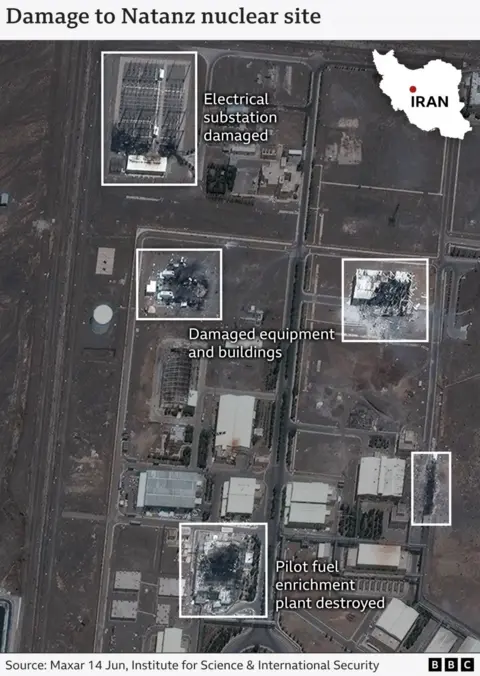
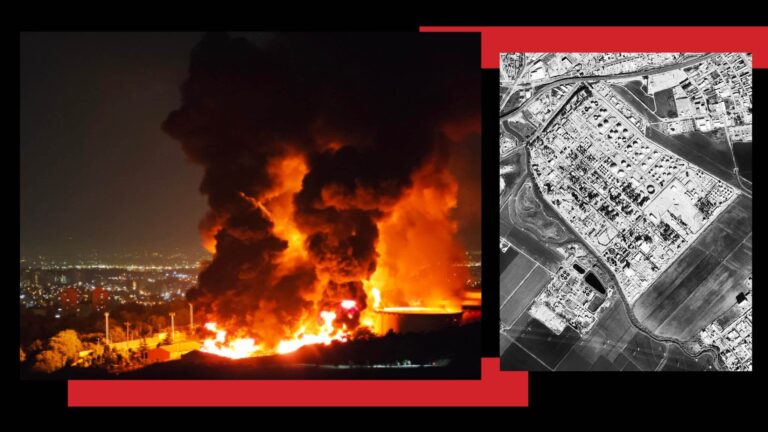
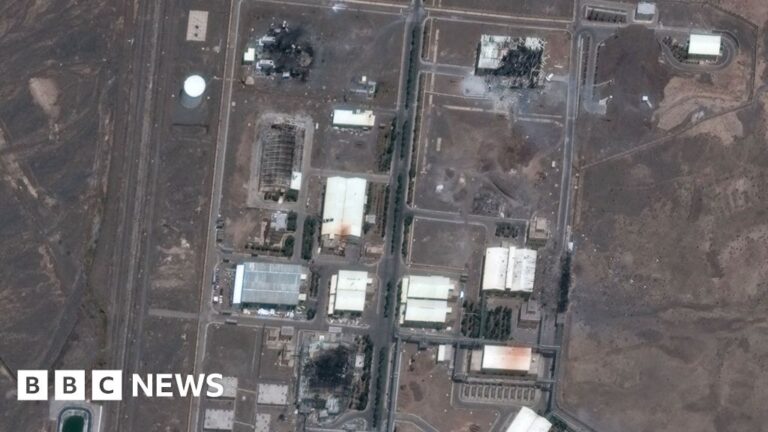
Rafael Grossi told the International Atomic Energy Agency’s (IAEA) board of governors that an above-ground enrichment facility at Natanz was destroyed, but that there were no signs of a physical attack at the underground facility there.
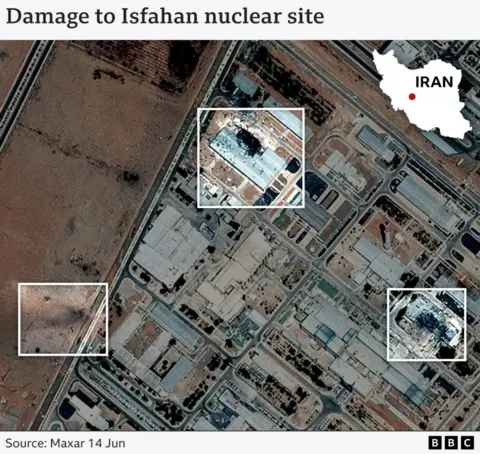
Four buildings were also damaged at the Isfahan site, he said, including a uranium conversion plant, and no damage was visible at the underground Fordo enrichment plant.
Israel said it attacked the sites and killed nine nuclear scientists to stop Iran developing nuclear weapons.
It alleged that Iran had in recent months “taken steps to weaponize” its stockpile of enriched uranium, which can be used to make fuel for power plants but also nuclear bombs.
On Sunday, Iran reiterated that its nuclear programme was peaceful and urged IAEA’s 35-nation board to strongly condemn the Israeli strikes.
Grossi briefed the board on Monday that the IAEA had been monitoring the situation in Iran very carefully, ascertaining the status of the country’s nuclear facilities and assessing radiation levels through communication with local authorities.
He said Friday’s attack on Natanz destroyed the above-ground part of the Pilot Fuel Enrichment Plant (PFEP), where cascades of centrifuge were producing uranium enriched up to 60% purity – close to the 90% required for weapons-grade uranium
Electricity infrastructure at Natanz, which included an electrical sub-station, a power supply building, and emergency generators, were also destroyed.
“There has been no indication of a physical attack on the underground cascade hall containing part of the PFEP and the main Fuel Enrichment Plant. However, the loss of power to the cascade hall may have damaged the centrifuges there,” Grossi added.
He also said there was radiological and chemical contamination at the site, but that the level of radioactivity outside had remained unchanged and at normal levels.
The Israeli military said on Friday that the underground centrifuge hall was also damaged as part of the attack on Natanz, but it provided no evidence.
The IAEA chief said four buildings were damaged in a separate attack on Friday on the Isfahan Nuclear Technology Centre – the central chemical laboratory, a uranium conversion plant, the Tehran reactor fuel manufacturing plant, and a facility to convert uranium hexafluoride to uranium metal, which was under construction.
As at Natanz, off-site radiation levels remain unchanged, he added.
The Israeli military said on Friday that the Isfahan strike “dismantled a facility for producing metallic uranium, infrastructure for reconverting enriched uranium, laboratories, and additional infrastructure”.
On Saturday, Iran’s semi-official Isna news agency quoted spokesman of the Atomic Energy Organization of Iran (AEOI) as saying there was “limited damage to some areas at the Fordo enrichment site” following an Israeli attack.
However, the Israeli military has not confirmed carrying out any strikes there.
Grossi said no damage had been seen at Fordo, or at the Khondab heavy water reactor, which is under construction.
He urged all parties to exercise maximum restraint, warning that military escalation threatened lives and increased the chance of a radiological release with serious consequences for people and the environment.
Iranian Foreign Minister Abbas Araghchi told foreign diplomats in Tehran on Saturday that Israel’s attacks on his country’s nuclear facilities were a “blatant violation of international law”, and that he hoped the IAEA’s board would issue a strong condemnation.
He also said that Iran’s missile strikes on Israel since Friday were a “response to aggression”.
The Israeli military’s spokesperson, Brig Gen Effie Defrin said on Monday that its large-scale air campaign would “continue to act in pursuit of the operation’s objective, to neutralize the existential threat from Iran, from its nuclear project to the regime’s missile array”.
Iran’s health ministry says Israeli strikes have killed more than 220 people since Friday. Twenty-four Israelis have been killed by Iranian missiles, according to Israeli authorities.
Last Thursday, the IAEA’s board formally declared Iran in breach of its non-proliferation obligations for the first time in 20 years. A resolution said Iran’s “many failures” to provide the agency with full answers about its undeclared nuclear material and nuclear activities constituted non-compliance.
Under a 2015 nuclear deal with world powers, Iran was not permitted to enrich uranium above 3.67% purity – the level required for fuel for commercial nuclear power plants – and was not allowed to carry out any enrichment at Fordo for 15 years.
However, US President Donald Trump abandoned the agreement during his first term in 2018, saying it did too little to stop a pathway to a bomb, and reinstated US sanctions.
Iran retaliated by increasingly breaching the restrictions – particularly those relating to enrichment. It resumed enrichment at Fordo in 2021 and has amassed enough 60%-enriched uranium to potentially make nine nuclear bombs, according to the IAEA.
Chinese President Xi Jinping reached Kazakhstan on Monday to attend the second China–Central Asia Summit, a high-stakes diplomatic gathering aimed at deepening Beijing’s economic and strategic ties with the region.
The summit, which will be held on Tuesday in the Kazakh capital Astana, comes at a time when China is intensifying its outreach to Central Asian countries amid shifting global power alignments — and mounting tensions in neighbouring Iran, which is roiled in an escalating conflict with Israel.
The summit will bring together the heads of state from all five Central Asian nations — Kazakhstan, Kyrgyzstan, Tajikistan, Turkmenistan and Uzbekistan — along with Xi.
The Astana summit also carries symbolic weight: it is the first time that the five Central Asian nations are holding a summit in the region with the leader of another country.
So, what is the importance of the China-Central Asia Summit? And is China battling both the United States and Russia for influence in the region?
What’s on Xi’s agenda in Astana?
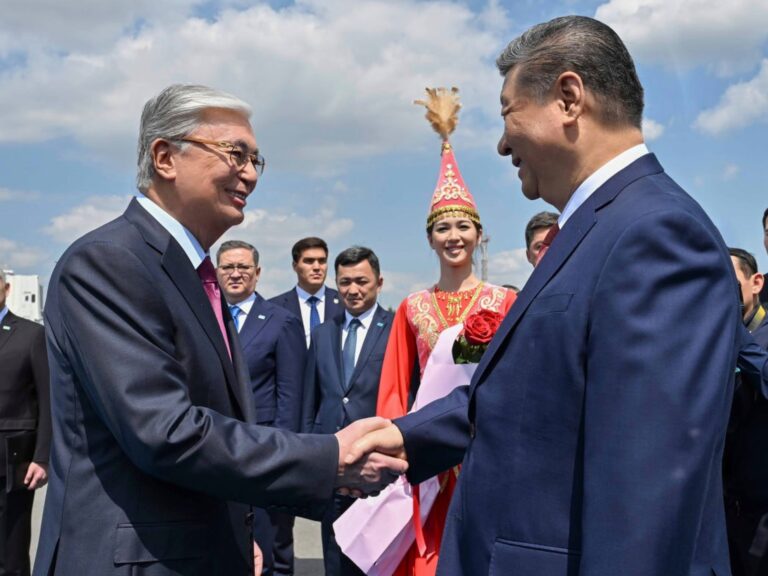
On Monday, Xi was greeted by Kazakh President Kassym-Jomart Tokayev and other senior officials at the airport in Astana. The Astana summit follows the inaugural May 2023 China–Central Asia Summit, which was held in Xi’an, the capital city of China’s Shaanxi province.
Xi is expected to be in Astana from June 16 to 18 and is scheduled to hold bilateral meetings with Kazakhstan’s leaders on Monday before the summit on June 17.
At the summit, he is expected to deliver a keynote speech and “exchange views on the achievements of the China-Central Asia mechanism, mutually beneficial cooperation under the framework, and international and regional hotspot issues,” said a Chinese Foreign Ministry spokesperson.
The office of Kazakhstan’s president noted that both countries are “set to further strengthen bilateral ties” and Xi will also chair “high-level talks with President [Tokayev] focused on deepening the comprehensive strategic partnership”.
Tokayev, who has been in office since 2019, is a fluent Mandarin speaker and previously served as a diplomat in China.
Zhao Long, a senior research fellow at the Shanghai Institutes for International Studies (SIIS), told Al Jazeera that Central Asian countries see their partnership with China as a deep, multifaceted cooperation grounded in shared strategic and pragmatic interests.
“The alignment with China helps Central Asian states enhance their regional stability, pursue economic modernisation, and diversify their diplomatic portfolios,” said Zhao. Where Central Asia has abundant energy resources, he said, China offers vast markets, advanced technology, and infrastructure expertise.
Last Friday, Lin Jian, a Chinese Foreign Ministry spokesperson, told a news briefing that establishing “the China-Central Asia mechanism was a unanimous decision among China and the five Central Asian countries, which dovetails with the region’s common desire to maintain stability and pursue high-quality development”.
Since China first formalised and chaired the China-Central Asia Summit in May 2023, Lin said, “China’s relations with Central Asian countries have entered a new era … injecting fresh impetus into regional development and delivering tangibly for the peoples of all six countries.”
“We believe through this summit, China and five Central Asian countries will further consolidate the foundation of mutual trust,” Lin added.
“During the summit, President Xi will also meet with these leaders and lay out the top-level plan for China’s relations with [the] five Central Asian countries,” said the spokesperson.
SISS’s Zhao said Xi’s attendance at the second summit sends a clear message: “China places high strategic importance on Central Asia.”
Former US President Joe Biden (centre) hosts a C5+1 summit meeting with the presidents of Kazakhstan, Kyrgyzstan, Tajikistan, Turkmenistan and Uzbekistan on the sidelines of the 78th Session of the United Nations General Assembly in New York City, New York, the US, September 19, 2023 [File: Kevin Lamarque/Reuters]
What’s ‘C5+1’ – and is China racing the US for influence?
Experts are dubbing the China-Central Asia Summit as a C5+1 framework, because of the five regional nations involved.
The United States first initiated the concept of such a summit with all five Central Asian nations in 2015, under then-US President Barack Obama. But at the time, the conclave was held at the level of foreign ministers. Then-US Secretary of State John Kerry led the first meeting in September 2015 on the sidelines of the United Nations General Assembly (UNGA) in New York.
In January 2022, Indian Prime Minister Narendra Modi held a virtual summit with the five Central Asian state heads, and then in June 2025, he invited them for a follow-up conclave in India.
Meanwhile, in 2023, Xi hosted the leaders in Xi’an. Four months later, then-US President Joe Biden hosted the C5 state heads on the sidelines of the UNGA in New York. It was the first time a US president met with Central Asian heads of state under this framework.
But current US President Donald Trump’s tariff policies could upset that outreach from Washington. Kyrgyzstan, Tajikistan, Turkmenistan and Uzbekistan have all been tariffed at 10 percent.
Trump initially imposed an even higher 27 percent tariff on imports from Kazakhstan, the region’s largest economy, though as with all other countries, the US president has paused these rates, limiting tariffs to a flat 10 percent for now.
China has cited these tariff rates to project itself as a more reliable partner to Central Asia than the US. At the meeting with the foreign ministers of the region in April, Chinese Foreign Minister Wang Yi criticised unilateralism, trade protectionism, and “the trend of anti-globalisation [that] has severely impacted the free trade system”.
The US, Wang said, was “undermining the rule-based multilateral trading system, and destabilising the global economy”.
Kazakhstan’s President Kassym-Jomart Tokayev and China’s President Xi Jinping walk past honour guards during a welcoming ceremony before talks in Astana, Kazakhstan on July 3, 2024 [File: Press Service of the President of Kazakhstan/via Reuters]
Why does Central Asia matter to China?
The region, rich in uranium, oil, and rare earth metals, has become increasingly important to China as a key corridor for trade with Europe. Subsequently, China has increased its engagement with Central Asian countries.
Xi, who has curtailed his foreign visits since the COVID-19 pandemic, is visiting Kazakhstan for the third time since 2020. He visited in 2022, and then again in 2024.
Central Asia is also a critical part of Xi’s Belt and Road Initiative (BRI) — a network of highways, railroads and ports connecting Asia, Africa, Europe and Latin America — as a gateway to Europe.
Experts expect the BRI to figure prominently at the summit in Astana on Tuesday, with additional emphasis on collaboration in energy and sustainable development.
A planned $8bn railway connecting China’s Xinjiang region to Uzbekistan through Kyrgyzstan is likely to be on the agenda, the SISS’s Zhao said. Construction on the project is scheduled to begin in July. Expected to be completed by 2030, the railway route will provide China with more direct access to Central Asia and reduce the three countries’ reliance on Russia’s transport infrastructure.
Additionally, Zhao said that the summit may feature agreements on reducing tariffs, streamlining customs procedures, and lowering non-tariff barriers to boost bilateral trade volumes.
From left to right, Uzbekistan’s President Shavkat Mirziyoyev, Tajikistan’s President Emomali Rahmon, Kazakhstan’s President Kassym-Jomart Tokayev, China’s President Xi Jinping, Kyrgyzstan’s President Sadyr Japarov, and Turkmenistan’s President Serdar Berdymukhamedov pose for a group photo session during the first China-Central Asia Summit in Xi’an, Shaanxi province, China, May 19, 2023 [File: Florence Lo/Reuters]
How much does Central Asia depend on China?
A lot.
China is today the top trading partner of each of the five Central Asian republics.
Kazakhstan imported goods worth $18.7bn from China and exported goods worth $15bn in 2023 — making up 30 percent of its total imports and 16 percent of exports.
Tajikistan imported goods worth $3.68bn from China and exported goods worth $250m in 2023 — making up 56 percent of its total imports and 16 percent of exports.
Kyrgyzstan imported goods worth $3.68bn and exported goods worth $887m in 2023 from China — constituting 29 percent of its total imports and 26 percent of exports.
Uzbekistan imported goods worth $12.7bn and exported goods worth $1.82bn in 2023 from the world’s second-largest economy — representing 32 percent of its total imports and 6 percent of exports.
Turkmenistan imported goods worth $957m and exported goods worth $9.63bn in 2023 from China — or 20 percent of its total imports and 62 percent of exports.
China is also ramping up its investments in the region. It has committed to an estimated $26bn in investments in Kazakhstan, for instance.
Russian President Vladimir Putin at the Collective Security Treaty Organisation (CSTO) summit in Astana, Kazakhstan, November 28, 2024 [File: Gavriil Grigorov/Kremlin via Reuters]
Is China replacing Russia in Central Asia?
It’s complicated.
Formerly parts of the Soviet Union, the five Central Asian republics have long belonged in Russia’s strategic sphere of influence. Millions of people from the five republics live and work in Russia, and since 2023, Moscow has become a supplier of natural gas to Kazakhstan and Uzbekistan, which have faced energy shortages — even though Central Asia was historically a supplier of energy to Russia.
But though Russia remains a major economic force in the region, China has overtaken it as the largest trading partner of Central Asian republics over the past three years — a period that has coincided with Russia’s war on Ukraine. Some of that increased trade, in fact, is believed to be the outcome of China using Central Asia as a conduit for exports to Russia of goods that face Western sanctions.
Still, there are ways in which Russia remains the region’s preeminent outside ally. Kazakhstan, Kyrgyzstan and Tajikistan — three of the region’s five nations — are part of the Collective Security Treaty Organisation (CSTO) — along with Russia, Armenia and Belarus. Like NATO, this bloc offers collective security guarantees to members. In effect, Kazakhstan, Kyrgyzstan and Tajikistan have the cover of Russia’s protection if they are attacked by another nation — something that China does not offer.
Gunmen have killed the mayor of the Mexican municipality of San Mateo Piñas in the latest deadly attack on local officials.
Witnesses said four armed men arrived on motorcycles, stormed the village hall and opened fire on the mayor, Lilia Gema García Soto, and a local official who was in a meeting with her, Eli García Ramírez.
Two municipal police officers were also injured in the attack.
While officials are still investigating the possible motive for the killing, local officials are often targeted by criminal gangs for failing to do their bidding.
García Soto is the second mayor to be killed in Oaxaca state this year. In May, the mayor of Santiago Amoltepec was shot dead in an ambush along with two other people who were in the car with him at the time of the attack.
The governor of Oaxaca has condemned this latest killing, adding that the crime would not go unpunished.
However, security forces are still searching for the four gunmen, who escaped after the attack.
The state prosecutor’s office said federal agents had been deployed to the area to help locate them.
Violence against local politicians and those running for office in Mexico has been on the rise in recent years, spiking in the run-up to last year’s general election.
Major record companies have filed a rebuttal to the US government’s support for Cox Communications in a copyright dispute that has been elevated to the Supreme Court.
The music companies argued that Cox Communications “knowingly contributed to, and reaped substantial profits from, massive copyright infringement committed by thousands of its subscribers.”
A Virginia jury initially sided with the labels, awarding them $1 billion and finding Cox liable for both “contributory” and “vicarious” copyright infringement.
However, in February 2024, the Fourth Circuit Court of Appeals overturned the “vicarious liability” finding and the damages, while upholding the “contributory infringement” ruling.
“Cox was held liable not because it failed to do enough to police infringement, but because it took no meaningful steps to stop infringement.”
Sony Music Entertainment and others
Since then, both Cox and the music labels have asked the Supreme Court to review the case. In November 2024, the Supreme Court invited the federal government to provide input on the case.
In late May, the Solicitor General backed Cox’s position, arguing that ISPs don’t become liable simply by failing to terminate accounts after receiving infringement notices. The government brief stated that “willfulness” requires knowledge that subscriber conduct was actually unlawful, not just awareness of potential infringement.
Most recently, the labels described the Justice Department’s position as “bewildering,” according to a supplemental brief filed June 10 by Sony Music Entertainment and others.
The supplemental brief said: “Cox was held liable not because it failed to do enough to police infringement, but because it took no meaningful steps to stop infringement and continued serving specific, identifiable subscribers even after receiving explicit notice of their repeat (and often rampant) infringement.”
“Cox kept supplying the means of infringement because it said ‘F the dmca!!!,’ C.A.App.1495, and adopted an express policy of prioritizing profits from subscription fees over compliance with the Copyright Act or the DMCA.”
The DMCA refers to the Digital Millennium Copyright Act, which provides legal protections for ISPs that cooperate with copyright holders.
“Cox… chose to keep [infringing subscribers] with internet access anyway—because it was more interested in protecting its own profits than Plaintiffs’ copyrights.”
Sony Music Entertainment and others
The labels further argued that Cox kept serving customers specifically because of their monthly payments, even after receiving hundreds of infringement notices.
“Cox was held liable because it was repeatedly put on express notice that specific subscribers were engaged in rampant infringement, yet it chose to keep supplying them with internet access anyway—because it was more interested in protecting its own profits than Plaintiffs’ copyrights.”
Internal exchanges provided by the labels showed Cox declined to terminate a customer because “[he] pays us over $400/month”), and giving another subscriber “one more chan[c]e[because] he pays [$]317.63 a month”).
Sony and other labels further accused Cox of looking the other way and “hope that its ‘unwritten semipolicy’ would not come out in litigation.” They said Cox allowed 13 strikes before considering “soft terminating” accounts, then quickly reinstated most terminated users.
Cox terminated over 600,000 subscribers for unpaid bills while rarely terminating users for copyright violations, according to the supplemental filing.
The labels’ legal team urged the Supreme Court to review the vicarious liability question while rejecting Cox’s contributory infringement arguments.
The long-running lawsuit is among a number of other cases involving ISPs and music labels. Labels have also brought similar lawsuits against other ISPs including Charter Communications and Astound Broadband.
Most recently on May 28, major record companies and ABKCO have settled a piracy lawsuit with Frontier Communications, ending a legal battle that threatened the internet provider with hundreds of millions of dollars in damages.
The case, filed in 2021, was dismissed “with prejudice,” meaning it can’t be refiled. Terms of the settlement were not disclosed, but the filing, which you can read in full here, noted that all parties have agreed to “bear [their] own fees and costs.”
In 2025, around 24 million Americans are estimated to suffer from sleep apnea, and around 90% of these cases are undiagnosed. Now, a groundbreaking new study warns that this is going to rapidly increase as the planet warms.
New research by scientists at Australia’s Flinders University has found a link between new cases of sleep apnea and climate change, which is on trend with many chronic conditions and diseases expected to be more prevalent as temperatures change. Increased temperatures are expected to also increase the severity of obstructive sleep apnea (OSA), with cases doubling in most countries within the next century.
“This study helps us to understand how environmental factors like climate might affect health by investigating whether ambient temperatures influence the severity of OSA,” said Dr. Bastien Lechat, a research associate at the Adelaide Institute for Sleep Health. “Overall, we were surprised by the magnitude of the association between ambient temperature and OSA severity.”
“Higher temperatures were associated with a 45% increased likelihood of a sleeper experiencing OSA on a given night,” he added.
Around a billion people around the world are already impacted by sleep apnea, which at best causes daytime fatigue, but is a key factor in elevated blood pressure and in turn stroke and heart attack. If left untreated, it also increases the risk of a suite of conditions including depression, dementia and Parkinson’s disease.
In this study, scientists looked at the data of 116,620 people around the globe using a mattress sensor to assess their OSA severity. Each individual had their bed fitted with a sensor, which recorded around 500 separate nights of sleep data from each person. This information was then paired with corresponding 24-hour temperature information drawn from climate models.
“Using our modeling, we can estimate how burdensome the increase in OSA prevalence due to rising temperature is to society in terms of wellbeing and economic loss,” said Lechat. “The increase in OSA prevalence in 2023 due to global warming was associated with a loss of approximately 800,000 healthy life years across the 29 countries studied.”
“This number is similar to other medical conditions, such as bipolar disorder, Parkinson’s disease or chronic kidney diseases,” he added.
So what does hotter temperatures have to do with how well we sleep? Previous studies had linked an increase ambient temperature in the bedroom with poorer sleep quality. Not surprisingly, these results predict that people in lower socioeconomic areas and countries will be at a higher risk of OSA, due to a lack of access to cooling devices such as air conditioning.
“Importantly, these findings varied by region, with people in European countries seeing higher rates of OSA when temperatures rise than those in Australia and the United States, perhaps due to different rates of air conditioning usage,” Lechat said.
Economically, this climate-induced increase in OSA is expected to create a huge financial burden – US$68 billion from wellbeing loss and $30 billion thanks to a negative impact on workplace productivity.
“Our findings highlight that without greater policy action to slow global warming, OSA burden may double by 2100 due to rising temperatures,” Lechat added.
Senior researcher on the paper, Professor Danny Eckert, says that while the study is one of the largest of its kind, it was skewed towards high socio-economics countries and individuals, likely to have access to more favorable sleeping environments and air conditioning.
“This may have biased our estimates and led to an under-estimation of the true health and economic cost,” said senior author Danny Eckert, a professor at Flinders University.
The researchers believe this first-of-a-kind study tables the urgency of interventions – in both providing better access to comfortable sleeping conditions for everyone, and boosting awareness to increase OSA diagnosis so people can effectively manage the serious condition.
“Higher rates of diagnosis and treatment will help us to manage and reduce the adverse health and productivity issues caused by climate related OSA,” said Eckert. “Going forward, we want to design intervention studies that explore strategies to reduce the impact of ambient temperatures on sleep apnea severity as well as investigate the underlying physiological mechanisms that connect temperature fluctuations to OSA severity.”
While the new study has many variables and limitations – including being able to accurately capture ambient temperatures, which vary considerably depending on sleeping areas and arrangements – researchers say it should, at the very least, encourage people to be assessed for OSA and understand their personal risks.
“Our study underscores the potential significant impact of increasing ambient temperatures on the prevalence of OSA, globally,” the researchers wrote. “Without substantially greater policy change to slow global warming, the health and economic burdens associated with OSA may double by 2100.”
“Our findings also emphasize the immediate need for targeted measures to potentially minimize the health and economic impacts of the growing OSA prevalence associated with rising temperatures,” they concluded.
Iran’s deadly strike on Monday hit Israeli residential buildings and energy infrastructure, while Israel said it targeted the Quds Force military command centers.


 Reuters