

25.4 C
New York
Tuesday, March 31, 2026
Home Blog Page 648

Israeli forces attack incomplete Arak heavy water reactor in Iran

0

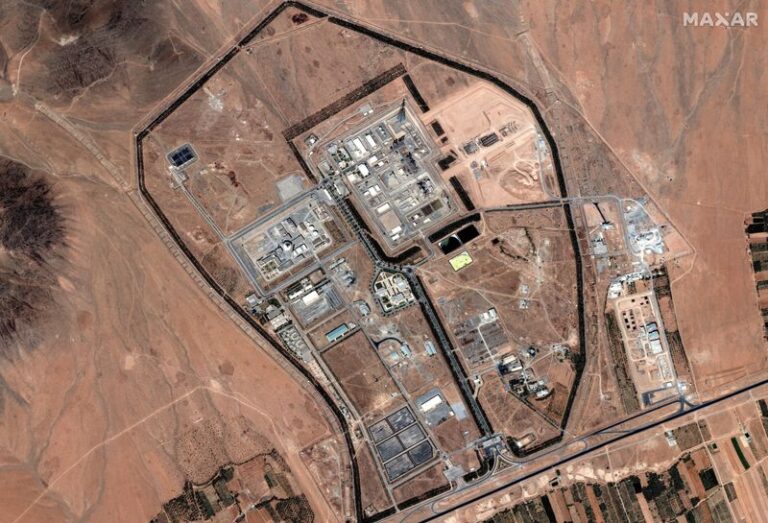
Maxar Technologies/Handout via Reuters Satellite image from Maxar Technologies shows the damaged roof of the Arak heavy water reactor following an Israeli air strike, in Iran (19 June 2025)Maxar Technologies/Handout via Reuters

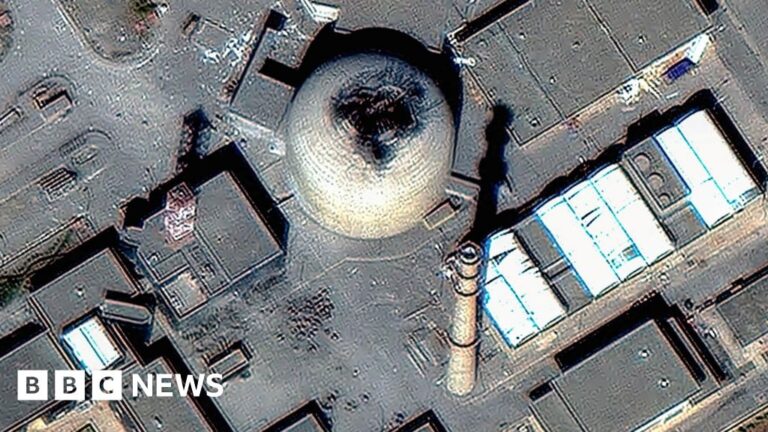
Satellite imagery showed a large whole in the Arak reactor building’s domed roof

Israeli jets have bombed a nuclear reactor under construction in central Iran during a wave of air strikes on the seventh day of the conflict between the two countries.

The Israeli military said it targeted the Arak heavy water reactor’s core seal to stop it being used for “nuclear weapons development”.

The International Atomic Energy Agency confirmed the reactor was hit and that it contained no nuclear material.

Spent fuel from heavy water reactors contains plutonium suitable for a nuclear bomb.

Iran – which says its nuclear programme is entirely peaceful – agreed under a 2015 deal with world powers to redesign and rebuild Arak so it could not produce weapons-grade plutonium.

The following year, the IAEA said Iran had removed Arak’s calandria, or reactor core, and rendered it “inoperable”.

The global nuclear watchdog’s latest quarterly report from late May said minor civil construction work was ongoing at the reactor, and that Iran expected it to be commissioned this year and to start operating in 2026.

The Israeli military said Iran’s government had “deliberately ordered [workers] not to complete the conversion… in order to exert pressure on the West”.

“The strike targeted the component intended for plutonium production, in order to prevent the reactor from being restored and used for nuclear weapons development,” it added.

Black-and-white aerial footage of the attack released by the military appeared to show a bomb hitting the domed roof of the reactor building and several large explosions from Arak, which about 250km (155 miles) south-west of Tehran and is also known as Khondab.

Daytime video broadcast by Iranian state TV showed two large plumes of white smoke rising from the facility. It also cited Iranian officials as saying that the site had been “secured in advance” and that there was “no contamination resulting from the attack”.

Satellite imagery showed a large hole in the reactor building’s roof.

Also visible were what analysts identified as destroyed distillation towers belonging to the adjacent heavy water production plant. The IAEA said it had no information indicating that the heavy water plant was hit.


Reuters Iranian state TV footage purportedly showing smoke rising from the Arak nuclear facility on 19 June 2025Reuters

Iranian state TV broadcast footage showing smoke rising from the Arak facility

The Israeli military also announced on Thursday that its fighter jets had struck a “nuclear weapons development site” at Natanz.

It is the location of Iran’s main plant producing enriched uranium, which is used to make reactor fuel for power stations but, if further enriched, can be used in nuclear weapons.

The first wave of Israeli strikes last Friday destroyed the above-ground part of Natanz’s Pilot Fuel Enrichment Plant (PFEP), where cascades of centrifuges were enriching uranium, as well as electricity infrastructure at the site.

Rafael Grossi, the IAEA director general, told the BBC on Monday that while there was no sign of a physical attack on the underground centrifuge hall at Natanz, the sudden loss of power was likely to have severely damaged, if not destroyed, the centrifuges operating there.

Four buildings were destroyed in a separate attack on Friday on the Isfahan Nuclear Technology Centre, he said. But very little, if any, damage was visible at Iran’s underground enrichment plant at Fordo, he added.

President Donald Trump is said to be weighing up whether the US should participate in a strike on Fordo because it is the only country with a conventional bomb large enough to destroy it. Sources told the BBC’s US partner CBS News that his mindset was that disabling the facility was necessary.

In 2018, Trump abandoned the nuclear deal with Iran, saying it did too little to stop its pathway to a bomb, and reinstated US sanctions that crippled the Iranian economy.

Iran retaliated by increasingly breaching the restrictions – particularly those relating to the production of enriched uranium.

In its quarterly report, the IAEA expressed concern that Iran had amassed enough uranium enriched up to 60% purity – a short, technical step away from weapons grade, or 90% – to potentially make nine nuclear bombs.

Benjamin Netanyahu, Israel’s prime minister, said on Friday that it was targeting the Iranian nuclear programme because “if not stopped, Iran could produce a nuclear weapon in a very short time”. He did not provide any evidence.

Abbas Araghchi, Iran’s foreign minister, said on Sunday that Israel had “crossed a new red line in international law” by attacking nuclear sites. He also insisted that Iran’s doctrine was “rooted in our belief in the prohibition and illegitimacy of nuclear weapons”.

Israel is widely believed to have nuclear weapons, although it neither confirms nor denies this.

The Israeli air strikes have also destroyed Iranian military facilities and weapons, and killed senior military commanders and nuclear scientists.

Iran’s health ministry said on Sunday that at least 224 people had been killed, but a human rights group put the unofficial death toll at 639 on Thursday.

Iran has launched hundreds of ballistic missiles at Israel in response to the air strikes that have killed at least 24 people, according to the prime minister’s office.

Understanding the Nuclear Contamination Risks of Israel’s Attacks on Iran

0

Explainer-What are the nuclear contamination risks from Israel's attacks on Iran?

Outrage sparked by Trash-Filled Caves in ‘Avatar’ Park

0

Piles of trash-filled caves in Zhangjiajie, China, famous for its towering sandstone pillars.

Bain & Co’s Luxury Report Reveals Decline in Personal Goods Market Last Year

0

Luxury brands have retreated back to their safe space of exclusivity, having explored new avenues to win customers during COVID. The only problem is, to win and retain the next generation of shoppers they must marry their need to remain elusive with a consumer who wants to share everything online.

These companies have no time to waste. According to a spring update on the sector from Bain & Co, the industry is losing speed relatively quickly.

The study released Thursday shows the sector’s worth was €1.5 trillion ($1.7 trillion) in 2024, though for Q1 of 2025 estimates are shrinkage of 3% compared to last year.

Even last year, personal luxury goods was one of the categories which marked the most notable slowdown, knocking from €369 billion in 2023 down to €364 billion in 2024. That marked its first contraction in 15 years—with the notable exception of the pandemic.

And the gap between winners and losers in the luxury sector is also growing, added the author’s writers Claudia D’Arpizio and Federica Levato.

The gap between the top 75th percentile and the bottom 25th percentile performers increased by 1.5 times in Q1 2025 compared to a year earlier, with market leaders continuing to charge ahead while the bottom 20% to 30% of the sector continued to report a reduction in growth.

Part of the problem is consumers are wrangling with what Bain & Co describes as the “value equation”—basically, are they getting enough—be it experience, social and cultural kudos, or workmanship—out of the purchase for the elevated price they are paying?

For a “long period” luxury brands were trying to enlarge their customer base to be more inclusive, D’Arpizio tells Fortune. This was really reinforced in some categories with “entry items like streetwear, sneakers, and even beauty—all the categories that could have been more relevant for young people, but also with people with less discretionary spending.”

That strategy “overcorrected” she added, with brands overly relying on iconic design or experiences, reducing their pace of innovation and hence, leading consumers to question if their spend is really worth it.

“So last year we had a big loss of customers—around 50 million less customers buying luxury product—in particular in the younger generation, and a big drop on customer advocacy,” D’Arpizio continued. “What is happening now that the brands are trying to fix that, and trying to reignite this relationship with these customers without losing their exclusivity.”

Exclusivity in the online age

Shifting back to exclusivity is a more difficult ask when younger consumers are known as the social media generation for their propensity to post online.

Gone are the days of galas with no cameras, of designer handbag back rooms with no filming allowed: It’s all available on a For You Page within moments of ending.

“Luxury has always been about showing off,” D’Arpizio, who is Bain & Co’s lead for the global fashion, luxury goods vertical, continued. “The previous generation was showing off wealth and showing off accomplishments in life, now it’s more showing off of your of your personality or your ability to choose your aesthetics, your quality of life. 

“There is a big need, in particular in Gen Z, for sharing. This sharing means expressing their personality … but also a desire of conformity. These are two forces that are contradictory but in reality are a big driver for luxury consumption because luxury brands can provide this conformity, but then inside the luxury brand, mixing and matching, choosing your own style, developing your own style, creates your self-expression.”

She continued: “Social media has provided a huge impulse to luxury consumption because the potential of sharing with a larger audience has created both more customers but also in augmentation of their communication strategies and so they have a broader reach. 

“So yes, they want to be exclusive, but they know the power of social media.”

Footage captures SpaceX Starship exploding during test at site

0

Eyewitness video shows SpaceX’s Starship 36 erupting in a huge fireball during a ground test in Texas.

Create Music Group forms joint venture with Star Trak Entertainment, the former label of The Neptunes

0

Create Music Group (CMG) has formed a new joint venture with Star Trak Entertainment, along with co-founder Rob Walker.

Originally launched in 2001, Star Trak Entertainment was founded by Rob Walker and producer duo Pharrell Williams and Chad Hugo of The Neptunes.

The joint venture marks the official relaunch of the imprint.

In addition to co-founding Star Trak, Rob Walker was the longtime manager of The Neptunes, served as a talent agent at UTA, and co-founded Billionaire Boys Club and its Ice Cream clothing line with Pharrell Williams and Japanese fashion figure Nigo.

His decades-long career spans music, fashion, and brand development alongside some of the industry’s most notable acts.

The deal marks the latest in a series of recent partnerships for Create, which was valued at $1 billion following a $165-million investment round last year.

Last month, Create swooped for independent electronic music label Monstercat and launched a joint venture with Ty Dolla $ign and his EZMNY Records label earlier this month.

In April, Create Music Group acquired Berlin-headquartered independent music company !K7.

Through the partnership with Star Trak, Create said it will provide worldwide distribution, technology, and marketing services.

Star Trak quickly rose to prominence through releases with acts such as Clipse, N.E.R.D., and Snoop Dogg.

With RIAA certified hits such as Drop It Like It’s Hot by Snoop Dogg and Pharrell Williams, Grindin by Clipse, and She Wants to Move by N.E.R.D., Create noted that “Star Trak has long been known for shaping early-2000s hip-hop and R&B culture”.

“This isn’t just about bringing Star Trak back – it’s about building a new chapter- rooted in where we’ve been, and built for where we’re headed.”

Rob Walker, Star Trak Entertainment

“This isn’t just about bringing Star Trak back – it’s about building a new chapter- rooted in where we’ve been, and built for where we’re headed,” said Rob Walker, co-founder of Star Trak Entertainment.

“The energy and vision that helped shape a generation is entering a new era. With Create as our partner, we’re giving artists the space to move differently, think bigger, and tap into an ecosystem of brands and collaborators that Star Trak has cultivated over the years.”

“We are honored to partner with Rob as he kicks off the next chapter of Star Trak.”

Kyle Bartelman, Create Music Group

Kyle Bartelman, Director of Global Corporate Development and M&A at Create Music Group added: “We are honored to partner with Rob as he kicks off the next chapter of Star Trak.

“Rob’s creative vision and industry experience will uniquely position our artists for success with their music and beyond. We’re excited to have Star Trak join the CMG family, and we can’t wait to support Rob and the next wave of Star Trak talent.”

 Music Business Worldwide

Iranian missile strike targets Israeli hospital

0

BBC on the scene at Israeli hospital struck by Iranian missile

A hospital in the Israeli town of Beersheba has been hit as Iran fired a barrage of missiles at the country, with the conflict between the two nations continuing into a seventh day.

Iran said it had targeted a military site close to the hospital, not the facility itself. With strikes being reported in several locations across Israel, the country’s health ministry said 271 people had been injured.

After visiting the Soroka Medical Centre on Thursday, Israel’s Defence Minister Israel Katz said Iran’s supreme leader “can no longer be allowed to exist”.

Meanwhile, Israel’s military said it had targeted Iran’s nuclear sites including the “inactive” Arak heavy water reactor and Natanz facility.

The conflict began on 13 June, when Israel launched attacks on Iranian nuclear sites and killed several top generals and nuclear scientists.

Israel’s deputy foreign affairs minister said Iran’s hit on the Soroka hospital was “deliberate” and “criminal”.

In a post on X, Sharren Haskel said the site that was the main medical centre for Israel’s entire Negev region.

Israeli Prime Minister Benjamin Netanyahu said Israel would “exact the full price from the tyrants in Tehran”.

While Israel’s Defence Minister Israel Katz told reporters: “[Iran’s Supreme Leader Ayatollah Ali] Khamenei openly declares that he wants Israel destroyed – he personally gives the order to fire on hospitals.”

BBC correspondents in the area described the scale of the damage as extensive, with debris and plumes of smoke floating through the air long after the blast.

Several wards were completely destroyed as fire spread through one of the buildings, causing windows to smash and ceilings to collapse, hospital authorities said.

Around 200 patients will be transferred to other hospitals centres, Prof Shlomi Codish, chief executive of the Soroka said.

“At the moment we don’t know if buildings or other wards might collapse,” he added.

On Thursday morning, an Iranian ballistic missile struck the business district of Ramat Gan, east of Tel Aviv – causing a large sheet of glass to fall several floors from a skyscraper and part of an electrical pylon to crash to the ground.

About 20 people are believed to have been injured by the blast in the area, authorities have said.

The Israeli military said it told people living in the cities of Iranian cities Arak and Khondab, which are near the reactor, to leave the area “as soon as possible,” in a post on X, prior to the attack.

The nuclear facilities that were attacked include a partially-built heavy-water research reactor.

Heavy-water reactors produce plutonium, which – like enriched uranium – can be used to make the core of an atom bomb.

Iranian media reported two projectiles hitting an area near the facility. There were no reports of radiation threats.

In a separate announcement, Israel’s military said it also struck a site in the area of Natanz, which it said contains “unique components and equipment used to develop nuclear weapons”.

Israel has alleged Iran has recently “taken steps to weaponise” its enriched uranium stockpile, which can be used for power plants or nuclear bombs. Iran has always claimed that its nuclear programme is entirely peaceful.

Iran’s armed forces said their response to the Israeli attack will have “no limits.”

It has lodged a complaint with the UN nuclear watchdog, accusing Israel of “continuing its aggression and actions contrary to international laws that prohibit attacks on nuclear facilities,” Iranian state media reported.

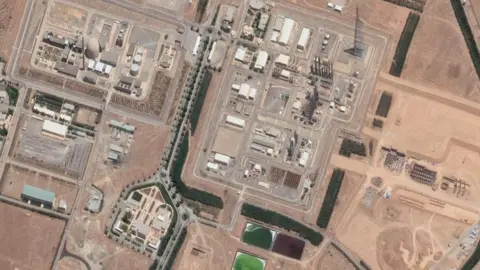
Reuters A satellite image shows the Arak nuclear facility in Iran. Reuters

Arak’s nuclear facility had been evacuated before the attack according to Iranian media

The latest attacks come at a critical time, as President Trump considers the possibility of direct American involvement in Israel’s campaign.

Iran’s deputy foreign minister Kazem Gharibabadi warned the US that Tehran will have “no other option but to use its tools to teach aggressors a lesson” if it intervenes in support of Israel.

The Iranian Supreme Leader Ali Khamenei rejected Trump’s calls to surrender, and Iran has threatened to strike American military interests in the Middle East in response.

Trump, so far, has given no clear indication of his next move. According to the BBC’s partner CBS, he has approved plans to attack Iran but has held off on a final decision about striking the country.

On Wednesday, Trump said, “I may do it, I may not do it”, when asked a question about US involvement in Iran.

Additional reporting by Tom Bennett in Jerusalem

Auburn Signs Top Recruit Mack Schumann for 2025-26 Season

0

Fitter and Faster Swim Camps is the proud sponsor of SwimSwam’s College Recruiting Channel and all commitment news. For many, swimming in college is a lifelong dream that is pursued with dedication and determination. Fitter and Faster is proud to honor these athletes and those who supported them on their journey.

Mack Schumann, who hails from Nashville, Tennessee, is headed to Auburn University to swim and study in the class of 2029. At the time of his verbal commitment a year ago, he wrote on social media:

“I am blessed to say that I will be continuing my academic and athletic career at Auburn University. I want to thank my parents, my brother, my teammates, and my current and future coaches for helping me make this decision! War Eagle🦅”

Schumann trains year-round with Nashville Aquatic Club and specializes in distance. We named him one of the “Best of the Rest” distance freestylers in the class of 2025. In prep swimming, he won the 200/500 free double –with PBs of 1:37.66 and 4:22.38– during his junior year at Donelson Christian Academy at the 2024 TISCA State Championships.

Then, during his senior year of high school, he dropped 10.6 seconds in the 200 breast, 7 seconds in the 200 IM, 2.7 in the 400 IM, and .6 in the 100 breast. He still has impressive freestyle times but this breaststroke/IM development gives him more options at Auburn.

Schumann had a strong showing at Winter Juniors East, where he was runner-up in the 400 IM and placed 9th in the 500 free and 10th in the 200 breast. He picked up new times in all three events. He added PBs in the 100 breast and 200 IM at Southern Premier two months later, while winning the 500 free (4:23.75) and 400 IM (   3:50.79) and placing 2nd in the 100 breast (54.79) and 3rd in the 200 IM (1:47.58).

In LCM, he earned most of his PBs last summer in July at the Lakeside Aquatic Club Summer Senior Showdown. Those included 200 free (1:54.51), 50 breast (29.43), 100 breast (1:04.12), 200 breast (2:18.99), and 200 IM (2:06.76). He also scored a Summer Nationals cut in the 400 IM (4:25.62) in June.

Schumann will suit up for the Tigers next fall with Brody Singley, Finnley Conklin, Luke Bedsole, Luke Waldrep, Maston Ballew, and Paul Hong. He would have been the 3rd-fastest on Auburn’s roster last year in the 200 breast and 400 IM, 4th in the 500 free, and 5th in the mile.

Best SCY times:

  • 200 breast – 1:57.85
  • 100 breast – 54.42
  • 400 IM – 3:45.98
  • 200 IM – 1:47.58
  • 1650 free – 15:11.83
  • 1000 free – 9:30.30
  • 500 free – 4:21.29
  • 200 free – 1:37.66

If you have a commitment to report, please send an email with a photo (landscape, or horizontal, looks best) and a quote to [email protected].

About the Fitter and Faster Swim Tour 

Fitter & Faster Swim Camps feature the most innovative teaching platforms for competitive swimmers of all levels. Camps are produced year-round throughout the USA and Canada. All camps are led by elite swimmers and coaches. Visit fitterandfaster.com to find or request a swim camp near you.

FFT SOCIAL

Instagram – @fitterandfasterswimtour
Facebook – @fitterandfastertour
Twitter – @fitterandfaster

FFT is a SwimSwam partner.

Parkinson’s Early Signs May Be Detected Through Ear Wax Test

0

Catching the onset of Parkinson’s Disease early can be critical to slowing the disease’s progression and improving a patient’s life. A new test that uses nothing more than a sample of someone’s ear wax is set to do exactly that.

Despite the fact that an estimated 10 million people live with Parkinson’s Disease, there is currently no definitive test to spot the condition in its early stages. To identify someone with Parkinson’s, doctors rely on cognitive and motor skill testing, which can be inexact and have a degree of bias involved. Other tests include imaging, which can rule out other conditions rather than confirm a Parkinson’s diagnosis, and a response to Parkinson’s medication – in which people who might not have the disease take a prescription designed to combat its effects.

Progress in diagnosing the disease is happening, however. Earlier this year, we even reported on how a simple eye test might help spot the condition early.

One of the more promising ways to spot Parkinson’s early has to do with the way in which the disease impacts the oily layer of our skin known as sebum. In 2021, a team of scientists found 10 biomarkers that were heightened or lowered in patients with Parkinson’s by analyzing sebum collected with non-invasive skin swabs. Using that data, the researchers were able to distinguish between those who had the condition and those who didn’t with an 85% rate of accuracy.

Understanding that our skin is exposed to environmental conditions that can alter its composition but seeing the value in using sebum to detect Parkinson’s, researchers led by scientists from a range of universities and research institutes in China turned to a different source of sebum: ear wax. Unlike our skin secretions, ear wax is more protected and therefore offers a more pure read on our sebum composition.

To conduct their study, the researchers swabbed the ears of 209 adults, 108 of whom had Parkinson’s disease. After analyzing the wax using gas chromatography and mass spectrometry, they identified four different volatile organic compounds (VOC) that were significantly lower in Parkinson’s patients than in those without the condition. Next, the team trained a sniff-enabled AI system on the data. Once the training was complete, the system was able to distinguish Parkinson’s patients from non-Parkinson’s patients with an accuracy rate of 94%.

Such a successful test, say the researchers, could provide doctors with an inexpensive, non-invasive early diagnostic tool in identifying Parkinson’s Disease. However, they say more research is needed.

“This method is a small-scale single-center experiment in China,” says study co-author Hao Dong. “The next step is to conduct further research at different stages of the disease, in multiple research centers and among multiple ethnic groups, in order to determine whether this method has greater practical application value.”

The study has been published in the journal Analytical Chemistry.

Source: American Chemical Society

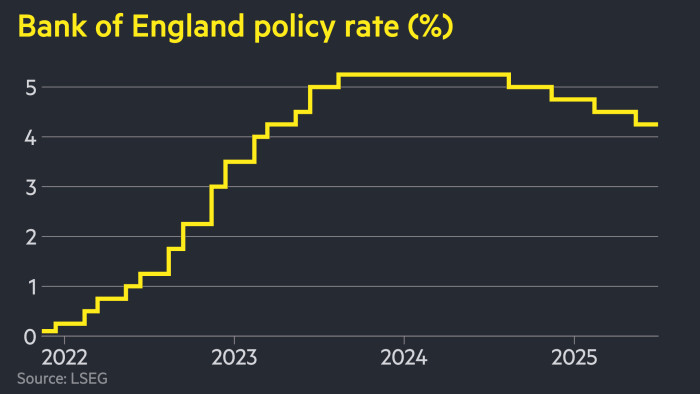
Amid Uncertainty in the Middle East, Bank of England Maintains Interest Rates at 4.25%

0

Stay informed with free updates

The Bank of England has held interest rates at 4.25 per cent but signalled a possible cut as soon as August after recent data showed a weakening jobs market.

The six-to-three vote by the Monetary Policy Committee followed a quarter-point cut in May amid concerns over the impact of US President Donald Trump’s aggressive tariff policy.

“Interest rates remain on a gradual downward path, although we’ve left them on hold today,” said Andrew Bailey, the BoE’s governor.

Thursday’s widely expected decision came as policymakers wrestle with persistently strong inflation and the additional uncertainty posed by the escalating conflict between Israel and Iran, and its potential impact on oil prices.

“The world is highly unpredictable,” Bailey added, adding that the central bank would pay careful attention to the impact on inflation of the weak labour market.

Deputy governor Dave Ramsden joined external MPC members Swati Dhingra and Alan Taylor in calling for an immediate further cut in rates to 4 per cent.

Gordon Shannon, a fund manager at TwentyFour Asset Management, said the voting pattern was “marginally more dovish” than investors had been expecting.

The MPC predicted a “significant slowing” in pay growth, a sign that another rate cut will be on the table as soon as its August 6 meeting, while also noting that “underlying UK GDP growth appears to have remained weak”.

A report from the BoE’s network of regional agents found business hiring intentions to be “mildly negative” as companies in sectors including manufacturing, retail and construction warned they were not expecting much improvement in customer demand until 2026.

The MPC acknowledged that problems with the UK’s labour market data continued to be a concern, but noted that May’s 109,000 fall in the UK’s official estimate of payrolled employees was the largest monthly contraction since May 2020.

It added that an internal BoE measure suggested a “subdued rate of near-zero employment growth”.

“Labour market developments suggest that the economy is weakening faster than expected,” said Tomasz Wieladek, chief European economist for fixed income at asset manager T Rowe Price.

Earlier this week, data from the Office for National Statistics showed UK consumer price inflation for May at 3.4 per cent, well above the BoE’s 2 per cent target. The central bank expects CPI inflation to remain just under 3.5 per cent for the rest of the year, with a brief rise to 3.7 per cent in September.

The pound was flat against the dollar at $1.341 after the MPC’s decision.

Traders kept their bets on further rate cuts largely unchanged, expecting two quarter-point reductions by the end of the year, according to levels implied by swaps markets.

The BoE emphasised that policy was not on a preset path, adding that it was closely watching “elevated” inflation expectations.

As the worsening conflict in the Middle East risks pushing oil prices higher, the MPC said it would remain “sensitive to heightened unpredictability in the economic and geopolitical environment”, noting recent increases in energy costs.

The BoE reiterated its existing guidance that it would take a “gradual and careful” approach to future rate reductions, which investors have interpreted as pointing towards quarterly cuts.

Additional reporting by Ian Smith