Iran fired missiles at the US’s Al Udeid Air Base in Qatar, saying it was retaliation for recent American strikes on its nuclear facilities. Qatar intercepted the missiles and said it reserves the right to respond “to this blatant aggression in accordance with international law.” No casualties were reported.
Music creation platform Splice has integrated its sample library with Avid’s Pro Tools digital audio workstation, making millions of loops, sound effects and one-shots available to the artists and producers who use the popular music-making tool.
The idea is to speed up the music-making process by eliminating the need to switch between apps when adding samples to a music project.
The new Pro Tools 2025.6 will allow subscribers to access around 2,500 samples for free, with the rest available through a monthly subscription fee.
“Putting Splice directly into the creative workflow is core to our mission,” Splice SVP of Content Kenny Ochoa said in a statement on Wednesday (June 18).
“This integration makes it easier than ever for Pro Tools users to access our AI-powered discovery and world-class sound library – right where they’re making music.”
“This integration makes it easier than ever for Pro Tools users to access our AI-powered discovery and world-class sound library – right where they’re making music.”
Kenny Ochoa, Splice
Pro Tools users will be able to drag audio clips from the Pro Tools timeline into Splice’s AI-powered ‘Search with Sound’ panel to match samples by rhythm, key and tempo, Avid said, eliminating the need to switch between apps and manually import Splice samples into Pro Tools. Users will then be able to drag the sample back into their session.
“Whether producers and artists are sketching out ideas, building out tracks, or applying final touches, Pro Tools’ Splice integration provides a more powerful environment for creating music – giving users the ability to quickly find the perfect sound while staying in their creative flow,” said Kenna Hilburn, SVP, Product at Avid.
The new Pro Tools version also rolls out a new AI-powered speech-to-text tool that allows editors to search audio files in a session for speech and lyric information. The tool displays text alongside the relevant clip, speeding up the navigation process.
“The reaction from both the postproduction and music communities has been incredibly positive,” Hilburn said. “Speech-to-text is a major step forward, simplifying ADR, editing, and dialogue workflows.”
“Whether producers and artists are sketching out ideas, building out tracks, or applying final touches, Pro Tools’ Splice integration provides a more powerful environment for creating music.”
Kenna Hilburn, Avid
MBW understands that the Splice integration and other new features in the latest Pro Tools version were powered by R&D made possible in part by the capital injection that Avid got from its $1.4-billion all-cash acquisition by private equity firm Symphony Technology Group (STG) in 2023.
Founded in 1987, Avid is one of the most prominent names in video and audio editing technology. On its “about” page, the company boasts that Avid DAW users scooped up numerous awards at the 2024 Grammys, including Album of the Year, Record of the Year, and Best Immersive Audio Album.
For Splice, the Pro Tools integration comes a few months after it acquired virtual instrument library Spitfire Audio in what the Financial Timesdescribed as a $50 million deal. The deal marked Splice’s entry into the music plugin market.
Splice was valued at nearly $500 million in 2021, following a $55 millioninvestment round led by Goldman Sachs, and the company has been busy rolling out new features in recent years, including Splice Mic, introduced earlier this year on its mobile app, which allows users to record vocals over instrumentals made in the app.
Since 2022, various versions of Splice’s mobile app have featured a AI-powered tools that enable creators to browse, audition, and craft music directly from their phones.
The company recently said it hit nearly 350 million downloads of its sample packs in 2024.Music Business Worldwide
Three police officers in Kenya have been charged with the murder of a 31-year-old blogger who died in police custody earlier this month.
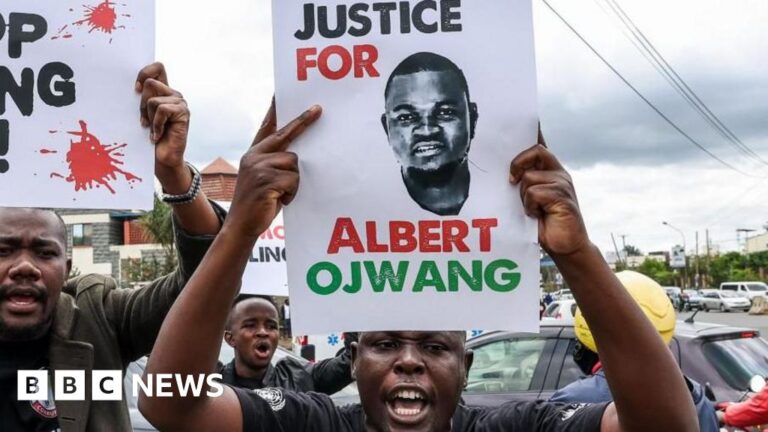
Albert Ojwang’s death has sparked outrage in Kenya with protests held to demand justice.
Mr Ojwang was arrested after Kenya’s deputy police chief Eliud Lagat filed a complaint, accusing the blogger of defaming him on social media.
Mr Lagat stepped aside last week pending the outcome of investigations into Ojwang’s death. He has denied any wrongdoing.
The three police officers – Samson Kiprotich, Talaam James Mukhwana and Peter Kimani – were charged along with three civilians.
All six appeared in court on Monday, but have not yet pleaded.
Police initially said that Mr Ojwang died of self-inflicted wounds, but were forced to retract the statement after an autopsy found that he was likely to have died from assault wounds.
A street vendor was shot during a demonstration last week in the capital, Nairobi, over Mr Ojwang’s death, sparking renewed outrage from Kenyans who accuse police of using excessive force against protesters.
Boniface Kariuki was reportedly selling masks when a uniformed police officer fired a bullet at close range, critically injuring him.
Activists have called for a “total shutdown” of the economy on Wednesday as they step up protests against police brutality, and mark a year since the security forces opened fire on crowds protesting against an increases in taxes.
During last Tuesday’s protests, Mr Kariuki was holding a packet of face masks when he was caught up in a confrontation with two officers in Nairobi as hundreds of protesters clashed with police.
One officer, who had concealed his face with a mask, was filmed shooting him in the head as he walked away.
“Watching that video of Boniface being shot was heart-breaking. He was just selling masks. How could anyone hurt someone who hadn’t done anything wrong? It made me fearful,” Jonah Kariuki, the vendor’s father, told the BBC.
Mr Kariuki senior, who is also a hawker, said his son was the family’s bread-winner and called for the prosecution of the police officers involved, if they are found guilty of shooting him.
“I was so shocked because my son was not armed with stones or clubs like other protesters who were seen armed. They found him doing his work. It pained me because my son has never stolen anything,” said Susan Njeri, the victim’s mother.
Boniface Kariuki is being treated at Kenyatta National Hospital, Kenya’s largest referral facility, where he remains in critical condition.
“Boniface cannot talk. He cannot hear as well. He cannot see us. To be sincere, he can’t survive without life support,” Emily Wanjiru, the family spokesperson, told the BBC.
The case has attracted widespread condemnation, with demonstrators demanding accountability for both the vendor’s shooting and Mr Ojwang’s earlier death.
Foreign embassies and rights organisations have urged the government to ensure transparency in the investigations and to hold those responsible to account.
Your guide to what Trump’s second term means for Washington, business and the world
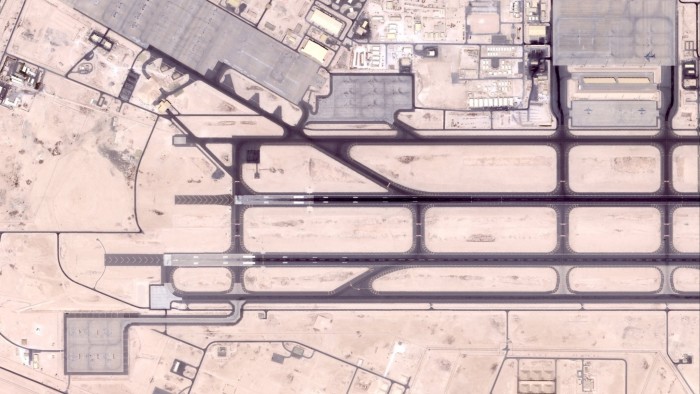
Iran fired missiles at an American military base in Qatar as Tehran struck against the US in retaliation for Donald Trump’s bombing of the Islamic regime’s main nuclear sites at the weekend.
Residents heard explosions booming across Doha on Monday evening as air defences sought to intercept up to 10 missiles that were fired towards Al Udeid base.
The sprawling base just outside the Qatari capital is the US Central Command’s regional headquarters and typically hosts about 10,000 American troops. But most personnel were evacuated last week and aircraft and other equipment moved as regional tensions soared.
Qatar’s foreign ministry spokesperson Majed al-Ansari said: “Qatari air defences thwarted the attack and successfully intercepted the Iranian missiles.” He said there were no casualties.
The US and Qatar were aware of the imminent threat of an attack hours before the missiles were launched, a person familiar with the matter told the FT.
Oil prices fell as traders calculated that the attack was largely symbolic, and could signal an effort by Iran to de-escalate the conflict, despite the risk that it could trigger a robust response.
Qatar had earlier closed its airspace in expectation of an Iranian attack. The US and UK embassies in Doha had also told their citizens in the small Gulf state to “shelter in place”.
The Iranian attack came just over a day after Trump ordered the US military to drop “bunker buster” bombs on Fordow and Natanz — Iran’s main nuclear sites — as Washington joined Israel’s 10-day war against the Islamic republic.
The attack on Al Udeid, which also serves as the Royal Air Force’s regional headquarters, also risks dragging the UK into the conflict. On Monday UK foreign secretary David Lammy said the UK was ready to defend its personnel and assets in the region and that “of its allies and partners”.
Shortly before the attack, Major General Abdolrahim Mousavi, chief of Iran’s armed forces, said Trump had “violated all international norms by breaching the airspace of our beloved country” and “the crime itself and the blatant disrespect cannot go unanswered”.
Iran launched a similar attack against the US in 2020 when it fired missiles at two US bases in Iraq after Trump ordered the assassination of Qassem Soleimani, Iran’s most powerful commander. The assault was telegraphed and caused no damage, and both sides stepped back from the brink of a full-blown war.
But a regional official said the attack and threat to countries in the Gulf “will undoubtedly impact the relationship-building efforts that have been under way between” Iran and its Arab neighbours.
Qatar’s Ansari said the Gulf state “reserves the right to respond directly”, raising the possibility of an expanding regional confrontation, but also called for an “immediate cessation” of military actions.
International airlines including British Airways, Air France, Kuwait Airways and Etihad Airways had previously cancelled or rerouted some destinations in the Gulf.
BP, TotalEnergies and Eni have also begun to evacuate foreign staff from oilfields in southern Iraq amid fears that Iran could target energy infrastructure in the region.
Regional states have been on edge since Israel launched its war against Iran 10 days ago, fearing an attack on US bases or energy facilities. They also worry that Iran could seek to block the Strait of Hormuz, the waterway through which around a quarter of the world’s seaborne crude passes.
Gulf states, including Qatar, have previously told the Trump administration that they would not allow the US to use bases on their territory to launch attacks against Iran.
The US has about 40,000 troops in the Middle East at bases and military sites in Qatar, Bahrain, which hosts the Navy’s Fifth Fleet, Kuwait and the United Arab Emirates, as well as Egypt, Iraq, Jordan, Oman, Saudi Arabia and Syria.
The US also has 2,500 troops in Iraq and hundreds in Syria who could be vulnerable to attacks from Iranian-backed Shia militants as well as from Iran’s missiles.
Israel widened its strikes on Iran earlier on Monday, hitting sites in Tehran, including the notorious Evin prison, and the headquarters of the Basij, a force linked to the elite Revolutionary Guards.
Israel’s defence minister Israel Katz said the military would continue striking Iran as long as the Islamic republic kept firing at Israel.
But two people familiar with the Israeli government’s thinking said that given the damage it had already done to Iran’s ballistic missile and nuclear capabilities, it was looking for ways to wind up the conflict.
“Israel can ‘close’ this operation in the coming days, and is willing to. It depends on the US, the international community, and most of all the Iranians,” one of the people said.
After one of the most brutal wars of this century, a new Syria is rising from the disastrous legacy of the toppled dictator Bashar al-Assad.
His photos have been torn from the walls, as people exercise freedoms denied during his family’s decades-long reign. Now, a different flag flies across Syria, the emblem of the rebels in charge.
For Syrians, the future is uncertain — a tangle of elation and pain, of hope and fear.
By Ben HubbardVisuals by David Guttenfelder
The team reported for more than a month from a dozen cities, towns and villages across Syria.
The fall of the Syrian dictator Bashar al-Assad, which ended 13 years of civil war, ushered in a precarious new era for a country deeply scarred by its past.
Syrians are free, but the war’s toll is unfathomable — more than a half-million people killed or missing, millions more displaced and many communities in tatters.
The battles have stopped, but sporadic violence persists, hobbling the country’s efforts to move forward.
I began covering Syria early in my career as a Middle East correspondent, sneaking across the border in 2012 to meet some of the first rebels taking up arms against the government as the civil war picked up. In the years that followed, I chronicled how the conflict spread across the country, devastating cities and bringing incalculable suffering to so many people.
After the Assad regime fell in December, I rushed to the capital, Damascus, and found a swirl of joy and trepidation about the future. Two months later, I returned with the photographer David Guttenfelder and other colleagues to travel the country from south to north to see how Syrians were living through this momentous change.
Over a few weeks and hundreds of miles, we drove on pockmarked highways and dirt roads, met masked gunmen and jubilant children and spoke with scores of Syrians as they worked to rebuild their lives.
Daraa
The Child Martyr
We began our journey a short drive from Syria’s southern border with Jordan at al-Baneen Secondary School, an unremarkable building in a neighborhood so damaged by war that most people have left. The school is scarred by gunfire and shrapnel, its desks, chairs and many of its walls long gone.
It is a building that changed the course of Middle Eastern history.
In 2011, graffiti appeared on its walls threatening Mr. al-Assad, an ophthalmologist by training. “Your turn has come, doctor,” it read.
By that time, the antigovernment uprisings known as the Arab Spring had already overthrown autocrats elsewhere in the Middle East. The Syrian authorities detained some students, demonstrations erupted demanding their release, and the police violently suppressed them, fueling more protests. In the crackdown, a 13-year-old boy named Hamza al-Khateeb was killed.
These events kindled the civil war.
On our trip, we found Hamza’s mother, Samira al-Khateeb, in the town of al-Jeezeh, with the help of neighbors who directed us to her home.
Sitting somberly in her son’s room, she recalled him as a quiet seventh-grader who ate too many cookies and used to kiss her cheeks before leaving for school.
“I still have his clothes and his stuff,” she said. “I miss seeing him sleeping in this room.”
When the uprising began, Hamza tagged along to a demonstration. The security forces attacked, chaos ensued and the boy disappeared, presumably detained by the police.
A month later, his relatives found his corpse in a morgue, bearing signs of abuse in custody. His torso was swollen, discolored and marred by cuts and burns. Bullet holes pierced his chest and shoulder. His penis was missing.
Images of “the child martyr” spread and Hamza became a potent symbol of the regime’s cruelty. Secretary of State Hillary Clinton mourned him, hoping his death would push Syria to “end the brutality and begin a transition to real democracy.”
Things only got worse.
The war escalated, drawing in the Syrian military, rebels, jihadists, Russia, Turkey, Iran and the United States. When it ended, more than half of Syria’s prewar population of 22 million had fled their homes, about six million of them to other countries.
In Daraa when we visited, residents were coming to grips with the war’s toll. Next to the gutted school, boys gathered to play soccer. A large photo of Hamza hung in his family’s sitting room, where his cousin Khalid al-Khateeb, 51, said the years of war had been painful, but worth it to end the regime.
“Now we can breathe,” he said. “Before, the air used to rattle in our lungs.”
As we drove north to the Syrian capital of Damascus, we saw new life emerging, a city brimming with energy and fresh possibilities.
Since it had been Mr. al-Assad’s base, its center bore fewer scars than other parts of the country.
But it is an ancient city whose soul is battered, its people and neighborhoods rived with contradictions.
Damascus
The Divided Capital
Damascus hit like a storm of traffic and pollution. Cars jammed roundabouts. Smoke from tailpipes and generators clogged the air.
Its streets also coursed with revolutionary fervor. People gathered nightly to celebrate, and residents organized concerts, debates and other events that Mr. al-Assad’s security services would have shut down.
“There was no way that this could have happened before,” said Hoda Abu Nabout, an organizer of an event for a book about women’s experiences during the war.
Leila Hashemi, a novelist in attendance, compared practicing Syria’s newfound freedoms to exercising when out of shape.
“Your muscles are still tight from the lack of movement,” she said, flapping her elbows like wings.
Across Damascus, we felt two forces emerging: a people practicing freedoms long denied by a brutal regime and a government exerting control to build a new state. It remains uncertain whether those forces will coexist or clash, especially in a damaged society with vast sectarian divisions whose rules must be rewritten.
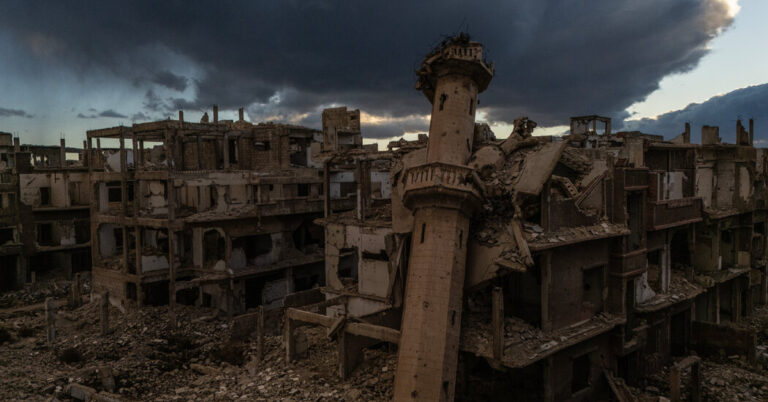
The challenges ahead are clear in the neighborhoods beyond the city center that combat reduced to vast expanses of shattered concrete. These ominously quiet areas used to be home to millions of shopkeepers, teachers, mechanics, students, civil servants and others. Now, those residents are scattered elsewhere in Syria or beyond its borders, unable to easily return because their homes are gone.
Some families survive in these ruins.
“We live like cave people,” said Fidaa al-Eissa, a mother of four in the neighborhood of Qaboun.
The family’s damaged apartment building stood next to others that had been flattened. It received two hours of electricity per day, which Ms. al-Eissa used to charge her computer and phone, run the washing machine, make tea and heat bath water.
She kept in touch with former neighbors, refugees in Jordan, Turkey and Germany, and tried to convince them to come home.
“I want there to be life here again,” she said.
The state, too, largely collapsed during the war, its ability to provide services hollowed out by violence, corruption and poverty. Damascus is the focus of efforts by Syria’s president, Ahmed al-Shara, to build an administration that can put the country back together and ensure water, electricity and security.
One morning, hundreds of newly trained officers in crisp blue uniforms lined up outside the Damascus Police College for graduation. They had finished a 10-day course aimed at bolstering the force’s ranks with basic training on how to handle guns and criminals. It also included religious lessons, reflecting the Islamist orientation of Mr. al-Shara’s government.
The ceremony was laced with Islamic language, and large banners atop the college had been repainted, one with a verse from the Quran, another with the Muslim declaration of faith, “There is no God but God and Muhammad is his prophet.”
When we asked whether members of Syria’s other religious groups would join a force whose symbols were so Islamic, a lead trainer, Maawiya al-Khatib, did not understand why not.
“These are simple slogans,” he said. “It’s a normal thing.”
The Islamist background of Mr. al-Shara has left many Syrians worried about how he could change the country and their place in it.
We got a glimpse of these concerns at a new play in Damascus that a friend told us about. At a local theater with buckets in the hallway to catch dripping water, we watched “The Life of Basel Anis,” a dark comedy about a shipwreck survivor who loses a leg to a shark only to find himself preyed upon by the very people who are supposed to help.
The audience laughed throughout, sympathizing with the wounded hero and how much of his life was beyond his control. Backstage, the cast members said they strove to keep the arts alive, but some worried that the new government would impose constraints.
One actor, Sedra Jabakhanji, said she feared the authorities would segregate unmarried men and women or force women to cover their hair.
The original script, the cast said, had poked fun at Mr. al-Shara by quoting a line from one of his speeches. They cut it to avoid problems.
“There are still people who aren’t convinced that the regime fell,” said Anwar al-Qassar, the assistant director. “It takes time to get rid of that phobia.”
The war shredded Syria’s social fabric, pitting neighbor against neighbor.
The regime granted vast privileges to the favored from Mr. al-Assad’s own sect, while oppressing other groups.
After a two-hour drive from Damascus to Homs on the eighth day of our trip, we found former enemies trying to live together.
Homs
The Vanquished
Along a boulevard in Homs, hundreds of cold, nervous men stood in long lines outside a police station, hoping to find a place for themselves in the new Syria.
They had all served in Mr. al-Assad’s military or security services, so when he lost the war, they did too. They were purged from their jobs and surrendered their weapons. Now, they were waiting for hours to receive civilian ID cards.
Stripped of their former privileges and power, they hung their heads and said little as the lines inched forward. The masked rebels-turned-police who controlled the city walked among them, hands on their guns.
The scene reflects one of Syria’s knottiest challenges, as the state grapples with how to deal with those who fought for Mr. al-Assad, many of them Alawites, the same religious minority as the ousted president.
We spent time in Homs to see how people were adapting, because the city’s sectarian mix had made the fighting there particularly personal. Alawite districts loyal to the regime had battled their Sunni Muslim neighbors, who supported the rebels.
We found an unlikely pair of men working together: a muscled former rebel in camouflage and face mask and an Alawite neighborhood leader with a scarf twisted around his head to ward off the cold.
The two men had been on opposite sides of the war and showed no affinity toward each other. But they both wanted their city to recover.
The former rebel gave his nom de guerre, Abu Hajar, and said the regime had exiled him and his comrades from Homs during the war. Now he was 32 years old, back home and in charge.
The government should punish those who killed innocent people, he said, but all of the Alawites could not be blamed for the regime’s violence. “We were against Bashar the dictator, not against his sect,” he said.
His counterpart was Mustafa Aboud, a 58-year-old neighborhood leader and barber on whom other Alawites counted to deal with the new authorities.
The Alawites had suffered, too, Mr. Aboud said, their communities besieged and shelled, their relatives kidnapped. About 2,000 people from his neighborhood alone had been killed in the war, including soldiers, civilians and his own mother, by a rebel car bomb.
The purge of the former regime’s forces had created a crisis in his Alawite neighborhood of Al-Zahra. Families lost their incomes, and residents feared they would be kidnapped or killed if they left the area to look for work.
“If they take me away, I have no one to ask about me, to pay money to get me out,” said one former soldier who declined to give his name for fear of retribution. “I have nothing.”
Mr. al-Shara has called for unity among Syria’s sects, but rights groups have reported regular killings of Alawites. In March, after deadly attacks on the new government’s security forces, armed men rampaged through Syria’s Alawite heartland, killing an estimated 1,600 people.
Hundreds of men from Mr. Aboud’s neighborhood had gathered that morning to get their new IDs together. They had been scared to leave their community, so Mr. Aboud had organized buses and security with Abu Hajar.
In interviews, the men said they had been in Mr. al-Assad’s army, but as guards, cooks or administrators. None admitted having fought.
“I distributed vegetables,” one said, adding that most soldiers never had a choice.
“Even if I had fired shells, the order was not in my hands,” he said.
Mr. Aboud acknowledged that his fellow Alawites feared for the future but said they had to accept Syria’s new reality.
“This situation was imposed on us, so I tell them that we have to live with it and not deceive ourselves,” he said. “It is not about settling scores. It is about the future and how to feed our families.”
Telmanes
The Village With No Roofs
Twelve days into our trip, we diverted from the main highway to see what life was like in a rural area. I expected the villages to have fared better in the war since they had fewer spoils to offer than big cities did. I was wrong.
Our route took us through a succession of towns and hamlets torn apart by shelling and airstrikes and picked apart by pillagers — or both.
Some residents endured in what remained. Men herded sheep near shops smashed to rubble. Women hung laundry near walls with giant holes. Night fell and entire communities went dark.
One of our drivers mentioned a nearby village where “they stole all the roofs.” So the next morning we drove to Telmanes, where we met Abdel-Rahman Hamadi, 38. He had returned home after the war to find that scavengers had hammered in his reinforced concrete roof and stolen the rebar to sell for scrap.
“The dogs climbed up on the roof to steal the metal!” he said.
He had no money for repairs, so he had covered one room with plastic for his family to sleep in. “There are 20 villages around here that are destroyed like this,” he said.
That is likely an undercount. Across Syria, destructive battles often led to industrial-scale pillaging of homes, businesses, power stations and other facilities.
The country needs vast rebuilding projects to recover, but it remains unclear who might pay for them. The United Nations says half of Syria’s infrastructure no longer works and reconstruction is expected to cost hundreds of billions of dollars, many times the country’s annual economic output of $29 billion.
The scale of the plundering in Telmanes, a stretch of cinder-block homes surrounded by farmland and orchards, was mind-boggling.
Residents said the army expelled them and took over the village in 2019. Then, on the military’s watch, work crews descended like locusts, stripping the community clean with hammers, saws and bolt cutters.
They hauled off furniture and appliances. They popped tiles off bathroom walls. They tore out electrical wires, sinks, faucets and pipes.
They pulled down power lines and yanked internet cables from the ground. They stole manhole covers — and the ladders inside the manholes. When the obvious spoils were gone, they knocked in the roofs to steal the rebar.
Osama Ismael, the head of the local council, said that only a few hundred of the village’s 5,100 houses and six of its 13 mosques still had roofs.
Less than one-tenth of the prewar population of 28,000 had returned since the war ended and he wasn’t sure when the rest would. “We want people to come back, but there is no water,” he said.
Nor was there a pharmacy, a clinic, a bakery or reliable internet or phone service.
One of the village’s 14 schools had reopened, which had been enough to convince the extended Aboud family to come home.
They stayed together in a house with three rooms, a veranda, a kitchen and a bathroom. All the roofs were gone, so they had covered two rooms with plastic and erected a tent in the yard, where Khadija al-Omar, 30, slept with her husband and three children.
“We have no choice but to live here,” she said.
Life was hard, said Aboud al-Aboud, a relative who teaches at the school.
The family trucked in water to fill a metal tank. They salvaged wood for fires and cooked on an electric stove powered by 12 solar panels lined up across the yard.
“Usually we would put them on the roof,” Mr. al-Aboud said with a shrug. “But since there is no roof….”
The war devastated businesses in Syria’s largest city, Aleppo, once also its economic engine.
Its historic center lies in ruins, where stray dogs outnumber merchants in old stone souks.
As in the rest of the country, the momentous task of rebuilding the economy is just beginning.
Aleppo
The Ravaged Economy
“Aleppo is the nerve center of Syria,” said Khalid Tahhan, the owner of a metal-smelting workshop who said he barely turns a profit. “Aleppo is a disaster zone.”
Before the war, Aleppo boasted a wealth of historic mosques, churches and caravansaries, ringing a towering citadel that drew tourists from around the world. It was a commercial hub, humming with factories that provided jobs and produced textiles, food products and other goods.
I never made it to Aleppo before the war. I first visited in 2012 with rebels who had taken over outlying neighborhoods. Instead of the sights, I saw choppers transporting soldiers and fighter jets dropping bombs.
The fighting chewed through the city over many years, a violent collision of rebels, the Islamic State, government forces and the Russian military. By the time I returned to Aleppo with my colleagues this year, only remnants of its past remained. Tourists are rare, and a small fraction of the industrial zone still functions, mere leftovers of a once-vaunted economy.
Syria faces tremendous hurdles to get its economy running. Hobbled for years by sanctions that are just beginning to ease, the country has been isolated from global trade, causing economic atrophy.
Per capita gross domestic product is one-quarter of what it was before the war. At Syria’s current growth rate, it won’t recoup its losses until 2080, the United Nations says.
Some businesspeople are working to recover.
Inside the Bahhade Furniture factory in the industrial zone, dozens of craftsmen hand-carved patterns into the backs of couches and stapled foam pads onto seats.
Jack Bahhade, a co-owner, said that before the war the family business had employed 40 people and exported to the United States, Britain, Russia and elsewhere.
In 2012, the factory was taken over by rebels from the Nusra Front, the affiliate of Al Qaeda founded by Syria’s new president. While the family operated out of an alternate facility, their original factory was looted. They were trying to rebuild the business when Mr. al-Assad fell.
Production is about 30 percent of what it was before the war. Demand is low and financial transactions are limited because Syrian banks lack cash.
When asked about Mr. al-Shara, Mr. Bahhade laughed, noting that despite the president’s extremist past, he had been welcomed by foreign officials and heads of state.
“If these countries accept him, why shouldn’t we?” he said.
If conditions improved, Mr. Bahhade said, Aleppo’s businesspeople would bounce back.
“If there is security and stability here, everything will go back to the way it was,” he said.
Atmeh
A New Beginning
At the end of our trip, we drove to a refugee camp along the Turkish border in the far north, on the opposite side of Syria from where we began. The camp had spread over the years as it absorbed people with nowhere else to go. Now, suddenly, those people could leave.
In a dirt lane in front of a drab house, we found Khalid al-Hajj, a father of six, piling his meager possessions onto the back of a truck.
After surviving on aid and odd jobs in the camp for 13 years, he didn’t have much: thin mattresses, fuzzy blankets, pots, pans, a rusty dish rack, a gas stove and some firewood.
But he felt good. The war was over and he was going home.
“I was always convinced that I would return,” said Mr. al-Hajj, 53.
His family had fled their hometown, Kafr Zeita, 80 miles to the south, in 2012. Like millions of others, they came to Syria’s rebel-controlled northwest, and they settled in the camp.
It was crowded and poor, a sprawl of concrete structures with few trees or paved roads. At first, the extended family of 11 slept in a tent. Over time, they scraped together the money to build three small rooms.
Missing village life, Mr. al-Hajj planted a rose bush and kept two songbirds in a cage.
A few years ago, he said, a surprising dash of beauty appeared — a green shoot next to the rose bush. Mr. al-Hajj snipped off a piece and its smell gave it away as a peach tree. Pleased, he tended to it as the war, and his time in the camp, dragged on.
His eldest son was killed by a government shell. He had another son, then another daughter, and his adult children bore him three grandchildren. The peach tree grew taller than him.
After the regime fell, he decided to return to his village, to fix up and live in his damaged home.
As he cleaned out his house in the camp, the pile in the back of the truck grew: metal window frames, solar panels and a ceiling fan. He climbed on top to tie everything down.
When it was time to leave, he expressed no nostalgia for the place where he had lived for so many years.
“We will take all of our stuff and leave it behind,” he said.
But first, he stood before the peach tree. It was eight feet tall and the first pink buds of spring had appeared on its branches. Perhaps this year, he said, it would produce fruit, although he would not be there to taste it.
“We hope that it grows so that whoever comes here can eat from it,” he said.
He caressed a branch with his fingers. “May God protect you,” he said.
Prior to the championships we examined the turnover in the finals of each Trials/U.S. Nationals since 2013. With several stars sitting out this year after the shortened Olympic Cycle between Tokyo and Paris it was expected that there would be new faces in the top eight of a lot of events in 2025, and that did prove to be the case.
We’re looking at only Olympic events here, so this is a straight comparison to 2024.
NB. The 800 and 1500 were run as timed finals this year in contrast to the heats-and-finals setup last year. When we refer to 2025 finalists in these events we’re talking about the top-eight finishers, even though some came from the early heats.
The Methodology
To compare the continuity of Trials finals, we have devised a Finals Continuity Score. Each swimmer in a Trials final receives a score based on their finishing position in that event. At the next Trials, we add up the scores of the returning swimmers and divide by the maximum possible score (all swimmers returning).
Example:
2021 Women’s 200 IM
Alex Walsh- 8 points
Kate Douglass- 7 points
Madisyn Cox – 6 points
Torri Huske – 5 points
Meghan Small – 4 points
Melanie Margalis- 3 points
Beata Nelson- 2 points
Emma Barksdale – 1 point
2022 Women’s 200 IM
Alex Walsh – 8 returning points
Leah Hayes – NEW
Beata Nelson – 2 returning points
Mackenzie Looze – NEW
Isabelle Odgers – NEW
Sara Stotler – NEW
Abby Hay – NEW
Teagan O’Dell – NEW
Total returning points: 10
Maximum possible returning points: 36
Final Continuity Score – 0.278 (10/36)
Note that this methodology does not look at why a swimmer does not return – someone missing the final in 9th is treated the same way as a swimmer who did not enter the event, such as Kate Douglass in the example above.
How did 2025 fare?
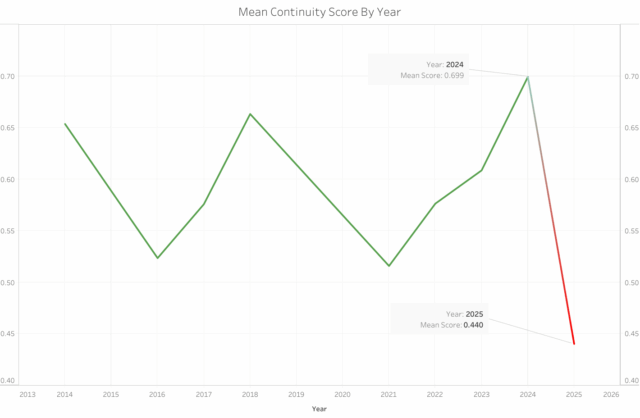
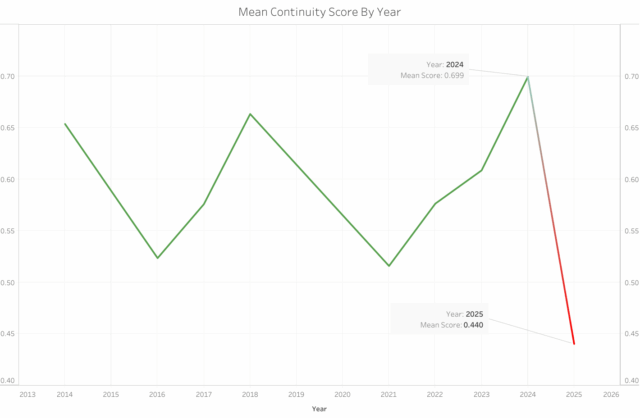
The men saw their biggest turnover of finalists in over a decade, with an average continuity score of less than 0.50 – nearly 20% less than the previous lowest in 2021. This was also a huge drop in returning finalists compared to last year, caused both by big names sitting out (Ryan Murphy, Caeleb Dressel, Hunter Armstrong) and others missing finals they were expected to be in (Brooks Curry, Matt King).
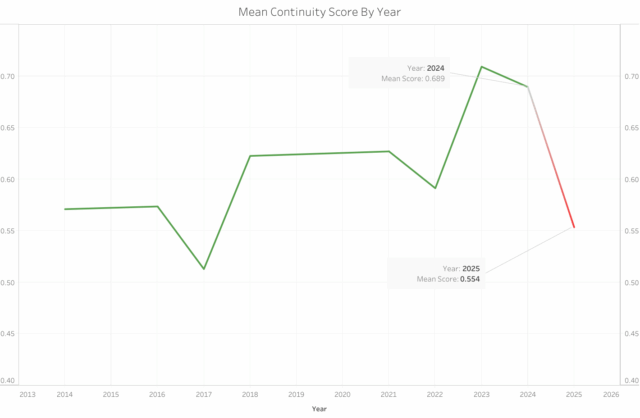
The women fared slightly better, only dropping to 0.554, however that is still the lowest since 2017. Most of the big names returned, which was reflected in the size of the World’s squad; 20 different women hit one of the four World Championship priorities compared to 27 men.
By Event
Outside of breaststroke, the 200s were the most continuous distance at this year’s Championships. The 200 IM saw five of the eight finalists from Olympic Trials return including all of the top three, joint most of any event along with the 200 fly.
Despite the comparatively high score for the 200 free, only three finalists returned; Luke Hobson (1st in 2024), Chris Guiliano (2nd) and Kieran Smith (4th). That’s one fewer than the 100 backstroke (Jack Aikins, Will Modglin, Jack Wilkening, Tommy Janton), where three of the four returners finished 6th-8th last year.
Half of the events had only two returning finalists from 2024 – that was every event from the 1500 downwards, excluding the 100 back.
The scores were much higher for the women, which saw only three events (200 breast, 1500 free, 400 free) have two returners compared to the seven the men had. Backstroke was the highest scoring stroke with both distances in the top two, each with six returning swimmers.
Katie Ledecky ensured a level of consistency in the 400 and 1500 free, with only a single swimmer returning other than her: Kate Hurst in the 1500 and Madi Mintenko in the 400. Interestingly, both of those finished in the same position in both 2024 and 2025, fourth for Hurst and eighth for Mintenko.
At least half the finalists returned for nine of 14 events, with 10 events scoring at least 0.50. The 100 free was the highest scoring event with only exactly half the final to return – those were last year’s top four of Kate Douglass, Torri Huske, Gretchen Walsh and Simone Manuel, who took the top four spots once again in 2025, albeit in a different order.
In the mid-20th century, the Thames was declared a biologically dead river. Although it has now been regenerated through various remediation measures, it’s an example of the sad fate of many rivers as they pass through large cities. Even today, despite all the solutions implemented, few people would venture to take a swim in it. However, New York intends to allow its inhabitants to take a dip in the East River —synonymous with pollution, industrial barges and grey landscapes— without taking any risks. The key lies in +POOL, a project more than a decade in the making that will place a floating pool in the middle of the waterway.
A cross-shaped design
The first thing that is striking about this structure is its cross shape, or “+” symbol due to its functionality. Each of its arms will be dedicated to a different use: a children’s area, an area for sports training, a relaxation space and an open area for recreational activities. The result of adding these four arms together is a large swimming pool of 800 square metres with a capacity for hundreds of bathers.
Beyond iconic design, +POOL seeks to democratise access to water in an urban environment. It is part of the NY SWIMS plan, an initiative that aims to create new public swimming facilities, with a special focus on historically underserved communities. According to its promoters, it is the largest public investment in aquatic facilities since the 1930s.
Advanced filtering technologies
But the key to +POOL lies not so much in its shape as in its passive filtration system that makes it a sustainable pool. The water flowing through the East River enters directly through the floating structure and passes through a set of highly efficient membranes that eliminate solid waste, bacteria and pollutants without the need for chlorine or other chemical additives. This is supplemented by an ultraviolet light treatment stage that ensures final disinfection.
This process will filter almost four million litres per day, which not only supplies the pool, but also contributes to returning cleaner water to the environment. In the event of heavy rainfall or pollution episodes, the system is automatically stopped by sensors that monitor the water quality in real time.
An infrastructure that moves by sea
Another curious aspect of this project is the approach used in its construction. The ship-like pool is being built at the Bollinger shipyard in Pascagoula (Mississippi). The first 185 m² rectangular module, which will serve as a pilot for the project, has been completed there. The structure will then be towed by sea to a pier on the Lower East Side. The journey is expected to take more than three weeks along Florida and the Atlantic coast.
Once at its destination, the module will undergo technical and hydrodynamic tests. If the results are positive, progress will be made towards the definitive installation of the complete pool. The project promoters estimate that the structure will be operational during the summer of 2026.
A swimming pool with environmental and social benefits
In addition to providing a safe place to swim and purify the river water, this floating pool will serve as an educational platform. It is planned to host activities for school children, environmental monitoring training programmes and workshops on urban ecology.
Although the project is a pioneering initiative in New York, its promoters have already announced their desire to replicate it in other cities. Perhaps in the coming years cities such as Tokyo or London will benefit from a system that combines floating infrastructure and passive filtration with a focus on urban regeneration.
From renders to reality
The road to this point has not been an easy one. Since its initial conception in 2010, the project has gone through several phases of technical validation, prototyping and the search for funding. In parallel, it has managed to attract the attention of institutions such as the New York City Council, which has earmarked nearly sixteen million dollars for its development.
If the pilot module tests are successful, +POOL could become an icon of sustainable urbanism. Not only for its ability to clean water, but for its value as a catalyst for a more liveable and resilient city.
Initiatives such as this pool are in addition to other works such as these refrigerated canopies powered by renewable energy that we talked about some time ago. The aim is the same: to tackle the challenges of climate change and pollution through technological and social innovation.
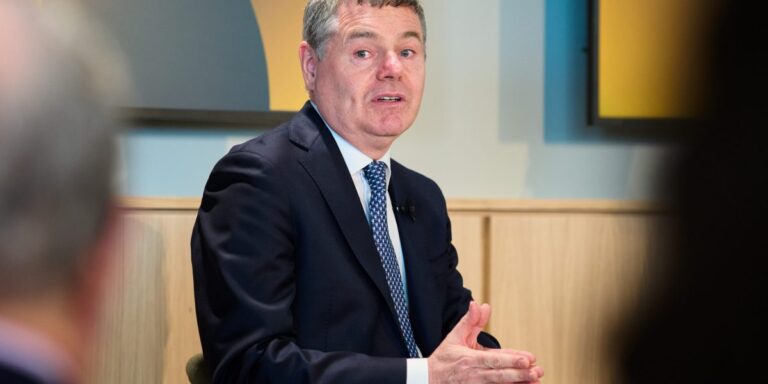
Irish Finance Minister Paschal Donohoe said US pharmaceutical tariffs would cost the economy thousands of jobs and that his focus is on maintaining competitiveness to protect the country’s long-term success
Ireland is running a strong fiscal position with a huge budget surplus thanks to corporate tax income from US multinationals such as Apple Inc. and Pfizer Inc. Speaking on Monday at Bloomberg’s Future of Finance in Ireland event in Dublin, Donohoe said that the government must use that surplus with an eye on the longer term.
That’s particularly that case as tariff uncertainty and a global slowdown mean that a large chunk of that tax revenue is at risk. The government is likely to have tighten the purse strings this year — a stark contrast to last year’s budget, which was littered with one-off giveaways for taxpayers.
Pharmaceutical tariffs, if imposed by President Donald Trump, are a key concern. They could cost around 75,000 pharma jobs in Ireland, Donohoe warned.
“I will make every effort possible to protect and prioritize capital investment,” Donohoe said, arguing that cuts carry a long-term cost for the economy, businesses and jobs.
“One of my deep lessons from the aftermath of the global financial crisis is, when capital investment is decreased, the costs mount up in the future,” he said. “If our growth outlook does change, we will use our fiscal position to try to maintain and support capital investment and do all we can to avoid cutting it back again.”
The US administration has repeatedly singled out the Irish model, with Commerce Secretary Howard Lutnick saying Ireland runs a surplus at America’s expense. Trump even raised the matter with Irish Prime Minister Micheal Martin at a St Patrick’s Day White House reception.
British government will use antiterrorism laws to ban campaign organisation in the wake of damage to planes by activists.
The British government has said it will deploy antiterrorism laws to ban Palestine Action, a prominent campaign organisation that has protested against Israel’s genocidal war in Gaza and the United Kingdom’s role in supporting it, in the wake of its activists damaging two military planes.
Protesters clashed with police in London’s Trafalgar Square on Monday at a demonstration in solidarity with Palestine Action. The crowd moved towards police when officers tried to detain someone, while protesters chanted “let them go”.
The government’s move will make it a criminal offence to belong to the pro-Palestinian group and effectively place them in the same category as Hamas, Hezbollah, al-Qaeda or ISIL (ISIS) under British law.
It would be illegal for anyone to promote Palestine Action or be a member. Those who breach the ban could face up to 14 years in prison.
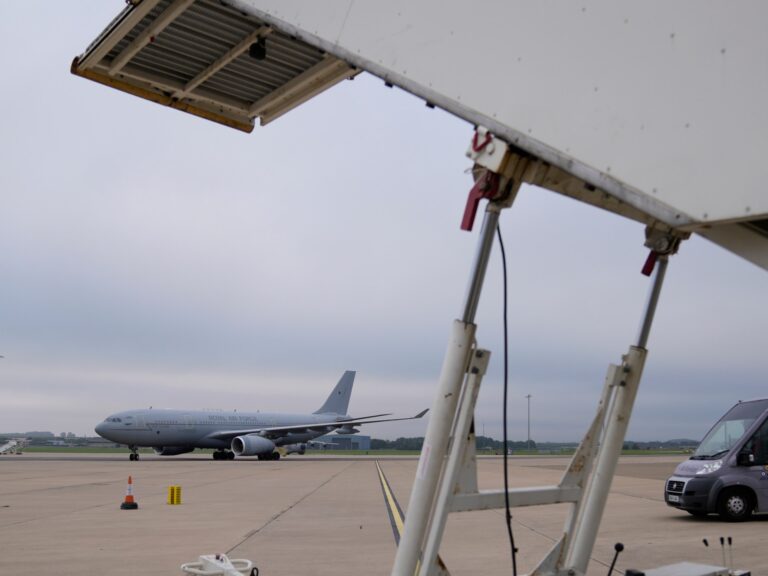
Activists from the group broke into a Royal Air Force (RAF) base in central England last week and claimed to have damaged two military aircraft to protest against the UK government’s support for Israel’s war on Gaza.
Palestine Action said two of its members entered the RAF Brize Norton military base in Oxfordshire, spraying paint into the engines of the Voyager aircraft and attacking them with crowbars.
“Despite publicly condemning the Israeli government, Britain continues to send military cargo, fly spy planes over Gaza and refuel U.S./Israeli fighter jets,” the group said in a statement on Friday, posting a video of the incident on X.
The group said the red paint “symbolising Palestinian bloodshed was also sprayed across the runway and a Palestine flag was left on the scene”.
It said the activists were able to exit the military facility undetected and avoid arrest.
UK Prime Minister Keir Starmer condemned the “vandalism” as “disgraceful”.
There has been condemnation of the government’s move on Monday. Labour Party MP Apsana Begum said: “Proscribing Palestine Action as ‘terrorists’ while continuing to send arms to a state that is committing the gravest of crimes against humanity in Gaza is not just unjustifiable, it is chilling. The ongoing crackdown on the right to protest is a threat to us all.”
Palestine Action called the police response to the solidarity protest “draconian”.
Draconian response by the police at the protest in solidarity with Palestine Action.
They want to ban us, they banned our protest at parliament and now they attack us.
Weekly protests in the UK have drawn tens of thousands of people opposed to Israel’s war on Gaza and its besieged and bombarded population, as well as Britain’s supply of weapons to the Israeli military, which the government says it has suspended but still continues.
NGO Campaign Against Arms Trade (CAAT) found the UK increased its licences to Israel for military equipment after the government announced a temporary arms suspension in September 2024.
The government also refused to suspend the shipment of components of F-35 fighters, arguing it would cause a “profound impact on international peace and security”.