5.2 C
New York
Friday, April 3, 2026
Home Blog Page 631

Leading in the Age of Automation: Embracing Humanity in a World of Machines

0

Mark Minevich is the president of Going Global Ventures and a strategic partner at Mayfield Venture Capital.

Computers now can write code, assess markets, prepare marketing campaigns, and carry out negotiation. As a leader, you must begin to ask yourself, where will we be when all of our people are no longer needed? Computers powered by AI can do nearly every task needed to run the technical aspect of an organization. Some in the field are sounding the alarm on potentially catastrophic effects to the labor market. Anthropic CEO Dario Amodei recently warned that AI tools could eliminate half of entry-level, white-collar jobs and spike unemployment to as much as 20%.

But there is one indispensable thing machines can never do: Be human. 

The future of leadership will be the result of working through this paradox.

Advances in hybrid intelligence

We are entering a time where machines and humans can join forces and work as one—aka hybrid intelligence. AI is being used as a tool by humans everywhere to enhance their abilities and productivity. Unfortunately, the fact that AI is primarily a tool and not a replacement for humans is not always well understood by the general public, or the workforce.

Simply putting artificial intelligence into a system isn’t enough for hybrid intelligence. How that AI is integrated is the crucial part. AI agents are not only used at the final stage of decisions, but they also partner with teams and sometimes even decide things by themselves. Because of this change, managers have to rethink their roles and how they control, supervise, and produce value.

Simply managing workflows is not enough for you to be a true leader anymore. Leadership in 2025 and beyond requires fitting humans, who supply feelings and ethics, together with technology that enhances the speed, reach, and uniformity of processes. 

The human responsibilities in this era are not just crucial to the use of AI, they are the main ingredient to AI’s existence.

How to manage when AI rules the world

Last year, private investment in AI reached nearly $110 billion in the U.S. As AI agents quickly wrestle work away from us humans, how does management respond and truly lead? To lead organizations in the future, executives need to change how their org charts are written and begin focusing on human skills rather than divisions and ranks. 

Always consider what only humans can do:

  • Emotions and political skills require better understanding of people. AI falls short here.
  • Strategic creativity is needed since innovation does not happen in a single direction. Only humans can make up the rules for games, rather than only focus on playing it faster.
  • Visionary leaders work on coming up with stories, judging ethical issues, building trust with all parties, and planning for various threats.

Some organizations are choosing to build teams now based on personal qualities. What does the human bring that is unique? Are they open-minded enough to use AI instead of deeming it a threat? Are they experienced with the technology and do they see it as an advantage rather than a personal detriment? These are the questions leaders of this new reality will continually ask.

Traditional leadership is becoming increasingly irrelevant 

Middle management teams are being slowly removed in many organizations as more and more work can be automated and less human hours are needed. I am not talking about this happening over the course of the next five years—I mean now. So, your methods of leading and coaching these types of teams are no longer needed.

But not all the needs for humans will disappear. Leaders must figure out, in their specific business, what human skills are most relevant to the success of the company. Identify the employees in your business who possess these skills or are agile enough to be coached up. These are the workers you focus your coaching and development skills on. 

Then, leaders must sell this approach, in essence, to all the major stakeholders in their business. This ensures that stakeholder confidence in the business is strong and well-maintained. Part of this sell is informing stakeholders that what you are keeping your human workforce for is to find better ways to think about a problem, rather than simply finding the fastest answers.

Can your culture keep up with technology? 

Technologically everything moves at an ever-increasing pace. Culture in leadership is always much slower. While the worldwide move to automation is happening now, the majority of C-suites are sticking to ideas from the 20th century.

We already see that up to 99% of Fortune 500 companies use automation in hiring and resume screening and that AI is being used in sales and marketing, as well as in nearly every other part of work as we know it. So, leaders must adapt their approach. 

A large part of leading and coaching in the future will be showing your teams the ways in which AI is being deployed to their benefit, not as their replacement. You will need to let them behind the scenes as you create and implement new automations. You need to show them not only how this AI will work, but also why it is being used to their and the company’s benefit. 

Who the new leader needs to be

In order to succeed in this new environment, leaders must be the director of societal ethics in their company. They must decide what is an ethical use of AI and when they are about to cross the line of pushing for pure profit at any human cost. 

They must paint the picture for their teams of the full AI vision and make that picture related to every employee they want to keep in the fold. 

They must also lead to create—or allow space for their teams to create—innovative approaches that make machine operations meaningful for people. They have to then be the orchestrators and bring people, platforms, and processes together without just sticking to antiquated organizational charts.

With less middle management, there is less delegation. Leaders must be the ones with the soft skills to work across divides. Whether those divides be cross functional, age gaps, or personality differences, leaders must speak all of these languages to get their teams working together. This allows them to foster quick and steady solutions.

The humanity dividend

Machines will keep getting better—there is no slowing that train. They will handle writing, building, forecasting budgets, and giving advice. Leaders earn the greatest advantage by having qualities that machines do not: judgment, empathy, and imagination.

In this era of AI, leadership means judging situations rather than controlling them. It means standing firm and seeing clearly, and being able to see all potential outcomes and how they affect your people, because AI will not know the best path for humans. That is your job, to make the decisions that benefit the most important part of your business: your people. 

The opinions expressed in Fortune.com commentary pieces are solely the views of their authors and do not necessarily reflect the opinions and beliefs of Fortune.

Read more:

Cable theft causes severe delays for Eurostar passengers

0

Eurostar passengers are facing a second day of severe delays after two people died on the railway track in France and then cables were stolen.

The high-speed rail operators says repairs are complete and the railway line is open again, but delays will last until the end of the day.

Eurostar said passengers should postpone their journey, after the disruption saw services cancelled and delayed in both directions on lines connecting London with Paris, Brussels and Amsterdam.

Eurostar said there was already knock-on disruption on Wednesday after two people died in separate incidents on the LGV Nord line on Tuesday, but services were further impacted after cable was stolen on the same line.

The theft near Lille, which French media said was of around 600 metres of copper cables, caused trains to be rerouted, leading to extended journey times.

Further cancellations are not expected on Wednesday now that the railway line is repaired.

Eurostar said that so far, five trains between London and Paris have been cancelled.

It added that impacted passengers can change their travel plans for free or request a full refund.

“We’re very sorry for the impact this is having on our customers,” Eurostar said in a statement.

“Our teams are working closely with the French authorities and infrastructure teams to manage the situation and restore services safely.”

The operator earlier said one track had reopened, allowing some trains to run in both directions until full repairs were completed.

Water is being handed out to passengers onboard delayed trains, and stations are also very busy.

Hundreds of people are queuing at London’s St Pancras International railway station trying to access the service centre to rebook onto other trains.

Elizabeth Romijn, a yoga teacher from the Netherlands, told PA news agency at St Pancras that the situation was “very chaotic” and people were having to sit on the ground because there were not enough chairs.

The 75-year-old was planning to travel home to Brussels after visiting friends in Surrey.

“My plan is to just wait. Maybe I should go and be more proactive and go to ask one of the staff but nobody seems to know anything,” she said, adding that “it’s quite horrible long queues.”

The railway line in France was closed for much of the afternoon and evening on Tuesday after the two fatalities between Lille and Paris.

Services were cancelled on routes to and from Paris while trains between London, Brussels and Amsterdam ran with delays.

Eurostar said disruption continued into Wednesday as trains and crew were displaced.

K-pop agencies, including HYBE and SM Entertainment, agree to subcontract reforms following FTC investigation

0

Five major entertainment companies in South Korea, including K-pop giants SM Entertainment and HYBE, have reached an agreement with the market’s Fair Trade Commission over alleged subcontracting violations.

The resolution marks the first time a consent resolution system was applied to the manufacturing and service subcontracting sector since the system was introduced in July 2022, the South Korean FTC said in a notice on Tuesday (June 24).

The FTC’s consent resolution system allows companies under investigation to propose voluntary corrective measures instead of facing violations.

The resolutions were finalized with HYBE, SM Entertainment, YG Entertainment, JYP Entertainment and Starship Entertainment after the companies applied for the consent procedure between April and May 2024, with the commission approving the process in December.

It follows an investigation by the FTC, launched in July 2023, which examined whether companies violated subcontracting laws by failing to issue written contracts in advance when outsourcing production of music records, merchandise like light sticks and dolls, video content, and performance services including stage composition, lighting installation and sound equipment operations.

South Korea’s Subcontracting Transaction Fairness Act requires companies to provide written contracts containing statutory information before work begins, the FTC said.

Under the settlement finalized on June 9, each company will contribute KRW 200 million ($147 million) to create a KRW 1 billion ($736m) mutual cooperation fund, instead of paying fines to the government over their violations.

The fund will provide practical assistance to suppliers. Each companies have outlined specific support programs ranging from health checkup subsidies, safety equipment purchases, to educational course vouchers.

HYBE, the agency behind BTS, has allocated KRW 100 million ($73,600) over the next three years to support protective equipment purchases for its suppliers. It has also earmarked another KRW 100 million to provide assistance with purchasing consumables for video production such as memory cards and batteries.

SM Entertainment, home to groups like aespa and NCT, will set aside KRW 50 million ($36,800) for health checkup expenses or holiday gifts for employees of suppliers. It also earmarked KRW 50 million for video editing programs and support for suppliers’ filming equipment.

Before finalizing the agreements with the five K-pop companies, the FTC collected opinions from stakeholders including the Ministry of Culture, Sports and Tourism and Ministry of SMEs and Startups during a 49-day review period from February to March 2025.

Key reforms include provisional contracts that can be converted to formal contracts, establishing an electronic contract system, enhancing in-house contract management system and improving education on subcontracting laws.

The regulatory action comes as the K-pop economy continues to grow at home and overseas. In 2023, the K-pop market achieved overseas sales of KRW 1.24 trillion ($914m), according to data from Statista. Of the total, 47.6% came from overseas performances, while 31% were from overseas album sales.

K-pop companies have pursued aggressive expansion strategies overseas. Less than a month ago, HYBE officially launched a subsidiary in China, the world’s fifth-largest recorded music market. The news follows another report by South Korean news agency Yonhap last month that HYBE is also planning to establish an office in Mumbai, India.

SM Entertainment, meanwhile, set up a Southeast Asian headquarters in Singapore in late 2022. Back in March, the company announced that it would launch a training academy for K-pop hopefuls in the city-state.

Music Business Worldwide

Introducing New Metrics for Assessing Passing in the NBA Draft

0

No part of basketball captivates me like beautiful passing does. Possibly reflective of my basketball strengths and weaknesses, I’ve always felt partial to brilliant players with a sixth sense for playmaking. Hours of watching Jason Williams, Steve Nash and Chris Paul passing highlights growing up led me to my most ambitious scouting project to date.

Passing is a critical component of basketball scouting, yet there’s a lack of depth in traditional evaluation of playmaking. Basic passing analysis starts and ends with assist and turnover counts. Even more ‘advanced’ passing stats like assist-to-turnover ratio, assist rate and passing-by-playtype link back to the box score.

Problems surrounding passing evaluation center around one idea — not all assists (and turnovers) are equal, though the box score views them as such. Though raw assist totals point in the direction of the best passers in a given class, there’s so much more to passing than the outcome of the possession.

Take this assist from Cooper Flagg — screening action between Kon Knueppel and Sion James springs James wide open downhill. Flagg simply has to pass the ball forward to a wide-open target who finishes the play:

Compare the play above, which added one assist to Flagg’s total, to this play, which is my personal favorite pass of the 2025 cycle. Flagg drives baseline, twists in midair under heavy pressure and kicks it out for a wide-open three and an assist in the box score:

The first clip presented a fairly basic pass. Flagg had to read the action unfolding and pass over a defender, but most NBA-caliber players comfortably convert that pass. The second clip, worth the same box score value as the first, demonstrates high-level vision, creativity and spatial awareness from Flagg, as well as an ability to pass under pressure.

This basic example underscores the need for more detailed analysis when projecting plamymaking. In pursuit of a deeper understanding of the passers in this draft, I set out to watch an ungodly amount of passes, hand-tracking different passing features to better describe true passing talent.

Football stats inspired this project, as I always envied the depth and diversity of metrics and insights about the game described quantitatively. I mirrored some of what Pro Football Focus attempts to achieve with their passing metrics, subjectively evaluating a quarterback’s ball placement, anticipation, arm strength and pocket presence, all important football traits that basic stats struggle to capture.

It would be impossible for one person to watch every second of every prospect’s season and log every single pass. To best approximate a player’s passing totals, I watched all of their assists, turnovers and pick-and-roll/isolation/post-up passes that didn’t lead to assists on Synergy. This process was inherently imperfect, notably missing blown potential assists in transition and on other playtypes not mentioned before. It still encompassed a fairly large sample of passes for quite a few prospects.

Across the last eight months, I watched hours of passing clips, charting 4,982 passes for 28 different prospects, logging information on each pass to create 10 different ‘metrics,’ each aiming to capture a different aspect of passing.

(In quotations, as these aren’t truly statistical metrics in the traditional sense, rather a quantitative expression of my subjective experience. I’ll use the word ‘metric’ throughout the piece to refer to these stats as a shorthand, but these aren’t trying to replace true numerical measures.)

Here are the 10 main metrics I aimed to log and create, explained:

Passing Chances

Each clip I charted added a single ‘passing chance’ to a player’s total. Passing chances include logged assists, passes that led to potential shots but didn’t result in points and turnovers resulting from passing. This number, adjusted per 40 minutes to normalize for playing time, can help us visualize the highest volume playmakers in the class.

Potential Assists

Potential assists in this case can be viewed as passing chances without including passing turnovers. This metric also helps illustrate the highest volume passers who create the most shots for their teammates. As I mentioned before, this shouldn’t be used as a substitute for traditional assist totals, but rather an approximation of shot creation responsibility.

Big Time Passes

Pro Football Focus’s ‘Big-Time Throw’ metric directly inspired this stat, which forms a baseline for the entire project. At its core, this project aims to evaluate and quantify passing quality, which is best represented by their big-time passing rate.

A prospect’s big-time passing rate (total big-time passes / total passing chances) illustrates how many of their passing chances are high quality, meaning they demonstrate one or more of advanced vision, processing speed, timing, anticipation, creativity or skill in creating points for teammates.

Here’s an obvious big-time pass from Nique Clifford, showcasing incredible creativity to fire this pass behind his back for an easy layup:

Broome whips this pass into a tight window, skipping the ball from the post to create a high-value open three. The vision, velocity and skill are all impressive here:

This Kon Knueppel swing pass to the corner doesn’t qualify as a big-time pass. It’s a fairly easy read that most perimeter players at the NBA level make. One could argue the pump fake to draw the closeout adds some value, but it’s a large window to pass into regardless

Pressure Rate

Alongside big-time passes, pressure rate (total pressured passes / total passing chances) was most directly inspired by football stats. Modern defenses throw waves of bodies at great initiators and it’s paramount for them to beat pressure with their passing to crack defenses and dictate coverages.

I defined ‘under pressure’ as two or more defenders or one defender plus an out-of-bounds line directly crowding the passer. The second Flagg clip above is a textbook pressured pass, as he creates an open three surrounded by two defenders and the baseline. Passes around a soft hedge or show weren’t included in this analysis.

This Egor Demin turnover won’t count towards his pressure rate, since the turnover results from a travel before the pass:

Even though this might look like a pressured possession at first glance, this Kasparas Jakucionis pass doesn’t qualify. Only one defender is immediately guarding him and he isn’t applying particularly intense pressure (this does count as a big-time pass, though):

Importantly, this pressure rate metric only considers a player’s ability to beat pressure as a passer and not as a ball-handler. A pass that comes after a player splits a blitz or passes after dribbling away from pressure won’t count towards the metric (though I wish I had the time to chart holistic pressure rates on scoring chances, maybe one day).

Passing Turnovers

Passing turnovers (total passing turnovers / total passing chances) simply tally how often a player’s passing chance results in a turnover. I watched each player’s turnovers in full, logging the turnovers that resulted directly from a pass, rather than from ball control, an offensive foul or something else miscellaneous. 

This metric can help us understand a player’s decision-making, accuracy and risk aversion. For each passing turnover, I logged whether the turnover occurred because of a mental error (a poorly timed pass, passing to a covered teammate) or a technical error (inaccurate ball placement, sub-optimal delivery angle) as an attempt to understand why players commit turnovers.

In the future, I’d like to account for turnover-worthy passes that don’t result in giveaways (more on this later).

Weak Hand Passing

Weak hand passing rate (total weak hand passes / total potential assists) simply calculates how often a player passes with their non-dominant hand. It’s a rough measure of skill expression and versatility, though I’m not sure how much value something like this carries.

(These final five metrics only consider a player’s potential assist, not potential turnovers, which I may change to include all passing chances in the future.)

Live Dribble Passing

For this metric, I defined live dribble passing (total live dribble passes / total potential assists) as passes thrown where a player doesn’t discontinue their dribble and pick the ball up with both hands to pass. These two Flagg passes are examples of live dribble passes by my definition, with Flagg passing the ball before killing his dribble:

In the future, I’ll probably change this metric to a broader ‘passing on the move’ one, as I found my live dribble definition to be a bit too restrictive. It doesn’t capture exactly what I hoped, more representative of dexterity than processing/decision making on the move.

Rim Potential Assists

Most elite passers create tons of layups for teammates, manufacturing easy shots at the hoop for points and free throws. I charted each prospect’s rim potential assists (total rim potential assists / total potential assists), logging how often a player created a fairly open dunk, layup or foul at the hoop.

This metric doesn’t include entry passes to post-ups where a player has to dribble to create space, or passes into short rolls where a player dribbles into a rim attempt. 

Paint Touch Potential Assists

The paint touch potential assist (total paint touch potential assists / total potential assists) metric evaluates how often a player creates shots for their teammates from self-created paint touches. It doesn’t account for paint touches that don’t result in passes and shouldn’t be used fully as a substitute for paint pressure.

In the future, I might alter this metric to cover all passes that result from an advantage created, even ones that don’t result in paint touches, or I’ll create a separate metric to encompass this idea.

Manipulation

Many of the greatest passers ever create passing windows by moving defenses with their eyes, body language or the ball. This manipulation (total manipulation passes / total potential assists) metric aims to capture how often a passer passes proactively, forcing defensive mistakes and punishing those mistakes.

It’s impossible to truly know why a defender moves or doesn’t move somewhere, but we can infer confidently enough on many of these plays. We can watch the weak-side defender (bottom of the screen in white) stare down Clifford and watch his eyes, oblivious to the cutter slipping behind him:

Again, none of these metrics are perfect. I’ll further explain limitations and future planned changes at the end of the piece. For now, let’s dive into the passing data I charted for the 2025 draft class. I have completed data collection on 25 draft-eligible prospects and am missing a few notable players (Nolan Traore, Ben Saraf, Kam Jones, Javon Small, Ryan Kalkbrenner) that I wish I had had time for. However, our sample of prospects is solid.

Data Deep Dive

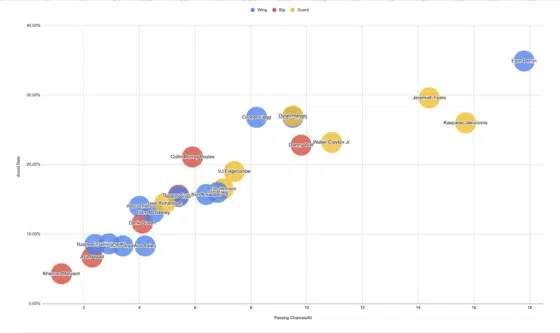
As expected, there’s an extremely strong positive correlation (r² = 0.92) between assist rates and passing chances, even accounting for passing turnovers. Regardless of teammate quality, players who pass more will almost always log more assists:
NBA Draft 2025: Developing a New Method for Projecting and Evaluating PlaymakingNBA Draft 2025: Developing a New Method for Projecting and Evaluating Playmaking

Three prospects stand out among the group as the highest volume passers by passing chances per 40 minutes — Egor Demin (17.8), Kasparas Jakucionis (15.7) and Jeremiah Fears (14.4). This makes sense, as all three of these players spend much of their time on the court with the ball in their hands, which inherently leads to passing chances.

A second cluster of players (Walter Clayton Jr., Danny Wolf, Nique Clifford, Dylan Harper, Cooper Flagg) sit between 8-11 passing chances per 40 minutes. Many of these prospects grade positively in terms of big-time passing rate, as visualized below:
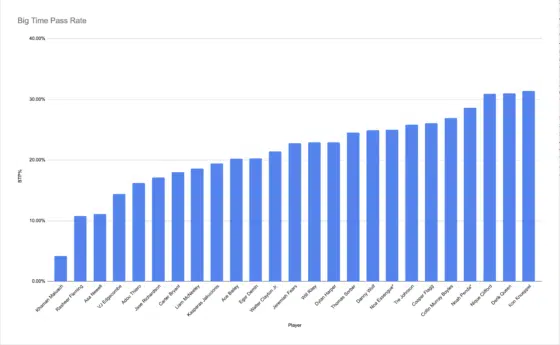
NBA Draft 2025: Developing a New Method for Projecting and Evaluating PlaymakingNBA Draft 2025: Developing a New Method for Projecting and Evaluating Playmaking

Three prospects I charted eclipsed a 30% big-time passing rate — Kon Knueppel, Nique Clifford and Derik Queen. I view all three of these players as underrated passing prospects and this metric can help explain that. Though these players don’t pass as much as some others, they consistently exhibit high-quality vision, anticipation, manipulation and skill on their passing chances.

We can combine passing volume and passing quality metrics to estimate the most impressive passers in the class, comparing passing chances and big-time passing:
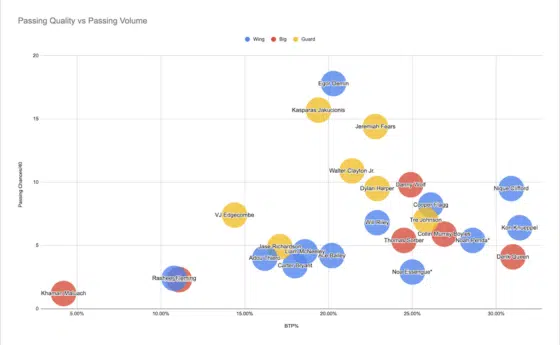
NBA Draft 2025: Developing a New Method for Projecting and Evaluating PlaymakingNBA Draft 2025: Developing a New Method for Projecting and Evaluating Playmaking

Our highest volume passers (Demin, Jakucionis and Fears) all rank closer to average by passing quality, but some of this comes with their heavy on-ball role. All three uncork plenty of high-level passes, but on-ball roles force plenty of basic assists, especially on strong offenses like BYU’s.

By raw big-time pass totals, the three highest volume passers rank second, third and fourth, only trailing Clifford (94 big-time passes). Still, the players towards the top right of the chart above generally line up with the best passers in the class on film.

Aside from passing quality, pressure rates and playmaking under pressure were the other main metrics this project aimed to create. Here are the leaders among prospects I charted in passing pressure rate, including how often they created potential assists from those possessions:
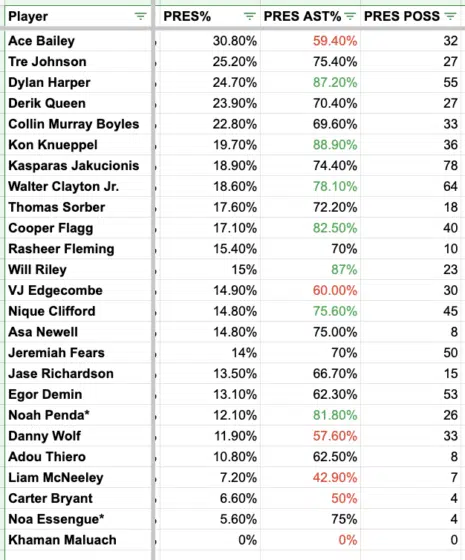
NBA Draft 2025: Developing a New Method for Projecting and Evaluating PlaymakingNBA Draft 2025: Developing a New Method for Projecting and Evaluating Playmaking

Dylan Harper is the main standout here, as he ranks third among the class in pressure rate (24.7%) and second in pressured potential assist rate (87.2%). Though this doesn’t account for Harper’s ability to burn pressure with his handle or shots, it reflects well on his future on-ball value. Jakucionis faced the most total pressure and mostly succeeded in cracking defenses with his playmaking.

Specifically, charting passing turnovers can help offer context for a high-turnover player like Jakucionis, where most of his turnovers stem from handling and strength limitations rather than mental processing ones. Jakucionis provides an example of a broader trend here.

Earlier, we noted the strong positive correlation between my charted passing volume and assist rate, which makes logical sense. However, the same doesn’t hold when we visualize charted passing turnovers against raw turnover rates:
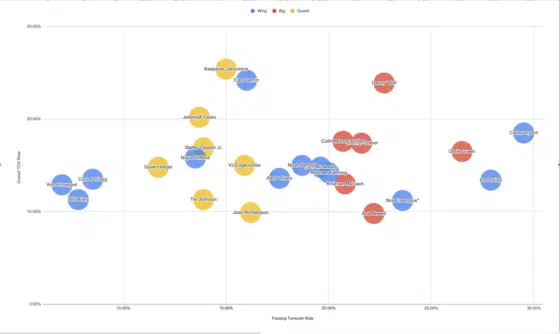
NBA Draft 2025: Developing a New Method for Projecting and Evaluating PlaymakingNBA Draft 2025: Developing a New Method for Projecting and Evaluating Playmaking

Rather than our strong positive correlation, this chart reveals a weaker correlation (r² = -0.57) between raw turnovers and passing turnovers. Not all turnovers result from a pass, so this relationship underscores the need for better analysis of individual player giveaways.

Some players towards the top right of the chart (Danny Wolf, Carter Bryant, Derik Queen) have both high turnover rates and high passing turnover rates, indicating possible problems with decision making, accuracy or skill. Some high turnover players like Jakucionis don’t cough the ball up while passing often, and some lower overall turnover players (Ace Bailey, Asa Newell) turn it over often relative to their passing volume.

Even beyond the passing versus non-passing turnover distinction, not all passing turnovers are equal. For each prospect, I logged when a turnover stemmed from a mental error or a technical one, as mentioned earlier, to better understand why a player turns the ball over and how to interpret their turnover numbers going forward (ordered by passing turnover rate, descending left to right):
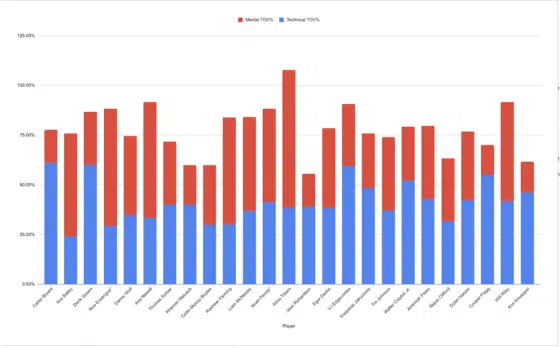
NBA Draft 2025: Developing a New Method for Projecting and Evaluating PlaymakingNBA Draft 2025: Developing a New Method for Projecting and Evaluating Playmaking

Players with more blue comprising their bar turned the ball over more often because of technical errors and players with more red comprising their bar turned the ball over more often due to mental errors. Not all turnovers are easily bucketed into one category. Some are the fault of both mental and technical issues and some passing turnovers aren’t the passer’s fault, resulting in some players notching above or below 100% on the chart above.

For prospects like Flagg and Queen, the majority of their passing turnovers resulted from accuracy and placement errors, which we could interpret more optimistically than prospects like Bailey and Newell, whose decision-making and processing more consistently faltered.

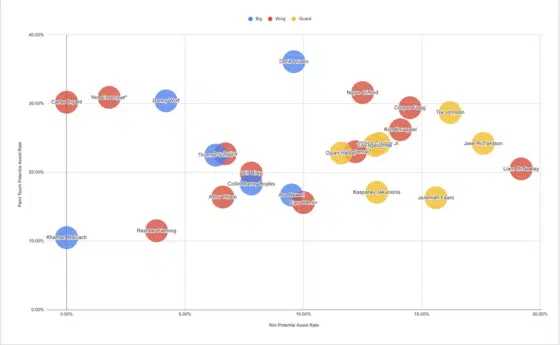
Let’s visualize how often prospects passed for easy shots at the rim (rim potential assist rate) versus how often they created potential assist chances from self-created paint touches (paint touch potential assist rate):
NBA Draft 2025: Developing a New Method for Projecting and Evaluating PlaymakingNBA Draft 2025: Developing a New Method for Projecting and Evaluating Playmaking

As a reminder, this metric doesn’t encompass paint touches without a pass, but there appears to be some anecdotal correlation between players who live near the hoop (Queen, Wolf, Clifford) and the paint touch metric. 

We can infer that players towards the top (Queen) mostly kick out of the paint to shooters and players towards the top right (Flagg, Tre Johnson, Jase Richardson) lay down passes for rim attempts. Those top-right prospects both collapse defenses and find high-value passes, which could forecast them optimistically as shot creators at the next level.

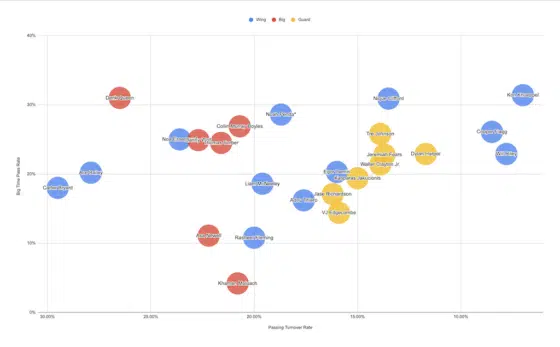
Based on these metrics and the film, who are the best passers in the 2025 NBA Draft? Before we answer that question, let’s look at one more chart, visualizing the relationship between passing quality (big-time pass rate) and passing turnover rate:
NBA Draft 2025: Developing a New Method for Projecting and Evaluating PlaymakingNBA Draft 2025: Developing a New Method for Projecting and Evaluating Playmaking

If I had to choose one chart from the piece to best represent the premier playmakers in the class, I’d pick the one above. Creating high-value passing chances without turning the ball over is a valuable commodity, reflected in most of the players I view as the best passing prospects in this draft.

Kon Knueppel

Knueppel’s best passes come when he feeds his rolling big man, often feeding the towering Khaman Maluach easy points. He processes defenses instantly on the fly, placing these interior passes accurately, often into tight windows while facing some pressure.

It’s incredibly rare for players to process the floor as quickly as Knueppel while consistently throwing high-value, often tight-window passes without turnovers. While Knueppel doesn’t break defensive structures like the best passers in the league, his playmaking brilliance comes in the form of remarkably consistent play-to-play decision-making on high-value passes.

Returning to the chart just above this section, he leads the class in big-time passing rate (31.4%) and passing turnover rate (7%) with solid enough passing volume (12th among all prospects). That’s an incredibly impressive feat, especially considering how Knueppel scaled his playmaking up in games without Cooper Flagg.

There’s an important distinction between passing and playmaking and Knueppel balances those as well as any prospect in the class. Some players can’t weaponize their brilliant processing, passing skill or vision because they lack the handle or scoring gravity to force defensive movement.

His gravity pulls two defenders his way after flaring off the Maluach screen, which forces rotations and opens the skip pass. Knueppel processes this instantly, releasing the pass within a second of catching the basketball. Plays like these let Knueppel wield his playmaking power without dominating the ball:

Knueppel’s magnetic shooting gravity and solid burst make him a dangerous on and off-ball playmaker who will create easy shots for his teammates. He’s a phenomenal pick-and-roll player, but his passing out of on-ball chances, closeout drives and off-ball movement help him create more efficient shots than more traditionally elite passers.

Derik Queen

Queen’s traditional passing statistics (0.8 assist-to-turnover rate, 11.6% assist rate) don’t paint him as a particularly strong passer. Our passing metrics present more of a mixed bag — he ranks second in big-time passing rate, fourth in pressure rate, first in weak-hand pass rate and first in rim potential assist rate. 

However, he ranks 23rd in passing turnover rate and 19th in potential assists per 40 minutes. If Queen’s overall passing quality grades so highly, why doesn’t he create more shots for his teammates?

Though Queen’s high passing turnover rate could cause some concern, a staggering 60% of those turnovers, ranking second, result from technical mistakes. He ranked sixth in the class in mental turnover rate (26.7%), as many of his passing giveaways look like this, resulting from accuracy issues and avoidable, unforced errors:

Queen’s low passing volume isn’t as easy to decipher. Some of it may result from Queen’s wiring leaning towards scoring, especially on a Maryland offense that relied heavily on his creation. Maryland’s offense improved a staggering 16.5 points per 100 possessions with Queen on the floor, evidencing his huge importance to their success.

Though Queen currently tilts toward a score-first playstyle, I generally trust players as talented as him to adapt and grow. There simply aren’t many players, especially in the frontcourt, with Queen’s vision, live-dribble ambidexterity and processing speed.

While he can capitalize on his scoring gravity to create for teammates, his lightning-fast processor adds value off-ball. Queen tossed quite a few assists like the first clip here, where it’s almost a touch pass with how fast the ball moves:

Those traits allow Queen to excel as an on-ball and off-ball passer. Though his numbers might not suggest it, I view Queen as one of the very best passing prospects in the class, regardless of position, for his phenomenal blend of gravity, vision and creativity.

Egor Demin

Demin would likely win a consensus poll for best passer in the 2025 class. It isn’t hard to understand why — at 6-foot-8, he comfortably leads the 25 prospects charted in passing volume by traditional assist rate and my passing chances measure. He spent the bulk of his time on the ball as a primary pick-and-roll initiator for a strong BYU offense this season.

He sports a sixth sense for space, timing and movement, passing like he’s constantly reading a miniap displaying every player and their position on the court. That court mapping leads to some incredible anticipatory passes, where Demin throws his target open like an elite quarterback.

Watch Demin uncork this pass before his target even enters the paint, leading him right to the block for a wide-open layup despite heavy traffic in front of the pass:

His height lets Demin attempt passes that other passers simply couldn’t imagine. While he’s doubled out to half-court, Demin launches a pass half the length of the court, leading his big man away from the rotating defender by lofting it away from the middle of the floor:

Demin’s height, vision, live-dribble trigger and sheer ambition render him the clear best skip passer in the class. He ranked 23rd in rim potential assist rate, illuminating his preference for exterior passing. Some of these skip passes come with ludicrous timing, velocity and ball placement, helping Demin create tons of open threes for great shooters:

Even with some obviously special passing traits, Demin offers an opposite example to Knueppel in the passing versus playmaking discussion. Despite possessing the mental acumen and technical skill to make every pass in the book, Demin may struggle to execute those passes.

He isn’t an accurate 3-point shooter, struggles to create separation on drives and turns the ball over at the slightest hint of contact. Though Demin’s passing talent will always let him punish tilted defenses, his inability to force defensive movement and rotations could hinder how much value his passing can add in an on-ball role.

Notice what happens when defenders play the pass against Demin, ignoring his scoring threat. Demin drives into open space here, but the help defenders read his intention to pass and back off to close the gap and force a turnover:

A weak handle, average burst and poor strength and balance limit Demin’s ability to unleash his passing brilliance. Improvement in any of those areas will help Demin extract more value from his playmaking at the NBA level. If he ever provides any semblance of a scoring threat on the ball, Demin has the tools to develop into one of the NBA’s better playmakers.

The strength of the 2025 draft’s overall passing makes it challenging to determine the best playmaking prospect of the bunch. I’d group the three above as the most intriguing passing prospects, but it’s reasonable to argue for Flagg, Clifford or Jakucionis as the best passer in the draft as well.

Beneath those prospects, the class features a handful of strong but limited passers in one or more way, notably Collin Murray-Boyles, Dylan Harper, Noah Penda and Jeremiah Fears. I’d love to write more in-depth passing profiles in the future, but my greatest hope for this project is expanding it to cover past and future draft classes.

For the moment, these metrics across a single draft class reveal some insights, but we can’t know the true predictive power of any of these metrics without a historic sample. At some point, I want to chart passes for historic prospects who did or did not become great NBA passers and if any of the metrics indicated that.

Assuming my current state of life doesn’t change too much, I plan on continuing this project over to the 2026 class. For the next cycle, I have a few changes in mind. As I previously alluded to, I’ll stop specifically charting live-dribble passes and focus more on on-the-move passing to capture a broader scope of plays and better estimate live-dribble processing.

Going forward, I’d like to develop a method for charting accuracy and decision speed. Measuring accuracy could be challenging without precise tracking data. Still, eyeballing placement, logging plays that almost resulted in turnovers but didn’t or charting tight versus open window passes could offer reasonable estimates. As always, I’m open to any suggestions here.

This project is inherently subjective and shouldn’t be viewed as a substitute for more traditional statistical measures; rather, another tool to enhance our knowledge of prospects. A different scout charting for the same thing might come to different conclusions than I would.

It’s important to note that plenty of these prospects have extremely limited samples, which lowers the confidence in the accuracy of the metrics. Gleaning much of anything from players like Newell, Maluach and Fleming with fewer than 100 total passing chances won’t uncover much definitive information.

Closely watching and writing notes on nearly 5,000 passes across 25 prospects will lead to inevitable human error. I undoubtedly miscounted, botched a calculation or evaluated a clip incorrectly at least a few times.

This project was a labor of love. Countless hours watching film, refining my process and creating this data isn’t something I would recommend anybody else do, but it brought me immense joy throughout the cycle. I love basketball deeply and I love obsessing over fine details. Intentional tracking work like this helps keep me grounded and present, which never hurts.

If you read this piece and made it through these 4,000 or so words, please know how deeply I appreciate it. I hope this project that brought me so much joy and insight can do the same for you and, again, this will ideally act as the beginning of my passing charting to keep expanding our understanding of projecting playmaking for NBA draft prospects.


26 ft Tiny Home Accommodates a Family with Two Bedrooms

0

Backcountry Tiny Homes knows a thing or two about maximizing living space, having been responsible for the incredibly small Acorn. Now the firm has used this experience to fit a two-bedroom model suitable for a small family into a length of just 26 ft (7.9 m).

The Honey Bee is based on a triple-axle trailer and is finished in metal, with lap siding accenting. The home’s entrance is raised, creating the opportunity for some useful storage. It connects to the kitchen, which occupies the center of the home. This includes a two-burner propane-powered stove, electric oven, full-size fridge/freezer, sink, and quite a lot of cabinetry. There’s also a breakfast bar for two.

The kitchen joins onto to the living room, which has a sofa bed for guests, a small coffee table, and is surrounded by generous glazing. Located opposite the living room, on the other side of the kitchen, is the bathroom. It has a sink, shower, composting toilet (this can be changed for a flushing toilet), and a small nook that can function as a laundry area or for storage.

The Honey Bee’s interior is arranged around a central kitchen

Backcountry Tiny Homes

There are two bedrooms in the Honey Bee, both of which are loft models with low ceilings. The main bedroom is reached by a storage-integrated staircase and has space for a double bed, plus it has a lowered standing platform area to make getting dressed easier. The second bedroom, meanwhile, is accessed by a wooden ladder and again has space for a double bed.

The Honey Bee is currently up for sale and starts at US$53,300 for a shell, while a turnkey model ready to move in will set you back $111,000. There are also multiple optional upgrades available, including a full off-the-grid setup with a wood-burning stove, solar panels, and water tanks.

Source: Backcountry Tiny Homes

Kenyans march in the streets one year after deadly anti-government protests

0

NewsFeed

Kenyan police fired tear gas to disperse protesters marking one year since the deadly 2024 anti-government protests, when at least 60 people were killed and demonstrators stormed parliament over tax hikes and alleged state corruption.

Once more, America’s withdrawal from the global stage comes to a halt

0

Unlock the White House Watch newsletter for free

I take it we all agree now that he isn’t an “isolationist”. A word that should never have been applied to Donald Trump in the first place went up in smoke last weekend, along with an unknown amount of Iran’s nuclear programme. The US bombings were consistent with his strike against Syria in 2017, against the leader of the militant group Isis in 2019 and against Iran’s most senior general in 2020. Given all the abstract nouns that fit Trump well — jingoism, unilateralism, anti-Europeanism — it is a wonder that isolationism ever saw daylight. It is not even clear that he opposed the Iraq war as a private citizen in 2003.

What is true of one man might turn out to be true of the US as a great power. The lesson of the Iran intervention is that America’s dreaded retreat from the world is more talked about than strictly realistic, whoever is the president.

For a start, keep the “split” over the Iran bombing in some perspective. The most prominent dissenters are Steve Bannon and Tucker Carlson, not administration officials or even a large group of congressional Republicans. Some of this is the slavishness of a Maga movement whose ultimate bond is to Trump himself, not to non-intervention or any other principle. (On the same theme, lots of vaccine sceptics revere a president who oversaw and promoted the Covid-19 jab). But it isn’t as if the Democratic revolt has been very thundering, either. Or the wider public one. The market for isolationism in the US tends to be exaggerated from outside, as it fits old stereotypes of an insular people.

A hugely overdone theme over the past decade or two is that of “war fatigue”. To be clear, what the fiascos of Iraq and Afghanistan turned voters against was ground wars, which are open-ended and liable to cost American lives. People are more serene about air strikes. Barack Obama bombed Libya, achieved some perverse outcomes and won re-election regardless.

Were US ground forces to be risked far from home, perhaps to secure an Iran whose state had collapsed, the domestic split would be real. But the US can still exert world-changing influence from the skies or, as Ukraine knows, through aid. And if mass commitment of land forces is the red line, how does that mark a change from the 1990s, when Washington shied from too much involvement in the Balkans? No one talked of the end of America’s global role then.

Even if there were a genuine isolationist in the White House, there is one reason to doubt that America could ever sheath its sword as the world’s enforcer. Habit. If we trace it back to the conquest of the Philippines in 1898, the US has had an empire for longer than it hasn’t. (“Why date it so late?”, a Mexican reader might ask.) That is a lot of muscle memory to unlearn, a lot of sunk cost to throw away. Closing or even much reducing the garrisons in east Asia, Europe, the Gulf, Djibouti and elsewhere isn’t like unwinding a property portfolio. As well as the logistical friction, there is amour propre and strategy involved: a backward step in one place would invite China into the vacuum.

The US has had too many interests and assets in too many places for too long to relinquish them with ease. In America, an isolationist is really someone who wishes the nation hadn’t acquired these burdens in the first place. Wanting to actively unload them several decades after the fact is another matter entirely. This is why Trump in what is his fifth year of power has had much less effect on America’s global hoofprint than some of his own fans had hoped.

It is a vice of journalism to underestimate the stickiness of things. Fourteen years after Obama’s fabled pivot to Asia, and even longer since the shale bonanza was thought to have freed the US from its long involvement in the Middle East, the White House is half-entertaining a regime change in Iran. Last month, Trump made the Gulf the first big trip of his second term as president — as it had been in his first too. That America still has assets in Qatar for Iran to target tells its own story. If the US can’t even extricate itself from one region, the idea of a wider world drawdown seems fanciful.

Incidentally, which empire ever voluntarily decommissioned itself? Britain and France ran out of juice, and even then the latter resisted the inevitable into the 1960s. Japan and Germany were defeated. The Soviets’ entire economic model had rotted from inside. The prospect of American withdrawal from the world is discussed as though great powers choose to do this kind of thing all the time. In fact, it would be a near unique act of self-abnegation. And to that extent, perhaps unlikely.

What people tend to mean by American retreat is American retreat from Europe. That is a shattering change, of course. Even the slightest question about the US commitment to Nato’s Article 5 — that an armed attack on one will be considered an attack on all — incentivises Russia to try its luck. But it is a parochial European who conflates this with a general American reticence abroad. Events in Iran should bring that home.

If nothing else, the US has a colossal defence budget that no politician of note wants to cut much. As long as that holds, those armaments will find a purpose often enough. “The iron draws the hand towards it,” is the Homeric way of saying that everything looks like a nail to a hammer-wielder. If even an America First president can’t resist a bash, don’t count on future US leaders to be any more coy.

janan.ganesh@ft.com

Zimbabwe’s Agricultural Legacy: A Look back 25 Years Later – Was it Worth it?

0

Shingai Nyoka

BBC News, Harare

Getty Images A white farmer who lost land looks a tilled soil in ZimbabweGetty Images

Before the land reform programme, Zimbabwe had about 2,500 white farmers owning 4,000 farms

A quarter of a century after their land was seized during a chaotic land reform programme that made global headlines, a small group of white Zimbabwean farmers have accepted a controversial compensation deal from the government.

Once the backbone of the country’s agricultural sector, many of them are now elderly, visibly frail, battling illness and financially desperate.

“I believe this is the only opportunity. We can’t wait 10 years for another deal, ” 71-year-old Arthur Baisley told the BBC.

Still recuperating from back surgery, Mr Baisley was among those who arrived earlier this year at a conference room in the capital, Harare – some aided by walking sticks and walking frames – to discuss the deal.

The catch is that these farmers have now been paid only 1% of their total compensation in cash – the rest is being issued as US dollar-denominated treasury bonds that mature in 10 years – with 2% interest paid twice a year.

The land reform programme, sparked by the invasion of white-owned farms around the country by supporters of the late Robert Mugabe, was launched in 2000 by the then president, who was desperate to shore up political support at the time when Zimbabwe had about 2,500 white farmers owning 4,000 farms – half of the country’s best farmland.

The seizures became Africa’s biggest modern-day land revolution, and was meant to redress colonial-era land grabs, when black people were forced to leave their land. But it set the country on a collision path with Western nations – economic sanctions followed, companies exited and the economy collapsed.

This compensation deal has been pushed by Mugabe’s successor President Emmerson Mnangagwa, who is keen to mend fences. The money being given to the farmers, as stipulated by the constitution, is for infrastructure and improvements to the land – like buildings and dams, not the value of the land itself, which Zimbabwe’s government insists was illegally seized from the country’s original inhabitants.

Overall this is estimated to total $3.5bn (£2.6bn). However, the recent cash pay-out totalled just $3.1m for 378 farms.

Mr Baisley said it was not the best deal but was reasonably fair – and his decision to accept it has come with the realisation that the takeovers cannot be undone.

“It was difficult for my family in the beginning but life goes on, you have to move on,” he said, adding that he would start selling some of the bonds immediately to offset medical bills and to care for his sickly parents.

It is a significant shift, a softening of hard lines previously drawn by both sides.

AFP/Getty Images A crowd Zanu-PF supporters dance together as they welcome President Robert Mugabe home from a trip abroad in 2000, with placards saying ‘Zimbabwe will never be a colony again’.AFP/Getty Images

In 2000 it suited President Robert Mugabe to push land reform to shore up his support in the face of growing opposition

Mugabe used to pound the lectern at party rallies saying the white farmers should go to the UK, the former colonial power, for their compensation – although quietly he was paying out select farmers.

The white farmers meanwhile had insisted on a $10bn full cash settlement. Both sides have settled on the $3.5bn figure.

However, unlike Mr Baisley, the majority of white farmers are holding out for a deal which would see all the cash paid upfront.

Deon Theron, who in 2008 was forced off the farm he had bought after independence, leads more than 1,000 farmers who have rejected the offer.

Boxes of his possessions, hastily packed during his departure, still fill the veranda of his Harare home where he told me the deal was not fair as there was no guarantee that the bonds would be honoured in 10 years’ time.

Deon Theron in a shirt and jacket stands in front of boxes and crates.

Deon Theron’s faction of farmers wants to be paid in cash and feel the UK government should help with negotiations

The 71-year-old said it was clear that the government did not have the money – and he wanted to see the international community, including the UK, help with negotiations as the government was refusing to budge, or even meet the dissenting group.

“The British can’t go and sit in the pavilion and watch what’s happening because they are part of it. They are linked with our history. They can’t walk away from it,” he told the BBC.

In an agreement brokered in the run-up to independence, the UK was to support land reform financially – but it floundered towards the end of the 1990s when the Labour government came to power and relations soured.

The need to re-engage Britain on the compensation was the battle cry of many of the war veterans who led the farm invasions. They had fought in the 1970s war against white-minority rule – and felt let down by the slow pace of land reform following independence.

But like the white farmers, the war veterans are also split over the government’s handling of the compensation.

Godfrey Gurira sitting on a chair in front of a small round and thatch building. He is wearing a brown long sleeved shirt and gestures with his finger as he talks

Godfrey Gurira is part of a group of war veterans suing the government – saying the compensation agreed for white farmers is too much at a time of economic hardship

One faction is suing the government for “clandestinely” agreeing to pay $3.5bn in compensation, saying the offer should have been agreed in parliament.

One of its leaders, Godfrey Gurira, said that given the myriad economic challenges cash-strapped Zimbabwe faced, it should not have prioritised white farmers.

“It’s such a colossal amount… for a nation of our size. People are suffering they can hardly make ends meet, the hospitals have nothing, then we have the luxury to pay $3.5bn. In our opinion it’s an unnecessary act of appeasement,” he told the BBC.

A second lawsuit challenges an aspect of a new land policy that demands that new farmers pay for the land in order to obtain title deeds to own the land outright.

In the wake of the redistribution, the 250,000 people who replaced the 2,500 white farmers were only entitled to 99-year leases. However this meant it was near-impossible for them to get bank loans as their security of tenure was not guaranteed.

Last year, the government said farmers could apply to own their land outright – with title deeds – but they needed to pay between $100 and $500 per hectare (2.47 acres).

That money will go towards the compensation deal to white farmers, according to the government.

Those challenging this say forcing black farmers to effectively buy back the land contradicts the law.

And the black farmers themselves are divided over the issue.

The land reform programme has had mixed results. Many new farmers did not have the skills, the finances and labour to farm successfully. But the country’s agricultural sector is now rebounding with pockets of successful farmers.

In 2002, Solomon Ganye arrived on a bicycle to receive a 20-hectare bare piece of land in Harare South.

It was part of the sprawling 2,700-hectare farm that had been divided among 77 people.

He found the initial years a struggle – suffering from a lack of finances and climate shocks. But slowly through Chinese money ploughed into the tobacco sector, and after handing the business over to his sons – both agriculture graduates in their 20s – things have improved.

They have built an enviable enterprise with 200 permanent workers, and have expanded into dairy and livestock farming. They are applying for the title deeds of their land and have even acquired more in recent years from the government.

Aaron Ganye, his oldest son, told the BBC that without the land reform programme, his family would probably not have been able to buy a farm because in the past the structure of ownership saw vast tracts of land being held by a single family.

“I’m very happy because to be honest we’ve taken farming to another level because now we’re living a good life through farming. We’re doing more than what the white guys were doing in terms of quality of tobacco and the leaf is good,” the 25-year-old said proudly.

“We’ve invested in technology. It’s not easy. I’m now motivating more farmers to do good work here,” he said.

He does believe that new farmers should contribute to compensation payments but based on the value of infrastructure they inherited.

Getty Images A woman carrying a big bundle of bright tobacco leaves over her headGetty Images

The agriculture sector is rebounding – with the highest tobacco production ever this year

On the political front, tensions are also easing – and the UK government no longer has any Zimbabwean on its sanction list having recently delisted four military and government officials it had accused of human rights abuses.

The UK’s Foreign, Commonwealth and Development Office told the BBC this was because they were no longer in the positions they held at the time they were added to the list in 2021.

Nonetheless, it is a significant development, marking the end of more than 20 years of sanctions against Zimbabwe.

The country now hopes that the farmers’ compensation issue can be properly sorted out to get Western support for ongoing talks on restructuring its massive foreign debt.

There is no question that 25 years on, calm has returned to almost all farming fronts.

Agriculture is rebounding, this year farmers have sold over 300,000 tonnes of tobacco at auction – the highest tobacco production ever.

But compromise is needed on all sides for the country to fully jump over the hurdle of land reform and its fallout.

More Zimbabwe stories from the BBC:

Getty Images/BBC A woman looking at her mobile phone and the graphic BBC News AfricaGetty Images/BBC

Canaccord Genuity initiates Buy rating on Flutter Entertainment stock

0


Flutter Entertainment stock initiated with Buy rating at Canaccord Genuity

UK to purchase 12 F-35A fighter jets equipped for nuclear weapon delivery

0

Downing Street says the purchase will be the ‘biggest strengthening of the UK’s nuclear posture in a generation’.

The United Kingdom plans to buy at least a dozen F-35A fighter jets capable of carrying tactical nuclear weapons, in what will be the “biggest strengthening of the UK’s nuclear posture in a generation”, Prime Minister Keir Starmer’s office says.

Starmer will make an announcement about the purchase, which will allow the UK’s air force to carry nuclear weapons for the first time since the end of the Cold War, at the NATO summit in The Hague on Wednesday, where NATO leaders are expected to approve a major boost to their defence spending.

The UK’s nuclear deterrence capability is currently limited to submarine-launched missiles.

“In an era of radical uncertainty we can no longer take peace for granted, which is why my government is investing in our national security,” Starmer said in a statement.

“These F35 dual-capable aircraft will herald a new era for our world-leading Royal Air Force and deter hostile threats that threaten the UK and our Allies.”

NATO Secretary-General Mark Rutte said in the statement that he strongly welcomed the announcement, describing it as “yet another robust British contribution to NATO”.

‘Dual-capable’ fighter jets

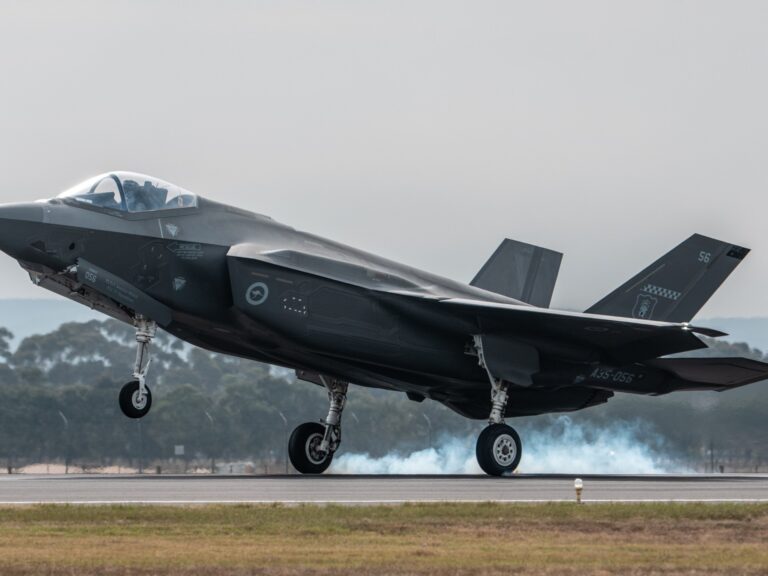
The F-35A, produced by United States company Lockheed Martin, is similar to the F-35B currently used by the UK air force, but can carry nuclear bombs in addition to conventional weapons.

Seven NATO members, including the US, Germany and Italy, already have dual-capable planes on European territory capable of carrying the same US B61 nuclear warheads that the UK will likely carry, the AFP news agency reported.

The aircraft would be deployed as NATO’s nuclear dual-capable aircraft mission, strengthening the alliance’s nuclear deterrence posture, Downing Street said.

The new jets would be based at the Marham airbase, with the acquisition of the planes expected to support 20,000 jobs in the UK, the statement said, as 15 percent of the global supply chain for the jets is based in the country.

Europe re-arms

NATO’s 32 members are expected to approve a major hike in targets for the defence spending, from 2 percent to 5 percent of gross domestic product (GDP), at the summit in The Hague.

The UK has already committed to meeting the spending target, and has announced major investments in building new attack submarines and munitions factories.

The boost in defence budgets follows criticism from the Trump administration, which says the US carries too much of the alliance’s financial burden. US President Donald Trump has questioned whether the alliance should defend countries that fail to meet the spending targets, and has even threatened to leave the bloc.

Other countries have also signalled they are making major investments in their militaries in response to the threat posed by Russia, with German Chancellor Friedrich Merz saying Tuesday that Germany would increase spending to become “Europe’s strongest conventional army”.