


These nuns in Brazil went viral for beatboxing. Now, they’re using their newfound fame to draw attention to the Catholic church and to their congregation’s mission. Jack Nicas, the Brazil bureau chief for The New York Times, goes behind the scenes as the nuns record their first music video.
Weekly Street Calls
Street Calls of the Week
Irish band Kneecap shows support for Palestine Action Group at Glastonbury | Music News

Thousands of fans chanted ‘free Palestine’ and waved Palestinian flags as the Irish trio performed in the UK.
Irish-language rap group Kneecap has performed at the Glastonbury Festival in front of tens of thousands of fans chanting “Free Palestine”, defying United Kingdom Prime Minister Keir Starmer who said he did not think it was “appropriate” for the band to appear.
The group’s Liam O’Hanna on Saturday also gave a “shout-out” to Palestine Action Group, which UK Interior Minister Yvette Cooper announced last week would become a banned group under the Terrorism Act of 2000.
“The prime minister of your country, not mine, said he didn’t want us to play, so f*** Keir Starmer,” said O’Hanna, who appeared on stage wearing his trademark Palestinian keffiyeh in front of the capacity crowd, including many people waving Palestinian flags.
“This situation can be quite stressful but it’s minimal compared to what the Palestinian people are [facing],” O’Hanna, who performs under the name Mo Chara, added, referring to the backlash the band has faced for its outspoken support of Palestinians in Gaza.
He is facing charges under the British Terrorism Act of supporting a proscribed organisation for allegedly waving a flag of Lebanon’s Hezbollah armed group at a concert in London in November last year.
O’Hanna has said he picked up a flag that was thrown onto the stage without knowing what it represented.
The rapper is on unconditional bail before a further court hearing in August.
“Glastonbury, I’m a free man!” he shouted as the trio took to the stage at Glastonbury’s West Holts field, which holds about 30,000 people.
The trio also thanked festival organisers Michael and Emily Eavis for resisting pressure to cancel their appearance, including from Starmer.
Several Kneecap concerts have been cancelled since the band’s performance at the Coachella Valley Music and Arts Festival in California in April, where they accused Israel of committing genocide against the Palestinians, enabled by the United States government.
At least 56,412 Palestinians have been killed and 133,054 wounded in Israel’s war on Gaza, according to Gaza’s Ministry of Health.
Ireland’s people and government have been some of the most outspoken critics of the war, as well as Israel’s deliberate starvation of Gaza’s population, which many people see as having parallels to the English occupation of Ireland.
The BBC, which broadcasts dozens of Glastonbury performances, did not show Kneecap’s set live, but said it planned to make it available online later.
The broadcaster said it would not be re-airing the live performance of British rap punk duo Bob Vylan who appeared on stage before Kneecap and led chants of “Free, free Palestine” and “Death, death to the IDF [Israeli army]”.
A BBC spokesperson said the comments were “deeply offensive”, and that they would not be available to rewatch on BBC iPlayer.
The BBC also reported that UK Culture Minister Lisa Nandy spoke to the BBC director general, Tim Davie, seeking an “urgent explanation” after the chants were aired live.
According to the BBC, Avon and Somerset Police also said that they would be reviewing footage of both Kneecap and Bob Vylan’s sets to “determine whether any offences may have been committed that would require a criminal investigation”.
The bands were among about 4,000 performers across 120 stages to appear at this year’s festival, which also featured headliners including Neil Young, Charli XCX, Rod Stewart, Busta Rhymes, Olivia Rodrigo and Doechii, as well as a surprise appearance by Britpop band Pulp.
Two employees of the SEC’s EDGAR system accused of engaging in insider trading

Two men who worked for the Securities and Exchange Commission’s EDGAR public filing system were charged with insider trading after allegedly pocketing $1 million by stealing non-public information obtained through their jobs.
Justin Chen and Jun Zhen, both of Brooklyn, New York, were charged in a federal complaint with obtaining material, non-public information about companies like Purple Innovation Inc., Ondas Holdings Inc., SigmaTron International Inc., and Signing Day Sports Inc. through their work at EDGAR, according to Brooklyn US Attorney Joseph Nocella.
Prosecutors say that between March and June 2025 the pair engaged in a scheme to obtain information about these companies, which announced they had entered into merger agreements or partnerships “that resulted in significant increases in the share price of each company’s stock.”
Chen, 31, and Zhen, 29, purchased shares in the companies before the announcements, “and sold those shares at a significant profit immediately after the announcement,” according to a complaint filed in federal court in Brooklyn. “In total, Chen and Zhen have made a profit of more than $1 million from their trading.”
Agents with the Federal Bureau of Investigation arrested Chen and Zhen Friday night at John F. Kennedy International Airport as they were planning to board a flight to Hong Kong, said John Marzulli, a spokesman for Nocella.
Chen worked as an EDGAR operator and assistant manager while Zhen worked as an EDGAR operator and typeset manager, prosecutors said. The two had access to the company announcements before they were filed.
Both men are charged with securities fraud, which carries a prison term of as long as 25 years, prosecutors said.
Chen and Zhen made their initial court appearances in federal court in Brooklyn on Saturday before US Magistrate Judge Vera Scanlon, who ordered them held without bail.
Chris Wright, a lawyer for Zhen, and Charles Millioen, a lawyer for Chen, didn’t immediately return email messages seeking comment about their clients.
Introducing the 2025 Fortune 500, the definitive ranking of the biggest companies in America. Explore this year’s list.
David Popovici and Pan Zhanle Dominate Top 9 of the 12 Best 100 Freestyle Times in History
2025 LEN U23 European Championships
H/T to Tencor for the inspiration for this article.
On Saturday in Samorin, Romanian David Popovici swam a new best time of 46.71, which is the #2 performance in the history of the event.
The result is building anticipation for an explosive head-to-head showdown in Singapore between Popovici and China’s Pan Zhanle. Both swimmers are only 20 years old, setting up as much as a decade of battles between the two.
In spite of their relatively-young age, the two now hold 9 of the 12 fastest performances in history in an event where no other swim in the top 50 performances was done by a swimmer as young as they are.
Top 15 Performances in History – Men’s 100 LCM Freestyles
Popovici is currently 7,591 days old. In his most recent entry on the list, the World Record swim from August, Pan was a few days shy of his 20th birthday, or 7,306 days old.
While there are a few other 20 year olds on the list, none were as young as Pan or Popovici currently are. Australian James Magnussen was 7,644 days old when he swam the #22 time in history (47.10). American Chris Guiliano was 7,664 days old when he swam the #42 time in history (47.25).
The next-highest ranked swimmers who were younger than Pan and Popovici is a tie: Russian Kliment Kolesnikov was 7,574 days old when he swam 47.31 in history in 2021, and American Jack Alexy was 7,494 days old when he swam 47.31 in 2023. That ties them as the #53 performances in history.
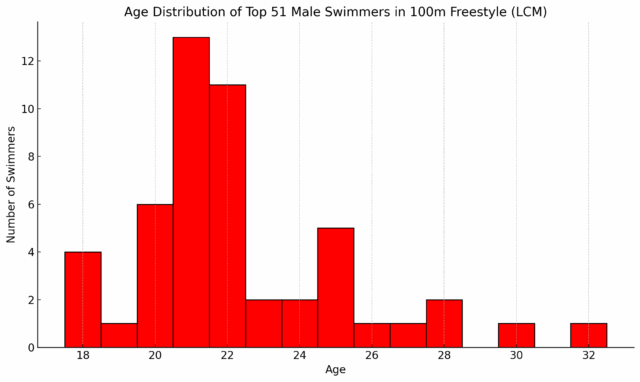
While the men’s 10o free isn’t exactly an event dominated by veterans, most elite swimmers go their best times at ages 21 and 22. The graph below shows the age distribution of the current top 51 men’s performers in history.
That means that Pan and Popovici are, based on historical standards, coming into their prime.
Volkswagen’s ID. Buzz van reshapes the concept of autonomous mobility

Nope, we’re not talking about a Tesla Robotaxi we’re talking about. This is the self-driving ID. Buzz, a fully autonomous van created and engineered by Volkswagen’s mobility-focused sub-brand, MOIA. Unlike retrofitted cars, the ID. Buzz has been built from the ground up specifically for mobility services.
For the past few years, the ID. Buzz has been frequently spotted during tests on the streets of Hamburg. MOIA plans to launch the vehicle in Germany first, with wider rollout across Europe and the US expected by 2026.
Just days ago, Elon Musk announced that Tesla’s Robotaxis would begin official testing in Austin, Texas. VW’s announcement signals that competition in autonomous mobility is heating up. But there’s a key difference: MOIA is aiming at corporate clients and mobility providers, while Tesla is targeting the passenger ride-hailing market directly.
This means you’re more likely to see fleets of ID. Buzz vans operated by companies than owned by your next-door neighbor.
Volkswagen
“With our fully autonomous complete solution, we are creating a mobility offering that is unique in this form: cities, municipalities, and fleet operators can provide autonomous mobility for all simply and reliably,” said Oliver Blume, CEO of the Volkswagen Group. “Our driverless ID. Buzz shuttles are part of a fully connected 360-degree package made up of leading technology, an attractive vehicle fleet, intelligent fleet management, and a customer-centric booking system – all from a single source and quickly scalable to fleet size on the road.”
The ID. Buzz comes bundled with a comprehensive support suite for public and private transportation operators, including self-driving tech, operator training, fleet management software, and passenger assistance tools.
The van uses Mobileye’s validated self-driving technology that has been validated to meet automotive safety regulations. Paired with MOIA’s Autonomous Driving Mobility-as-a-Service (AD MaaS) platform, the ID. Buzz doesn’t just drive itself, it integrates with ride apps, manages fleets, and can respond to operational challenges autonomously.
VW even offers end-to-end operator enablement, including simulation, training, deployment, and real-time fleet monitoring. Operators will be able to serve rural, suburban, and urban areas on their own terms.

Volkswagen
The van features a full 360-degree view enabled by 27 sensors: 13 cameras, nine LiDAR units, and give radar sensors. Its AI meets the requirements for Level 4 autonomy, meaning it can handle all driving without human intervention in specific scenarios, which is on par with Waymo’s fleet of Jaguar I-Pace vehicles in the US.
There is already vigorius competition in this market. Waymo is apparently handling around 250,000 trips a week, and Tesla says it is close to launching a robotaxi service with its Model Y.
Where Tesla and Waymo favor standard car formats, the ID. Buzz looks and feels different with a vehicle that sits somewhere between a minivan and a small bus. Expect generous legroom, a taller roof, a longer wheelbase, and even a luggage rack where the front passenger seat would typically be.
Inside, passengers will find a plush cabin with four seats, large grab handles, faux-wood flooring, and visible Start/Stop, Support, and SOS buttons. “Intuitive boarding via smartphone” allows users to unlock the van using their device.

Volkswagen
If regulatory approval goes ahead, deployment could begin as early as next year.
“As part of our journey to become a global technology leader in the automotive industry, we will introduce sustainable, autonomous mobility to large-scale deployment in Europe and the US starting in 2026,” said Blume.

Volkswagen
Hamburg is already confirmed as MOIA’s first municipal client, using the Buzz as a complement to existing public transport. Meanwhile, a partnership with Uber will bring the ID. Buzz to Los Angeles in 2026, marking its entry into the US ridesharing market.
Source: MOIA
Trump’s ‘Big Beautiful Bill’ moves forward, yet encounters resistance from Republicans
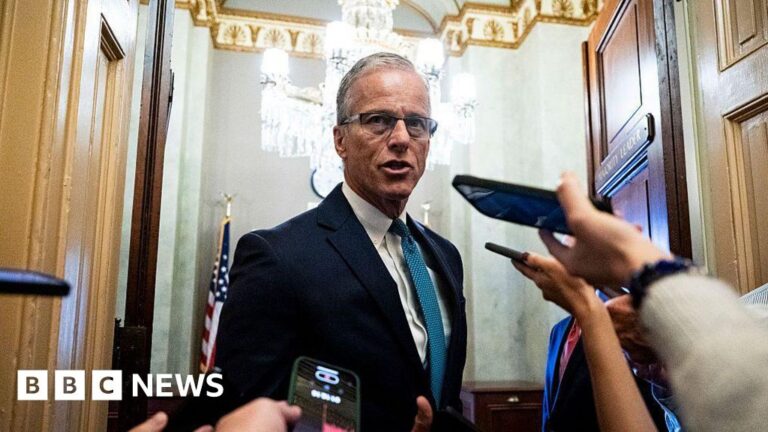
Senate Republicans narrowly advanced a budget bill that is pivotal to President Donald Trump’s second-term agenda ahead of a self-imposed 4 July deadline.
In a 51-49 vote largely along party lines, the Senate has moved to open debate on the bill, a key initial hurdle that Republicans scrambled to overcome. Two Republicans joined Democrats in opposing the move to take up the bill.
Party leadership had been twisting arms for the initial vote on the “Big Beautiful Bill” on Saturday, following the release of its latest version – all 940 pages – shortly after midnight.
Republicans were divided over how much to cut welfare programmes in order to extend $3.8tn (£2.8tn) in Trump tax breaks.
The bill’s fate on the Senate floor remains uncertain, as Republicans in the chamber continue to quarrel over the bill’s provisions. Vice-President JD Vance travelled to the Capitol on Saturday night to offer a tiebreak vote, though party leaders were ultimately able to negotiate majority support without his help.
Meanwhile, Democrats say they will drag out the process in protest at the bill, with Senate Minority Leader Chuck Schumer saying his party will force Republicans to read out the nearly 1,000 pages of text before the Senate can begin debate and potentially take up a final vote.
Separately, some Republicans in the House of Representatives have expressed concerns over the changes in the Senate version of the bill. The sprawling tax and spending measure passed the House of Representatives by a single vote last month.
The Senate’s version of the bill included a series of changes meant to address points of disagreement among Republicans. Still, party leaders struggled to secure enough votes.
In a memo sent to Senate offices, the White House endorsed the latest revisions to the bill and called for its passage.
The memo reportedly warned that failure to approve the budget “would be the ultimate betrayal”.
Republicans Rand Paul of Kentucky and Thom Tillis of North Carolina joined Democrats in rejecting the bill.
As the Senate vote concluded, President Trump posted on Truth Social, his social media platform, that Tillis was making a “BIG MISTAKE”. He wrote that he would be meeting with candidates who “come forward wanting to run in the Primary against “Senator Thom” Tillis”.
However, the bill did win over some Republicans who had expressed scepticism, including centrist Republicans Lisa Murkowski of Alaska and Susan Collins of Maine. Ron Johnson of Wisconsin intially voted against it, but changed his vote at the end of the voting session.
The latest version was designed to appease some backbench Republican holdouts.
Other amendments incorporate input from the Senate parliamentarian, an official who reviews bills to ensure they comply with the chamber’s procedures.
It includes an increase in funding for rural hospitals, after some party moderates argued the original proposal would harm their constituents.
There are also changes to the Supplemental Nutrition Assistance Program (Snap), which provides food benefits to low-income Americans.
Under the latest bill, Alaska and Hawaii would be temporarily exempt from a proposed requirement for some states to start footing the bill for the programme, which is currently fully funded by the federal government.
The revision comes after Alaska’s two Republican senators pushed for an exemption.
The legislation still contains some of its core components, including extending tax cuts passed by Republicans in 2017, as well as the addition of new cuts that Trump campaigned on, such as a tax deduction on Social Security benefits and the elimination of taxes on overtime work and tips.
More contentious measures are also still in place, including restrictions and requirements on Medicaid – a healthcare programme used by millions of elderly, disabled and low-income Americans.
Democrats have heavily criticised this piece of the bill, saying it will limit access to affordable healthcare for millions of Americans.
The Congressional Budget Office estimates that 7.8 million people would become uninsured due to such Medicaid cuts.
Senator Patty Murray, a Washington state Democrat, took to social media on Saturday to argue the bill contains “the largest healthcare cuts in history”.
Another critic of the bill is Elon Musk, who wrote on X on Saturday that the latest iteration of the bill “will destroy millions of jobs in America and cause immense strategic harms to our country”.
Musk took issue with taxes the bill proposes on solar and wind energy projects.
The bill now needs a simple majority to clear the Senate. With Republicans holding 53 seats out of 100, plus a tiebreaker from Vice-President JD Vance, the party can only afford three defections.
Nvidia executives sell $1 billion in shares
Unlock the Editor’s Digest for free
Roula Khalaf, Editor of the FT, selects her favourite stories in this weekly newsletter.
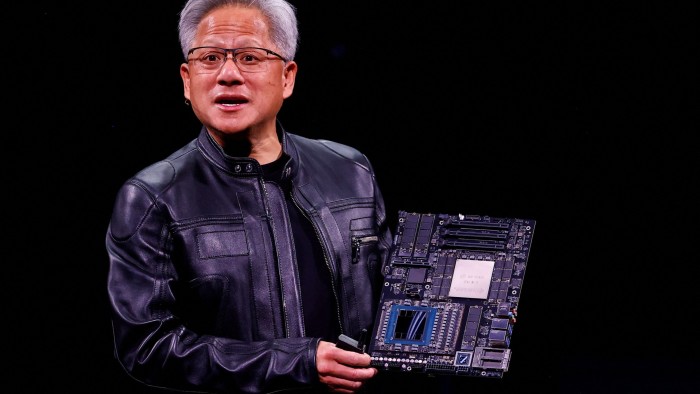
Nvidia insiders have sold more than $1bn of the company’s stock over the past 12 months including a recent surge in trading as executives cash in on investors’ enthusiasm for artificial intelligence.
More than $500mn of the share sales took place this month as the California-based chips designer’s share price climbed to a record high.
Investors have piled back into the stock, making it the world’s most valuable company as they bet on huge demand for chips to power AI applications. The price rise comes after a turbulent year in which Nvidia was knocked by US-China trade tensions and Chinese AI breakthroughs that threated demand for its products.
Jensen Huang, Nvidia chief executive, started selling shares this week for the first time since September.
Nvidia said all of Huang’s sales were part of a pre-arranged trading plan, agreed in March, that set the prices and dates at which sales would be triggered. Huang still retains the vast majority of his shares in Nvidia.
“When the stock [dropped] in the first quarter, he did not sell, [which was] was really smart,” said Ben Silverman, vice-president of research at VerityData.
“[Huang] waited for the stock to return to levels that he felt more comfortable selling at,” Silverman added.
VerityData, which tracks insider sales based on regulatory filings, said in a report that Nvidia’s share price bump above $150 appears to have triggered Huang’s sales.
Huang started selling just after a mandated 90-day cooling-off period for his sales plan expired. Directors and senior executives often agree these plans to avoid insider trading allegations.
Under the plan, Huang can sell as many as 6mn shares before the end of this year. At the current share price, that leaves Huang on track to earn more than $900mn.
Huang’s net worth is estimated at $138bn, according to Forbes.
Nvidia’s market capitalisation has quadrupled to $3.8tn in the space of a few years as companies and nation states pour billions of dollars into the infrastructure behind AI.
A number of other top Nvidia executives are also reaping a windfall from the company’s growth.
These include longtime board member Mark Stevens, a former managing partner at Sequoia Capital who was one of the earliest investors in Nvidia. On 2 June, he announced he would sell up to 4mn shares, currently valued at $550mn, and has since sold $288mn of them.
Nvidia’s executive vice-president of worldwide field operations, Jay Puri — a two-decade veteran of the company who has deputised for Huang on trips to China to meet officials — sold shares worth around $25mn on Wednesday.
Two other board members, Tench Coxe and Brooke Seawell, have moved to sell, with Coxe offloading around $143mn on June 9 and Seawell around $48mn this month.
Coxe, a former managing director of Sutter Hill Ventures, is another longtime board member who has been at the company since its early days. Huang co-founded the company in 1993 as a video game graphics card company in a Denny’s restaurant in San Jose.
Seawell, who joined the board in 1997, is a partner at venture firm New Enterprise Associates and a former executive at chip design software company Synopsys.
Nvidia’s shares have rebounded in recent weeks, with its market capitalisation regaining about $1.5tn since its lowest point in April. The stock took a hit following breakthroughs by China’s DeepSeek and new US export controls on AI chips destined for China.
Russia-Ukraine War: Significant Events on Day 1,221 | Updates on Russia-Ukraine Conflict

Here is how things stand on Sunday, June 29:
Fighting
- A Russian drone attack killed a teacher and her husband in Ukraine’s Odesa, and wounded 14 others, according to Ukrainian officials. Three of the victims, including a child, were in critical condition.
- At least two others were killed in another Russian attack on the villages of Kostiantynivka and Ivanopillia in the eastern region of Donetsk on Friday, according to Governor Vadym Filashkin.
- Explosions were heard in the Ukrainian capital, Kyiv, on Saturday night, with Mayor Vitali Klitschko warning residents to take shelter from Russian drones “heading for the city”, according to the official Ukrinform news agency.
- Russia’s Ministry of Defence said Russian forces have taken control of the settlement of Chervona Zirka in Donetsk. The ministry later said it had also seized the area between the Vovcha and Mokri Yaly rivers.
- Top Ukrainian commander Oleksandr Syrskii also said on Telegram that Russia’s military was “surging towards” the key city of Kostiantynivka in Donetsk, but that “apart from sustaining numerous losses, [it] has achieved nothing”.
- In Russia, a Ukrainian drone attack caused several injuries to a 43-year-old man, including a traumatic brain injury, in the village of Glushkovo in the Kursk region, the TASS news agency reported, citing a local official.
- Ukraine’s SBU security service said Ukrainian forces using special drones attacked the Kirovske military airfield in Russian-occupied Crimea, destroying three attack helicopters and an anti-aircraft missile system.
- Russia’s military said it destroyed 64 Ukrainian drones over western Russia and Russian-occupied Crimea overnight and into Saturday.
Politics and diplomacy
- Poland’s outgoing president, Andrzej Duda, during a visit to Kyiv, asked Ukraine to “please be patient” during the handover to his nationalist successor, Karol Nawrocki. Ukrainian President Volodymyr Zelenskyy told reporters he would “of course” invite Nawrocki to Ukraine after he assumed office.
- Ruslan Stefanchuk, the speaker and chairperson of the Ukrainian Parliament, told Ukraine’s ongoing marathon television broadcast that a bill is being drafted to hold elections after the war, Ukrinform reported.
Republicans in the US Senate push Trump bill closer to approval

US Senate Republicans advance Trump bill toward passage