
12.3 C
New York
Tuesday, April 7, 2026
Home Blog Page 587

Srebrenica’s Ongoing Tragedy: 30 Years Later, the Painful Task of Burying the Dead Continues

0

Potocari, Bosnia and Herzegovina – In a grassy valley dotted with white gravestones, thousands of people gathered to mark 30 years since the Srebrenica massacre on Friday.

Seven victims of the 1995 genocide, some of whose remains were only discovered and exhumed in the past year from mass graves uncovered in Liplje, Baljkovica, Suljici and Kamenicko Brdo, were buried during the sombre anniversary on Friday.

Limited remains of one of the victims, Hasib Omerovic, who was 34 when he was killed, were found and exhumed from a mass grave in 1998, but his family delayed his burial until now, hoping to recover more.

Zejad Avdic, 46, is the brother of another of the victims being buried. Senajid Avdic was just 19 when he was killed on July 11, 1995. His remains were discovered in October 2010 at a site in Suljici, one of the villages attacked that day by Bosnian Serb forces.

“When the news came, at first, I couldn’t – I didn’t – dare tell my mother, my father. It was too hard,” Avdic told Al Jazeera, referring to the moment he learned that some of his brother’s remains had been found.

“What was found wasn’t complete, just a few bones from the skull.”

Zejad Avdic, 46, is the brother of one of the Srebrenica victims buried on Friday, Senajid Avdic, who was just 19 when he was killed [Urooba Jamal/Al Jazeera]

Families like Avdic’s have waited decades for even a fragment of bone to confirm their loved one’s death. Many have buried their loved ones with only partial remains.

The Srebrenica massacre was the crescendo of Bosnia’s three-year war from 1992 to 1995, which flared up in the aftermath of Yugoslava’s dissolution, pitting Bosnian Serbs against the country’s two other main ethnic populations – Croats and Muslim Bosniaks.

On July 11, 1995, Bosnian Serb forces stormed the enclave of Srebrenica, ​​a designated United Nations-protected safe zone, overrunning the Dutch UN battalion stationed there. They separated at least 8,000 Bosniak men and boys from their wives, mothers and sisters, slaughtering them en masse.

Thousands of men and boys attempted to escape through the surrounding woods, but Serb forces chased them through the mountainous terrain, killing and capturing as many as they could. Women and children were expelled from the city and neighbouring villages by bus.

Thousands of people attended the commemoration for victims of the massacre on Friday, which began with a congregational Islamic prayer – men, women and children prostrating in unison among the rows of gravestones.

After the prayer, the remains of the victims, who have been identified using extensive DNA analysis, were carried in green coffins draped with the Bosnian flag.

The coffins were lowered into newly prepared graves. At each site, groups of men stepped forward to take turns covering the caskets with soil, shovelling from nearby mounds in a solemn conclusion to the proceedings.

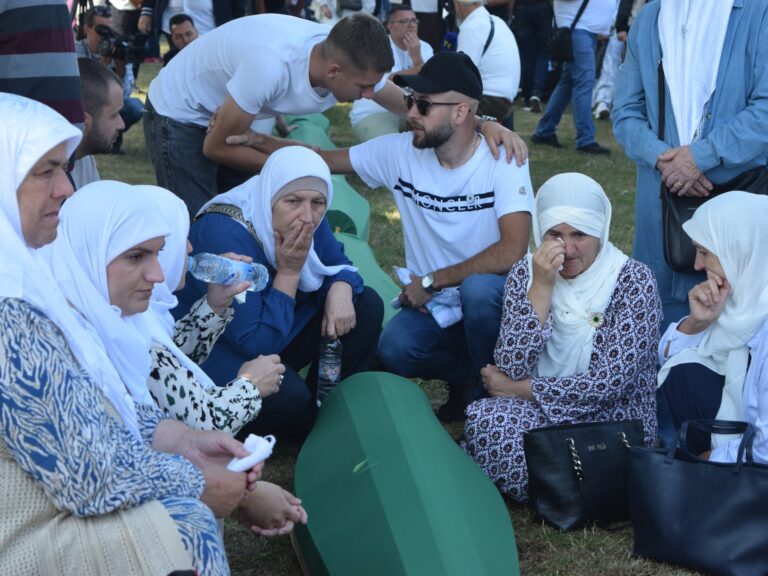
After the remains had been buried, the victims’ families crowded around the sites, wiping away their tears as an imam recited verses over the caskets.

Men take turns covering the caskets with soil, shoveling from nearby mounds of dirt.
Men take turns covering the caskets with soil, shovelling from nearby mounds of dirt [Urooba Jamal/Al Jazeera]

‘I will keep coming as long as I’m alive’

Fikrera Tuhljakovic, 66, attends the memorial here each year, but this year her cousin was among the victims being buried.

She said she is determined to ensure he is remembered and that all of the victims are never forgotten.

“I will keep coming as long as I’m alive,” Tuhljakovic told Al Jazeera.

Forensic scientists and the International Commission on Missing Persons have, in the decades since the mass killings, worked to locate the remains of those killed.

More than 6,000 victims have been buried at the memorial site in Potocari, but more than 1,000 remain missing.

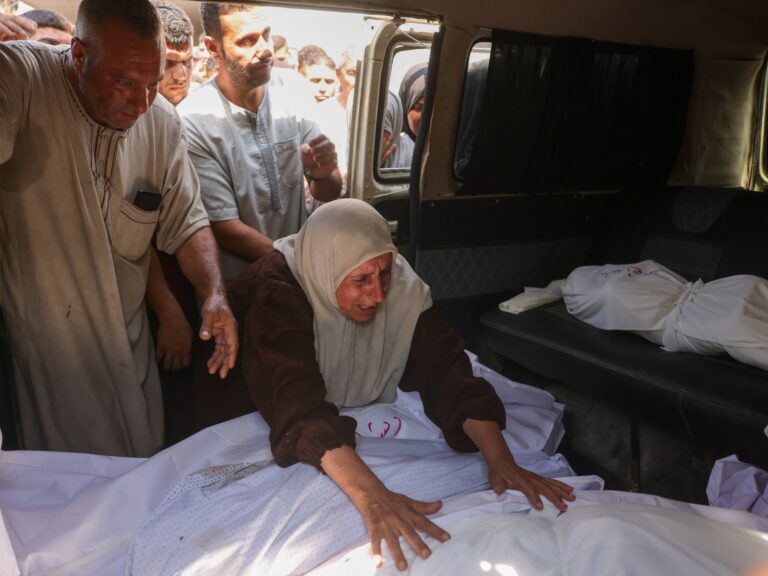
A woman mourns the burial of her loved one [Urooba Jamal/Al Jazeera]
A woman mourns during the burial of her loved one [Urooba Jamal/Al Jazeera]

In 2007, the International Court of Justice (ICJ) declared the events in Srebrenica and the surrounding area a genocide. Bosnian Serb leaders Radovan Karadzic and Ratko Mladic were both convicted of genocide, war crimes and crimes against humanity and sentenced to life in prison.

In total, the tribunal and courts in the Balkans have sentenced almost 50 Bosnian Serb wartime officials to more than 700 years in prison for the genocide.

But many accused remain unpunished. Denial of the genocide also continues – especially among political leaders in Serbia and the Serb-majority entity of Republika Srpska, which was established in the northeast of the country at the start of the war in 1992 with the stated aim of protecting the interests of the Serbs of Bosnia and Herzegovina.

According to Emir Cica, Islamic Relief’s Bosnia country director, international institutions have not done enough to prevent events like Srebrenica from happening again, with similar atrocities happening in Gaza at the moment.

“When we see what has happened, for example, in Gaza, it is very painful for us because we understand this [experience],” Cica told Al Jazeera.

For Avdic, Gaza is indeed a painful reminder of history repeating itself.

“Today we are burying our victims of genocide, and today in Gaza, genocide is happening, too,” he said solemnly.

“I don’t know what kind of message to send; there’s no effect on those in power who could actually do something.”

Srebrenica Genocide Memorial in Potocari
The Srebrenica Genocide Memorial in Potocari [Urooba Jamal/Al Jazeera]

Achieving Unprecedented Levels in 3D-Printed Construction

0

3D printing in construction is revolutionizing the industry, offering a faster, more affordable, sustainable, and creative method for creating living spaces. This technology is altering construction methodologies and expanding architectural design possibilities, turning previously unfeasible projects into reality. The White Tower, or Tor Alva, is an initiative by the ETH Zurich that exemplifies 3D printing’s potential in construction.

The White Tower overlooking the Alps

This thirty-meter-high building crafted through 3D printing with concrete extrusion is envisioned as a space for art installations and musical and theatrical performances. Its innovative design draws inspiration from the baroque builders of Canton Graubünden in Switzerland while embracing the possibilities offered by computational design and digital fabrication to revamp traditional building systems.

With a printing process that reduces concrete consumption by half and eliminates the need for formwork, the tower promotes a modular and sustainable construction method for the structural elements, which can be disassembled and rebuilt in another location. Designed to act as a beacon for travelers, the White Tower will be positioned along the Juliers Pass in the Alps, near the remains of an ancient Roman sanctuary. The structure will feature one hundred and two columns 3D printed with white concrete, supporting different levels connected by a spiral staircase. The top floor is designed to house an auditorium with seating for fifty people.

The construction process of the tower is anticipated to be completed in less than 900 hours, demonstrating the significant potential of 3D printing technologies in construction to streamline project timelines. And that is not the only advantage of this construction technique.

Advantages of 3D printing in the construction industry

3D printing in the construction sector is revolutionizing how structures are conceptualized, designed, and built. This technology offers several significant benefits that make it particularly attractive for various projects.

  • Accelerated construction times: As noted above, the ability to 3D print components and structures continuously allows projects to be completed in a much shorter timeframe compared to traditional construction methods.
  • Design flexibility: 3D printing in construction offers unprecedented design freedom, allowing the creation of shapes and structures that would be difficult or impossible to realize with conventional techniques.
  • Sustainability: This technology promotes sustainable construction by minimizing material waste and enabling the use of more environmentally friendly materials. The precision of 3D printing in construction ensures that only the exact amount of material needed for each project is used.
  • Customization: Allows mass customization of projects at a relatively low cost. Each element can be designed and manufactured to meet specific needs without significantly increasing production costs since no molds or formwork are required.
  • Improved safety: The automation of the construction process through 3D printing reduces the exposure of workers to hazardous working conditions, minimizing the risk of accidents in the workplace.
  • Cost reduction: 3D printing can significantly reduce construction costs by reducing the amount of wasted materials and optimizing the use of resources. In addition, the automation of the construction process reduces the need for labor, which also contributes to cost savings. In this video, you can learn about two techniques that allow to achieve these results:


3D printing methods in the construction industry

There are various 3D printing techniques currently under research and development, each with specific applications and advantages depending on the project and its location.

  • Material extrusion: Deposits materials layer by layer, commonly concrete or plastic, following a digital design. This is the additive manufacturing technique being used in the construction process of the White Tower, where a robot deposits layers as thin as five millimeters.
  • Binder jet printing: Uses a liquid binder sprayed onto a powdered material, layer by layer, to form a solid object.
  • Stereolithography (SLA) for construction: Creates objects by solidifying a liquid resin with ultraviolet light, layer by layer.
  • Selective laser sintering (SLS) for construction: Uses a laser to melt and solidify a material powder, building the desired object layer by layer.
  • Laser powder bed fusion (LPBF) or selective laser melting (SLM) for metals: Similar to SLS, but focused on metals, it melts metal powders with lasers to form complex structures.

Of all these 3D printing methods, the most common is material extrusion, especially with the use of concrete, due to its versatility, cost-effectiveness and the ability to build large-scale structures. In addition, this technique allows for a wide range of applications in the construction sector, from small components to entire buildings.

Interested in exploring further applications of 3D printing in construction? Dive into this insightful article to see how art and architecture merge beautifully in the creation of an extraordinary piece of 3D-printed street furniture.

Source:

Imágenes:

Stocks decline and Canadian dollar loses strength due to Trump’s increased tariffs.

0

Stocks fall, Canadian dollar weakens as Trump doubles down on tariffs

Kurdish PKK Takes Significant Step Towards Resolution of Turkey Conflict by Destroying Guns in Cauldron

0

Ayse Sayin

BBC Turkish, Ankara

Paul Kirby

Europe digital editor

Kurdish PKK burns guns in symbolic step towards ending Turkey conflict

After four decades of conflict with the Turkish state, the outlawed Kurdish PKK has held a ceremony to mark a symbolic first act in laying down its arms.

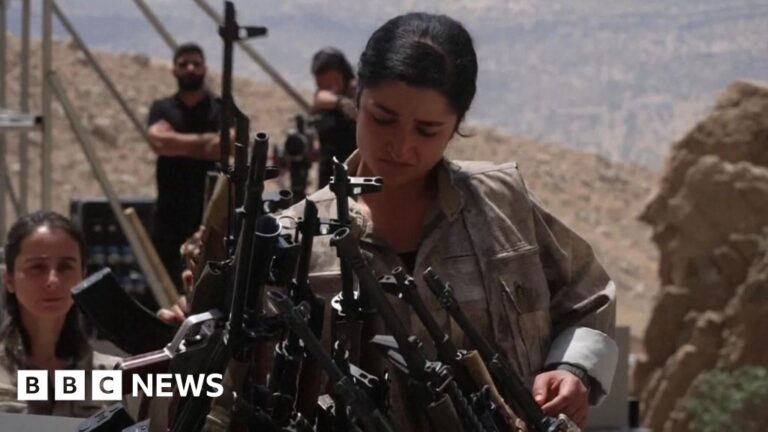
About 30 fighters, men and women, placed their weapons in a cauldron, starting a disarmament process expected to last all summer.

Turkish President Recep Tayyip Erdogan said the ceremony marked an “important step towards our goal of a terror-free Turkey”.

Some 40,000 people have been killed since the conflict began, and the PKK is listed as a terror group in Turkey, the US, EU and UK. Its disarmament will be felt not just in Turkey but in Iraq, Syria and Iran.

How did the disarmament begin?

A convoy of reporters and politicians, including members of Turkey’s pro-Kurdish opposition Dem party, were taken to a well known tourist spot to witness the ceremony – at Jasana cave 50km (30 miles) north-west of the city of Suleymaniyah in Iraqi Kurdistan.

The PKK fighters, including four high-ranking officials, lined up to put their weapons in the cauldron, where they were set alight.

Reuters A woman places a gun into a cauldronReuters

Fifteen women and 15 men took part in the ceremony at a cave in Iraqi Kurdistan

“We voluntarily destroy our weapons, before your presence, as a step of goodwill and determination,” the group said in a statement, describing it as a historic, democratic step.

Earlier this week, the PKK’s long-imprisoned leader, Abdullah Ocalan, said it was “a voluntary transition from the phase of armed conflict to the phase of democratic politics and law”.

Ocalan has been in solitary confinement on the small prison island of Imrali, south-west of Istanbul, since he was captured in 1999.

The process will continue over the coming months at points set up with the involvement of the Turkish, Iraqi and Kurdistan regional governments, BBC Turkish has been told.

Who are the PKK and why has the conflict lasted so long?

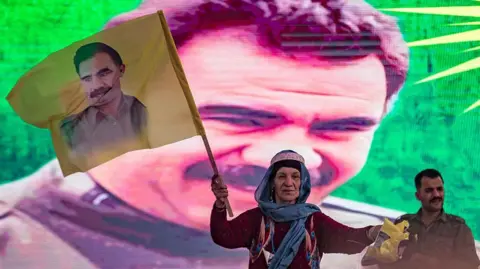
DELIL SOULEIMAN/AFP A supporter holds a flag with the face of Abdullah Ocalan, with his face also on the backdrop behind herDELIL SOULEIMAN/AFP

Imprisoned PKK leader Abdullah Ocalan still commands support among many Kurds

This is not the first attempt at peace involving Turkey and the PKK, but this is the best hope so far that the armed struggle that began in 1984 will come to an end.

Originally a Marxist group, the Kurdistan Workers’ Party took up arms calling for an independent state inside Turkey.

In the 1990s, they called instead for greater autonomy for Kurds, who make up about 20% of the population.

Ocalan announced a ceasefire in 2013, and urged PKK forces to withdraw from Turkey. The 2015 Dolmabahce Agreement was supposed to bring democratic and language rights for Kurds, but the fragile truce collapsed amid devastating violence, especially in the Kurdish-dominated cities of the south-east, including Diyarbakir.

Turkey’s air force targeted PKK bases in the mountains of northern Iraq. Several military campaigns have also targeted Kurdish-led forces in Syria.

The government in Ankara ruled out further talks until the PKK laid down its arms. That has now begun to take place.

Why has the PKK decided to disband?

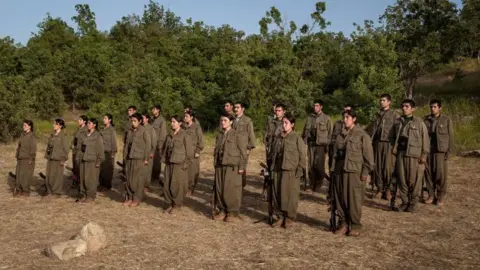
Getty Images PKK fighters training in Iraqi KurdistanGetty Images

A fragile ceasefire with the PKK broke down in 2015

In October 2024, a prominent nationalist leader and key Erdogan ally called Devlet Bahceli began a process described by the government as “terror-free Turkey”. He urged the PKK’s imprisoned leader to call for the dissolution of the outlawed group. It could pave the way for his possible release from Imrali island, he suggested.

The Turkish government launched talks with Ocalan via the pro-Kurdish Dem party, and then in February came his historic appeal for the PKK to disband, read out by two Dem MPs who had just returned from a visit to the prison island.

“All groups must lay their arms and the PKK must dissolve itself,” read Ocalan’s letter.

The PKK had been formed primarily because “the channels of democratic politics were closed”, he said, but Devlet Bahceli and Erdogan’s own positive signals had created the right environment.

The PKK followed Ocalan’s lead and declared a ceasefire and later declared that it had “completed its historical mission”: the Kurdish issue could now “be resolved through democratic politics”.

President Erdogan said it was an “opportunity to take a historic step toward tearing down the wall of terror” and met pro-Kurdish politicians in April.

Why is Ocalan so important?

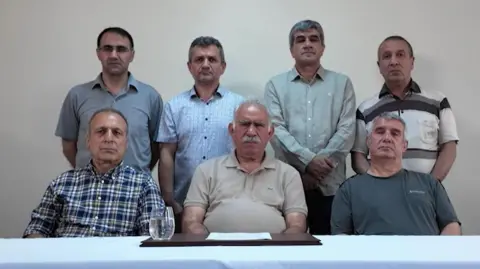
ANF Seven men - three sitting and four standing - are in front of a camera looking solemn.ANF

Ocalan, in the centre at the front, released a video on Wednesday ahead of Friday’s ceremony

As founder of the PKK, Ocalan continues to be reviled by many Turks, even after 26 years in solitary confinement.

And yet he still plays an important role in the eyes of Kurds.

“I think he really has this authority; he is a main symbol for many Kurds, not all,” says Joost Jongerden, a specialist on the 41-year conflict at Wageningen University in the Netherlands.

Two days before the PKK were due to begin disarmament, Ocalan appeared on video for the first time since he was put on trial more than 20 years ago.

Speaking for seven minutes, he addressed the outlawed group: “I believe in the power of politics and social peace, not weapons. And I call on you to put this principle into practice.”

Ocalan was wearing a beige Lacoste polo shirt, and in an indication of his enduring relevance, the shirt quickly went viral and websites selling it ran out of stock.

What happens next?

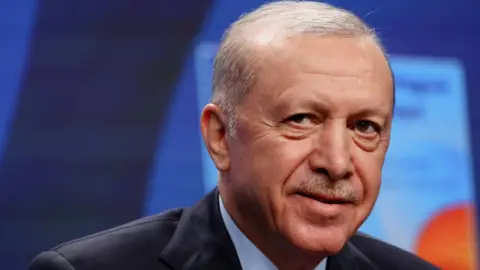
Reuters Turkey's President Erdogan looks at the camera Reuters

Turkey’s President Erdogan has denied wanting to continue in office when his term runs out

The scene will now switch to Turkey’s parliament in Ankara where a commission will be set up to make decisions on the next steps for the government.

As the summer recess is around the corner, no concrete decisions are expected for several months, when MPs vote on the commission’s recommendations and President Erdogan has the final say.

What happens to Abdullah Ocalan is not yet clear. The government says his conditions in jail could be reviewed as the process unfolds, but any chance of release will be left to the latter stages.

What’s in this process for Erdogan?

Erdogan’s AK Party has begun work on changing the constitution, and there has been speculation that this would mean Erdogan would be able to run for the presidency again when his final term runs out in 2028.

The AKP and pro-Kurdish Dem party deny there is any link between the peace process and reshaping the constitution, but if Erdogan secures Dem support he would have a far greater chance of pushing through changes.

Erdogan is behind in the polls, but his main opposition rival, Istanbul Mayor Ekrem Imamoglu, is in jail accused of corruption, which he denies, and more opposition mayors have been arrested as part of a crackdown in the past week.

Nonprofit CEO mobilizes 200 businesses to secure significant childcare victories under Trump’s legislation

0

– Childcare win. The recently passed “One Big Beautiful Bill” will have far-reaching effects on everything from income taxes to student loans to immigration. One under-covered aspect of the law: It also includes billions of dollars in childcare-related tax cuts, a rare win for a pocketbook issue that Washington typically overlooks.

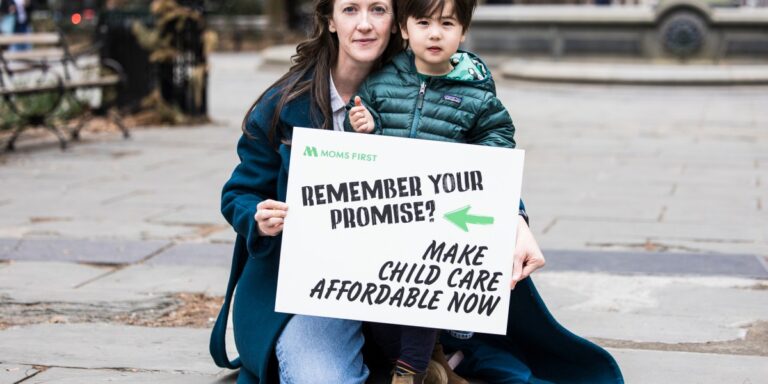
The key to winning the investment, says Reshma Saujani, CEO of advocacy organization Moms First, was getting businesses on board and appealing to voters across the political spectrum. Knowing the tax bill would be the first big opportunity in the second Trump administration to address childcare, Saujani says the organization focused on building a strategy that involved over 200 businesses and bipartisan parents advocating for federal relief. Earlier this year, representatives from over 50 employers, including UPS, Toyota, and Mazda, traveled to Capitol Hill to meet with legislators and demand action. In fact, Saujani was “overwhelmed” by the willingness of businesses to help.

“Childcare, as you know, has been seen as a personal problem for women and workers, but not an economic imperative,” Saujani says. “We knew we needed to get businesses to make the case…when we were in those offices, many of the Republicans and the Democrats, quite frankly, noted that this was the first time businesses had ever been in their office to advocate for childcare.”

While it’d be easy to give up on the goal during a Republican administration—the party has been resistant to expanding childcare and paid leave policies—Saujani and Moms First pushed ahead: Since January, they partnered with a conservative pollster to better understand what messaging would get across in the administration and helped get 25,000 parents to tell lawmakers that childcare should be a priority, in addition to their visits to Congress. The fact that businesses are so eager to help and Republicans expanded the tax breaks shows how salient the issue has become for families of all political stripes.

“We knew we needed to make clear that childcare was the linchpin of affordability. This president and Congress had gotten elected on affordability,” she says.

The strategies worked. The tax breaks included in the bill that Moms First advocated for include:

  • The Child and Dependent Care Tax Credit, or CDCTCPermanently expands this credit for working parents for the first time since 2001.
  • Employer-Provided Child Care Credit: Triples the maximum credit to employers to help locate or provide childcare for their employees, also last updated in 2001.
  • Dependent Care Assistance Plans, or DCAP: Increases the pre-tax amount parents can put in these flexible spending plans to pay for childcare expenses, from up to $5,000 annually to up to $7,500. This was last updated in 1986.

The Child Tax Credit was also increased from $2,000 per child to $2,200. While the tax breaks are a win, the bill also includes provisions that experts say will harm families, particularly those who are lower income. After the midterm elections next year, the new law slashes funding for Medicaid, which covers 41% of all births in the U.S. while also providing care for millions of disabled kids. Funding for nutrition benefits, including for families with children, will also be cut. But Saujani says the organization isn’t waiting for the “perfect moment” or perfect piece of legislation, they’re fighting at every opportunity.

“What we realized in this advocacy is that progress isn’t sweeping, it’s incremental,” she says. “We’re in a once-in-a-lifetime generational fight for childcare, and that means that we have to celebrate the wins even when they’re imperfect.”

Alicia Adamczyk
alicia.adamczyk@fortune.com

The Most Powerful Women Daily newsletter is Fortune’s daily briefing for and about the women leading the business world. Today’s edition was curated by Sara Braun. Subscribe here.

ALSO IN THE HEADLINES

Farmer funding. The U.S. Department of Agriculture announced that it would no longer consider a farmer’s race or sex in many of its loan, commodity, and conservation programs. The move comes amid the Trump Administration’s overarching push to end DEI policies in the federal government. Reuters

Rose’s turn. WPP, the multinational advertising group, has named Cindy Rose as its next CEO. Rose currently serves as the COO of Microsoft’s global enterprise business. She’ll be taking over for Mark Read, who has led the company for the past seven years. Fortune

An American upset. Amanda Anisimova, an American tennis player and 13th seed at Wimbledon, defeated number one seed Aryna Sabalenka in the semi-finals on Thursday. Anisimova moves on to the final, where she’ll compete against Iga Swiatek on Saturday. At 23, Anisimova is the youngest American woman to make it to the Wimbledon final since Serena Williams. NBC News

-Moët Hennessy under fire. Moët Hennessy, LVMH’s drinks division, is facing accusations of sexual harassment, gender discrimination, and unfair dismissal in a whistleblower lawsuit. Other staff members say it’s part of a pattern at the company. Financial Times

MOVERS AND SHAKERS

Bespoke Partners, an executive recruiting and leadership advisory firm, announced the promotion of Jenny Gray to partner. She most recently served as senior vice president in the company’s CEO practice. 

BrainXell, a biotechnology company specializing in central nervous system disease models, appointed Katherine Vega Stultz as CEO and board director. She previously served as the CEO and president of Ocelot Bio.

First U.S. Community Credit Union named Jennifer Wilkinson as its first chief lending officer. 

McCann Worldgroup, a global creative solutions company, appointed Ida Rezvani as president and global chief client officer. She most recently served as global client lead at Publicis.

Osmose Utilities Services, an asset management solutions company, appointed Harsha Tank as chief financial officer. She most recently served as CFO at Veritext Legal Solutions. 

The Picklr, an indoor pickleball franchise, announced the appointment of Abby Olson as chief operating officer. She most recently served as VP of field operations at Crumbl. 

ON MY RADAR

Yaccarino’s break from Musk was months in the making Wall Street Journal

What Caitlin Clark learned from Michael Jordan and Phil Jackson on the path to stardom The Athletic

For years, women complained that this medical procedure was painful. Doctors are finally listening Vox

PARTING WORDS

“I have these crazy anxieties, and I get freaked out, and I do have impostor syndrome. And that’s just very human, but also, I can do it. I’ve gotten this far.” 

Actor Madelyn Cline on ambition and insecurity in her career

This is the web version of MPW Daily, a daily newsletter for and about the world’s most powerful women. Sign up to get it delivered free to your inbox.

The Contamination of a River in Thailand

0

Unregulated heavy rare earth mining in war-torn Myanmar is poisoning the Kok River in Thailand. Hannah Beech, a New York Times reporter based in Bangkok, spoke to locals about the negative effects.

Kobalt signs publishing agreement with country songwriter Derrick Southerland, secures rights to part of his song catalog

0

Independent music publisher Kobalt has signed a global publishing deal with Derrick Southerland, the Grammy- and Country Music Awards-nominated songwriter best known for Ingrid Andress’ hit More Hearts Than Mine.

As part of the deal, Kobalt has acquired a portion of Southerland’s song catalog, the company said in a statement on Thursday (July 10). The value of the transaction was not disclosed.

Sutherland’s songs have accumulated more than 1 billion streams and secured film and TV placements with ABC, Hallmark and Netflix, among others. He was nominated for a Best Country Song award at the 63rd Annual Grammys for More Hearts Than Mine, which picked up the Song of the Year prize at the Nashville Songwriters Association International awards in 2020, as well as Song of the Year at the MusicRow awards.

Sutherland also worked with Andress on the gold-certified Lady Like, as well as Seeing Someone Else and Yearbook, which made Rolling Stone’s list of 100 Best Songs of 2022.

Beyond his work with Andress, Sutherland has co-written songs for Carrie Underwood, Jordan Davis, Vince Gill, Fletcher, Laci Kaye Booth, Hunter Hayes, Breland, Charlotte Sands, High Valley, Charles Kelley, Muscadine Bloodline, Tanner Adell, Blair Davie and Dallas Smith, among many others.

He worked on Kane Brown’s gold-certified Like A Rodeo and Joshua Bassett’s Crisis, which NPR named one of the Top 10 Songs of 2021. Sutherland shares a writing credit on Mitchell Tenpenny’s current hit Same Moon.

“I’m so excited to be partnering with Kobalt,” Southerland said.

“When I met with [Kobalt Music Group CEO] Laurent Hubert, [President and COO] Jeannette Perez, [General Manager/SVP of Creative at Kobalt Nashville] Stephanie Cox, [EVP/Head of US Creative] Rani Hancock, [Head of Creative UK] Kenny McGoff and so many others of the creative team, I knew this was where I needed to be.

“[Kobalt’s] enthusiasm not only about my writing and songs, but my dreams and vision for the future made this the perfect partnership to help me accomplish my goals.”

Derrick Southerland

“Their enthusiasm not only about my writing and songs, but my dreams and vision for the future made this the perfect partnership to help me accomplish my goals. Huge thanks to [Senior Creative Director] Kevin [Lane], who was with me for my first major label outside cut and brought me to this amazing team. I’m looking forward to what’s coming in this next chapter of our careers.”

Stephanie Cox added: “Derrick is one of the most gifted, prolific songwriters working in Nashville today. He has the incredibly unique ability to write across genres which makes him a perfect fit for Kobalt’s global ecosystem.”

“Derrick and I had the opportunity to work together early in our careers, and I am ecstatic to have the opportunity to work with him again,” Lane said.

“His ability to craft songs that permeate the Nashville community while having multi-genre impact is rare. Combine that with his relentless work ethic, and you have a true creative force to be reckoned with. The sky’s the limit for what we can accomplish together, and I’m so excited to see where this partnership takes us.”

For Francisco Partners-owned Kobalt, the deal with Southerland comes in the wake of a number of new signings and initiatives. The company formed a joint venture with emerging markets-focused label Heatwave last fall, following that up with a global publishing admin deal with Música Mexicana indie record label K Music in May.

“Derrick is one of the most gifted, prolific songwriters working in Nashville today.”

Stephanie Cox, Kobalt

Kobalt also inked a publishing admin deal with The Circuit Group, a music company formed by industry veterans to acquire stakes in catalogs, and a global licensing deal with blockchain-powered music platform Audius.

It also signed a music publishing admin deal with licensing platform Slipstream, which included Kobalt taking a stake in the company.

Earlier this year, Kobalt launched Kosign, a new publishing platform aimed at emerging artists and songwriters with the goal of addressing the problem of uncollected royalties.

SVP and Head of Kosign Jason Feinberg recently told MBW that the platform already represents 12,000 songs.Music Business Worldwide

Multiple casualties in Israeli strike on northern Gaza school described as ‘Beyond horrific’

0

‘Panic, fear, and terror that swept through the school overwhelming’ says survivor. of strike in Jabalia an-Nazla.

At least eight people have been killed, including children, in an Israeli bombardment of the Halimah al-Saadiyah School in Jabalia an-Nazla, in northern Gaza, where displaced Palestinians were sheltering, according to sources at al-Shifa Hospital in Gaza City who spoke to Al Jazeera.

Several people were also injured in the attack. Survivors relayed a harrowing scene of inferno.

“I saw the whole area filled with dust – that’s when I realised the strike had hit this place,” Abu Haitham Khalla told Al Jazeera, standing among the rubble.

“The panic, fear, and terror that swept through the school was overwhelming. There were about 1,000 displaced people sheltering here – tents and classrooms all being used as refuge,” he said.

“So far, 10 people have been confirmed killed, in addition to many injuries – all of them women and children,” he added.

Another witness, Ahmed Khalla, said he found dead victims people lying on the floor of a classroom. “Children torn apart, charred. Women who had done absolutely nothing. The scenes were beyond horrific. I saw a little girl without a head – literally, without a head.”


Challenging the Client

0


Client Challenge


JavaScript is disabled in your browser.

Please enable JavaScript to proceed.

A required part of this site couldn’t load. This may be due to a browser
extension, network issues, or browser settings. Please check your
connection, disable any ad blockers, or try using a different browser.

The Experience of Migrant Children Seeking to Come to the UK

0

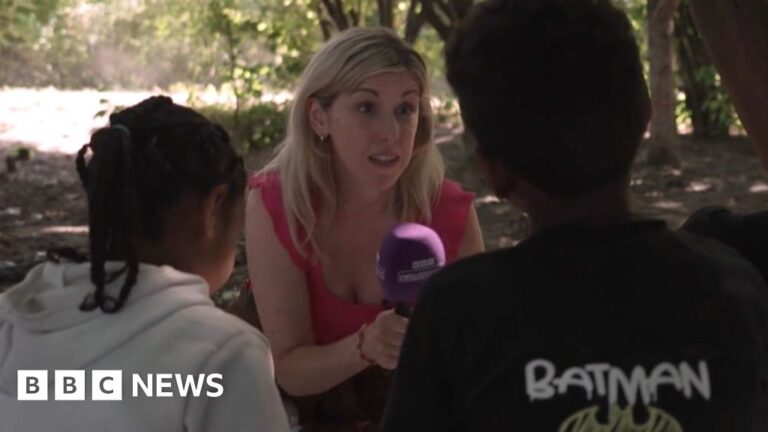
Nearly 20,000 people arrived in the UK in the first half of this year by crossing the English Channel in small boats, up by almost 50% from the same period last year.

BBC Newsround correspondent Jenny Lawrence went to Calais to find out why so many people, including children try to make the dangerous crossing from France daily.