U.S. stocks powered higher on Monday as strong earnings overshadowed continued uncertainty on tariffs and the White House’s pressure on the Federal Reserve.
The S&P 500 closed up 0.14%, and the Nasdaq rose 0.38%, paring gains after touching new all-time intraday highs. The Dow Jones Industrial Average reversed lower, slipping 19 points, or 0.04%.
The yield on the 10-year Treasury dropped 4.7 basis points to 4.384%. The U.S. dollar fell 0.55% against the euro and sank 0.97% against the yen. That’s after upper-house parliamentary elections in Japan were not as disastrous for Prime Minister Shigeru Ishiba’s coalition as feared, though his future remains in doubt.
Gold jumped 1.52% to $3,409.50 per ounce. U.S. oil prices dipped 0.52% to $66.99 per barrel, and Brent crude lost 0.42% to $68.99.
Verizon helped the market after beating quarterly earnings forecasts and raising its profit outlook for the year. Shares of the telecom giant surged 4%.
That follows upbeat results last week from big banks like JPMorgan, which said U.S. consumers remain resilient despite headwinds from tariffs.
After the first week of this earnings season, 73% of companies have beaten per-share profit estimates, above the first-week average of 68%, according to Bank of America.
Meanwhile, Trump’s trade war and his war on the Fed are still hanging over the market.
On Monday, Treasury Secretary Scott Bessent told CNBC that trade talks are moving along, adding that getting a good deal is more important than the timing of a deal. That could suggest the Aug. 1 deadline, when higher tariff rates are due to kick in, may be more flexible.
In the same interview, he also ramped up pressure on Fed Chairman Jerome Powell, who has resisted Trump’s calls to lower rates. Bessent said “the entire Federal Reserve institution” should be examined.
That’s after the White House accused Powell of mismanagement over the Fed headquarters renovation, while backing off suggestions he should be fired.
The UK and 27 other countries have called for an immediate end to the war in Gaza, where they say the suffering of civilians has “reached new depths”.
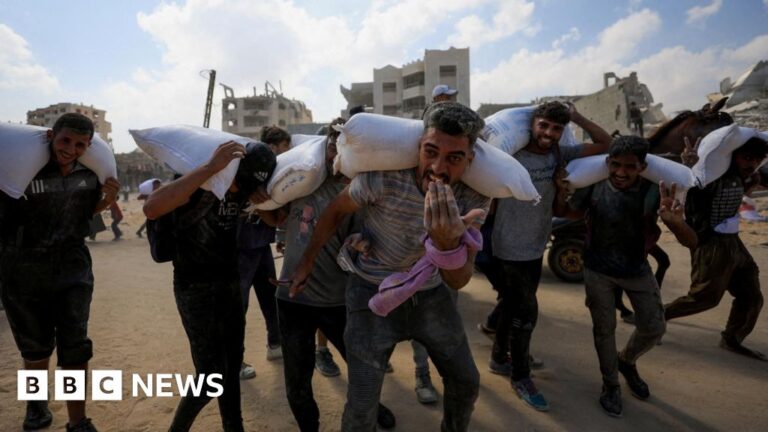
A joint statement says Israel’s aid delivery model is dangerous and condemns what it calls the “drip feeding of aid and the inhumane killing of civilians” seeking food and water.
Gaza’s Hamas-run health ministry said more than 100 Palestinians were killed by Israeli fire while waiting for food over the weekend and that 19 others died as a result of malnutrition.
Israel’s foreign ministry rejected the countries’ statement, saying it was “disconnected from reality and sends the wrong message to Hamas”.
The ministry accused the armed group of spreading lies and undermining aid distribution, rather than agreeing to a new ceasefire and hostage release deal.
There have been many international statements condemning Israel’s tactics in Gaza during the past 21 months of its war with Hamas. But this declaration is notable for its candour.
The signatories are the foreign ministers of the UK and 27 other nations, including Australia, Canada, France, Italy, Japan, New Zealand and Switzerland.
The statement begins by declaring that “the war in Gaza must end now”.
It then warns: “The suffering of civilians in Gaza has reached new depths. The Israeli government’s aid delivery model is dangerous, fuels instability and deprives Gazans of human dignity.”
“We condemn the drip feeding of aid and the inhumane killing of civilians, including children, seeking to meet their most basic needs of water and food. It is horrifying that over 800 Palestinians have been killed while seeking aid.”
There have been almost daily reports of Palestinians being killed while waiting for food since May, when Israel partially eased an 11-week total blockade on aid deliveries to Gaza and, along with the US, helped to establish a new aid system run by the Gaza Humanitarian Foundation (GHF) to bypass the existing one overseen by the UN.
Israel has said the GHF’s system, which uses US private security contractors to hand out food parcels from sites inside Israeli military zones, prevents supplies being stolen by Hamas.
But the UN and its partners have refused to co-operate with the system, saying it is unsafe and violates the humanitarian principles of impartiality, neutrality, and independence.
Last Tuesday, the UN human rights office said it had recorded 674 killings in the vicinity of the GHF’s aid sites since they began operating eight weeks ago. Another 201 killings had been recorded along routes of UN and other aid convoys, it added.
On Saturday, another 39 people were killed near two GHF sites in Khan Younis and nearby Rafah, according to Gaza’s health ministry. The Israeli military said its troops fired warning shots to prevent “suspects” approaching them before the sites opened.
And on Sunday, the ministry said 67 people were killed as they surged toward a convoy of UN aid lorries near a crossing point in northern Gaza. The Israeli military said troops fired warning shots at a crowd “to remove an immediate threat” but disputed the numbers killed.
Following the incident, the World Food Programme warned that Gaza’s hunger crisis had “reached new levels of desperation”.
“People are dying from lack of humanitarian assistance. Malnutrition is surging with 90,000 women and children in urgent need of treatment,” the UN agency said.
Gaza’s Hamas-run health ministry said on Monday that 19 people had died as a result of malnutrition since Saturday and warned of potential “mass deaths” in the coming days.
“Hospitals can no longer provide food for patients or staff, many of whom are physically unable to continue working due to extreme hunger,” Dr Khalil al-Daqran, a spokesperson for al-Aqsa hospital in Deir al-Balah, told the BBC.
“Hospitals cannot provide a single bottle of milk to children suffering from hunger, because all baby formula has run out from the market,” he added.
Residents also reported that markets were closed due to food shortages.
“My children cry from hunger all night. They’ve had only a small plate of lentils over the past three days. There’s no bread. A kilogramme of flour was $80 (£59) a week ago,” Mohammad Emad al-Din, a barber and father of two, told the BBC.
The statement by the 27 countries also says Israeli proposals to move Gaza’s entire 2.1 million into a so-called “humanitarian city” in the southern Rafah area are unacceptable, noting that “permanent forced displacement is a violation of international humanitarian law”.
They urge Israel, Hamas and the international community to “bring this terrible conflict to an end, through an immediate, unconditional and permanent ceasefire”.
And they warn that they are “prepared to take further action to support an immediate ceasefire and a political pathway to security and peace”.
That is seen by many as code for recognising a state of Palestine, something many countries have done but not all, including the UK and France.
Israeli foreign ministry spokesperson Oren Marmorstein rejected the criticism.
“All statements and all claims should be directed at the only party responsible for the lack of a deal for the release of hostages and a ceasefire: Hamas, which started this war and is prolonging it,” he said.
“Instead of agreeing to a ceasefire, Hamas is busy running a campaign to spread lies about Israel. At the same time, Hamas is deliberately acting to increase friction and harm to civilians who come to receive humanitarian aid,” he added.
The Israeli military body responsible for co-ordinating aid, Cogat, also said that Israel “acts in accordance with international law and is leading efforts to facilitate the entry of humanitarian aid into Gaza in co-ordination with the international organisations”.
A spokesperson for the GHF meanwhile appealed to UN agencies to join its operation while also blaming them for “stopping” work and for failing to deliver supplies across the territory.
Chapin Fay told journalists that he had been to border crossings where he saw aid supplies “rotting” because UN agencies would not deliver them.
The Israeli foreign ministry said on Sunday that 700 lorry loads of aid were waiting to be picked up by the UN from crossings.
The UN has said it struggles to pick up and distribute supplies because of the ongoing hostilities, Israeli restrictions on humanitarian movements, and fuel shortages.
The Israeli military launched a campaign in Gaza in response to the Hamas-led attack on southern Israel on 7 October 2023, in which about 1,200 people were killed and 251 others were taken hostage.
At least 59,029 people have been killed in Gaza since then, according to the territory’s health ministry.
Facebook and Instagram owner Meta Platforms has indicated it won’t be signing on to the European Union’s voluntary AI Code of Practice, which includes restrictions on how AI companies can collect copyrighted content.
In a statement posted to LinkedIn on Friday (July 18), Meta’s Chief Global Affairs Officer, Joel Kaplan, said the EU “is going down the wrong path” on AI policy.
“We have carefully reviewed the European Commission’s Code of Practice for general-purpose AI (GPAI) models and Meta won’t be signing it. This Code introduces a number of legal uncertainties for model developers, as well as measures which go far beyond the scope of the AI Act,” Kaplan wrote.
That sets Meta apart from a number of other major AI players, including ChatGPT maker OpenAI, which has declared that it will sign on to the voluntary Code of Practice.
On Monday (July 21), Anthropic, the AI developer being sued by music publishers over claims its Claude chatbot reproduced copyrighted lyrics, threw its support behind the Code of Practice, and according to a report at Reuters, Microsoft also plans to sign on.
The Code of Practice stems from the EU’s AI Act, a comprehensive law regulating the development and use of AI that was passed last year. The law applies to any company that makes it AI tools available in the European Union.
The European Commission says the Code will “reduce [the] administrative burden” on AI developers created by the AI Act and “give them more legal certainty than if they proved compliance through other methods.”
Among other things, the Code of Practice restricts how AI developers can collect copyrighted content. It requires AI companies not to circumvent restrictions placed by rightsholders on web-scraping of their data, and not to collect content from copyright-infringing sources such as digital piracy websites. It also requires the companies to draw up policies on how they address copyright law, and are “encouraged” to make those copyright policies public.
“We have carefully reviewed the European Commission’s Code of Practice for general-purpose AI (GPAI) models and Meta won’t be signing it.”
Joel Kaplan, Meta
The EU AI Act created an “opt-out” system for AI development that means copyright holders have to explicitly state that they don’t want their content to be used in training AI models. That rule prompted both Sony Music Group and Warner Music Group to send letters to AI companies telling them the music companies don’t consent to having their music or lyrics used to train AI.
Many AI developers, including those that say they are signing on to the Code of Conduct, have been accused of using pirate sites to download massive troves of copyrighted content.
For instance, Anthropic was recently ordered by a federal court in California to stand trial over its downloading of digital books from online pirate libraries.
In a congressional hearing last week, lawyer Maxwell Pritt, who’s litigating a number of copyright cases against AI companies, accused them of “what is likely the largest domestic piracy of intellectual property in [US] history.”
Pritt presented internal communications from Meta staff, indicating that they were aware of the fact they were using illegally obtained content to train the company’s AI models.
In his statement on LinkedIn, Meta’s Kaplan pointed to a recent letter to the European Commission signed by the heads of more than 40 major European companies urging the EU to “stop the clock” on the implementation of the EU’s AI Act.
The letter, signed by the heads of companies including Airbus, BNP Paribas, Lufthansa, Mercedes-Benz, Philips, Total and leading French AI startup Mistral, said AI development in Europe is at risk of being “disrupted by unclear, overlapping and increasingly complex EU regulations.”
They argued the AI Act could potentially put European AI developers at a disadvantage and also delay the implementation of AI technologies across businesses, making Europe less competitive.
“We share concerns raised by these businesses that this over-reach will throttle the development and deployment of frontier AI models in Europe, and stunt European companies looking to build businesses on top of them,” Kaplan wrote.
“If thoughtfully implemented, the EU AI Act and Code will enable Europe to harness the most significant technology of our time to power innovation and competitiveness.”
Anthropic
However, other AI companies took a more positive view of the AI Act and the Code of Practice.
“We believe the Code advances the principles of transparency, safety and accountability – values that have long been championed by Anthropic for frontier AI development,” Anthropic stated on its website.
“If thoughtfully implemented, the EU AI Act and Code will enable Europe to harness the most significant technology of our time to power innovation and competitiveness.”
OpenAI said signing the Code of Practice “reflects our commitment to ensuring continuity, reliability, and trust as regulations take effect, while continuing to partner with European businesses and citizens, bringing them increasingly capable, safe, and secure AI models to reap the benefits of the AI revolution.”Music Business Worldwide
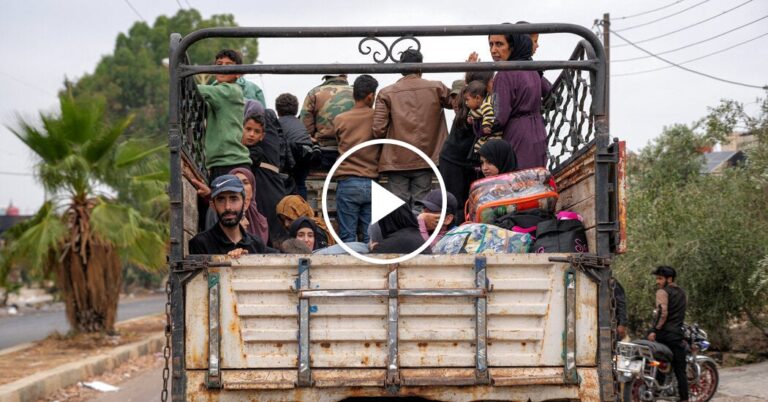
new video loaded: Bedouin Families Evacuate Syrian Province Hit by Violence
By Nader Ibrahim•
The cease-fire came after days of deadly violence between Bedouin tribes and local Druse militias. The government evacuated hundreds of Bedouin families from the southern Syrian province of Sweida.
A required part of this site couldn’t load. This may be due to a browser
extension, network issues, or browser settings. Please check your
connection, disable any ad blockers, or try using a different browser.
At least 49 Palestinians have been killed in Israeli attacks across Gaza, medical sources say, as the Israeli military has sent tanks into areas of Deir el-Balah in central Gaza for the first time since Israel began its assault on the besieged territory in October 2023.
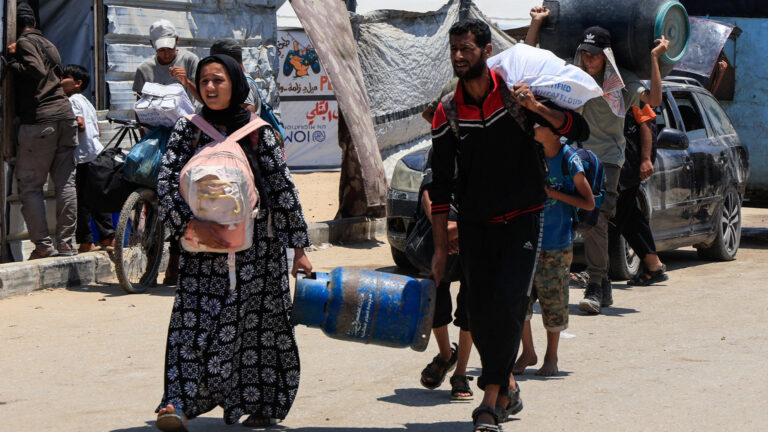
Israel on Monday launched the ground offensive on southern and eastern areas of the city that is packed with displaced Palestinians, a day after its military issued a forced displacement order for residents in the areas, forcing thousands of people to flee west towards the Mediterranean coast and south to Khan Younis.
Tank shelling in the area hit houses and mosques, killing at least three Palestinians and wounding several, the Reuters news agency reported, quoting local medics.
Reporting from Deir el-Balah, Al Jazeera’s Tareq Abu Azzoum said gunfire was audible as Israeli tanks rolled into the area on Monday morning.
“We can see that the entire city is under Israeli attack,” he said. “We did not manage to sleep last night.”
“There has been an ongoing Israeli bombardment. Israeli jets, tanks and naval gunboats continue to strike multiple residential areas. Three more squares were destroyed in the city, and then residential houses were flattened.”
Smoke and flames rise from a residential building hit by an Israeli strike in Gaza City on July 21, 2025 [Khamis Al-Rifi/Reuters]
He said many Deir el-Balah residents fled using donkey carts and other modes of transport.
Israel intensifies attacks
In Khan Younis in southern Gaza, an Israeli air strike killed at least five people, including a husband and wife and their two children, in a tent, medics said.
Among those reported killed since dawn on Monday were four aid seekers waiting for food near a distribution centre operated by the United States- and Israeli-backed Gaza Humanitarian Foundation (GHF).
Five other Palestinians were killed in a separate Israeli bombardment in Jabalia al-Balad in the north.
Earlier, the Palestine Red Crescent Society reported that its teams had recovered the body of one person and evacuated three wounded after an Israeli artillery strike on the nearby Jabalia al-Nazla area.
Drone strikes were reported in Gaza City, resulting in casualties, a source at al-Shifa Hospital told Al Jazeera Arabic.
The previous day, at least 134 people were killed and 1,155 injured by Israeli forces, according to the Gaza Ministry of Health. At least 59,029 people in Gaza have been killed since the war began.
On Sunday, Gaza health authorities reported at least 19 people had starved to death in one day, highlighting the desperate situation under the Israeli aid blockade.
In an interview with Al Jazeera, the World Food Programme’s Palestine representative, Antoine Renard, said the United Nations agency has warned for “weeks” that Palestinians in Gaza are facing starvation.
“You have a level of despair that people are ready to risk their lives just to reach any of the assistance actually coming into Gaza,” Renard said from occupied East Jerusalem.
“[There’s a] soaring number of people facing malnutrition, and we can really see that the situation is really getting to levels that we’ve never seen ever before.”
UNRWA, the UN agency for Palestinian refugees, said it is receiving “desperate messages of starvation” from inside Gaza, including from its staff, as humanitarian conditions continue to deteriorate.
“The suffering in Gaza is manmade and must be stopped. Lift the siege and let aid in safely and at scale,” UNRWA said in a statement posted on X.
Amjad Shawa, head of the Palestinian NGO Network, told Al Jazeera on Monday that 900,000 children are experiencing varying degrees of malnutrition in Gaza.
Twenty-five countries, including the United Kingdom, France and other European nations, issued a joint statement saying the war in Gaza “must end now” and Israel must comply with international law.
The foreign ministers of the 25 countries, including Australia, Canada and Japan, said “the suffering of civilians in Gaza has reached new depths”, and they condemned “the drip feeding of aid and the inhumane killing of civilians, including children, seeking to meet their most basic needs of water and food”.
“The Israeli government’s aid delivery model is dangerous, fuels instability and deprives Gazans of human dignity,” the statement said.
“The Israeli government’s denial of essential humanitarian assistance to the civilian population is unacceptable. Israel must comply with its obligations under international humanitarian law,” it said.
Prominent Kenyan activist Boniface Mwangi has been charged with illegal possession of ammunition linked to protests last month in which at least 19 people were killed.
He denied the charge and has been released on bail.
He was not charged with “facilitation of terrorist acts”, as the police had earlier said.
On Sunday, investigators said they had seized phones, a laptop, and notebooks from his Lukenya home on the outskirts of the capital, Nairobi, and hard drives, computers, tear gas canisters and a blank firearm roundfrom his office in the city.
His arrest – and especially the suggestion that he would face terrorism charges – sparked a wave of condemnation, with human rights groups denouncing it as aimed at suppressing opposition voices. The activist denied the accusations against him, saying in a post on X: “I am not a terrorist.”
As he appeared in court on Monday, fellow activists and supporters, who had gathered to show their solidarity and support, sang the national anthem.
The alleged offences are linked to the 25 June protests when, according to the state-funded Kenya National Commission on Human Rights (KNCHR), 19 people died when demonstrators clashed with police. Hundreds were also injured and property and businesses were damaged.
Most of those killed died from gunshot wounds, with human rights groups blaming police brutality.
However, Interior Minister Kipchumba Murkomen described the demonstrations as “terrorism disguised as dissent” and an “unconstitutional attempt” to change the government. He said that several police station had been attacked, with many officers injured and vehicles set on fire.
At least 38 more people were killed in subsequent protests earlier this month, the KNCHR says.
Since June last year, more than 100 people have been killed in successive waves of anti-government protests, with police accused of using excessive force to quell each one, leading to further demonstrations.
President William Ruto urged the police to shoot violent protesters in the leg, rather than killing them.
On Sunday, a coalition of 37 rights organisations condemned Mr Mwangi’s arrest on “unjustified terrorism allegations”, describing it as the “latest escalation in a systematic crackdown that has seen hundreds of young Kenyans detained on fabricated terrorism charges”.
“What began as targeted persecution of young protesters demanding accountability has metastasized into a full-scale assault on Kenya’s democracy,” they said in a joint statement.
James Orengo, a veteran politician and governor of Siaya county, said it was “ridiculous to charge Boniface Mwangi and our children who have demonstrated a high level of political consciousness with terrorism”.
Mr Mwangi has been detained multiple times in the past, and has been at the centre of many protests.
Following their release several days later, both said they had been abducted, tortured and sexually assaulted. They have since filed a case at the regional East African Court of Justice over the matter.
Mr Mwangi is widely regarded as one of Kenya’s most prominent and fearless activists with a significant part of his life defined by his push for social justice.
He has been the face of many protests in the past, some of them dramatic and symbolic. This includes the 2013 demonstration when he brought piglets covered in blood to the gates of parliament in a protest against “greedy MPs” – who were demanding a pay increase.
In 2024, he called on people to bring coffins to the streets in a symbol of the way he said MPs were taxing Kenyans “to death” and to represent people killed by police in protests.
He has been beaten, arrested and detained many times for his bold and provocative actions. He has often spoken about the physical and emotional scars from his years of activism – and yet he has remained undeterred.
A former photojournalist, Mr Mwangi rose to global prominence after he documented the deadly violence that followed the 2007 election, with his powerful images capturing the depth of the crisis in which more than 1,000 people died and 350,000 forced from their homes.
He subsequently won the CNN Africa Photojournalist of the Year Award in 2008.
Mr Mwangi has since said that the journey of documenting these images personally affected him and left him disillusioned. He later moved to activism, and has since won other accolades, including being named among the top 100 most influential Africans by New African magazine in 2020.
As mental health continues to take center stage in the workplace, employers have made strides in offering support, but we can still improve in understanding who, exactly, needs help and how to reach them. Too often, mental health strategies overlook the people quietly carrying layered responsibilities outside of work: caregivers, older employees, and women navigating pivotal life and health transitions.
These groups aren’t niche. They make up a large share of the workforce, and their needs are shaping the future of employee well-being.
Mental health doesn’t have a retirement age
Workers aged 55 and older now comprise over 20% of the U.S. labor force, yet they remain an afterthought in many workplace mental health programs. While older workers may report better self-rated mental health than their younger peers, they’re also more likely to be navigating chronic pain, grief, or caregiving, and less likely to use digital tools that could help.
According to a recent Calm Health study—the “Work-Life-Health Balance Report,” a survey of 1,500 adults across the U.S. and U.K.—half of all workers reported at least one mental health concern.Furthermore, a study by the Aging Society Research Network found the impact of mental health on older workers in the lower income bracket is even more pronounced, with users aged 50 to 59 reporting nearly five days a month where their mental health is impacted. This is noticeably worse than even just 20 years ago.
Unfortunately, usage of workplace mental health resources among older workers remains low. Importantly, the issue isn’t unwillingness: Over 80% of workers overall said they would be open to using digital tools if offered, provided those tools are trustworthy, simple, and relevant. However, just 23% are actually aware they are offered this kind of tool.
To truly support older employees, employers must design for inclusion. That could mean creating low barriers to entry for support or framing support in ways that resonate with goals like independence and longevity. These small changes can boost digital engagement, reduce absenteeism, and help retain some of an organization’s most experienced talent.
The ‘sandwich generation’ of caregivers needs attention
One of the most overlooked experiences impacting employee mental health is caregiving. In Calm Health’s study, one in three workers reported a caregiving event in the past year. These experiences, whether related to aging parents, children, or partners, don’t stay neatly outside work hours.
The impact is profound: 65% of caregivers said they had to take time off or use leave due to caregiving responsibilities, and more than half reported reduced productivity, difficulty focusing, or needing coworkers to cover for them.
And yet, caregiving benefits remain rare. While these programs are rated among the most helpful of any workplace mental health resource, they are also among the least offered, representing a major gap in employer support.
With more workers falling into the “sandwich generation,” caring for both children and aging parents, addressing this need isn’t just compassionate, it’s strategic. Employers can start by offering flexible scheduling, mental health counseling, and content tailored for caregivers, or assistance navigating elder care. These investments not only improve employee well-being, but they also protect retention and productivity among a critical slice of the workforce.
Women shouldn’t have to suffer in silence
Another blind spot: women’s health. Experiences like pregnancy, perimenopause, and menopause aren’t just physical; they carry emotional and psychological impacts that ripple into how women show up at work.
In the U.K., 56% of women said reproductive health events interfered with their ability to perform at their best, compared to 37% of women in the U.S. Yet, most employer mental health programs don’t address these transitions directly.
What’s needed in addition to evolved benefits is recognition. Training managers to respond with empathy, including supportive content or tools specific to women’s health stages—or normalizing conversations around the intersection of women’s health and mental health—can make a measurable difference in how supported employees feel.
Life doesn’t pause for work
In the past year alone, 78% of workers experienced at least one major life event, such as caregiving, illness, or a significant unexpected expense. And 44% said these events negatively impacted their work performance.
What’s more, many of the events with the greatest impact, like the death of a loved one or the illness of a family member, often go unsupported by workplace programs. Three in 10 workers report wanting mental health resources that their employers simply don’t offer.
If employers want to build resilient, future-ready teams, they must move beyond generic wellness programs, supporting the full spectrum of life experiences across age, gender, and caregiving status. Make sure you actually know your workforce and the unique needs they have. This requires tailored tools, empathetic leadership, and benefits that meet people where they are.
The mental health conversation is expanding. Workplace strategies have to do the same.
The opinions expressed in Fortune.com commentary pieces are solely the views of their authors and do not necessarily reflect the opinions and beliefs of Fortune.
Alright, alright, this one may seem like a no-brainer (pun intended), but I can’t count the number of times I’ve seen travelers cruise past me on a moped with no helmet on!
Concussions can disrupt a trip, and your “how’d you get that scar?” story won’t exactly sound epic when you tell them you fell off a bike without a helmet on your head. Unfortunately, common sense is not always a common virtue.
Besides, while your insurance company may cover emergency medical evacuation or repatriation, it may not cover dumb decisions like not wearing your helmet. Do you really want to test it?
And this goes for any kind of personal protective equipment, especially if you opt to participate in extreme sports. You wouldn’t skydive without a parachute, so please don’t scooter without a helmet!
I hope these travel safety tips help you feel secure while getting the most out of your travels (and if you want more, check out my 65 Best Travel Tips). Whether you’re backpacking or traveling first class for a vacation, this universal list of advice is tried and true. Travel safe!