

7.9 C
New York
Wednesday, April 22, 2026
Home Blog Page 540

Thailand and Cambodia reach agreement on ‘immediate and unconditional ceasefire’

0

Thailand and Cambodia have agreed to an “immediate and unconditional ceasefire” after five days of fighting at their border killed at least 33 people and displaced tens of thousands.

“This is a vital first step to a de-escalation and a restoration of peace and security,” said Malaysian Prime Minister Anwar Ibrahim, flanked by his Thai and Cambodian counterparts, as he announced that hostilities would end at midnight.

Thailand initially rebuffed his offer to mediate but agreed after US President Donald Trump said tariff negotiations would not proceed until “fighting STOPS”.

Tensions over the century-old border dispute had ramped up in May after a Cambodian soldier was killed in a clash.

Thailand imposed restrictions on citizens and tourists heading into Cambodia via land, while Cambodia banned some imports from Thailand, including fruits, power and internet services. Local Cambodian outlets reported that hundreds of thousands of workers had returned from Thailand since May.

The situation escalated last week, after a Thai soldier lost his leg in a landmine explosion. Thailand closed some of its border crossings with Cambodia, expelled their ambassador and recalled its own.

Both sides exchanged gunfire early last Thursday, with each claiming the other had triggered the conflict.

Many of the casualties on the Thai side have been civilians in villages hit by rockets, according to Thailand’s army. Cambodia said 13 people had been killed so far on its side, including eight civilians.

Shells and rockets continued to land in both countries even as the peace talks were under way in Kuala Lumpur on Monday.

Anwar said Malaysia and other members of the regional bloc, Association of South East Asian Nations, or Asean, were on hand to help monitor the ceasefire.

Both sides will need to agree to pull their armies, which have now been greatly reinforced, back from the border, and to accept some kind of independent monitoring, to prevent further clashes.

Cambodia’s Prime Minister Hun Manet described it as a very good meeting that he hoped would immediately stop the fighting. Cambodia has been pushing for a ceasefire since Friday, as its outgunned forces have been driven back by the Thai military.

Acting Thai PM Phumtham Wechayachai spoke briefly, promising to honour the ceasefire.

The situation on the front lines, which are accessible only to the two armies, is still unclear.

Thailand claims to have taken control of a number of Cambodian-held hills, and kept up a sustained artillery barrage from its much larger arsenal of heavy guns, as well as hitting Cambodian positions from the air.

The Thai government was reluctant to join peace talks, saying that a ceasefire could only follow a dialogue between the two countries and “sincere intentions” from Cambodia, by which it meant an end to the rocket barrages which have killed at least 14 Thai civilians.

While Malaysia brokered the talks, as much credit probably belongs in Washington, with President Trump. His ultimatum on Saturday night, threatening to stop all negotiations on reducing US tariffs unless the two countries agreed to stop fighting, was almost certainly what forced them to accept the ceasefire.

Both are heavily dependent on exports to the US and both face a 36% tariff on exports without a deal. That would put their manufacturers at a big disadvantage to those in neighbouring countries like Vietnam and Indonesia, which have already done deals to reduce their tariffs to 20% or less.

But maintaining the ceasefire will be hard, given that there is now deep mistrust between the two armies, and a lot of powerful nationalist sentiments have been stirred up.

Thailand is especially aggrieved by the sudden use of multiple rocket launchers on Thursday that caused most of the civilian casualties, and dramatically escalated what until then had been small-scale skirmishes between their soldiers.

Older evacuees near the Thai border who had lived through bombardments during the Cambodian Civil War of the 1980s told the BBC last week that this is the worst they had experienced.

The Thai military had said on Sunday that nearly 140,000 civilians had been evacuated to shelters across seven provinces.

In Cambodia, where the press is severely restricted, the pro-state Khmer Times quoted a defence ministry spokesperson who said about 135,000 people along the border were relocated on Sunday.

A 75-year-old Cambodian woman who was evacuated to a shelter told the BBC earlier on Monday that she still did not feel safe because she could hear Thai drones fly over the tents.

She said she wanted to “see the war stop this evening”.

King Gizzard & the Lizard Wizard, Deerhoof, and Xiu Xiu unite in protest, removing music from Spotify over Daniel Ek’s military AI investment

0

Australian rock band King Gizzard & The Lizard Wizard have become the latest act to withdraw their music from Spotify in protest over CEO Daniel Ek‘s investment in a defense company focused on AI-powered military drones.

In a statement posted on an Instagram story, King Gizzard said: “Hello friends. A PSA to those unaware: Spotify CEO Daniel Ek invests millions in Al military drone technology. We just removed our music from the platform. Can we put pressure on these Dr. Evil tech bros to do better? Join us on another platform.”

In a separate post on Instagram, the band said: “New demos collection out everywhere except Spotify (f*** Spotify). You can bootleg it if you wanna.”

King Gizzard joins a growing list of artists to cut ties with Spotify over Ek’s investment in European defense technology company Helsing, founded in 2021, which specializes in AI defense software but also makes drones like the HX2.

As MBW reported last month, Ek led a €600 million (USD $703m) series D for Helsing, which has also developed the ‘Centaur’ system that “integrates advanced AI pilots into the cockpits of existing and future fighter aircraft”.

“Spotify CEO Daniel Ek invests millions in Al military drone technology. We just removed our music from the platform. Can we put pressure on these Dr. Evil tech bros to do better?”

King Gizzard & The Lizard Wizard

The series D round was led by Ek via his investment vehicle Prima Materia, alongside existing investors Lightspeed Ventures, Accel, Plural, General Catalyst and SAAB and new investors BDT & MSD Partners. Helsing also named Ek as chairman.

In a statement following the investment, Sweden-born Ek said: “As Europe rapidly strengthens its defense capabilities in response to evolving geopolitical challenges, there is an urgent need for investments in advanced technologies that ensure its strategic autonomy and security readiness.”

In addition to King Gizzard, experimental rock band Xiu Xiu also announced plans to leave Spotify over Ek’s Helsing investment. The band wrote on Instagram: “Spotify uses music money to invest in AI war drones.”

They added: “We are currently working to take all of our music off of garbage hole violent armageddon portal Spotify. It is taking longer than we had hoped due to procedurally complications but will be completed soon. Thanks for the support and patience. For all the reasons you already know – PLEASE CANCEL YOUR SUBSCRIPTION WITH SPOTIFY.”

“Spotify uses music money to invest in AI war drones. We are currently working to take all of our music off of garbage hole violent armageddon portal Spotify.”

Xiu Xiu

San Francisco-based Indie rock band Deerhoof started the wave of departures, writing on their website on June 30: “We don’t want our music killing people. We don’t want our success being tied to AI battle tech.”

“We are privileged that it was a pretty easy decision for us. Spotify only pays a pittance anyway, and we earn a lot more from touring. But we also understand that other artists and labels do rely on Spotify for a bigger chunk of their income, and don’t judge those who can’t make the same move in the short term.”

They added: “Spotify is flushing itself down the toilet. Eventually, artists will want to leave this already widely hated data-mining scam masquerading as a ‘music company.’ It’s creepy for users and crappy for artists. Music-making lasts forever, but this or that digital get-rich-quick scheme is sure to become obsolete.”

Deerhoof said they “aren’t sure exactly how soon the takedowns can happen, but it will be as soon as possible.”

“We want to thank our various labels for their support on this tricky decision. The grunt work of pulling content off of Spotify is something they’re now tasked with, and they are sharing the financial hit. We know we are asking them to make a sacrifice, and it means a lot to us.”

“We don’t want our music killing people. We don’t want our success being tied to AI battle tech… Spotify only pays a pittance anyway, and we earn a lot more from touring.”

Deerhoof

Prior to these withdrawals, other artists like Joni Mitchell, Neil Young, and Crosby, Stills & Nash have also decided to pull their music from Spotify in recent years.

Young announced in January 2022 that he was pulling his music from the streaming platform over its hosting of the Joe Rogan Experience podcast. However, in March 2024, Young’s music returned to Spotify now that the podcast is no longer exclusive to the platform.

Following Young’s return, Joni Mitchell’s music also reappeared on the platform two years after she removed her catalog from Spotify in protest of what Young and Mitchell perceived as the platform’s amplification of COVID-19 vaccine misinformation.

Music Business Worldwide

Despite the bombing, a few individuals stay at the Thailand-Cambodia border

0

new video loaded: Despite Bombing, Some Remain at Thailand-Cambodia Border

By Nailah Morgan

Hundreds of thousands of civilians have fled the Thailand-Cambodia border area where violence has erupted. However, a few have chosen to not evacuate.

Recent episodes in News Clips: Asia Pacific

Challenging the Client

0


Client Challenge


JavaScript is disabled in your browser.

Please enable JavaScript to proceed.

A required part of this site couldn’t load. This may be due to a browser
extension, network issues, or browser settings. Please check your
connection, disable any ad blockers, or try using a different browser.

Five individuals shot dead in a market in Bangkok, Thailand | Crimea News

0

Police say they are working to identify deceased suspect.

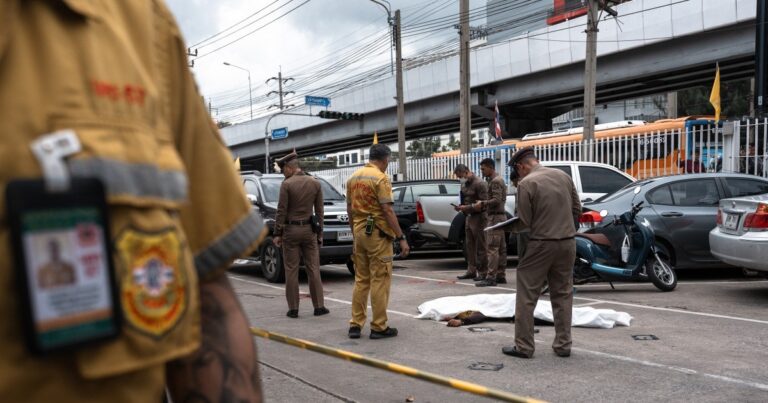
Five people have been killed and one person wounded in a shooting in Thailand’s capital, Bangkok, police say.

The shooting occurred at Or Tor Kor Market in the Bang Sue district of northern Bangkok at 12:31pm (05:31 GMT) on Monday, the Royal Thai Police said.

All five of the deceased victims were security guards at the market, and the suspected perpetrator took his own life, according to police.

“Police are investigating the motive. So far, it’s a mass shooting,” Worapat Sukthai, deputy police chief in the Bang Sue district, was quoted as telling the AFP news agency.

The police are working to identify the suspect and investigating “any possible link” to the current border clashes between Thailand and Cambodia, the official said.

The shooter was seen in surveillance footage wearing a black T-shirt, a cap, camouflage shorts and a backpack hung over his chest, the Thai Public Broadcasting Service reported.

Gun violence is relatively common in Thailand compared to much of the rest of Southeast Asia.

In 2020, a junior army officer killed 29 people and wounded 58 in a shooting rampage in the northeastern city of Nakhon Ratchasima.

Analysis of Texas Capital Bancshares SWOT: Mixed Perspective on Mid-Cap Bank Stock

0


Texas Capital Bancshares' SWOT analysis: mixed outlook for mid-cap bank stock

Mass shooting in Thailand market leaves five dead

0

Five people have been killed in a mass shooting at a food market in Bangkok, according to Thai officials.

The suspect in the attack at Or Tor Kor Market is also dead, police in Thailand’s capital confirmed.

Local media have reported that some of those killed are security guards.

The Or Tor Kor market is well known for high quality fresh fruit and seafood.

Gun ownership rates in Thailand are relatively high for the region and mass shooting incidents are not common, but the country has seen several deadly incidents in recent years.

In 2023, a 14-year-old boy killed two people and injured five others in a shooting at a luxury shopping mall in the centre of Bangkok.

An ex-policeman killed at least 37 people, most of them children, in a gun and knife attack at a childcare centre in in Nong Bua Lamphu province in north-east Thailand in October 2022.

In 2020, a soldier killed 29 people and injured dozens more in the city of Nakhon Ratchasima.

AI may increase efficiency in workers, but doesn’t always translate to higher productivity: ‘They work quickly, then take coffee breaks’

0

Many boardrooms, caught up in a post-ChatGPT frenzy, are trying to incorporate AI into their corporate workflows.

Generative AI may be the first technological advance to allow for greater automation of service and knowledge work, whether it’s at a call center or a management consultancy. But does letting workers generate emails or PowerPoint presentations faster really lead to greater productivity? Ramine Tinati, the lead at Accenture’s APAC Center for Advanced AI, speaking at the Fortune Brainstorm AI Singapore conference last week, wasn’t so sure.

“If you give employees a tool to do things faster, they do it faster. But are they more productive? Probably not, because they do it faster and then go for coffee breaks,” Tinati explained. 

Instead, “if you reinvent the work then suddenly those coffee breaks don’t become meaningful anymore because you’re doing something else,” Tinati said, adding that some companies in Asia may be slower to adopt AI because “they don’t think about reinventing the work.” (Accenture is a founding partner of Brainstorm AI)

Companies have, of course, been embracing forms of artificial intelligence to boost productivity for years, even before the release of ChatGPT in late 2022. May Yap, chief information officer at manufacturing solutions provider Jabil, said that her company had been using automation and AI to augment their so-called Golden Eye, the army of workers inspecting phones for scratches and blemishes.

“Golden Eye” workers spend eight hours a day on inspections and working that long means that “errors will creep in,” Yap said. AI helped to augment the inspection process to account for possible mistakes from human workers. 

Chee Wee Ang, the chief AI officer at Singapore’s Home Team Science and Tech Agency, a government agency that develops tech capabilities for national security, said AI has helped improve processes significantly.

“Some of the information extraction… we see like 200% [improvement]. So that’s a significant improvement in terms of ROI,” Ang said.

Yet Ang also pointed out that beyond improving productivity, AI advancements are allowing Singapore’s Home Team to do things that it couldn’t do before like responding to new kinds of crime or emergency. Singapore’s Home Team has 10 departments including the police force, emergency services, and immigration authorities.

Reskilling

AI will inevitably lead to some job losses as certain roles become obsolete. But that can unnerve employees who are worried about getting automated out of a job. Employees already report concerns that they are being used to train their AI replacements. 

Panelists last week agreed that the way forward for affected employees would be reskilling and moving people into adjacent roles. 

“Transformation is scary, right? When you hear the word transformation, people don’t like it,” Yap, from Jabil, said last week. She made it clear that Jabil wanted to augment, not replace, its human workforce. She added that “general skills sets” and “good leadership traits” cannot be taken away by AI, regardless of how it might automate other tasks.

Ang added that it was “very difficult to find in Singapore familiar with [generative AI],” meaning that his team has hired people with adjacent skill sets without direct experience. Another limitation? The lack of GPUs, as the Home Team has to work with on-site processors due to the sensitive nature of its work. 

And Tinati was optimistic that AI could liberate human employees to work on more productive things. “Their skills are now being uplifted to do other things, whether it’s supervisory work or…learning other skills which allow them to support higher order tasks in the development cycle,” he said. 

Singaporean Swimmer Ching Hwee Gan Shatters National Record in 1500 Free with a Time of 16:01.29, Improving by 9 Seconds

0

By Anya Pelshaw on SwimSwam

2025 World Championships

WOMEN’S 1500 FREESTYLE – PRELIMS

TOP 8 QUALIFIERS:

  1. Katie Ledecky (USA) – 15:36.68
  2. Lani Pallister (AUS) – 15:46.95
  3. Simona Quadarella (ITA) – 15:47.43
  4. Ching Hwee Gan (SGP) – 16:01.29
  5. Li Bingjie (CHN) – 16:02.31
  6. Moesha Johnson (AUS) – 16:05.13
  7. Anastasiia Kirpichnikova (FRA) – 16:06.97
  8. Yang Peiqi (CHN) – 16:08.19

Ching Hwee Gan of Singapore swam to a new national record in front of her home crowd in the 1500 freestyle. Gan touched in a 16:01.29, faster than her previous best time of a 16:10.13 that she swam during prelims at the 2024 Paris Olympics. That swim earned her a 9th place finish as she was a second and a half off of making the final. Unlike last summer, Gan will have a chance to swim in the final tomorrow night as she swam the 4th fastest time of prelims.

Split Comparison

2025 Worlds- Prelims
2024 Olympics- Prelims
Distance (m) Cumulative Time Split Time Cumulative Time Split Time
50 0:29.93 0:29.85
100 1:01.47 31.54 1:01.88 32.03
150 1:33.38 31.91 1:33.92 32.04
200 2:05.21 31.83 2:06.31 32.39
250 2:37.33 32.12 2:38.57 32.26
300 3:09.20 31.87 3:10.96 32.39
350 3:41.27 32.07 3:43.20 32.24
400 4:13.27 32 4:15.66 32.46
450 4:45.52 32.25 4:47.92 32.26
500 5:17.34 31.82 5:20.44 32.52
550 5:49.50 32.16 5:52.74 32.3
600 6:21.51 32.01 6:25.31 32.57
650 6:53.86 32.35 6:57.66 32.35
700 7:25.76 31.9 7:30.18 32.52
750 7:58.08 32.32 8:02.64 32.46
800 8:29.93 31.85 8:35.25 32.61
850 9:02.01 32.08 9:07.61 32.36
900 9:33.95 31.94 9:40.17 32.56
950 10:06.16 32.21 10:12.53 32.36
1000 10:38.22 32.06 10:44.99 32.46
1050 11:10.26 32.04 11:17.52 32.53
1100 11:42.49 32.23 11:50.03 32.51
1150 12:14.92 32.43 12:22.51 32.48
1200 12:47.05 32.13 12:55.14 32.63
1250 13:19.36 32.31 13:27.77 32.63
1300 13:51.92 32.56 14:00.22 32.45
1350 14:24.43 32.51 14:32.77 32.55
1400 14:56.93 32.5 15:05.62 32.85
1450 15:29.44 32.51 15:38.28 32.66
1500 16:01.29 31.85 16:10.13 31.85

Gan consistently held low-32s and had a few 31-highs during her race today, faster than she was a year ago as she was in the middle of the 32 second range last summer. Her average split today was a 32.12, compared to a 32.42 in Paris.

In addition to her new record in the 1500 free, Gan already broke the National Record in the 400 freestyle just yesterday. She swam to a 4:09.81, dropping over two and a half seconds off her previous personal best. Gan just finished her senior season at Indiana, notably finishing 3rd in the 1650 SCY free at the 2025 NCAA Championships.

Gan holds the Singapore national records in the 400, 800, and 1500 freestyles. She is also set to swim the 800 free later this week.

Read the full story on SwimSwam: Ching Hwee Gan (Singapore) Breaks Own National Record By 9 Seconds With 16:01.29 1500 Free

Innovative Technology Extracts Green Hydrogen from Thin Air Experimentally

0

Green hydrogen holds significant promise for the renewable energy sector and the ongoing effort to decarbonize the economy. Given hydrogen’s abundance as the most abundant element in the universe, intensive research is underway to devise methods for its extraction and processing. This hydrogen is classified as green hydrogen when achieved using renewable sources like solar or wind power.

Traditionally, water electrolysis, which splits hydrogen molecules, has been the prevailing method. Nevertheless, alternative strategies are emerging to expedite hydrogen production. Among these methods is air electrolysis, also referred to as DAE (Direct Air Electrolysis), which has proven successful in extracting hydrogen.

How to obtain green hydrogen from air

Conventional water electrolysis, a process that splits oxygen from hydrogen using an electric current, relies on two key components: a freshwater source and an energy supply for optimal execution. In regions with access only to saltwater, such as coastal areas, seawater desalination becomes a prerequisite before electrolysis can occur, resulting in increased production costs. Moreover, many high-potential solar energy regions are characterized by arid or semi-arid conditions with limited water resources.

To circumvent these challenges, one innovative approach is to harness renewable energy resources wherever they are available, irrespective of freshwater availability. In light of this, the concept becomes clear: the atmosphere, a ubiquitous and readily accessible resource, can serve as a solution. This rationale underpins a recent breakthrough technology, spotlighted in the scientific journal Nature, which utilizes direct electrolysis to extract green hydrogen directly from the air.

In a series of experiments conducted by the research team utilizing direct air electrolysis modules, stable production of green hydrogen from the atmosphere was maintained for twelve consecutive days, exclusively powered by electricity generated from solar photovoltaic panels and wind turbines. But what precisely does this technology entail? The DAE modules rely on water but source it from atmospheric humidity, similar to the method discussed in this article about home drinking water dispensers.

With the Earth’s atmosphere housing a staggering 12.9 trillion tons of water at any given time, leveraging this vast reservoir through innovative technologies like the “air harps” mentioned in a previous article could revolutionize clean drinking water access. Moreover, a similar approach holds promise for producing green hydrogen from the atmosphere.

The experiment involved stacking five DAE modules designed to capture atmospheric water, store it, and perform electrolysis using solar energy. The outcome was the production of 1490 milliliters of high-purity hydrogen in a single day. Notably, even after eight months without maintenance, the modules maintained their efficiency almost intact.

Researchers assert that this efficiency level is unprecedented and marks one of the first technologies capable of surpassing the 20 percent efficiency threshold for solar-to-hydrogen conversion set by the U.S. Department of Energy. Consequently, deploying these devices, which can capture atmospheric moisture even in arid conditions like the Sahel desert in Africa, presents an opportunity to generate green hydrogen from the air in developing countries struggling with freshwater scarcity.

What is green hydrogen used for?

Green hydrogen boasts a host of advantages, with its straightforward storage capabilities and impressive calorific value. Its versatility extends to fuel cells and industrial applications, similar to liquefied natural gas usage. Among its prominent applications, we find:

  • Integration into industrial processes and ground transportation, exemplified by the Power to Green Hydrogen Mallorca project.
  • Deployment in aviation for long-distance flights.
  • Promotion of sustainable urban mobility, including cars and even hydrogen-powered bicycles.
  • Facilitation of renewable energy storage from sources like solar and wind.
  • Implementation of hydrogen boilers for residential use.

For a deeper exploration of green hydrogen’s potential and insights into other renewable energy sources, such as wind, solar, or wave energy, consider subscribing to our newsletter at the bottom of this page.


Source: