7.9 C
New York
Wednesday, April 22, 2026
Home Blog Page 539

ISIL Takes Credit for Deadly Church Attack in Eastern DR Congo | Latest ISIL/ISIS News

0

A UN mission says 43 worshippers were killed in the attack at a night mass in a church.

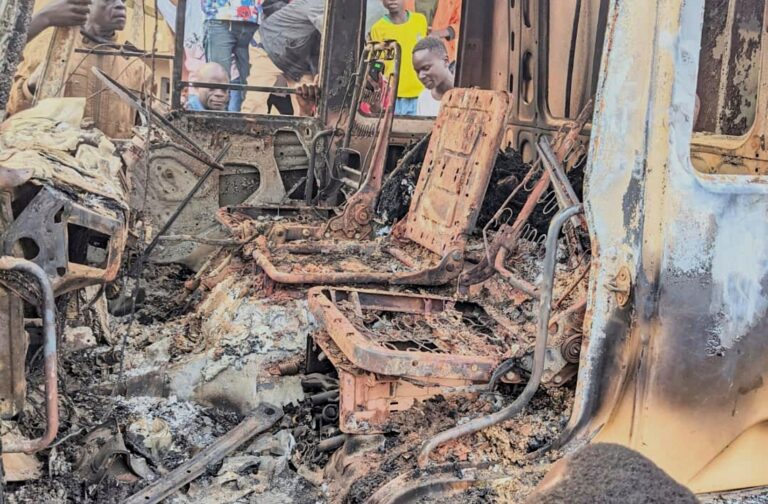
The armed group ISIL (ISIS) has claimed responsibility for a deadly attack that a United Nations mission says killed at least 43 worshippers during a night mass at a church in eastern Democratic Republic of the Congo (DRC).

The attack, which took place at the church in Ituri province’s Komanda city, saw members of the ISIL-affiliated Allied Democratic Forces (ADF) killing people with guns and machetes, and taking captives.

ISIL said on its Telegram channel that rebels had killed some 45 churchgoers and burned dozens of homes and shops.

The UN mission known as MONUSCO said at least 43 people had been killed, including 19 women and nine children, and condemned the attack.

Pope Leo sent a message of condolences to the bereaved families and the Christian community who lost their relatives and friends in the assault, saying he would pray for them.

The Congolese government condemned the church attack as “horrific”, while the military described it as a “large-scale massacre” carried out in revenge for recent security operations targeting the ADF.

However, M23, another Congolese rebel group, backed by Rwanda, used the attack to accuse the government of “blatant incompetence” in attempts to protect citizens.

MONUSCO said the church killings will “exacerbate an already extremely worrying humanitarian situation in the province”.

The church attack on Sunday was the latest in a series of deadly ADF assaults on civilians, including an attack earlier this month when the group killed 66 people in Ituri province.

The attack happened on July 11, at about 1am (00:00 GMT) in the Irumu area, near the border with Uganda.

The ADF originates in neighbouring Uganda, but is now based in the mineral-rich eastern DRC. It mounts frequent attacks, further destabilising a region where many armed groups compete for influence and resources.

The ADF was formed by disparate small groups in Uganda in the late 1990s following alleged discontent with President Yoweri Museveni.

In 2002, following military assaults by Ugandan forces, the group moved its activities to the neighbouring DRC and has since been responsible for the killings of thousands of civilians. In 2019, it pledged allegiance to ISIL.

The ADF’s leadership says it is fighting to form a government in the East African country.

The DRC army has long struggled against the rebel group, and it is now also grappling with a complex web of attacks since renewed hostilities with the Rwanda-backed M23 rebels.

Cyrille Bolloré, Vincent’s son, resigns from Universal Music Group board amid Bolloré Group’s battle with French regulator over Vivendi share offer.

0

Cyrille Bolloré, the son of French media mogul Vincent Bolloré, today (July 28) resigned from his position on Universal Music Group‘s board with immediate effect.

Outside of his non-executive directorship on UMG’s board, Cyrille Bolloré serves as the Chairman and Chief Executive Officer of France’s Bolloré Group.

An investor update from UMG issued today said that Bolloré was standing down to “focus his time and energy on the Bolloré Group”.

It added: “Mr. Bolloré remains strongly supportive of UMG´s management team and strategy.”

It’s no great surprise that Bolloré Jr. and Sr. may be rather busy right now: France’s equivalent to the SEC – the AMF – ruled last week that the Bolloré Group has to make a public tender offer for Vivendi shares it doesn’t own in the next six months.

The move could potentially delist Vivendi from the public markets.

According to Bloomberg, even though Vincent Bolloré officially owns less than 30% of Vivendi, “A Paris court in April found that the French businessman effectively controls Vivendi through his Bolloré SE holding company and controls the decisions made at its shareholders’ meetings.”

The Bolloré Group announced today that it would be appealing the AMF’s decision.

Cyrille Bolloré’s departure from UMG’s board follows that of Bill Ackman, who resigned his non-exec position in May.

According to its website, The Bolloré Group owned an 18.5% stake in Universal Music Group at the close of 2024.

In addition, it held 29.3% of Vivendi, which, in turn, owned approximately 10% of UMG’s issued share capital, according to Universal’s latest annual report.

This implies that, via the Bolloré Group, Vincent Bolloré controls around 21.4% of Universal’s share capital.

An update from UMG in its annual report for 2024 showed that Vivendi SE had a capital interest of 14.59% in UMG as of December 10, 2024.

However, that same note confirmed that on December 10, 2024, Vivendi “notified a short position of 4.65% as a result of its entry into a forward sale”.

The annual report further confirmed that 4.65% of Vivendi’s 14.59% capital interest in UMG “represents a potential capital interest… as a result of its entry into an equity swap”.

UMG’s biggest stockholders as per the music company’s latest annual report for 2024

Vivendi is the previous owner of Universal Music Group.

The music company was ‘spun out’ onto the Paris Euronext in 2021, with Vivendi maintaining a 10% ownership stake.

Other than Vincent Bolloré / The Bolloré Group, Universal Music Group’s biggest shareholder is a consortium led by China’s Tencent Music and Tencent Holdings (‘Concerto Partners’) which owns around 20% of UMG.Music Business Worldwide

France and Germany take the lead in expressing a negative EU response to US trade deal

0

Leaders from Europe’s two largest economies have led a chorus of gloomy reactions to the trade deal struck between EU chief Ursula von der Leyen and US President Donald Trump.

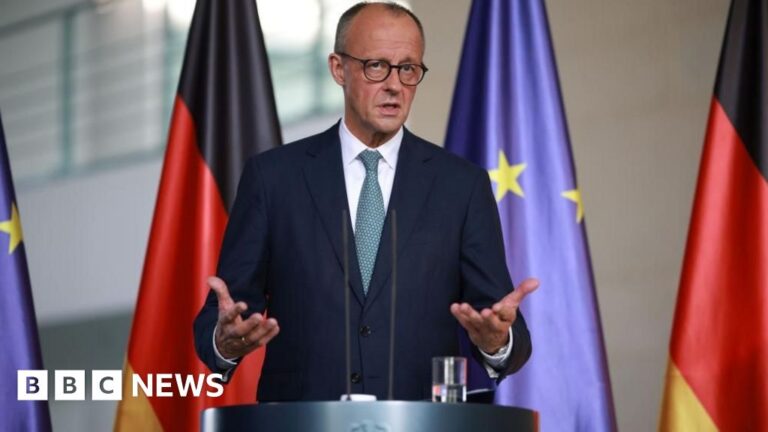
German Chancellor Friedrich Merz said the agreement would “substantially damage” his nation’s finances, while French Prime Minister Francois Bayrou said it was tantamount to “submission”.

The reaction has been downbeat across the bloc – though several capitals acknowledged signing an uneven deal was worth it in order to avert an all-out trade war.

It will see a 15% tariff on most EU exports to the US – half the rate threatened by Trump – in return for Europe buying more American energy and slashing taxes on some imports.

Following private talks at Trump’s Turnberry golf course in Scotland, von der Leyen described the agreement as a “huge deal”, while Trump said it would bring the US and EU “closer together”.

The deal will require the approval of all 27 members of the EU, each of which has differing interests and levels of reliance on the export of goods to the US.

While no member state indicated it intended to block it from coming into force, there was little celebration among European leaders.

Merz warned that the economies of the US and European would both be negatively impacted, but also said the Brussels negotiating team “couldn’t expect to achieve any more” against a US president determined to rebalance relationships with major trading partners.

Bayrou was more damning, writing on X: “It is a dark day when an alliance of free peoples, brought together to affirm their common values and to defend their common interests, resigns itself to submission.”

Hungarian Prime Minister Viktor Orban, a close ally of Trump, said the US president “ate von der Leyen for breakfast”.

Spanish Prime Minister Pedro Sanchez said he would support it “without any enthusiasm”.

In the weeks building up the final EU-US talks there had been a growing appetite among some European leaders to ramp up the pressure on Trump by using so-called anti-coercion measures, which would have blocked US firms access to European markets.

But with 30% tariffs looming, the EU struck a deal on behalf of its members – one which will still inflict an economic blow, but a less severe one that had been feared when Trump originally threatened import taxes.

Von der Leyen had sought to present it as a success on Sunday – but by Monday, even the leader of her European People’s Party, Manfred Weber, described it as “damage control”.

While the broad outline of the deal has been agreed, its details will be finalised after technical talks – and despite the scepticism of some, there was also widespread relief in Europe.

Finland’s prime minister said it would provide “much-needed predictability”, while Irish Trade Minister Simon Harris said it brought the certainty “essential for jobs, growth and investment”.

Defending its terms at a press conference on Monday, the EU’s trade commissioner Maros Sefcovic said it was the “best deal we could get under very difficult circumstances”.

He also pointed to the security implications of maintaining cordial trade relations with the US in the context of the Ukraine war.

Ensuring that Europe and the US were “aligned on the geopolitical issues of today”, he said, came with “an additional price”.

Challenging Client

0


Client Challenge


JavaScript is disabled in your browser.

Please enable JavaScript to proceed.

A required part of this site couldn’t load. This may be due to a browser
extension, network issues, or browser settings. Please check your
connection, disable any ad blockers, or try using a different browser.

Trump’s Tariffs Extended to China, Europe, and Beyond

0

Since returning to office, President Trump has waged a global trade war without parallel in modern history. With steep and sometimes punishing tariffs on America’s friends and foes alike, the president has sought to reset the world trading order, raise new federal revenue and pressure private businesses to make more of their products in the United States.

But Mr. Trump’s campaign is only beginning — and whether he will succeed remains an open question with great consequence for the U.S. economy.

On Aug. 1, the president is set to impose another round of taxes on imports from many countries, including Canada and Mexico, with rates up to 50 percent. Those are on top of the tariffs that the White House has already announced on other nations or negotiated through recent deals, as well as specific products, including foreign cars.

Mr. Trump’s actions threaten to revive a style of trade brinkmanship that has previously rattled markets, and it will likely result in price increases on American consumers and businesses. Here’s where the tariffs stand.

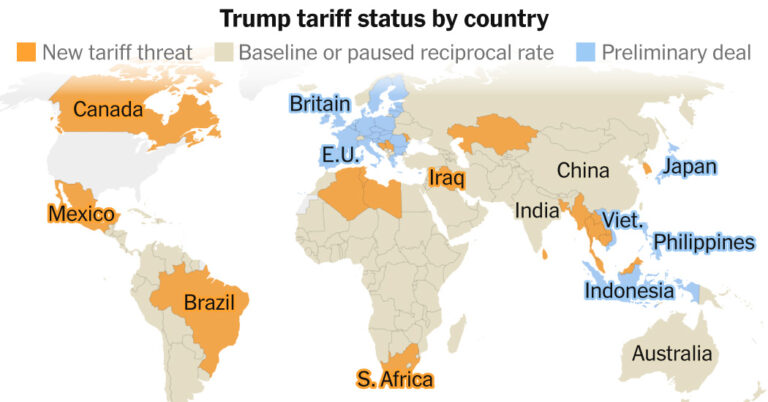
Many countries are set to see higher tariffs beginning Aug. 1. Some have learned in recent weeks about the new duties that will soon be applied to their goods in the United States. Others will be subject to taxes that the president announced and suspended earlier this year. And still more nations have brokered agreements with the United States that lower the rates they might have faced otherwise.

In the first camp are roughly two dozen countries that have received letters spelling out the higher tariff rates that will apply to their goods beginning next month unless they can strike a last-minute trade truce with the White House.

Taxes on imports from South Korea would rise to 25 percent, and the duties on Thailand’s goods would be set at 36 percent. The highest, so far, would be Brazil, which would see tariffs hit 50 percent next month.

Mr. Trump announced that tariff in a searing letter that attacked Brazilian leaders for their treatment of former President Jair Bolsonaro, an ally of Mr. Trump who is facing charges for inciting a coup.

In each of his letters, Mr. Trump said he would ratchet up the taxes on imports even higher if countries retaliated against the United States. He also said that the duties are separate from those he has applied to specific sectors.

When Mr. Trump unveiled many of his initial tariffs in April, he described the staggering rates as “reciprocal.” He derived the duties from a formula – widely questioned by experts – relative to the size of the U.S. trade deficit with each nation.

Soon after announcing the tariffs, Mr. Trump halted them for 90 days, in a pause that was set to expire in early July. But Mr. Trump extended the pause again this month as part of his renewed push to strike trade deals before Aug. 1. (For China, the date is Aug. 12, under a deal it brokered with U.S. officials.)

It is unclear if the president plans to reimpose these exact tariffs or modify them in some way. For the moment, though, his executive order would see his “reciprocal” rates implemented next month for countries that haven’t been told otherwise.

Issuing his initial pause, Mr. Trump sought to broker 90 deals in 90 days, as one of his advisers described it. That never materialized, though the president has struck a series of trade agreements with a handful of nations, including those in the European Union, which announced a preliminary agreement with the United States on Sunday.

That deal would set tariffs on E.U. goods at 15 percent, in exchange for better market access for U.S. goods and other concessions. The Trump administration has not released detailed terms of the arrangement.

Last week, the president announced a deal with Japan that calls for a 15 percent tariff on that country’s exports to the United States while relaxing duties that had applied to the Japanese auto industry. Japan agreed to supply $550 billion for investment in the United States.

The White House has previously announced similar framework agreements with Britain, Vietnam, the Philippines and Indonesia. The Indonesia deal, which Mr. Trump also announced last week, set its tariff rate at 19 percent. For several countries, the deals impose higher duties on goods that use a significant portion of parts or raw materials from countries including China and Russia.

  • 54%

    ”Reciprocal“
    tariff

  • 104%

    Rate increases as China punches back

  • 30%

    Negotiated truce rate

    Feb. 1

    March 4

    April 2

    May 12

The United States has set a 30 percent baseline tariff on imports from China under an agreement in May that walked back, at least for now, a highly damaging tit-for-tat escalation of duties between the two superpowers. (Other tariffs may also apply to Chinese goods.)

The deadline for the current rate to expire is Aug. 12, though American officials have said they may push the date as talks continue. Mr. Trump has said that tariffs could rise again without a new deal. But he signaled that it would be less than the 145 percent rate the U.S. government had imposed at one point in April, as the two sides escalated trade penalties on each other.

China has long been a target for Mr. Trump dating back to his first term. Upon returning to office, he initially sought to penalize Beijing for failing to stem the flow of fentanyl into the United States.

Two of America’s largest trading partners may also see tariffs rise on some of their exports to the United States beginning Aug. 1. For Canada, that new rate would be 35 percent; for Mexico, 30 percent.

White House officials say the rates would apply to imports from the two countries that are not covered under a trade deal that Mr. Trump signed during his first term. But the president’s aides have cautioned that a decision on the matter is not final.

Share of imports entering under U.S.M.C.A. trade deal

Mr. Trump first targeted Canada and Mexico in February, announcing a 25 percent import tax on all arriving goods, which the president justified by saying the two nations had not sufficiently helped to combat the flow of fentanyl. Facing blowback domestically and abroad, he later paused and modified that arrangement to exempt items that are covered under the U.S.-Mexico-Canada Agreement, or U.S.M.C.A.

These broad tariffs are separate from duties that Mr. Trump has imposed on specific imports and industries, including foreign cars and auto parts. Those tariffs also affect Canada and Mexico, with some key exceptions for products covered by U.S.M.C.A.

Some countries have not been targeted with specific new tariff threats. Instead, they are subject to a flat, 10 percent tariff on all imports into the United States, under an order Mr. Trump signed earlier this year.

  • Active
    Steel

    50

    About 20 percent of steel is imported.

  • Active
    Aluminum

    50

    Half of aluminum imports come from Canada.

  • Active
    Autos and auto parts

    25

    Nearly half of all vehicles sold in the United States are imported.

  • In process
    Copper

    Chile and Canada are major sources of copper imports.

  • In process
    Lumber

    The United States is the largest buyer of Canadian lumber.

  • In process
    Semiconductors

    A number of Asian countries are major sources.

  • In process
    Pharmaceuticals

    China and India are major suppliers of generic medications.

  • In process
    Trucks

    Mexico and Canada account for 80 percent of imports.

  • In process
    Critical Minerals

    China controls the world market for rare-earth minerals.

  • In process
    Aircraft

    The aerospace industry relies on specialized global suppliers.

  • In process
    Polysilicon

    A key ingredient in semiconductors and solar panels.

  • In process
    Unmanned Aircraft

    The majority of commercial drones are made in China.

Several of Mr. Trump’s tariffs target specific products or industries, using a provision of federal law – Section 232 – meant to help the president address trade issues that present national security threats.

Since the start of his second term, Mr. Trump has announced these duties on imports of aluminum, foreign cars and car parts and steel. In some cases, these tariffs supplement the duties targeted at specific countries, and the taxes do not pile on top of each other. For others, like the European Union, agreements brokered with the United States would override the sector-specific duties.

The president has started the process to impose additional sector-specific tariffs on products including copper, pharmaceuticals and semiconductors.

Combined, the tariffs Mr. Trump has imposed this year mean the vast majority of goods that enter the United States now are subject to higher import taxes. Those duties are paid by the companies that import the goods, raising the risk that U.S. businesses and consumers will soon see higher prices. Mr. Trump insists otherwise, arguing that foreign producers will essentially eat the costs.

Mr. Trump also has shown no signs of slowing down with what has been an on-again-off-again trade war.

The president and his top aides repeatedly have said they do not plan to extend their upcoming Aug. 1 deadline. But Mr. Trump has announced, then relaxed, some of his toughest trade policies in a bid to buy more time to negotiate deals.

Here’s how the rates break down:

Germany

Preliminary deal reached

20 10 20 15

Japan

Preliminary deal reached

24 10 25 15

Vietnam

Preliminary deal reached

46 10 20

Ireland

Preliminary deal reached

20 10 20 15

Italy

Preliminary deal reached

20 10 20 15

Britain

Preliminary deal reached

10 10

France

Preliminary deal reached

20 10 20 15

Netherlands

Preliminary deal reached

20 10 20 15

Indonesia

Preliminary deal reached

32 10 32 19

Belgium

Preliminary deal reached

20 10 20 15

Spain

Preliminary deal reached

20 10 20 15

Sweden

Preliminary deal reached

20 10 20 15

Austria

Preliminary deal reached

20 10 20 15

Philippines

Preliminary deal reached

17 10 17 19

Poland

Preliminary deal reached

20 10 20 15

Hungary

Preliminary deal reached

20 10 20 15

Denmark

Preliminary deal reached

20 10 20 15

Slovakia

Preliminary deal reached

20 10 20 15

Finland

Preliminary deal reached

20 10 20 15

Czechia

Preliminary deal reached

20 10 20 15

Portugal

Preliminary deal reached

20 10 20 15

Slovenia

Preliminary deal reached

20 10 20 15

Romania

Preliminary deal reached

20 10 20 15

Greece

Preliminary deal reached

20 10 20 15

Lithuania

Preliminary deal reached

20 10 20 15

Bulgaria

Preliminary deal reached

20 10 20 15

Estonia

Preliminary deal reached

20 10 20 15

Croatia

Preliminary deal reached

20 10 20 15

Luxembourg

Preliminary deal reached

20 10 20 15

Latvia

Preliminary deal reached

20 10 20 15

Malta

Preliminary deal reached

20 10 20 15

Cyprus

Preliminary deal reached

20 10 20 15

Mexico

Renewed tariff threat

25 30

Canada

Renewed tariff threat

25 35

South Korea

Renewed tariff threat

25 10 25

Thailand

Renewed tariff threat

36 10 36

Malaysia

Renewed tariff threat

24 10 25

Brazil

Renewed tariff threat

10 50

South Africa

Renewed tariff threat

30 10 30

Cambodia

Renewed tariff threat

49 10 36

Bangladesh

Renewed tariff threat

37 10 35

Iraq

Renewed tariff threat

39 10 30

Sri Lanka

Renewed tariff threat

44 10 30

Algeria

Renewed tariff threat

30 10 30

Kazakhstan

Renewed tariff threat

27 10 25

Libya

Renewed tariff threat

31 10 30

Tunisia

Renewed tariff threat

28 10 25

Serbia

Renewed tariff threat

37 10 35

Laos

Renewed tariff threat

48 10 40

Myanmar

Renewed tariff threat

44 10 40

Brunei

Renewed tariff threat

24 10 25

Bosnia and Herzegovina

Renewed tariff threat

35 10 30

Moldova

Renewed tariff threat

31 10 25

China

Reciprocal tariff paused

20 125 10

Taiwan

Reciprocal tariff paused

32 10

India

Reciprocal tariff paused

26 10

Switzerland

Reciprocal tariff paused

31 10

Israel

Reciprocal tariff paused

17 10

Norway

Reciprocal tariff paused

15 10

Venezuela

Reciprocal tariff paused

15 10

Nigeria

Reciprocal tariff paused

14 10

Guyana

Reciprocal tariff paused

38 10

Pakistan

Reciprocal tariff paused

29 10

Nicaragua

Reciprocal tariff paused

18 10

Jordan

Reciprocal tariff paused

20 10

Angola

Reciprocal tariff paused

32 10

Cote d’Ivoire

Reciprocal tariff paused

21 10

Madagascar

Reciprocal tariff paused

47 10

Botswana

Reciprocal tariff paused

37 10

Dem. Rep. Congo

Reciprocal tariff paused

11 10

Namibia

Reciprocal tariff paused

21 10

Fiji

Reciprocal tariff paused

32 10

Cameroon

Reciprocal tariff paused

11 10

Liechtenstein

Reciprocal tariff paused

37 10

Lesotho

Reciprocal tariff paused

50 10

Mauritius

Reciprocal tariff paused

40 10

Mozambique

Reciprocal tariff paused

16 10

North Macedonia

Reciprocal tariff paused

33 10

Zambia

Reciprocal tariff paused

17 10

Equatorial Guinea

Reciprocal tariff paused

13 10

Chad

Reciprocal tariff paused

13 10

Zimbabwe

Reciprocal tariff paused

18 10

Malawi

Reciprocal tariff paused

17 10

Vanuatu

Reciprocal tariff paused

22 10

Syria

Reciprocal tariff paused

41 10

Nauru

Reciprocal tariff paused

30 10

Singapore

Baseline tariff

10

Colombia

Baseline tariff

10

Australia

Baseline tariff

10

Turkey

Baseline tariff

10

Chile

Baseline tariff

10

Saudi Arabia

Baseline tariff

10

Costa Rica

Baseline tariff

10

Peru

Baseline tariff

10

Ecuador

Baseline tariff

10

United Arab Emirates

Baseline tariff

10

Dominican Republic

Baseline tariff

10

Argentina

Baseline tariff

10

New Zealand

Baseline tariff

10

Honduras

Baseline tariff

10

Guatemala

Baseline tariff

10

Trinidad and Tobago

Baseline tariff

10

Russia

Baseline tariff

10

Egypt

Baseline tariff

10

El Salvador

Baseline tariff

10

Morocco

Baseline tariff

10

Qatar

Baseline tariff

10

Bahamas

Baseline tariff

10

Kuwait

Baseline tariff

10

Oman

Baseline tariff

10

Uruguay

Baseline tariff

10

Bahrain

Baseline tariff

10

Ghana

Baseline tariff

10

Ukraine

Baseline tariff

10

Iceland

Baseline tariff

10

Kenya

Baseline tariff

10

Haiti

Baseline tariff

10

Panama

Baseline tariff

10

Bolivia

Baseline tariff

10

Ethiopia

Baseline tariff

10

Jamaica

Baseline tariff

10

Paraguay

Baseline tariff

10

Lebanon

Baseline tariff

10

Senegal

Baseline tariff

10

Tanzania

Baseline tariff

10

Gabon

Baseline tariff

10

Georgia

Baseline tariff

10

Azerbaijan

Baseline tariff

10

Uganda

Baseline tariff

10

Albania

Baseline tariff

10

Armenia

Baseline tariff

10

Nepal

Baseline tariff

10

Suriname

Baseline tariff

10

Togo

Baseline tariff

10

Belize

Baseline tariff

10

Papua New Guinea

Baseline tariff

10

Liberia

Baseline tariff

10

Benin

Baseline tariff

10

Barbados

Baseline tariff

10

Monaco

Baseline tariff

10

Uzbekistan

Baseline tariff

10

Djibouti

Baseline tariff

10

Kosovo

Baseline tariff

10

Rwanda

Baseline tariff

10

Sierra Leone

Baseline tariff

10

Maldives

Baseline tariff

10

Mongolia

Baseline tariff

10

San Marino

Baseline tariff

10

Antigua and Barbuda

Baseline tariff

10

Eswatini

Baseline tariff

10

Afghanistan

Baseline tariff

10

Belarus

Baseline tariff

10

Marshall Islands

Baseline tariff

10

Saint Kitts and Nevis

Baseline tariff

10

Kyrgyzstan

Baseline tariff

10

Montenegro

Baseline tariff

10

Turkmenistan

Baseline tariff

10

Grenada

Baseline tariff

10

Sudan

Baseline tariff

10

Yemen

Baseline tariff

10

Niger

Baseline tariff

10

Saint Vincent and the Grenadines

Baseline tariff

10

Saint Lucia

Baseline tariff

10

Iran

Baseline tariff

10

Guinea

Baseline tariff

10

Timor-Leste

Baseline tariff

10

Samoa

Baseline tariff

10

Mali

Baseline tariff

10

Cuba

Baseline tariff

10

Tajikistan

Baseline tariff

10

Burkina Faso

Baseline tariff

10

Cape Verde

Baseline tariff

10

Burundi

Baseline tariff

10

Andorra

Baseline tariff

10

Bhutan

Baseline tariff

10

Mauritania

Baseline tariff

10

Tonga

Baseline tariff

10

Somalia

Baseline tariff

10

Micronesia

Baseline tariff

10

Palau

Baseline tariff

10

Dominica

Baseline tariff

10

Gambia

Baseline tariff

10

Comoros

Baseline tariff

10

Central African Republic

Baseline tariff

10

Solomon Islands

Baseline tariff

10

Eritrea

Baseline tariff

10

South Sudan

Baseline tariff

10

Kiribati

Baseline tariff

10

Sao Tome and Principe

Baseline tariff

10

Tuvalu

Baseline tariff

10

Guinea-Bissau

Baseline tariff

10

North Korea

Baseline tariff

10

Republic of the Congo

Baseline tariff

10

Digital Leadership Drives Stock Outlook: A SWOT Analysis of Williams-Sonoma

0


Williams-Sonoma's SWOT analysis: digital leadership drives stock outlook

Israeli human rights group accuses Israel of committing genocide in Gaza | Israel-Palestine conflict updates

0

Israeli-Palestinian human rights group B’Tselem has declared Israel’s actions in Gaza as genocide in its latest report, titled Our Genocide.

The report, released on Monday, carries strong condemnation of Israel’s war on Gaza, which has killed at least 59,733 people and wounded 144,477.

“An examination of Israel’s policy in the Gaza Strip and its horrific outcomes, together with statements by senior Israeli politicians and military commanders about the goals of the attack, leads to the unequivocal conclusion that Israel is taking coordinated action to intentionally destroy Palestinian society in the Gaza Strip,” the report reads.

“In other words: Israel is committing genocide against Palestinians in the Gaza Strip.”

An estimated 1,139 people died during the Hamas-led October 7, 2023, attacks on Israel, and some 200 were taken captive.

‘Our Genocide’

The report delves into Israeli violations against Palestinians, going back to the 1948 foundation of the Israeli state, which “had a clear objective from the outset: to cement the supremacy of the Jewish group across the entire territory under Israeli control”.

As such, the state of Israel exhibits “settler-colonial patterns, including widespread settlement involving displacement and dispossession, demographic engineering, ethnic cleansing and the imposition of military rule on Palestinians”, the report continues.

And while it looks back at Israel’s efforts to “uphold Jewish supremacy, relying on a false pretense of the rule of law while, in reality, the rights of the Palestinian subjects are left unprotected”, the report notes that this was accelerated after October 7.

The “broad, coordinated onslaught against Palestinians in the Gaza Strip” that the report points to has “enjoyed support, legitimization, and normalization from the majority of Jewish-Israelis, as well as from the Israeli legal system”.

The report also speaks about the intensified efforts since October 2024 to displace Palestinians in Gaza.

“Israel’s actions in northern Gaza were described by many experts … as an attempt to carry out ethnic cleansing. In practice, by November 2024, some 100,000 people who had lived in northern Gaza had been displaced from their homes,” the document reads.

The report goes beyond Gaza to say that Israel has intensified its violent operations in the occupied West Bank and occupied East Jerusalem since October 7, “on a scale not seen since Israel occupied the West Bank in 1967”.

B’Tselem first used the word “apartheid” in 2021 to describe the two-tier reality for Israelis and Palestinians in historic Palestine.

A child reacts during the funeral of Palestinians killed in an overnight Israeli strike, according to medics, at Nasser Hospital, in Khan Younis in the southern Gaza Strip, July 28, 2025 [Ramadan Abed/Reuters]

Genocide in words and actions

B’tselem’s report follows an op-ed in the New York Times by Holocaust scholar Amos Goldberg, where he described Israel’s actions in Gaza as genocide, as well as growing demonstrations by protesters in Israel calling for an end to the war.

However, opposition to Israel’s war on Gaza is still widely controversial in Israeli society. Only around 16 percent of Jewish Israelis believe peaceful coexistence with Palestinians is possible, according to a June poll by the Pew Research Center.

Meanwhile, 64 percent of Jewish Israelis believe Israel should temporarily occupy the Gaza Strip, according to a survey by the Jerusalem Center for Security and Foreign Affairs (JCFA).

Critics of stereotypical Israeli views include Israeli political commentator Ori Goldberg, a former university professor and national security consultant, who called these views “vile” on the social media platform X.


“I can only conclude that the pressures from within Israeli society are truly as great as Ori Goldberg recently noted,” Elia Ayoub, a writer, researcher, and the founder of the podcast The Fire These Times, told Al Jazeera.

“Israeli society has normalised a genocide for nearly two years, and this speaks to a deep moral rot at the core of their political culture,” he continued.

Meanwhile, Israeli government officials have continued their violent calls against the people of Gaza.

“The government is rushing to erase Gaza, and thank God we are erasing this evil. All of Gaza will be Jewish,” Heritage Minister Amichai Eliyahu said on Israeli radio last week.

Welcomed news, even if late

B’Tselem’s report runs 79 pages and documents interviews with numerous Palestinians in Gaza who have lived through the last 22 months of attacks.

That one of Israel’s most prominent human rights organisations described Israel’s actions in Gaza as genocide is bound to draw criticism of the group in Israeli society. Many Israeli critics of their own country’s actions in Gaza have faced brutal denunciations from their compatriots.

That makes B’Tselem using the weight of the word “genocide” all the more powerful, even if some believe it could have been done sooner.

“I welcome this news even though it comes very late into the genocide,” Ayoub said.

In December 2023, South Africa brought a case that Israel was committing genocide against Gaza to the International Court of Justice (ICJ). Several other countries, including Brazil, Spain, Turkiye and the Republic of Ireland, have joined South Africa in its ICJ case.

Live Recap of Day 2 Finals at the 2025 World Championships

0

By Sophie Kaufman on SwimSwam

2025 World Championships

Day 2 Finals Heat Sheet

Happy Monday, everyone! It’s time for the second session of finals at the 2025 World Aquatic Championships in Singapore. There are no relays tonight, but it’s still an action-packed evening with four medal rounds and four semifinals.

Order Of Events: 

  • Men’s 100 breaststroke final
  • Women’s 100 butterfly final
  • Men’s 100 backstroke semifinals
  • Women’s 100 breaststroke semifinals
  • Men’s 50 butterfly final
  • Women’s 100 backstroke semifinals
  • Men’s 200 freestyle semifinals
  • Women’s 200 IM final

Qin Haiyang leads the way into the first final of the evening, the men’s 100 breaststroke. Qin holds about a four-tenth lead over the second seed Nicolo Martinenghi, who was reinstated after originally being disqualified. With Ludovico Viberti holding the third seed, the Italians are looking to put two onto the podium. Germany’s Lucas Matzerath rounded out the swimmers who broke 59 seconds in the semifinal.

Then, the focus shifts to the women’s 100 butterfly final. Gretchen Walsh and Roos Vanotterdijk tied for the top seed overall. Walsh notably scratched the women’s 4×100 freestyle relay final immediately after swimming 56.07 in her semifinal, presumably due to the virus affecting many of the Team USA swimmers. That’s the big question heading into the final, as a healthy Walsh is the heavy favorite in this race.

It was a battle to make the men’s 50 butterfly final, with multiple big names missing out. Maxime Grousset is the top seed after swimming a French record of 22.61 in the semifinals. He’s seeded .11 seconds ahead of short-course world record holder Noe Ponti and former world champion Ben Proud, the latter of whom swam a British record in the event. It’s a European-heavy final as Gui Caribe is the lone finalist from another continent.

The final medal round of the evening is the women’s 200 individual medley. Summer McIntosh breezed through the semifinal about 30 minutes after winning the women’s 400 freestyle. She’s on a quest for five individual gold medals at these World Championships, and she’s put herself in a strong position to grab her second tonight. Alex Walsh and Mio Narita are the second and third seeds behind her, while 12-year-old Yu Zidi qualified 7th overall.

Men’s 100 Breaststroke – Final

Final: 

  1. Qin Haiyang (China) — 58.23
  2. Nicolo Martinenghi (Italy) — 58.58
  3. Denis Petrashov (Kyrgyzstan) — 58.88
  4. Caspar Corbeau (Netherlands) — 59.06
  5. Ludovico Viberti (Italy) — 59.08
  6. Lucas Matzerath (Germany) — 59.14
  7. Josh Matheny (United States) — 59.26
  8. Danil Semianinov (NAB) — 59.55

DQ: Kirill Prigoda 

Qin is back on top. After winning the gold at the 2023 World Championship, Qin had a disappointing performance at the Paris Olympics. But now in his first event in Singapore, he’s already grabbed his first gold medal.

The Paris Olympic champion Martinenghi was out first at the halfway point, turning in 26.90. He was the only swimmer out sub-27 seconds, as Qin turned second in 27.07, less than a tenth ahead of Viberti.

Qin took over on the second 50 meters, coming home in a field-best 31.16. He pulled ahead of Martinenghi and got his hands on the wall first with a 58.23. After being reinstated following a disqualification in the semifinals, Martinenghi grabbed the silver medal in 58.58. Denis Petrashov moved from fourth to third over the final 50 meters, swimming a Kyrgyzstani record to earn bronze. It’s his first time breaking 58 seconds in this race, undercutting the national record of 59.20 that he swam in semifinals to earn his first medal at the World Championship level.

After setting a Russian record in prelims, Kirill Prigoda was disqualified for a downward butterfly kick prior to the finish touch.

WOMEN’S 100 BUTTERFLY – Final

  • World Record: 54.60– Gretchen Walsh, United States (2025)
  • World Junior Record: 56.33– Mizuki Hirai, Japan (2024)
  • Championship Record: 55.53 – Sarah Sjostrom, Sweden (2017)
  • 2023 World Champion – Zhang Yufei, China — 56.12
  • 2024 Olympic Champion – Torri Huske, United States — 55.59

Final: 

  1. Gretchen Walsh (United States) — 54.73 *Championship Record*
  2. Roos Vanotterdijk (Belgium) — 55.84
  3. Alexandria Perkins (Australia) — 56.33
  4. Zhang Yufei (China) — 56.47
  5. Daria Klepikova (NAB) — 56.53
  6. Angelina Köhler (Germany) — 56.57
  7. Mizuki Hirai (Japan) — 56.83
  8. Yu Yiting (China) — 57.36

It seems like Walsh is feeling better.

After getting pulled from the women’s 4×100 freestyle relay in the last finals session, she’s now claimed her first individual long-course world championship title. She did it in championship record fashion too, obliterating the 55.53 Sarah Sjostrom swam at the 2017 World Championships.

“I was aiming for 55, so to go 54 is something I’m really proud of,” Walsh told NBC Sports after the race.

Walsh set the tone early, getting out under her world record pace with a 25.16 split, opening up over a half-second lead on Belgian Roos VanotterdijkWalsh also acknowledged in her post-race interview that she’s a swimmer “who flies and dies” but she held on and had the fastest split in the field on the back half of the race, splitting 29.57.

Walsh broke through the 55 second barrier again, swimming a 54.73 to win her title just .13 seconds from the world record she swam in Fort Lauderdale.

Vanotterdijk went three-for-three on personal bests and Belgian records throughout the rounds. She came into the meet with a lifetime best of 57.05 and has lowered her time to 55.84. The silver-medal winning swim makes her the ninth woman to break the 56-second mark.

Australia’s Alexandria Perkins rounded out the podium with a 56.33, holding off a late charge from Zhang Yufei, a two-time Olympic medalist in this event. After a 30.12 closing split, Zhang touched fourth in 56.47.

MEN’S 100 BACKSTROKE – Semifinals

  • World Record: 51.60 – Thomas Ceccon, Italy (2022)
  • World Junior Record: 52.08 – Miron Lifintsev, Russia (2024)
  • Championship Record: 51.60 – Thomas Ceccon, Italy (2022)
  • 2023 World Champion: Ryan Murphy, United States – 52.22
  • 2024 Olympic Champion: Thomas Ceccon, Italy – 52.00

Top 8 Qualifiers: 

  1. Hubert Kos (Hungary) — 52.21
  2. Kliment Kolesnikov (NAB) — 52.26
  3. Pieter Coetze (South Africa) — 52.29
  4. Thomas Ceccon (Italy) — 52.35
  5. Oliver Morgan (Great Britain) — 52.41
  6. Apostolos Christou (Greece) — 52.44
  7. Yohan Ndoye-Brouard (France) — 52.47
  8. Miron Lifintsev (NAB) — 52.27

Hubert Kos, the reigning Olympic champion in the 200 backstroke, will swim in lane four tomorrow night for the men’s 100 backstroke final. Kos won the second semifinal in 52.21, clipping Kliment Kolesnikov‘s winning time from the first semifinal by five-hundredths.

The swim is also a Hungarian record for Kos, breaking the standard he set in April at the Hungarian Championships by three-hundredths.

Pieter Coetze continues to swim well after his breakout performance at the World University Games in this event, where he broke through the 52-second mark. Coetze checked in with a 52.29 to move through to the final in third, making it three men to swim 52.2 in the semifinals.

Thomas Ceccon, the Paris Olympic champion, swam in lane one during the second semifinal after an easy morning swim. He picked it up tonight, touching third in his heat with a 52.35 to move through to the final as the fourth seed.

After posting the fastest time in prelims, France’s Yohann Ndoye-Brouard made the final in seventh (52.47). Olympic finalists Apostolos Christou and Oliver Morgan also made it through to the final, as did Miron Lifintsev, who earned double gold in the sprint backstrokes at the 2024 Short Course World Championships.

WOMEN’S 100 BREASTSTROKE – Semifinals

  • World Record: 1:04.13 – Lilly King, United States (2017)
  • World Junior Record: 1:04.35 – Ruta Meilutyte, Lithuania (2013)
  • Championship Record: 1:04.13 – Lilly King, United States (2017)
  • 2023 World Champion: Ruta Meilutyte, Lithuania – 1:04.62
  • 2024 Olympic Champion: Tatjana Schoenmaker, South Africa – 1:05.28

Top 8 Qualifiers:

  1. Kate Douglass (United States) — 1:05.49
  2. Anita Bottazzo (Italy) — 1:05.61
  3. Tang Qianting (China) — 1:05.87
  4. Evgeniia Chikunova (NAB) — 1:05.97
  5. Alina Zmushka (NAA) — 1:06.09
  6. Satomi Suzuki (Japan) — 1:06.12
  7. Anna Elendt (Germany) — 1:06.13
  8. Kotryna Teterevkova (Lithuania) — 1:06.17

Kate Douglass took control of the first semifinal of the women’s 100 breaststroke down the final stretch. The Paris Olympic champion in the 200 breaststroke, Douglass has gotten the chance to show off her sprint breaststroke skills this summer. After winning the 2025 U.S. National Championship, Douglass swam a 1:05.49 here in Singapore, a lifetime best by three-tenths.

That swim held up as the fastest time of the semifinals as the 2024 World Champion Tang Qianting clocked a 1:05.87 to win the second semifinal. She was also the silver medalist in Paris but she’ll head into the final as the third seed. Italy’s Anita Bottazzo swam a lifetime best of her own, 1:05.61, to move into the final as the second seed.

There will be some big names missing from this final. Lilly King missed the final of the 100 breaststroke at her last international competition, finishing ninth in 1:06.26. She missed the final by nine-hundredths. Lithuania has a representative in the final in Kotryna Teterevkova, but Olympic champion Ruta Meilutyte missed out, finishing 13th (1:06.57). Mona McSharry, the top seed coming into semifinals, is also out after touching 11th overall in 1:06.33.

Men’s 50 Butterfly – Final

Final: 

  1. Maxime Grousset (France) — 22.48
  2. Noe Ponti (Switzerland) — 22.51
  3. Thomas Ceccon (Italy) — 22.67
  4. Diogo Ribeiro (Portugal) — 22.77
  5. Ben Proud (Great Britain) — 22.79
  6. Nyls Korstanje (Netherlands)/Luca Armbruster (Germany) — 22.84
  7. (tie)
  8. Gui Caribe (Brazil) — 22.92

It was a battle between Maxime Grousset and Noe Ponti all the way to the wall for gold. At the touch, Grousset got the better of the short-course world record holder, swimming a 22.48 to out-touch Ponti’s 22.51.

Both move up the all-time performers list. Grousset’s time undercuts the French record of 22.70 he swam in the semifinals by .22 seconds. Meanwhile, Ponti betters the 22.65 he swam last year by nine-hundredths.

The podium was three-for-three on national records. Fresh off the 100 backstroke semifinal, Ceccon–the 2023 world champion in this race–grabbed bronze by lowering his Italian record to 22.67. The swim knocked a hundredth off his lifetime best.

Updated All-Time Top Performer Rankings

  1. Andrii Govorov, Ukraine – 22.27 (2018)
  2. Caeleb Dressel, USA – 22.35 (2019)
  3. Rafa Munoz, Spain – 22.43 (2009)
  4. Maxime Grousset, France — 22.48 (2025) *NEW*
  5. Noe Ponti, Switzerland — 22.51 (2025) *NEW*
  6. Nicholas Santos, Brazil – 22.60 (2023)
  7. Oleg Kostin, Russia – 22.62 (2023)
  8. Milorad Cavic, Serbia & Thomas Ceccon, Italy — 22.67 (2009)/(2025) *NEW*
  9.  Ilya Kharun, Canada — 22.68 (2025)

The semifinals featured a barrage of national records and the final did the same. Aside from the medalists, the fourth-place finisher Diogo Ribeiro fired off one of his one, swimming a 22.77. Ribeiro won this event at the 2024 World Championships. Germany’s Luca Armbruster lowered the national record he set in semifinals. He swam 22.84 to tie for sixth with Nyls Korstanje, breaking the 22.91 mark he swam to qualify for the final.

WOMEN’S 100 BACKSTROKE – Semifinals

Top 8 Qualifiers:

  1. Regan Smith (United States) — 58.21
  2. Kaylee McKeown (Australia) — 58.44
  3. Kylie Masse (Canada) — 58.66
  4. Katharine Berkoff (United States) — 58.79
  5. Taylor Ruck (Canada) — 59.18
  6. Peng Xuwei (China) — 59.19
  7. Mary-Ambre Moluh (France) — 59.35
  8. SWIM OFF REQUIRED: Pauline Mahieu (France)/Wan Letian (China) — 59.56

The Americans Regan Smith and Katharine Berkoff won their respective semifinals tonight, guaranteeing that both will feature in the final as they aim to back up their medals from the Paris Games.

Berkoff won the first semifinal in 58.79, with Taylor Ruck taking second in 59.18. That put her in a solid position ahead of the second semifinal, which featured the likes of Smith, Kaylee McKeownand Kylie Masse.

Smith checked in with a 58.21 for the win in the second semifinal, cruising in .23 seconds ahead of McKeown, the two-time defending Olympic champion, and .45 seconds ahead of the veteran Masse. McKeown’s 58.44 and Masse’s 58.66 mean they will be on either side of Smith in tomorrow’s final, with Berkoff qualifying fourth.

The final will feature two Americans and two Canadians for sure, though we will have to wait to see whether France or China will join the club with two swimmers in the final. Pauline Mahieu and Wan Letian tied for 8th overall in 59.56, necessitating a swim-off between the pair for lane eight in the final.

MEN’S 200 FREESTYLE – Semifinals

  • World Record: 1:42.00 – Paul Biedermann, GER (2009)
  • World Junior Record: 1:42.97 – David Popovici, ROU (2022)
  • Championship Record: 1:42.00 – Paul Biedermann, GER (2009)
  • 2023 World Champion: Matt Richards, GBR – 1:44.30
  • 2024 Olympic Champion: David Popovici, ROU – 1:44.72

Top 8 Qualifiers:

  1. Luke Hobson (United States) — 1:44.80
  2. Hwang Sunwoo (South Korea) — 1:44.84
  3. Kamil Sieradzki (Poland) — 1:45.00
  4. David Popovici (Romania) — 1:45.02
  5. Carlos D’Ambrosio (Italy) — 1:45.23
  6. Tatsuya Murasa (Japan) — 1:45.39
  7. James Guy (Great Britain) — 1:45.50
  8. Gabriel Jett (United States) — 1:45.60

The first semifinal proved to be the faster of the two, as the top six finishers in that heat made it through to the semifinals. Luke Hobson and Hwang Sunwoo had a great race, with Hobson, the short-course world record holder, hitting the wall four-hundredths ahead of Hwang, 1:44.80 to 1:44.84.

Poland’s Kamil Sieradzki swam a big Polish record of 1:45.00, chopping 1.02 seconds from the standard he set in April at the Polish Championships. The swim qualified him for the final in third position.

The second semi-final saw a battle between reigning Olympic champion David Popovici and Japan’s new star Tatsuya Murasa down the final stretch. Using his long wingspan to his advantage, Popovici managed to distance himself in the final meters and got his hand on the wall first with a 1:45.02 to Murasa’s 1:45.39. The pair are the only two from their semifinal to make tomorrow’s medal round, as third place Zhang Zhanshuo finished 11th overall.

The biggest name out of tomorrow’s final is Olympic silver medalist and 2023 World Champion Matt Richards. He swam a 1:45.84 and finished 12th overall. The Brits will still have a representative in the final though. After tying for the win with Duncan Scott at British Trials (and Richards earning an automatic bid), Team GB’s second roster spot in this event went to Guy, who has found a new level more than a decade into his career. Guy has made the most of the opportunity and made it through to the final in 7th (1:45.40).

Women’s 200 IM — Final

Final: 

  1. Summer McIntosh (Canada) — 2:06.69
  2. Alex Walsh (United States) — 2:08.58
  3. Mary-Sophie Harvey (Canada) — 2:09.15
  4. Yu Zidi (China) — 2:09.21
  5. Mio Narita (Japan) — 2:09.56
  6. Abbie Wood (Great Britain) — 2:09.92
  7. Anastasia Gorbenko (Israel) — 2:10.26
  8. Ellen Walshe (Ireland) — 2:11.57

Summer McIntosh is two-for-two through the first two days of the 2025 World Aquatic Championships. She claimed her second individual gold medal in her quest for five by winning the women’s 200 IM in 2:06.69 with an almost two second margin of victory.

McIntosh never trailed in this race, opening in 26.71 then splitting 31.76 on the backstroke leg. Alex Walsh, who was second the entire way, pushed McIntosh on the breaststroke leg. Walsh’s 37.03 breaststroke split made up a lot of ground on McIntosh (38.06). But on freestyle, McIntosh swam away from Walsh with a field-best 30.16 split, hitting the wall in 2:06.69.

Walsh earned silver in 2:08.58, getting back on the senior international podium in this race after getting disqualified at the 2024 Olympics.

Mary-Sophie Harvey was eighth after butterfly but made her way into the middle of the pack over the backstroke leg with a 32.87 split. She pulled herself into third after breaststroke with a 37.21 and held on to win her first individual long-course world championship medal in 2:09.15.

12-year-old Yu Zidi challenged Harvey for the final step on the podium. Yu was third at the halfway point of the race. A 38.69 breaststroke split put her in seventh heading into the freestyle. She rallied and split 30.17 on freestyle to pull herself into fourth, six-hundredths away from a medal in 2:09.21.

Women’s 100 Backstroke — Swim-Off

  1. Pauline Mahieu (France) — 59.28
  2. Wan Letian (China) — 1:00.86

Mahieu won the swim-off for lane eight in the women’s 100 backstroke final by over a second. After Mahieu and Wan tied for eighth at 59.56 in the semifinal, Mahieu exploded with a 59.28 to win the semifinal.

Mahieu owns a lifetime best of 59.13 from June’s French Elite Championships.

That gives France two swimmers in the final along with the United States and Canada. Mahieu joins her teammate Mary-Ambre Moluh in the final.

Read the full story on SwimSwam: 2025 World Championships: Day 2 Finals Live Recap

BAE Systems reveals design for sixth-generation fighter demonstrator

0

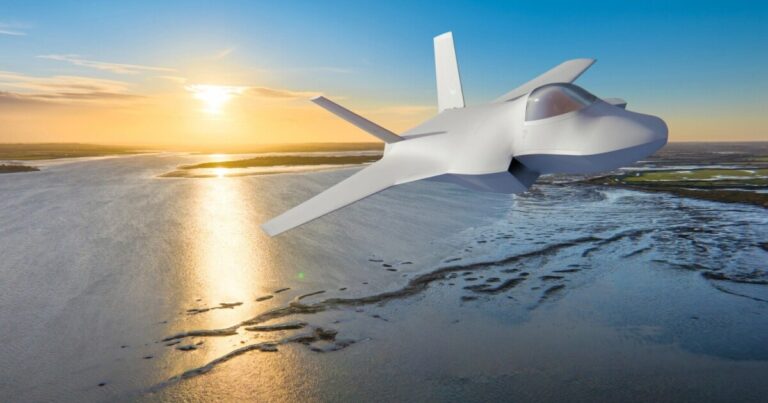
One of the world’s first sixth-generation fighters has moved closer to its first flight, as BAE Systems unveils the prototype Combat Air Flying Demonstrator, now under construction for the Global Combat Air Programme by Britain, Italy, and Japan.

Known as Tempest in the UK, which began the effort, the supersonic Global Combat Air Programme fighter is not only the first fighter to be built in Britain in 40 years, it’s one of the first of a whole new class of combat aircraft with an advanced design incorporating a raft of new technologies and capabilities that verge of science fiction.

Expected to become operational by 2035 as a replacement for the Typhoon Eurofighter and a major advance on the F-35 Lightning II, the first major step in the program is to complete the demonstrator aircraft for its first flight in 2027. Its purpose is to help iron out any bugs in the design and develop the processes needed to manufacture the final aircraft.

Demonstrator under construction

BAE Systems

Until now, we’ve had to rely on artist’s concepts and mock ups of the final Tempest fighter, but the release of the admittedly unadorned rendering of the demonstrator and of the actual airframe on the factory floor provide the first concrete idea of the finished product.

According to BAE Systems, by structural weight the demonstrator is already two-thirds completed, including the fuselage and wings. It’s the product of a tranche of new digital manufacturing techniques that include 3D printing for rapid prototyping and simplification of components, digital twins, model-based systems engineering virtual simulations, and cobotics, which are robots designed to work closely and safely with human workers.

Even though the demonstrator has yet to be completed, test pilots from BAE Systems, Rolls-Royce, and the RAF have already flown over 300 simulated hours. This has allowed for rapid improvements of the flight controls by putting them and the simulated aircraft through complex flight operations.

In addition to identifying manufacturing problems, the program also deals with a new high-speed pilot ejector seat and a new Rolls-Royce jet engine. The expected end result will be a pilot-optional fighter with twice the payload of the F-35A and enough range to carry out transatlantic flights without refueling for an engine that has enough surplus electrical generating capacity to handle energy weapons and hypersonic launchers.

Testing the high-speed ejector seat for the demonstrator

BAE Systems

Along with these improvements, the Tempest boasts a modular design for quick upgrades, integrated AI and machine learning systems, Loyal Wingman controls that turn the fighter into a command and control center for swarm drones, new stealth technologies, and a virtual cockpit that can be easily reconfigured to suit a particular mission or task.

“This significant and challenging project will deliver the UK’s first crewed combat demonstrator aircraft in four decades,” said Tony Godbold, Future Combat Air Systems Delivery Director, BAE Systems. “The program is accelerating the development of advanced design approaches and manufacturing techniques, helping to sharpen the UK’s industrial edge and deliver benefits beyond the production of the aircraft.

“As well as developing a unique aircraft, we’re building the technical foundations, workforce readiness and digital maturity essential to deliver the next generation of combat air capability.”

Source: BAE Systems

Existing Home Sales Drop to Lowest Level in 9 Months, Described as Housing Market ‘Purgatory’

0

U.S. existing home sales fell sharply in June 2025, dropping to their lowest level in nine months as elevated mortgage rates and record-high prices continued to sideline many prospective buyers. According to the National Association of Realtors (NAR), existing home sales slipped 2.7% from May to a seasonally adjusted annual rate of 3.93 million transactions, exceeding analysts’ expectations for a more modest decline. Compared to last year, sales were flat overall, with concentrated declines in several regions.

The housing market is traditionally busiest in spring, but this year’s key buying season proved lackluster. The month-over-month decline largely reflected affordability challenges: mortgage rates hovered close to 7% throughout April and May, when most June closings would have entered contract.

“Existing home sales have been in purgatory since mortgage rates spiked in 2022,” Lance Lambert, editor-in-chief of ResiClub, told Fortune Intelligence. “Some of that’s because strained affordability n many markets is making it harder for sellers to find a buyer at their asking price—which is also why active inventory is rising. And some of it is because many would-be home sellers, who’d like to sell and buy something else, either can’t afford that next payment or don’t want to part with their lower mortgage rate and payment. No matter how you look at it, this is an unhealthy housing market.”

Skyhigh prices

On a nationwide basis, home prices climbed to an all-time high, underpinning the market’s affordability squeeze. The median price for existing homes reached $435,300 in June, up 2% from the same month a year earlier and marking the 24th consecutive month of yearly price gains. NAR Chief Economist Lawrence Yun sounded an optimistic tone about this staggering climb: “The record high median home price highlights how American homeowners’ wealth continues to grow—a benefit of homeownership. The average homeowner’s wealth has expanded by $140,900 over the past five years.”

Despite weak sales, inventory is slowly rebuilding: 1.53 million homes were listed for sale at the end of June, up nearly 16% from a year ago—the highest level in years—though still 0.6% lower than in May due to seasonal factors. This puts the market’s unsold inventory at a 4.7-month supply, matching pre-pandemic norms and up from 4.0 months a year prior.

Regional dynamics varied. Sales dropped in the Northeast, Midwest, and South, but edged higher in the West, with year-over-year changes mirroring these splits. Single-family home sales slipped 3%, while sales of condominiums and co-ops were stable compared to May but down 5.3% against June 2024.

One positive for buyers: more supply and slightly longer time on market. Realtor.com reported that active inventory for June rose for the 20th straight month, climbing nearly 29% year over year to 1.08 million homes, and the average home spent 53 days on market, five days longer than a year earlier. However, these gains are offset by persistent undersupply when compared to the pre-pandemic market, and price cuts became more common, with nearly 21% of listings experiencing downward adjustments—the highest June share since 2016.

“Multiple years of undersupply are driving the record high home price,” Yun said, noting that construction continues to lag population growth and is holding back first-time buyers. “If the average mortgage rates were to decline to 6%, our scenario analysis suggests an additional 160,000 renters would become first-time homeowners and a boost in activity from existing homeowners,” Yun added.

If mortgage rates decrease in the second half of this year, Yun said, he expects home sales to increase across the country due to strong income growth, healthy inventory, and a record-high number of jobs.” For now, though, it’s a familiar story of peak prices and affordability the main obstacle for would-be homebuyers in the U.S.

For this story, Fortune used generative AI to help with an initial draft. An editor verified the accuracy of the information before publishing.