7.7 C
New York
Wednesday, April 22, 2026
Home Blog Page 537

Dozens Arrested During Violent Protests Over Soaring Fuel Prices

0

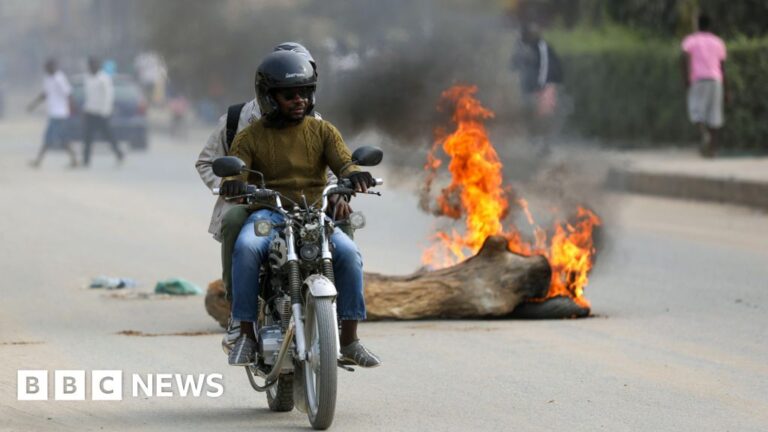
EPA People on a motorbike drive past a tree stump set on fire in Luanda on Monday.EPA

Parts of the capital, Luanda, came to a standstill on Monday

Police in Angola say four people have been killed and 500 have been arrested after demonstrations in the capital, Luanda.

What began as a three-day strike by taxi drivers against rising petrol prices has escalated into one of the most widespread and disruptive waves of protest the country has seen in recent years.

Thousands of people joined demonstrations in the capital on Monday that saw roads blocked, shops looted, cars destroyed as well as clashes between demonstrators and police.

Since Monday night there have been reports of gunfire in parts of the capital.

Pockets of protests continued in Luanda on Tuesday, along with further clashes with police and more looting of shops, while there are reports the demonstrations have spread further afield to the central city of Huambo.

“The fuel price issue is just the last straw that has reignited widespread public discontent… People are fed up. Hunger is rife, and the poor are becoming miserable,” a prominent local activist, Laura Macedo, told the BBC.

The strike was called by taxi operators in response to the government’s decision to raise the price of diesel by over 33%, a measure introduced in early July as part of plans to remove fuel subsidies in the oil-rich nation.

Not only has this resulted in higher fares for urban Angolans who rely on the taxis, but it has also driven up the price of staple foods and other basics – as suppliers who transport those goods by road are passing on their additional costs to consumers.

But President João Lourenço has dismissed such concerns, saying that protesters are using petrol prices as a pretext to undermine the government.

“Even after the increase, the price of diesel in Angola remains around 40 US cents [per litre], and there are not many countries in the world with prices this low,” he told CNN Portugal in a recent interview.

The average monthly wage in Angola is just 70,000 kwanzas ($75; £56), and a promise by the presidency to increase this to 100,000 kwanzas has not materialised.

As frustrations spilled over on Monday, groups of protesters took to the streets in various parts of Luanda, chanting against fuel price increases, nearly five decades of rule by the governing MPLA party and expressing their frustration with the country’s current state of affairs.

Luamba Muinga Protest organiser Laura Macedo.Luamba Muinga

Laura Macedo, seen here at a smaller fuel protest earlier this month, says Angolans are fed up

State-run media in Angola came under heavy criticism on social media for continuing with its regular programming and failing to cover the demonstrations.

By Monday evening, the MPLA warned young people not to join the protests and said that these “acts of vandalism are deliberately intended to tarnish and hinder the joyful celebration” of Angola’s 50th anniversary of independence.

Local authorities in Luanda on Monday also issued a public statement expressing “deep concern” over the events, which they described as “disturbances and acts of vandalism associated with the forced halting of taxi services”.

According to the statement, the strike originally announced by taxi organisations had been called off following negotiations with authorities.

However, it said, “groups of unidentified individuals, without any legitimate representation of the taxi sector, resumed the call for strike actions, promoting intimidation and violence, including attacks on vehicles circulating on public roads, even those not providing taxi services”.

Much of these protests have been spontaneous in nature.

A major taxi association, Anata, has distanced itself from Monday’s violence but vowed to continue the three-day strike, saying “the voice of the taxi drivers reflects the outcry of the Angolan people”.

As of Tuesday afternoon, major shops, banks and other businesses have remained closed. Some civil servants have returned to work, but many people who work for private companies have stayed at home on the advice of their employers.

Police warn they are patrolling the streets and will continue to “intervene where there are still disturbances” to “re-establish public order and peace”.

AFP via Getty Images A group of shops are targeted as looting erupted in the Kalemba 2 district of Luanda on Monday.AFP via Getty Images

Some shops in the capital were raided

More BBC stories on Angola:

Getty Images/BBC A woman looking at her mobile phone and the graphic BBC News AfricaGetty Images/BBC

AEG teams up with Because, Combat in fresh ownership model for Paris festival We Love Green

0

Jay Marciano, CEO of AEG Presents, rightly calls it one of Europe’s “marquee” live music festivals.

Now, the Paris event We Love Green, which attracts more than 120,000 festival goers each summer, is moving forward with a new alliance of partners.

The festival was co-founded by Emmanuel De Buretel’s Because Group, plus Corida and We Love Art.

According to a press release, We Love Green has now entered a “strategic partnership” with independent media platform Combat and AEG Presents, in an alliance that also includes Because.

That press release reads: “Combat (publisher of Radio Nova, Les Inrockuptibles and co-producer of Rock en Seine, Golden Coast, La Route du Rock and Les Inrocks Festival, shareholder of Rough Trade) and AEG Presents are joining the adventure as key partners of We Love Green, [alongside] the Because group, one the biggest independent music groups in Europe, and We Love Art the famous cultural events company.

“This alliance aims to strengthen the festival’s ambitions by providing the resources to grow, expand its international reach and continue exploring new sustainable cultural formats.”

By taking an ownership stake in the event, AEG adds We Love Green to a European indie festival portfolio that also includes France’s Rock En Seine, plus London’s All Points East, and Lido.

We Love Green has a reputation for trailblazing new music in France. Since 2011, it has hosted the first festival performances in the country for Charli XCX, Rosalia, Jorja Smith, Lorde, PNL, Aya Nakamura, and Angèle.

Elsewhere, it’s hosted performances from the likes of Tyler the Creator, Gorillaz, Tale Impala, Bjork, FKA Twigs, Migos, Justice, LCD SoundSystem, Skrillex, Phoenix, Little Simz, Jamie XX, Tale of us, Amelie Lens and many more.

The festival has long focused on sustainable development and operates on 100% renewable energy.

In 2024, Yourope awarded it the Green Operation Award. Meanwhile, based on a detailed on-site audit, the NGO A Greener Festival has certified it “outstanding” for each of the past ten years.

“This partnership marks a new chapter in the history of We Love Green. It will help us amplify our values alongside partners who share our vision of a creative, responsible, and ever-evolving festival,” said Marie Sabot, Festival Director and founder of We Love Art.

“This partnership marks a new chapter in the history of We Love Green.”

Marie Sabot, We Love Art

Emmanuel de Buretel, founder of Because Group, added: “We Love Green has always been fueled by artistic ambition and environmental responsibility. We’re excited to now embed it within a collective momentum that will help to develop and respect the brand worldwide.”

Mathieu Pigasse, founder and President of Combat, said: “This is more than a partnership — it is a strategic alliance that reflects our belief in the power of culture to drive change. At Combat, we are reaffirming our commitment to society, diversity and inclusion.

“We are also investing in cultural formats that reflect our times and help shape the future. With AEG at our side, we are bringing the scale, resources and ambition needed to elevate We Love Green while preserving its singular identity.”

“We Love Green has always been fueled by artistic ambition and environmental responsibility. We’re excited to now embed it within a collective momentum that will help to develop and respect the brand worldwide.”

Emmanuel De Buretel, Because

Jay Marciano, Chairman and CEO of AEG Presents, commented: “Emmanuel and the entire We Love Green team have built a festival that is one of the marquee live events in Europe.

“I’ve known Emmanuel for quite some time and have always respected his vision and taste. I’m delighted that we get to work together in this new partnership.

“I’ve known Emmanuel for quite some time and have always respected his vision and taste. I’m delighted that we get to work together in this new partnership.”

Jay Marciano, AEG Presents

Jim King, CEO of European Festivals for AEG Presents, said: “We Love Green is a premium and sustainable event with an identity that – alongside Rock En Seine, All Points East and Lido – fits perfectly into our overall European festival strategy: connecting our marquee festivals to create high value summer routings for artists.

“We’re delighted to be partnering with them and excited for what’s to come.”

Arnaud Meersseman, Managing Director of AEG Presents France, said: “We Love Green is an inspiring model. We are proud to contribute to it, respecting its identity and supporting it in a new phase of its development.”

And Alex Jaillon, CEO of We Love Art, added: “This is a truly major strategic step for We Love Art, who imagined and designed the festival and are proud to have brought the festival to this decisive stage to launch its international development ”

Under the leadership of Marie Sabot, the teams are already preparing for the 2026 edition.


Last week, AEG announced that Jim King had been promoted to a new dual role: CEO of AEG Presents UK and European Festivals.

King adds the company’s UK concert promotion business, which includes arena and stadium tours as well as club performances, to his portfolio.Music Business Worldwide

Beijing Overwhelmed by Deadly Flooding

0

Severe rains caused flooding and landslides in Beijing and surrounding areas, leaving homes destroyed as mass evacuations were underway.

Challenging Clients

0


Client Challenge


JavaScript is disabled in your browser.

Please enable JavaScript to proceed.

A required part of this site couldn’t load. This may be due to a browser
extension, network issues, or browser settings. Please check your
connection, disable any ad blockers, or try using a different browser.

Video: Israeli settler murders activist featured in Oscar-winning film | War Crimes

0

NewsFeed

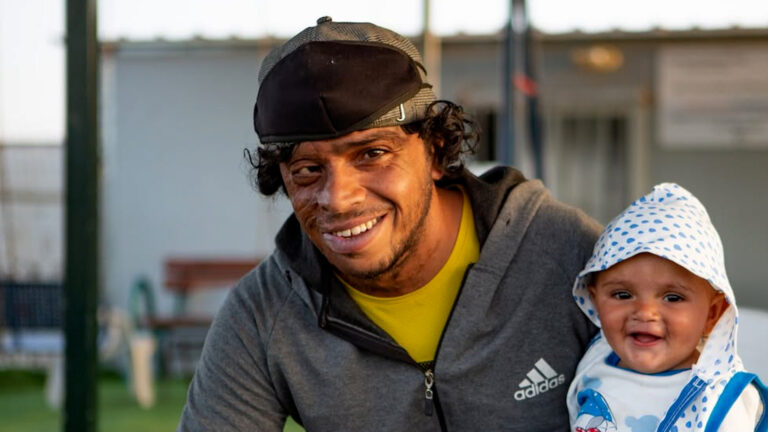
Activist, football player and participant in Oscar-winning film Odeh Hadalin was shot in the chest and killed by an Israeli settler, in the Occupied West Bank. The shooter, Yinon Levi, has been under sanctions by both the EU and the US.

Live Recap of Day 3 Finals at the 2025 World Championships

0

By James Sutherland on SwimSwam

2025 World Championships

DAY 3 FINALS HEAT SHEET

Order Of Events: 

  • Men’s 200 freestyle final
  • Women’s 1500 freestyle final
  • Men’s 50 breaststroke semi-finals
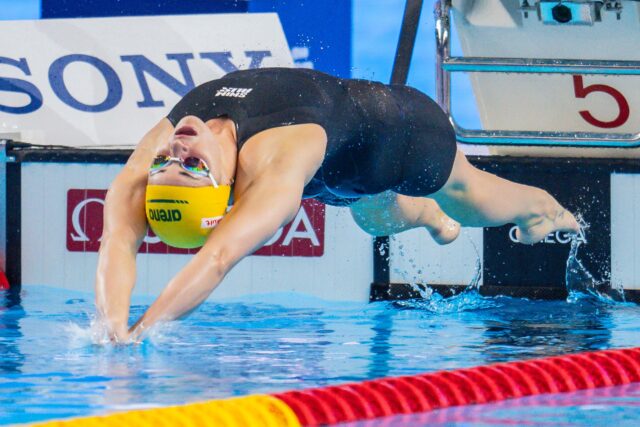
  • Women’s 100 backstroke final
  • Men’s 100 backstroke final
  • Women’s 200 freestyle semi-finals
  • Men’s 200 butterfly semi-finals
  • Women’s 100 breaststroke final

The third night of finals from the 2025 World Championships is set to get underway in Singapore with medals on the line in five events, plus semi-final rounds in three more.

The men’s 200 freestyle final promises to be a barn-burner with David Popovici and Luke Hobson set to go head-to-head, while Katie Ledecky aims to win her sixth world title in the women’s 1500 freestyle, with those events being the first two on the docket.

Then we’ll see the 100 back final for both genders, highlighted by Kaylee McKeown versus Regan Smith in the women’s event and a wide open battle for the men, and then things will close with the women’s 100 breaststroke final where American Kate Douglass leads the field out of the semis while China’s Tang Qianting is the favorite on paper and the defending champion.

We’ll also see semis in the men’s 50 breast, the women’s 200 free and the men’s 200 fly.

MEN’S 200 FREESTYLE – FINAL

  • World Record: 1:42.00 – Paul Biedermann, GER (2009)
  • World Junior Record: 1:42.97 – David Popovici, ROU (2022)
  • Championship Record: 1:42.00 – Paul Biedermann, GER (2009)
  • 2023 World Champion: Matt Richards, GBR – 1:44.30
  • 2024 Olympic Champion: David Popovici, ROU – 1:44.72

WOMEN’S 1500 FREESTYLE – FINAL

MEN’S 50 BREASTSTROKE – SEMI-FINALS

  • World Record: 25.95 – Adam Peaty, GBR (2017)
  • World Junior Record: 26.97 – Nicolo Martinenghi, ITA (2017)
  • Championship Record: 25.95 – Adam Peaty, GBR (2017)
  • 2023 World Champion: Qin Haiyang, CHN – 26.29

WOMEN’S 100 BACKSTROKE – FINAL

MEN’S 100 BACKSTROKE – FINAL

  • World Record: 51.60 – Thomas Ceccon, Italy (2022)
  • World Junior Record: 52.08 – Miron Lifintsev, Russia (2024)
  • Championship Record: 51.60 – Thomas Ceccon, Italy (2022)
  • 2023 World Champion: Ryan Murphy, United States – 52.22
  • 2024 Olympic Champion: Thomas Ceccon, Italy – 52.00

WOMEN’S 200 FREESTYLE – SEMI-FINALS

  • World Record: 1:52.23 – Ariarne Titmus, AUS (2024)
  • World Junior Record: 1:53.65 – Summer McIntosh, CAN (2023)
  • Championship Record: Mollie O’Callaghan, AUS – 1:52.85
  • 2023 World Champion: Mollie O’Callaghan, AUS – 1:52.85
  • 2024 Olympic Champion: Mollie O’Callaghan, AUS – 1:53.27

MEN’S 200 BUTTERFLY – SEMI-FINALS

  • World Record: 1:50.34 – Kristof Milak, HUN (2022)
  • World Junior Record: 1:53.79 – Kristof Milak, HUN (2017)
  • Championship Record: 1:50.34 – Kristof Milak, HUN (2022)
  • 2023 World Champion: Leon Marchand, FRA – 1:52.43
  • 2024 Olympic Champion: Leon Marchand, FRA – 1:51.21

WOMEN’S 100 BREASTSTROKE – FINAL

  • World Record: 1:04.13 – Lilly King, USA (2017)
  • World Junior Record: 1:04.35 – Ruta Meilutyte, LTU (2013)
  • Championship Record: 1:04.13 – Lilly King, USA(2017)
  • 2023 World Champion: Ruta Meilutyte, LTU – 1:04.62
  • 2024 Olympic Champion: Tatjana Schoenmaker, RSA – 1:05.28

Read the full story on SwimSwam: 2025 World Championships: Day 3 Finals Live Recap

AstraZeneca’s shares rise following better-than-expected Q2 results; company maintains steady outlook

0


AstraZeneca shares gain after beating Q2 forecasts; outlook steady

Revolutionary New Titanium Alloys Enhance 3D Printing Capabilities

0

Apparently, folks in the material science world are totally over the fact that we’re able to 3D print titanium alloys willy-nilly.

Because they have exceptional strength-to-weight ratios, corrosion resistance, and biocompatibility, titanium alloys are used to make aircraft frames, jet engine parts, hip and knee replacements, dental implants, ship hulls, and golf clubs.

Ryan Brooke, an additive manufacturing researcher at Australia’s RMIT University, believes we can do way better. “3D printing allows faster, less wasteful and more tailorable production yet we’re still relying on legacy alloys like Ti-6Al-4V that doesn’t allow full capitalization of this potential,” he says. “It’s like we’ve created an airplane and are still just driving it around the streets.”

Titanium alloys are light, strong and corrosion-resistant, which is why they find use in jet engines

Ti-6Al-4V is also known as Titanium alloy 6-4 or grade 5 titanium, and is a combination of aluminum and vanadium. It’s strong, rigid, and highly fatigue resistant. However, 3D-printed Ti-6Al-4V has a propensity for columnar grains, which means that parts made from this material can be strong in one direction but weak or inconsistent in others – and therefore may need alloying with other elements to correct this.

To be fair, Brooke is putting his money where his mouth is. He’s authored a paper that appeared in Nature this month on a new approach to finding a reliable way to predict the grain structure of metals made using additive manufacturing, and thereby guide the design of new high-performance alloys we can 3D print.

The researchers’ approach, which has been in the works for the last three years, evaluated three key parameters in predicting the grain structure of alloys to determine whether an additive manufacturing recipe would yield a good alloy:

  • Non-equilibrium solidification range(ΔTs): the temperature range over which the metal solidifies under non-equilibrium conditions.
  • Growth restriction factor (Q): the initial rate at which constitutional supercooling develops at the very beginning of solidification.
  • Constitutional supercooling parameter (P): the overall potential for new grains to nucleate and grow throughout the solidification process, rather than just at the very beginning.

Through this work, the team experimentally verified that P is the most reliable parameter for guiding the selection of alloying elements in 3D-printed alloys to achieve desired grain structures for strength and durability.

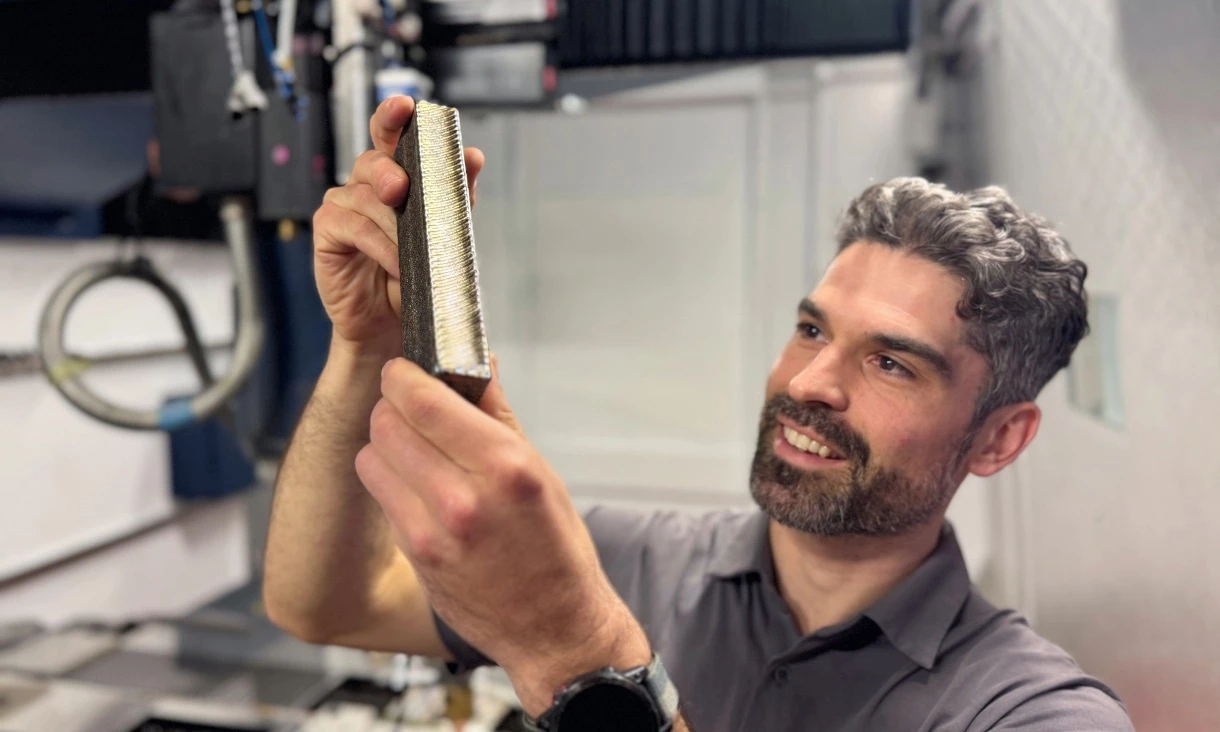
Study lead author Ryan Brooke inspects a sample of the new titanium alloy that's 30% cheaper to produce than standard titanium
Study lead author Ryan Brooke inspects a sample of the new titanium alloy that’s 30% cheaper to produce than standard titanium

Image courtesy of the researchers

This method, which uses a wealth of experimental data and computational tools, is said to save on time and costs in developing additively manufactured alloys by reducing the number of iterations and speeding up development cycles.

The team didn’t describe its own titanium alloy in the paper as it plans to commercialize it soon – but claims it’s 29% cheaper to produce than regular titanium. The researchers also noted that they “have been able to not only produce titanium alloys with a uniform grain structure, but with reduced costs, while also making it stronger and more ductile.”

That could make titanium alloy more accessible for the aforementioned applications across industries ranging from aerospace to healthcare, and potentially lower the costs of manufacturing and maintaining high-performance components.

Source: RMIT University

17 killed and dozens wounded as Russia attacks Ukrainian prison

0

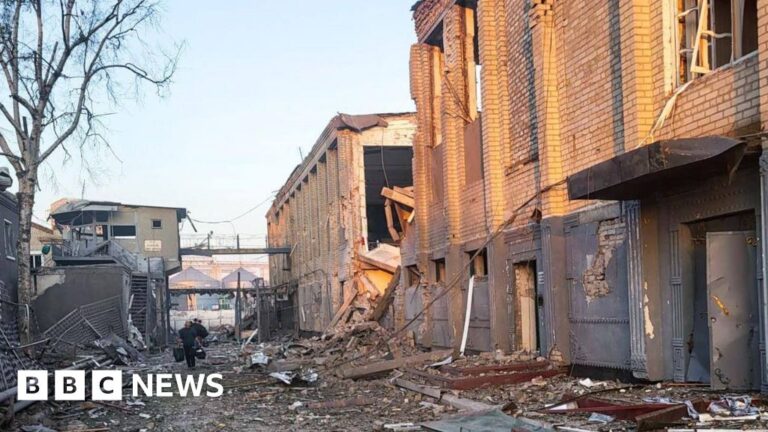
A Russian airstrike on a prison in a frontline region in southeastern Ukraine has killed 17 people and wounded 42 others, according to Ukrainian officials.

The overnight attack in Zaporizhzhia also damaged surrounding homes, regional leader Ivan Fedorov said. Russian forces launched eight strikes using high-explosive aerial glide bombs, he added.

The Ukrainian president’s chief of staff, Andriy Yermak, condemned the strikes as “another war crime” committed by Russia.

Zaporizhzhia is one of four eastern regions in Ukraine that Russia claims to have annexed since 2022, although the region is largely under Ukrainian control.

Ukraine’s justice ministry said four bombs hit the Bilenke penitentiary, destroying the dining hall, administrative HQ and quarantine area and that all those killed and wounded were inmates.

Russian forces have frequently targeted Zaporizhzhia since the start of the full-scale invasion of Ukraine in 2022.

Ukraine’s human rights commissioner said attacking a prison was a gross violation of humanitarian law as people in detention did not lose their right to life and protection.

US President Donald Trump issued a stark ultimatum to Moscow Monday, warning that Russia had “about 10 or 12 days” to agree a ceasefire or face sweeping sanctions. Speaking during a visit to Scotland, Trump told reporters he would “announce it probably tonight or tomorrow,” adding, “there’s no reason to wait, if you know what the answer is”.

Earlier in July, Trump set a 50-day deadline for the Kremlin to reach a truce with Kyiv or risk economic penalties, but the warning has not halted Russia’s barrage of strikes.

There were further casualties in a missile and drone attack late on Monday in the Dnipropetrovsk region of eastern Ukraine.

A strike on the industrial city of Kamyanske left two people dead and five injured, according to regional head Serhiy Lysak.

Another person was killed and several were wounded in the Synelnykivsky district, while a 75-year-old woman was killed and a 68-year-old man injured when their home was hit in a village late on Monday.

The wave of attacks came as Russia pushed deeper into Ukrainian territory in Dnipropetrovsk.

At the weekend, Moscow said its forces had captured the village of Maliyevka, weeks after capturing their first village in the region. Ukraine has rejected Russia’s claims.

Meanwhile, in Russia, officials said Ukraine had launched dozens of drones overnight in the southern Rostov region, killing one person in their car in the town of Salsk and setting fire to a goods train.

Another person was reported killed in their car in the border region of Belgorod and his wife was wounded.

Tom Hayes, the UBS trader wrongly imprisoned for 5 years for interest rate rigging, shares his experience of finally being cleared of all charges

0

Former UBS and Citigroup banker Tom Hayes was one of the few people convicted of crimes and sentenced to prison for trading activities leading up to the Great Financial Crisis. His conviction was overturned last week by the U.K. Supreme Court.

Hayes told Fortune the news took days to sink in—even though he was notified about the decision a day in advance.

“It was actually like 24 hours of anxiety, just like ridiculous anxiety, like ‘Are they going to change their mind? Are they going to change the ruling? Is something going to change,” he said. “Then, obviously, once the ruling came out, bang, like, I just got very busy, very quickly.”

In Hayes’ case, a U.K. court found he manipulated a key interest rate used by banks as a benchmark that set costs for hundreds of millions of dollars of loans and mortgages worldwide. The “manipulation” was that Hayes and colleagues at other banks would discuss the range of interest rates at which their banks were willing to lend money to each other (the “London Inter-Bank Offered Rate” of interest, or Libor), and then Hayes would select a rate inside that range that was most advantageous to his bank.

During the trial, prosecutors argued Hayes was the mastermind of a global operation to fix the now-defunct Libor, which underpinned everything from student loans to derivatives. Prosecutors argued Hayes led a network of traders and brokers to submit information that benefited his trades and earned illicit profits for himself and his employer.

In his defense, Hayes argued that the way he set rates was considered a routine part of doing business, and that no one in banking—especially his bosses—thought it was illegal.

A jury found that choosing an advantageous Libor rate was corruptly self-serving, and Hayes, now 45, was sent to prison.

But, after a decade-long insistence on his innocence, Hayes was vindicated last week when his conviction was overturned. The court said the judge in Hayes’ trial misdirected the jury in a way that “undermined the fairness of the trial.” Yet, it did not fully absolve him, as the justices allowed that there was “ample evidence” in the course of Hayes’ trial that could’ve led to a conviction. The Supreme Court did not comment on the actions of the U.K.’s Serious Fraud Office (SFO), which prosecuted Hayes.

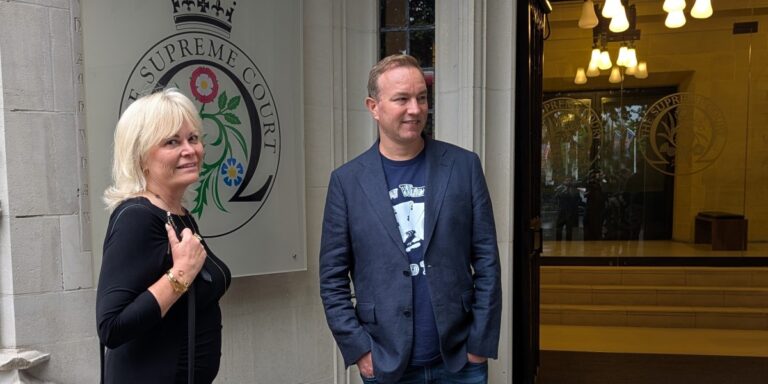
Tom Hayes (right) poses on July 23 with Carlo Palombo, a former Barclays exec whose conviction for rigging Euribor was also overturned by the U.K. Supreme Court.

Courtesy of Sian Harrison

Hayes disagrees with the Supreme Court’s “ample evidence” claim. He argues that if the SFO, which investigates financial crimes, would have chosen to retry his case, if this were true. The SFO said it did not move to retry Hayes because it determined seeking a retrial would “not be in the public interest.”

“If I’d been retried, I would have actually relished that, because I probably would have won,” he told Fortune.

The SFO declined to comment to Fortune beyond what it said in a public statement. 

Although 19 other bankers were also convicted in the U.K. and U.S. for the LIBOR scandal, Hayes’ 14-year prison sentence was among the harshest. He served just over five years in prison (his sentence was reduced to 11 years on appeal) and another four years on probation. 

Hayes’ conviction was overturned on July 23 but it wasn’t until July 26 that the ruling hit home, he said.

That was the day he opened a letter from his sister. She wrote him a letter nearly every week, if not more often, while he was in prison, said Hayes. Following the decision on his conviction, he said, she sent one more.

“The last letter, she called it. She just said, you know, ‘I thought that I should write to you this one last time using pen and paper,’” he said. “The last paragraph of it was, ‘I’m so proud of you, Tom. Here’s to never writing you a letter ever again. The end of an era. And what an end.’”

Tom Hayes: scapegoat

Hayes usually prefers to avoid attention. On the London Underground, he likes to shuffle into a corner and look at his phone to avoid being recognized, he said. Walking around town, his eyes are always fixed on his feet. 

Despite his discomfort, the former star yen derivatives trader for UBS and Citigroup has become globally recognized, some might say, as a fall guy for the Libor scandal, which involved myriad actors, including bankers, banks, and even world governments.

In the aftermath of the 2008 financial crisis, Hayes said the public’s yearning for a scapegoat played into his conviction as well. Getting a fair shake was impossible, he said, at a time when governments and the media were looking to hold bankers to account following the Great Financial Crisis. 

In Hayes’ view, he and his fellow bankers were unfairly targeted for engaging in routine business practices that, at the time, everyone thought were legal. Among those prosecuted was Carlo Palombo, a former Barclays exec, whose conviction for rigging another benchmark rate, Euribor, was also overturned last week by the U.K. Supreme Court.

“Eric Holder gave a live press conference charging me when I’d never even been spoken to by the DOJ. I had nothing to do with America, and I got charged with the same offense at the same time in the U.K. Not even terrorists get that,” he said.

The SFO, which, besides Hayes, also successfully prosecuted another nine people for rigging rates, is at conflict with itself because of its mandate both to investigate and prosecute, said Hayes. In his case, the SFO’s reliance on an investigation by the outside counsel of his former employer, UBS, was also problematic, he claimed.

“There’s a very dark side to the relationship between third-party law firms acting for banks who are suspects and being paid hundreds of millions by those banks or corporates who are suspects and acting in their interests, and their relationship with prosecutors and regulators and that hand-in-glove approach where you know, they all have sort of a similar goal,” he said.

In prison, Hayes ran into inmates who couldn’t believe he was given such a lengthy sentence for fraud and assumed he was either a pedophile or an undercover police officer. In prison, he shied away from conflict, and was only “throttled” once he said, though the altercation ended quickly. Contrary to common belief, Hayes felt safer in the high-security prison, which was less unruly because “the real guys don’t even got nothing to prove.” 

Looking to the future

Hayes maintained that he’s no longer constantly angry for the time he spent in prison or at the judge who oversaw his trial. During his time in confinement, he became a Christian, he said, and learned to forgive. His conviction being overturned last week has also helped keep the “weeds” of his repressed rage from sprouting up again, he said.

“Interestingly, I felt those weeds have not been appearing quite so much since Wednesday. So definitely, I think whatever happened on Wednesday is helping me with that.”

Looking to the future is difficult. Despite—or perhaps because of—being on probation, he hasn’t felt free for years. He’s undecided on whether he’ll return to finance, even as the U.K. Financial Conduct Authority dropped his lifetime ban Friday, Bloomberg reported

One thing he does know is he feels a responsibility to speak out for other convicted bankers who were sentenced for similar charges, despite his wish to live anonymously. At least four convicted bankers have already said they will appeal their convictions following the Supreme Court’s decision on Hayes’ case this week, the Financial Times reported.

For now, though, Hayes is ready for a break. After a week of interviews, he enjoyed a weekend away with his father and 13-year-old son in St Ives, a small coastal town in Cornwall, in the southwest of England. In the future, he wants to live by the sea and buy a dog, he said.

Hayes, who at the pinnacle of his career was bringing in a multi-million-dollar salary with incentives, is now focused on the things he used to take advantage of, and he said the rest of the world should too.  

“Don’t take your freedom for granted. Don’t take all the things that are amazing in your life for granted,” he said. “Don’t get obsessed about just trying to acquire more stuff and thinking this is a good way of measuring your quality of life, because it really isn’t.”