

10.4 C
New York
Thursday, April 23, 2026
Home Blog Page 529

The Far Right: Poland’s Growing Anti-Migrant Anger and Scapegoating

0

It started with a violent crime. In June, in the centre of Torun, central-north Poland, a Venezuelan man stabbed 24-year-old Klaudia, a Polish woman, to death as she was walking home from work through a park.

That horrific incident led to a silent march by thousands of protesters through Torun on Sunday, July 6. Local media reported that the march had been organised by supporters of the far-right Konfederacja political alliance and people carried signs saying “stop illegal immigration”.

Then came the rumours and misinformation. On July 14, someone in Walbrzych, southwestern Poland, called the police to report a Paraguayan man who had allegedly taken pictures of children on a playground.

The police stopped the man but did not find anything incriminating on his phone. That didn’t stop two Polish men from beating him up soon afterwards. And, the next day, a group of about 50 people stormed the hostel he and other migrants were living in. Some people threw flares into the building, and the owner has since been forced to close the hostel down.

In recent weeks, anti-migrant sentiment in Poland has been on the rise, spurred by far-right rhetoric, which asserts that Poland has been flooded with “unconstrained illegal migration”. Claims that migrants take local jobs and that they pose a threat to Poles both physically and figuratively, with their “foreign lifestyle”, are common and even encouraged by lawmakers.

One MP from Konfederacja – Konrad Berkowicz from Krakow – told TOK FM radio: “Xenophobia is an important element of our national unity. Condemning xenophobia and stifling it in the West has led to rapes and terrorist acts, that’s why we should cherish xenophobia.”

Elmi Abdi, 62, a Somali who came to Poland in 1996 as a refugee, told Al Jazeera: “Today, migrants are seen as responsible for all of Poland’s problems; we are scapegoats that all parties attack, even though politicians know it’s all untrue.” Today, Abdi is head of the Good Start foundation, which supports migrants, offering help with access to language classes, legal assistance and other matters.

“It is sad because we [immigrants] do everything to work safely here, pay taxes, and integrate into society.”

As misinformation – such as in the Walbrzych incident – about immigrants spreads, the Polish Migration Forum, a rights group, has called the atmosphere in Poland “pre-pogrom-like”.

“What distinguishes today’s situation is the violence. We are in a very bad place,” said Agnieszka Kosowicz, head of the forum. “Acts of violence already take place, people are subject to insults, threats and displays of hostility and contempt. This is a very alarming situation that requires a decisive response from the state.”

Border guard officers stand guard at the Polish-Belarusian border, in Polowce, Poland, on Monday, July 21, 2025 [Czarek Sokolowski/AP]

Rumours of ‘illegal returns’

On July 7, Poland reinstated border controls with Germany and Lithuania. That followed similar restrictions Germany imposed earlier in the year to discourage asylum seekers from entering through Poland.

Poland is also now actively monitoring the return of migrants – both asylum and non-asylum seekers – by the German police, as per European Union rules. These are people who arrived in Poland from outside the EU before crossing to Germany.

These returns of migrants by the German authorities are legal, but as rumours on the internet about “illegal returns” of migrants continue to spread, unofficial, far-right patrols have appeared at the borders to monitor the situation and make “citizen arrests” of individuals they believe to be entering the country illegally – so far without much success.

The EU accused Belarusian and Russian authorities of fomenting the EU’s migration crisis to destabilise the continent, by encouraging people from the Global South to travel to Belarus and then onwards into Europe via Poland.

In 2022, Poland built a fence along the border with Belarus to prevent migrants from entering the country irregularly. The fence, however, did little to physically stop migrants from coming in.

So, in March this year, Poland suspended the right to claim asylum altogether in a bid to deter people from coming.

All of this has served to stir up anti-migrant fear in Poland, which has been further amplified by far-right groups for their own political purposes.

Anti-migrant protests in Poland
Far-right groups march through central Krakow on Saturday, July 19 [Agnieszka Pikulicka-Wilczewska/Al Jazeera]

‘We are being humiliated’

The hysteria reached a new high nearly two weeks ago, when, on Saturday, July 19, anti-migrant marches organised by the far-right Konfederacja party and football fans swept through 80 Polish towns and cities, shouting racist slurs and slogans.

Sixteen-year-old Nikola, who did not want to give her surname, told Al Jazeera that she had travelled 125km (80 miles) from her home in Gorlice, southern Poland, to attend the march in Krakow. She said she came along after watching videos on YouTube claiming that, in Western Europe, people are “afraid to leave their homes” because of the number of undocumented immigrants.

She said it was important to her to join a cause that “unites Poles today”.

“I wanted to be part of a community. People are showing those at the top that they care about security and that Poland is our country. We should do everything we can to prevent what’s happening in Western Europe,” she said.

“I’d like to feel safe in my city, and I’ve already seen a few people who looked like they are not from here,” she added.

On the march, Nikola joined a large column of several hundred people, many of them wearing Polish patriotic T-shirts and emblems of the Wisla football club, walking to Market Square. On the way, they passed tourists, some of whom were filming the protesters.

Three elderly women proudly waved white-and-red Polish flags among the football fans. “The nation has had enough of what’s happening. It’s waking up because we’re living under terror, being humiliated,” said Danuta, 60, who also did not want to give her full name. “The borders are not sealed and have to be defended by civilians,” she added, referring to the right-wing groups who patrol the Polish-German border.

On Market Square in the centre of the city, the march crossed paths with a smaller counterdemonstration organised by local left-wing groups, and the two groups exchanged insults while separated by the police.

The police did not record any major incidents during the day. But Abdi and other migrants Al Jazeera spoke with by telephone said they did not dare to leave their homes on Saturday.

Krakow demo
Police officers try to separate and secure a small group of counter-demonstrators who attempt to block an anti-immigration demonstration in Warsaw, Poland, on Saturday, July 19, 2025 [Czarek Sokolowski/AP]

Fake news fans the flames

According to experts, anti-migrant sentiment in Poland has been spurred by misinformation and fake news about the number of people entering the country, which does not reflect reality.

“Poland is not experiencing any large-scale irregular migration,” said Kosowicz. “Within the Dublin procedure [under EU rules], Germany returns people who claimed asylum in Poland and then crossed into Germany. In 2024, there were 688 such people, and this year – 318. This is nothing new.”

According to the International Migration Outlook report for 2024 from the Organisation for Economic Co-operation and Development (OECD), 2.2 percent of Poland’s population was foreign-born in 2023. This is low compared with other European countries such as the UK (15.4 percent), Germany (18.2 percent) and France (13.8 percent).

In 2022, 152,000 immigrants obtained residence permits for more than one year in Poland, the OECD said.

At the Polish-Belarusian border, which has been used by migrants from Global South countries trying to reach Europe since 2021, incoming numbers of migrants have not been particularly high, either. According to official data, from January to late June this year, 15,022 illegal crossing attempts were recorded, of which only 5 percent were successful.

In 2024, there were nearly 30,000 attempts, out of which, by contrast, one-third (10,900) were successful. In 2021, before Poland built a fence at the border with Belarus, the number of attempts reached 52,000.

Kosowicz also blames the government, which she says has failed to build awareness about the costs and benefits of development and migration, making all foreigners potential victims of hate attacks.

“A study by Deloitte and UNHCR says that 2.7 percent of Polish GDP comes solely from the work of Ukrainian refugees. But this isn’t the information we hear from politicians,” she said.

Abdi, who is married to a Polish woman with whom he has two children, worries greatly about their future.

“When I arrived here, the Poles welcomed me wonderfully, and I care deeply about Poland; it’s my home. I want it to be safe for everyone,” he told Al Jazeera in fluent Polish.

“At the marches, people shout that they want a white Poland. I’m old enough, I’m not afraid of anything. But I am worried about my children.”


The increasing power of AI makes it challenging to accurately assess the intelligence of models

0

How do you judge an AI model when it’s already starting to perform better than human beings? That’s the challenge faced by researchers like Russell Wald, executive director of the Stanford Institute for Human-Centered Artificial Intelligence (HAI). 

“As of 2024, there are very few task categories where human ability surpasses AI, and even in these areas, the performance gap between AI and humans is shrinking rapidly,” Wald said last week in a presentation hosted at the Fortune Brainstorm AI Singapore conference. “AI is exceeding human capabilities and it’s becoming increasingly harder for us to benchmark.”

The HAI releases the AI Index each year, which aims to provide a comprehensive, data-driven snapshot of where AI is today. At Fortune Brainstorm AI Singapore, Wald shared a few highlights from the 2025 edition of the AI index, such as the increasing power of today’s models, the growing dominance of industry on the AI frontier, and how China is poised to overtake the U.S.


The following transcript has been lightly edited for conciseness and clarity.

I’m Russell Wald, the executive director of the Stanford Institute for Human-Centered Artificial Intelligence, or what we call “HAI”. 

We are Stanford University’s globally recognized interdisciplinary research institute at the forefront of shaping AI development for the public good. HAI was established in 2019 with the goal of advancing AI research, education, policy and practice. And, through our convening role and rigorous study of AI, we have become the trusted partner on AI governance for decision makers in industry, government and civil society. 

I’m going to talk about what we produce at HAI, which is the AI index, an annual data driven analysis of trends in AI that tracks research, development, deployment and the socio-economic impact of AI across academia, government and industry.

We see AI performance consistently improve year over year. We use Midjourney, a text-to-image generator, asking for a hyper-realistic image of Harry Potter. And from February 2022 to July 2024, we see rapidly increasing quality in these generated images. 

In 2022, the model produced cartoonish, inaccurate renderings of Harry Potter, but by 2024, it could create startlingly realistic depictions. We have gone from what mirrors a Picasso painting to an uncanny rendering of Daniel Radcliffe, the actor who played Harry Potter in the movies. 

Because of this consistent performance growth, we are increasingly challenged when it comes to benchmarking these models. As of 2024, there are very few task categories where human ability surpasses AI, and even in these areas, the performance gap between AI and humans is shrinking rapidly. From image recognition to competition-level mathematics to PhD-level science questions, AI is exceeding human capabilities and it’s becoming increasingly harder for us to benchmark.

From healthcare to transportation, AI is rapidly moving from the lab to our daily life. In 2023, the U.S. Food and Drug Administration approved 223 AI-enabled medical devices, up from just six in 2015. 

On the roads, self-driving cars are no longer experimental. For example, Waymo, which I regularly take while living in San Francisco, is one of the largest U.S. operators and provides over 150,000 autonomous rides each week, while Baidu’s affordable Apollo Go robotaxi has a fleet now that serves numerous cities across China. 

Business use of AI increased significantly after stagnating from 2017 to 2023. The latest McKinsey report reveals that 78% of surveyed respondents say their organizations have begun to use AI in at least one business function, marking a significant increase from 55% in 2023. 

Driven by increasingly capable small models, the inference cost for a system performing at the level of [GPT 3.5] dropped over 280-fold between November 2022 and October 2024. Hardware costs have declined 30% annually, while energy efficiency has improved by 40% each year. 

Open-weight models are also closing the gap with closed models, reducing the performance [gap] from 8% to just 1.7% on some benchmarks in a single year. Together, these trends are rapidly lowering the barriers to advanced AI. 

However, even with inference and hardware costs going down, training costs remain out of reach for academia and most small players. Nearly 90% of notable AI models in 2024 came from industry, which is up from 60% in 2023. And while academia remains a top source of highly cited research, it does struggle at this point to stay as advanced at the frontier level. 

Model scale continues to grow rapidly. Training compute doubles every five months, datasets every eight, and power use annually. Yet performance gaps are shrinking. The score difference between the top and 10th ranked models fell from 11.9% to 5.4% in a year, and the top two models are now separated by just 0.7%. The frontier is increasingly competitive and increasingly crowded. 

In recent years, AI model performance at the frontier has converged, with multiple providers now offering highly capable models. This marks a shift from late 2022, when ChatGPT’s launch, widely seen as AI’s breakthrough into the public consciousness, coincided with the landscape dominated by just two players: OpenAI and Google. 

One of the most important things to note is that the transformer model cost $930 for Google to train in 2017—and that is the T in GPT, the baseline level of architecture—and now today we’re at $200 million to train Gemini Ultra. 

Last year’s AI index was among the first publications to highlight the lack of standard benchmarks for AI safety and responsibility evaluations. The index has also been analyzing global public opinion. If you are from a non-Western industrialized nation, you are more likely to view AI positively than not. China has an 83% positive view, Indonesia 80%, and Thailand 77%. Whereas Canada is at 40%, the U.S. 39%, and the Netherlands 36%. 

I’ll close with the geopolitical situation. The U.S. still maintains a lead in AI, followed closely by China. However, this gap is tightening. My intention is not to exacerbate the idea of an AI arms race between China and the U.S., but instead to highlight the different approaches between the most advanced frontier AI model developers. 

Over the last several years, the U.S. has relied on a few proprietary model providers. Meanwhile, China has deeply invested in its talent base, and more importantly, an open-source environment. If this trend continues, and I appear next year, at this rate, China would surpass the U.S. in terms of model performance. 

Two female individuals were injured by gunshot wounds in Gaza

0

The BBC World Service has pieced together the stories of Layan al-Majdalawi, two, and Mira Tanboura, six, both killed in Gaza in separate incidents in November 2023, in areas where the Israel Defense Forces (IDF) was operating.

In response to our findings, the IDF said the details of Layan and Mira’s cases had been recorded and “will be examined by the competent authorities”. It added: “Intentional harm to civilians, especially children, is strictly prohibited.”

Layan and Mira are just two of more than 160 cases of children shot in the war in Gaza, for whom we have gathered accounts.

We found that in 95 of these cases, the child had been shot in the head or chest. In 59 of those, we obtained testimony from eyewitnesses, either directly or via human rights organisations and medics. The witnesses alleged that 57 of these children were shot by the IDF, and two were shot by Palestinians – one in celebratory gunfire and the other in a gang conflict.

For the remaining 36 out of the 95 cases, we have no account of what happened. Israel bans foreign reporters from entering Gaza independently, and the destruction and displacement make gathering details difficult.

The International Committee of the Red Cross has told the BBC the world cannot accept as a “new normal” the type of warfare that allows so many children to be shot.

How Netflix’s ‘Hitmakers’ Could Educate the Everyday Viewer on Songwriting and Spark Conversations about Fair Compensation

0

If the executives at Milk & Honey are studying Netflix‘s charts even harder than Spotify‘s this month, you can understand why.

The Los Angeles-headquartered management company represents three writers whose work is highly visible across two priority Netflix releases: record-breaking smash KPop Demon Hunters, and behind-the-curtain music biz ‘docu-reality’ series, Hitmakers.

Jenna Andrews and Stephen Kirk both contribute songwriting and production to music on KPop Demon Hunters, on the tracks Free and What It Sounds Like.

Meanwhile, Andrews and Kirk also appear as featured songwriters on Hitmakers – alongside fellow Milk & Honey signee, JHart.

Hitmakers follows a group of songwriters – all well-known in music biz circles – as they seek to pen the next global smash for artists such as John Legend, Shaboozey, Usher, and BLACKPINK’s Lisa.

The show is created and exec-produced by Adam DiVello, whose other credits include Netflix reality staple Selling Sunset and MTV’s The Hills.

As you’d expect from that resumé, Hitmakers isn’t precisely what you’d call all about the music; there’s plenty of (melo)drama to be mined from the competitive nature of the songwriting camps featured within.


There’s also more than a touch of that Selling Sunset sheen. Opulence and luxury (locations! fashion! real estate!) are constantly on display in Hitmakers, which may seem slightly alien to your average charting songwriter, famously plying a trade that pays considerably less than other segments of the music biz.

Yet with Recording Academy chief, Harvey Mason Jr., as one of the show’s producers – and an array of real-life songwriting talent featured – Hitmakers bears some resemblance to the real-life workings of the modern pop music factory.

For JHart, aka British artist/writer/producer James Abrahart, Hitmakers is an opportunity to teach Joe Public about songwriters’ craft (and their challenges), wrapped up in a Hollywood bow.

“Being a part of a show like this, a first of its kind, was terrifying but exciting in the thought that we could introduce the average viewer to a world they didn’t know existed, in a format that felt familiar to them,” he tells MBW.

“I hoped this platform would afford me the opportunity to talk about the things that matter to me and the greater community, like the need for fair pay in the streaming era and creative ownership in the age of AI.”

JHart on Hitmakers

He adds: “I think all of us had an understanding going into this that we needed to strike that balance of entertainment value and a real glimpse at the writing process.

“I personally hoped this platform would afford me the opportunity to talk about the things that matter to me and the greater community, like the need for fair pay in the streaming era and creative ownership in the age of AI.”

JHart has previously co-written songs cut by Justin Bieber, Camila Cabello, Troye Sivan, and Charlie Puth, while collaborating as a performer on tracks with Kygo, KREAM, and Felix.

He’s currently building on the exposure he’s receiving through Hitmakers by pushing his artist career forward via new track, Can’t Relate. It was released on July 25, the day after the Netflix show premiered.

“My hope is this visibility is compounding… and that the general public will be able to recognize songwriting as a standalone career, not just as a piece of the pie for multi-millionaire songwriter/artists who also earn touring and merch income and don’t need to be fought for in the same way that we do.”

JHart

Yet it’s the songwriter community that JHart says is most on his mind when he watches Hitmakers – on which he appears with Andrews and Kirk, plus Tommy Brown, Trey Campbell, Ferras, Harv, Ben Johnson, Whitney Phillips, Sevyn Streeter, and Nova Wav.

Adds JHart: “My hope is that visibility is compounding for us, and that the general public will be able to recognize songwriting as a standalone career, not just as a piece of the pie for multi-millionaire songwriter/artists who also earn touring and merch income and don’t need to be fought for in the same way that we do.

“I definitely felt more comfortable knowing Harvey Mason Jr. was a producer and was there every step of the way, reassuring us on the quality of the project.”


Hitmakers is available on Netflix now. Watch it here.Music Business Worldwide

Check out the article on The New York Times

0

EUROPEAN COMMISSION

Brussels, 28.7.2025 C(2025) 5429 final

Ms Stevis-Gridneff

DECISION OF THE EUROPEAN COMMISSION PURSUANT TO ARTICLE 11 OF THE DETAILED RULES FOR THE APPLICATION OF REGULATION (EC) No 1049/2001, ANNEXED TO THE RULES OF PROCEDURE OF THE COMMISSION¹

Subject: Your confirmatory application for access to documents under Regulation (EC) No 1049/2001 – EASE 2022/2678

Dear Ms Stevis-Gridneff,

I refer to your note of 9 August 2022, registered on the same day, by which you lodged a confirmatory application in accordance with Article 7(2) of Regulation (EC) No 1049/2001 regarding public access to European Parliament, Council and Commission documents² (hereafter ‘Regulation (EC) No 1049/2001′).

1. CONTEXT ON THE PRESENT DECISION

1. In your initial application of 11 May 2022, you requested access to:

“All text messages between President Ursula von der Leyen and Albert Bourla, the chief executive of Pfizer, from January 1, 2021 to the present’.

2. By letter of 20 July 2021, the unit E.4 ‘Health, Education & Culture’ of the Secretariat- General of the European Commission informed you that the European Commission does not hold any documents that would correspond to the description provided in your application.

3. In your confirmatory application of 9 August 2022, you requested a review of this position. You referred to the article entitled “How Europe Sealed a Pfizer Vaccine Deal With Texts and Calls”, published on the New York Times on 28 April 2021, which reports that “for a month, Ms. von der Leyen had been exchanging texts and calls with Albert Bourla, the chief executive of Pfizer”.

1 Commission Decision (EU) 2024/3080 of 4 December 2024 establishing the Rules of Procedure of the Commission and amending Decision C(2000) (OJ L, 2024/3080, 5.12.2024,

http://data.europa.eu/eli/dec/2024/3080/oj).

3614

ELI:

2 OJ L145, 31.05.2001, p. 43.

Commission européenne/Europese Commissie, 1049 Bruxelles/Brussel, BELGIQUE/BELGIË – Tel. +32 22991111

Challenging the Client

0


Client Challenge


JavaScript is disabled in your browser.

Please enable JavaScript to proceed.

A required part of this site couldn’t load. This may be due to a browser
extension, network issues, or browser settings. Please check your
connection, disable any ad blockers, or try using a different browser.

Russia-Ukraine Conflict: Recap of Major Events on Day 1,254 | Latest Updates on Russia-Ukraine War

0

Here are the key events on day 1,254 of Russia’s war on Ukraine.

Here is how things stand on Friday, August 1:

Fighting

  • Russia launched waves of missiles and drones at Kyiv before dawn on Thursday, killing 16 people, including two children, and wounding more than 100 others, officials in the Ukrainian capital said. Russia’s Ministry of Defence claimed it targeted and hit Ukrainian military airfields and ammunition depots as well as businesses linked to what it called Kyiv’s military-industrial complex.
  • Russia claimed to have taken full control of the shattered town of Chasiv Yar in eastern Ukraine after nearly 16 months of fighting, an assertion which Kyiv dismissed as “propaganda”.
  • Ukrainian drones, operated by the state security agency SBU, struck an electronics plant which produces combat control systems for the Russian military in the western Russian city of Penza.

Military aid

  • A powerful United States Senate committee has approved a military spending bill that includes about $1bn to support Ukraine, despite US President Donald Trump’s administration having asked Congress to eliminate such funding in its budget request.

Ceasefire

  • US special envoy Steve Witkoff will travel to Russia after his current trip to Israel, President Trump said. Trump did not provide an itinerary for Witkoff, who has held extensive ceasefire talks in Moscow with Russian President Vladimir Putin in the past.
  • Trump has sharply criticised Russia’s “disgusting” behaviour against Ukraine and said he plans to impose sanctions on Moscow if no agreement can be reached on a ceasefire. The US president has given Putin until August 8 to reach a deal to halt the fighting.
  • The US reiterated its Ukraine war ceasefire deadline to the United Nations Security Council, with senior US diplomat John Kelley telling the 15-member council that “both Russia and Ukraine must negotiate a ceasefire and durable peace”. Kelley said: “It is time to make a deal. President Trump has made clear this must be done by August 8. The United States is prepared to implement additional measures to secure peace”.
  • Trump also told Dmitry Medvedev to “watch his words” after the deputy chairman of Russia’s Security Council said Washington’s threats of hitting Moscow and buyers of its oil with punitive tariffs were “a game of ultimatums” and a step closer towards a war between Russia and the US.
  • In response, the former Russian president said Trump should remember that Moscow possessed Soviet-era nuclear strike capabilities of last resort.

Ukrainian affairs

  • Ukraine’s parliament voted to restore the independence of two key anticorruption agencies, moving to defuse the country’s biggest political crisis since Russia’s invasion.
  • Lawmakers voted 331 to 0 in favour of the bill, which President Volodymyr Zelenskyy submitted last week following pressure from thousands of protesters and top European officials to reverse course on the issue.

Regional developments

  • Chinese naval vessels have steamed into Russia’s far eastern port of Vladivostok in advance of joint drills scheduled from August 1-5.

Exponent’s Q2 2025 Revenue Increases, Stock Declines After Earnings Report

0


Earnings call transcript: Exponent's Q2 2025 revenue up, stock dips post-earnings

Luka Doncic May Be Tempted by Nuggets Instead of Lakers

0

Luka About To Be Eligible To Sign

As Luka Dončić becomes eligible to sign a long-term contract extension with the Los Angeles Lakers on August 2, uncertainty is beginning to cloud his future in purple and gold. The Slovenian star, who is currently focused on representing his country in the upcoming FIBA EuroBasket, may take his time before putting pen to paper.

Though the Lakers boast a solid roster, they’re not viewed as true title contenders. Their early playoff exit—losing in five games in the first round—only intensified questions about the team’s current direction. According to one Western Conference executive, Los Angeles may risk alienating Dončić if it prioritizes chasing future stars over building a championship-caliber team now.

“The Lakers have to be careful,” the executive said. “Luka just got his butt kicked by a team he handled easily last year, and now they’re telling him to wait another year before he can really compete.”

Nuggets Could Be On The Look

That team is the Denver Nuggets, and according to the same executive, they could emerge as a serious contender to steal Dončić away. The Nuggets, who won the NBA title two seasons ago, are widely seen as one of the winners of this offseason. They traded Michael Porter Jr. for versatile forward Cam Johnson and added Bruce Brown Jr., Tim Hardaway Jr., and Jonas Valančiūnas in free agency.

More importantly, they still have Nikola Jokić, who many consider the best player in the world. Jokić just became the third player in NBA history to average a triple-double across a season.

NBA Executive Warns: Nuggets Could Lure Luka Doncic Away From LakersNBA Executive Warns: Nuggets Could Lure Luka Doncic Away From Lakers

Lakers Looking For New Players as Well

While the Lakers did address their need for a center by acquiring Deandre Ayton—whose pick-and-roll potential with Dončić could be intriguing they have not improved as significantly as Denver. Their long-rumored plan to pursue Giannis Antetokounmpo or Jokić in the near future could send a discouraging message to Dončić.

“If Denver wins it all or comes close while Rob Pelinka makes it clear he doesn’t believe in Luka and LeBron as a combo,” the executive added, “they could be a real threat for him this next season or two.”

With Dončić’s opt-out clause looming next summer, the Lakers’ decisions in the coming months could shape the franchise’s trajectory for years to come.

Unveiling the turmoil, upheaval, and discussions surrounding Thailand’s trade agreement

0

Jonathan Head

South East Asia correspondent in Bangkok

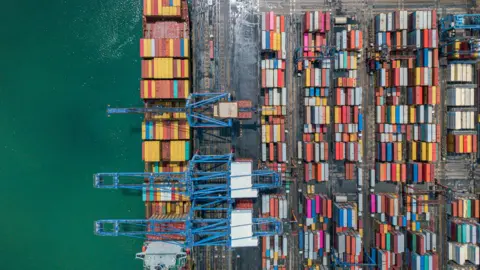
Getty Images Coloured cargo containers at a port.Getty Images

Export-driven economies like Thailand have been scrambling for a trade deal to avoid President Trump’s steep tariffs

When US President Donald Trump made his dramatic tariff announcement on 2 April, nowhere was the shock greater than in South East Asia, a region whose entire world view and economic model is built on exports.

The levies went as high as 49% on some countries, hitting a range of industries from electronics exporters in Thailand and Vietnam to chip makers in Malaysia and clothing factories in Cambodia.

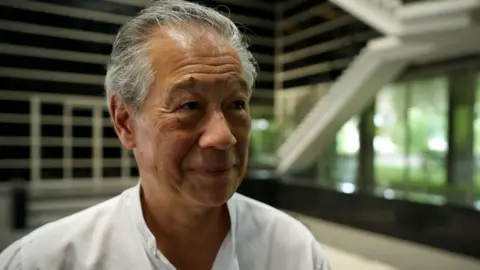
“I remember waking up in the morning. It was quite early, and seeing him standing there on the White House lawn with his board. I thought: ‘Did I see that right? 36%? How could it be?” says Richard Han, whose father founded Hana Microelectronics, one of Thailand’s biggest contract manufacturers.

Thailand, which was facing a 36% levy, now has a deal, like most of its neighbours, to reduce the tariffs to 19%.

The negotiations went down to the wire, finalised just two days before the deadline Trump had set – 1 August. It has been a fraught process getting there, and there is still very little detail about exactly what has been agreed.

BBC/ Lulu Luo A grey-haired Richard Han is smiling as he talks to the BBC. He is wearing a white shirt.  BBC/ Lulu Luo

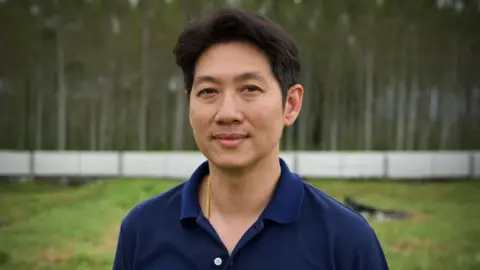
Richard Han says the 36% levy on Thailand was a “shock”

The 10 countries in Asean, as the South East Asian regional bloc is known, exported $477bn (£360bn) worth of goods to the United States in 2024. Vietnam is by far the most exposed economy, its exports to the US totalling $137bn, making up about 30% of its GDP.

No surprise then that the Vietnamese government was first off the block to negotiate with the US, and the first in the region to do a deal to cut the punishing 46% rate Trump had imposed on them.

According to the US president, the deal cuts the tariffs to 20%, while he claims Vietnam will now impose no tariffs at all on any imports from the US. Tellingly, the Vietnamese leadership has said nothing about the deal.

There are no details, no written or signed documents, and some reports suggest Vietnam does not agree with Trump’s numbers. But they set the bar for other countries in the region.

Indonesia and the Philippines followed with deals reducing their tariffs to 19%, although neither country depends much on exports to the US.

Thailand does export a lot to the US. Last year they earned it more than $63bn, about one-fifth of its total exports. Thailand too should have been at the head of the queue in Washington, pleading for a reduction in the 36% tariff Trump had designated for it.

Getty Images Thailand's acting Prime minister Phumtham Wechayachai surroundeed by mics as reporters as ask him questions. He is wearing a balck suit.   Getty Images

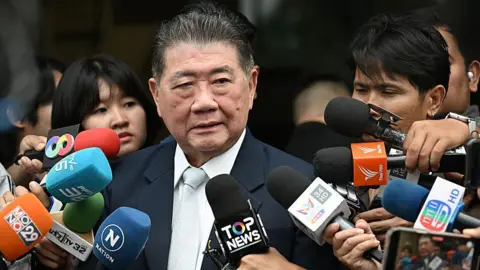
Thailand’s acting Prime Minister Phumtham Wechayachai took office after the last PM stepped down over a political scandal

But Thailand is not Vietnam, a one-party communist state where critical decisions can be made quickly by a few leaders, with little need to worry about the opinions of businesses or the public.

Rather, like South Korea and Japan, whose deals came after much wrangling despite them being staunch American allies, Thailand too has to contend with domestic politics and public opinion. Thailand also has a weak and fractious coalition government, beholden to a range of vested interests.

Worse still, decisions it took which were entirely unrelated to trade angered the US side.

In February it sent 40 Uyghur asylum-seekers who had been stuck in Thailand for more than a decade back to China, defying warnings by the US Secretary of State Marco Rubio. One Thai trade official told the BBC the US negotiators were still bringing up the Uyghurs as a grievance at tariff talks in May.

Then a regional army commander filed a lèse-majesté complaint against a US academic, resulting in him being jailed and then forced to leave Thailand. So, far from being at the front, Thailand found itself at the back of the queue.

The other difficulty facing the Thai trade team was what the US was asking for in return for cutting the tariff rate, in particular access to Thailand’s agricultural market, which is heavily protected.

Food is big business in Thailand. CP Group, one of the world’s agribusiness giants, is the biggest company in the country. This US demand was painful for Thailand.

“Vietnam opened a Pandora’s box,” says another Thai trade official. “By offering zero percent tariffs on all US imports, they make it hard for those of us who can’t easily open up all sectors to US competition.”

BBC/ Lulu Luo Two pigs with their snouts touching as they look up at the camera.BBC/ Lulu Luo

Zero tariffs on US pork imports would be a blow for Thailand’s pig farms

Three hours’ drive from Bangkok, in Nakhon Nayok, Worawut Siripun keeps 12,000 pigs – an important business in Thailand; Thais eat a lot of pork. He is active in the Thai Swine Raisers Association, and has been lobbying against eliminating tariffs on US pork.

“US farmers produce on a much bigger scale than us, and their costs are lower. So, the price of their pork will be lower, and domestic farmers won’t be able to survive.”

Access to the agricultural market was also a sticking point in negotiations with Japan, which sought to protect its rice farmers, and continues to be one of the main hurdles with India.

In Thailand, it is presumed that agribusiness giants like CP have also been lobbying against US demands to open up other sectors like poultry and corn. There have been fractious meetings between the trade team and cabinet ministers after every round of tariff talks in Washington, the BBC understands.

BBC/ Lulu Luo Worawut Siripun in a navy blue t shirt standing in his farmBBC/ Lulu Luo

Worawut Siripun says he cannot compete with US farmers who produce a lot more

But on the other side are Thailand’s manufacturers, who represent a much larger contribution to GDP than agriculture. They badly needed a deal.

“If we get 36% then it’s going to be terrible for us,” said Suparp Suwanpimolkul, deputy managing director of SK Polymer, before the deal was announced. The company makes a bewildering array of components from rubber and synthetic materials, for washing machines, fridges, air conditioners.

“I guarantee you would find at least one of our products in your home,” he said.

SK Polymer was founded by Suparp and his two brothers in 1991. Its story is the story of modern Thailand, originating from their father’s small family business, but riding the explosive growth of global trade which has been the foundation of Thailand’s economy.

They are an integral part of a complex supply chain, where their products join other components from multiple countries to make consumer, industrial or medical goods for export. About 20% of the company’s income comes from the US, but the number is much higher when products which contain its components are included. The Trump tariffs have thrown a spanner in the works.

“We have small margins,” said Suparp. He said they could still manage with tariffs up to 20% or even 25% by cutting costs. When he spoke to the BBC, before the deal was announced, he said the uncertainty was the biggest challenge: “Please – to our government, just get the deal, so we can plan our business.”

BBC/ Lulu Luo A woman in overalls with her head covered and wearing a mask is cutting rubber in a factory in Thailand.BBC/ Lulu Luo

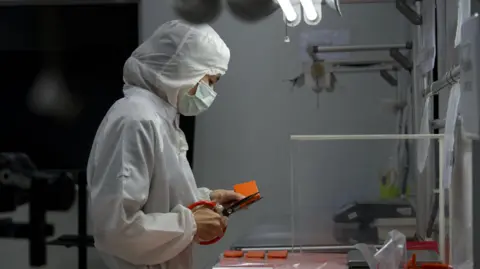
A worker at SK Polymer, which makes rubber products for export to the US

A 20% levy is also palatable for electronics manufacturers, a big industry in Thailand.

“If all of us in this region end up with around 20% our buyers won’t seek alternative suppliers – it will just be a tax, like VAT, for US consumers,” says Richard Han, CEO of Hana Microelectronics. The company makes the basic components that go into everything in our digital lives: printed circuit boards, integrated circuits, RFID tags for pricing.

Mr Han says only about 12% of his products go to the US directly, but like SK Polymer the proportion that goes indirectly, as part of other manufactured goods, is much higher. But it is not just the tariff number that worries him.

His concern is trans-shipment, the US charge that China is avoiding tariffs by routing its production through South East Asia. Already Vietnam, according to President Trump, will pay 40% – double the new tariff rate – on goods the US judges to be trans-shipped.

Both Thailand and Vietnam saw foreign investment increase significantly after tariffs were imposed on China in the first Trump term, and their exports to the US rose as well. Some of that was Chinese companies moving production; some was products using a lot more Chinese-made components. And they are not just from China.

At another electronics manufacturer, SVI, robots glided up and down the assembly line bringing hundreds of tiny components to assemble circuit boards in machines that cost hundreds of thousands of dollars. A quick look at the labels showed the components came from Malaysia, the Philippines, Taiwan and China.

SVI makes security cameras, bespoke amplifiers, medical equipment, to whatever specification their customers, who are mainly in Scandinavia, want. Thailand’s vital manufacturing sector is part of an immensely complex global supply chain which is almost impossible to rearrange to meet the US president’s demands.

Under WTO rules a product is considered local if at least 40% of its value is added in the local manufacturing process, or if it has been “substantially transformed” into a new product, the way an iPhone becomes something different once it has been assembled.

BBC/ Lulu Luo A worker in overalls at an electronics factory between rows of machinesBBC/ Lulu Luo

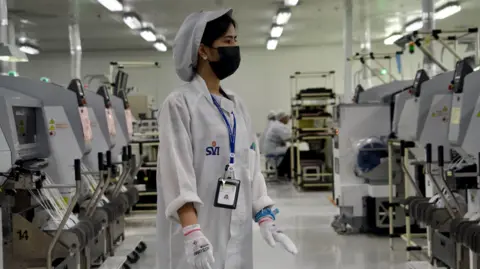
Electronics manufacturer SVI is one of many Thai companies that sits at the heart of a complex global supply chain

The Trump administration pays no heed to WTO rules, and it is not clear what will be counted as trans-shipped, but Mr Han fears this could prove a bigger problem for Thai companies than the standard tariff rate if the US insists on more local components, or fewer from China.

“South East Asia relies very heavily on China,” he explains. “China, by far, has the largest supply chain for electronics and many other industries, and they are the cheapest.

“We could buy materials from another part of the world. It would be a lot more expensive. But it would be virtually impossible for Thailand or Vietnam or the Philippines or Malaysia to get a very high threshold, say 50-60%, made within that country. And if that is the condition to get the US certificate of origin, then nobody’s going to get the certificate of origin.”

For the moment very few of these details have been revealed. Despite President Trump claiming he has got zero percent tariffs for US goods coming into the Philippines and Indonesia, both those countries have said this is not correct, and that much still needs to be negotiated.

For the Thai government, having started so late, and struggled to meet US demands, just getting a deal will have been a relief.

They will worry about how to make the deal work later, as the details are worked out, which typically takes years. And in that, they are far from alone – rich and developing economies alike are scrambling to keep up with Trump’s mercurial tariff policy.

“At some point this has to stop. Surely it has to stop?” Mr Han says. “The trouble is, we don’t know what the rules of the game are going to be, so we’re all milling around, just waiting to find out how to play the new game.”