

15 C
New York
Friday, April 24, 2026
Home Blog Page 506

Renewable Energy on Water: Solar Panels Adopted by Water Reservoirs

0

Just looking at some basic figures is enough to understand that the future of renewable energy is bright. Over the past ten years, the cost of solar panels has decreased by 91%, and it is now cheaper to build renewable energy plants than coal-fired power plants in many parts of the world, especially considering environmental costs. Renewable energy consumption data is equally encouraging: in the EU, it already accounts for 37.5% of the total electricity consumption. Among the various renewable energies, including wind, hydro, and photovoltaic, the one that has grown the most is photovoltaic: while it only represented 1% of the total in 2008, it now exceeds 15%. It can be said that renewable energy has long ceased to be an alternative and has become conventional. And that poses new challenges for green power.

One of the main challenges is location: where can the growing number of wind turbines and solar panels be placed? Although the land area required for these types of installations is relatively small and often compatible with traditional land uses, other options besides inland territories are particularly suitable for countries with limited available land. In the case of wind energy, one of the options with the greatest potential is offshore wind turbines installed in the sea near the coast. In the case of solar panels, an alternative could be linking them to another renewable energy source: hydroelectric power. Floating photovoltaics technology, usually installed in water reservoirs, offers undeniable benefits. The projects already implemented confirmed this, and now a recent study published in the scientific journal Nature Sustainability corroborates its benefits.

Advantages of floating photovoltaics

Colloquially known as “floatovoltaics,” these solar panels work identically to traditional ones, i.e., converting sunlight into electricity, but with some logistical peculiarities. The main difference is that instead of fixed supports like those in conventional solar plants, they are anchored to the bottom of water reservoirs like barges. According to the Nature Sustainability study, this entails some additional benefits:

  1. Increased production: If 30% of the world’s water reservoirs were covered with photovoltaic panels, they could produce 9,000 terawatt-hours annually, three times the total energy generated in the EU in one year. The countries with the greatest potential are the US, China, Brazil, and India.
  2. Better water utilization: Besides generating clean electricity, floating solar panels prevent the evaporation of drinking water intended for human consumption. Likewise, they reduce the proliferation of algae due to less solar radiation. The conserved water could meet the needs of 300 million people.
  3. Greater energy efficiency: Overheating damages the longevity and efficiency of photovoltaic panels. Floating solar panels generate more energy due to the cooling effect of being situated on water, an environment with lower temperatures than the land. Moreover, being mobile, they can be easily rotated to better harness sunlight.

Apart from these factors, one of the advantages of this approach is called hybridization, which means that the photovoltaic energy generated is channeled through the existing connections in hydroelectric installations. In addition, it releases land for farming, forests or construction. That being said, the installation costs of floating photovoltaic energy are higher than those of panels installed on land, so terrestrial and floating solar energy are destined to coexist in the near future; their implementation will depend on multiple factors, such as available land.

One of the first floating solar panel plants connected to the grid

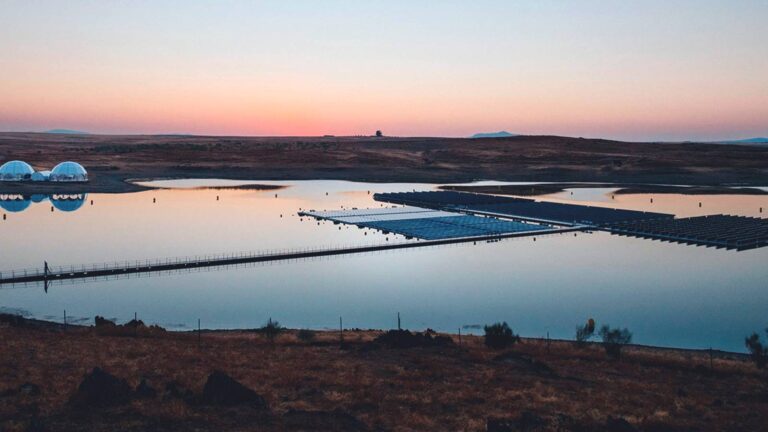
This approach to solar energy is relatively new. In fact, the first floating plant prototype was installed in the United States in 2008. Today, there are some examples of advanced floating photovoltaic energy with a direct connection to the grid. The Sierra Brava reservoir in Zorita, Cáceres, hosts the first floating photovoltaic plant connected to the electrical grid in Spain.

This area, which once housed a nuclear power plant, now produces 1125 MWp of electricity thanks to 600 photovoltaic modules covering 12,000 m2 of surface area. An interesting aspect of the solar panels used is that they utilize bifacial technology, which means they can harness the light energy received from the sun on both sides, multiplying the impact of reflected light on the water. Another peculiar feature of this project is the installation of nest boxes and floating islands to promote bird nesting along with the solar panel infrastructure.

If you want to delve into floating solar energy, don’t miss reading this story that explains all the details of this promising modality of photovoltaic energy as it has been implemented in Sierra Brava. And if you want to learn more about floating wind energy, check out this news article on wind pyramids, a striking reinvention of offshore wind turbines.


Sources:
Could Kim Jong-un’s Daughter Be the Next Leader of North Korea?

0

She holds no known official title in North Korea. The outside world has never heard her voice. The North’s state media has not even named her, referring to her only as the “most beloved,” “respected” or “dear” daughter of its leader.

But intelligence officials and analysts in South Korea are paying close attention to the young woman whom they consider to be her father’s most likely successor.

She is believed to be just 12.

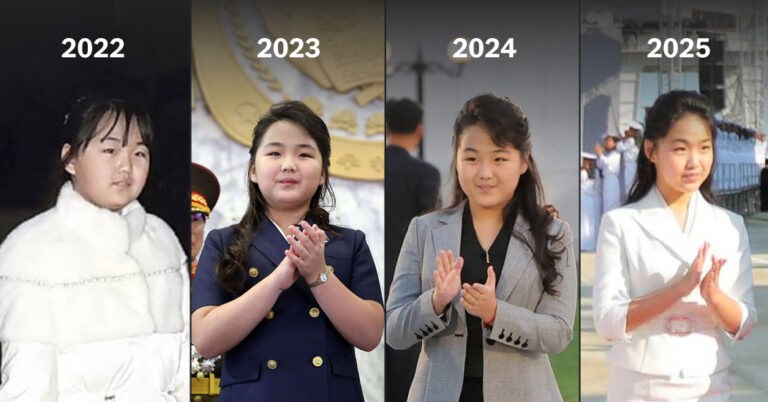
The New York Times analyzed hundreds of images and videos of Ju-ae’s public appearances since her debut three years ago to trace her transformation from a shy girl by her father’s side to a poised public figure who shares center stage with him.

Some analysts say she has largely replaced her mother, Mr. Kim’s wife, Ri Sol-ju, in the role of first lady. North Korea has been ruled by the Kim family since its founding at the end of World War II, making it the only dynasty in the communist world.

South Korean intelligence officials believe that Mr. Kim most likely has two children. There have also been unconfirmed reports that he might have a third child, possibly a son older than Ju-ae. But Ju-ae is the only child who has made public appearances. If she is her father’s designated successor, she would be in line to become the first woman to rule North Korea’s deeply patriarchal and highly militarized society and the world’s newest nuclear power. Mr. Kim is only 41 but, with a family history of heart trouble, preparing a successor makes sense.

Here is a look at Ju-ae’s rise.

Taking the Stage

Ju-ae has undergone a striking transformation in North Korea’s tightly choreographed state media.

Intelligence officials and analysts in South Korea caution against firm conclusions about her future role. But as her profile has risen, she has eclipsed her mother and Mr. Kim’s powerful sister Kim Yo-jong, also once considered a potential successor, as the main female face of the ruling family.

When Mr. Kim and his daughter visited the greenhouse complex, state media called them “great persons of guidance” — an honorific that over the years has been reserved for only North Korea’s top leader and his designated successor.

North Korea also began issuing postage stamps bearing the images of father and daughter together.

“In North Korea, where officials and people are not ready to accept a female leader, Kim Jong-un is making his daughter’s successor status a fait accompli by repeatedly exposing her through state media,” said Cheong Seong-chang, an analyst at the Sejong Institute in Seoul who has written books on Mr. Kim and his family.

A New Look

Ju-ae’s birth and name were first revealed to the outside world by the retired N.B.A. star Dennis Rodman, who met the Kim family during a visit to North Korea in 2013.

When she made her first public appearance in 2022 in a white padded winter jacket, Ju-ae looked no different from the other children of the elites in Pyongyang. But as she has grown, her clothes have become more formal, and she has been transformed into a figure of authority. Her wardrobe now includes tailored leather coats with fur collars and two-piece designer suits.

As her mother has receded from public view, Ju-ae has begun to adopt her sense of fashion.

Her mannerisms and demeanor have also changed. Even something as small as how she claps looks different now than it did two years ago.

Source: Korean Central Television

“The child who first appeared as a family curiosity is now a polished, rehearsed figure woven into North Korea’s ongoing story of dynastic power,” said Donald Southerton, the author of “Korea 101.” “Each photo, parade walk and salute I see as a carefully staged story of succession, legitimacy and continuity for the Kim dynasty.”

Should a brother emerge, Ju-ae may end up serving as a mere placeholder, said Kang Dong-wan, an expert on North Korea at Dong-A University in South Korea. For now, though, her prominent portrayal is sending a message to North Koreans that the Kim family rule will continue into a fourth generation.

Her Main Inheritance

Mr. Kim chose the launch of an intercontinental ballistic missile, or ICBM, for his daughter’s public debut in November 2022. Since that day, he has taken her to other nuclear-related sites, introducing her to officials involved in North Korea’s weapons programs. He has lauded the arsenal as a major legacy of the family’s rule.

Sources: Korean Central News Agency; Korean Central Television

When Mr. Kim himself was being groomed to succeed his father, he first established his authority with the military, the key to maintaining power. Now, by taking Ju-ae to military events, Mr. Kim has been showing her how he handles the top brass.

He has also offered senior military officers opportunities to meet and show loyalty to her, analysts said.

Mr. Kim’s Health

By preparing a successor publicly from an early age, Mr. Kim may be trying to avoid the mistake his father made, analysts say. It was not until after his father had a stroke in 2008 that Mr. Kim was unveiled as the heir apparent.

That led to uncertainty about the younger Mr. Kim. In his early years, he faced skepticism from outside analysts who dismissed him as an inexperienced leader and argued that he would not last long.

That was before Mr. Kim executed his uncle, had his half brother assassinated by his agents in Malaysia and purged several top generals to establish his unchallenged authority.

Now it is primarily Mr. Kim’s health, not his hold on power, that is in question. He is about 5 feet 7 inches and weighs about 310 pounds, according to South Korean intelligence officials. They added that he had unhealthy habits, including chain-smoking, heavy wining and dining, and frequently staying up into the early morning to surf the internet, where he likes to browse weapons sites.

Source: Korean Central News Agency

Mr. Kim is believed to have cardiovascular issues, which contributed to the deaths of both his father and grandfather.

One advantage to grooming a successor early, even a young child, is leverage against his American and South Korean adversaries, said Sung-Yoon Lee, the author of “The Sister: North Korea’s Kim Yo Jong, the Most Dangerous Woman in the World.”

“It tells them: ‘We have all the time in the world, while you are bound by term limits of four to five years,’” Mr. Lee said.

IDF rift with Benjamin Netanyahu over Gaza occupation plan

0

Even by the pugilistic standards of Israeli politics, the week of rancour between Benjamin Netanyahu and his handpicked military chief Lieutenant General Eyal Zamir was extraordinary.

Across days of co-ordinated leaks and public mudslinging, Netanyahu and Zamir clashed over the prime minister’s plan to expand Israel’s offensive in Gaza, bring it under Israeli control and in effect reoccupy the entire enclave of 2.1mn Palestinians.

Government ministers publicly reminded the military that it must obey their orders, Zamir put out a terse statement calling disagreement “an inseparable part of the history of the Jewish people” and Netanyahu’s son even accused the army chief of attempting a “coup”.

Ultimately, after a heated 10-hour meeting of Israel’s security cabinet ended on Friday morning, Netanyahu pulled rank over the square-jawed general and ordered the Israel Defense Forces to “prepare” for invading Gaza City, despite the military’s warnings that it would stretch an exhausted army and endanger Israeli hostages.

As for a narrower alternative put forward by Zamir and the IDF? Netanyahu’s office dismissed it as capitulation, an option that would “neither achieve the defeat of Hamas nor the return of the hostages”.

It wasn’t the first time Israel’s political leaders and military chiefs have sparred publicly. Menachem Begin spent 45 minutes cajoling a brigade commander who refused to invade West Beirut in 1982 — “I see children,” the commander said — before the prime minister relieved him of his command.

The Israeli military has also previously resisted demands by political leaders, including a call by Ariel Sharon’s government to invade Gaza during the second intifada in the early 2000s, and a plan by Netanyahu for a major attack on Iran’s nuclear facilities more than a decade ago.

But, at a time of growing international isolation over Israel’s conduct in its 22-month war in Gaza, this latest rift threatens to deepen domestic divisions and further undermine trust in the country’s institutions as Netanyahu seeks to deploy the IDF to suit his own political gain.

Politicians “used to listen to the army . . . Things have changed in Israel since those days”, a former senior Israeli security official said. “There was a lot less politics back then . . . Under this government tectonic changes are under way.”

Then-Israeli Defense Minister Ariel Sharon (L) with Prime Minister Menachem Begin (C) in Lebanon in 1982 © Uzi Keren/Getty Images

Cabinet meetings are often shouting matches, with hardline ministers accusing each other and military personnel of defeatism and treason, while leaking private conversations for political gain.

But the recriminations and breakdown of trust that followed Hamas’s surprise October 7 2023 attack on Israel, in which officials say the militant group killed 1,200 people and took 250 hostages, have been amplified by Israel’s political divisions.

The long-serving premier has attempted to shift all blame for the assault, the worst loss of Jewish life since the Holocaust, on to the security chiefs — while refraining from any expressions of responsibility himself.

Netanyahu’s aides even reportedly had the former IDF chief of staff, who later resigned over his failures on October 7, frisked for listening devices before going into briefings, according to the New York Times.

The prime minister and his far-right cabinet allies have repeatedly insisted that any halt to the conflict short of “total victory” over Hamas will ensure it is only a matter of time until the militant group unleashes another October 7-style massacre on the Israeli public.

His far-right cabinet allies have also exploited Netanyahu’s political reliance on them to push for the IDF to occupy Gaza, expel Palestinians and resettle the enclave.

Many Israeli generals, past and present, view things very differently. Earlier this week, most living former Israeli military and spy chiefs signed a letter arguing that Hamas was a depleted force and Israel was now in a strong enough position to accept a ceasefire and end the war.

Palestinians carry bags as they return from a food distribution point run by the US and Israeli-backed Gaza Humanitarian Foundation (GHF)
Palestinians return from a food distribution point run by the US and Israeli-backed Gaza Humanitarian Foundation (GHF) © Eyad Baba/AFP/Getty Images

Zamir, who took up his role in March, has instead advocated a plan one Israeli journalist called “siege and attrition”, in which the IDF encircles remaining pockets of Hamas control and launches targeted raids and strikes.

His allies briefed the Israeli press aggressively, presenting his resistance to Netanyahu’s plan as a way to spare the tired army and lessen the risk to the 20 living Israeli hostages still held by Hamas.

This would also keep open the possibility of a ceasefire in which they and the bodies of 30 more Israeli hostages would return home, they said.

Zamir chided the security cabinet that if they ordered the IDF to carry out Netanyahu’s plan, they should consider removing the release of hostages from their war goals, according to leaks to Israeli newspapers.

Demonstrators lift placards and chant slogans during an anti-government protest in Tel Aviv
Demonstrators lift placards and chant slogans during an anti-government protest in Tel Aviv © Jack Guez/AFP/Getty Images

There are even rumblings in the press, which Zamir has not publicly denied, that the military chief could resign if ordered to take actions he considered counter to national security.

“When there’s too much PR and leaks regarding an operation, including the differences between the government and army, then you know that there are other [political] considerations going on behind the scenes,” said a person familiar with the government’s thinking.

Rarely has so much been at stake for Palestinians, 60,000 of whom have already been killed in Israel’s offensive, according to local officials.

An invasion of Gaza City would force the evacuation of up to 1mn civilians, many of whom have already been displaced multiple times, and deepen the humanitarian disaster that has tipped much of the population into starvation.

Ultimately, the dispute within Israel over next steps in Gaza may be far from over, with the decision to start the offensive on Gaza City still weeks away — enough time, argued Zohar Palti, a former senior official in the defence ministry and Mossad, for the IDF to shape its contours.

“The government’s directive to the IDF, with an emphasis on the word ‘prepare to take over’, gives time and space for many factors to influence the move,” he said.

“There is time for the IDF to influence [the decision], there is time for the international community, with an emphasis on the US and the moderate Arab world, to influence — including to renew negotiations on a deal.”

Mexico accuses Adidas of cultural appropriation over new footwear design | Business and Economy News

0

Mexican officials say sportswear giant took design idea from Indigenous community in country’s southern Oaxaca state.

Mexico’s government is seeking compensation from Adidas, accusing the sportswear giant of cultural appropriation for launching a new shoe design strikingly similar to traditional Indigenous footwear known as huaraches.

Adidas’s new Oaxaca Slip-On was created by United States fashion designer Willy Chavarria, who has Mexican heritage.

But the footwear has drawn strong pushback from officials in Mexico’s southern state of Oaxaca, who say no authorisation was given by the Indigenous community, in the village of Villa de Hidalgo Yalalag, behind the original design.

“It’s collective intellectual property. There must be compensation. The heritage law must be complied with,” Mexico’s President Claudia Sheinbaum said during her regular news conference on Friday.

“Big companies often take products, ideas and designs from Indigenous communities,” Sheinbaum said.

“We are looking at the legal part to be able to support them,” she said.

The government said that Adidas representatives had agreed to meet with Oaxaca authorities.

Mexico’s Undersecretary of Cultural Development Marina Nunez Bespalova, right, alongside President Claudia Sheinbaum, left, at a news conference to condemn Adidas and US designer Willy Chavarria in Mexico City, Mexico, on August 8, 2025 [Handout/Presidency of Mexico via Reuters]

In a public letter to Adidas, Oaxaca state governor, Salomon Jara Cruz, criticised the company’s design – which has a sneaker sole topped with the weave of huarache sandals – saying that “creative inspiration” is not a valid justification for using cultural expressions that “provide identity to communities”.

“Culture isn’t sold, it’s respected,” he said.

Mexican news outlet Periodico Supremo said the country’s National Institute of Indigenous Peoples will launch a legal challenge over the Adidas design, and asked followers on social media: “Are you going to buy them?”

Translation: The government of Mexico defends Indigenous intellectual property, against the well-known brand ADIDAS. The INPI will legally challenge the improper use of the traditional design of huaraches originating from Villa Hidalgo Yalalag, Oaxaca. Are you going to buy them?

The controversy is the latest instance of Mexican officials denouncing major clothing brands or designers using unauthorised Indigenous art or designs from the region, with previous complaints raised about fast fashion juggernaut Shein, Spain’s Zara and high-end labels Carolina Herrera and Louis Vuitton.

Mexico’s Deputy Culture Minister Marina Nunez confirmed Adidas had contacted Oaxacan officials to discuss “restitution to the people who were plagiarised”.

Neither Adidas nor the designer Chavarria, who was born in the US to an Irish-American mother and a Mexican-American father, immediately responded to requests for comment from reporters.

Chavarria had previously told Sneaker News that he had intended to celebrate his cultural heritage through his work with Adidas.

“I’m very proud to work with a company that really respects and elevates culture in the truest way,” he said.

Handicrafts are a crucial economic lifeline in Mexico, providing jobs for about half a million people across the country. The industry accounts for approximately 10 percent of the gross domestic product (GDP) of states such as Oaxaca, Jalisco, Michoacan and Guerrero.

For Viridiana Jarquin Garcia, a huaraches creator and vendor in Oaxaca’s capital, the Adidas shoes were a “cheap copy” of the kind of work that Mexican artists take time and care to craft.

“The artistry is being lost. We’re losing our tradition,” she said in front of her small booth of leather shoes.

Sandals known as "huaraches" are displayed for sale at a market in Oaxaca, Mexico, Friday, Aug. 8, 2025. (AP Photo/Luis Alberto Cruz)
Sandals known as ‘huaraches’ are displayed for sale at a market in Oaxaca, Mexico, on August 8, 2025 [Luis Alberto Cruz/AP Photo]

BankFinancial reports earnings that fall short by $0.20, but revenue surpasses expectations

0


BankFinancial earnings missed by $0.20, revenue topped estimates

Trump and Putin scheduled to convene in Alaska for discussions on Ukraine next week.

0

US President Donald Trump and Russian President Vladimir Putin will meet in Alaska next Friday to discuss the future of the war in Ukraine.

Trump announced the 15 August meeting on social media and it was later confirmed by a Kremlin spokesperson, who said the location was “quite logical” given Alaska’s relative proximity to Russia.

The spokesperson added that Trump had been invited to Russia for a potential second summit.

There was no immediate reaction from Ukraine.

The announcement of the meeting came just hours after Trump signalled Ukraine might have to cede territory in order to end the war, which began with Russia’s full-scale invasion of its neighbour in February 2022.

“You’re looking at territory that’s been fought over for three and a half years, a lot of Russians have died. A lot of Ukrainians have died,” Trump said at the White House on Friday.

“It’s very complicated. We’re going to get some back, we’re going to get some switched. There will be some swapping of territories, to the betterment of both.”

The US president did not provide further details of what that proposal would look like.

However, the BBC’s US partner CBS News, citing sources familiar with the discussions, reports that the White House is trying to sway European leaders to accept an agreement that would include Russia taking the entire Donbas region in eastern Ukraine and keeping Crimea.

It would give up the Kherson and Zaporizhzhia regions, which it partially occupies, as part of the proposed agreement, CBS reports.

Earlier on Friday, the Wall Street Journal reported that Putin had proposed a similar arrangement to Trump’s envoy Steve Witkoff during a recent meeting in Moscow.

It remains unclear whether Ukraine and European allies would agree to such a deal, given Ukrainian President Volodymyr Zelensky and Putin remain far apart on the conditions for peace.

Zelensky has roundly rejected any preconditions for territorial concessions.

One senior White House official told CBS the planning for next Friday’s meeting was still fluid, and it was still possible that Zelensky would be involved in some capacity.

Moscow has failed to achieve a decisive breakthrough in its full-scale invasion, but occupies around 20% of Ukraine’s territory. Ukrainian offensives, meanwhile, have not pushed the Russian forces back.

Three rounds of direct talks between Ukraine and Russia in Istanbul have failed to bring the war closer to an end, and Moscow’s military and political preconditions for peace are seen by Kyiv and its allies as the de facto capitulation of Ukraine.

Russian demands include Ukraine becoming a neutral state, dramatically reducing its military and abandoning its Nato aspirations, as well as the lifting of Western sanctions imposed on Russia.

Moscow also wants Kyiv to withdraw its military from the four regions which Russia partially occupies in south-east Ukraine, and to demobilise its soldiers.

Trump, however, insisted on Friday that the US had “a shot at” a trilateral peace agreement between the countries.

“European leaders want to see peace, President Putin, I believe, wants to see peace, and Zelensky wants to see peace,” he told reporters.

“President Zelensky has to get all of his, everything he needs, because he’s going to have to get ready to sign something and I think he’s working hard to get that done,” Trump said.

Last month, Trump admitted to the BBC that after all four of Witkoff’s previous visits, Putin had disappointed him after talks had initially led to optimism.

He hardened his stance against the Kremlin in recent weeks, imposing a deadline of Friday for Russia to agree to a ceasefire in Ukraine or face more sweeping sanctions.

But as the deadline approached, the economic threat was quickly overshadowed by plans for Trump and Putin to meet in person to discuss a potential peace deal.

There was no announcement of further sanctions on Russia from the White House on Friday.

Trump and Putin spoke by phone in February in the first direct exchange between the leaders of the two countries since Russia’s full-scale invasion.

The last time a US president met Putin was in 2021, when Joe Biden met the Russian president at a summit in Geneva, Switzerland.

Watch: Trump says there is a “good prospect” of summit with Putin and Zelensky “very soon”

Trump sons’ cryptocurrency company set to launch public company focused on family token

0

The Trump family business World Liberty Financial is planning to announce a crypto treasury company, say three investors who have seen parts of the deal. The plan, according to details shopped around to investors and viewed by Fortune, revolves around a publicly traded company that would hold a combination of World Liberty’s proprietary token WLFI and cash. 

The proposal also calls for Eric Trump and Donald Trump Jr. to serve on the board, and hopes to raise $1.5 billion to fund the new company.

If the plan goes forward, it would be the latest addition to the Trump family’s fast-growing crypto empire. The Trump family first announced the World Liberty crypto project last fall, launching a series of products including the WLFI token, which has netted $550 million in sales, as well as its own stablecoin, USD1. 

A spokesperson for World Liberty declined to comment. Spokespeople for Eric Trump and Donald Trump Jr. did not respond to requests for comment.

The planned treasury company comes amid a boom in so-called “digital asset treasury companies,” or publicly traded firms that hold large stashes of cryptocurrency on their balance sheets. According to details shared with investors, the planned treasury company for World Liberty’s token is a shell firm that is already listed on the NASDAQ, and that it has already acquired.

The concept of crypto treasury companies was pioneered by billionaire Michael Saylor, who remade his software company MicroStrategy into a vehicle to acquire Bitcoin in 2020 then renamed it Strategy in 2025. Traders soon saw the company’s stock as a proxy for the world’s largest cryptocurrency, and bought up its shares as Bitcoin’s price increased.

For Strategy, the tactic proved so successful that it went on to accumulate more than $72 billion worth of the cryptocurrency and reached a market capitalization of almost $113 billion, despite reporting only $115 million in revenue in the second quarter of 2025.

Crypto investors saw the boom in Strategy’s valuation and followed suit. Early copycats included a budget hotel company in Japan, which began adding Bitcoin in 2024, as well as a handful of other companies that joined the trend later that year.

But this year, the practice has accelerated. There are now treasury companies for Ethereum, the world’s second-largest cryptocurrency. There are also others for a growing number of cryptocurrencies, including Litecoin, Sui, and Ethena. Meanwhile, another Trump family venture, Trump Media, bought $2 billion of Bitcoin earlier this summer for its own treasury. 

Advocates say the treasury companies let traditional investors, who may be constrained by what they can trade through brokerages like Vanguard, trade cryptocurrencies and gain exposure to the digital assets market.

But an increasing number of investors have warned that the trend is a fad and say many of these companies may be at risk of collapse as the current crypto boom subsides.

Aside from World Liberty Financial, which promises to launch different decentralized financial applications built around its token and stablecoin, President Donald Trump and First Lady Melania Trump have both launched their own memecoins. Eric and Donald Jr. are also deeply involved in the blockchain industry, including their backing of a Bitcoin mining company.

On the new Fortune Crypto Playbook vodcast, Fortune’s senior crypto experts decode the biggest forces shaping crypto today. Watch or listen now

The Reasons for the Thailand-Cambodia Conflict

0

new video loaded: What’s Behind the Thailand-Cambodia Conflict

Recent episodes in Latest Video

Whether it’s reporting on conflicts abroad and political divisions at home, or covering the latest style trends and scientific developments, Times Video journalists provide a revealing and unforgettable view of the world.

Whether it’s reporting on conflicts abroad and political divisions at home, or covering the latest style trends and scientific developments, Times Video journalists provide a revealing and unforgettable view of the world.

MBW’s weekly wrap-up: From Live Nation’s record Q2 concert revenue to Kobalt’s latest AI agreement

0

Welcome to Music Business Worldwide’s Weekly Round-up – where we make sure you caught the five biggest stories to hit our headlines over the past seven days. MBW’s Round-up is exclusively supported by BMI, a global leader in performing rights management, dedicated to supporting songwriters, composers and publishers and championing the value of music.


This week, Live Nation defied expectations by growing Q2 concert revenues 19% YoY to $5.946 billion… despite promoting fewer shows than it did in the same period of 2024.

The firm’s quarterly global attendance in Q2 2025 surged 14% YoY to 44.1 million fans.

Meanwhile, Kobalt struck a groundbreaking AI licensing deal with ElevenLabs that establishes 50/50 revenue parity between publishing and recorded music, complete with a ‘Most Favored Nation’ clause that could reshape industry negotiations.

Elsewhere, Spotify‘s shares jumped 5% after the company announced fresh price hikes across multiple international markets. Two examples: individual monthly Premium subscriptions rose to EUR €11.99 in Italy and Spain.

Also this week, Sony‘s music operations generated USD $2.768 billion in calendar Q2 2025, up 8.8% YoY, while Warner Music Group regained momentum with underlying recorded music revenues climbing 8.3% YoY.

Here are some of the biggest headlines from the past few days…


1. LIVE NATION JUST GREW CONCERTS REVENUE BY 19.0% YOY… DESPITE PUTTING ON FEWER SHOWS

Live Nation Entertainment delivered a strong Q2 2025 performance, with concerts revenue hitting a record $5.946 billion – up 19% year-on-year – despite promoting fewer total events.

The company promoted 14,292 events globally, down from 14,678 in the same quarter last year, but total global attendance exploded 14% YoY to 44.1 million fans.

The secret to Live Nation’s success lies in its strategic shift toward bigger, higher-value international events.

While its volume of North American shows fell by 876 events YoY in Q2 2025 (vs. Q2 2024), the number of its international events rose from 4,688 to 5,268, as international attendance surged up 33% YoY(MBW Explains)


2. KOBALT’S AI DEAL WITH SUNO RIVAL ELEVENLABS GUARANTEES PUBLISHING ‘PARITY’ WITH RECORDED MUSIC

Kobalt has secured a potentially precedent-setting licensing agreement with ElevenLabs’ new AI music platform, Eleven Music, that establishes 50/50 revenue parity between publishing and recorded music – a significant departure from traditional streaming economics where publishers typically receive around 25% compared to recorded music’s 75% share.

Perhaps most significantly, MBW has learned that Kobalt secured a Most Favored Nation (MFN) clause in the deal, meaning if any recorded music rightsholder negotiates better terms, Kobalt will automatically be upgraded to match them.

Kobalt’s opt-in agreement now exists alongside Merlin‘s separate deal with ElevenLabs for the recorded music rights of its members… (MBW)


3. SPOTIFY ANNOUNCES NEW PRICE HIKES

Spotify shares jumped 5% on Monday (August 4) after the streaming giant announced subscription price hikes across multiple international markets outside the US, covering South Asia (including India), the Middle East, Africa, Europe, Latin America and the Asia-Pacific region.

Premium monthly individual subscriptions have already increased by €1 per month in Italy, Portugal and Spain, with prices now at €11.99 in Italy and Spain, and €8.99 in Portugal. Countries that saw price increases earlier in the year appear unaffected by this latest round… (MBW)


4. SONY GENERATED $2.77BN FROM RECORDED MUSIC AND PUBLISHING IN CALENDAR Q2 2025, UP 8.8% YOY

Sony’s global music rights operation posted impressive Q2 2025 results, generating $2.768 billion across recorded music and publishing – an 8.8% year-on-year increase representing approximately $223 million more than the prior year quarter.

Recorded music operations contributed $2.09 billion, up 8.4% year-on-year, while music publishing added $683 million, climbing 9.9% YoY.

Streaming revenue dominated Sony’s recorded music performance, generating $1.36 billion with 7.3% year-on-year growth(MBW)


5. WARNER MUSIC GROUP REGAINS MOMENTUM: UNDERLYING RECORDED MUSIC REVENUES UP 8.3% YOY IN CALENDAR Q2, SUBSCRIPTION REVENUES UP 8.5%

Warner Music Group bounced back strongly in calendar Q2 2025, reporting total revenue of $1.689 billion, representing 7.0% year-on-year growth in constant currency.

When one-time items are excluded, the company’s underlying performance was significantly stronger, with recorded music revenues up 8.3% year-on-year and subscription streaming revenues climbing 8.5% YoY – a marked reacceleration from the previous quarter.

CEO Robert Kyncl emphasized that the results demonstrate the company’s strategy is working, delivering “massive chart hits, breakthrough stars, strong revenue growth, and market share gains…” (MBW)


Partner message: MBW’s Weekly Round-up is supported by BMI, the global leader in performing rights management, dedicated to supporting songwriters, composers and publishers and championing the value of music. Find out more about BMI hereMusic Business Worldwide

Key Points from the Women’s 4×200 Free Relay at the 2025 World Championships

0

By Sam Blacker on SwimSwam

2025 World Championships

Ledecky Reverts To The Anchor – And To Form

Katie Ledecky swam second on this relay in 2023 and 3rd in 2024, clocking times of 1:54.39 and 1:54.93 respectively. That was trending up from the 1:53.67 she swam in 2022, the last time the U.S. won gold in the 4×200 free.

However, she was back on the anchor leg this year, and delivered her fastest split in three years to go 1:53.71, pretty much matching Mollie O’Callaghan. That helped propel the U.S. to a new Americas’ record in 7:40.01, just two-hundredths away from breaking 7:40.

With Claire Weinstein and Anna Peplowski still improving and a fully fit Erin Gemmell likely to be quicker than 1:56.40, they could break through that barrier next year.

Ledecky had her second-fastest split ever here, and was faster than she went at the 2016 Olympics where she won individual 200 free gold. A decade on in Irvine next year, she could be just as good.

Australia’s Steady 200 Free Production Line

You might have seen this one under the Day 5 relay analysis, but we’ve included it here in case you didn’t.

With no Ariarne Titmus in Singapore, and Emma McKeon and Brianna Throssell retiring after Paris, a significant proportion of the depth that had helped Australia to become the dominant nation in the 4×200 freestyle over the last couple of years had disappeared.

The front half of this relay was actually the same as the heats team in Paris, but a full 2.62 seconds faster than they managed there. Jamie Perkins was 1:56.78 there, and has dropped a good chunk of time in the event this season to go from 1:56.22 to 1:55.44 and rank #7 all-time among Australian women. Pallister, who led off, has now dipped under 1:55 on the last two occasions that she has swum the 200 free, and outdueled the individual bronze medalist Claire Weinstein on her leg. Even with her focus on the longer freestyle events, she will continue being a key member of this team when Titmus is back.

Through last season Brianna Throssell became an important part of this team, despite primarily being a fly swimmer. She ended up splitting 1:56.00 on the relay in Paris to help them to gold, and that pipeline is in full effect again this year with Brittany Castelluzzo. The 200 fly specialist finished 6th at Trials in 1:57.04, but split 1:55.93 and 1:56.01 here. She is probably the leg to be swapped out for Titmus, but she will be valuable for the prelims team and if any one leg of the finals team is off.

The pipeline of talent that has come through Australia’s ranks in the last few years shows no sign of slowing down. There are several youngsters among the top-10 Australian’s this year.

Top-10 Australian Women This Season, 200m Free

  1. Mollie O’Callaghan (21) – 1:53.48
  2. Lani Pallister (23) – 1:54.77
  3. Jamie Perkins (20) – 1:55.44
  4. Abbey Webb (24) & Hannah Casey (19) – 1:56.09
  5. Brittany Castelluzzo (25) – 1:57.04
  6. Inez Miller (18) – 1:57.32
  7. Amelia Weber (19) – 1:57.32
  8. Jaimie de Lutiis (19) – 1:58.62
  9. Leah Neale (29) –  1:58.63

Abbey Webb and Hannah Casey tied at Trials in 1:56.09, and both got some valuable experience in prelims, albeit much slower than their bests. With Milla Jansen and potentially even Olivia Wunsch an option in the future, as well as the inevitable next batch of swimmers to come through, this relay is not going anywhere any time soon.

Japan Have Been Shuffling Backwards Recently

Japan’s relay here finished 8th here in 7:58.13, a fair way off their national record of 7:48.96 from 2018. What was more surprising is that this side, their ‘A’ team was less than two seconds faster than their World University Games team, which took bronze in Berlin three weeks ago.

That quartet clocked 7:59.99, and actually hit the halfway point more than half a second ahead of their counterparts did in Singapore. Two of the swimmers from Berlin, Ruka Takezawa (1:58.86 FS) and Kanon Nagao (1:59.51), would have improved the worlds relay.

Not since their National Record-setting relay in 2018, driven by a 1:54.69 split from Rikako Ikee, has Japan broken 7:50. In fact, they have not broken 7:56 since then, and have been trending slower over the last few years.

Japan was 13th in just 7:59.10 last summer, and only a second faster this year. Putting their best quartet together would gain them around another second and a half, but that still doesn’t take them under 7:56.

Both this team and the individual 200 freestylers have not been one contending for medals recently, and, as such, are hit fairly hard by Japan’s stiff qualifying requirements. Rikako Ikee was their last finals level swimmer in the individual 200 free, and they don’t have a ton of depth right now either with no sub-1:58 swimmers.

They pushed Canada hard for the final place on the Pan Pacs podium at the last edition in 2018. Don’t expect that to happen next year.

Anna Peplowski Looks Like USA’s Next Underrated Relay Star

While Katie Ledecky and Mollie O’Callaghan drove each other to 1:53-point splits on the anchor, the third-fastest leg in the field, flat-start or not, came from a swimmer who has never had an individual swim at the world level.

Anna Peplowski, this season’s NCAA champion in the 200 free, had the U.S. in the lead at the halfway point thanks to a 1:54.75 split. She out-duelled Jamie Perkins, an individual finalist in both the 200 and 400, on this leg, and was nearly a second faster than her flat start best.

She was 1:57.98 leading off in the heats in Paris, and 1:56.88 anchoring the prelims squad the year before in Fukuoka. This year was the first time she was selected for the final, and she repaid that decision in spades.

Paige Madden was somewhat similar on this relay, delivering big 1:55-point splits in both Tokyo and Paris for a pair of silver medal-winning relays, the latter after finishing a successful NCAA career. Peplowski looks like she could be just as key to American hopes.

Claire Weinstein and Katie Ledecky may take the plaudits, but Peplowski is the piece that really gives them a chance to upset Australia in the future. If she follows form and drops time again next year, there could be another gripping anchor leg between the two even with the return of Ariarne Titmus.

The Front Three Are A Long Way Clear

There was a difference of 3.64 seconds between 1st and 3rd this year, slightly less than the 4.26 second gap from Paris. However, as this margin contracted, another lengthened. The gap from 3rd to 4th, which was 3.71 seconds in Paris, ballooned to 6.67 seconds.

Those respective margins have both increased since Tokyo, although the gap between 3rd and 4th by over a second more.

2021 2022 2023 2024 2025
1st to 3rd (seconds) 0.96 3.29 6.90 4.26 3.64
3rd to 4th (seconds) 2.48 0.96 2.13 3.61 6.67

Canada and Great Britain, who have been down in the 7:43.46 range, were well off that this year as neither broke 7:50. Great Britain seemed to have missed their chance with the current generation, as Freya Anderson does not look near her 1:55-point best and the fourth piece they have long needed still not there.

Canada meanwhile, have a trump card in Summer McIntosh, but will be loath to use her on the same night as the 200 fly semis unless it is the difference between making or missing the podium, and with the current squad that is not the case, even for the best female (and probably overall) swimmer in the world. She would have needed to split 1:49.11 to put Canada in 3rd this year.

China are keeping the gap close to the front two, but the rest of the pack is falling away. With the 200 free not seeing too much depth outside of the three nations at the front, that doesn’t look like changing anytime soon.


Hungary Has A Quick, Young, And Improving Core

The Hungarians were a thoroughbred of a dark horse in this event for 4th place. Nikolett Padar and Lilla Minna Abraham had tied for the win at the European U23 championships in 1:56.03, and Dara Molnar and Panna Ugrai are all solid 1:58-point swimmers.

They backed up their promise here, taking 4th after Abraham pulled away from Great Britain on the anchor leg.

Looking at their recent results in this event, Hungary were 5th in 2022 (7:57.90), 7th in 2023 (7:54.65), 6th in 2024 (7:50.52) and then 4th this year in 7:49.66. That growth is remarkable, and even more so for having done this with a mostly consistent group of swimmers – Padar has been on all four, Abraham and Molnar on three and Ugrai on the last two.

Not only that, but the only time one of those swimmers did not improve their split from the previous year was Padar’s leadoff this year, where she was a second slower than her 1:56.14 from last summer. She has a season best of 1:56.03, set when tying Abraham for the win at the European U23 Championships back in June.

They are getting closer to the super-suited National Record of 7:48.04 from 2009, which was anchored by a certain Katinka Hosszu. This was the only female relay record Hungary did not break in Singapore, but time is ticking on this one.

Read the full story on SwimSwam: 2025 World Championships: Six Takeaways From The Women’s 4×200 Free Relay