

14.4 C
New York
Saturday, April 25, 2026
Home Blog Page 502

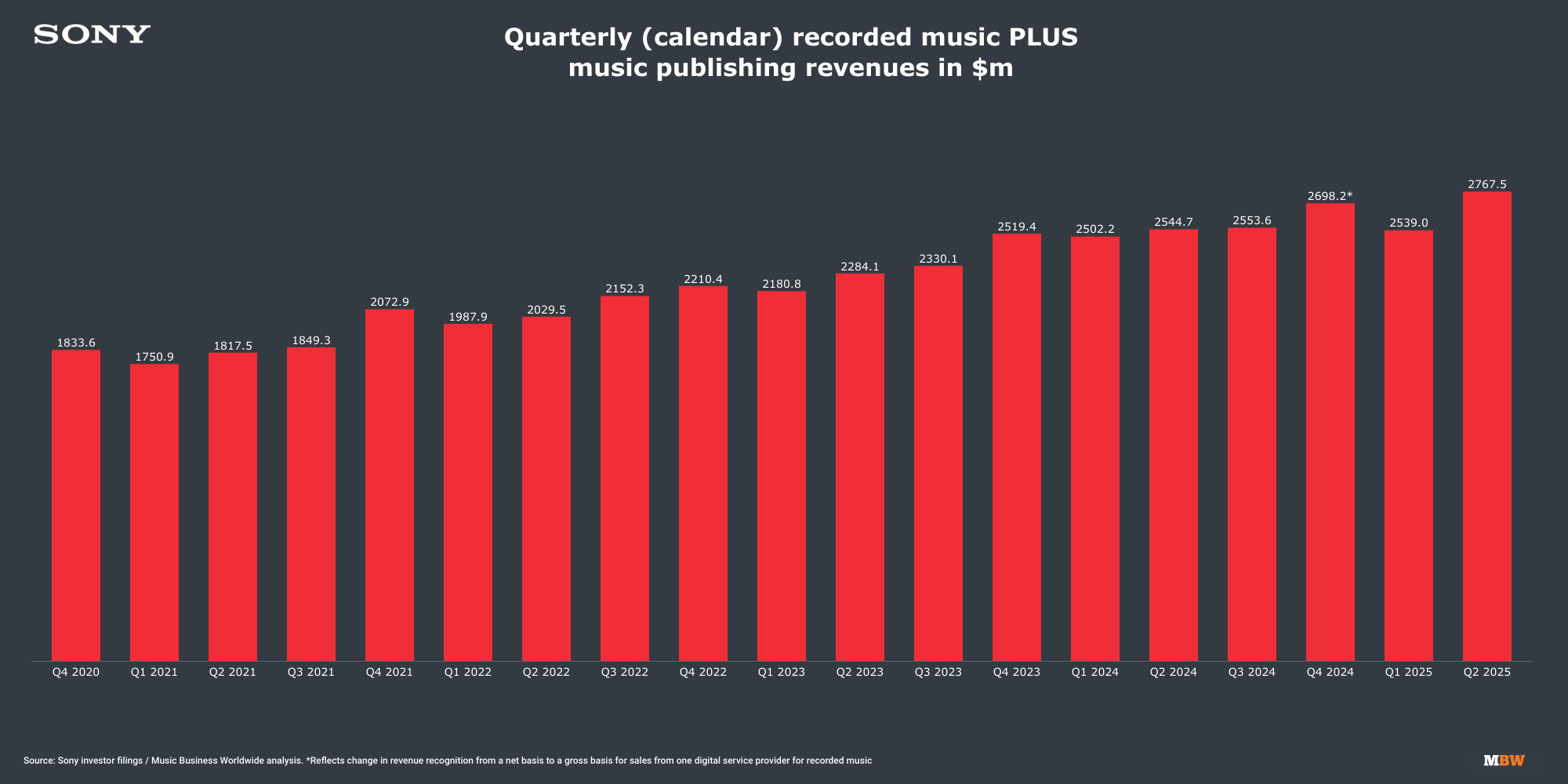
Sony’s recorded music and publishing revenue reached $2.77 billion in calendar Q2 2025, marking an 8.8% increase year-over-year.

0

Sony’s global music rights operation – across recorded music and music publishing – generated USD $2.768 billion in the three months to end of June 2025.

That’s according to MBW’s calculations based on Sony Group Corp’s calendar Q2 2025 (fiscal Q1 2025) results, as announced by the Japanese firm today.

The $2.768 billion figure was up by 8.8% year-on-year (vs. calendar Q2 2024) at US dollar-converted consistent currency.

In monetary terms, Sony’s overall music rights operation (recorded music plus music publishing) generated approximately $223 million more in calendar Q2 2025 than in the prior-year quarter.


(Our regular note: MBW’s calculations of Sony’s music earnings – explained at the bottom of this story – are based on average quarterly exchange rates, provided by Sony, from its reported Yen to USD. We believe this gives a more accurate picture of Sony’s worldwide results than its reported Yen figures. This is because Sony Music Entertainment and Sony Music Publishing both aggregate the results of their worldwide subsidiaries on a USD basis. However, this global USD conversion system still risks a certain amount of FX distortion by converting revenues from Tokyo-based Sony Music Entertainment Japan – which would usually report revenues in its ‘root’ currency of Yen – into USD.)

Recorded music revenue breakdown

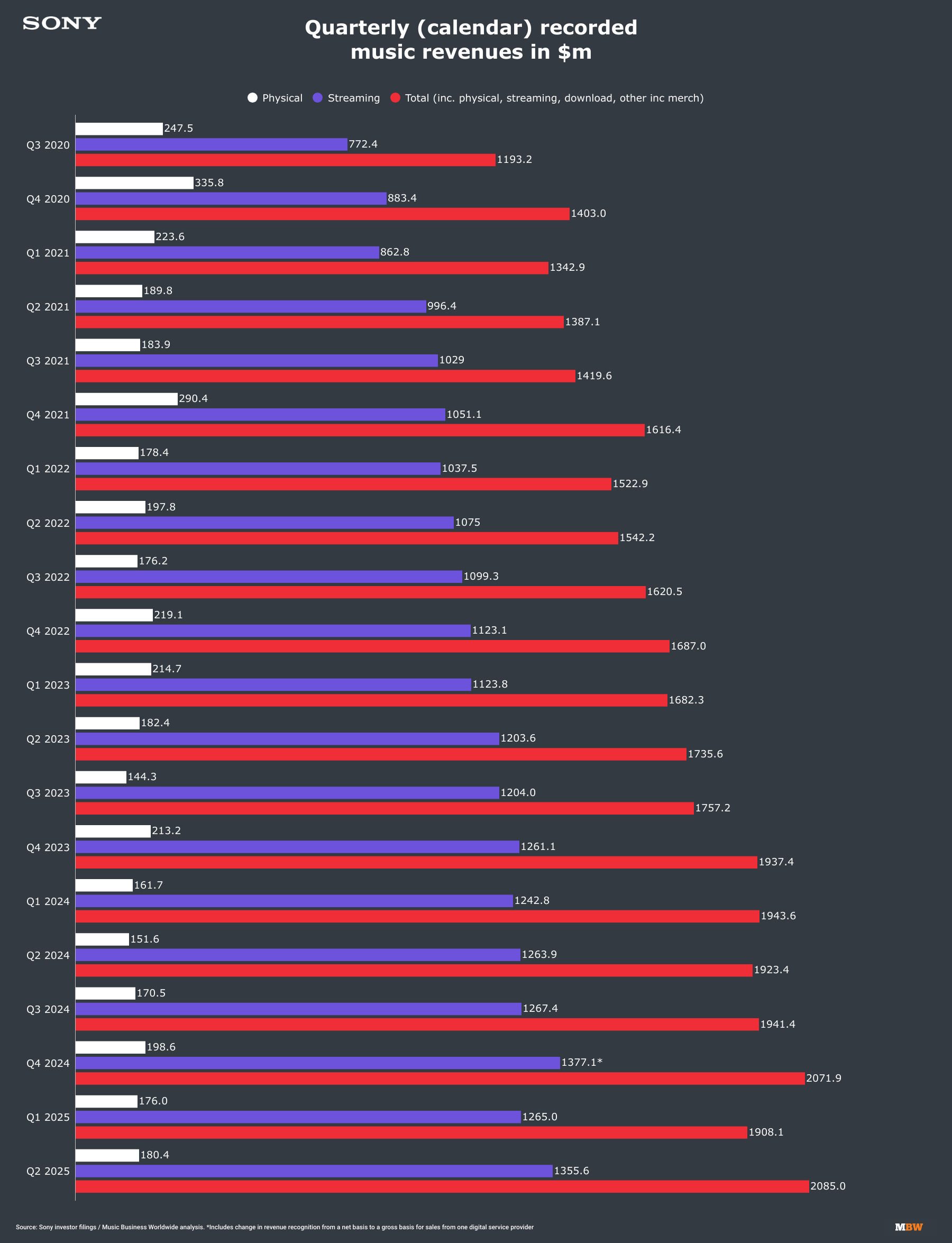
Sony’s global recorded music operation generated USD $2.09 billion in calendar Q2 2025, up 8.4% YoY versus the equivalent quarterly period of the prior year on a USD basis.

Within Sony’s calendar Q2 2025 global recorded music result, streaming generated USD $1.36 billion (on a USD-converted basis), up 7.3% YoY.

(This ‘streaming’ number combines both subscription and ad-funded streaming revenues generated by Sony’s global recorded music operation.)

Quarterly revenues from physical music sales in calendar Q2 2025 hit USD $180 million (up 19.0% YoY).

Sony’s ‘Other’ category within recorded music generated $481 million in calendar Q2 2025, up 3.1% YoY versus the prior-year quarter.

This latter category (‘Other’) includes license revenue (public performance, broadcast and sync), merchandising, and live performance income.

The solid performance across all categories contributed to the overall growth in recorded music revenues, with streaming remaining the largest revenue driver.

According to Sony Corp‘s results, Sony Music Entertainment’s ten biggest recorded music projects in the calendar Q2 2025 quarter (ex-artists signed in Japan), in order of global revenue generation, were:

  1. Bad Bunny (Rimas Entertainment) – DeBÍ TiRAR MáS FOToS
  2. SZASOS
  3. Sleep TokenEven in Arcadia
  4. Tate McRaeSo Close to What
  5. Bad Bunny (Rimas Entertainment) – Un Verano Sin Ti
  6. Pink FloydPink Floyd at Pompeii – MCMLXXII
  7. ATEEZGOLDEN HOUR : Part.3
  8. Bruce SpringsteenTracks II: The Lost Albums
  9. JENNIERuby
  10. Miley CyrusSomething Beautiful

Music publishing performance

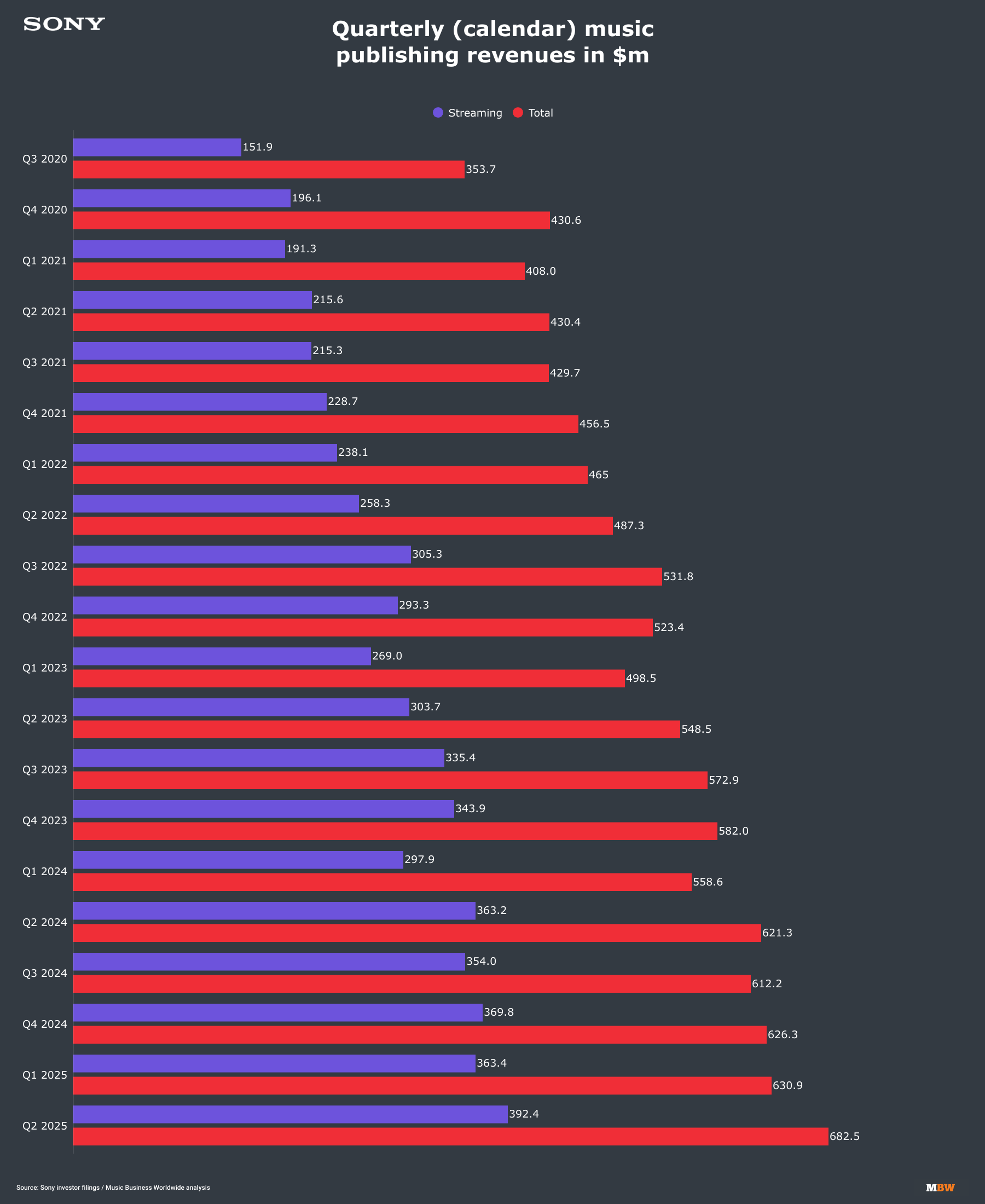
Sony’s global music publishing operation – led by Sony Music Publishing – generated USD $683 million in the three months to end of June 2025.

That quarterly revenue figure, at the US dollar level, was up 9.9% year-on-year.

Based on Sony’s reported streaming growth rates, Sony’s global music publishing operation derived approximately $392 million of its quarterly revenues in the calendar Q2 2025 period from streaming.

That publishing streaming figure was up 8.0% year-on-year.

Quarterly profits

Sony Corp also today issued some profit numbers for its corporate Music division in the three months to end of June 2025. (The following figures include Sony’s operations across Recorded Music, Music Publishing plus Visual Media & Platform.)

In calendar Q2 2025 (fiscal Q1 2025), Sony’s corporate Music division posted a quarterly operating income of 92.8 billion Yen (USD $642m).

That represented an operating margin of 19.9%, from total divisional quarterly revenues (again, ‘Music’ including ‘Visual Media & Platform’) of 465.3 billion Yen (USD $3.22bn).

Sony Corp additionally presents to investors its Adjusted OIBDA performance in each quarter (see below) – a metric also used by Warner Music Group to present its earnings.

In calendar Q2 2025 (fiscal Q1 2025), Sony’s Music division posted an Adjusted OIBDA of 117.1 billion Yen (USD $810m).

That represented an Adjusted OIBDA margin from total divisional quarterly revenues of 25.2%.


Methodology note

Note: All YoY percentage rises/falls published in this story are calculated at constant currency at the US dollar-converted level.

MBW uses Sony’s own quarterly average currency rates for these calculations, and the below data from Sony’s filings.


For this analysis, MBW has calculated Sony’s financials from Japanese Yen into US dollars at the following prevailing exchange rates in each quarter, as provided by Sony Corp:

  • Calendar Q1 2023: 135.4 Yen per USD
  • Calendar Q2 2023: 137.0 Yen per USD
  • Calendar Q3 2023: 144.4 Yen per USD
  • Calendar Q4 2023: 147.9 Yen per USD
  • Calendar Q1 2024: 148.2 Yen per USD
  • Calendar Q2 2024: 155.6 Yen per USD
  • Calendar Q3 2024: 149.5 Yen per USD
  • Calendar Q4 2024: 152.2 Yen per USD
  • Calendar Q1 2025: 152.6 Yen per USD
  • Calendar Q2 2025: 144.6 Yen per USD

By applying these exchange figures to each applicable period, we effectively get a US-leaning constant currency picture of Sony Music’s performance.

This isn’t a perfect system; it risks overplaying Sony Music Entertainment’s global business slightly by converting a chunk of revenues from Sony Music Entertainment Japan (which would usually be straight-reported in Yen) into US dollars.

But it provides us with a cleaner reflection of the performance of New York-based Sony Music Entertainment outside of FX distortion, because the company had to convert its US currency into Yen in the first place for Sony Corp’s results. The same is true for US-based Sony Music Publishing.

MBW believes this currency exchange system is the yardstick used internally at Sony Music Group‘s HQ in New York.

Sony’s own description of its three corporate music divisions is as follows:

  • Recorded Music – Streaming includes the distribution of digital recorded music by streaming; Recorded Music – Others includes the distribution of recorded music by physical media and digital download as well as revenue derived from artists’ live performances;
  • Music Publishing includes the management and licensing of the words and music of songs;
  • Visual Media and Platform includes the production and distribution of animation titles, including game applications based on the animation titles, and various service offerings for music and visual products.

Within / covering the first two divisions listed above:

  • Sony Music Publishing, run by CEO & Chairman Jon Platt, is Sony’s US-headquartered music publishing operation. Sony Music Entertainment, run by CEO Rob Stringer, is Sony’s US-headquartered recorded music operation.
  • And Sony Music Group – also run by Rob Stringer, as Chairman – is Sony’s US-headquartered umbrella group for both Sony Music Entertainment and Sony Music Publishing.

Music Business Worldwide

Willy Chavarria expresses regret following cultural appropriation controversy with Adidas shoe

0

Jennifer Meierhans

Business reporter

Getty Images Willy Chavarria on a red carpet with photographers all around wearing a black hat, sunglasses and a pale pink tuxedo with exaggeratedly large lapels and holding three red rosesGetty Images

US fashion designer Willy Chavarria at The Mark Hotel before the 2025 Met Gala

US fashion designer Willy Chavarria has apologised after a shoe he created in collaboration with Adidas Originals was criticised for “cultural appropriation”.

The Oaxaca Slip-On was inspired by traditional leather sandals known as huaraches made by Indigenous artisans in Mexico.

The Mexican president was among those who spoke out against the footwear, which was reportedly made in China without consultation or credit to the communities who originated the design.

Chavarria said in a statement sent to the BBC: “I am deeply sorry that the shoe was appropriated in this design and not developed in direct and meaningful partnership with the Oaxacan community.” The BBC has contacted Adidas for comment.

Cultural appropriation is defined as “the unacknowledged or inappropriate adoption of the customs, practices, ideas, of one people or society by members of a typically more dominant people or society”.

Mexico’s President Claudia Sheinbaum told a press conference: “Big companies often take products, ideas and designs from Indigenous communities.”

She added: “We are looking at the legal part to be able to support them.”

Adidas had contacted Oaxacan officials to discuss “restitution to the people who were plagiarised”, Mexico’s deputy culture minister Marina Nunez added.

Jesús Méndez/EPA/Shutterstock Traditional huaraches are displayed at a market in Oaxaca, MexicoJesús Méndez/EPA/Shutterstock

Traditional huaraches displayed at a market in Oaxaca, Mexico

Promotional images of the black moulded open-toe footwear have been taken down from the brand’s social media accounts as well as Chavarria’s.

In his statement, Chavarria said he wanted “to speak from the heart about the Oaxaca slip-on I created with Adidas”.

“The intention was always to honor the powerful cultural and artistic spirit of Oaxaca and its creative communities – a place whose beauty and resistance have inspired me. The name Oaxaca is not just a word – its living culture, its people, and its history.”

He went on to say he was “deeply sorry” he did not work with the Oaxacan community on the design.

“This falls short of the respect and collaborative approach that Oaxaca, the Zapotec community of Villa Hidalgo Yalalag, and its people deserve,” he added.

“I know love is not just given – it is earned through action.”

Chavarria was Calvin Klein’s senior vice president of design until 2024 and is the founder and chief creative officer of his eponymous label.

Adidas has not responded to the BBC’s request for a comment.

The Associated Press reported that Adidas responded to Mexican authorities in a letter on Friday.

The company reportedly said it “deeply values the cultural wealth of Mexico’s Indigenous people and recognises the relevance” of criticisms, and requested a sit-down to talk about how to “repair the damage” to Indigenous communities.

Israel’s finance minister warns that Benjamin Netanyahu’s Gaza war plan is destined to fail.

0

Unlock the Editor’s Digest for free

Israeli finance minister Bezalel Smotrich said he has “lost faith” that Benjamin Netanyahu can achieve a “decisive victory” in Gaza, days after the country’s security cabinet agreed to expand the military offensive in the shattered enclave.

Smotrich, an ultranationalist and key member of the governing coalition, accused Netanyahu of conducting an “about-face” after having promised this time to “go all the way”, and criticised the premier for leaving open the possibility of a ceasefire-for-hostage deal with Palestinian militant group Hamas, in a blistering three-minute video on Saturday.

Smotrich said he had remained in government “as long as I believed we were driving for decisive victory”, but that he had now “lost faith that the prime minister can and wishes to lead the [Israeli military] there.”

The veteran premier has come under pressure from his far-right allies, including Smotrich and national security minister Itamar Ben-Gvir, for more hardline policies throughout the Gaza war. While the statements on Sunday were the most expansive to date by the finance minister, he did not explicitly threaten to resign or bring down Netanyahu’s government.

While Smotrich has attempted to outflank Netanyahu from the right, the premier’s decision to expand the offensive against Hamas in Gaza has been heavily criticised as reckless both at home and abroad.

Netanyahu’s security cabinet ordered the Israeli military to begin preparations to “take control of Gaza City” after a marathon session that lasted into Friday morning. The cabinet suggested that civilians sheltering in what was once the enclave’s largest population centre would be forced to evacuate.

Yet the expanded military offensive could be delayed until early October to allow time to call up reserves, forcibly evacuate hundreds of thousands of Palestinians, and create the required humanitarian aid infrastructure.

Smotrich, who took part in the deliberations, said the plan amounted to “launching a military operation that is not aimed at resolving the issue, but rather at putting pressure on Hamas to agree to a partial hostage deal”.

‘‘That’s not how you win a war,” Smotrich added, highlighting an aggressive alternative plan — which he did not describe in detail — he claimed would lead to “a lightning-fast military victory”.

Smotrich and his far-right allies have publicly supported the full reoccupation of the entire Gaza Strip, the “voluntary emigration” of the territory’s 2mn people to undefined foreign countries, and the re-establishment of Israeli settlements across the enclave.

Zvi Sukkot, a parliamentarian from Smotrich’s Religious Zionism party, told Israel’s army radio on Sunday morning that the party could reconsider its membership in Netanyahu’s government and push for early elections.

“I don’t see any point being partner to something that will ultimately send soldiers [into battle] without first knowing what the end result will be,” Sukkot said.

Netanyahu’s governing coalition consists of the premier’s Likud party, two far-right parties, and two ultra-Orthodox factions, which have already suspended their involvement in government due to differences over conscription.

Despite the coalition troubles, political analysts remain sceptical that snap elections are likely in the coming months. The governing coalition is trailing the opposition in the polls, with Religious Zionism in danger of not passing the electoral threshold for entry into the next parliament. Elections are not formally meant to be held until the autumn of 2026.

The country’s military chiefs opposed Netanyahu’s plan due to fears that it would overstretch an already exhausted fighting force after 22 months of war and endanger the remaining 50 Israeli hostages held by Hamas, 20 of whom are still believed to be alive.

Opposition leaders emphasised the toll that expanding the war would have on Israel’s international standing, as well as the cost for the Israeli taxpayer.

Opposition leader Yair Lapid warned on Sunday that ‘‘delusions of conquering the strip’’ would result in new taxes, cuts in social welfare spending and higher debt service.

“Instead of improving education for Israel’s children — we will pay for the education of Gaza’s children,’’ Lapid said on X.

Nine western states — including the UK, Germany and France — rejected the Israeli security cabinet’s decision in a joint statement with the EU on Saturday, warning that it risked aggravating the “catastrophic humanitarian situation” in Gaza and endangering the Israeli hostages, and could violate international law.

Female staff in Afghanistan of UN report receiving death threats, says Women’s Rights News

0

Taliban rulers say they are not behind the threats and are investigating, according to the United Nations.

Explicit death threats have been made against dozens of Afghan women working for the United Nations in Afghanistan, according to a new UN report, where their rights have been severely curtailed since the Taliban returned to power in 2021.

The UN mission to the country said female national staff were subjected to direct death threats in May, in the latest update on the human rights situation in Afghanistan published on Sunday.

The report says the Taliban told the UN mission that their cadres were not responsible for the threats, and an Interior Ministry investigation is under way.

The threats came from unidentified individuals related to their work with the UN Assistance Mission in Afghanistan, or UNAMA, other agencies, funds, and programmes, “requiring the U.N. to implement interim measures to protect their safety”, according to the report.

Afghan authorities, including the Taliban Interior Ministry, didn’t immediately respond to requests for comment on the report or the investigation, according to The Associated Press news agency.

The Taliban barred Afghan women from working at domestic and foreign nongovernmental organisations in December 2022, extending this ban to the UN six months later. They then threatened to shut down agencies and groups still employing women. Aid agencies and NGOs say the Taliban have disrupted or interfered with their operations, allegations denied by authorities.

The UN report is the first official confirmation of death threats against Afghan women working in the sector. The report also highlighted other areas affecting women’s personal freedoms and safety, including inspectors from the Vice and Virtue Ministry requiring women to wear a chador, a full-body cloak covering the head. Women have been arrested for only wearing the hijab.

Women have also been denied access to public areas, in line with laws banning them from such spaces.

A UN report from August 2024 found that Afghanistan’s Taliban government has “deliberately deprived” at least 1.4 million girls of their right to an education during its three years in power.

About 300,000 more girls are missing out on school since UNESCO last carried out a count in April 2023, it said on Thursday, warning that “the future of an entire generation is now in jeopardy.”

ICC targets Taliban for persecution of women

The International Criminal Court (ICC) issued arrest warrants in July for two top Taliban leaders in Afghanistan on charges of abuses against women and girls.

ICC judges said at the time there were “reasonable grounds” to suspect Taliban Supreme Leader Haibatullah Akhunzada and Chief Justice Abdul Hakim Haqqani of committing gender-based persecution.

“While the Taliban have imposed certain rules and prohibitions on the population as a whole, they have specifically targeted girls and women by reason of their gender, depriving them of fundamental rights and freedoms,” the court said in a statement in July.

The Taliban has “severely deprived” girls and women of the rights to education, privacy, family life and the freedoms of movement, expression, thought, conscience and religion, ICC judges said.

The Taliban has rejected the ICC warrants as “baseless rhetoric”, saying it does not recognise the ICC’s authority, and underlined the court’s failure to protect the “hundreds of women and children being killed daily” in Gaza.

Growing demands for Israel to abandon proposed Gaza offensive plans

0

Israel faces growing calls to scrap new Gaza offensive plans

Jack Haidl, Michigan State Finalist, to Attend Wheaton College (Illinois) in the Fall

0

By Claire Wong on SwimSwam

Fitter and Faster Swim Camps is the proud sponsor of SwimSwam’s College Recruiting Channel and all commitment news. For many, swimming in college is a lifelong dream that is pursued with dedication and determination. Fitter and Faster is proud to honor these athletes and those who supported them on their journey.

Saline Swim Team’s Jack Haidl, a Dexter, Michigan native will join the Wheaton College Thunder this fall. Haidl, a Dexter High School graduate, is a distance free specialist.

I would like to announce my commitment to Wheaton College for the next phase of my academic, swimming and spiritual journey!  I am so thankful for the support from my high school and club team coaches and teammates.  Also a huge thanks to Coach Ayers and the Wheaton family, and my family for the amazing support so far. I am very excited to begin the next phase of my life at Wheaton!

Haidl helped Dexter to a 10th place finish—in a field of 46 teams—at the Michigan Boys Division 2 State Championships to wrap up his high school swimming career. His 12 individual points was the 2nd most of his team, and all 12 were via his 7th place finish in the 500 free. He swam a 4:43.52, the second fastest time of his career and just off the 4:42.18 he swam in prelims to snag his first sectional cut. Haidl also swam the 200 free (1:47.00), finishing in 19th, and contributed a split of 49.23 in Dexter’s 400 free relay to help them finish 10th overall. 

Just a week later, Haidl carried his momentum at the Michigan Ultra Championships, swimming a 9:47.25 in the 1000 free to shave nearly 20 seconds from his previous best of 10:06.64.

At Speedo Sectionals – Columbus (LCM) in July, Haidl hit best times in every event he swam; his highest finish came in the 400 free, where he took 29th in 4:18.38. Though off his prelim swim of 4:17.29, both swims were significantly under his previous best of 4:25.03. Haidl also competed in the 200 free (2:03.08) and 800 free (8:53.76), coming in 85th and 18th, respectively. Haidl went on to time trial the 100 free, touching the wall in 57.59 to set yet another personal best.

Best times (SCY):

  • 100 free – 50.22
  • 200 free – 1:47.00
  • 500 free – 4:42.18
  • 1000 free – 9:47.25
  • 1650 free – 17:20.44

Wheaton College, a D3 school, is located in Wheaton, Illinois and a member of the College Conference of Illinois and Wisconsin (CCIW). At the 2025 CCIW Championships, Wheaton finished in 3rd, and distance/IM specialist Jed Ritchie, a rising sophomore, led the team with 57 points. Haidl would’ve been 3rd on Wheaton’s roster in both the 500 and 1000 free this past year, behind the aforementioned Ritchie and Isaac Eilmes, a rising junior. 

His commitment strengthens Wheaton’s already-strong mid-distance group, as Haidl’s best time in the 500 would have placed 6th at the CCIW Championships this past season—an event Wheaton already had 3 A-finalists in. Further, Haidl would have scored in both the 200 free and 1650 free.

Joining Haidl this fall is a breaststroke-heavy freshman class, featuring Nick John (breast), Solomon Berg (breast), Peyton Truman (breast), and  Zak Kohoutek (sprint free).

If you have a commitment to report, please send an email with a photo (landscape, or horizontal, looks best) and a quote to Recruits@swimswam.com.      

About the Fitter and Faster Swim Tour 

Fitter & Faster Swim Camps feature the most innovative teaching platforms for competitive swimmers of all levels. Camps are produced year-round throughout the USA and Canada. All camps are led by elite swimmers and coaches. Visit fitterandfaster.com to find or request a swim camp near you.

FFT SOCIAL

Instagram – @fitterandfasterswimtour
Facebook – @fitterandfastertour
Twitter – @fitterandfaster

FFT is a SwimSwam partner.

Read the full story on SwimSwam: Michigan State Finalist Jack Haidl to Join Wheaton College (Illinois) This Fall

Honey’s Ancient Secrets Unveiled by Ancient Greek Shrine

0

Back in 1954, archaeologists uncovered a hidden shrine deep beneath a Greek settlement in Paestum (southern Italy). Inside, they found bronze jars arranged around an iron bed. The jars held a waxy, scented paste that hinted at something ancient and once fluid. Sealed with cork and marked with traces on their surfaces, the vessels held a sticky secret.

Curious minds at London’s Bee Research Association asked a German lab to investigate. The residue didn’t dissolve in water, but other solvents revealed a fatty, wax-like substance. Bits of plants, insects, and pollen showed up too, though researchers chalked that up to contamination. Some believed the waxy top layer had been added later, masking the original contents within.

By 1970, curiosity still lingered over the strange waxy paste found in these ancient jars from Paestum. Scientists at Rome’s Central Restoration Institute ran solubility tests and found no traces of sugars or proteins, just fatty substances like waxes and resins. A sticky puzzle indeed.

Fast forward to 1983, and another lab took up the mystery. This time, analysts from the Rome Chamber of Commerce confirmed that the paste wasn’t water-soluble and held no sugary or starchy clues.

What did they find? Remnants of animal or plant fats and phospholipids, ingredients that hinted at something once organic, maybe even ritualistic.

In 2019, the mysterious residue from the Paestum shrine made its way to the Ashmolean Museum for the Last Supper in Pompeii exhibition. This wasn’t just a display; it was an opportunity for more scientific investigation. With access to cutting-edge tools and fresh curiosity, researchers seized the chance to reanalyze the substance’s biomolecular makeup.

After decades of speculation, Oxford researchers took yet another look at the 2500-year-old waxy residue and struck archaeological gold. Using modern techniques like mass spectrometry and small molecule compositional analysis, they uncovered biomolecular proof that the mysterious substance was once honey, likely in its original honeycomb form.

They also detected sugars, organic acids, and royal jelly proteins in the molecular makeup of the residue. This chemical signature is nearly identical to today’s beeswax and eerily similar to modern honey. It’s a scientific triumph where ancient ritual meets cutting-edge chemistry.

The team didn’t just scrape the surface; they dissected it layer by layer. Using several approaches helped them identify a comprehensive picture of the residue’s molecular composition. This enabled them to pinpoint what was ancient, what was contamination, and what had broken down over centuries.

The surface analysis made using X-ray photoelectron spectroscopy revealed traces of copper corrosion tightly bonded with the residue.

The twist? Copper is naturally antimicrobial, and its presence likely kept the sugar molecules safe from decay – as if nature gave the residue a protective armor.

“In preparation for the exhibition ‘Last Supper in Pompeii’ at the Ashmolean Museum in 2019, our colleagues at the Archaeological Park of Paestum and Veila generously made several important and high-profile loans, including a Greek bronze hydria from the Heroon and its organic contents,” explained Kelly Domoney, Heritage Science Manager at the Ashmolean Museum. “We were permitted a unique opportunity to re-analyze those contents using modern instrumentation at the University.”

During the exhibition, researchers gave 37 other historical artefacts a modern-science-powered makeover. Using microscopy and X-radiography, they looked beyond the surface, and what they uncovered was a treasure trove of stories hidden in soot and limescale.

They found burn marks on the undersides of some vessels. This hinted at their use over open hearths for cooking. Thick limescale inside others revealed they were likely used to boil water, functioning as ancient kettles.

The team didn’t just study artefacts, they also resurrected the rituals and routines of past lives, proving that museum shelves hold more than dusty relics. They’re silent storytellers waiting to be decoded.

Researchers believe that this work will inspire further re-analysis of legacy materials, especially those held in museum collections where sampling is limited and earlier tests proved inconclusive.

The study was published in the Journal of the American Chemical Society.

Source: University of Oxford

Protesters in Israel increase pressure against proposal to escalate conflict in Gaza

0

Watch: The BBC’s Emir Nader reports from protests against PM Netanyahu’s plans for Gaza

Thousands of protesters have taken to the streets across Israel to oppose the government’s plan to expand its military operation in Gaza.

On Friday, Israel’s security cabinet approved five principles to end the war that included ‘taking security control’ over the Gaza Strip, with the Israeli military saying it would “prepare for taking control” of Gaza City.

Protesters, including family members of 50 hostages in Gaza, 20 of whom are still thought to be alive, fear the plan puts the lives of hostages at risk, and urged the government to secure their release.

Israeli leaders have rejected criticism of their plan, with Prime Minister Benjamin Netanyahu saying “this will help free our hostages”.

A group representing families of the hostages said on X: “Expanding the fighting endangers the hostages and the soldiers – the people of Israel are not willing to risk them!”

One protester Shakha, rallying in Jerusalem on Saturday, told the BBC: “We want the war to end because our hostages are dying there, and we need them all to be home now.”

“Whatever it takes to do, we need to do it. And if it needs to stop the war, we’ll stop the war.”

Among the protesters in Jerusalem was a former soldier who told the BBC he is now refusing to serve. Max Kresch said he was a combat soldier at the beginning of the war and “has since refused.”

“We’re over 350 soldiers who served during the war and we’re refusing to continue to serve in Netanyahu’s political war that endangers the hostages (and) starving innocent Palestinians in Gaza,” he said.

The Times of Israel reported that family members of hostages and soldiers at a protest in Tel Aviv near the Israel Defense Forces (IDF) headquarters called on other soldiers to refuse to serve in the expanded military operation to protect hostages.

The mother of one of the hostages has called for a general strike in Israel, and the main opposition leader, Yair Lapid, said it would be a “justified and worthy” response.

However, the country’s main labour union will not back a strike, according to the Times of Israel.

Prime Minister Benjamin Netanyahu has also faced strong opposition from the army’s Chief of Staff, Lt Gen Eyal Zamir who, according to Israeli media, had warned the prime minister that a full occupation of Gaza was “tantamount to walking into a trap” and would endanger the living hostages.

Polls suggest most of the Israeli public favour a deal with Hamas for the release of the hostages and the end of the war.

EPA An aerial image shows a crowd of protesters filling a street, some waving yellow banners and displaying a white flag with a pink heart, calling for the release of Israeli hostages in Tel Aviv, Israel on 9 August 2025.EPA

Protesters flood a street in Tel Aviv

Netanyahu had told Fox News earlier this week that Israel planned to occupy of the entire Gaza Strip and eventually “hand it over to Arab forces”.

“We are not going to occupy Gaza – we are going to free Gaza from Hamas,” Netanyahu said on X on Friday. “This will help free our hostages and ensure Gaza does not pose a threat to Israel in the future.”

The Israeli security cabinet’s plan lists five “principles” for ending the war: disarming Hamas, returning all hostages, demilitarising the Gaza Strip, taking security control of the territory, and establishing “an alternative civil administration that is neither Hamas nor the Palestinian Authority”.

A top UN official earlier this week warned that a complete military takeover of Gaza City would risk “catastrophic consequences” for Palestinians civilians and hostages.

Up to one million Palestinians live in Gaza City in the north of the Gaza Strip, which was the enclave’s most populous city before the war.

The UK, France, Canada and several other countries have condemned Israel’s decision and Germany announced that it would halt its military exports to Israel in response.

The United Nations Security Council will meet on Sunday to discuss Israel’s plan.

A map of Gaza showing areas the UN says are in militarised zones or under evacuation orders

International leaders and UN agencies have also called on Israel, which controls the entry of all goods into Gaza, to allow more humanitarian aid and food into the territory amid a growing number of reported deaths due to hunger.

Five people, including two children, died in Gaza during the past 24 hours due to malnutrition, the Hamas-run health ministry said on Sunday.

The total number of malnutrition-related deaths in Gaza is now 217, including 100 children, the health ministry added.

Israel has blamed Hamas and denied starvation in Gaza. However, UN-backed food security experts assessed in July that “the worst case scenario of famine is already playing out”.

The BBC and other news organisations are not allowed by Israel to report independently from Gaza.

At least 59 people were killed and 363 injured in the past 24 hours as a result of Israel’s military operation, the health ministry said, with 35 people killed while trying to get aid.

Israel began its military offensive in Gaza after the Hamas-led attacks on Israel on 7 October 2023, in which about 1,200 people were killed and 251 others were taken hostage.

Since then, 61,430 people have been killed in Gaza as a result of Israeli military operations, the health ministry says.

The 20-year decline of once-iconic Intel

0

What happens when a U.S. president tries to take down the CEO of a publicly traded company?

We’re about to find out in a bizarre case that could alter not just the career of a CEO but also a one-time corporate jewel of American enterprise, a global industry, and what a previous Commerce Secretary has called “the most important piece of hardware in the 21st century.”

The drama began on the morning of August 7, when President Trump posted a short statement on Truth Social: “The CEO of INTEL is highly CONFLICTED and must resign, immediately. There is no other solution to this problem. Thank you for your attention to this problem!” The post suddenly directed attention to a letter Senator Tom Cotton (R.-Ark.) had sent to Intel’s board chairman two days earlier. It said Intel CEO Lip-Bu Tan “reportedly controls dozens of Chinese companies,” and a multinational company had recently pleaded guilty to violating U.S. export controls “under Mr. Tan’s tenure,” among other accusations. By day’s end, Tan had sent a letter to Intel employees saying, “There has been a lot of misinformation circulating about my past roles…. I have always operated within the highest legal and ethical standards,” and Intel had told the media, “We look forward to our continued engagement with the Administration.” The stock fell 5% on an up day for the market, another blow to Intel shareholders who had hoped—finally—that things might have hit bottom.

How Intel lost its edge

It would have been a one-day story if it weren’t about Intel, once the world’s biggest, most advanced maker of computer chips.

It’s decline began some 20 years ago, when the company made multiple acquisitions, many of which were in telecommunications and wireless technology. In concept, that made great sense. But acquiring businesses is a skill of its own, and David Yoffie, a Harvard Business School professor who was on Intel’s board of directors at the time, told Fortune “100% of those acquisitions failed. We spent $12 billion, and the return was zero or negative.”

Intel also tried unsuccessfully to grasp the mammoth cell phone opportunity. The company understood the opportunity and was supplying chips for the highly popular BlackBerry phone. The chips were designed by Arm, a British firm that designs chips but doesn’t manufacture them. Intel understandably preferred to make phone chips with its own architecture, known as x86. The company decided to stop making Arm chips and to create an x86 chip for cell phones—in retrospect, “a major strategic error,” says Yoffie. “The plan was that we would have a competitive product within a year, and we ended up not having a competitive product within a decade,” he recalls. “It wasn’t that we missed it. It was that we screwed it up.”

As years went by, simple poor management crept in. Intel kept missing new-chip deadlines and lost market share. The company gave up on smartphone chips. CEOs were replaced, but the production troubles continued until, by 2021, for the first time in Intel’s existence, its chips were two generations behind competitors’. Those competitors were Taiwan’s TSMC and South Korea’s Samsung.

In crisis mode, Intel’s board brought back Pat Gelsinger, an engineer who had spent 30 years at Intel before leaving for 11 years to be a high-level executive at EMC and then CEO of VMware. As Intel’s CEO he announced an extraordinarily ambitious and expensive plan to reclaim the company’s stature as the world leader in chip technology. In February of this year, as the stock price fell, the board fired him and brought in Tan.

Despite it all, Intel is still crucially important because it’s the only U.S. company with the technology and know-how to make leading-edge chips in America–though it hasn’t actually done that in eight years. At the highest level of geopolitics, primacy in chips is central to power, and for the past eight years the world’s fastest, most valuable chips have been made only in Taiwan and South Korea. That’s why Congress passed the CHIPS and Science Act with bipartisan majorities. It became law in 2022 and starting last year has sent billions of dollars to chipmakers, American and foreign, building new factories and other chip infrastructure in the U.S. Intel was allotted the most subsidies, about $8 billion plus loans, though the company hasn’t received most of the money, which is disbursed based on reaching project milestones.    

It’s as if the money came just a little too late. “Intel had a great opportunity,” says Gauvar Gupta, an analyst at the Gartner research firm. “They were getting all these subsidies from the government. But I think they just could not execute.” At that critical moment, poor performance was costly. “A year and a half ago there was still positivity with Intel,” says Alvin Nguyen, an analyst at the Forrester research firm. “Now, not as much. The negativity that’s hit them, it’s just snowballed.” 

Now suppose Tan were to step down as CEO. “Who wants that job?” asks Stacy Rasgon, a longtime tech analyst at Bernstein. He observes in a recent note that Tan “doesn’t ‘need’ to run Intel (he’s very wealthy and has a lot of other things to occupy his time)…. He clearly wants to do what is best for Intel…” But it’s unclear if resigning would be good or bad for the company, “especially with Trump’s crosshairs on his back.” Rasgon, speaking to Fortune, asks, “How do you attract somebody else into that spot?”

Getting Tan wasn’t easy. “The board took a while in finding the new CEO when [previous boss] Pat Gelsinger left,” says Gupta. “It took a long time to find a candidate willing to take control and lead the company in a direction.”

Nonetheless, Yoffie and three other former Intel directors argued in a statement to Fortune for a new company, a new board, and a new CEO, spinning off Intel’s manufacturing arm into an independent company to secure America’s chipmaking dominance.

Trump’s post puts himself at the center of a crucial conundrum for national security. Global dominance requires a reliable source of leading-edge chips. That’s why Commerce Secretary Gina Raimondo in 2024 said they’re “the most important piece of hardware….” The world’s largest producer of leading-edge chips by far, Taiwan’s TSMC, is building two fabs in Arizona, subsidized by the CHIPS Act, with more planned. “You can make the argument that the more capacity builds in Arizona, maybe the less we need Intel,” says Rasgon. But TSMC isn’t an American firm, and Nguyen says “the best technology from TSMC is definitely not coming to the U.S. at this time.”

Which leaves Intel. “They’re the only American company that can do it,” says Rasgon. “But Intel still has to prove they could deliver. They haven’t proven that.” Trump has shined a spotlight on the once-iconic company. But identifying problems and solving them are two very different matters, something Intel-watchers have known for going on two decades.

Protests erupt in Israel over government’s proposed expansion of military operations in Gaza

0

NewsFeed

‘This is a death cabinet.’ Thousands of Israelis have marched in Tel Aviv to demand an end to the war on Gaza and the return of captives, a day after Israel’s security cabinet announced plans to occupy Gaza City.