
10.5 C
New York
Saturday, April 25, 2026
Home Blog Page 500

Court Approves Drake to Serve Key Witness in UMG Defamation Case

0

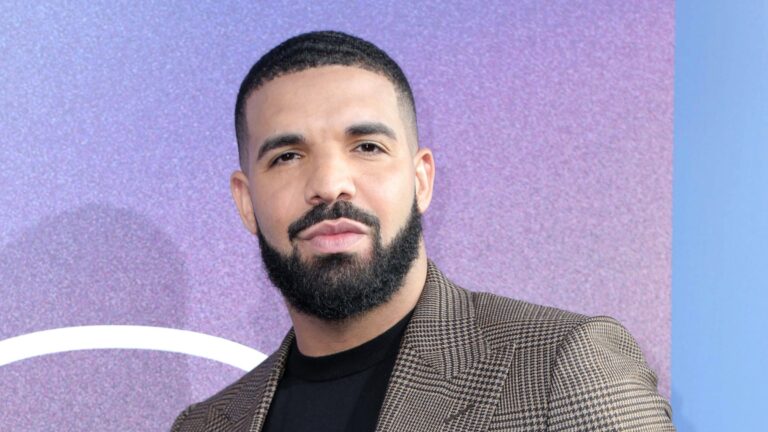
A US district court judge has approved Drake’s motion to subpoena a man his lawyers claim “possesses knowledge” in his defamation lawsuit against Universal Music Group.

Judge Jeannette Vargas of the US District Court for the Southern District of New York granted Drake‘s “motion for alternative service” on Kojo Menne Asamoah, allowing the rapper’s legal team to serve legal papers to Asamoah and his business ventures.

The rapper’s attorneys claimed they have spent $75,000 trying to track down the witness. According to the latest court document, which you can read in full here, the rapper’s team made 11 attempts to serve Asamoah at various addresses, hiring both process servers and a private investigation firm.

Despite weeks of surveillance across multiple locations, investigators could not locate Asamoah in person, prompting Drake’s request for alternative service methods, according to the court document filed August 6.

The approved service methods include mailing copies of the subpoena to five physical addresses connected to Asamoah, his family members, and business ventures. Drake’s team can also email the subpoena to three addresses linked Asamoah, which attorneys confirmed remain active.

“Plaintiff alleges that Mr. Asamoah ‘possesses knowledge relating to UMG’s use of covert tactics to promote the Defamatory Material.’”

Jeannette Vargas, US District Court Judge

Judge Vargas wrote: “Plaintiff alleges that Mr. Asamoah ‘possesses knowledge relating to UMG’s use of covert tactics to promote the Defamatory Material, including because Plaintiff believes that Mr. Asamoah was involved in directing payments and/or financial incentives from UMG to third parties involved in online botting for the purpose of artificially inflating the streaming numbers of the Recording.’”

The ruling is part of Drake’s high-profile defamation case against UMG, filed in January, over Kendrick Lamar’s diss track Not Like Us, arguing that UMG “decided to publish, promote, exploit and monetize allegations that it understood were not only false, but dangerous.”

Lamar’s music is distributed by UMG’s Interscope label, while Drake is signed to UMG’s Republic Records.

In April, Drake amended his lawsuit with new claims targeting Lamar’s Not Like Us performance during the Super Bowl LIX halftime show. The 107-page filing now references the NFL’s decision to censor the words “certified pedophile” from the performance in February. Drake’s legal team argued that while the televised performance censored the word “pedophile,” no other modifications were made.

“Plaintiff believes that Mr. Asamoah was involved in directing payments and/or financial incentives from UMG to third parties involved in online botting for the purpose of artificially inflating the streaming numbers of the Recording.”

Jeannette Vargas, US District Court Judge

The halftime performance, broadcast by Fox, was the most-watched of all time, with 133.5 million views, according to Billboard.

UMG described Drake’s defamation suit “one absurd legal step after another.” The music giant pointed to a pattern of legal actions by Drake’s team, noting that proceedings initiated “with much fanfare and bluster” in Texas last November were “quietly dropped” in April.

UMG also highlighted that Drake has withdrawn certain allegations from his original January filing, potentially to avoid court sanctions for “asserting false allegations.”

The music company filed a motion to dismiss the amended lawsuit in May, arguing that the lyrics are “nonactionable opinion and rhetorical hyperbole” rather than assertions of fact.

In a statement issued to MBW in May, a UMG spokesperson slammed “the hundred-plus page ‘legal’ blather written by Drake’s lawyers”.

They added, however, that UMG “remain[s] committed to propelling Drake’s career while maintaining our unwavering support of all our artists’ creative expression. Drake’s included.”

About a week later, a group of academics urged the court to dismiss the case against UMG, arguing that taking rap lyrics as factual threatens freedom of speech and risks a miscarriage of justice.

Four scholars, all linked to the University of California–Irvine, warned of “the harms that arise when courts treat rap lyrics confessions or factual representations,” according to a proposed amicus brief on May 14.

Music Business Worldwide
Australia set to acknowledge Palestinian statehood, New Zealand potentially to do the same | Latest updates on Israel-Palestine tensions

0

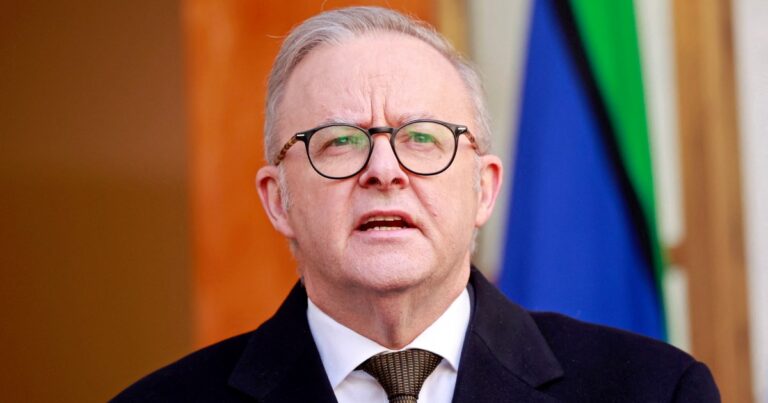
Australia will recognise a Palestinian state in September, Australian Prime Minister Anthony Albanese has announced.

Albanese said on Monday that his government would formally announce the move when the United Nations General Assembly (UNGA) meets in New York.

“A two-state solution is humanity’s best hope to break the cycle of violence in the Middle East and to bring an end to the conflict, suffering and starvation in Gaza,” Albanese said at a news conference in Canberra.

Australia’s announcement comes as Canada, France and the United Kingdom are preparing to formally recognise Palestine at the meeting next month, joining the vast majority of UN member states.

It also comes about a week after hundreds of thousands of Australians marched across the Sydney Harbour Bridge to protest Israel’s war in the Gaza Strip.

Speaking a day after the protest, Australian Minister for Foreign Affairs Penny Wong told the Australian Broadcasting Corporation (ABC) that “there is a risk there will be no Palestine left to recognise.”

“In relation to recognition, I’ve said for over a year now, it’s a matter of when, not if,” Wong added.

The opposition Liberal Party criticised the move, saying it put Australia at odds with the United States, its closest ally, and reversed a bipartisan consensus that there should be no recognition while Hamas remains in control of Gaza.

“Despite his words today, the reality is Anthony Albanese has committed Australia to recognising Palestine while hostages remain in tunnels under Gaza and with Hamas still in control of the population of Gaza. Nothing he has said today changes that fact,” Liberal Party leader Sussan Ley said in a statement.

“Recognising a Palestinian state prior to a return of the hostages and defeat of Hamas, as the Government has today, risks delivering Hamas one of its strategic objectives of the horrific terrorism of October 7.”

The Australian Greens, the fourth-largest party in parliament, welcomed the move to recognise Palestine, but said the announcement did not meet the “overwhelming calls from the Australian public for the government to take material action”.

“Millions of Australians have taken to the streets, including 300,000 last weekend in Sydney alone, calling for sanctions and an end to the arms trade with Israel. The Albanese Government is still ignoring this call,” Senator David Shoebridge, the party’s spokesperson on foreign affairs, said in a statement.

The Australian Palestine Advocacy Network (APAN) also criticised the announcement, describing it as a “political fig leaf, letting Israel’s genocide and apartheid continue unchallenged, and distracting from Australia’s complicity in Israeli war crimes via ongoing weapons and components trade”.

“Palestinian rights are not a gift to be granted by Western states. They are not dependent on negotiation with, or the behaviour or approval of their colonial oppressors,” APAN said in a statement.

According to Albanese, Australia’s decision to recognise Palestinians’ right to their own state will be “predicated on the commitments Australia has received from the Palestinian Authority (PA)”.

These “detailed and significant commitments” include the PA reaffirming it “recognises Israel’s right to exist in peace and security” and committing to “demilitarise and to hold general elections”, Albanese said while announcing the decision.

The PA is a governing body that has overseen parts of the Israeli-occupied West Bank since the mid-90s.

It has not held parliamentary elections since 2006 and has been criticised by some Palestinians for helping Israel to keep tight control over residents in the West Bank.

Albanese said the commitments secured by Australia were “an opportunity to deliver self-determination for the people of Palestine in a way that isolates Hamas, disarms it and drives it out of the region once and for all”.

Hamas has been in power in the Gaza Strip since 2007, when it fought a brief war against forces loyal to PA President Mahmoud Abbas.

New Zealand to decide on recognition next month

Meanwhile, New Zealand’s Foreign Minister Winston Peters said on Monday that his country’s cabinet will make a formal decision on Palestinian statehood in September.

“Some of New Zealand’s close partners have opted to recognise a Palestinian state, and some have not,” Peters said in a statement.

“Ultimately, New Zealand has an independent foreign policy, and on this issue, we intend to weigh up the issue carefully and then act according to New Zealand’s principles, values and national interest.”

Peters said that while New Zealand has for some time considered the recognition of a Palestinian state a “matter of when, not if”, the issue is not “straightforward” or “clear-cut”.

“There are a broad range of strongly held views within our Government, Parliament and indeed New Zealand society over the question of recognition of a Palestinian state,” he said.

“It is only right that this complicated issue be approached calmly, cautiously and judiciously. Over the next month, we look forward to canvassing this broad range of views before taking a proposal to Cabinet.”

Of the UN’s 193 member states, 147 already recognise Palestinian statehood, representing some three-quarters of the world’s countries and the vast majority of its population.

Under its 1947 plan to partition Palestine, the UNGA said it would grant 45 percent of the land to an Arab state, though this never eventuated.

The announcements by Australia and New Zealand on Monday came hours after an Israeli attack killed five Al Jazeera staff members in Gaza City, and as Israeli Prime Minister Benjamin Netanyahu continues to threaten a full-scale invasion of the city in the north of the Gaza Strip.

Israel’s war on Gaza has killed at least 61,430 people, according to Gaza’s health authorities.

Close to 200 people, including 96 children, have died from starvation under Israel’s punishing siege, according to health authorities.

Challenging the Client

0


Client Challenge


JavaScript is disabled in your browser.

Please enable JavaScript to proceed.

A required part of this site couldn’t load. This may be due to a browser
extension, network issues, or browser settings. Please check your
connection, disable any ad blockers, or try using a different browser.

Day 5 Recap: Six Additional Masters Records Broken at USMS Nationals

0

By Terin Frodyma on SwimSwam

2025 U.S. Masters Summer National Championships

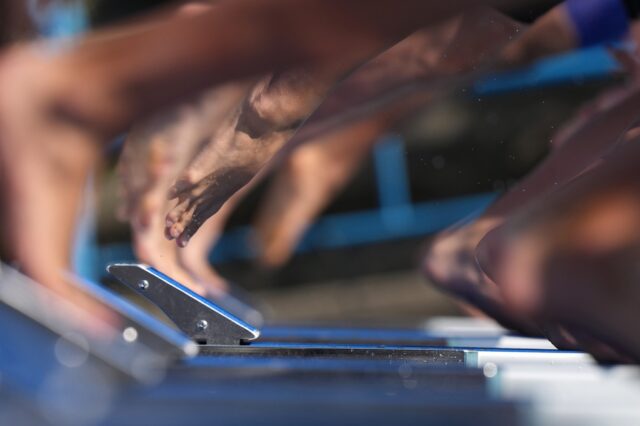
Putting a bow on competition in Federal Way, the final day of the 2025 U.S. Masters Summer National Championships was once again full of new standards. Most notable was Charlotte Davis closing out her stellar showing with yet another AQUA Masters world and USMS national record in the women’s 75-79 50 butterfly, marking her 9th and 10th records on the week (counting both national and world records).

Davis, 75, finished in 36.47, besting her own world and national marks of 37.23 set back in April of this year.

Jerome Frentsos, 60, of Oregon Masters took down both the AQUA Masters world record and USMS record in the men’s 60-64 200 backstroke, touching in 2:25.61. Topping the previous national and world marks set by Jamie Fowler of 2:26.12, set just over six years ago.

Frentsos’ teammate Chris Hiatt, 85, saw similar success in the men’s 85-89 200 back, knocking down his own USMS national record from just under three months ago of 3:48.78, with his final time of 3:43.62.

Swim Fort Lauderdale’s Cecilia McCloskey, 75, touched over 30 seconds ahead of the rest of her age group to take the win in the women’s 75-79 200 back. Her final time of 3:09.61 set a new AQUA Masters world and USMS national standard. McCloskey’s time overtook Diann Uustal’s 3:17.63 to nab the national mark, and Australian Clary Munns‘ 3:16.80 to break the world record.

Robert Wright, 75, took down a pair of records in the men’s 75-79 100 breaststroke, clocking 1:25.57 to earn himself both the AQUA Masters world and USMS national records. Wright simultaneously lowered Mike Freshley’s 1:27.74 national mark and Toshiharu Fujii’s 1:26.64 world standards.

Wrapping up the record-breaking was Lone Star Masters in the Mixed 240-279 200 free relay. The team of Michael Bergman (65), Stephanie Stone (58), Maureen Rea (49), and Tom Wolf (71) took down the nearly nine-year-old USMS national standard previously held by the Sarasota Sharks of 1:54.54, with their final time of 1:53.68.

Read the full story on SwimSwam: Six More Masters Records Crumble to Wrap Up USMS Nationals – Day 5 Recap

Israeli strike near Al-Shifa hospital claims lives of five Al Jazeera journalists

0

Amy Walker & Tiffany Wertheimer

BBC News

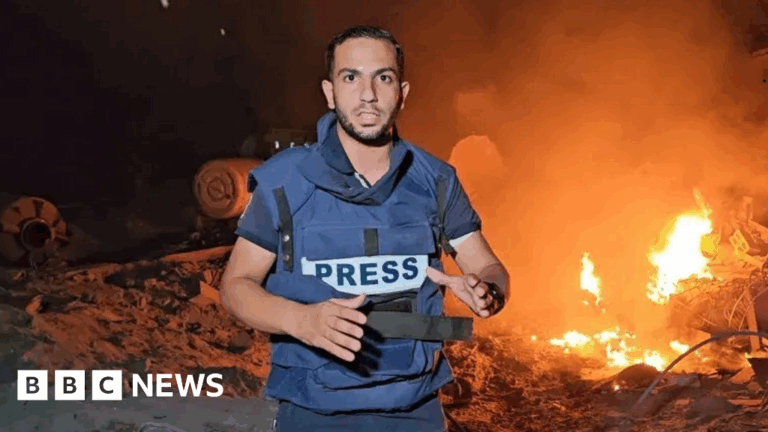
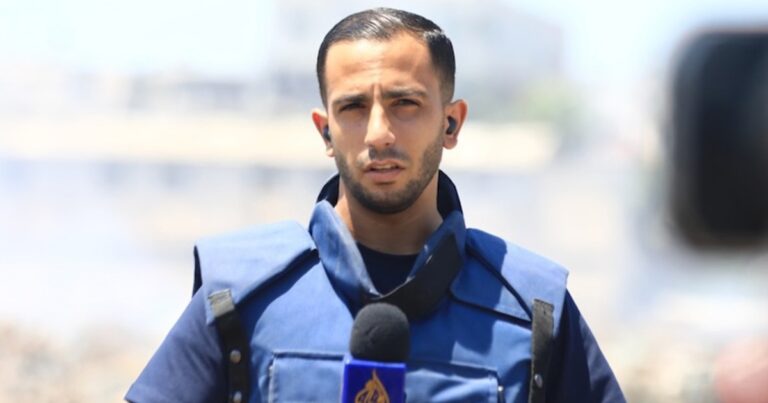
Al Jazeera Anas al-Sharif is wearing a blue flak jacket with 'PRESS' written across the front, and he's standing in front of burning debris.Al Jazeera

Anas al-Sharif had reported extensively from northern Gaza, Al Jazeera said

Five Al Jazeera journalists have been killed in an Israeli strike near Gaza City’s Al-Shifa Hospital, the broadcaster has said.

Correspondents Anas al-Sharif and Mohammed Qreiqeh, alongside cameramen Ibrahim Zaher, Mohammed Noufal and Moamen Aliwa were in a tent for journalists at the hospital’s main gate when it was struck, Al Jazeera reported.

The “targeted assassination” on Sunday was “yet another blatant and premeditated attack on press freedom”, it said in a statement.

Shortly after the strike, the Israel Defense Forces (IDF) confirmed that it had targeted Anas al-Sharif, writing in a Telegram post that he had “served as the head of a terrorist cell in Hamas”.

The IDF did not mention any of the other journalists who were killed.

In total, seven people died in the strike, Al Jazeera reports. The broadcaster initially said that four of its staff had been killed, but revised it to five a few hours later.

Its managing editor, Mohamed Moawad, told the BBC that al-Sharif was an accredited journalist who was “the only voice” for the world to know what was happening in the Gaza Strip.

Throughout the war, Israel has not allowed international journalists into Gaza to report freely. Therefore, many outlets rely on local reporters within the territory for coverage.

“They were targeted in their tent, they weren’t covering from the front line,” Moawad said of the Israeli strike.

“The fact is that the Israeli government is wanting to silence the coverage of any channel of reporting from inside Gaza,” he told The Newsroom programme.

“This is something that I haven’t seen before in modern history.”

Al-Sharif, 28, appeared to be posting on X in the moments before his death, warning of intense Israeli bombardment within Gaza City. A post that was published after he was reported to have died appears to have been pre-written and published by a friend.

In two graphic videos of the aftermath of the strike, which have been confirmed by BBC Verify, men can be seen carrying the bodies of those who were killed.

Some shout out Qreiqeh’s name, and a man wearing a media vest says that one of the bodies is that of al-Sharif.

Ebrahim Hajjaj/ Reuters A tent with only it's poles left standing, a lot of rubble and mess, and a badly damaged carEbrahim Hajjaj/ Reuters

The team were in Al Jazeera’s tent outside Al-Shifa Hospital in Gaza City when the air strike hit

In its statement, the IDF accused al-Sharif of posing as a journalist, and being “responsible for advancing rocket attacks against Israeli civilians and IDF troops”.

It said it had previously “disclosed intelligence” confirming his military affiliation, which included “lists of terrorist training courses”.

Last month, the Al Jazeera Media Network – along with the United Nations and the Committee to Protect Journalists (CPJ) – issued separate statements warning that al-Sharif’s life was in danger, and calling for his protection.

Jodie Ginsberg, chief executive of the CPJ, told the BBC that Israeli authorities have failed to provide evidence to show that the journalists they killed were terrorists.

“This is a pattern we’ve seen from Israel – not just in the current war, but in the decades preceding – in which typically a journalist will be killed by Israeli forces and then Israel will say after the fact that they are a terrorist, but provides very little evidence to back up those claims,” she said.

This is not the first time the IDF has targeted and killed Al Jazeera journalists in Gaza, who they claimed were Hamas-affiliated.

In August last year, Ismael Al-Ghoul was hit by an air strike as he sat in his car – harrowing video shared on social media showed his decapitated body. Cameraman Rami al-Rifi and a boy passing on a bicycle were also killed.

In al-Ghoul’s case, the IDF said he took part in Hamas’ 7 October 2023 attacks against Israel, a claim Al Jazeera strongly rejected.

According to the CPJ, 186 journalists have been confirmed killed since the start of Israel’s military offensive in Gaza in October 2023.

For the journalists still in Gaza, the situation is dire. As well as air strikes, there is the threat of starvation.

Last month, the BBC and three news agencies – Reuters, AP and AFP – issued a joint statement expressing “desperate concern” for journalists in the Strip, who they say are increasingly unable to feed themselves and their families.

Three freelancers whom the BBC relies on for its coverage said they often go days without eating, and one collapsed during filming.

More than 100 international aid organisations and human rights groups have warned of mass starvation in Gaza. Israel, however, which controls the entry of aid supplies into Gaza, has accused the charities of “serving the propaganda of Hamas”.

Israel launched its offensive in response to the Hamas-led attack on southern Israel on 7 October that year, in which about 1,200 people were killed and 251 others were taken hostage.

More than 61,000 people have been killed in Gaza since the Israeli military operation began, according to the territory’s Hamas-run health ministry.

Additional reporting by Shayan Sardarizadeh, BBC Verify

More on the Israel-Gaza war

A Custom Superbike Fitted with a Ferrari F355 V8 Engine

0

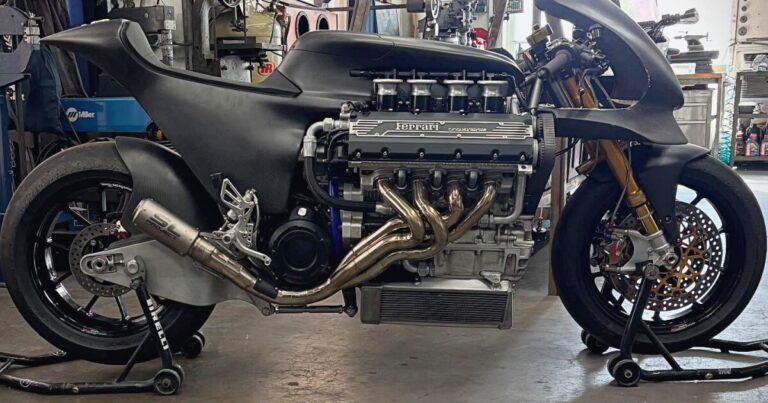
There probably wouldn’t be many people who’d look at a V8 engine and think, yup, let’s put that on a motorcycle. Well, Max Hazan is one of the rare few who not only thought it, he actually did it – creating an entire bespoke motorcycle in the process.

A few months back, we did a story when Hazan was still in the early stages of the build. Since then, the project has come a long way, steadily taking the shape of a café racer–styled custom – one that actually runs.

It’s taken him close to a year to bring the bike to life. It’s called the HF355, named for the 3.5-liter V8 engine that originally powered the Ferrari F355 between 1994 and 1999. It’s one of the best-sounding engines ever to come out of Ferrari’s stable, revving to nearly 10,000 rpm.

Before we get into the details, here’s what it sounds like:

That’s a naturally aspirated, 400-horsepower motor, mounted longitudinally and paired with a six-speed gearbox. The bike weighs 550 lb (250 kg) dry, 590 lb (267 kg) wet, with nearly half of that weight, 237 lb (107 kg), coming from the engine alone.

That’s roughly 100 lb (45 kg) heavier than a typical 1,000cc sportsbike, but given the sheer size of the V8, it’s a trade-off that makes sense.

To help with cooling, there’s a ducted radiator beneath the engine, working in tandem with four computer-controlled electric fans to manage heat. The engine also runs a dry sump system, with the oil tank mounted on top freeing up space, reducing complexity, and keeping things accessible for whoever ends up maintaining this beast.

The bike weighs 590 lb (267 kg) wet, and nearly half of that weight – 237 lb (107 kg), comes from the engine alone!

Hazan Motorworks

To accommodate the heft of the V8, Hazan completely stripped away any stock frame. All components are bolted directly to the engine and transmission. The HF355 runs a bespoke ECU, in-house carbon bodywork, custom headers and exhaust, fully custom front and rear suspension – well, pretty much everything is bespoke.

The result? A power-to-weight ratio of about 0.67 hp/lb—better than the ultra-high-performance BMW S1000 RR, which comes in at 0.46 hp/lb.

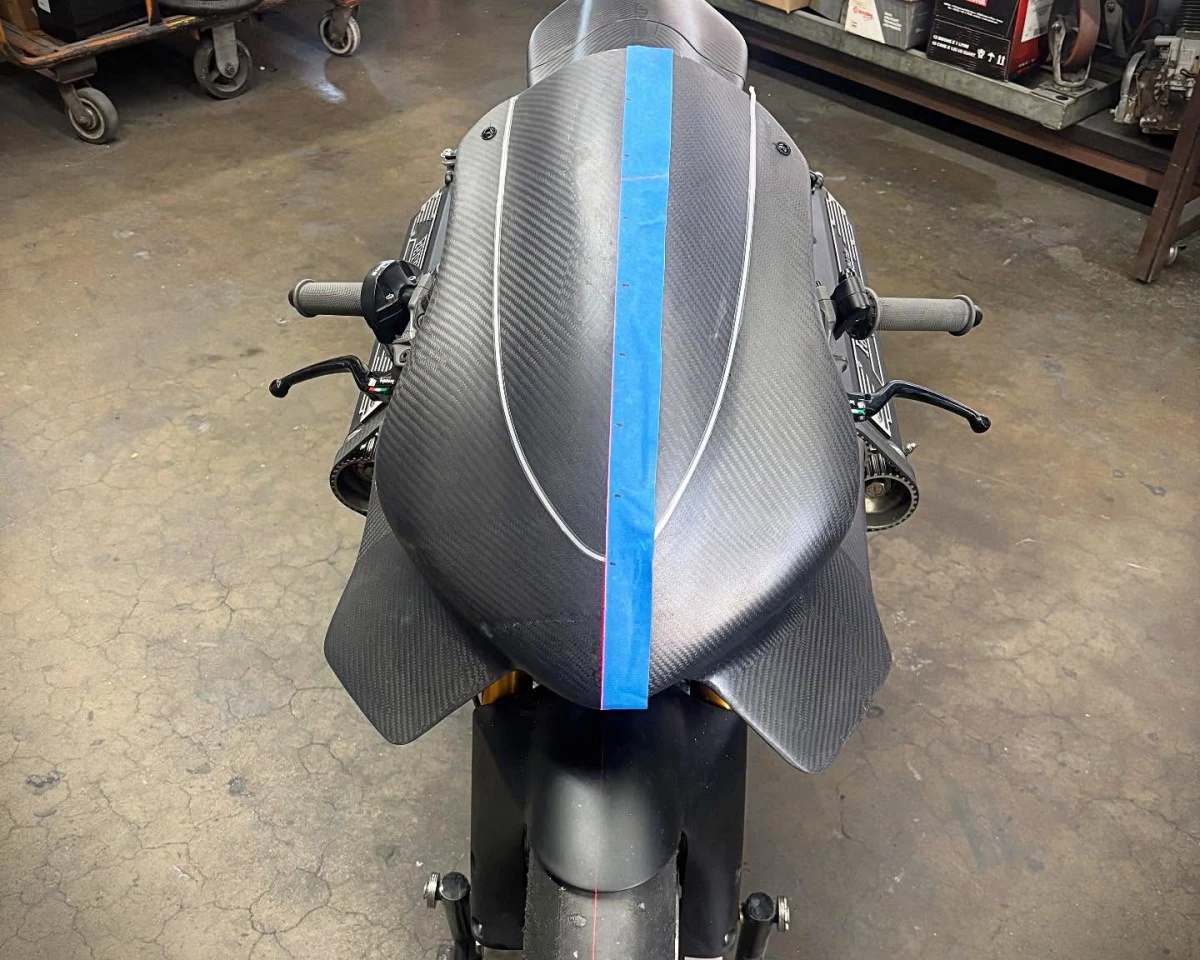
There’s no donor bike here – Hazan crafted all of the bodywork himself, using composite materials and custom molds. He even added an acrylic windshield and aerodynamic winglets to the front fairing.

There’s no donor bike – Hazan created all of the gorgeous bodywork in composite materials using his own molds

Hazan Motorworks

The finished machine is about the length of an adventure bike, though Hazan shortened the wheelbase to 63 inches (1,600 mm) axle-to-axle to preserve that classic sportbike appearance. Ergonomics were a major challenge with a bike this size, so Hazan spent significant time dialing in seat height, footpeg location, and handlebar reach.

Exact specifications are still under wraps – it’s currently listed under the “in the works” section of Hazan’s website. One thing’s certain: the HF355 is not destined for mass production. As for who will be crazy enough to ride it, that remains to be seen.

Source: Hazan Motorworks / Maxwell Hazan

Northern Data, a German AI cloud firm, is being considered for a nearly $1.2 billion bid by Rumble.

0

Rumble weighs near $1.2 billion bid for German AI cloud firm Northern Data

Al Jazeera denounces the Israeli forces for the killing of its journalists in Gaza | News on Israel-Palestine conflict

0

Media network condemns ‘assassination’ of its Gaza correspondents and photographers by Israeli forces.

Below is Al Jazeera Media Network’s statement on the killing of Anas al-Sharif, Mohammed Qreiqeh, Ibrahim Zaher and Mohammed Noufal.

Al Jazeera Media Network condemns in the strongest terms the targeted assassination of its correspondents Anas Al Sharif and Mohammed Qraiqea, along with photographers Ibrahim Al Thaher, and Mohamed Nofal, by the Israeli occupation forces in yet another blatant and premeditated attack on press freedom.

In a statement by the Israeli occupation force, admitting to their crimes, the journalists were targeted by a directed assault towards the tent where they were stationed opposite Al-Shifa Medical Complex in Gaza. In which they were martyred. This attack comes amid the catastrophic consequences of the ongoing Israeli assault on Gaza, which has seen the relentless slaughter of civilians, forced starvation, and the obliteration of entire communities. The order to assassinate Anas Al Sharif, one of Gaza’s bravest journalists, and his colleagues, is a desperate attempt to silence the voices exposing the impending seizure and occupation of Gaza.

As Al Jazeera Media Network bids farewell to yet another group of its finest journalists, who boldly and courageously documented the plight of Gaza and its people since the onset of the war, it holds the Israeli occupation forces and government responsible for deliberately targeting and assassinating its journalists. This follows repeated incitement and calls by multiple Israeli officials and spokespersons to target the fearless journalist Anas Al Sharif and his colleagues.

Anas and his colleagues were among the last remaining voices from within Gaza, providing the world with unfiltered, on-the-ground coverage of the devastating realities endured by its people. While international media was barred from entering, Al Jazeera journalists remained within besieged Gaza, experiencing the hunger and suffering they documented through their lenses. Through continuous, courageous live coverage, they have delivered searing eyewitness accounts of the horrors unleashed over 22 months of relentless bombing and destruction.

Despite losing several journalists to deliberate attacks and working under constant threat, Anas Al Sharif, Mohammed Qraiqea, and their colleagues persisted in the strip to ensure the world sees the harrowing truth experienced by Gaza’s populace.

While vehemently condemning these heinous crimes and the ongoing attempts by Israeli authorities to silence the truth, Al Jazeera Media Network calls on the international community and all relevant organisations to take decisive measures to halt this ongoing genocide and end the deliberate targeting of journalists. Al Jazeera emphasises that immunity for perpetrators and the lack of accountability embolden Israel’s actions and encourage further oppression against witnesses to the truth.

US tech industry pivots to open source in attempt to keep up with China’s AI advancements

0

OpenAI, the developer behind ChatGPT, released two bombshell AI developments last week. Last Thursday, it released GPT-5, the long-awaited update to its powerful GPT model. 

But OpenAI’s earlier decision to release open-source versions of its powerful model—the first time it’s done so since 2020, may be more consequential. OpenAI’s move follows a flood of Chinese AI models spurred by the surprise release from Chinese AI startup DeepSeek.

It’s a major shift for the U.S. AI developer, now worth $300 billion. Open weight models allow developers to fine-tune for specific tasks without retraining it from scratch. Despite its name, OpenAI has focused on releasing closed, proprietary models, meaning developers couldn’t get under the hood to see how they worked—allowing OpenAI to charge for access to its powerful models. 

DeepSeek tested that strategy. The Hangzhou-based start-up made waves by releasing models that matched the performance of products from Western rivals like OpenAI and Anthropic. By making its technology openly accessible, DeepSeek allowed developers around the globe to experience the power of its models firsthand.

Since then, Chinese AI development has exploded, with companies large and small rushing to unveil increasingly advanced models. Most releases are open-source. 

“Globally, AI labs are feeling the heat as open source models are increasingly recognized for their role in democratizing AI development,” Grace Shao, an China-based AI analyst and founder of AI Proem, says. 

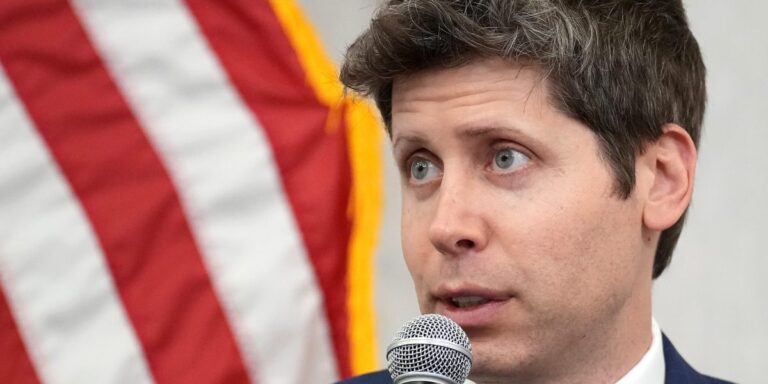
U.S. tech stocks have rebounded from the slump triggered by DeepSeek, but the shift to open-source may be more permanent. In March, OpenAI CEO Sam Altman conceded that the developer may have been on the “wrong side of history” by maintaining a closed approach. 

The race is now geopolitically charged. Ahead of releasing the open-source models, Altman said he was “excited for the world to be building on an open AI stack created in the United States, based on democratic values, available for free to all and for wide benefit.” Altman’s statement leans into a growing competition over AI–one that developers in the U.S. are worried of losing.

“This plethora of simultaneous open AI models (with published weights and papers about technique) is an ‘idea orgy.’ The collective innovation should easily soar past anything one company can do alone,” Benchmark general partner Bill Gurley wrote on X in late July. “It’s formidable and should easily win over single proprietary players (anywhere in the globe).”

China embraces open-source

Chinese AI firms are now aggressively championing open-source. 

Baidu, once the leader in China’s AI development with its ERNIE model, went open-source a few months ago to catch up with Alibaba and DeepSeek. Kuaishou and Tencent have both released open-source video-generation models. Zhipu AI, Moonshot AI and MiniMax–some of China’s so-called “AI tigers”—have also released open-source models in recent weeks.

Rather than closely guard their breakthroughs, Chinese developers think an open approach will encourage greater innovation and encourage adoption. “When the model is open-source, people naturally want to try it out of curiosity,” Baidu CEO Robin Li told analysts in February, soon after the company unveiled its plans to go open-source

And there’s a business argument too: Alibaba executives, for example, argue that their open-source Qwen models encourage companies and startups to use Alibaba’s cloud computing services. 

Since DeepSeek’s release, Chinese companies have rushed to integrate Chinese AI models into their products, including social media platforms, cars, and even air-conditioners

There may also be a psychological element at play. Going open-source lets users around the world see the power of Chinese AI models for themselves, appealing to an up-and-coming tech sector that’s long been denigrated by outsiders as a copycat.

Export controls

China has supported other open-source technologies. Officials back the use of the RISC-V chip design architecture, an open-source alternative to proprietary architectures like ARM and Intel’s x86. RISC-V allows Chinese chip engineers to share best practices and ideas, spurring the growth of the broader sector. 

Beijing seeks to develop a self-sufficient semiconductor sector, in part due to concerns of the U.S.’s control of critical parts of the chip supply chain. The Biden administration’s decision to impose chip controls in 2022 intensified China’s push for domestic innovation. 

China’s embrace of RISC-V has raised eyebrows in Washington. Last year, the House Select Committee on the Chinese Communist Party recommended that U.S. officials study the risks of RISC-V, and reportedly proposed preventing U.S. citizens from aiding China on the open-source architecture. 

Leaders vs. followers

China’s embrace of open-source aligns with the country’s initial position as a runner-up in AI.

“If you’re an OpenAI, an Anthropic, a Google…if you’re really leading, then you have this incredibly valuable asset,” Helen Toner, the director of strategy at Georgetown’s Center for Security and Emerging Technology, said at the Fortune Brainstorm AI Singapore conference in mid-July. “It’s easy to understand why they wouldn’t want to just hand out [their models] for free to their competitors if they’re able to sell access to their closed systems at a premium.”

But for followers, who “can’t compete at the frontier,” releasing an open-source model is a way to show “how advanced you are,” she explained. 

Open-source models also “buy a lot of goodwill,” Toner, who once served on OpenAI’s board, added. “What we’ve seen over the last couple years is how much soft power is available to people who are willing to and organizations that are willing to make their technology available freely,” she explained.

The U.S. may now recognize the “soft power” potential of open-source. “The United States is committed to supporting the development and deployment of open-source and open-weight models,” Michael Kratsios, director of the U.S. Office of Science and Technology Policy, said in South Korea earlier this week

And with OpenAI’s decision, U.S. AI is now perhaps put in a rare position: Following, not leading.

Balikesir province devastated by Turkey earthquake, buildings flattened

0

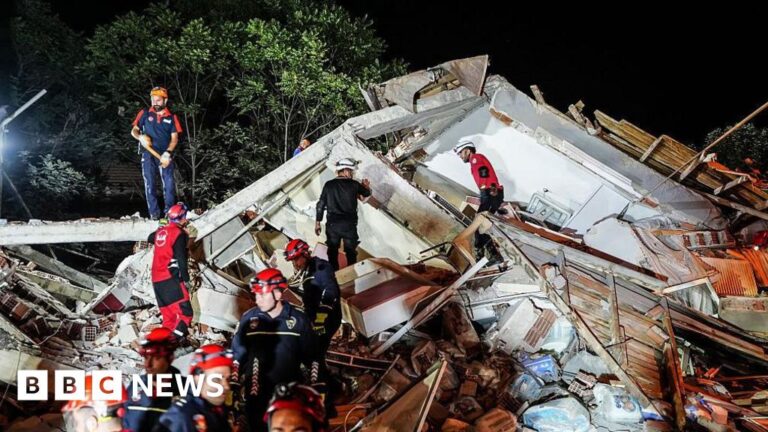
Sergen Sezgin/Anadolu via Getty Images Emergency workers in blue and red uniforms stand on a building that has crumbled from the earthquake. It is night time and the debris is light brightly by spot lights.Sergen Sezgin/Anadolu via Getty Images

One person has died in Turkey after a magnitude 6.1 earthquake struck the north-west province of Balikesir on Sunday evening.

An 81-year-old woman passed away shortly after she was pulled out from rubble in the town of Sindirgi, which was the epicentre of the quake, Turkey’s interior minister said.

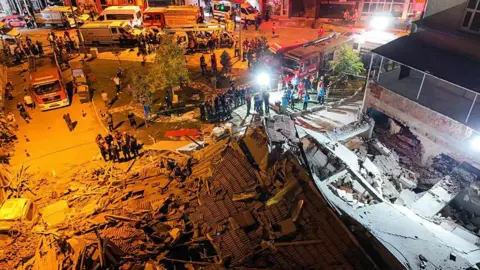
Sixteen buildings collapsed as a result of the tremors, and 29 people had been injured, Ali Yerlikaya added.

Turkey’s disaster management agency said the quake was recorded at around 19:53 local time (16:53 GMT), and was felt as far away as Istanbul.

President Recep Tayyip Erdogan issued a statement wishing a swift recovery to everyone who was affected, and said that all recovery efforts were being closely monitored.

“May God protect our country from any kind of disaster,” he wrote on X.

Search and rescue operations have now concluded, and the interior minister said that there were no other signs of serious damage or casualties.

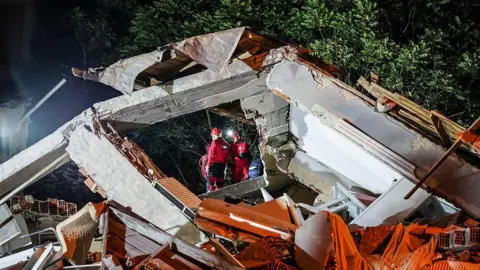
Pictures from Sindirgi, however, show large buildings totally flattened and towering piles of twisted metal and debris.

Berkan Cetin/Anadolu via Getty Images An aerial view of a collapsed building with emergency workers all around it. The picture is taken at night time and the debris is lit by strong spot lights.Berkan Cetin/Anadolu via Getty Images
Sergen Sezgin/Anadolu via Getty Images Emergency workers can be seen through a square frame that is being created by a massive chunk of collapsed building.Sergen Sezgin/Anadolu via Getty Images

Turkey is located at the intersection of three major tectonic plates, and experiences frequent seismic activity as a result.

In February 2023, more than 50,000 people were killed when a 7.8 magnitude earthquake devastated the south-eastern region of the country.

A further 5,000 were killed in neighbouring Syria.

More than two years on from that quake, hundreds of thousands of people remain displaced.