

9.5 C
New York
Saturday, April 25, 2026
Home Blog Page 497

Warner Music Group values EMP at $70m – Potential Sale in the Works?

0

Warner Music Group may be preparing to sell EMP Merchandising, the European rock and metal merchandise e-retailer it acquired for USD $180 million in 2018.

That’s according to clues in WMG’s latest earnings press release and quarterly SEC filing, spotted by MBW.

The quarterly filing, covering the three months ended June 30, 2025, reveals a USD $70 million pre-tax impairment charge on “long-lived assets associated with certain of [WMG’s] non-core e-tailer operations” – following what Warner describes as a “triggering event”.

In previous Warner annual filings, only one subsidiary is referred to as an “e-tailer”: EMP.

An impairment charge, essentially a corporate write-down, occurs when a company determines that assets on its balance sheet are worth less than their recorded book value.

So-called “triggering events” for companies to record impairments can include receiving market offers, commissioning independent valuations ahead of asset sales, or other reasons.

In addition to revealing details of the impairment charge, Warner’s Q3 filing notes that the e-tailer now carries “recoverable fair value based on current market indicators”.

“Current market indicators” could obviously suggest sale discussions, or unsolicited offers.

Either way, the $70 million write-down ($48 million after tax) confirms that EMP’s previous book value significantly exceeded what Warner believes it can recover, either through operations or a sale.

Given Warner paid approximately $180 million for EMP in 2018, this represents a substantial reduction in market value.


The tell-tale line in Warner’s fiscal Q3 (calendar Q2) earnings report

WMG confirming EMP’s status as a “non-core” asset tells its own story.

This potentially fits within WMG CEO Robert Kyncl‘s recently announced strategic cost-reduction plan, and his determination to focus on “core” music assets.

In July, Kyncl announced plans to reduce WMG’s annual costs by $300 million.

That target was broken down into $200 million from lay-offs ($170 million from redundancies and a further $30 million in related admin/real estate costs) plus an additional $100 million in “a decrease in SG&A expenses unrelated to headcount”.

Whole-asset sales are an obvious avenue to achieve the latter part of the plan.

In February 2024, as part of a previous restructuring program, Warner sold/shed its “owned and operated media properties” including UPROXX and HipHopDX, with Kyncl telling staff these brands “operate outside our core responsibilities to our roster.”

Warner’s decision to write off $70 million from EMP’s value came in the same quarter as a change of leadership for the e-tailer.

According to filings at Germany’s companies register, Dr. Jan Marc Fischer ended his tenure as EMP’s boss in April.

Fischer was named CEO of EMP in 2023 after 10 years as its Chief Financial Officer and Chief Operating Officer.

Succeeding him as EMP’s leader was Tom Kuper, who stepped up from his then-role as COO.

Writing on LinkedIn at the time, Kuper said (translated): “Change brings opportunities – and I am ready to lead the EMP crew through this exciting phase of change with heart and attitude.”


EMP, founded in Germany in 1986, was acquired by Warner in September 2018 from private equity firm Sycamore Partners.

At acquisition, Warner described it as offering merchandise from artists including Twenty One Pilots, Panic! At The Disco, Metallica, Motörhead, Guns N’ Roses, Nirvana, Pink Floyd, AC/DC, and The Doors.

EMP also operates as an e-tailer beyond music merchandise, selling products from entertainment brands like Disney, Marvel, Star Wars, gaming brands like Nintendo and PlayStation, and alternative fashion brands like Vans.

This diversification may no longer align with Warner’s music-first strategy under Kyncl, who last week emphasized “focusing on the artists, songwriters, and markets with the greatest potential”.

Warner Music Group spokesperson declined to comment when contacted by MBW.Music Business Worldwide

Alondra Ortiz, Butterflyer, to Swim at William Jewell for the 2025-26 Season

0

By Anne Lepesant on SwimSwam

Fitter and Faster Swim Camps is the proud sponsor of SwimSwam’s College Recruiting Channel and all commitment news. For many, swimming in college is a lifelong dream that is pursued with dedication and determination. Fitter and Faster is proud to honor these athletes and those who supported them on their journey.

Alondra Ortiz from Edmond, Oklahoma, has committed to swim and study at William Jewell College beginning in the 2025-26 school year.

“I loved the team dynamic and how well everyone trains and works together. As well as how the coaches support them every step of the way.”

Ortiz graduated from Epic Charter School this spring. She does her year-round swimming with Sooner Swim Club and specializes in butterfly and IM. During her senior year of high school, she updated her lifetime bests in the 50 back and 50/100/200 fly at the King Marlin Swim Club Pro-Am Classic and at the Oklahoma Senior State Championships.

She achieved a PB in the 100 meter fly (1:11.03) this summer at the Oklahoma Senior State Championships, which followed on last summer’s PBs in the 50/100 free and 200 fly.

Best SCY times:

  • 200 fly – 2:18.93
  • 100 fly – 1:02.73
  • 50 fly – 29.00
  • 200 back – 2:20.63
  • 100 back – 1:04.55
  • 50 free – 27.1
  • 100 free – 58.06
  • 400 IM – 5:12.51
  • 200 IM – 2:27.05

Ortiz will join the Cardinals’ class of 2029 with Addison Williams and Mallorie Reed. William Jewell competes in Division II’s Great Lakes Valley Conference. The women’s team placed 7th out of 10 teams at the 2025 GLVC Championships.

If you have a commitment to report, please send an email with a photo (landscape, or horizontal, looks best) and a quote to Recruits@swimswam.com.

About the Fitter and Faster Swim Tour 

Fitter & Faster Swim Camps feature the most innovative teaching platforms for competitive swimmers of all levels. Camps are produced year-round throughout the USA and Canada. All camps are led by elite swimmers and coaches. Visit fitterandfaster.com to find or request a swim camp near you.

FFT SOCIAL

Instagram – @fitterandfasterswimtour
Facebook – @fitterandfastertour
Twitter – @fitterandfaster

FFT is a SwimSwam partner.

Read the full story on SwimSwam: Butterflyer Alondra Ortiz Commits to Swim at William Jewell for 2025-26

Solar Panels’ Efficiency Could Be Enhanced by Plants

0

After oxygen, silicon is the most abundant element in the earth’s crust. Sand, for example, is composed mainly of it. It is also the material that has driven the microprocessor revolution and a key element in green power production, as it is the basis for most photovoltaic panels. However, silicon is not the only option for developing computing technologies or producing solar energy. 

Lahari Saha, a researcher at the University of Maryland in the USA, believes there are other strategies for achieving more efficient solar panels. In her case, it is a matter of using elements from the greatest experts in processing sunlight: plants and the molecules with which they carry out photosynthesis. Today, photovoltaic panels offer a maximum efficiency of around 20 %. The challenge is to increase this figure and to do so in a sustainable manner.

Improving the efficiency of solar panels with chlorophyll and other moleculese

The findings of Saha’s research were presented at the 67th Biophysical Society Meeting in San Diego, California, as part of his paper “Fluorophore-induced plasmonic current for solar energy harvesting. Her project, which is still preliminary, focuses on fluorescence, specifically on molecules known as fluorophores. That is, they can absorb energy at one wavelength and emit it at a longer wavelength but with lower energy.

“Any sort of molecule that fluoresces, gives off light. If we excite the fluorophore, it can transfer its energy to metal nanoparticles, and if the particles are close enough to each other, they will knock off electrons and generate current,” explained Saha. This principle can be extrapolated to other non-fluorescent particles with a high light absorption capacity, such as chlorophyll or lutein. In addition to improving the panels’ efficiency, these molecules’ use will facilitate their recycling.

Another of the researcher’s major goals is the development of solar panels with a smaller footprint since the same renewable energy can be generated with a smaller size. As renewable energies become increasingly important, finding ways to optimize the physical space they occupy will be necessary. While wind energy opts for offshore installations, photovoltaics is turning to floating facilities in water reservoirs. The new “vegetable” panels could help obtain more energy per square meter

The quest for biophotovoltaic energy

Of course, silicon has a long life ahead of it, as these developments based on plant molecules have not yet reached commercial or industrial maturity. However, research in biophotovoltaics is opening up exciting possibilities, as in the case of these solar panels based on living bacteria. And there are even more radical approaches. One of the latest research projects has explored the power-generating potential of plants, specifically succulents.

In a paper recently published in the scientific journal ACS Applied Materials & Interfaces, a team of researchers has raised the possibility of a living “biosolar cell” based on photosynthesis. All living cells move electrons as part of their biological processes. In the case of plants, photosynthesis produces a flow of electrons that can be harnessed to power an external circuit.

In this case, scientists have concentrated their efforts on a succulent plant known as the Ice Plant. As part of their research, they inserted an iron anode and a platinum cathode into one of its leaves and managed to generate a current of 0.28 v. Although this is a small voltage, lower than that of an alkaline battery, the current was maintained throughout the day and, technically, could be increased by using a network of plants.

Another example of biophotovoltaics is using an algae colony to power a microprocessor. In the experiment, researchers at the University of Cambridge used blue-green algae, also known as cyanobacteria, capable of photosynthesis. Their system, exposed to light, managed to power an ARM Cortex-M0+ microprocessor for six months. The current generated is small but sufficient to power IoT devices in remote areas.

If you want to know more about the potential of microorganisms to produce and store energy, you can check out this article about a new generation of biobatteries that can deliver power for weeks by leveraging the interaction of three types of bacteria.


Source:

India’s Journey Towards Healthier Eating: Samosas Face Scrutiny

0

new video loaded: Samosas Under Fire as India Strives to be Healthier

By Shawn Paik and Anindito Mukherjee

Samosas, the deep-fried street snack, should be consumed in moderation, the Indian government recently recommended. Not everyone welcomed the advice.

Recent episodes in International

International video coverage from The New York Times.

International video coverage from The New York Times.

Challenging Client

0


Client Challenge


JavaScript is disabled in your browser.

Please enable JavaScript to proceed.

A required part of this site couldn’t load. This may be due to a browser
extension, network issues, or browser settings. Please check your
connection, disable any ad blockers, or try using a different browser.

French Nuclear Power Plant Shutdown Due to Jellyfish Swarm | Nuclear Energy Update

0

Scientists say warmer waters in the North Sea due to climate change have created conditions allowing jellyfish to thrive and reproduce.

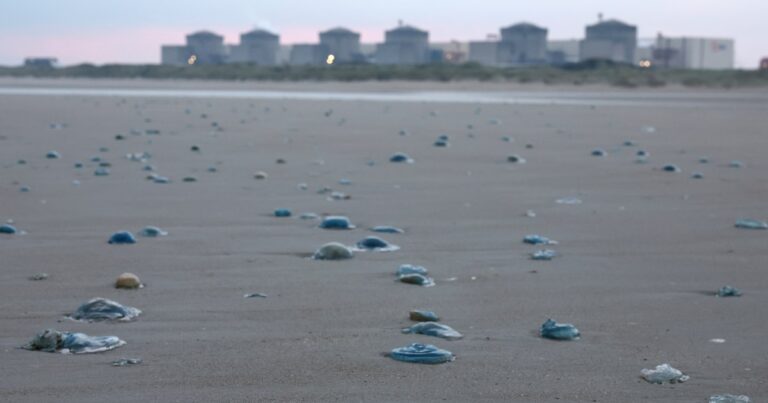
Four reactor units at one of France’s largest nuclear power stations have been forced to shut down due to a swarm of jellyfish in the plant’s water pumping stations, French energy group Electricite de France (EDF) said.

Three reactor units were automatically shut down on Sunday evening at Gravelines on the English Channel, followed by the fourth early on Monday morning, EDF said, adding that the safety of the plant, its employees and the environment was not at risk.

“These shutdowns are the result of the massive and unpredictable presence of jellyfish in the filter drums of the pumping stations,” EDF said in a statement.

The plant in northern France is one of the largest in the country and is cooled from a canal connected to the North Sea.

Teams were carrying out inspections to restart the site “in complete safety”, EDF said, adding the reactors that were shut down are expected to restart on Thursday.

The beaches around Gravelines, between the major cities of Dunkirk and Calais, have seen an increase in jellyfish in recent years due to warming waters and the introduction of invasive species.

Jellyfish lie on the shore near the Gravelines nuclear power plant in Gravelines, northern France, August 12, 2025 [Sameer al-Doumy/AFP]

The Bulletin of the Atomic Scientists wrote in 2021 that jellyfish swarms incapacitating nuclear power plants is “neither new nor unknown” and there was substantial economic cost due to the forced closure of power plants.

Scientists are currently exploring ways to avert closures due to sea swarms, including using drones to map the movement of jellyfish, which would allow early intervention.

“Jellyfish breed faster when water is warmer, and because areas like the North Sea are becoming warmer, the reproductive window is getting wider and wider,” Derek Wright, marine biology consultant with the United States National Oceanic and Atmospheric Administration, told the Reuters news agency.

“Jellyfish can also hitch rides on tanker ships, entering the ships’ ballast tank in one port and often getting pumped out into waters halfway across the globe,” he said.

An invasive species known as the Asian Moon jellyfish, native to the Pacific Northwest, was first sighted in the North Sea in 2020. The species, which prefers still water with high levels of animal plankton, such as that in ports and canals, has caused similar problems before in ports and at nuclear plants in China, Japan, and India.

EDF said it did not know the species of jellyfish involved in the shutdown, but this is not the first time jellyfish have shut down a nuclear facility, though such incidents were “quite rare” – the last effect on EDF operations was in the 1990s.

There have been cases of plants in other countries shutting down due to jellyfish invasions, notably a three-day closure in Sweden in 2013 and a 1999 incident in Japan that caused a major drop in power output.

Experts say overfishing, plastic pollution and climate change have created conditions for jellyfish to thrive and reproduce.

EDF said there was no risk of a power shortage due to the shutdown, saying other energy sources, including solar power, were operational.

Israeli media quieted by Hamas hostage videos, ignoring Gaza aid crisis

0

Hamas hostage videos silenced Israeli media's talk of Gaza aid crisis

US and China agree to extend trade truce deadline by 90 days

0

The US and China have extended their trade truce until 10 November, just hours before a jump in tariffs had been set to take effect.

In a joint statement, the world’s two biggest economies said triple-digit tariffs on each other’s goods announced earlier this year will be suspended for another 90 days.

Talks last month ended with both sides calling the discussions “constructive”. China’s top negotiator said at the time that the two countries would push to preserve the truce, while US officials said they were waiting for final sign-off from US President Donald Trump.

On Monday, Trump signed an executive order to extend the tariff truce.

It means Washington will further delay imposing 145% tariffs on Chinese goods and Beijing will continue its pause on 125% duties on US shipments.

Under the agreement, the US will hold its tariffs on Chinese imports at 30%, while China will keep a 10% tariff on American goods.

The truce extension will give more time for negotiations about “remedying trade imbalances” and “unfair trade practices”, the White House said.

It cited a trade deficit of nearly $300bn (£223bn) with China in 2024 – the largest among any of its trading partner.

The talks will also aim to increase access for US exporters to China and address national security and economic issues, the statement said.

A spokesperson for the Chinese embassy in Washington said: “Win-win cooperation between China and the United States is the right path; suppression and containment will lead nowhere.”

In the statement, China also called on the US to lift its “unreasonable” trade restrictions, work together to benefit companies on both sides and maintain the stability of global semiconductor production.

A return of higher duties would have risked further trade turmoil and uncertainty amid worries about the effect of tariffs on prices and the economy.

Trade tensions between the US and China reached fever pitch in April, after Trump unveiled sweeping new tariffs on goods from countries around the world, with China facing some of the highest levies.

Beijing retaliated with tariffs of its own, sparking a tit-for-tat fight that saw tariffs soar into the triple digits and nearly shut down trade between the two countries.

The two sides had agreed to set aside some of those measures in May.

That agreement left Chinese goods entering the US facing an additional 30% tariff compared with the start of the year, with US goods facing a new 10% tariff in China.

The two sides remain in discussions about issues including access to China’s rare earths, its purchases of Russian oil, and US curbs on sales of advanced technology, including chips to China.

Trump recently relaxed some of those export restrictions, allowing firms such as AMD and Nvidia to resume sales of certain chips to firms in China in exchange for sharing 15% of their revenues with the US government.

The US is also pushing for the spin-off of TikTok from its Chinese owner ByteDance, a move that has been opposed by Beijing.

Earlier on Monday in remarks to reporters, Trump did not commit to extending the truce but said dealings had been going “nicely”. A day earlier he called on Beijing to increase its purchases of US soybeans.

Even with the truce, trade flows between the countries have been hit this year, with US government figures showing US imports of Chinese goods in June cut nearly in half compared with June 2024.

In the first six months of the year, the US imported $165bn (£130bn) worth of goods from China, down by about 15% from the same time last year. American exports to China fell roughly 20% year-on-year for the same period.

Climate change puts Southeast Asia’s cities at a heightened risk of flooding and heatwaves

0

In recent weeks, there have been viral images from the Philippines show couples exchanging wedding vows in flooded churches after Tropical Storm Wipha made landfall in late-July. The storm swept through southern China and central Vietnam, with heavy rain causing flooding in both locations. 

Vietnam and the Philippines are used to periods of intense rain, but climate change threatens to make these events more severe. Southeast Asia as a whole faces an escalating climate risk, due its densely populated cities, frequent heavy rain, and insufficient infrastructure.

Recent modelling from Zurich Resilience Solutions found that six major cities in Southeast Asia—Singapore, Bangkok, Ho Chi Minh City, Jakarta, Kuala Lumpur, and Manila—all face at least a “high risk” of extreme precipitation, heatwaves, and rising sea levels through the 2040s. 

In particular, the modelling noted that Manila, Bangkok, Singapore, and Jakarta are among Southeast Asia’s most climate-vulnerable cities, with critical infrastructure facing high exposure to multiple climate hazards.

Zurich’s risk modelling used data points from seaports, airports, and notable cultural sites, like Bangkok’s Grand Palace and Manila’s Fort Santiago. The analysis was conducted under the SSP2-4.5 scenario, a widely used projection developed Intergovernmental Panel on Climate Change. The “middle-of-the-road” pathway assumes moderate global mitigation efforts and anticipates a two degree Celsius increase in global average temperatures between 2041 and 2060.

“In Manila, sites are at severe risk from extreme precipitation, storm surge, sea level rise, and flooding, threatening trade and cultural preservation,” the report’s authors wrote. Both Bangkok and Jakarta are also threatened by worse flooding from climate change. 

Zurich notes that governments are already investing to address some of these risks. For example, its report highlighted that Singapore added another 5 billion Singapore dollars ($3.9 billion) to its coastal and flood protection fund this year to support new infrastructure like detention tanks, widened canals, and elevated platform levels. Ho Chi Minh City is also upgrading its drainage systems and expanding green urban spaces to curb local flooding. 

Not investing in mitigation could result in severe financial losses. A recent report from the World Economic Forum and Singapore International Foundation estimates that the impact of climate change could reduce Southeast Asia’s GDP by up to 25% by 2050. 

Another study from Oxford Economics estimates that a 1% increase in average temperatures could raise food prices across Vietnam, Thailand, Malaysia, Indonesia and the Philippines.

Businesses in the region are also taking notice of how climate change’s financial cost could hit their own operations. 

City Developments Limited (CDL), No. 139 on the Southeast Asia 500, estimated in 2023 that climate inaction could cost 120 million Singapore dollars ($93.2 million) by 2030, equal to almost 4% of its 2024 revenue. CDL is working on another climate scenario study to be published later this year. 

Trump Considering Reclassifying Cannabis as Less Dangerous Drug | Drug News

0

Cannabis stocks soar after US president says he is ‘looking at’ reclassification.

United States President Donald Trump has said his administration is “looking at” reclassifying cannabis as a less dangerous drug.

Speaking to reporters at the White House on Monday, Trump said he would make a determination on the legal classification of the drug over the next few weeks.

“That determination hopefully will be the right one,” Trump said. “It’s a very complicated subject.”

Trump said that while he had heard “great things” about medical-use cannabis, he had heard bad things about “just about everything else” to do with the drug.

“Some people like it, some people hate it,” he said. “Some people hate the whole concept of marijuana because if it does bad for the children, it does bad for people that are older than children.”

Stocks in cannabis-related businesses soared following Trump’s remarks.

New York-based Tilray Brands jumped nearly 42 percent, with Canada’s Village Farms International and Canopy Growth Corp closing up about 34 percent and 26 percent, respectively.

Trump made his comments after The Wall Street Journal reported last week that he told attendees at a recent fundraising dinner that he was interested in reclassifying the drug.

While cannabis is fully legal, including for recreational use, in 24 US states, the use and possession of the drug is illegal at the federal level.

Cannabis is currently classified as a Schedule I drug, putting it in the same category as heroin, LSD and ecstasy.

Under the Drug Enforcement Administration’s classification system, Schedule I drugs are defined as those with “no currently accepted medical use and a high potential for abuse”.

Former US President Joe Biden proposed reclassifying cannabis as a Schedule III drug – defined as those with a “moderate to low potential for physical and psychological dependence” – but failed to enact the change before leaving office in January.