5.7 C
New York
Sunday, April 26, 2026
Home Blog Page 485

Arab and Islamic nations denounce Netanyahu’s comments on ‘Greater Israel’ | Updates on Israel-Palestine tensions

0

A statement issued by the countries says the Israeli prime minister’s comments constitutes a direct threat to Arab national security and peace.

A coalition of Arab and Muslim nations has condemned “in the strongest terms” statements made by Israeli Prime Minister Benjamin Netanyahu regarding his vision for a “Greater Israel”.

When interviewer Sharon Gal with the Israeli i24NEWS channel asked Netanyahu if he subscribed to a “vision” for a “Greater Israel”, Netanyahu said “absolutely”. Asked during the interview aired on Tuesday if he felt connected to the “Greater Israel” vision, Netanyahu said: “Very much.”

The “Greater Israel” concept supported by ultranationalist Israelis is understood to refer to an expansionist vision that lays claim to the occupied West Bank, Gaza, parts of Lebanon, Syria, Egypt and Jordan.

“These statements represent a grave disregard for, and a blatant and dangerous violation of, the rules of international law and the foundations of stable international relations,” said a joint statement by a coalition of 31 Arab and Islamic countries and the Arab League.

“They also constitute a direct threat to Arab national security, to the sovereignty of states, and to regional and international peace and security,” the statement released on Friday said.

The signatories of the statement included the secretaries-general of the League of Arab States, the Organisation of Islamic Cooperation and the Gulf Cooperation Council.

The Arab and Islamic nations also condemned Israeli Finance Minister Bezalel Smotrich’s announcement on Thursday to push ahead with settlement expansion in the occupied West Bank.

The statement said the move is “a blatant violation of international law and a flagrant assault on the inalienable right of the Palestinian people to realise their independent, sovereign state on the lines of June 4, 1967, with Occupied Jerusalem as its capital”.

The statement added that Israel has no sovereignty over occupied Palestinian territory.

Smotrich said he would approve thousands of housing units in a long-delayed illegal settlement project in the West Bank, saying the move “buries the idea of a Palestinian state”.

Last September, the United Nations General Assembly (UNGA) overwhelmingly adopted a resolution calling on Israel to end its illegal occupation of the Palestinian territories within 12 months.

The resolution backed an advisory opinion by the International Court of Justice (ICJ) – the UN’s top court – which found that Israel’s presence in the Palestinian territories is unlawful and must end. In January 2024, the ICJ said Israel was “plausibly committing genocide”. The top UN court has yet to announce its verdict in the case brought by South Africa.

Netanyahu and Smotrich made the remarks during Israel’s devastating 22-month war on Gaza, which has killed at least 61,827 people and wounded 155,275 people in the enclave.

Last week, Israel’s Security Cabinet approved Netanyahu’s plan to fully occupy Gaza City, and in Tuesday’s interview, Netanyahu also revived calls to “allow” Palestinians to leave Gaza, telling i24NEWS: “We are not pushing them out, but we are allowing them to leave.”

Campaigners said Netanyahu’s use of the word “leave” was a euphemism for the ethnic cleansing of Gaza – home to 2.1 million people, most of whom are refugees and their descendants from the 1948 Nakba when more than 700,000 Palestinians were forced to flee from what became the state of Israel.

Past calls to resettle people from Gaza outside the war-battered territory, including from United States President Donald Trump, have sparked fears of forced displacement among Palestinians and condemnation from the international community.

In their statement on Saturday, the Islamic countries reiterated their “rejection and condemnation of Israel’s crimes of aggression, genocide, and ethnic cleansing” in Gaza and highlighted the need for a ceasefire in the enclave while “ensuring unconditional access to humanitarian aid to halt the systematic starvation policy used by Israel as a weapon of genocide”.

They also reaffirmed their “complete and absolute rejection of the displacement of the Palestinian people in any form and under any pretext” and called on the international community to pressure Israel to halt its aggression and fully withdraw from the Gaza Strip.

Rural America Misses Out on Billion-Dollar Remote Work Opportunity

0

The U.S. has spent billions to bring broadband to rural communities—but many of the people it’s meant to help still aren’t logging on.

Unless governments focus on adoption—not just access—they risk funding infrastructure that goes unused, while rural Americans remain cut off from healthcare, education, and the growing remote job market that today represents nearly a quarter of the U.S. workforce.

Most public discussion around rural broadband has centered on availability. Federal and state programs have rightly prioritized reaching remote areas, building towers, and upgrading last-mile delivery. But access doesn’t guarantee uptake. Across rural America, broadband networks are expanding—yet adoption remains stubbornly low in many regions.

As recently as 2021, nearly one in five rural households did not subscribe to a broadband service. Among those, nearly 25% said they simply weren’t interested. This wasn’t about affordability or technical skill—it was a matter of relevance.

By 2023, broadband adoption had surpassed 80% among younger rural adults, but dropped sharply with age. Just 68% of rural adults over 75 had broadband. Among those aged 65–74, adoption hovered around 71%, compared to over 80% for adults under 50.

This divide is as generational as it is geographic. Most younger residents are already online. What remains are older Americans who haven’t found a reason to change long-standing habits.

Even in communities where broadband is already available, uptake lags for reasons that go beyond infrastructure or cost. Without demand, access doesn’t translate into impact.

These usage patterns reflect long-established habits. A study of broadband deployment in rural Missouri found that most early adopters used their new connection primarily for entertainment. Only half engaged with applications like telehealth or remote work. Even after access is delivered, usage often stays stuck in the past.

The cost of disconnection

The economic implications are real. Counties with high broadband adoption see stronger job growth, higher self-employment, and greater income gains. Nationally, about 22% of the workforce—roughly 32 million Americans—now works remotely at least part of the time, compared to just 6% before the pandemic. While the Covid-era boom in remote or hybrid work has cooled, the share of remote-capable jobs remains an enduring opportunity for rural communities positioned to take advantage of it. But while three-quarters of mid-career rural workers say they’re willing to train for those jobs, most say they haven’t taken any courses to do so — often because they lack the broadband access to even start.

We’ve seen this before. In the mid-20th century, rural electrification and telephone service faced similar hurdles. Infrastructure wasn’t enough. Outreach, financing, and cultural adaptation were required — especially to reach older residents. It took years of effort to shift behavior and build trust.

There are modern parallels. The Affordable Connectivity Program helped low-income households get online—but it didn’t close the gap. Those who benefited most were already inclined to value broadband. The people who remained offline tended to be older, more isolated, and less convinced of its relevance.

Rural clinics have seen this firsthand. Many invested in telehealth platforms—only to find older patients still preferred phone calls. Even basic digital engagement, like using patient portals, lags in many areas. In Ohio and West Virginia, providers report low digital adoption among seniors despite widespread broadband availability.

Local employers face similar challenges. Remote roles go unfilled because applicants lack digital confidence. Older caregivers often struggle to support kids’ online homework. In parts of Appalachia, internet access exists, but without digital literacy, it remains underused. These are behavioral problems. They have nothing to do with infrastructure.

The real last mile

Solving the broadband adoption gap must begin at the local level. National subsidies help build networks, but the harder work happens in places where trust already exists and outreach can take hold — in neighborhoods, schools, libraries and clinics. These places and resources serve as anchors in many rural communities and are well positioned to explain how broadband supports everyday needs. 

Some states have created digital navigator programs that train local leaders to help residents use the internet with confidence. And here’s an idea that’s as simple as it gets: why not offer a year of free service to help people figure out how broadband fits into their daily lives? If relevance is the hurdle, trial access may be the bridge. Both strategies focus on showing value through use, not just access.

But without local engagement, the gap is likely to grow. Young people may leave in search of digital opportunity. Older adults may become more isolated. The economic benefits of broadband depend on broad participation. If large portions of a community remain offline, the return on investment will fall short.The federal government has laid the physical foundation. The next phase requires a social strategy—one that supports education, outreach, and trial access. Residents need more than the option to connect. They need a reason to log on, whether it’s talking to a doctor from home, helping their child with homework, or landing a remote job that pays a city salary from the kitchen table.

The opinions expressed in Fortune.com commentary pieces are solely the views of their authors and do not necessarily reflect the opinions and beliefs of Fortune.

Introducing the 2025 Fortune Global 500, the definitive ranking of the biggest companies in the world. Explore this year’s list.

The Untold Story of Michael Phelps: Revealing the Letter USA Swimming Kept Hidden

0

By Gold Medal Mel Stewart on SwimSwam

This is an editorial. These opinions are my own, not on behalf of SwimSwam, its staff, or its partners. I write as someone who swam year-round from 1972 to 1996, won Olympic gold medals, and lived the national team experience for nearly 12 years.

Michael Phelps released a statement earlier this week giving context around his recent social post and remarks during the 2025 World Championships. Read his statement here.

In my opinion, Michael was far, far too nice, controlled even. I know because I was in those early conversations he led. And the truth is, those talks began in April. By late May, Michael had his letter ready to go.

The Facts

  • Over 120 Olympic gold medals were represented among the Olympians who signed Michael’s letter.
  • Top U.S. swim clubs in the nation signed.
  • Four U.S. Olympic swimming coaches spanning Games from 1976 to 2024 signed.
  • USA Swimming donors signed.

Michael tried to engage USA Swimming earlier this year and was brushed off. That’s when he put pen to paper drafting a letter that called for a systemic leadership reset at USA Swimming.

Michael was ready to go public as early as June 2nd. He delayed because he didn’t want to distract athletes at U.S. Trials. But once the letter’s existence became known to the Board, the tone changed. Suddenly, they engaged with him because the greatest Olympian of all time had put them on notice. That letter was hanging over their heads.

What Michael Didn’t Share

Behind the scenes, Michael faced relentless, overwhelming pressure not to release his letter.

To be 100% clear so everyone understands this, Michael’s letter was not nor has it ever been about the swimmers or any single meet. It was 100% about leadership—specifically, the USA Swimming Board of Directors.

The USA Swimming Statement

Think about this: The interim CEO’s recent statement leaned heavily into a narrative of illness at World Champs and praise for National Team Director Greg Meehan, but it completely ignored the elephant in the room.

All summer long, the Board knew the greatest Olympian of all-time was leading a coalition (Olympians, clubs, coaches, and donors) calling for seismic change, a complete overhaul.

And yet USA Swimming told the public it was all about sick swimmers.

My Opinion

That’s not just spin. That’s a massive misdirect.

This felt like a clear attempt to pit the sport’s biggest icon, Michael Phelps, against its most visible asset, the U.S. National Team.

From my perspective, if I were Michael, reading that statement, I would think they were saying this between the lines:

We’re making it about the ill swimmers, Michael, and not about your letter that we’ve known about all summer. In other words, we’re willing to throw you under the bus, rather than take any accountability for our failings.

And to me, that is infuriating.

Why Was A Coalition Calling For Leadership Change?

We are nearly a year into a CEO search, and this Board’s first pick back in February got a Safe Sport claim.

I called a fellow Olympian. No hello. They just roared into the phone: “What the actual f#&@, Mel? Am I reading this right? What is going on in Colorado Springs?!”

The Board did not disclose the Safe Sport claim until Braden Keith, SwimSwam’s co-founder and editor-in-chief, pressed them. Braden didn’t ambush them. He gave them a chance to clarify. Only then did they issue a statement.

It is my opinion that they, the USA Swimming Board of Directors, had no intention of telling the membership. My opinion is supported by the fact that the original explanation was at best a half-truth, not even a silence, but an intentional distraction. I believe they, the Board, would have been content for the CEO to quietly withdraw, Safe Sport claim unseen. That belief comes from 40 years in the sport, 33 years dealing with the Board, 13 years running the most-read swim media site in the world, and over a decade as a national team member.

No one on the board of directors resigned after that debacle. No one took responsibility. And, yes, it was a debacle.

A Pattern of Avoidance

Scandal has plagued the Olympic ecosystem: USA Gymnastics went bankrupt before rebooting, USA Swimming weathered years of lawsuits, and yet this Board made their first CEO hire without apparently doing any real due diligence.

Here’s what I know and why that is my opinion: When Braden’s staff looked into it, they got the backstory in one hour and eleven minutes.

Michael Phelps and Rowdy Gaines had every reason to question Board leadership. The CEO fiasco was just one of many grievances.

The Culture Problem

Olympians mortgage their childhood for Olympic glory. The sacrifice is worth it, but you need to know that behind the scenes USA Swimming can be embarrassingly clumsy, lacking in professionalism, and at times, they work against the very athletes they serve.

Of all Olympians, it is my opinion that Michael Phelps has suffered, been frustrated by and disappointed by this culture in an extraordinarily unique way.  He was a star before he got his driver’s license, and a one-man messaging machine that never went off-script from the age of 15 in 2000 at the Sydney Olympics, through the age of 31 at the 2016 Rio Olympics. His message never wavered,  “I want to grow the sport.”

Consider this public comment by Michael Phelps about USA Swimming:

“They treated me like a piece of meat.” 

And his most recent statement on Instagram:

“I spent most of my life inside of a system that is supposed to support athletes. I gave it my everything, but I often felt that my voice went unheard. I was told to be grateful for the chance to compete and that it was more important to stay quiet and to keep the peace.”

Want to know how much daylight there is between those two statements? My better judgement tells me it could be a sprawling memoir, a multiple million dollar book deal,  unpacking an enormous amount of detail he has swallowed up and stuffed deep down inside…and, yes, he just smiled and waved through it all, “Just happy to be a part of Team USA Swimming,” like we expect all of our Olympians to do.

Money Talks – Consider The Athlete Partnership Agreement (APA)

USA Swimming’s C-suite is well-paid. Their public 990s prove it. Yet when SwimSwam attempted to request comment and context on publicly posted financials—which are on USA Swimming’s website because they are required by law to publish them — USA Swimming fought SwimSwam for nine weeks. Their eventual excuse for not responding to the request? That SwimSwam was planning a “hatchet job.”

For the record, SwimSwam published over 12,000 reports that year. Less than five covered USA Swimming financials, and the reports were very AP style direct. Just the facts.

It is my opinion that USA Swimming does NOT want the membership base to know or to be educated about the financials.

Here’s one big reason why:

Compare C-suite salaries since 2010 to the Athlete Partnership Agreement (APA) stipends for national team members. APA support has been flat for 15 years, while executive pay has climbed. The takeaway: do NOT kid yourself. This is about them, the C-suite—not about you. They, the C-suite, are the top priority. And, if you’re keeping score, it is far more lucrative to be an executive at USA Swimming than to chase Olympic medals for the majority of National Team members.

USA Swimming can distribute all of the glowing press releases and statements they want about how much they love the swimmers, how proud they are of the swimmers. It’s BS. If you don’t believe me. Follow the money.

*NOTE:  I contacted national team peers regarding this one topic for background and context. They shared my opinion about APA, but did not want their names revealed.  It is my opinion they fear being ostracised by their governing body. So you understand this, being on the national team is very much like being in a family, a wonderful family of achievement and honours and glory, a family you want to remain connected to and lean on, during your career and in retirement…so long as you keep the family secrets and don’t make waves. Going back to 1980, and up until today, some version of that fear has remained intact. 

Coaches and Fear

Until this summer, USA Swimming had never paid national team coaches for time away at Pan Pacs, Worlds, or the Olympics. Why? Because coaches feared that asking for compensation would get them sidelined.

Think about that: the very people who develop our athletes at home worried about retaliation from their own governing body.

Imagine this: You’re a swimming coach. You have invested years of your life to gain mastery, and then teach and guide young swimmers. You gain this skill and talent that molds young people with resilience strong enough to be first or second in the most powerful Olympic nation on earth. You do this, you achieve this, and then you fear advocating for your basic needs, basic costs (sometimes quite high) for 3, 4 or even 7 weeks away from your club team, your swimmers, your family.

*I asked USA Swimming about this, about what they are paying national team coaches. USA Swimming would not provide that information. While I am extremely thankful national team coaches are finally being paid (after 45 years), I am concerned that their payment does not match their sacrifice in time and skill. My better judgement tells me they are being underpaid.

Club Coaches – The Backbone of USA Swimming

If you are uninformed, watch this podcast with Chris Davis, CEO and Founder of SwimAtlanta. Chris has fostered and developed SwimAtlanta since 1977, building it into the third largest club team in the United States.

The USA Swimming Board of Directors will make excuses and push back about Chris’ opinions regarding governance. It’s all BS. Again, Chris has been at this since 1977, producing Olympians and national champions and helping countless young swimmers reach the very achievable goal of swimming in college.

Chris, a direct quote: “I would pay USA Swimming to leave me alone.”

Chris has a lot to share about USA Swimming, and at the same time, he desperately wants the governing body to be successful.  Let that sink in. After 47 years in the sport, he’s sober about USA Swimming’s lack of support, but he still hopes.  That’s sad. I’m sad, and I’m sad for him, for me, for anyone who cares about the state of the sport.

I shared Chris’ quote because it is so stark, but if you do not like Chris or share his opinion from his 47 years of coaching, I promise that you will get some version of a similar response from countless other club teams, club owners, and coaches. They might not be as dismissive or as harsh about USA Swimming as Chris Davis, but their opinions of the governing body will be pointed and hyper-critical.

The Colorado Springs Bubble

Heard of this? Most national team members and veteran coaches just say The Bubble. You typically have to log years in the sport to come to an understanding of what this means.

For me, someone running a business, I see it in dollars and cents.

The Olympic ecosystem is a giant warchest of cash, and business is better than it has ever been in history.

– $18 billion in rights fees and sponsorships

– $1 billion in reserve

That money flows down from the IOC and is doled out like Olympic welfare (and you should think of it as Olympic welfare) to the USOPC and then to each sport, like USA Swimming.

USA Swimming triumphantly distributed a press release earlier this year about how they earned $50 million and change over 2024, the Paris Olympic year, the most, in fact, in USA Swimming history,

Most read that and think leadership is kicking-butt and taking names! A closer look will reveal that USA Swimming sponsorships were down and registration was flat in 2024. USA Swimming gross revenue was up due to higher fees and Olympic welfare trickle. In sum, USA Swimming collected their welfare and called it a win, while losing sponsors and not growing the sport in an Olympic year..

Consider that. If you are in USA Swimming leadership, you don’t really need to do anything, take chances, strive to grow, strive to be creative or solve problems. Why would you? The gravy train, that massive Olympic welfare, is there, and you can count on it. (Heck, you can even throw Michael Phelps under the bus. Who cares about his 28 medals. He’s retired.)

The Bubble is warm and rewarding, but it has bred complacency, which is why club teams, national team members, Olympic alums, and informed shareholders are so angry.

We have taken the massive lead Michael Phelps gave us, and we’re squandering it.

Anger spikes in non-Olympic years, especially when we see the same problems persist, registration shrink, and core financials flag. Anger simmers due to the fact that we know how large the sport could be, how pervasive our sport is as a recreational lifestyle, and how necessary swimming is to the masses as a life-saving skill. Swimming touches a lot of lives. We know our potential is great, that the business of swimming should be far more robust.

Change is long overdue, but it’s challenging to create change when The Bubble keeps growing and hiding how poorly USA Swimming’s performing.

How Out of Touch Is The Board?

I love this game. It’s not fair, but it’s fun. SwimSwam has owned a data company since 2015, and Braden Keith, our co-founder, is basically Swimming-AI in human form. I’ve been in the sport for four decades. I know the history, I know the numbers, and I know the people.

And I should add: I like most of the board members. I consider many of them friends. But here’s an example of just how detached they can be.

I called a board member back in early December 2023, and said, “Hey buddy, your roof’s on fire. What are you doing about it?”

Confused and a little annoyed, he said, “Roof on fire? Come on, Mel, just tell me.”

I explained that I’d been tracking the SWIMS 3.0 development for over a year. I’d spoken with top swimming alums in tech (real experts with serious CVs). Their verdict? SWIMS 3.0 was going to be a disaster. One even told me, “Grab your popcorn, Mel. This is USA Swimming. It’s going to be a sh#%-show. Like a 12-year-old thinking they can make the Olympics.”

They were right. The rollout wasn’t stress-tested. It was abrupt, messy, and created a wave of grievances from coaches and clubs. By early December, coaches were furious, and I predicted registration would drop at least 4% heading into an Olympic year.

Then I added the kicker, telling the board member: “And my bet is you’ll still bonus the CEO $250K or more on top of his $650K base.”

He, the board member, brushed me off.

The reality? Registration was down 4.6%, and the board did bonus the CEO just under $250K, roughly about $234–236K (from my memory) on top of his base.

I wish I could say this was an outlier moment. It’s not. It’s one of many examples that show a pattern: avoidance, misdirection, and zero urgency when real issues hit.

We should all want a board that’s engaged, proactive, and visionary, leaders who dream big and chart a course the whole sport can rally around. Instead, we have a board that reacts too slowly, dodges the hard stuff, and has historically been spineless on vision. The board talent has been there, truly impressive individuals striving to serve the sport. The vision has not.

What Does The Future Hold? Predictions!

The Board will hire a CEO from outside swimming culture. The announcement will come soon. They’ll release a polished opening letter about how “honored” they are to lead our great tradition. They’ll go on a listening tour (aka, wasted time because they’re green and will be flying blind). And sometime before Pan Pacs in 2026, USA Swimming will roll out a branding tweak or some shiny new messaging about how we should feel about ourselves.

By November 2027, SwimSwam will report the financials. The coaches, the member base, and shareholders in the industry will read how much we’ve paid this person. They’ll look around, realize nothing’s changed, and they will be angry.

Remember The Bubble? It’s warm and safe. Inside that bubble, we have a culture of overpaying chief executives, and it’s corrosive.

Here’s why it is corrosive. The new CEO will walk in with an $800K–$850K base, padded to $900K–$1M+ with fluffy KPIs, and spend their tenure protecting that paycheck. That will be their top priority, to protect their position, not grow the sport. Their real job will be keeping the Board happy, making them close friends, dodging risk, and making sure the boat never rocks. It will shape every aspect of their leadership, meaning they will hire C-suite executives who are loyal to them. They will hedge on support of athletes, coaches, and clubs because it will all factor in and impact their personal bottom-line….money.

I’m sorry to say this, but it’s human nature.

If that doesn’t make you mad, consider this: this CEO will be an outsider, paid roughly $1M per year to learn on the job. Swimming is complicated and an extremely unique culture.  Our last CEO swam through college and coached for a few years, but left the sport for nearly three decades. Our last CEO, being fair to him, was savvy, and even with that background, he was still figuring things out seven years into the role.

We have less than three years until LA2028. We can’t afford another on-the-job training cycle.

The Bubble is real. And if we keep inflating it, the sport we love will stay stuck exactly where it is.

Where Do We Go From Here?

If you’ve read this far, you’re probably exhausted. Me too. I know you’re tired of complaints and want real answers.

My goal here wasn’t to dump on USA Swimming for sport. It was to give you a glimpse of the history, patterns, and missteps that have now spilled into public view via voices like Michael Phelps and Rowdy Gaines.

Here’s my promise: if I’m wrong or inaccurate, I’ll update the record. I’ll provide context. I’ll even apologize if I’ve been shortsighted or lacked data. And I’ll recommit to chasing the truth, explaining exactly how, why, and when that will be done.

In my opinion, USA Swimming will not do that. (I’m pretty sure they’ll attempt another misdirection.) And that is the tragedy. You cannot improve, evolve, or grow stronger without first confronting your weaknesses head-on. If you’re not brutally honest about your history and failures, you’re not just stumbling forward, you’re locking yourself into the same cycle of mistakes, dooming the future before it starts.

Solutions? A path forward? We can and have gotten granular on this topic. I will detail that in another post, but as a teaser, I would begin by addressing the problem of incentivizing a leader, a CEO to actually make swimming their top priority and not their paycheck.

What if:

C-suite salaries (CEO, COO, National Team Director) are capped at $360,000/year, with equally shared bonuses tied to three KPIs:

  1. Membership growth
  2. New revenue generation
  3. National team performance

If leadership gets a raise, Athlete Partnership Agreement stipends (aka National Team members) and national team coach compensation get the same percentage increase. No exceptions. No compensation committee needed. The math is simple enough for the membership to understand.

We’re building a team. Everyone is invested and everyone enjoys the success.

Remember, our aim is to push C-suite performance. Don’t feel sorry for the top three executives. 360k base in Colorado Spring meets their needs, and bonuses are not challenging to land. Any CEO worth their salt should walk revenue through the door on day one.

It is my belief that transformational change is possible, but only when we get brutally honest about The Bubble and the culture of complacency it breeds.

The frustration you’ve heard throughout this piece can be distilled to one simple truth: national team members, veteran coaches, and club owners are diehards. We’re all-in. We live this sport, breathe it, and fight for it every single day. All we’re asking (especially in a domestic Olympic run-up where the potential for success is sky-high) is for our leadership to match that commitment. Even half of it. Just give us a fraction!

That’s not too much to ask. And it’s long past time to deliver.

Read the full story on SwimSwam: Michael Phelps’ Letter And The Story USA Swimming Didn’t Tell You


First Electric Vehicle with Semi-Solid-State Battery

0

When it comes to electric vehicles, there’s always a race to be first. It was only a matter of time until we got the first production EV with a semi-solid-state battery.

But here’s the thing: many folks would have imagined that car to be a futuristic modern marvel with sharp lines and god-knows-what electronics on board. Least of all, you’d be hard-pressed to have found someone who would have thought it would be an MG. But here we are, and we are not too far away from the car’s official release, too!

The battery tech will find its way onto a special version of the MG4 crossover hatchback. Called the Anxin Edition, the special model will be powered by a manganese-based lithium-ion battery with cells supplied by SAIC-backed Suzhou QingTao Power Technology, instead of the usual lithium-iron-phosphate (LFP) battery.

The MG4’s semi-solid-state battery is expected to perform better in cold weather and offer some of the benefits of an all-out solid-state battery, even though its energy density is comparable to typical lithium-ion designs

MIIT

Yup, that’s the same Chinese-based SAIC that owns MG Motors. As reported by Car News China, the new trim came to light as a result of regulatory filings with China’s Ministry of Industry and Information Technology (MIIT).

For those of you who aren’t privy to this industry, let me tell you why it’s such a big deal. You see, solid-state batteries promise faster charging times, more thermal safety, improved cold-weather performance, higher energy density, and longer overall battery life, as well as the ability to withstand full charge/discharge cycles.

That said, the MG4 sports a semi-solid-state battery. So even though its energy density is comparable to typical lithium-ion designs, it’s still expected to perform better in cold weather and offer some of the benefits of an all-out solid-state battery.

Per regulatory filings with China's Ministry of Industry and Information Technology (MIIT), the EV is expected to debut this September
Per regulatory filings with China’s Ministry of Industry and Information Technology (MIIT), the EV is expected to debut this September

MIIT

If this were a truly solid-state design, it would feature a solid electrolyte instead of a liquid or semi-liquid one, and it would have no anode at all, resulting in a significant weight reduction. Sadly, at this point, there are no details regarding battery size or range. However, the semi-solid-state-battery version of the MG4 is likely to have the same front electric motor as the LFP-equipped vehicles, which generates 161 hp.

The filings indicate that the special edition trim will carry similar design cues as the existing MG4, including the headlamp clusters and a segmented lower intake with honeycomb detailing. From the side, you can spot the car’s signature long wheelbase and short overhangs, two touches meant to maximize interior space and handling capability.

The current MG4 costs between 73,800 and 105,800 yuan (approximately US$10,272 to $14,727) and comes with two LFP battery capacities: 42.8 kWh and 53.9 kWh. Expected to debut in September of this year, the Anxin Edition’s battery technology is projected to offer an increased capacity (and range), but it will likely come at a higher cost.

The current MG4 costs between 73,800 and 105,800 yuan (approximately US$10,272 to $14,727)

MG Motors

But keep this in mind: MG isn’t the only one working on solid-state batteries – most EV manufacturers are doing likewise. It’s just the first one to get a production version out. We’re likely to see a rise in cars coming with this battery tech at the turn of next year.

Via: Car News China

Trump praises peace agreement after departing Alaska with no ceasefire agreement

0

Jake Lapham

BBC News in Anchorage

Watch: How the Trump-Putin summit unfolded in 82 seconds

Donald Trump has said he, along with the presidents of Russia and Ukraine, have determined that a peace agreement was preferable to a ceasefire in the conflict between the two warring nations.

Writing on Truth Social after departing a high-stakes meeting with Russian leader Vladimir Putin in Alaska without reaching any deal, the US president said that ceasefires “often times do not hold up”.

Trump had earlier told the world’s media that “great progress” was made during the meeting but “we didn’t get there” when it came to making a deal.

On his flight back to Washington, he held a call with Ukrainian President Volodymyr Zelensky, who later said he would travel to Washington DC on Monday.

Trump said it had been “a great and very successful day in Alaska” after arriving back in Washington.

He added that the meeting with Putin had gone “very well”, as had phone calls with Zelensky, European leaders and Nato Secretary-General Mark Rutte.

“It was determined by all that the best way to end the horrific war between Russia and Ukraine is to go directly to a Peace Agreement, which would end the war, and not a mere Ceasefire Agreement, which often times do not hold up,” he wrote.

“If all works out” with Zelensky on Monday “we will then schedule a meeting with President Putin”, Trump added.

“A real peace must be achieved, one that will be lasting, not just another pause between Russian invasions,” Zelensky said following the call.

The potential breakthrough came after a highly stage-managed summit that appeared to yield no tangible results.

The leaders’ arrival at Joint Base Elmendorf-Richardson in Anchorage was carefully choreographed.

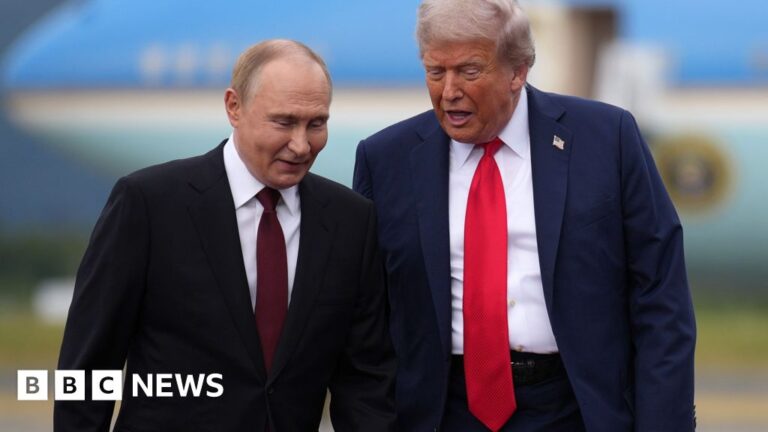
Putin, who is facing an International Criminal Court arrest warrant for alleged war crimes in Ukraine, stepped off his jet and onto a red carpet to be warmly greeted by Trump.

Over the roar of a B2 bomber overhead, the two leaders posed for photos before climbing in Trump’s presidential vehicle, known as The Beast.

But despite the pageantry and public shows of geniality – as well as the Kremlin’s earlier estimate that the meeting could last six or seven hours – Trump and Putin emerged less than three hours later with just a joint statement to the press.

Handshakes and a shared limo: Our correspondents unpack Trump and Putin’s greeting

Putin said that, in order to make a “settlement lasting and long-term, we need to eliminate the root causes of the conflict” in Ukraine.

The phrase indicated that Putin has not budged from his longstanding position that Ukraine should withdraw from four regions partially occupied by Russia – Donetsk, Luhansk, Kherson and Zaporizhzhia – and give up its efforts to join the Nato military alliance.

Zelensky has ruled out retreating from the four embattled region, warning that would leave the door open for an emboldened Russia to mount another offensive in the future. Moscow launched its full-scale invasion of Ukraine more than three years ago, after annexing the Crimean peninsula in 2014.

Putin also urged Ukrainians and Europeans to “not throw a wrench” into the peace process. Trump remained silent as his guest spent about eight minutes addressing the media.

After being given the floor, the US president said he had a “fantastic relationship with President Putin. Vladimir,” switching to the Russian leader’s first name.

Even though “many points were agreed to”, he said, “a few” remain, adding that “one is the most significant” – without specifying what that key sticking point was. Neither took questions.

The two also did not attend the planned bilateral “working lunch” that was set to follow the talks.

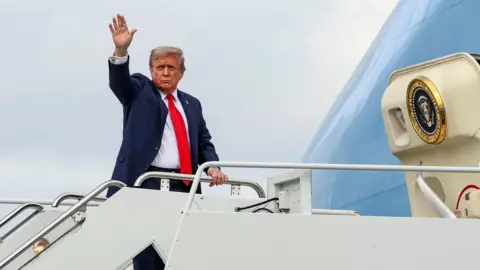
Reuters Donald Trump wearing a blue suit waves as he boards Air Force OneReuters

Donald Trump boards Air Force One as he departs Alaska

An interview on Fox News after the meeting offered few additional details.

The meeting went “very well”, Trump told host Sean Hannity, adding “maybe we’ll have a good result”.

Heading into the Alaska meeting, Trump had threatened “very severe consequences” if his Russian counterpart did not agree to end the war. In July, he said he’d impose 100% secondary tariffs targeting Russia’s remaining trade partners if a peace deal with Ukraine was not reached within 50 days.

But questioned on Fox News over where the meeting left those threats, Trump said: “We don’t have to think about it today.”

“Maybe in two weeks, three weeks,” he said, “but the meeting went very well.”

Asked about a possible trilateral summit including Zelensky, Trump said: “They both want me there and I’ll be there,” without giving a date or location for meeting.

Conspicuously absent from the Alaska meeting was the Ukrainian leader who, like Putin, has elicited a range of reactions from Trump since he returned to the Oval Office.

The two had a lengthy call on the flight back to Washington, before other Nato leaders including UK Prime Minister Sir Keir Starmer joined the conversation.

Zelensky said he supported Trump’s proposal for a trilateral meeting and that sanctions against Russia should be strengthened if Moscow “tries to evade an honest end to the war”.

“All issues important to Ukraine must be discussed with Ukraine’s participation, and no issue, particularly territorial ones, can be decided without Ukraine,” he added.

He noted “positive signals from the American side regarding participation in guaranteeing Ukraine’s security” – something European allies have called for as part of a combined effort to prevent another conflict.

Monday’s meeting will see Zelensky return to the White House for the first time since he clashed with Trump in an explosive meeting in February.

They appeared to patch things up on the sidelines of Pope Francis’s funeral in April, with the White House describing the 15-minute meeting as “very productive”.

Those in Ukraine may breathe a sigh of relief that no deal that would cede territory to Russia had been reached on Friday.

But they may also be alarmed that Putin continued to use rhetoric that seeks to justify the original objective of the invasion – to dismantle Ukraine as an independent state.

Tencent Music’s Growth Accelerates with Bubble Superfan App, Concerts, and Merchandise as Company Diversifies Beyond Streaming

0

MBW Explains is a series of analytical features in which we explore the context behind major music industry talking points – and suggest what might happen next. Only MBW+ subscribers have unlimited access to these articles. MBW Explains is supported by Reservoir.


Tencent Music Entertainment delivered impressive Q2 2025 results on Tuesday (August 12), with total online music revenues brushing a billion dollars in the quarter (USD $957 million), up 26.4% YoY.

Meanwhile, its higher-priced Super VIP (SVIP) streaming tier surpassed 15 million subscribers – representing around 12% of TME’s total 124.4 million streaming music subscribers.

This represents significant growth from the 10 million SVIP subscribers TME reported in Q3 2024, meaning the tier’s penetration has jumped from 8% to approximately 12% of the firm’s total subscriber base in less than a year.

On TME’s earnings call yesterday, Executive Chairman Cussion Pang, CEO Ross Liang, and CFO Shirley Hu discussed the firm’s expansion far beyond traditional music streaming – into superfan services, concert promotion, and merchandise sales.

Here’s what we learned…


1. The bubble ‘superfan’ service could become a “key growth driver” for SVIP subscriptions

TME partnered with SM Entertainment-affiliate DearU to launch superfan app “Bubble” in China on QQ Music in June.

A clear rival to HYBE’s Weverse, TME executives see the service as having significant potential to drive premium subscription growth.

The Bubble feature, integrated into QQ Music, “enables users to engage directly with hundreds of K-pop artists from labels such as SM, JYP and CUBE Entertainment, providing artists an avenue to share members-only content,” according to Pang’s prepared remarks.


DearU’s Bubble is designed specifically for superfans, allowing them to view livestreams and exchange messages with artists for a monthly fee.

The service has gained traction across the K-pop industry, with SM Entertainment recently acquiring an additional 11.42% stake in DearU for around $92 million in March. The deal raised SM’s stake in DearU to 45.1%. (SM already held a 33.7% stake in the company via its subsidiaries SM Studios, SM Japan, and Everysing Japan prior to the latest transaction.

Bubble, launched in February 2020, reportedly had around 2.3 million subscribers as of the second half of 2023.

TME has plans to expand beyond K-pop, with Pang noting: “To cater to a wider audience, we also plan to invite some popular Chinese artists to the community, allowing them to foster a deeper and more personal connections with their fans.”

Crucially for TME’s monetization strategy, the company appears to be bundling Bubble access with its higher-priced premium subscriptions. “We also have the bundled service for Bubble and [TME’s] subscription and SVIP business. And we do hope such a bundled service would become a key growth driver for the future SVIP growth,” Pang explained during the Q&A session.

2. Tencent Music is quietly evolving into a serious concert promoter in multiple markets

TME is aggressively expanding into live events and merchandise, with Pang revealing that revenues from these newer business lines “more than doubled from a year-over-year basis, which really validates our strategy of building a comprehensive music entertainment platform.”

The company’s most high-profile live event so far was G-DRAGON’s three sold-out nights at the Galaxy Arena in Macau, as part of the artist’s 2025 world tour, promoted by AEG PresentsTME live and Chessman.

Pang explained: “We successfully hosted leading Korean artist, G-DRAGON’s first major tour since 2017 in Macau, which attracted over 36,000 attendees to immerse in the cultivative atmosphere, and the event merchandise was quickly sold out.”

Tencent Music’s streaming platform QQ Music logged over 7 million users online simultaneously during the show.

This marked what Pang called “our first large-scale international concert production, significantly pushing our industry reputation”.

He added: “Following a strong kickoff, we are scheduled to expand the tour into other regions this year.”

Tencent Music’s live events arm, TME Live, is also involved in the G-DRAGON 2025 WORLD TOUR’s stops in Sydney, Melbourne, Taipei, Kuala LumpurJakartaBangkok, and Hong Kong.

Photo Credit: GALAXY CORPORATION
G-Dragon performs at Macau’s Galaxy Arena in June 2025

Beyond major international acts, TME is also investing heavily in domestic artists, with Pang noting: “We organized a series of stadium concerts for Fiona Sit, TIA RAY, and rapper GAI, helping them to reach a broader, younger audience. Due to the overwhelming demand, we quickly responded and worked with TIA RAY to schedule additional shows to accommodate fan interest.”

The company is also supporting emerging talent through its proprietary live event brands. “In the first half of the year, we leveraged our proprietary IPs, CITY LIVE and BUFF LIVE, to host over 300 off-line shows for nearly 100 Tencent musicians,” said Pang.

Physical album sales and merch have also contributed significantly, with CFO Shirley Hu noting: “The shipping for the physical album of Xiao Zhan this quarter, together with the offerings of artist-related merchandise, such as Joker Xue’s physical albums and G-DRAGON’s offshore light sticks significantly enhanced the revenues from artist-related merchandise sales in Q2.”


Photo credit: Piotr Swat / Shutterstock.com

3. TME is piloting a ‘three-tier’ subscription model including a new “ad-based membership”

TME has quietly begun testing a new subscription tier that sits between its free and paid offerings, creating what executives described as a “3-tier membership system.”

When asked about the company’s advertising growth, CEO Ross Liang explained that TME had “started to pilot on the advertisement membership format” about two months prior to the earnings call.

“For ad-based membership, the ARPPU is relatively low, but it can provide a differentiated solution to different user groups,” the executive said.

Liang outlined TME’s vision: “For ad-based membership plus our standard member as well as SVIP, it’s a 3-tier membership system. It can help us to continue to broaden the size of our subscribers and the user. So this is indeed a very important strategic operational direction for us to go.”

However, the company emphasized this remains in early stages, with Liang noting: “I have to say it’s still in the infancy stage. If there’s any nice progress being made in the near future, we will surely share it with all of you.”

The move appears designed to capture users who might be willing to pay something but resist full subscription pricing – a strategy that could help bridge the conversion gap between TME’s free and paid tiers.


Credit: Shutterstock

4. TME remains tight-lipped on its $2.4bn Ximalaya acquisition while awaiting regulatory approval… but explains the ‘SVIP’ strategy behind the deal

When asked about TME’s planned $2.4 billion acquisition of long-form audio platform Ximalaya, Executive Chairman Cussion Pang remained cautious, explaining that regulatory constraints limit what the company can discuss publicly.

“Regarding our deal with Ximalaya, according to the regulation in China, we’re still waiting for the further approval from the regulatory authorities. So now, it would be very difficult for us to make any corresponding comments,” Pang said during the Q&A session.

However, Pang did outline the strategic rationale behind the proposed acquisition, emphasizing TME’s belief in the value of long-form audio content. “The reason why we [have pursued] the Ximalaya deal is because, for the management team and for the whole company, we always believe in the value of long-form audio. Long-form audio is a very important content form. To us, it’s already played a complementary role to our existing music business.”

“Long-form audio is a very important content form.”

The company has observed growing engagement with long-form audio among its premium subscribers, with Pang adding: “We also see that consumption of the long-form audio and its penetration ratio with SVIP continue to go up.”

The acquisition, if approved, would significantly expand TME’s content offering beyond music into podcasts, audiobooks, and other spoken-word content – areas that have become increasingly important for global streaming platforms seeking to differentiate their services and improve user retention.


Reservoir (Nasdaq: RSVR) is a publicly traded, global independent music company with operations across music publishing, recorded music, and artist management. Music Business Worldwide

No Ceasefire Deal Reached at Trump-Putin Summit for Russia-Ukraine War

0

NewsFeed

The highly anticipated meeting between US President Donald Trump and Russian President Vladimir Putin ended without a ceasefire deal to stop the war in Ukraine. Trump said he would brief Volodymyr Zelenskyy on the talks, but there was no clear plan agreed for the Ukrainian president to meet with Putin for further negotiations. v

Challenging the Client

0


Client Challenge


JavaScript is disabled in your browser.

Please enable JavaScript to proceed.

A required part of this site couldn’t load. This may be due to a browser
extension, network issues, or browser settings. Please check your
connection, disable any ad blockers, or try using a different browser.

Danish train derails after hitting tanker, leaving one dead and multiple injured

0

At least one person has died and dozens have been injured after a train collided with a slurry tanker and derailed in southern Denmark, officials have said.

Police said the crash occurred between the towns of Tinglev and Kliplev in southern Jutland, near the German border, leaving a 60-year-old woman dead and 27 others injured.

In an update shortly after midnight, police said a crane was being used at the site to lift some of the damaged carriages to ensure there were no more injured passengers.

Of the five people seriously injured, two remained in a critical condition in hospital.

Local media reported the train as having hit a slurry tanker, which are used to transport farm waste.

Pictures from the scene showed a carriage lying on its side, with passengers standing around the train tracks.

Police said 106 people in total had been involved in the accident. Among the passengers onboard included pupils from a school in nearby Sønderborg, the train’s intended destination.

None of the students or the two teachers with them were seriously injured, police said, but they had been invited to go into school on Saturday to talk to a psychologist.

“My thoughts go out to the relatives, the many injured and everyone who is currently affected by the accident,” Danish Prime Minister Mette Frederiksen said in a statement to public broadcaster DR.

“I hope that everyone gets the best possible help and support.”

The country’s rail operator DSB said that it had shut down services along the line until further notice.

The national rail agency Banedanmark wrote on X that the collision happened at a level crossing. At least two of the train carriages were derailed, according to local media.

Hundreds of flights grounded as Air Canada cabin crew goes on strike

0

Air Canada cabin staff go on strike, grounding hundreds of flights