

7.1 C
New York
Sunday, April 26, 2026
Home Blog Page 480

Bolivia’s Presidential Run-Off Set Between Centrist and Right-Wing Candidates | Latest Election Updates

0

Early results showed centrist Rodrigo Paz take the lead, with 32.8 percent of the vote, in surprise outcome.

Bolivia is heading to a presidential run-off between a centrist and right-wing candidate, confirming the end of two decades of government by the Movement for Socialism (MAS), according to the South American country’s electoral council.

With more than 91 percent of the ballots counted on Sunday night, preliminary results showed centrist Rodrigo Paz of the Christian Democratic Party (PDC) in the lead, with 32.8 percent of the vote.

Conservative former interim President Jorge “Tuto” Quiroga, of the Alianza Libre coalition, was in second place, with 26.4 percent of the vote, meaning he will face Paz, the son of former left-leaning President Jaime Paz, in a run-off election on October 19.

Candidates needed to surpass 50 percent, or 40 percent with a 10-point margin of victory, to avoid a run-off.

Al Jazeera’s Latin America editor Lucia Newman, reporting from Bolivia’s Santa Cruz de la Sierra, said the early results confirmed that MAS, which has governed the country since 2005, is “out of the picture”.

But the “biggest surprise”, Newman said, is “that the frontrunner is none other than somebody who was polling between fourth and fifth place up until now”.

Paz is “more to the centre” than his father, Newman added.

Eight presidential candidates were in the running in Sunday’s presidential election – from the far-right to the political left.

Pre-election polls had shown Samuel Doria Medina, a wealthy businessman and former planning minister, as one of two frontrunners alongside Quiroga, who served as interim president and vice president under former military leader President Hugo Banzer.

Former leftist President Evo Morales was barred from running, and the outgoing socialist President Luis Arce, who had fallen out with Morales, opted out of the race.

The division within their leftist coalition, along with the country’s deep economic crisis, meant few expected MAS to return to power.

Official results are due within seven days. Voters will also elect all 26 senators and 130 deputies, and officials assume office on November 8.

Electoral workers count votes during the general election for president and members of Congress, in Santa Cruz, Bolivia on Sunday [Ipa Ibanez/Reuters]

Spiralling inflation

The Andean country has been struggling through its worst economic crisis in a generation, marked by annual inflation of almost 25 percent and critical shortages of US dollars and fuel.

Bolivians repeatedly took to the streets to protest rocketing prices and hours-long waits for fuel, bread and other basics in the lead-up to Sunday’s election.

Bolivia enjoyed more than a decade of strong growth and Indigenous upliftment under Morales, who nationalised the gas sector and ploughed the proceeds into social programmes that halved extreme poverty during his stint in power between 2006 and 2019.

But a lack of new gas projects under Morales, who was outspoken on environmental issues and climate change, has seen gas revenues plummet from a peak of $6.1bn in 2013 to $1.6bn last year.

With the country’s other major resource, lithium, still underground, the government has nearly run out of the foreign exchange needed to import fuel, wheat and other foodstuffs.

Challenging Client

0


Client Challenge


JavaScript is disabled in your browser.

Please enable JavaScript to proceed.

A required part of this site couldn’t load. This may be due to a browser
extension, network issues, or browser settings. Please check your
connection, disable any ad blockers, or try using a different browser.

Bolivia poised to elect first right-wing president in two decades

0

Ione Wells

South America correspondent, BBC News

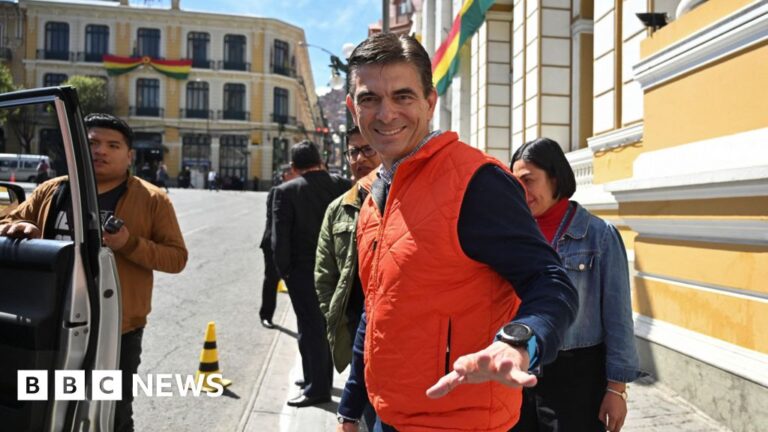
Reuters Senator Rodrigo Paz Pereira, presidential candidate of Bolivia's Christian Democratic Party (PDC), leaves the Legislative Assembly ahead of the August 17 general election, in La Paz, BoliviaReuters

Rodrigo Paz Pereira is the frontrunner in Bolivia’s first-round presidential election which took place on Sunday.

Bolivia is set to elect a non-left wing president after nearly two decades of near-continuous rule by the incumbent socialist party, according to official preliminary results.

Senator Rodrigo Paz Pereira and former president Jorge Quiroga came in first and second place respectively in Sunday’s presidential elections.

Neither received a high enough share of the vote to secure an outright win, so the vote will go to a run-off between these two candidates, due in October.

Paz Pereira, of the Christian Democratic Party, was a surprise vote leader, after opinion polls had suggested Samuel Doria Medina, a businessman, was the frontrunner.

The electoral authorities said it can take up to three days to finalise the results.

Paz Pereira’s campaign focused on redistributing more funds away from central government towards regional entities, and fighting corruption – with his slogan “capitalism for all, not just a few”.

He has suggested a programme of accessible credit, tax breaks to boost the formal economy, and eliminating import barriers for products that Bolivia doesn’t manufacture.

Quiroga briefly acted as interim president from 2001-2002 after serving as Vice President to Hugo Banzer, a military dictator until he was later elected.

The election of a president from outside the left camp will likely see sharp changes in the Latin American country’s foreign policy.

In terms of trade, both candidates capitalist stances could indicate more support for foreign investment in Bolivia’s vast lithium reserves – the key ingredient for batteries used in many electric cars, laptops and solar panels.

Politically, a change in government could mark closer ties with the US, after two decades of strengthening ties between Bolivia and China, Russia and Iran.

A recent US Congress report briefing described US-Bolivia relations as “strained” under the socialist party’s governance.

Reuters Jorge Quiroga of the conservative Alianza Libre coalition is set to face Paz Pereira in the next round.Reuters

The country’s turn to the right comes as it is experiencing its worst economic crisis in years, with shortages of fuel, foreign reserves and some food items and high inflation and debt.

Opinion polls ahead of the election suggested that many voters wanted to vote for change, or to punish the incumbent Movimiento al Socialismo (MAS) party.

The current president, Luis Arce, mired in deep unpopularity, decided not to seek re-election.

The punishment of the left is not just electoral, but physical in some cases.

The candidate for MAS, Eduardo del Castillo, was booed out of the school where he cast his vote. Bolivian media reported that some fellow voters told him to “wait in line like they do for fuel” rather than skip the voting queue.

People also threw stones at the highest-polling left-wing candidate, Andrónico Rodríguez, when he went to cast his ballot. Rodríguez was previously a member of MAS before splintering from the party.

Authorities in Bolivia also said that an explosive device was set off at the polling station where Rodríguez cast his vote. There were no reports of significant damage or injuries.

Rodríguez described it as an “isolated incident” orchestrated by a “small group” to a Bolivian newspaper.

The left has not just faced recent unpopularity over the economy. It is also deeply divided.

AFP via Getty Images Supporters holding a banner of Bolivian former President Evo Morales in a march.AFP via Getty Images

Ex-president Evo Morales still has many supporters – even though he is barred from running again.

For the first time in about two decades, the former president, Evo Morales, was not on the ballot.

Morales ruled the country from 2006-2019 and was barred from running again, despite attempts to challenge legal and constitutional rulings to let him run for a fourth term.

He has urged his supporters to null their vote.

Rodríguez was once seen as a protégé of Morales, but has since distanced himself from him.

The last election in 2019 was disputed and protests erupted. Morales was accused of fraud after auditors found irregularities with the poll and he resigned under pressure from the military.

In 2020, Luis Arce – a former finance minister under Morales – took office as president. Morales then announced he would return to politics in Bolivia, and deprived Arce of a majority – turning the pair from allies to rivals.

Deep rifts and power struggles have existed in the ruling MAS party ever since. Morales’s supporters have held protests and roadblocks against the re-election ban imposed on him, which have at times turned deadly with some emergency responders being killed.

Judges ordered an arrest warrant for Morales over an alleged sexual relationship and rape of a 15-year-old girl. He has called the accusations politically-motivated.

He has been living and operating from Chapare in Bolivia, protected at times by his supporters.

NAB in Australia faces $85 million cost hike to resolve staff underpayment problem

0

Australia’s NAB sees $85 million cost increase to fix staff underpay issue

Over 40 people missing after boat overturns in Sokoto, Nigeria | Maritime Update

0

Officials say about 10 people rescued after accident in African country’s northwestern region.

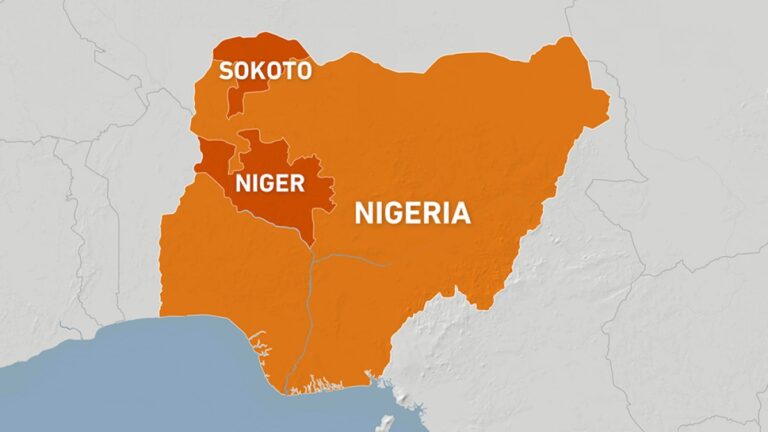
Rescuers are searching for more than 40 people who are missing after a boat capsized in Nigeria’s northwestern state of Sokoto, according to authorities.

Nigeria’s National Emergency Management Agency (NEMA) said on Sunday that its Sokoto operations office had deployed a response team to support rescue efforts following the “tragic boat mishap”.

NEMA’s director general, Zubaida Umar, said the agency responded after “receiving reports that a boat conveying over 50 passengers to Goronyo Market had capsized”.

NEMA said in a statement shared on social media that about 10 people had been rescued, and more than 40 other passengers were missing.

Nigeria’s The Punch newspaper, citing a local official, said the accident may have been caused by overloading, a recurring issue for boats in the state’s riverine communities.

Boat accidents are common in Nigeria, particularly during the annual rainy season, from March to October, when rivers and lakes overflow.

At least 16 farmers died in a similar accident in Sokoto State in August 2024, when a wooden canoe carrying them across a river to their rice fields capsized.

Last month, at least 13 people died and dozens more went missing after a boat ferrying about 100 passengers capsized in Niger State, in north-central Nigeria.

Two days later, six girls drowned after a boat taking them home from farm work capsized midstream in the northwestern Jigawa State.

Today’s Stock Market: Dow Futures Increase Prior to Powell’s Speech and Retail Earnings

0

U.S. stock futures pointed higher on Sunday evening ahead of a critical stretch for markets as investors brace for fresh clues on rate cuts and tariffs.

Futures tied to the Dow Jones Industrial Average rose 48 points, or 0.11%. S&P 500 futures were up 0.12%, and Nasdaq futures added 0.18%.

The yield on the 10-year Treasury was flat at 4.322%. The U.S. dollar was down 0.07% against the euro but up 0.07% against the yen.

Gold fell 0.25% to $3,374.10 per ounce. U.S. oil prices dropped 0.27% to $62.63 per barrel, and Brent crude fell 0.41% to $65.58.

Energy markets will also be in focus this week amid continued diplomacy to end Russia’s war on Ukraine as harsher U.S. sanctions on Moscow could target its oil exports, though President Donald Trump refrained from announcing any fresh penalties after ceasefire talks Friday failed to produce a deal.

Stocks have notched two consecutive weekly gains, with the S&P 500 hitting a fresh all-time high last week. That’s as corporate earnings have continued to come in strong and as the latest inflation readings were mixed but still haven’t set off panic about the effect of tariffs.

With the labor market also looking weaker, Wall Street overwhelmingly sees the inflation data giving the Federal Reserve a green light to resume rate cuts next month, further fueling market optimism.

But those views will be tested this week. On Wednesday, the Fed will release minutes from its policy meeting in July, when central bankers kept rates steady though two officials dissented. The details should show how much debate occurred and to what extent other policymakers were leaning a certain way.

Then the main attraction will take place on Friday, when Fed Chair Jerome Powell will deliver a speech at a gathering in Jackson Hole, Wyo. The annual event previously has served as an opportunity for policymakers to tease forthcoming rate moves.

Last year, Powell signaled a pivot to cuts, saying “the time has come for policy to adjust” and that “my confidence has grown that inflation is on a sustainable path back to 2%.” But he may not drop big hints this year, potentially setting up Wall Street for major disappointment.

Meanwhile, earnings season is winding down, but the coming week will feature several top retailers. Home Depot reports Tuesday, with Lowe’s and Target due on Wednesday. Walmart will put out its numbers on Thursday.

Their quarterly updates will provide new insights into how much tariffs are affecting prices and who is picking up the extra costs. The precise impact of tariffs on inflation remains somewhat of a mystery.

While companies may be absorbing much of the tariff costs for now, it’s not clear how much longer they can keep it up and how much consumers will be able to shoulder later.

If the retail giants keep eating tariff costs, that will show up on the bottom line and in their guidance. Citi doesn’t expect consumers to get hit with big price hikes in the future, even as more levies are expected to roll out.

“Softer demand means firms will have difficulty passing tariff costs on to consumers,” chief US economist Andrew Hollenhorst said in a note. “While some firms might still attempt to slowly increase prices in coming months, the experience so far suggests these increases will be modest in size. This should reduce concerns about upside risk to inflation and increase concerns that decreased profit margins will cause firms to pullback on hiring.”

Introducing the 2025 Fortune Global 500, the definitive ranking of the biggest companies in the world. Explore this year’s list.

White House discussions take precedence over US-Russia summit in Alaska

0

Frank Gardner

BBC Security Correspondent

Getty Images Ukrainian President Zelensky talks to the press while standing in front of a blue and yellow Ukrainian flag. Getty Images

It is quite possible that Monday’s meeting in the White House could prove even more crucial to the future of Ukraine – and for all of Europe’s security – than last Friday’s US-Russia summit in Alaska.

On the surface, that Putin-Trump reunion seemed to live down to every expectation.

There was no ceasefire, no sanctions, no grand announcements.

Were Ukraine and Europe about to get cut out of a deal cooked up behind closed doors by the world’s two foremost nuclear powers?

Not, apparently, if Ukraine and its partners can prevent it.

The presence of Sir Keir Starmer, President Macron, Chancellor Merz and other leaders alongside President Zelensky in Washington is about more than making sure he does not get ambushed in the Oval Office again, in the way he did on 28 February.

They are determined to impress upon Donald Trump two things: firstly, that there can be no peace deal for Ukraine without Ukraine’s direct involvement and secondly, that it must be backed by ‘cast-iron’ security guarantees.

Above all, Europe’s leaders want the US President to see that Ukraine and Europe present a united front and they are eager to ensure he is not being swayed by his obvious personal rapport with Vladimir Putin into giving in to the Russian leaders’ demands.

Watch: How the Trump-Putin summit unfolded… in under 2 minutes

This is where the Sir Keir Starmer’s diplomatic skills will be sorely tested.

Trump likes Starmer and listens to him, and in a month’s time Trump will be coming to the UK on a state visit.

He also likes Mark Rutte, the NATO Secretary-General who will be in attendance, a man who is sometimes called ‘the Trump Whisperer’.

The US President appears to be less fond of President Macron and the White House was sharply critical recently of his intention to unconditionally recognise a Palestinian state at the next UN General Assembly.

For a peace deal in Ukraine to have any chance of working, something has to give.

European leaders have said frequently that international borders cannot be changed by force and President Zelensky has said time and time again he will not give up land and besides, Ukraine’s constitution forbids it.

But Putin wants the Donbas, which his forces already control around 85 per cent of, and he has absolutely no intention of ever handing back Crimea.

Yet as the former Estonian PM and now Europe’s top diplomat Kaja Kallas once said to me: victory for Ukraine in this war does not have to be exclusively about reconquering occupied land.

If Ukraine can obtain the sort of Article 5-type security guarantees now being talked about, sufficient to deter any future Russian aggression and thereby safeguard its independence as a free and sovereign state, then that would be a form of victory.

It does now appear that what the US and Russia have been discussing is a proposal that broadly trades some Ukrainian land for security guarantees that it won’t have to give up any more to Russia.

But the question marks are huge.

Could Ukraine accept a deal that ends the war but costs it land, especially when so many thousands have died trying to save that land?

If it is asked to give up the remaining 30 per cent of Donetsk Oblast that Russia has yet to occupy then does that leave the path westwards to Kyiv dangerously under-defended?

And what of Starmer’s much-vaunted Coalition of the Willing?

Earlier talk of deploying tens of thousands of boots on the ground have since been scaled back.

Now it’s more about ‘safeguarding skies and seas’ while helping Ukraine to rebuild its army.

But even if peace does break out on the battlefield we are still in dangerous territory.

Every military expert I have spoken to believes that the moment the fighting stops Putin will reconstitute his army, build more weapons, until he is in a position, perhaps in as little as three to four years, to grab more land.

If and when that happens it will be a brave Typhoon or F35 pilot who is prepared to fire that first missile on an advancing Russian column.

Challenging Client

0


Client Challenge


JavaScript is disabled in your browser.

Please enable JavaScript to proceed.

A required part of this site couldn’t load. This may be due to a browser
extension, network issues, or browser settings. Please check your
connection, disable any ad blockers, or try using a different browser.

Robots Compete in Sports Competition Hosted by China

0

new video loaded: China Hosts Sports Competition for Humanoid Robots

By Axel Boada

Humanoid robots competed in a sports competition in Beijing where they ran, kicked and punched — as well as crashed and fell over many times.

Recent episodes in Technology

St. Bonaventure Recruits Impressive 47.5/1:47.6 Butterflier David Mutter for Class of 2029

0

By Sean Griffin on SwimSwam

Fitter and Faster Swim Camps is the proud sponsor of SwimSwam’s College Recruiting Channel and all commitment news. For many, swimming in college is a lifelong dream that is pursued with dedication and determination. Fitter and Faster is proud to honor these athletes and those who supported them on their journey.

David Mutter, who recently graduated from Mount Pleasant Area Jr/Sr High School in Mount Pleasant, Pennsylvania, has announced his commitment to continue his swimming career at St. Bonaventure University in the fall of 2025.

Mutter announced the commitment in an email to SwimSwam, writing:

Thank you to all of my family and friends for helping me get through this process, and making this [dream] come true!

The future Bonnie was a 4.0 student throughout his high school career and was named a James Collins Scholar-Athlete Award winner by the Western Pennsylvania Interscholastic Athletic League (WPIAL).

He was originally committed to the University of Alabama and signed with the Crimson Tide in November. However, the House v. NCAA case changed his plans and he lost his opportunity to swim for Alabama.

Mutter only represented his high school this past short course season and opted out of competing at any meets with his club team. His two major meets were the WPIAL Conference Championships and the Pennsylvania Interscholastic Athletic Association (PIAA) 2A State Championships.

At the WPIAL competition, Mutter walked away with three gold medals as he swept the 100 fly (48.01) and 500 free (4:34.54), with the former representing a season best and the latter a new lifetime best. He split 21.73 en route to helping his squad to 200 medley relay gold, and later notched 45.75 to help his team touch 5th in the 400 free relay.

At the State Championships, Mutter once again struck gold, logging 48.08 to take out the 100 fly and 4:31.56 for another lifetime best in the distance free event. The 200 medley relay also won gold again and he matched his split to the hundredth with 21.73. His win in the 100 fly was particularly dominant as he won by 1.44 seconds, while the margin in the 500 was just under three seconds. He produced a time of 45.02 anchoring to help his team finish 3rd in the 400 free relay to cap off the competition.

Top SCY Times:

  • 100 Butterfly: 47.52
  • 200 Butterfly: 1:47.66
  • 50 Freestyle: 21.01
  • 100 Freestyle: 46.59
  • 200 Freestyle: 1:40.88
  • 500 Freestyle: 4:31.56

The St. Bonaventure Bonnies placed 2nd out of eight teams at the 2025 Atlantic 10 Championships. The Bonnies are led by Mike Smiechowski, who was named head coach for men’s and women’s swimming and diving in July 2022. He announced the addition of Matthew Lowe as associate head coach in June 2023.

Mutter’s personal bests in the 500 free, 100 fly, and 200 fly make him an immediate ‘A’ final threat for the Bonnies. Assuming he swims one event per day at the conference meet, that particular schedule appears most likely given the conference meet event lineup and his abilities.

It took times of 47.84 and 1:47.48 to make the championship heat last year. His 100 fly PB is already under that threshold, while his 200 fly time would have been just 0.18 seconds off. His 100 fly best would have put him 7th after prelims, while his 200 PB would have placed him 9th.

His 500 free best would also put him into the ‘B’ final, sitting 9th out of prelims. It took 4:31.398 to make the ‘A’ final grade, leaving him 17 hundredths shy of an ‘A’ final berth.

On the team itself, he would have ranked 2nd behind sophomore Johnny Edwards‘ 4:26.65 in the 500 free. In the fly events, he would rank 3rd in both the 100 fly and 200 fly behind graduating senior Alex Behr, who was the runner-up in the 200 fly (46.94/1:43.80) and freshman Mark Mizsei (47.40/1:46.35).

Mutter is part of a large signing class for the St. Bonaventure men’s team. He joins Alex Aleinikovas, Gordan Cindric, Corey Su, Max Tucker, Marcos Bravo, Matheus Rinaldi, Willyan Matana, Blaise Sadowski, Emanuele Zingaro, and Cole Tangeman in committing to the university’s class of 2029.

If you have a commitment to report, please send an email with a photo (landscape, or horizontal, looks best) and a quote to Recruits@swimswam.com.

About the Fitter and Faster Swim Tour 

Fitter & Faster Swim Camps feature the most innovative teaching platforms for competitive swimmers of all levels. Camps are produced year-round throughout the USA and Canada. All camps are led by elite swimmers and coaches. Visit fitterandfaster.com to find or request a swim camp near you.

FFT SOCIAL

Instagram – @fitterandfasterswimtour
Facebook – @fitterandfastertour
Twitter – @fitterandfaster

FFT is a SwimSwam partner.

Read the full story on SwimSwam: St. Bonaventure Lands 47.5/1:47.6 Butterflier David Mutter For Class Of 2029