9.6 C
New York
Monday, April 27, 2026
Home Blog Page 473

Russia insists that negotiations for Ukraine security assurances must involve Moscow

0

Foreign Minister Sergey Lavrov says discussing Ukraine security issues without Russia is a ‘road to nowhere’.

Russia has warned that attempting to resolve security issues relating to Ukraine without the participation of Moscow is a “road to nowhere”, days after European leaders met US President Donald Trump to discuss security guarantees for Kyiv.

“We cannot agree with the fact that now it is proposed to resolve questions of security, collective security, without the Russian Federation. This will not work,” Russian Foreign Minister Sergey Lavrov said on Wednesday.

“I am sure that in the West and above all in the United States they understand perfectly well that seriously discussing security issues without the Russian Federation is a utopia; it’s a road to nowhere.”

The minister’s comments come two days after US President Donald Trump hosted Ukraine’s President Volodymyr Zelenskyy alongside prominent European leaders at the White House, and days after Trump met with Russian President Vladimir Putin.

Trump is trying to steer Putin and Zelenskyy towards a settlement more than three years after Russia invaded its neighbour, but major obstacles remain.

The Russian official said any summit between Putin and Zelenskyy “must be prepared in the most meticulous way” so the meeting does not lead to a “deterioration” of the situation around the conflict.

Lavrov also accused European leaders of making “clumsy attempts” to change the US president’s position on Ukraine.

“We have only seen aggressive escalation of the situation and rather clumsy attempts to change the position of the US president,” he said, referring to Monday’s meeting.

“We did not hear any constructive ideas from the Europeans there,” Lavrov added.

NATO talks

NATO military chiefs are due to meet on Wednesday to discuss the details of potential security guarantees for Ukraine amid efforts to broker a ceasefire to Russia’s offensive.

NATO’s Military Committee said that 32 defence chiefs from across the alliance would hold a video conference.

US General Alexus Grynkewich, who oversees NATO’s operations in Europe, will also take part in the talks.

Kyiv’s European allies are looking to set up a force that could backstop any peace agreement, and a coalition of 30 countries, including European nations, Japan and Australia, have signed up to support the initiative.

Military chiefs are considering how that security force might work. The role that the US might play is unclear. Trump on Tuesday ruled out sending US troops to help defend Ukraine against Russia.

Russia has repeatedly said that it would not accept NATO troops in Ukraine.

Photovoltaic Plants to Recycle Wind Turbine Blades

0

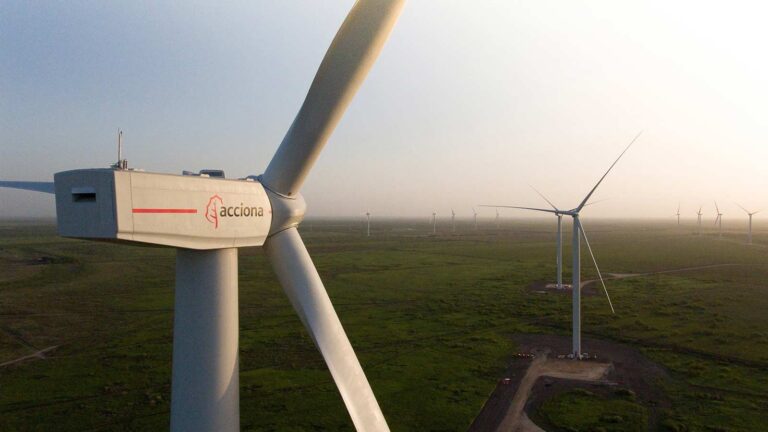
The first wind farms in countries like Spain date back to the mid-1990s. They are still fully operational, most with their original blades, which says a lot about wind energy and the durability of these infrastructures. It is estimated that between eight and ten blades are removed yearly in Spain, which is far from an environmental problem. However, the recycling possibilities offered by wind turbine blades need to be analyzed to ensure their environmental sustainability and contribution to the circular economy.     

And this is not only because of the useful life of the current wind farms but also because of a term that is beginning to be used more and more frequently – repowering. In other words, replacing existing wind turbines with more efficient ones that use the available space better. Repowering 100% of wind turbines with 20 years of useful life is estimated to generate more than 29,000 tons of blades per year between 2021 and 2025. And although today’s sophisticated maintenance programs can bring the service life of wind turbines to more than 40 years, it is necessary to dispose of obsolete components within circular economy parameters. How can this be done most sustainably?

In this article, you can read about the following:

Discover the transformation process

Do you like what you see? Download the PDF here

What are the elements of a wind turbine?

There are several types of wind turbine designs, but the vast majority of them, including those intended to produce offshore wind energy, share the following elements:

  • Foundations, which in the case of floating offshore wind can be an anchor to the seafloor.
  • Tower, which supports the wind turbine structure and is usually manufactured in the form of a steel or concrete tube.
  • Rotor, which is the rotating part of the turbine and comprises the blades and the hub, i.e. the central piece that connects them.
  • Nacelle, which is the heart of the wind turbine and houses the equipment that converts kinetic energy into electricity.

Approximately 90% of the mass of a wind turbine is easily recyclable. The tower and rotor, being mainly metal, although there are also concrete towers, are relatively easy to recycle, so the focus is on recycling wind turbine blades, which use composite materials such as fiberglass and resins.      

What techniques exist for the recycling of wind turbine blades?

At present, various techniques are being studied for the recycling of these wind turbine parts. Basically, the following options exist:

  1. Mechanical, with processes such as grinding or micronization, which reduce the materials to powder or scraps.
  2. Thermal, with processes such as pyrolysis or gasification that use high temperatures to obtain industrially usable raw materials.
  3. Chemical, with processes such as solvolysis that separate functional components using solvents such as water, alcohol, or acids.

Of course, the goal is to use recycling solutions that are not energy-intensive and non-polluting. In this sense, it is necessary to use renewable energy in the process and to avoid the emission of greenhouse gases or toxic chemicals.

From wind to the sun: the journey of a wind turbine blade

The challenge in recycling wind turbine blades is to develop solutions that enable the transition to a circular economy in large-scale industrial processes. In other words, solutions that are both ecologically sustainable and economically viable. One of the most promising projects in this respect has been carried out at Badajoz’s Extremadura I-II-III photovoltaic complex.

The initial raw material came from two out-of-service wind turbine blades to which a micronizing process was applied. Subsequently, the material was shaped utilizing a technique called pultrusion. But what exactly are these two techniques?

Micronizing is a pioneering technique in the blade recycling sector, which consists of reducing the size of the glass fiber to microns, mainly through mechanical transformation techniques. The resulting powder obtained is very versatile and is used as raw material of recycled origin to manufacture new products. Subsequently, through the continuous pultrusion process – from “pull” – the fiberglass powder is combined as a filler with the resin and the continuous fiberglass reinforcement. After being heated in a mold, a profile with the desired geometry and length is obtained.

The micronized powder has been used to create four beams to replace the galvanized supports that support the photovoltaic panels of the Extremadura solar plant. In other words, a zero-waste approach that also uses the raw material to continue generating renewable energy. You can check out the whole journey in the video below:   


Repurposing of wind turbine blades: other applications

In addition to a second life in a solar plant, there are other wind turbine blade recycling experiences worldwide. Some are based on processing the components, while others resort to cutting out segments to repurpose them. Here are some of the more exciting applications we have seen with the latter approach:

  • Use in the columns of electric car charging stations
  • Street furniture such as fences, playgrounds, benches, or acoustic panels
  • Construction of footbridges and bridges, such as the Blade Bridge in Ireland.
  • Bicycle parking shelters, as in Denmark
  • High voltage towers

In addition to specific materials such as wind turbine blades or construction materials, recycling is generally undergoing a real revolution, thanks to artificial intelligence and robotics. If you want to learn more about the future of recycling, you can read this article on some of the most innovative technologies in this field.  

Challenge from the Client

0


Client Challenge


JavaScript is disabled in your browser.

Please enable JavaScript to proceed.

A required part of this site couldn’t load. This may be due to a browser
extension, network issues, or browser settings. Please check your
connection, disable any ad blockers, or try using a different browser.

Final leg of Swedish church’s move captured in stunning aerial footage

0

A 113-year-old church in the far north of Sweden has arrived at its new home after a two-day journey.

Aerial footage shows the church hoisted onto specially designed trailers, as it was moved 5km (3 miles) along a road at a maximum speed of 500m an hour, with road fittings like lamp posts and signs removed to make way.

The church in Kiruna was at risk from ground subsidence after more than a century of iron ore mining in the old city centre.

Bank of England under scrutiny as UK inflation rises

0

Analysis-UK inflation heat puts Bank of England back in the spotlight

Exploring Trump’s Involvement with Russia and Ukraine

0

new video loaded: Inside Trump’s Effort on Russia and Ukraine

By Maggie Haberman, Christina Shaman and John Pappas

President Trump has repeatedly bent other leaders to his will, simply by refusing to budge. But there is one person who refuses to budge even more than President Trump, and that is Vladimir Putin of Russia. Maggie Haberman, a White House correspondent for The New York Times, takes us inside how Trump has been engaging with Russia and Ukraine.

Recent episodes in Behind the Reporting

Millennial Gut Health Scientist and Founder Balances 5 Jobs, 2 Kids, and a ‘Strict’ Coffee Routine, Swearing by a $20-a-Day Fresh Fruit Habit

0

Being in the C-suite is a high-pressure job with long hours, board responsibilities, and intense scrutiny. But what is it like to be a top executive when you’re off the clock?

Fortune’s series, The Good Life, shows how up-and-coming leaders spend their time and money outside of work.


Today, we meet Dr. Megan Rossi, the 36-year-old award-winning gut health scientist, TV regular, and best-selling author better known as The Gut Health Doctor.

Raised in Cairns, Australia by a single mum, Rossi’s career path was shaped early on by family loss: her grandmother’s battle with bowel cancer during her final year of university in 2009.

“I watched her go through chemotherapy and surgery, feeling frustrated with the gut for what it had done to her,” Rossi recalls to Fortune. “Not long after, I sat in a lecture on the early warning signs of bowel cancer and couldn’t help but wonder if we spoke more openly about gut health, could her story have ended differently? That question has stayed with me ever since.”

The experience pushed her to devote her life to gut health. She got a PhD in probiotics, treated health conditions from heart disease to type 2 diabetes as a clinical dietician and became the Australian Olympic Swimming Team’s nutritionist before moving to London.

Since then, she’s built a portfolio career that spans science, publishing, influencing and entrepreneurship: Rossi leads gut health research at the university King’s College London, runs her private practice, “The Gut Health, co-founded the £20 million ($27 million) food brand Bio&Me—which has sold over 35 million portions of “gut-loving goodness” in U.K. supermarkets—and is known as “The Gut Health Doctor,” on ITV’s This Morning show. 

Bio&Me

Earlier this year, Rossi launched Smart Strains a new range of clinically targeted live bacteria designed to replace one-size-fits-all probiotics. She faced 11 rejections before getting the product off the ground, but within eight weeks of launch, she says the line sold out in major retailers like Boots. It brings the total number of companies and side gigs in her portfolio to five.

And between running two fast-growing food and supplement brands, leading a team of specialist dietitians, publishing research, and raising two young children, a 20-minute Peloton ride has become her reset button when it all gets too much.


The finances

Fortune: What’s been the best investment you’ve ever bought?

The Peloton. I was reluctant to get one as they’re so expensive, and you have to pay the monthly fee on top of the actual bike. But it’s actually been the best investment because even if I’ve only got 15 minutes, I can do something positive for my health. With two young children and a busy work life, it’s helped remove that barrier to exercise for me.

And the worst?

Probably spending thousands on baby products (including a certain pram, as well as a rocker that shakes the pram and an expensive high chair) that we found we really didn’t need, or that we only used once or twice.

If you have children, what does your childcare arrangements look like?

We’re very lucky as we actually have a nanny to support us, and my husband is able to spend half-a-day a week with the kids as well. One of our sons now goes to nursery too, which definitely helps.

What are your living arrangements like: Swanky apartment in the city or suburban sprawling?

We were living in central London in a flat, but have recently moved to a house on the outskirts. We’re still well-connected to the city, but it’s just game-changing for the kids in terms of having the extra space to play. And for me? I now have a designated office space upstairs. This is a far cry from the small shed in my garden where I used to work—that said, I launched three businesses from that little space, so it will always be sentimental to me.

Do you invest in shares?

No, I haven’t managed to delve into that side of things—but never say never! I do have a financial adviser who advises me when it comes to pensions, but no investing yet. If you’re looking to focus on your finances, my tip would be to get the support of someone who knows what they’re doing and has a good track record!

What personal finance advice would you give your 20-year-old self?

I’ve always been a saver, not a spender. I believe if you focus on career growth, the money will follow. Early on, I chose research over higher-paying industry roles, which shaped my career path and opened the door to entrepreneurship. Don’t chase the short-term money—think about the longer-term financial goals.

What’s the one subscription you can’t live without?

That has to be Pact Coffee. The fresh delivery of coffee has been a complete game-changer. I just love the smell of fresh coffee—it’s one of my ‘morning moments’. From a gut health scientist’s perspective, coffee is high in polyphenols, so I like to think it’s a good investment for our microbiomes too.

The necessities

How do you get your daily coffee fix?

We have a Rocket coffee machine at home, which my husband is obsessed with. You have to buy a separate grinder, but it makes the perfect coffee. 

I’m quite strict with my coffee—I just have one a day, and then I switch to decaf, and maybe have two or three of those a day. This is because I’m quite caffeine sensitive, so it stops me from getting those afternoon jitters.

And because I’m treated to such amazing coffee at home, I find it really difficult to get a delicious coffee when I’m out and about. My go-to order would be an Americano with hot oat milk in a takeaway cup so it keeps nice and hot, especially important in the winter months!

Bio&Me

What about eating on the go?

I don’t typically buy breakfast on the go. I’ll usually bring a Bio&Me flapjack oat bar or porridge pot from home, or grab a piece of fruit as I’m running out the door to keep me fuelled.

For lunch, I generally avoid pre-packed sandwiches as I find they contain too much mayonnaise, butter, and additives, so I’ll usually make my own! For example, from Pret, I usually buy a Nicoise salad and a bread roll so I can cram the salad into the roll to get those complex carbs that keep me satiated for longer.

For added diversity, I’ll always try to nip into a supermarket and get some fresh fruit as well. I usually spend around £15 ($20). If you’re trying to feed your microbiome on the go, my advice is, mixing and matching is the way to go!

Where do you buy groceries?

My go-to is Ocado for convenience. I do miss spending hours in the grocery store as that’s one of my favourite pastimes, especially looking at all the new products. But I think when you have young kids and you’re working a lot, it’s not an option, so I go for Ocado.

How often in a week do you dine out versus cook at home?

Again, with having young kids, we maybe go out once a month in London just the two of us, and try to go somewhere new. When it comes to takeaway, though, we do always tend to go for a tried and tested favourite, which is usually a Thai from Busaba. We get that on Deliveroo maybe once a week.

What would be a typical work outfit for you?

I’m terrible at clothes shopping. When I need to look good then I have a stylist who puts outfits together for me. My favourite brands range from Mint Velvet and Reiss, through to LK Bennett and Cos. I’m happy when it gets to summer and I can stop wearing trousers as I prefer dresses. But as I’m an Australian living in the U.K., I often find it too cold!

As my career has progressed, I’m just a little more aware that if I’m on TV then I need to look slightly more professional. Hence the stylist.

Are you the proud owner of any futuristic gadgets?

I’ve tried some of the fitness tracking watches, but I’ve never really got on with them, or found they’ve made my life particularly better in any way. I do think you can over-track. For example, it can make you more stressed if you find you’ve had less sleep (or poorer quality sleep) than you thought. It can make you overanalyse and put extra pressure on yourself.

The treats

How do you unwind from the top job?

The Peloton. When I’m stressed in the evenings, I like to unwind with a 20-minute Peloton session. When you’ve got young kids, you don’t really have much alone time. I haven’t been able to work things like a weekly gym class back into my routine since having kids. Hopefully, when they grow a little older, I’ll go back again, but for now, this has been a game-changer for me.

What’s the best bonus treat you’ve bought yourself?

As a rule of thumb, when I get a bonus, I don’t splurge—I save. I’m future-focused, maybe to a fault. Like many entrepreneurs, I’m always thinking about the next challenge, sometimes worried that pausing to celebrate might make it all unravel!

Take us on holiday with you, what’s next on your vacation list?

We’ve just been to Crete, which we love. We haven’t always been good at taking holidays—my husband’s an NHS doctor and we’ve both been very career-focused to date. But now that the kids are a little bit older, we’re consciously prioritising family time and making those memories. We do one child-free week each year, usually skiing while the grandparents step in, and we visit Australia annually to see my mum. While we used to aim for new destinations with each trip, we now find ourselves returning to favourites like Italy and Crete, drawn back by the amazing food and how family-friendly they are.

How many days annual leave do you take a year?

This is tricky to say, because I do mostly work when I’m away–I’m always on my phone, still joining meetings, so everything keeps ticking over. True annual leave days are very hard when you’re a business owner.

Fortune wants to hear from leaders on what their “Good Life” looks like. Get in touch: orianna.royle@fortune.com

Why is Israel’s ‘most moral army in the world’ present in Gaza? | Gaza News

0

The Israeli military, which styles itself as the “most moral army in the world”, may be routinely committing war crimes, according to analysts in Israel and doctors who have worked in Gaza.

While killings, beatings and the arbitrary arrest of Palestinians are not new to the Israeli army, a long process of dehumanisation, the infiltration of far-right ideologies in the army and a lack of accountability have led to a scenario where Israeli soldiers can do as they please without even needing an operational reason, analysts said.

“As far as I can see, this is a new phenomenon,” Erella Grassiani of the University of Amsterdam, who has written on what she referred to as the moral “numbing” of Israeli soldiers during the second Intifada of 2000.

“It’s not as if Israeli soldiers haven’t beaten and arrested children for throwing stones before, but this is new,” she said.

“Previously, there were some kind of rules of engagement, even if they were loosely followed, but they were there. What we’re seeing now is completely different,” she said.

War as sport

Accusations of casual brutality by Israeli soldiers in Gaza, and the occupied West Bank, are longstanding.

Israeli soldiers have posted social media videos of themselves wearing the dresses of women whose homes they have raided, or playing with their underwear.

And there are accounts of soldiers shooting civilians for “target practice” or simply to stave off boredom.

In early August, the BBC investigated the cases of Israeli soldiers killing children in Gaza. Of the 160 cases examined, 95 children had been shot in the head or the chest – shots that could not be claimed as “intended to wound only”.

In addition to killing children, there are accounts suggesting that Israeli soldiers have been using the civilians who gather around aid distribution sites run by the self-styled GHF for target practice.

“The GHF sites are set up as death traps,” British surgeon Nick Maynard, who returned in July from his third trip to Gaza since the war began, told Al Jazeera.

“They’re compounds containing enough food for a family to eat for a few days, but not for all of the thousands of people they keep waiting outside. They then open the gates and let the chaos, fighting and even rioting happen, which they then use as a justification to fire into the crowd,” he said.

The nature of the shooting became clear to the doctors and emergency room medics at nearby Nasser Hospital, where Maynard was working.

“I was operating on a 12-year-old boy, who later died,” Maynard said.

“He’d been shot at one of the GHF sites. I had a conversation about it with a colleague in the Emergency Room later, who told me that he and other medics had seen repeated and strong patterns of wound grouping,” he explained.

Wound grouping refers to the phenomenon where several patients present with an injury to the same part of their body. The following day, many patients come in with a wound on a different part of the body, suggesting to Maynard that Israeli snipers were either playing or using civilians to improve their aim, as he told Sky News previously.

No accountability, no control

An investigation by the Israeli magazine +972 in July 2024 painted a bleak picture of Israeli soldiers with no restrictions on their ability to shoot at civilians in Gaza.

“There was total freedom,” a soldier who served in Gaza for months told +972. “If there is [even] a feeling of threat, there is no need to explain – you just shoot … it is permissible to shoot at their centre of mass [their body], not into the air”, the anonymous soldier continued.

“It’s permissible to shoot everyone, a young girl, an old woman.”

Of the 52 probes that the Israeli army said it carried out into crimes it has been accused of committing in Gaza or the West Bank between October 2023 and June 2025, 88 percent were stalled or were closed with no action taken, according to a study by Action on Armed Violence (AOAV).

Only one had resulted in a prison sentence against the accused.

According to AOAV, the 52 cases they examined involved the killing of 1,303 people, the wounding of 1,880 people and the reported torture of two more.

Even when there was footage of an incident, such as what appeared to be the gang rape of a Palestinian prisoner at the Sde Teiman Israeli prison facility, public pressure, including from members of the Israeli cabinet, led to the accused’s eventual release.

Accusations that the Israeli army routinely tortures Palestinians date back to at least 1967, when the Red Crescent documented the systematic torture of prisoners in Nablus Prison in the West Bank.

There has also been an increase in the dehumanising language used to refer to Palestinians that researchers now say is commonplace within the army.

As far back as 1967, Israeli figures such as David Hacohen, one-time Israeli ambassador to Burma, now Myanmar,, were recorded denying that Palestinians were even human.

In 1985, a survey of 520 books in Hebrew children’s literature found that 86 depicted Palestinians as “inhuman, war lovers, devious monsters, bloodthirsty dogs, preying wolves, or vipers”.

Twenty years later, when many of those now deployed to Gaza were likely at school, 10 percent of a sample batch of Israeli children who were asked to draw Palestinians depicted them as animals.

“The dehumanisation of Palestinians is a process that goes back decades,” Grassiani of the University of Amsterdam said. “But I’d say it’s now complete.

“We’ve seen incredibly cruel acts from the first day to now, with Israeli soldiers seeking revenge for [the Hamas-led attack of] October 7,” she said.

“It’s like a snowball running down a hill to which there’s no bottom,” Haim Bresheeth, author of An Army Like No Other, a book about the Israeli military.

“Every year, the violence is ratcheted up,” he said. “The idea of using civilians as target practice is the logical outcome.

“It’s a new sport, a blood sport, and these sports always develop from the bottom up,” he said of Israel’s infantry.

“It’s twisted, murderous, and it’s sick.”

Big Loud Records announces new promotions and hires in exciting new chapter

0

Big Loud Records has announced a series of executive promotions and new hires across its marketing leadership, further expanding the label’s global strategy.

Core members of Big Loud’s executive team have been elevated, including Brianne Deslippe to SVP of Marketing, Morgan Sweat to VP of Creative Services, and Amy Beard to VP of Marketing.

In her new role, Deslippe will oversee marketing, creative, digital, publicity, streaming, and international. Most recently, she served as SVP of International, where she spearheaded global campaigns for the label’s roster. Her recognition includes Billboard’s Global Power Players, Indie Power Players, Women in Music, International Power Players, and Canada Power Players lists, as well as two CCMA Industry Person of the Year awards.

Sweat, who has been with Big Loud since 2014, now leads the label’s creative team, overseeing video, design, photography, and overall brand creative for a chart-topping roster.

Beard, who joined in 2022 from MCA Nashville, will continue to build marketing campaigns for artists including Stephen Wilson Jr., Charles Wesley Godwin, and Thelma & James.

Big Loud has also appointed three new executives: Corey Brewer (VP of Media & PR), Jen Danielson (VP of Streaming), and Alex Henderson (VP of Global Marketing).

Brewer joins from Atlantic Records, where he led campaigns for Burna Boy, Kehlani, and Wallows.

Danielson brings two decades of experience with past roles at Warner Music Group, Pandora, and CMT, and was named Label Streaming Specialist of the Year at the 2025 CRS/Country Aircheck Awards.

“This marks an exciting new chapter for Big Loud Records. These well-earned announcements reflect the dedication and talent of our team, and this exceptional group of leaders is poised to drive the next era of artist development, innovation, and generational impact.”

Seth England, Big Loud

Henderson most recently served at EMI, contributing to Morgan Wallen’s first UK No. 1 album and campaigns for Bastille, The Chemical Brothers, and Bon Jovi.

Seth England, Co-Founder and CEO of Big Loud Records, said: “This marks an exciting new chapter for Big Loud Records. These well-earned announcements reflect the dedication and talent of our team, and this exceptional group of leaders is poised to drive the next era of artist development, innovation, and generational impact.”

Founded in 2015, Big Loud Records is celebrating its 10th anniversary having racked up over 65 billion global streams, 30 U.S. country airplay No. 1 hits, and more than 100 RIAA-certified titles.

The label’s roster includes Ashley Cooke, Charles Wesley Godwin, HARDY, Lauren Alaina, Miranda Lambert, Morgan Wallen, Stephen Wilson Jr., The 502’s, Thelma & James, and more.

Big Loud has been named Billboard’s No. 1 Hot Country Songs label multiple times (2021–2024) and won MusicRow’s Label Group of the Year (2022–2024), among other industry honors.

In June, Wes Donehower was elevated to Senior Vice President of A&R at Big Loud and Mercury Records, reflecting the label’s continued focus on building executive leadership and investing in artist development as part of its broader growth strategy.Music Business Worldwide

Walmart issues recall of shrimp due to potential radiation contamination following public health advisory

0

Walmart has recalled some of its shrimp products in the US after radioactive material was detected in a shipment of seafood.

The US Food and Drug Administration (FDA) warned the public not to eat frozen shrimp sold under Walmart’s Great Value label could have been exposed to a dangerous isotope in shipping containers.

One sample of breaded shrimp tested positive for the substance, the FDA said, but this positive sample “did not enter US commerce”.

Consumers in 13 US states the shrimp products are sold have been advised to throw any recently bought products among three batches.

“The health and safety of our customers is always a top priority,” a Walmart spokesperson told the BBC. “We have issued a sales restriction and removed this product from our impacted stores. We are working with the supplier to investigate.”

The spokesperson added that consumers who bought the recalled products could visit any Walmart location for a full refund.

The recalled shrimp was sold at Walmart locations in Alabama, Arkansas, Florida, Georgia, Kentucky, Louisiana, Missouri, Mississippi, Ohio, Oklahoma, Pennsylvania, Texas and West Virginia, and shoppers in those states were advised to be cautious.

It came from an Indonesian supplier that has since had a number of shipping containers denied entry to the US, the FDA said.

One shipment tested positive for Caesium-137, the radioactive form of the periodic element Caesium.

The amount contained in the tested shipment held by the FDA was not enough to pose acute harm to consumers, exposure over time could pose an elevated risk of cancer by damaging living cells in the body, said officials from the agency.

Caesium-137 is made through nuclear reactions and is present in trace amounts in soil, food and air worldwide. It is one of the principle sources of radiation around Chernobyl in Ukraine and Fukushima in Japan.

The FDA said no Caesium-137 had been detected in the other products it tested, but cautioned this did not rule out contamination.