

17.7 C
New York
Monday, April 27, 2026
Home Blog Page 464

HYBE label appoints second new CEO in a year after Min Hee-Jin departure

0

HYBE-owned label ADOR, which manages the K-pop group NewJeans, has appointed Lee Do-kyong as Chief Executive Officer, replacing Kim Ju-young after just a year.

That’s according to multiple news outlets out of South Korea on Wednesday (August 20), which reported that Lee joined HYBE in 2019 when it was still known as Big Hit Entertainment.

The Korea Herald reports that Lee helped shape corporate strategy and spearheaded new business ventures before taking charge of HYBE’s IPX division — which manages merchandise, immersive spaces and global licensing — in 2022.

Her responsibilities included overseeing merchandise operations, pop-up stores, and light stick operations across HYBE’s artist roster. One of Lee’s projects was “The City,” a fan experience program that extended artist branding throughout entire cities hosting HYBE concerts.

ADOR said in a statement cited by Korea Herald: “Having deemed the previous restructuring goals achieved, the board is now moving to an operational model focused on quickly supporting artists’ activities and driving business expansion.”

“Having deemed the previous restructuring goals achieved, the board is now moving to an operational model focused on quickly supporting artists’ activities and driving business expansion.”

ADOR

Lee succeeds Kim, who was appointed as CEO of ADOR in August 2024, replacing ADOR co-founder Min Hee-Jin amid a corporate power struggle. Min, who launched ADOR and developed NewJeans, was ousted following allegations that she attempted to seize control of the subsidiary from HYBE.

In a public letter issued in November, Min alleged that HYBE’s actions against her were retribution for her attempt to blow the whistle on misconduct within the K-pop giant.

The dispute continues in South Korean courts, with HYBE recently saying that it plans to appeal a decision by police not to file charges against Min.

“After more than a year of investigation, the police decided today not to forward either of HYBE’s complaints to prosecutors, having found no evidence of wrongdoing,” Min’s legal team said in a statement on Tuesday (July 15), as quoted in the Korea Times.

In response, HYBE said in a press release, as quoted at Korea JoongAng Daily: “There have been new developments made in the case after police investigations, such as the NewJeans members arguing that their contracts are invalid.”

“We have handed in numerous pieces of new evidence to court in related suits. The court has made firm decisions against Min based on such evidence and the Seoul High Court even deemed that Min is ‘intentionally sabotaging the very basis of an exclusive contract.’”

Separately, ADOR also faced a legal battle against NewJeans. In June, NewJeans failed to challenge a court injunction preventing them from pursuing independent activities without approval from ADOR, effectively ending their appeals process after missing a deadline.

The group, which has performed under the name NJZ since February, did not file an appeal to South Korea’s Supreme Court by the June 24 deadline. On May 30, the court warned NewJeans that they would be ordered to pay 1 billion South Korean won (USD $715,580) per member for each unauthorized activity outside their agency’s control, potentially totaling 5 billion won ($3.6 million) if all five members perform together.

Last month, NewJeans signaled their willingness to reconcile with ADOR, but only if the label returns to resembling the agency “that the members signed with”, their legal reps were quoted by Korea JoongAng Daily as saying on July 25.

The group’s legal reps said: “The root of this entire conflict lies in the audit launched by HYBE in April last year.” The said audit targeted Min.

Music Business Worldwide

The consequences of money’s demise in the Israel-Palestine conflict

0

You try to buy a kilo of flour in Gaza.

You open your wallet; what’s inside?  A faded 10-shekel note, barely held together by a strip of tape. No one wants it; it is all rubbish now.

The 10-shekel note, normally worth about $3, was once the most commonly used bill in daily life. Now, it is no longer in circulation. Not officially—only practically. It has been worn out beyond recognition. Sellers will not accept it. Buyers cannot use it.

There is no fresh cash. No replenishment.

Other banknotes are following the fate of the 10 shekels, especially the smaller ones.

If you pay with a 100-shekel note for an 80-shekel purchase, the seller will likely be unable to return the remaining 20 due to the poor physical state of the banknotes.

Many notes are torn or taped together, and entire stalls now exist just to repair damaged currency so it can be used again. Anything is better than nothing.

But the disintegration of banknotes is not the only problem we have in Gaza.

Civil servants have gone months without pay. NGOs are unable to transfer salaries to their employees. Families cannot send remittances. What once supported Gaza’s financial structure has vanished. There is no mention of when it will return. Just silence.

Money is stuck. Trapped behind closed systems and political barriers.

If you manage to obtain money from outside sources — perhaps from a cousin in Ramallah or a sibling in Egypt — it comes at a cost. A brutal one. If you get sent 1,000 shekels ($300), the agent will hand you 500. That’s right, the commission rate on cash withdrawals in Gaza is now 50 percent.

There are no banks to offer such withdrawals or oversee transfers.

The signs are still there. Bank of Palestine. Cairo Amman Bank. Al Quds Bank. But the doors are shut, the windows are dusty, and the inside is empty. No ATMs work.

There are only brokers, some with connections to the black market and smugglers, who are somehow able to obtain cash. They take huge cuts to dispense it, in exchange for a bank transfer to their accounts.

Every withdrawal feels like theft disguised as a transaction. Even so, people continue to use this system. They have no choice.

Do you have a bank card? Great. Try using it?

There is no power. There’s no internet. No POS machines. When you show your card to a seller, they shake their head.

People print screenshots of account balances that they cannot access. Some walk around with expired bank documents, hoping someone will think they’re “good enough” as a pay guarantee.

Nobody does.

There are a few sellers who accept so-called “digital wallets”, but those are few, and so are people who have them.

In Gaza today, money you can’t touch is equivalent to no money at all.

And so people have to resort to other means.

At the market, I saw a woman standing with a plastic bag of sugar. Another was holding a bottle of cooking oil. They did not speak much. I just nodded. Traded. Left.

This is what “shopping” in Gaza looks like right now.  Trade what you’ve got. A kilo of lentils for two kilos of flour. A bottle of bleach for some rice. A baby’s jacket for several onions.

There is no stability. One day, your item will be worth something. The next day, nobody wants it. Prices are guesses. Value is emotional. Everything is negotiable.

“I traded my coat for a bag of diapers,” my uncle Waleed, a father of twins, told me. “He looked at me as if I were a beggar. I felt like I was giving up a part of my life.”

This is not a throwback to simpler times. This is what happens when systems disappear. When money dies. When families are forced to sacrifice dignity for survival.

People don’t just suffer—they shrink. They lower their expectations. They stop dreaming. They stop planning. What future can you plan when you can’t afford tomorrow?

“I sold my gold bracelet,” Lina, my neighbour by tent, told me. “It was for emergencies. But now, every day is an emergency.”

Gaza’s economy did not collapse due to bad policy or internal mismanagement. It was broken on purpose.

The occupation has not just blocked goods entering Gaza; it has also blocked currency and with it, any sense of financial control. It has destroyed the banking system. It has made liquidity a weapon.

Cutting off Gaza’s money is part of a larger siege. There is no need to fire a bullet to destroy a people. Simply deny them the ability to live.

You can’t pay for bread, for water, for medicine, so how do you sustain life?

If this trend continues, Gaza will be the first modern society to completely return to barter. There are no salaries. There is no official market. Only personal trades and informal deals. And even those will not last forever. Because what happens when there is nothing left to trade?

If this isn’t addressed, Gaza will be more than just a siege zone. It will be a place where the concepts of money, economy, and fairness will die forever.

The views expressed in this article are the author’s own and do not necessarily reflect Al Jazeera’s editorial stance.

Challenging Client

0


Client Challenge


JavaScript is disabled in your browser.

Please enable JavaScript to proceed.

A required part of this site couldn’t load. This may be due to a browser
extension, network issues, or browser settings. Please check your
connection, disable any ad blockers, or try using a different browser.

Top 20 Rankings for the Mid-Atlantic Region in the 2025 Preseason

0

2025 MID-ATLANTIC REGION HIGH SCHOOL
PRESEASON TOP 20 RANKINGS

Rank School Name City, State
1 Trinity Episcopal Academy Richmond, Virginia
2 Bryn Mawr School Baltimore, Maryland
3 Collegiate School Richmond, Virginia
4 Norfolk Academy Norfolk, Virginia
5 Cape Henlopen High School Lewes, Delaware
6 Tabb High School Yorktown, Virginia
7 Nansemond River High School Suffolk, Virginia
8 Archbishop Spalding High School Severn, Maryland
9 First Colonial High School Virginia Beach, Virginia
10 Independence High School Ashburn, Virginia
11 Frank W. Cox High School Virginia Beach, Virginia
12 Oakton High School Vienna, Virginia
13 Cary Christian School Cary, North Carolina
14 Bishop O’ Connell High School Arlington, Virginia
15 Garrison Forest School Owings Mills, Maryland
16 Smyrna High School Smyrna, Delaware
17 Notre Dame Prep Towson, Maryland
18 Loudoun Valley High School Purcellville, Virginia
19 Crofton High School Gambrills, Maryland
20 Broadneck High School Annapolis, Maryland
OC Cardinal Gibbons High School Raleigh, North Carolina
OC Delmar High School Delmar, Delaware
OC Fairfax High School Fairfax, Virginia
OC Gloucester High School Gloucester, Virginia
OC Leonardtown High School Leonardstown, Maryland
OC St. John’s College High School Washington, District of Columbia

The post 2025 Preseason Mid-Atlantic Region Top 20 Rankings appeared first on MAX Field Hockey.

Innovative Method Enables 3D Printing of 5G and 6G Antennas

0

On this page, we have spoken on multiple occasions about the potential of 5G, which is quickly becoming a standard in developed countries. The benefits are undeniable, from the reduced latency that will support driverless vehicles to the coverage of millions of devices per square mile driving the Internet of Things. However, not everyone benefits at the same rate. Getting the most disadvantaged and remote areas to participate in these advances is the goal of a project at the University of Sheffield in the United Kingdom.

What are the main 5G infrastructures and bands?

The deployment of 5G networks requires substantial investments in radio spectrum and hardware in the form of antennas. So much so that implementation is gradual, with two types of architecture:

  1. Non-Stand Alone Architecture (NSA), which takes advantage of the existing 4G infrastructure, although with limited functionalities. Thus, they have a latency of 15 ms and speeds of up to 2 Gbps.
  2. Stand Alone (SA) architecture, which will enable the full potential of 5G to be realized, including latencies of 1 ms and transmission speeds of up to 20 Gbps.

Besides the hardware side of things, 5G antennas are also classified by the bands in which they operate.

  1. Sub-6, which operate below 6 GHz, typically between the 3.4 GHz and 3.8 GHz frequencies. These are used in urban environments, as they suffer less interference from physical or climatic obstacles.
  2. mmWave or millimeter wave, which operate between 24 GHz and 100 GHz. These frequencies offer higher speed and lower latency but require a more significant number of repeaters to compensate for the lack of penetration. This is the type of frequency that will be used as a priority in 5G SA infrastructures.

3D Printing of 5G and 6G Antennas

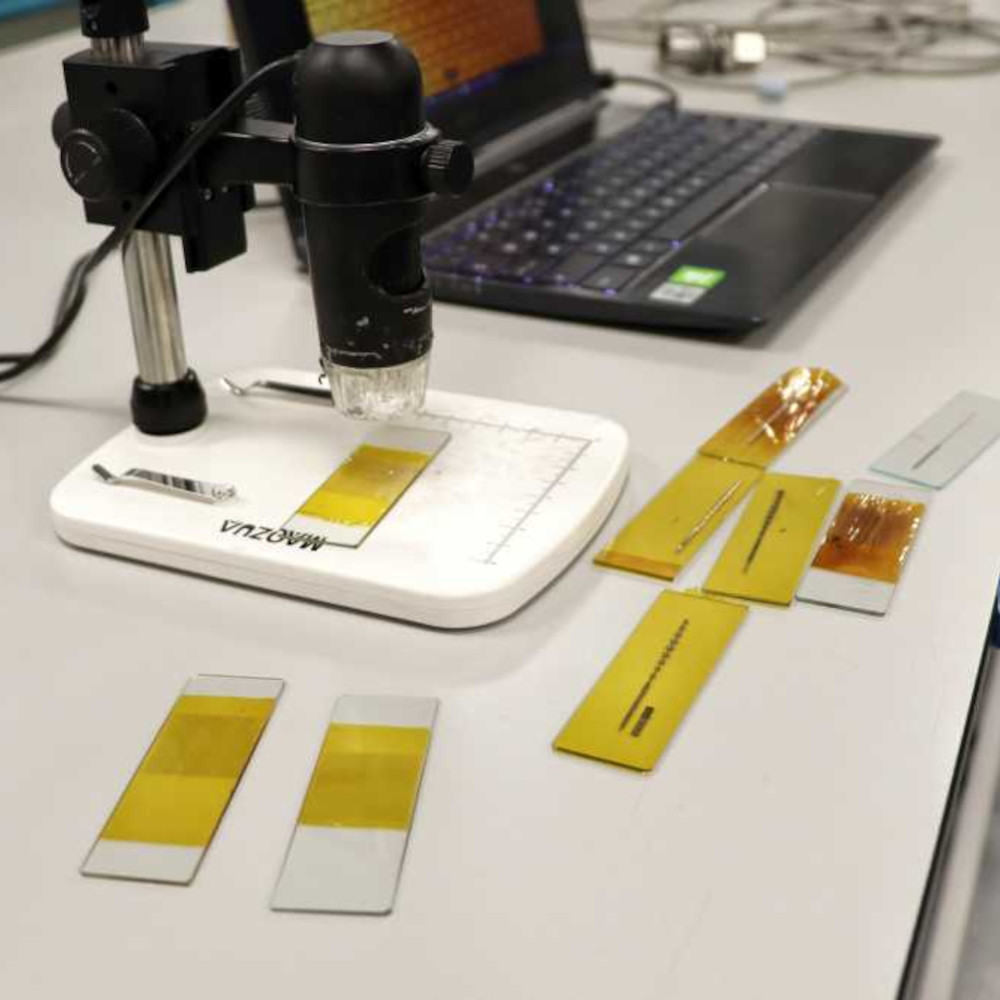
As seen, mmWave antennas will be crucial to take full advantage of this technology. And those are the 3D-printed devices developed by the Department of Electronic and Electrical Engineering at the University of Sheffield. The British university has just demonstrated the feasibility of 3D-printed 5G and 6G antennas, radically reducing cost and production times.

Thus, the new technique uses silver nanoparticles to print antennas in a few hours at the cost of just a few dollars, all without sacrificing functionality. In comparison, traditional 5G mmWave antennas can cost hundreds of euros, with much slower manufacturing.  

The developers point out that the new design will make it possible to produce large-scale, low-cost antennas to reach remote areas and provide coverage quickly and efficiently. Criteria such as miniaturization, speed of manufacture, low cost, and ease of installation define the usefulness of this type of technology in developing countries. 

Projects like this solar desalination plant developed by MIT bring technology, energy, and water to underprivileged areas. This is also the raison d’être of the Acciona Foundation, which carries out projects to take water or clean energy to unreached areas, such as Oaxaca or the tropical forests of Peru. Undoubtedly, energy technology and infrastructure advances are one of the keys to developing these areas.

A new age of additive manufacturing electronics

We have already seen that 3D printing has a wide range of applications, including metals and biomaterials. In recent years, the shortage of microchips due to problems in logistic chains caused by the pandemic and war conflicts has been a constant. And here, 3D printing could also play a crucial role.

Additive manufacturing electronics (AME) enable 3D printing to produce semiconductors, sensors, transistors, and other computer components, wearables, and circuitries.

A concrete example in this field is a project at the University of Washington, which has created a thermoelectric device that converts body heat into electricity. They have used a 3D printing system that generates different layers with specific functionalities to achieve this.

Thus, a liquid metal alloy filler is used that gives the wearable conductivity while simultaneously allowing it to stretch. The device also contains microspheres that transmit heat to the semiconductors in the base layer. According to the researchers, this type of wearable can be printed on textiles and curved surfaces.

Additive manufacturing electronics is a technique with great potential. So much so that some studies suggest it could quadruple in value over this decade, reaching almost $40 billion by 2030.


Source:

US Justice Department releases transcripts of Ghislaine Maxwell’s interview

0

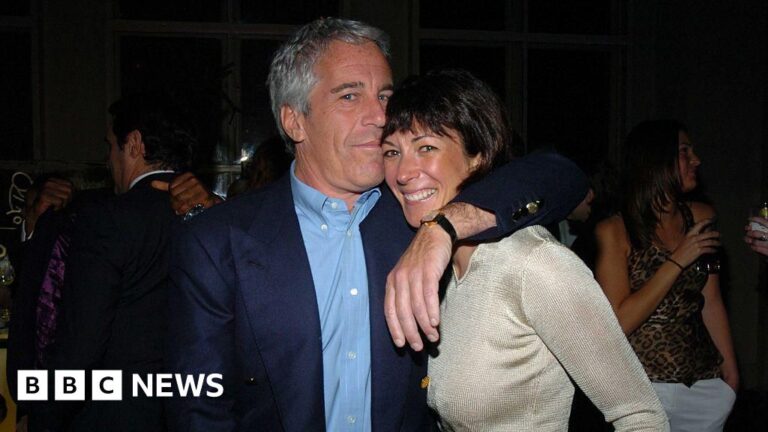
Ghislaine Maxwell, the jailed associate of sex offender Jeffrey Epstein, has told US officials she did not witness any inappropriate conduct by Donald Trump or former President Bill Clinton.

The Trump administration has faced pressure to disclose information about Epstein, who the US president was previously friendly with.

Maxwell was interviewed from prison in July and, according to the newly released transcript, told Deputy Attorney General Todd Blanche that a much-discussed Epstein “client list” does not exist.

She also called allegations of Prince Andrew having sexual relations with an underage girl in Maxwell’s home “mind-blowingly not conceivable”.

Maxwell is seeking a pardon from Trump and has been accused of lying to federal officials.

Shortly the interview with Blanche – who previously worked as Trump’s personal attorney – she was moved from her from a Florida prison to a new minimum-security facility in Texas. It is unclear why the move was made.

She is currently serving a 20-year sentence in a sex-trafficking scheme, and has petitioned the US Supreme Court to overturn her conviction. Her lawyer has said they would “welcome” a pardon from the president.

The White House has been adamant that “no leniency is being given or discussed” in Maxwell’s case.

Trump has maintained that he fell out with Epstein in 2004.

The president has accused his political opponents of using the case to distract from what he sees as his administration’s victories.

But he has also faced pressure from his own Republican Party for more transparency around investigations of Epstein.

In the transcripts – which amount to 300 pages, some heavily redacted – Maxwell said that while she believed Trump and Epstein were friendly “in social settings”, she did not think they were close friends.

“I actually never saw the president in any type of massage setting,” she said – alluding to the massage services that some Epstein victims have mentioned. “The president was never inappropriate with anybody.”

“In the times I was with him, he was a gentleman in all respects,” she added.

She also said she did not recall Trump sending Epstein a 50th birthday note in 2003, which drew recent headlines after the note was reported in the Wall Street Journal.

In the interview, Blanche also asked Maxwell about the alleged “client list” of high-profile personalities that has become the object of conspiracy theories in recent years.

Maxwell was asked about several well-known figures, including Bill Gates, Elon Musk, former Israeli Prime Minister Ehud Barak, Health and Human Services Secretary Robert F Kennedy Jr, actor Kevin Spacey, model Naomi Campbell and Prince Andrew – whom she denied she introduced to Epstein.

The list of his high-profile associates had become a focal point for conspiracy theorists who insisted that it was being kept hidden by the “deep state” to protect prominent participants in Epstein’s crimes.

Several figures in Trump’s administration – including FBI Director Kash Patel and Deputy Director Dan Bongino – repeated those claims in the past, although they have since backtracked.

“There is no list,” Maxwell said.

Maxwell also spoke about Prince Andrew, whose relationship with Epstein eventually led to his stepping down from royal duties.

She called it a “flat untruth” that she’d been the one who introduced the Duke of York to Epstein.

“First of all, let’s just state, I did not introduce him to Prince Andrew,” she said.

She spoke at length of Epstein’s relationship with both Prince Andrew and the Duchess of York, Sarah Ferguson.

Prince Andrew has previously said that Maxwell introduced him to Epstein. But Maxwell said she believed it was the duchess who was responsible.

When approached by the BBC about Maxwell’s claim, Sarah Ferguson’s representatives declined to comment.

Maxwell also spoke about Prince Andrew’s alleged relationship with a woman whose name has been redacted in the transcript.

She said she found the allegations against the Duke of York “mind-blowingly not conceivable”, partly due to the size of her house where the events allegedly took place.

She was also asked about a “famous photo” of Prince Andrew and the unnamed woman, with Maxwell in the background. She told Blanche this photo was fake.

The prince was accused by Virginia Giuffre, who is not named in the transcript, of sexually abusing her when she was 17. He denied the allegations but reached a financial settlement with her in 2022, which contained no admission of liability or apology.

A widely circulated photo shows him alongside Giuffre with Maxwell in the background. Andrew has previously disputed its authenticity.

Giuffre took her own life earlier this year. Her family has condemned the justice department for interviewing Maxwell and said she is a “monster” whose testimony cannot be trusted.

According to Maxwell, she first befriended Epstein in 1991, and subsequently developed a sexual relationship with him.

Even after that relationship ended, she said she was still paid by Epstein – up to $250,000 (£184,782) a year by 2009 – and remained “friends with benefits”. She added that their relationship was “almost non-existent” between 2010 and his death.

Epstein died by suicide in a New York jail cell in 2019 while awaiting trial on sex trafficking charges.

“I do not believe he died by suicide, no,” Maxwell said when asked, although she added that she did “not have any reason” to believe that he had been killed in a bid to silence him.

“It’s ludicrous,” she said of theories that he was murdered. “I also happen to think if that is what they wanted, they would’ve had plenty of opportunity when he wasn’t in jail.”

“And if they were worried about blackmail or anything from him, he would’ve been a very easy target,” she added.

Earlier this year, reports emerged that Trump had been told by US Attorney General Pam Bondi that his name appeared in the official files of the investigation into Epstein .

Trump has never been accused of any wrongdoing in connection with the case – and on the campaign trail last year said he would publicise more information about the case.

But he reversed his position several months into his administration, saying the case was closed, and criticised supporters and journalists who continued to press him on it.

Trump orders deployment of troops in Washington’s most secure areas to crackdown on crime

0

Trump crime crackdown deploys troops in Washington's safest sites

A Ukrainian Marine Comes Home After Being Held Captive by Russia

0

The bloodiest war in Europe since World War II has shaped a generation of Ukrainian men. Serhiy Hrebinyk, 25 years old and just released from a Russian prison, is one of them. Thomas Gibbons-Neff, a national correspondent, met him after his release from captivity.

Minnesota high school football team’s season delayed by Osprey nesting in floodlights – This is no ordinary bird

0

Turn off the lights. The Nesting Ospreys have defeated the Apple Valley Eagles in Minnesota high school football.

They haven’t actually played each other, but the ospreys took charge when they built a huge nest to raise their chicks, high up on a light pole at the Apple Valley High School football field. Because of it, the migratory raptors that are protected under state and federal law forced the school, known as the Eagles, to rearrange their football and soccer schedules, switching to day games instead of night.

Turning on the hot floodlights would have risked cooking the birds and starting a fire.

“When you tell someone this story of ‘Wow, we have to reschedule because there’s an osprey nest in our stadium,’ they’re like, ‘You can’t make this type of stuff up, right?’” said Cory Hanson, athletic director at the school in the Minneapolis suburbs.

Working with the state Department of Natural Resources, the school has been sending up a drone twice a week to monitor the chicks so that once the young ospreys are old enough and fly off, crews can remove the nest and switch on the traditional Friday Night Lights.

“Luckily for Apple Valley, they should be able to remove the nest within probably a week because the birds have already taken some of their first flights,” Heidi Cyr, the department’s nongame wildlife permit coordinator, said Friday.

Hanson said he’s seen as many as four chicks in the drone photos. He said the school became aware of the nest around June.

“When you see these large birds flying across your field with these humongous sticks, you start to ask questions like, ‘What is going on here?’” he said. “And you take one look at that nest, right? And you’re like, ‘OK, this is not your average bird.’”

DNR officials confirmed it was an osprey nest, and told school officials that federal law made it clear that they could not disturb it for now.

So, Hanson said, they had no choice but to revise their schedules. But he said other schools have been great about finding alternate sites and times, despite their initial disbelief.

According to the DNR, ospreys are one of the larger birds of prey that inhabit Minnesota, with wingspans of 4.5 to 6 feet (1.4 to 1.8 meters).

They’ll return to their nests every year and will build them up with new materials every season. Their nests can get as large as 10 feet deep (3 meters) and 3 to 6 feet (1 to 2 meters) in diameter. Their diet is almost exclusively live fish. They’ll dive from high altitudes to grab fish with their sharp talons, plunging as deep as 3 feet (1 meter) underwater.

Ospreys like to build their nests in high places with clear views, including dead old trees and structures that resemble them, like utility poles, channel markers and cellphone towers. That sometimes creates fire hazards. So the DNR issues a number of nest removal permits every year. But permission to remove nests that still hold young ospreys is normally denied unless there’s a major health and human safety concern. Stadium lighting doesn’t qualify, Cyr said.

Efforts to restore their population, which have included building nest platforms, have been a success in Minnesota and elsewhere, Cyr noted. They came off the state’s special concern list in 2015. Depending on the time of year, they can now be found across most of North America.

Once the chicks at Apple Valley fly off for good, Hanson said, school officials and the DNR will relocate the nest from the light tower to a new platform on school grounds in hopes that the parents will return next year. But just to be safe, they’ll also erect deterrents on the lights so the ospreys don’t try to nest there again.

“So if anyone sees that happening, don’t worry,” Cyr said. “The birds are safe. They’ve successfully left the nest and they’re on their way to becoming adults themselves.”

___

Associated Press writer Steve Karnowski reported from Minneapolis.

Introducing the 2025 Fortune Global 500, the definitive ranking of the biggest companies in the world. Explore this year’s list.

Is Trump’s ‘Big Beautiful’ Spending Law the Largest Tax Cut in US History? | Latest Updates on Donald Trump

0

By 

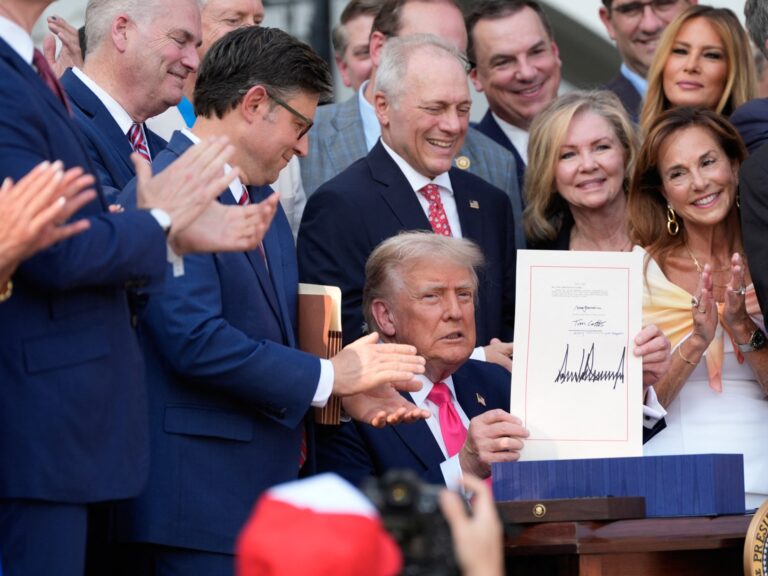
US Vice President JD Vance hit the road on August 21 to promote President Donald Trump’s legislative accomplishment, the One Big Beautiful Bill Act tax and spending bill.

The law permanently extended tax cuts from a 2017 law Trump signed, which would have expired at the end of 2025 had Congress not reauthorised them. The law also included some new tax cuts, including for tips, overtime and Americans 65 and older.

Speaking in Peachtree City near Atlanta, Vance said, “We had the biggest tax cut for families that this country has ever seen.”

The tax cuts were significant, but they weren’t the biggest in US history, which was a phrase Trump has often used to inaccurately describe his 2017 tax cut law. The 2025 tax cuts rank either third-biggest since 1980 or tied for seventh, depending on the yardstick.

At the same time, many Americans could see relatively modest changes to the taxes they owe starting in 2026, because the 2025 law mostly extended existing tax cuts.

The White House did not provide a response before publication.

Comparing historical tax cut laws

We examined the tax revenue decreases from major laws passed since 1980. (On balance, most tax laws prior to 1980 either raised taxes or cut them modestly.)

Tax bill dollar amounts tend to rise over time because of inflation, so we looked at tax cuts as a percentage of gross domestic product (GDP), which evens out the differences over time. And because some early laws have tax cut data available only for the first five or six years of the law’s life, we compared laws by looking at the cumulative tax savings during a law’s first five years in effect.

We found that the law with the biggest tax savings was 1981 legislation passed by the Democratic Congress and signed by President Ronald Reagan, who won office promising large tax cuts. That law cut taxes by 3.5 percent of the nation’s cumulative five-year GDP.

A 2012 bill passed by the Republican Congress and signed by President Barack Obama ranked second. That bill, which cut taxes by 1.7 percent of GDP, extended the tax cuts passed in 2003 under President George W Bush.

Based on current projections, Trump’s 2025 law ranks third, at 1.4 percent of GDP when factoring in Trump’s 2017 cuts.

Trump’s 2017 law ranks fourth at 1 percent, tied with a 2010 law Obama signed that extended Bush’s 2001 tax cuts. Bush’s 2001 and 2003 tax cuts ranked sixth and seventh, with 0.7 percent and 0.5 percent, respectively.

If considering only new tax cuts and not the re-upped 2017 tax cuts, then Trump’s 2025 law would tie for seventh at 0.5 percent of GDP.

Joseph Rosenberg, a senior fellow at the Urban Institute-Brookings Institution Tax Policy Center, said that it’s legitimate to measure the scale of the cuts in the 2025 tax law either way.

What will Americans see in their taxes starting in 2026?

There could be a disconnect between the historical scale of Trump’s 2025 bill and the impact that Americans will notice when filing 2026 taxes.

Because Americans are already paying the lower rates that began in 2017 and that the 2025 law extended, they won’t necessarily notice a sizeable reduction in taxes owed.

“For most families, they are going to see a child tax credit that increases by a maximum of $200 per child, from $2,000 to $2,200,” said Margot Crandall-Hollick, principal research associate at the Urban-Brookings Tax Policy Center. “Some are going to pay a little less because of the tips and overtime provisions and a slightly higher standard deduction.”

The law preserves a more generous standard deduction that had been set to expire and increases it slightly to $15,750 for single filers and $31,500 for joint filers in 2025, to be indexed to inflation annually.

At the same time, Crandall-Hollick said, some families, especially those with lower incomes, will pay higher taxes because of the expiration of health insurance premium tax credits, which were not extended by the Big Beautiful Bill.