

17.7 C
New York
Monday, April 27, 2026
Home Blog Page 463

Government minister says Spotify will open Istanbul office by 2026 after reversing decision to exit Turkey

0

Spotify will remain in Turkey and establish an Istanbul office by 2026, ending weeks of speculation about a potential exit from the market amid government pressure.

The resolution, announced by Turkey’s Culture and Tourism Minister Mehmet Nuri Ersoy via social media on Tuesday (August 19), emerged from meetings between Spotify executives and Turkish officials.

“In our meeting with Spotify, a pioneer in the global music industry, we made decisions on important steps. We will make concrete progress quickly to ensure our country’s music ecosystem receives the support it deserves from Spotify,” the minister’s translated post stated.

The minister added: “A Spotify Turkey office, a key area of ​​need, is opening. Spotify, which will open an office in Istanbul in 2026, will further deepen its collaborations in this area.”

Ersoy added that the company will work with the government in supporting Turkey’s music ecosystem and launching a music summit in September. The minister noted that Turkish artists reached 2.8 billion new listeners in 2024.

“A Spotify Turkey office, a key area of ​​need, is opening. Spotify, which will open an office in Istanbul in 2026, will further deepen its collaborations in this area.”

Mehmet Nuri Ersoy, Turkish Minister

The announcement follows weeks of escalating tensions that began when Turkey’s competition authority launched an investigation into Spotify’s business practices on July 4.

The probe is looking into whether Spotify violated Turkish law through practices that “complicate the operations of its rivals” and affect royalty distribution for artists and creators.

Turkish officials also accused Spotify of hosting content that insults religious and national values.

Deputy Culture and Tourism Minister Batuhan Mumcu  criticized playlist titles referencing President Recep Tayyip Erdoğan‘s wife, Emine Erdoğan, including “Emine Erdogan hotgirl playlist” and references to luxury fixtures in the presidential palace.


Other controversial playlists included “Songs Prophet Muhammad listened to in the cave,” which drew particular criticism from government officials. Mumcu also criticized Spotify for allegedly promoting content with violence and substance use while failing to support Turkish folk and Arabesque music genres.

The dispute escalated last month when The Times (UK) reported that Spotify was considering withdrawing from Turkey entirely. The newspaper cited sources as saying that the company was considering all options, including “pausing its operations in the market or exiting Turkey altogether.”

Such a move would affect both Spotify and Turkish music industry.

As MBW previously reported, data from Spotify suggests that the share of its streams by local artists in Turkey rose from 11% in 2013 to 65% in 2025, while the number of Turkish artists in Spotify’s yearly top 100 grew from 11 in 2013 to 93 in 2024,

Minister Ersoy said: “We will continue to work closely with the Spotify team on [the music summit] and similar initiatives that will showcase Turkey’s rich musical heritage and culture to the world.”

The latest development comes as Spotify recently announced price hikes in numerous markets outside the US including South Asia, the Middle East, Africa, Europe, Latin America and the Asia-Pacific region.

Music Business Worldwide
Nigeria claims to have eliminated 35 fighters in airstrikes close to the Cameroon border | Conflict Updates

0

Strikes are latest by the Nigerian military as it battles resurgence of attacks by armed groups in country’s northeast.

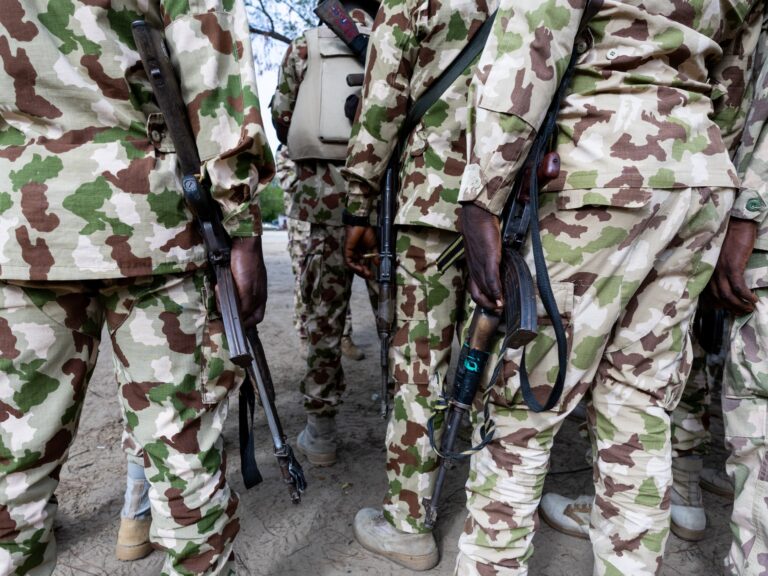
The Nigerian Air Force (NAF) says it has killed at least 35 armed fighters in air strikes near the country’s border with Cameroon, following intelligence that an attack on ground troops was being planned.

The strikes were launched on Saturday on four targets in the Kumshe area in Borno State, near the Nigeria-Cameroon border, said NAF spokesperson Ehimen Ejodame.

“Following the operation, communication was re-established with ground troops, who confirmed that the situation around their location had been stabilised,” he said.

The strikes are the latest by the Nigerian military as it battles a resurgence of attacks in the country’s embattled northeast.

The region faces frequent attacks from Boko Haram and its rival splinter group, ISIL (ISIS) West Africa Province (ISWAP).

Both ISWAP and Boko Haram have recently ramped up their assaults on the military in northeastern Nigeria, which, in addition to Cameroon, also borders Chad and Niger. Armed fighters have overrun military bases, killing soldiers and seizing weapons.

While Nigeria’s 16-year-old armed conflict has slowed since violence peaked around 2015, attacks have picked up since the beginning of the year.

According to the United Nations, the conflict has killed more than 35,000 civilians and forced more than 2 million people to flee their homes.

Last week, the US State Department approved the sale of $346m in weapons, including bombs, rockets and munitions, to Nigeria, subject to approval by Congress.

The weapons would “improve Nigeria’s capability to meet current and future threats through operations against terrorist organizations”, the department said.

Australia Secures First Medal at World Juniors to Enter Medal Standings on Day 5

0

By Charlotte Wells on SwimSwam

2025 World Junior Swimming Championships

After being notably absent from the medal table for the first four days of the 2025 World Junior Championships, Australia made its first appearance on the podium with a gold medal-winning performance on day 5.

Bringing home the first piece of hardware for her country was Ainsley Trotter, who won the girls’ 50 back. The Australian swimmer was the only one in the field to break 28 seconds, blasting into the wall just ahead of Korea’s Kim Seungwon, who broke the Championship Record earlier in the meet.

Turning in another notable performance for his country was Abdul Jabar Adama of Nigeria, who took home silver in the boys’ 50 fly. The 17-year-old made history on Saturday night, as he became the first swimmer, male or female, from his nation to win a medal at a World Aquatics meet.

Japan bumped itself back up to 5th on the medal table thanks to a 1-2 performance in the boys’ 400 IM. Raito Numata and Yumeki Kojima claimed gold and silver, respectively, marking their nation’s second gold medal of the meet and bringing its total tally to 14 medals.

Familiar names continued to make headlines and bring home the medals for their countries. China’s Yang Peiqi won her third individual gold of the meet, giving her nation four total gold medals through day 5.

Team USA only picked up one medal during the fifth finals session, but they did it in record-breaking fashion. The Americans crushed the World Junior Record in the girls’ 4×100 free relay, thanks to the team of Rylee Erisman, Liberty Clark, Julie Mishler and Lily King, bringing the nation’s gold medal count up to eight.

World Juniors Medal Table Through Day 5

Rank Country Gold Silver Bronze Total
1 United States 8 4 4 16
2 NAB 5 5 4 14
3 China 4 2 2 6
4 Great Britain 3 4 5 12
5 Japan 2 7 5 14
6 Italy 2 1 5 8
7 Lithuania 2 1 0 3
8 Argentina 1 1 0 2
9 Ireland 1 0 1 2
10 Australia 1 0 0 1
10 New Zealand 1 0 0 1
10 Turkey 1 0 0 1
10 Ukraine 1 0 0 1
14 Korea 0 1 1 2
14 Romania 0 1 1 2
16 Germany 0 1 0 1
16 Brazil 0 1 0 1
16 Nigeria 0 1 0 1
19 Canada 0 0 1 1
19 Czechia 0 0 1 1
19 Denmark 0 0 1 1

Read the full story on SwimSwam: Australia Wins Its First Medal of World Juniors to Break onto the Medal Table After Day 5

CFMoto Introduces Its First Inline-Four Motorcycle: The 750SR-S

0

It’s no secret that CFMoto has been working on a four-cylinder sports bike for a while. It was always meant to build on the three-cylinder 675SS and 675NK models to up the ante.

Now, the Chinese bikemaker has lifted the covers off the shiny new 2026 750SR-S, which becomes CFMoto’s first inline-four motorcycle, with a global debut expected at this year’s EICMA.

The 750SR-S features a 749cc DOHC four-cylinder engine that’s capable of 110 horsepower and 59 lb.ft (80 Nm) of torque. Now these aren’t exactly groundbreaking numbers – rather tame when you pit them against the likes of the 147-hp Suzuki GSX-R750. But it will likely have CFMoto’s trademark unique selling proposition: incredible value for money.

The CFMoto 750SR-S features a 749cc DOHC four-cylinder engine that’s capable of 110 horsepower and 59 pound-feet of torque

CFMoto

What it will be priced at is hard to say at the moment. What we do know is that it will make its way Stateside, branded as the 750SS, likely sometime next year. So which other bikes will it compete against, other than the aging Suzuki GSX-R750? The old favorite Yamaha R7, the recently-revealed Suzuki GSX-8R, and the extremely plush US$24,298 MV Agusta F3 RC are just a few.

As strange as it sounds, it might just be able to create a space for itself amid all the competition. Consider this – most middleweight sports bikes either belong to the 600-650cc category or the 800-900cc category. Other than the Suzuki siblings (GSX-R750 and GSX-8R), you don’t have many credible names to go for. The 750SR-S slots in perfectly in there.

In terms of features and specs, there’s an upside-down fork and a rear monoshock that sit on a cast aluminum, single-sided swingarm. That’s a fully adjustable KYB suspension on both ends. A 20-stage adjustable steering damper is set up above the top yoke. You get Brembo brakes, which include M4.32 monobloc radial-mount four-piston calipers up front, complete with race-style cowls to direct cooling air to the calipers.

The CFMoto 750SR-S features cornering ABS, a big 6.2-inch TFT screen, Bluetooth connectivity, keyless unlocking/ignition, over-the-air updates, and an upshift-only quickshifter

CFMoto

The 750SR-S features cornering ABS, a big 6.2-inch TFT screen, Bluetooth connectivity, keyless unlocking/ignition, over-the-air updates, an upshift-only quickshifter, automated headlamps with cornering lights, tire pressure monitoring – all pretty standard for a bike of this segment.

Interestingly, CFMoto points out that the 750SR-S has undergone wind tunnel testing. Those front spoilers are one of the first things you’ll spot on this bike, and they’re more than just a prop – they apparently generate 30 N of downforce at high speeds, which helps in increasing stability while enhancing airflow around the rider, resulting in less drag.

The seat height is listed at 31.7 inches (805.1 mm), which can be increased to 32.5 inches (825.5 mm) if you’re a tall rider. With a wet weight of 490 lb (222kg), it’s definitely not the lightest motorcycle out there. Meaning all that weight will definitely drag you back if you find yourself sprinting against run-of-the-mill 750-class bikes.

Mid-high level exhaust placement is a neat touch on the 750SR-S – doesn’t hide how many cylinders the bike has

CFMoto

Clearly, it’s not designed to win you drag races. But it’s designed well. You get CFMoto’s signature hockey stick-shaped daylight-running lamps in the headlamps with the turn signals integrated in the mirrors. And that mid-high level exhaust placement is a neat touch, too – doesn’t hide how many cylinders the bike has.

The 750SR-S also comes with KTM-engineered performance and proven Moto2/Moto3 racing heritage. It all the signs of establishing CFMoto’s global status as a credible contender to Japan’s Big Four. I think its retail price will ultimately decide its fate though.

Speaking of which, the 675SS starts from $7,999 in the United States, so if I had to take a wild swing, I’d put my money on a near-$10,000 MSRP. If that does turn out to be the case, that could be quite a tempting proposition. Especially when most other middleweight sportsters set you back by at least two grand more.

Source: CFMoto

Challenging Clients

0


Client Challenge


JavaScript is disabled in your browser.

Please enable JavaScript to proceed.

A required part of this site couldn’t load. This may be due to a browser
extension, network issues, or browser settings. Please check your
connection, disable any ad blockers, or try using a different browser.

Pope Leo XIV Describes UK’s Chagos Islands Deal as a ‘Significant Victory’

0

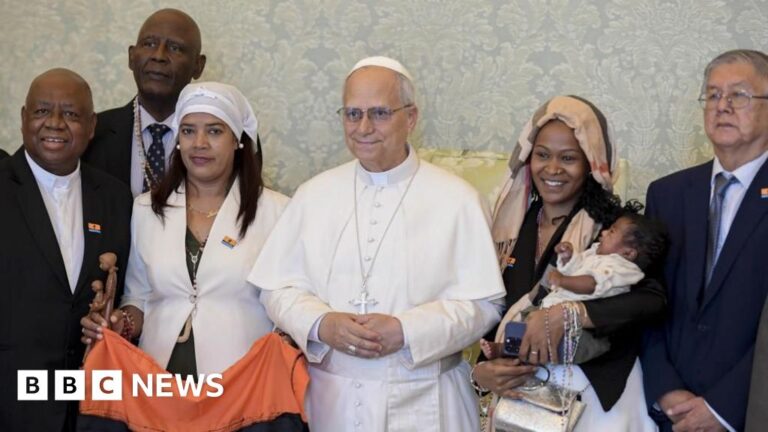
EPA Pope Leo XIV stands with members of the 'Chagos Refugees Group' of Port Louis on Mauritius in Vatican CityEPA

Pope Leo XIV met members of the Chagos Refugees Group in Vatican City

Pope Leo XIV has said he is “delighted” the UK has agreed to hand the Chagos Islands to Mauritius.

Speaking to a delegation of 15 refugees from Chagos, Pope Leo said that the move represented a “significant victory” in their long battle to “repair a grave injustice”.

Under the terms of a treaty signed in May, Mauritius will gain sovereignty of the islands from the UK, but allow the US and UK to continue operating a military base on one of the islands, Diego Garcia, for an initial period of 99 years.

The pope said he hoped Mauritian authorities would ensure the refugees are able to return home. UK opposition leaders – and some Chagossians now resident in the UK – have criticised the deal.

Speaking in French, Pope Leo said: “The renewed prospect of your return to your native archipelago is an encouraging sign and a powerful symbol on the international stage.”

He added that all people “must be respected by the powerful in their identity and rights, in particular the right to live on their land; and no one can force them into exile”.

The UK purchased the islands for £3m in 1968, but Mauritius has argued it was illegally forced to give away the islands in order to get independence from Britain.

The islands were then cleared to make way for a UK-US armed forces base with large groups of Chagossians moving to Mauritius and the Seychelles, or taking up an invitation to settle in England, mainly in Crawley, West Sussex.

In May, the government said it would pay Mauritius an average of £101m a year for 99 years under the terms of the agreement.

The deal sets a 24-mile buffer around Diego Garcia, where nothing can be built without UK consent.

Foreign military and civilian forces will also be barred from other islands in the archipelago, with the UK retaining a power to veto any access to the islands.

The treaty will come into effect only after it is approved by both the UK and Mauritian parliaments.

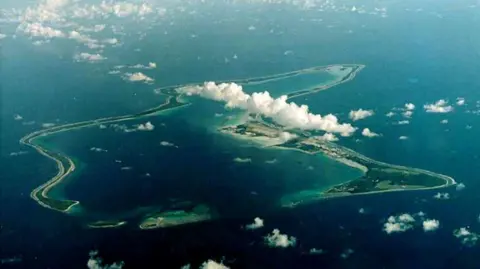
Reuters Photo shows Diego Garcia, the largest island in the Chagos archipelago, surrounded by waterReuters

Diego Garcia, the largest island in the archipelago, was separated from Mauritius along with the rest of the Chagos Islands in 1965 and now houses a US military base

When the deal was struck, the Conservatives described it as “an act of national self-harm”, which left the UK “more exposed to China” because of its ties with Mauritius.

The prime minister insisted that the deal was imperative to maintaining the UK’s national security.

“If we did not agree this deal the legal situation would mean that we would not be able to prevent China or any other nation setting up their own bases on the outer islands or carrying out joint exercises near our base,” Sir Keir Starmer said.

“No responsible government could let that happen.”

The agreement was welcomed by Mauritian Attorney General Gavin Glover who told the BBC in May: “Our country is elated that this 60-year struggle is finally over.”

However two women born in Diego Garcia who wanted to be able to return there had raised a last-minute legal challenge to the deal in May.

The High Court went on to dismiss the challenge.

Kim Jong-un, North Korea’s leader, supervises the launch of new air defense missiles, according to KCNA

0

North Korea leader Kim oversees firing of new air defence missiles, KCNA says

Thousands of Palestinian children in Gaza tent camps facing starvation amid Israel-Palestine conflict

0

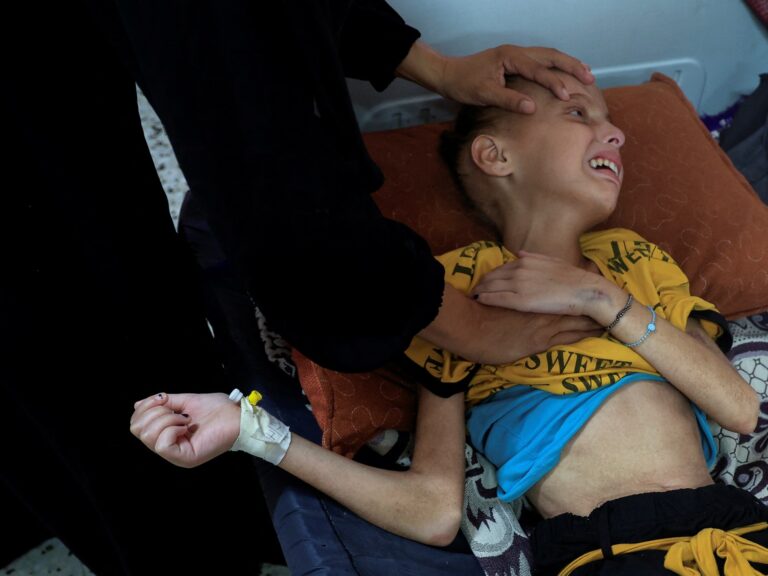
Huda Abu Naja lies weak and emaciated on a thin mattress in her family’s tent in a displacement camp in central Gaza’s Deir el-Balah.

The 12-year-old Palestinian girl’s arms are painfully thin, and the bones on her torso are protruding from under her skin, a telltale sign of her acute malnutrition.

“My daughter has been suffering from acute malnutrition since March when Israel closed Gaza’s borders,” Huda’s mother, Somia Abu Naja, tells Al Jazeera, stroking her daughter’s face.

“She spent three months in hospitals, but her condition did not improve,” said Somia, explaining that she decided to bring Huda back to the family’s tent after witnessing five children die of starvation at Nasser Hospital in southern Gaza’s Khan Younis.

“She used to weigh 35 kilos [77lbs], but now she’s down to 20 [44lbs],” Somia added.

Huda is just one of hundreds of thousands of Palestinian children suffering from malnutrition in Gaza, according to local health authorities, as Israel continues to block food and other humanitarian aid from entering the bombarded enclave.

On Friday, a United Nations-backed hunger monitor confirmed for the first time that more than half a million people were experiencing famine in northern Gaza – the first such designation ever recorded in the Middle East.

The Integrated Food Security Phase Classification (IPC) system warned that the figure could reach 614,000 as famine is expected to spread to the Deir el-Balah and Khan Younis governorates by the end of September.

According to the Health Ministry in Gaza, more than 280 people, including more than 110 children, have died due to Israel-induced starvation since the country’s war on Gaza began nearly two years ago.

Children are being hit hard by the crisis, the IPC said on Friday, with an estimated 132,000 children under the age of five projected to be at risk of death from acute malnutrition by June 2026.

Dr Ahmad al-Farra, the chief paediatric physician at Nasser Hospital in Khan Younis, said 120 children are seeking treatment for malnutrition at the facility, while tens of thousands more are suffering in displacement camps with little assistance.

He told Al Jazeera that children in Gaza will suffer the consequences of malnutrition for the rest of their lives, as hospitals in the enclave are lacking the resources and supplies to respond to the crisis.

Mohammed Abu Salmiya, the director of Gaza City’s al-Shifa Hospital, also told Al Jazeera that an estimated 320,000 children across Gaza were in a state of severe malnutrition.

He said all wounded patients in hospitals were suffering from malnutrition, as well, amid Israel’s continued blockade of the enclave.

Israel has rejected the IPC’s findings, with its foreign ministry saying – despite mounds of evidence – that there was “no famine in Gaza”.

While Israel has allowed limited supplies into the territory in recent weeks amid global outrage over the starvation crisis, the UN and humanitarian groups say what is being allowed in remains woefully insufficient.

An Israeli-backed aid distribution scheme known as GHF has also been condemned as ineffective and deadly, with Israeli forces and US contractors killing more than 2,000 Palestinians as they sought food at the sites since late May.

The IPC famine classification has triggered a renewed wave of calls for Israel to urgently allow a massive and sustained influx of aid into Gaza.

UN Secretary-General Antonio Guterres said on Friday that the famine was a “man-made disaster, a moral indictment, and a failure of humanity itself”.

UN aid chief Tom Fletcher also said starvation was occurring “within a few hundred metres of food” as aid trucks were stuck at border crossings due to Israeli restrictions. He demanded that Israel allow food and medicine in “at the massive scale required”.

The Federal Reserve is growing concerned about the housing market

0

Wall Street was laser-focused on the Federal Reserve’s monetary policy this past week, but minutes from the central bank’s last meeting revealed concern among some policymakers about the housing market.

As the sector’s slump drags on, it has triggered more alarm bells because activity in housing, such as residential investment and construction, has often served as a leading indicator on the overall economy.

Minutes from the Fed’s earlier meetings didn’t include such concerns. But that changed during the July 29-30 gathering.

“Participants observed that growth of economic activity slowed in the first half of the year, driven in large part by slower consumption growth and a decline in residential investment,” the minutes, which were released on Wednesday, said.

To be sure, housing was just one of several concerns that policymakers raised. Others included the labor market, the effect of tariffs on inflation, real income growth, elevated asset valuations, and low crop prices.

But Fed officials were also specific about their housing market worries, suggesting they were starting to pay more attention to the data.

“A few participants noted a weakening in housing demand, with increased availability of homes for sale and falling house prices,” the minutes said.

And not only did housing show up on the Fed’s radar, policymakers flagged it as a potential risk to jobs, along with artificial intelligence technology.

“In addition to tariff-induced risks, potential downside risks to employment mentioned by participants included a possible tightening of financial conditions due to a rise in risk premiums, a more substantial deterioration in the housing market, and the risk that the increased use of AI in the workplace may lower employment,” the minutes added.

Housing market data

The fact that the housing market is emerging as a worry at the Fed means that it could also weigh more on rate decisions, which influence mortgage rates.

In his Jackson Hole speech on Friday, Chairman Jerome Powell opened the door to a rate cut at the central bank’s meeting in September after months of maintaining a more hawkish stance, stoking a furious rally on Wall Street and sending the 10-year Treasury yield down sharply.

But in the meantime, fresh data show that the housing market remains stuck as elevated borrowing costs have kept would-be buyers on the sidelines.

Sales of existing homes rose in July but have largely been flat for most of the year, even as the number of listings has climbed, suggesting demand is weak. That’s suppressed home prices, with a gauge of median prices falling in all but one month this year. 

“Weekly data suggests home prices may remain subdued in coming months, close to flat on the year or rising only very modestly,” analysts at Citi Research wrote on Thursday. “Home price declines are rare outside of hiking cycles or recessions.”

In addition, construction of new single-family homes remains lethargic, and data for July showed that building permits have declined in six out of seven months this year. In fact, permits—a volatile but leading indicator of future activity—fell to the lowest level since 2019, excluding the pandemic.

That was reflected in the NAHB homebuilder confidence index, which fell in August to reverse a modest uptick earlier. It also showed that the share of homebuilders offering sales incentives hit a post-pandemic high.

“As housing demand remains weak with high mortgage rates and high home prices, we expect further softening in housing activity this year,” Citi said in a separate note on Tuesday. 

Introducing the 2025 Fortune Global 500, the definitive ranking of the biggest companies in the world. Explore this year’s list.

US government seeks to expel Kilmar Ábrego García to Uganda

0

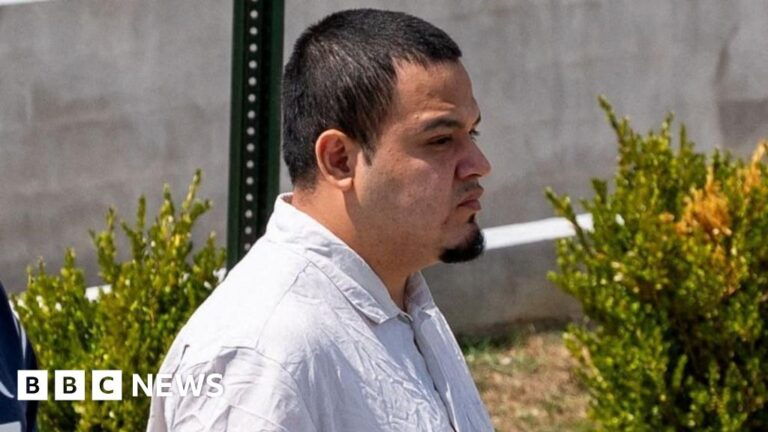
Less than 24 hours after his release, US authorities have informed Kilmar Ábrego García that he may be deported to Uganda, following his refusal to accept a plea deal in a pending criminal trial, his lawyers say.

Attorneys for Mr Ábrego García say he declined an offer to plead guilty to human smuggling charges in exchange for deportation to Costa Rica – a deal proposed after it became clear he would be released from custody on Friday.

Mr Ábrego García, a Salvadoran national, was mistakenly deported to El Salvador in March by the Trump administration and then brought back to the US on criminal charges.

Officials allege Mr Ábrego García has ties with MS-13 criminal gang, a charge he has denied.

The deal to be sent to Costa Rica was offered on Thursday after it became clear Mr Ábrego García would likely be freed from a Tennessee jail on Friday.

The Costa Rican government agreed to accept him as a refugee and provide him legal status there, a letter from a Costa Rican official included in the legal filing says.

His attorneys now say that upon Mr Ábrego García release from federal custody, they were informed of the government’s intention to deport him to Uganda – a country with which he has no known ties.

“There can be only one interpretation of these events,” they wrote in the filing. “The DOJ, DHS, and ICE are using their collective powers to force Mr. Abrego to choose between a guilty plea followed by relative safety, or rendition to Uganda, where his safety and liberty would be under threat.”

Mr Ábrego García, now in Maryland with his family, is scheduled to appear in a Baltimore court on Monday. If a judge approves the government’s request, he could face deportation within days.

The US has reached bilateral deportation agreements with Honduras and Uganda as part of its crackdown on illegal immigration, according to documents obtained by the BBC’s US partner CBS.

“This is a temporary arrangement with conditions including that individuals with criminal records and unaccompanied minors will not be accepted,” Bagiire Vincent Waiswa, permanent secretary to the Ugandan foreign ministry, said in a statement.

“Uganda also prefers that individuals from African countries shall be the ones transferred to Uganda.”

Mr Ábrego García’s deportation case has become a fixture of the Trump administration’s crackdown on immigration.

He was deported to his native El Salvador in March, and initially kept in the notorious Cecot prison. But after US government officials acknowledged he was deported due to an “administrative error”, a judge ordered the administration to “facilitate” his return.

He was returned to the United States in early June and sent to the state of Tennessee, where he was charged in a human smuggling scheme. He has pleaded not guilty to the charges.

In late June, a federal judge in Tennessee had ruled that Mr Ábrego García was eligible for release, but remained in jail over fears from his own legal team that he could be swiftly deported again if he left the facility.