11.8 C
New York
Wednesday, April 29, 2026
Home Blog Page 440

Could Mushroom Walls be a Solution to Air Pollution?

0

Two shocking statistics highlight the challenge. Firstly, in 2021 there was not a single country in the world that met the air quality standards set by the WHO. And secondly, the same organization estimates that air pollution is responsible for one out of every nine deaths per year worldwide. Using green power makes it possible to combat this almost invisible enemy mainly derived from fossil fuels. But there are many other solutions to air pollution.

How air purification with mycelium works

The use of fungi in sustainable architecture has already featured prominently in several of our articles in the past. What’s more, such an approach has its own name – mycotecture. A discipline that primarily uses the mycelium of fungi, i.e., their subterranean filaments, to produce organic structures. Now a Brunel Design student has come up with another sustainable application for these enigmatic organisms.

Named Myco-Hex, they are modular, hexagonal tiles that are integrated like honeycomb cells. The main component is mushroom mycelium, which has an explosive growth capacity and other properties. Firstly, it can absorb up to 80% of the carbon dioxide in the air. And secondly, it traps a large number of suspended hydrocarbon particles, a property that has already been proven in the cleanup of oil spills in the Niger Delta.

In addition to mycelium, this solution to air pollution has compartments in which nutrients are stored, which will be initially based on wood sawdust. However, using other raw materials, such as coffee grounds or compost from organic waste, is feasible.

Addressing air pollution is essential for the respiratory tract and skin care: hydrocarbon particles can cause ailments such as psoriasis, eczema, and even skin cancer.

As indicated in previous articles, mycelium-based structures also have fireproofing and insulating properties, thus allowing them to protect building facades and purify the air. 

Other solutions to air pollution

Electric mobility technologies are some of the primary solutions to air pollution, but there are also complementary techniques that could alleviate it. Here are some of the most striking ones we have seen lately:

The pollution-eating moss

Along the lines of mycelium, vegetation is one of the most common solutions to air pollution. Unfortunately, cities often do not have enough space for green areas. This is where the moss walls installed by a German company come into play. They can absorb carbon dioxide and polluting particles from the air without needing soil and more efficiently than trees.

A giant vacuum cleaner

A Dutch designer has devised a more drastic solution than moss panels. In his case, it is a seven-meter-high vacuum cleaner with a design inspired by Chinese pagodas. Research shows that the air in the areas where it has been installed is 75% purer. And that with the energy consumption of a living room fan.  

Windows that trap pollutant particles

What was once an architectural element designed to let in light and air from outside is now integrating more and more features, from photovoltaic glass to integrated TV screens. Stanford University and Tsinghua University in Beijing have joined forces in this field to develop a polymer coating sprayed onto window glass. This thin layer of nanofibers can filter out up to 90% of harmful particles and prevent them from entering buildings, which could be another solution to air pollution.

Concrete that grows (and cleans the air) like plants

Green concrete promises to be one of the significant assets of sustainable architecture. Several solutions have already been developed based on bacteria or synthetic chloroplasts that mimic photosynthesis to mineralize atmospheric carbon dioxide. And not only that: mineralization confers self-repairing properties to the material.

As you may have noticed, several of the solutions to air pollution mentioned in this article are inspired by nature to achieve more sustainable cities. This is known as biomimicry or biomimetics, a scientific approach behind many sustainable inventions.

Source:

Israel’s Destruction of Gaza City Leaves 78 Dead in Enclave | Latest Israel-Palestine Conflict News

0

Israel has stepped up its destruction of Gaza City as it plans to seize Gaza’s largest urban centre and forcibly displace around one million Palestinians to concentration zones in the south, as it killed at least 78 people across the besieged enclave since dawn, including 32 desperately seeking food.

On Sunday, in Gaza City, the Palestinian Civil Defence reported a fire in tents near al-Quds Hospital after Israeli shelling. At least five people were killed and three wounded when a residential apartment was hit near the Remal neighbourhood.

Ismail al-Thawabta, director of Gaza’s Government Media Office, said the Israeli army is also using “explosive robots” in residential areas and forcibly displacing Palestinians in Gaza City.

In a statement on X on Sunday, al-Thawabta said the army has detonated more than 80 such devices in civilian neighbourhoods over the past three weeks, calling it a “scorched-earth policy” that has destroyed homes and endangered lives.

He said more than one million Palestinians in Gaza City and the north of the enclave “refuse to submit to the policy of forced displacement and ethnic cleansing” despite the destruction and starvation caused by the Israeli assault.

Footage posted on Instagram by Palestinian journalist Faiz Osama and verified by Al Jazeera showed the moments that followed an Israeli aerial attack on the Sabra neighbourhood, in the southern part of Gaza City.

In the footage, as plumes of smoke rise to the sky, a child can be seen screaming with a wound to the leg. A man also lays on the ground with what appears to be a head injury.

The video also shows the destruction left by the strike after residential buildings were flattened by the explosion.

Israel’s forces have carried out sustained bombardment on Gaza City since early August as part of a deepening push to seize the area in the latest phase of its nearly two-year genocidal war.

On Friday, the Israeli military said it had begun the “initial stages” of its offensive, declaring the area a “combat zone”.

‘Fields of rubble’

Reporting from Gaza City on Sunday, Al Jazeera’s Hani Mahmoud said intensifying Israeli attacks have been turning parts of Gaza City, once teeming and crowded with residential buildings, into “fields of rubble”.

“There is non-stop heavy artillery targeting the Zeitoun area and Jabalia, where we are seeing the systematic demolition of homes. There is hardly any fighting going on, but heavy artillery and bulldozers are moving from one street to the other, destroying all of these residential clusters,” he said.

“The majority of people in those areas do not have the luxury to pack up and leave because there is no safety anywhere.”

Another Palestinian journalist was also killed on Sunday. A source at al-Shifa Hospital told Al Jazeera that Islam Abed was killed in an Israeli attack on Gaza City and that she worked for Al-Quds Al-Youm TV channel.

The Government Media Office said the “number of martyred journalists has risen to 247″ since the war began. Other tallies have put the number of journalists and media workers killed at more than 270.

On Monday, five journalists – one of whom worked for Al Jazeera – were among at least 21 people killed in an Israeli attack on Nasser Hospital in southern Gaza’s Khan Younis.

‘Life is difficult, so we will stay in our home’

Many residents in Gaza City are opting to stay put despite Israel declaring it a “combat zone”.

It was Gaza’s most populous city before the war began, home to about 700,000 people. Then hundreds of thousands fled under Israel’s forced evacuation threats before many returned, joined by thousands of other displaced from the south, during a January-to-March ceasefire, which Israel broke.

Fedaa Hamad, who was displaced from Beit Hanoon, said she has “no plans to leave” Gaza City this time despite Israel’s latest warning.

“We are tired from the first displacement. Where are we going to go? Is there a place in the south? We cannot find it,” she said.

Akram Mzini, a resident of Gaza City, said he would not leave “because displacement is very difficult”.

“We were displaced to the south before, and displacement in the south is not simple and it is costly,” he said. “Life is difficult, so we will stay in our home, and whatever God wants will happen.”

Elsewhere in Gaza on Sunday, an Israeli attack on the centre of Deir el-Balah killed at least four people, Al Jazeera Arabic reported.

Earlier, medical sources said an Israeli bombardment killed at least one person and wounded several in the city, located in the central part of the Gaza Strip.

Israeli forces have killed at least 78 Palestinians across Gaza since dawn, including 32 aid seekers, according to medical sources.

Since the war began, Israel has killed at least 63,459 people and wounded 160,256. A total of 1,139 people were killed in Israel during the Hamas-led October 7, 2023, attacks, and about 200 were taken captive.

On Sunday, Israeli army chief Eyal Zamir held a situation assessment meeting with his top commanders, saying the military must “initiate” more attacks to surprise and reach its targets anywhere.

Many more reserve soldiers will assemble this week “in preparation for the continued intensification of the fighting against Hamas in Gaza City”, Zamir was quoted as saying by the military.

Meanwhile, the armed wing of Hamas said its fighters successfully attacked two invading Israeli military vehicles in Gaza City on Saturday.

The Qassam Brigades said a Merkava tank of the Israeli army was hit with a Yassin-105 shell, while a D9 military bulldozer was targeted with an explosive device on a street southwest of the Zeitoun neighbourhood of the besieged area.

As global condemnation against the situation grows, in the largest attempt to break the Israeli blockade of the Palestinian territory by sea, the Global Sumud Flotilla left the Spanish port city of Barcelona on Sunday.

The flotilla’s launch comes after the United Nations-backed Integrated Food Security Phase Classification (IPC) declared a state of famine in Gaza this month.

The Global Sumud Flotilla, which describes itself as an independent group not linked to any government or political party, did not say how many ships would set sail or the exact time of departure, but Swedish campaigner Greta Thunberg spoke of “dozens” of vessels.

Sumud means “perseverance” in Arabic.

Two previous attempts by activists to deliver aid by ship to Gaza were blocked by Israel.

Mohamad Elmasry of the Doha Institute for Graduate Studies told Al Jazeera that while the flotilla was “an important act of symbolic resistance … ultimately, they will be intercepted”.

“This is not going to solve the famine,” he said. “What’s going to solve the famine, ultimately, is governments doing their job to stop genocide and deliberate starvation programmes.”

Challenging Client

0


Client Challenge


JavaScript is disabled in your browser.

Please enable JavaScript to proceed.

A required part of this site couldn’t load. This may be due to a browser
extension, network issues, or browser settings. Please check your
connection, disable any ad blockers, or try using a different browser.

Israel claims Hamas spokesperson Abu Obeida was killed in Gaza

0

Abu Obeida, the spokesman for Hamas’s armed wing, has been killed in an air strike in Gaza City, Israel has said.

Israel’s Defence Minister Israel Katz congratulated the Israel Defense Forces (IDF) and Israel’s security agency, Shin Bet, for the “flawless execution” in a post on X.

He gave no detail on the time or location of the operation, but the IDF earlier said its aircraft attacked “a key terrorist” in the al-Rimal neighbourhood on Saturday, prompting reports in Israeli media that Obeida had been the target.

Hamas has not confirmed his death. The Palestinian armed group earlier said dozens of civilians were killed and injured in Israeli strikes on a residential building in the district.

Katz warned on Sunday that many more of Obeida’s “criminal partners” would be targeted with “the intensification of the campaign in Gaza” – a reference to a recently approved Israeli plan to seize control of Gaza City.

Separately, the IDF and Shin Bet offered more details about Saturday’s strikes that targeted the Hamas spokesman.

They said in a joint statement that the operation had been “made possible due to prior intelligence gathered by [Shin Bet] and the IDF’s Intelligence Directorate” that had identified his hiding place.

Obeida was among the few remaining senior members of Hamas’s military wing from before its deadly 7 October 2023 attack on southern Israel.

Five missiles struck the second and third floor of the six-storey apartment in the al-Rimal neighbourhood building simultaneously from two different directions.

The flat that was targeted had been used as a dentist’s surgery. Witnesses reported seeing hundreds of thousands of dollars flying in the air after the strikes, with large sums stolen by locals but later recovered by Hamas.

The joint statement said Obeida “served as the public face of the Hamas terrorist organization” and “disseminated Hamas’ propaganda”.

Over the past few years, Obeida – believed to be about 40 years old – delivered a number of long diatribes against Israel on behalf of Hamas’s military wing, the al-Qassam Brigades.

Always masked in a Palestinian scarf, he became an idol to Hamas supporters throughout the Middle East.

In what may have been his final speech on Friday, Obeida said the fate of remaining Israeli hostages would be the same as that of Hamas fighters, warning Israel against its planned invasion of Gaza City.

Local journalists reported that at least seven people had been killed and 20 injured in the strikes on the densely populated al-Rimal neighbourhood, with children among the casualties.

Mohammed Emad, who runs a barbershop just 100m (328ft) from the site, told the BBC that “the blasts were terrifying – I couldn’t move for more than an hour”.

He added: “I can’t believe I’m still alive. I saw injured children with blood covering their faces, and people were running in every direction as if the world had ended.”

Footage verified by the BBC of the aftermath of the strikes shows terrified residents fleeing into the streets.

Blood can be seen flowing from a body covered by fabric, while an injured child is carried away by a man.

The IDF said that prior to the attack “many steps were taken to reduce the chance of harming civilians, including the use of precision weapons, aerial observations, and additional intelligence information”.

BBC News has been unable to independently verify the claims of either the IDF or Hamas.

In early August, Israel’s security cabinet approved a plan to seize control of Gaza City in a fresh offensive, with the stated aim of bringing the 22-month-long war to an end.

The UN has repeatedly warned that a complete military takeover would risk “catastrophic consequences” for Palestinian civilians and Israeli hostages held in Gaza. The UK’s ambassador to Israel has said it would be “a huge mistake”.

Israeli Prime Minister Benjamin Netanyahu has vowed to defeat Hamas and defied international criticism of his plans to expand the war.

Israel’s military operation in Gaza began in response to the Hamas-led 7 October attack, in which about 1,200 people were killed and 251 others were taken hostage. Since then, more than 63,000 Palestinians have been killed, according to the Hamas-run Gaza health ministry.

While the operation to capture Gaza City has yet to begin in earnest, Israeli attacks on the city – where nearly a million people live – have been ongoing.

One local resident told the BBC that the same apartment building struck on Saturday had already been hit in an earlier Israeli air raid months ago.

The Israeli military has said it plans to evacuate Gaza City’s entire population and move it to shelters in the south before troops move in. Most of Gaza’s population has already been displaced many times during the conflict.

More than 90% of the city’s homes are estimated to be damaged or destroyed, and the healthcare, water, sanitation and hygiene systems have collapsed.

Last week, conditions of famine were confirmed in Gaza City and its surrounding areas for the first time.

USTR states US continues trade deal negotiations despite court ruling

0

US still working on trade deals despite court ruling, USTR says

Leader of Yemen’s Houthi group denounces Israel’s history of violence following recent killings | UN News

0

Israel has repeatedly targeted the Houthis in recent months as tensions with the group increase over the war in Gaza.

The leader of Yemen’s Houthis, Abdel-Malik al-Houthi, has denounced Israel and signalled defiance, hailing assassinated government leaders as “the martyrs of all Yemen”, the day after the group confirmed the death of its prime minister and other cabinet ministers.

“The Israeli enemy, with its crimes and savagery, does not spare even children, women and defenceless civilians,” he said during his first speech on Sunday since the Israeli strikes, according to Houthi media.

“The crime of targeting ministers and civilian officials is added to the criminal record of the Israeli enemy in the region.”

The prime minister of the Houthis’ government in the capital, Sanaa, Ahmed Ghaleb al-Rahawi, was killed in a Thursday Israeli strike on Sanaa along with “several” other ministers, the Houthis said in a statement on Saturday.

Al-Rahawi, who served as prime minister in areas of the divided country that the group controls, was targeted along with other members of the Houthi-led government during a workshop, the statement said.

Al-Houthi added that the “record of the Israeli enemy is one of horrific terror” as it kills people in Palestinian territory, Lebanon, Syria, Iraq and Iran. He called Israel “a criminal foe that demonstrates its savagery, criminality and aggression through practices that know no rules, no commitments, no charters and no considerations”.

The Houthi commander said the group will keep acting against Israel in opposition to the war on Gaza in solidarity with Palestinians suffering, adding that “our people will not be weakened by the aggression they are facing”.

Israel has repeatedly targeted Houthi positions in recent months as the Yemeni group has launched attacks on Israel and on Western vessels in the Red Sea and Gulf of Aden.

Quoting unnamed sources, Israeli media reported on Friday that the Israeli army attacked the entire Houthi cabinet, including the prime minister and 12 other ministers, on Thursday.

The attack came four days after Israeli strikes on the Yemeni capital on August 24 killed 10 people and wounded more than 90, according to health officials.

Houthi raids on UN offices

In an apparent effort to tighten security amid Israel’s attacks across Sanaa, the Houthis on Sunday raided offices of the United Nations’ food and children’s agencies in Yemen’s capital, detaining at least one UN employee, officials said.

Ammar Ammar, a spokesperson for the UN Children’s Fund (UNICEF), told the Associated Press that there was “an ongoing situation” related to their offices in Sanaa, without providing further details.

The UN official said contacts with several other World Food Programme (WFP) and UNICEF staffers were lost and that they were likely also detained.

Abeer Etefa, a spokesperson for the WFP, told the Associated Press that security forces also raided the agencies’ offices in the Houthi-controlled capital on Sunday morning.

“WFP reiterates that the arbitrary detention of humanitarian staff is unacceptable,” Etefa said.

The raids are the latest in a long-running Houthi crackdown against the UN and other international organisations working in rebel-held areas in Yemen.

They have detained dozens of UN staffers, as well as people associated with aid groups, civil society and the now-closed US Embassy in Sanaa.

In February, the UN also suspended its operations in the Houthi stronghold of Saada in northern Yemen after the Houthis detained eight UN staffers in January.

The next 14 trading sessions will determine the stock market’s future

0

The next few weeks will give Wall Street a clear reading on whether this latest stock market rally will continue — or if it’s doomed to get derailed.

Jobs reports, a key inflation reading and the Federal Reserve’s interest rate decision all hit over the next 14 trading sessions, setting the tone for investors as they return from summer vacations. The events arrive with the stock market seemingly at a crossroads after the S&P 500 Index just posted its weakest monthly gain since March and heads into September, historically its worst month of the year.

At the same time, volatility has vanished, with the Cboe Volatility Index, or VIX, trading above the key 20 level just once since the end of June. The S&P 500 hasn’t suffered a 2% selloff in 91 sessions, its longest stretch since July 2024. It touched another all-time high at 6,501.58 on Aug. 28, and is up 9.8% for the year after soaring 30% since its April 8 low. 

“Investors are assuming correctly to be cautious in September,” said Thomas Lee, head of research at Fundstrat Global Advisors. “The Fed is re-embarking on a dovish cutting cycle after a long pause. This makes it tricky for traders to position.”

The long-time stock-market bull sees the S&P 500 losing 5% to 10% in the fall before rebounding to between 6,800 to 7,000 by year-end.

Eerie Calm

Lee isn’t alone in his near-term skepticism. Some of Wall Street’s biggest optimists are growing concerned that the eerie calm is sending a contrarian signal in the face of seasonal weakness. The S&P 500 has lost 0.7% on average in September over the past three decades, and it has posted a monthly decline in four of the last five years, according to data compiled by Bloomberg.

The major market catalysts begin to hit on Friday with the monthly jobs report. This data ended up in the spotlight at the beginning of August, when the Bureau of Labor Statistics marked down nonfarm payrolls for May and June by nearly 260,000. The adjustment set off a tirade by President Donald Trump, who fired the head of the agency and accused her of manipulating the data for political purposes. 

After that, the BLS will announce its projected revision to the Current Employment Statistics establishment survey on Sept. 9, which may result in further adjustments to expectations for jobs growth.

Then inflation takes the stage with the consumer price index report arriving on Sept. 11. And on Sept. 17, the Fed will give its policy decision and quarterly interest-rate projections, after which Chair Jerome Powell will hold his press conference. Investors will be looking for any roadmap Powell provides for the trajectory of interest rates. Swaps markets are pricing in roughly 90% odds that the Fed will cut them at this meeting.

Two days later comes “triple witching,” when a large swath of equity-tied options expire, which should amplify volatility.

That’s a lot of uncertainty to process. But traders seem oddly unconcerned about this crucial stretch of data and decisions. Hedge funds and large speculators are shorting the Cboe Volatility Index, or VIX, at rates not seen in three years in a bet the calm will last. And jobs day has a forward implied volatility reading of just 85 basis points, indicating the market is underpricing that risk, according to Stuart Kaiser, Citigroup’s head of US equity trading strategy.

Turbulence Risk

The problem is, this kind of tranquility and extreme positioning has historically foreshadowed a spike in turbulence. That’s what happened in February, when the S&P 500 peaked and volatility jumped on worries about the Trump administration’s tariff plans, which caught pro traders off-sides after coming into 2025 betting that volatility would stay low. Traders also shorted the VIX at extreme levels in July 2024, before the unwinding of the yen carry trade upended global markets that August.

The VIX climbed toward 16 on Friday after touching its lowest levels of 2025, but Wall Street’s chief fear gauge still remains 19% below its one-year average.

Of course, there are fundamental reasons for the S&P 500’s rally. The economy has stayed relatively resilient in the face of Trump’s tariffs, while Corporate America’s profit growth remains strong. That’s left investors the most bullish on US stocks since they peaked in February, with cash levels historically low at 3.9%, according to Bank of America’s latest global fund manager survey.

But here’s the circular problem: As the S&P 500 climbs higher, investors become increasingly concerned that it is overvalued. The index trades at 22 times analysts’ average earnings forecast for the next 12 months. Since 1990, the market was only more expensive at the height of dot-com bubble and the technology euphoria coming out of the depths of the Covid pandemic in 2020.

“We’re buyers of big tech,” said Tatyana Bunich, president and founder of Financial 1 Tax. “But those shares are very pricey right now, so we’re holding some cash on the sidelines and waiting for any decent pullback before we add more to that position.” 

Another well-known bull, Ed Yardeni of eponymous firm Yardeni Research, is questioning whether the Fed will even cut rates in September, which would hit the stock market hard, at least temporarily. His reason? Inflation remains a persistent risk.

“I expect this stock rally to stall soon,” Yardeni said. “The market is discounting a lot of happy news, so if CPI is hot and there’s a strong jobs report, traders suddenly may conclude rate cuts aren’t necessarily a done deal, which may lead to a brief selloff. But stocks will recover once traders realize the Fed can’t cut rates by much because of a good reason: The economy is still strong.”

Introducing the 2025 Fortune Global 500, the definitive ranking of the biggest companies in the world. Explore this year’s list.

Polish tennis star reunites with fan following viral video of US Open hat snatching incident

0

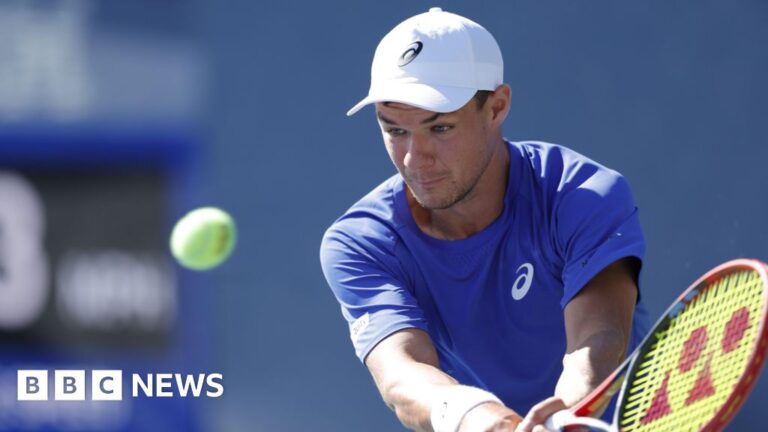
Polish tennis player Kamil Majchrzak has met a young fan after a video appearing to show a man snatching his hat from a boy in the crowd at the US Open went viral.

Majchrzak shared two clips on his official Instagram account in which he shook hands with two boys and presented them with gifts – including a cap similar to one handed to the boy and then swiftly taken off him in the clip.

“Today after warm up, I had a nice meeting,” the tennis pro wrote, adding: “Do you recognise [the cap]?”

The viral video, widely reported to be from Majchrzak’s match on Thursday, showed the tennis player interacting with fans before offering a child the cap he had been wearing.

A man next to the child can then be seen taking the cap before the child had a chance to grab it himself. The boy can then be seen pleading to get it back.

Versions of the clip were subsequently shared on social media, with many users criticising the man – who multiple media outlets have since named as Piotr Szczerek, a Polish CEO of a paving company.

BBC News has approached Mr Szczerek through his company for comment.

Majchrzak also posted an image of him standing and smiling next to the boy wearing the cap.

“Hello World, together with Brock we wish you a great day!” the tennis player’s caption said.

Majchrzak, 29, is ranked 76th in the world in men’s singles.

He won Thursday’s match at Flushing Meadows, New York against Russian player Karen Khachanov, ranked ninth in the world, but retired from a later match – saying he had torn an intercostal muscle.

Jamendo Launches AI-Powered Search Amid Plans to Sue Nvidia and Suno

0

Music licensing platform Jamendo has launched an AI-powered music search feature to help its clients search through a catalog of more than 300,000 tracks from over 70,000 independent artists and bands worldwide.

The development comes as the company, part of the Winamp family and owned by Belgium-based Llama Group, recently reaffirmed its plans to pursue legal action against Nvidia and Suno for allegedly using its content without authorization.

The new search feature allows users to find music by typing descriptions of their needs, whether entire sync briefs, scene outlines, pop culture references, or describing the vibe, genre, instrument, mood, or any creative idea.

Jamendo says the AI search feature draws on 180 tags such as style, mood or tempo to each track to deliver results. The company promises to “[use] AI responsibly, in service of artists and clients.”


Alexandre Saboundjian, CEO of Jamendo and Winamp, said: “AI should be used to empower artists and creators, not exploit them. With Search with AI, we are proving that technology can enhance creativity while fully respecting copyright and the livelihoods of musicians.”

The launch comes as Jamendo in July reiterated its plans to pursue legal action against Nvidia and Suno over the alleged use of its catalog in training their models Fugatto and SunoAI Foundation Model. Nvidia unveiled Fugatto, which stands for Foundational Generative Audio Transformer Opus 1, in November 2024. At the time, the AI computing company said the AI audio model can “produce sounds never heard before.”

Jamendo said: “No agreement has been reached with Nvidia, despite multiple attempts to resolve the matter amicably and in good faith, including a formal licensing proposal.”

“In contrast, Suno has failed to respond entirely, ignoring Jamendo’s repeated efforts to establish communication.” Suno is also facing lawsuits from major record companies over its training model.

Saboundjian in July said: “Our music catalog is not free for exploitation by commercial entities building AI models without permission or compensation. Nvidia and Suno’s use of our artists’ work without authorization is not only unlawful, it is a direct threat to the livelihoods of independent musicians worldwide. We will not stand idly by. As an example, under the US Copyright Act, violations of this nature are subject to statutory damages ranging from $750 to $150,000 per infringed track.”

Founded in 2004, Jamendo offers music free for personal use through Creative Commons licenses while generating revenue through commercial licensing for synchronization and in-store music use.

The company’s new AI search feature represents a different approach to the use of AI in music. Instead of replacing human creativity by generating music, its new feature positions it as a discovery tool.

Jamendo is part of Llama Group (formerly Radionomy), which acquired the iconic Winamp music player for desktop computers in 2014 and has been working to revive the brand. In 2023, MBW reported that Winamp is back with a new product for the modern era: an app for Android and Apple devices.

Music Business Worldwide

Top 4 Women’s NCAA Recruiting Classes of 2025

0

By Madeline Folsom on SwimSwam

Welcome to the best-of-the best for the 2025 Women’s NCAA recruiting class rankings. We have already looked at the schools with 2025 women’s recruiting classes ranked #5-#16, and we have just four more to go.

See Also:

A few important notes on our rankings:

  • The rankings listed are based on our Class of 2025 Re-Rank. “HM” refers to our honorable mentions and “BOTR” refers to our Best of the Rest section for top-tier recruits.
  • Like most of our rankings, these placements are subjective. We base our team ranks on a number of factors: prospects’ incoming times are by far the main factor, but we also consider potential upside in the class, class size, relay impact, and team needs. Greater weight is placed on known success in short course yards, so foreign swimmers are slightly devalued based on the difficulty in converting long course times to short course production.
  • Transfers are included, though they are weighed less than recruits who arrive with four seasons of eligibility.
  • For the full list of all verbally committed athletes, click here. A big thank you to SwimSwam’s own Anne Lepesant for compiling that index – without it, rankings like these would be far less comprehensive.
  • Some teams had not released a finalized 2025-26 team roster at the time these articles were published, meaning it’s possible we missed some names. Let us know in the comments below.

Honorable Mentions

  • UCLA, Wisconsin, South Carolina

Previously Ranked

  • #16 Notre Dame Fighting Irish
  • #15 Duke Blue Devils
  • #14 Ohio State Buckeyes
  • #13 Louisville Cardinals
  • #12 Michigan Wolverines
  • #11 USC Trojans
  • #10 Princeton Tigers
  • #9 Tennessee Volunteers
  • #8 Georgia Bulldogs
  • #7 Indiana Hoosiers
  • #6 NC State Wolfpack
  • #5 Texas Longhorns

#4 Florida Gators

Florida was 3rd at last year’s NCAA Championships, but they lost four of their top five point scorers after the season. They have a very strong class of nine athletes coming in with three diving recruits that will be huge for their point totals at both SECs and NCAAs.

Grace Rabb was our #6 ranked recruit for 2025, and she leads the Gator recruiting class with her backstroke and IM times being crucial in replacing Bella Sims. Rabb’s best time in the 200 back of 1:52.13 would have placed her comfortably in the ‘B’ final at NCAAs and her 200 IM would have been just outside scoring position. Rabb also has a best 100 backstroke time of 52.09 will bring her in just behind rising junior Catie Choate.

Our #9 ranked Lilla Bognar will also be headed to Gainesville, where her IM prowess will make an immediate impact. Her 400 IM time of 4:05.50 would sit just outside the ‘A’ final at NCAAs, but the time comes from when she was 15, and she had a very strong swim last summer at the Olympic Trials. She hasn’t swam a meet this year, which makes it hard to determine where she will be when she gets to Florida, but she is coming in with a time two seconds faster than Emma Weyant was as a high school senior, and Weyant developed into an NCAA title holder in the event.

They also grabbed HM Lynsey Bowen, whose 4:39.51 in the 500 free puts her less than a tenth back of the NCAA cutline in the event, and BOTR recruit Zuri Ferguson, who will come in with backstroke times of 52.6 and 1:53.3 to add depth to the backstroke roster at Florida.

Bowen has stagnated slightly the past year, with her top 500 freestyle time from the season coming in at 4:54.42 from January.

The Americans will be joined by two international sprint recruits Beatriz Bezerra and Sylvia Statkevicius. Bezerra’s best 50 free time converts to 22.26 and Stakevicius’s would convert to 22.53. Neither one of these are NCAA qualifying swims, but they will help bolster the 200 free relay finished 23rd last year. Statkevicius is also strong in the 100 free (converted 48.69) and 200 free (converted 1:45.20) that will help on relays. Bezerra comes in at a converted 49.21 in the 100 free, but her 100 fly of 58.99 converts to 52.80 which will be one of the top fly times on the team this season.

There will be three divers joining the Florida team that did not graduate any divers after last season. Alexa Fung and Maria Fernanda Garcia are both coming in as likely point scorers with Fung switching her commitment from Texas. Fung won the World Junior Championships in the 1-meter springboard in 2022 and will be a huge addition to the program

Fernanda Garcia finished in the top 8 at the 2024 World Junior Diving Championships in all five events she competed in (mixed team, 1-meter springboard, 3-meter springboard, 3-meter synchronized, and 10-meter platform), and recently was 12th in the 3-meter and 15th in the 1-meter at the World Championships in Singapore.

#3 Virginia Cavaliers

The five-time NCAA Champions Virginia might have lost their biggest star in Gretchen Walsh last year, but they will not be giving up the title easily. They are bringing in a large class of 11 swimmers, five of which are ranked recruits from our class of 2025 and two are huge international athletes.

Starting with the American swimmers we have the #4 ranked recruit in Colorado’s Madi Mintenko. A freestyle specialist, Mintenko will come in as a potential NCAA ‘A’ finalist in two events and has times under the cutline and in potential scoring position in four other events, though she will likely be a freestyle specialist for the Cavaliers.

Her 200 free of 1:43.20 (altitude adjusted 1:42.00) and her 500 free of 4:36.66 would have been 6th and 7th respectively at the 2025 meet, and her 100 freestyle time of 47.47 would have been 10th overall. She will be a huge addition to their freestyle relays with times that rival the athletes at the top of the program as a freshman.

The #17 ranked Raya Mellott will step into a relatively deep breaststroke program that had five sub-1:00 breaststrokers last season and will see three of them return. Her time of 59.53 puts her just over the cutline in the event and would have been 6th on the team last year. Her 200 breaststroke time of 2:09.53 is just under the cutline of 2:09.58.

Honorable mention Sophia Umstead, and BOTR recruits Lily Gormsen and Sylvia Roy will all add depth to their areas of expertise with Umstead sitting relatively close to the NCAA cutlines in the 200 IM and 200 breast and all three coming in as potential conference scorers.

Virginia also picked up two major international recruits in Lana Pudar from Bosnia and Herzegovina and Sara Curtis from Italy.

Pudar is two-time Olympian and World Junior Champion in the 200 and 100 butterfly events in 2023. Her 100 fly time of 56.95 converts to 50.28, which would be in the ‘A’ final and challenging for a medal position at the NCAA Championships, but she has not dropped time in the event since 2023. Her 200 fly also converts to an ‘A’ final time of 1:51.55, but she hasn’t dropped since 2023 in that event either. Even if she is off these times, though, she should be a strong addition to the butterfly program.

Curtis recently finished 8th in the 100 freestyle and 9th in the 50 freestyle at the 2025 World Championships in Singapore, and her lifetime bests of 24.41 in the 50 and 53.29 in the 100 were both set at that meet. These swims convert to 21.56 and 46.96, which are both comfortably within the ‘A’ final for the NCAA Championships. These swims will make a massive impact on the UVA sprint relays that lost their top swimmer after last season. While conversions are not an exact science, it is safe to say that Curtis is one of the strongest international recruits coming in and her impact looks like it will be significant, especially if she develops the way Virginia’s other sprint freestylers have over their four years.

They also have a few transfers who will add depth to the sprint freestyle program in double sport athlete and NCAA DII record holder Bryn Greenwaldt, Auburn transfer Lawson Ficken, and Richmond transfer Melissa Nwakalor, who was a Division I NCAA qualifier in the 50 and 100 freestyle last season. Any combination of these three women could swim on the 200 freestyle relay at the NCAA Championships.

Heavy is the head that wears the crown, and, while Virginia is bringing in some huge recruits this year, they have some huge names they are replacing. Only Pudar appears to be coming in at the top of the program, and that is only in the 100 butterfly where she hasn’t swam a best time since 2023. The rest of their recruits are strong, but they have to be strong if they want win another NCAA title.

#2 Stanford Cardinal

Stanford did not pick up an exceptional number of recruits, but the seven they did get will be huge for them in trying to take over Virginia’s top spot on the podium. There are also less questions about their performance because the recruiting class is entirely American.

The Cardinal only lost 60 NCAA points after last season with the graduation of Aurora Roghair and Lillie Nordmann, and they are well on their way to making up those point totals this season with all seven recruits making an impact on the team.

Their top ranked recruit was #13 Addie Robillard who will join NCAA Champion Lucy Bell in the breaststroke events as the fastest 200 breaststroker in the class. Her 2:07.75 from Winter Juniors was just over a tenth off from what it took to qualify for the ‘B’ final in the event. She is also strong in the 100 breaststroke, where her 59.33 is under the cutline, and she will be training with the current top 200 breaststroker in the NCAA.

Just behind her in the rankings was Alana Berlin, who seems likely to compete the dirty double at the NCAA Championships with times in the 100 back and 100 fly that are under the NCAA cutline. Her 100 back time of 51.33 would have been the fastest on the team last year, and will be very strong on the medley relay. She has also been 51.46 in the 100 fly which will come in behind Torri Huske and Gigi Johnson in team rank.

Berlin fills a gap in the Stanford team that finished in the top five in every relay except the 400 medley, where they were 6th. Berlin’s 51.33 is more than a second faster than Annika Parkhe swam leading off the relay, and moves them up to 4th overall.

The Cardinal will also benefit from sprint freestyler Annam Olasewere, the #19 recruit, is coming in under the cutline in the 50 free and just over it in the 100 free. Olasewere is on a very strong improvement curve, though, dropping almost two tenths in the 50 and almost a second in the 100. She also has had a strong long course season, qualifying for the World Junior Championships in the 50 free after finishing 7th at Nationals in 24.62. She will be a massive relay swimmer for Stanford, contributing to their 200 free relay and 400 free relay. Her time in the 50 would have been 2nd on the team last year, only behind Huske, which means that she could also end up on the 200 medley relay making her a three relay swimmer as a freshman.

The cardinal also did not put anybody in the 50 freestyle finals last year, a feat that Olasawere is less than a tenth from accomplishing as a freshman, filling another open space on the roster.

HM Ella Jablonski and BOTR Ella Detter will both add depth to the fly and freestyle programs with Jablonski leaning more towards the sprint freestyle and Detter being stronger in the 200.

Rounding out the class are two very strong divers Ellie Cole and Molly Gray. Both are World Junior silver medalists, with Gray taking the silver in the 1-meter diving in 2022 and Cole coming in 2nd in the synchronized 10-meter event last year. Cole also qualified for the Paris Olympics in 2024, where she earned a spot in the final, finishing 7th on the 10-meter platform.

They will join a diving program that scored just 14 points at last year’s NCAAs, leaving a lot of room for these two to earn a ton of points this season.

Stanford edges out Virginia for the 2nd spot on this list because their recruits are filling empty spaces in the overall program. Olasawere and Berlin are coming in as potential finalists in two of the only events that Stanford did not put any athletes in the final for.

#1 Cal Golden Bears

This list is incredibly subjective and most schools could make a reasonable case for being ranked higher than they are. A lot of this list has been splitting hairs to determine what school ranks higher, and schools have changed positions numerous times through the writing and compiling of it. The only constant throughout the process? Cal’s spot at the top.

Not only did the Golden Bears pick up the 2nd, 3rd, 5th, 12th, and 18th ranked recruits for the class of 2025. They also got Japanese butterflyer Airi Mitsui and Norwegian breaststroker Silje Slyngstadli. No other team has more than three top-20 recruits. Cal has five.

They were supposed to be even better, with the top recruit for 2025, Alex Shackell, originally sending her verbal commitment to Cal. Despite her flipping to Indiana, so she could train part time at her club team, the Cal class remains at the number one spot, representing just how strong it is.

Teagan O’Dell is the highest ranked recruit coming in for Cal at #2. She holds the top times in the class in the 100 and 200 backstroke and the 200 and 400 IMs and she will walk into Berkeley with times that would qualify for the NCAA ‘A’ final in the 200 free (1:42.47), 200 back (1:49.16), and the 200 IM (1:52.61). She saw large improvements last year in all three of these events, and even dropped under 48 seconds in the 100 free, coming in at 47.74, which would have been 2nd on the team last year. Her 200 free is 1:42.27 which would have been 2nd to the graduated Lea Polonsky. Both will be huge for Cal’s relays, especially with her 50 freestyle of 22.14 also being among the top four. O’Dell will realistically swim on four NCAA relays as a freshman, and could follow up those performances with three ‘A’ finals swims.

Olympic medalist Claire Weinstein sits at #3 in the class only because her distance orientation is slightly less impactful on relays. Weinstein is one of the broadest range freestylers we have ever seen, nearly making the World Championships team in the 100 free and the 1500 free in the same year. The 200 free is her long course wheelhouse, but she has the potential to sweep the 200, 500, and 1650 freestyle events over her four years in college. She beat the reigning champion in the 500 and 1650, Jillian Cox, head-to-head in both the 800 and 1500 freestyle at nationals and her lifetime best in the 500 of 4:29.38 is well under last season’s winning time. She hasn’t swum a terribly large number of SCY 1650s, only racing one a year, but her best time of 15:51.64 is still under the cutline and the top eight threshold. Her 100 free time of 47.95 also would have been one of the top times on the team last year, and will likely earn her a spot on the 400 freestyle relay.

Annie Jia is the #5 ranked recruit with best times of 50.35 in the 100 fly, 48.07 in the 100 free, and 1:45.79 in the 200 free (which could also end up on the 800 freestyle relay). Her 100 fly and 100 free times are both under the NCAA cutline with her 100 fly coming in as a potential ‘A’ finals swim. She has also been 22.05 in the 50 free, which sits just four hundredths over the NCAA cutline of 22.01. She is another swimmer who could end up on four relays for the Bears with her sprint freestyle and butterfly times.

They are also bringing in the fastest 100 breaststroker in the class, #12 Elle Scott. In February, Scott blasted a 100 breaststroke swim of 58.56 to make her the only swimmer in the class under 59 seconds, and put her just under three tenths from an NCAA ‘A’ finals swim in the event. This will make a huge impact on the medley relay that could be mostly freshmen. Scott is also a potential scorer in the 200 breast, where her 2:08.62 sits just outside of scoring range, and in the 200 IM, where her 1:56.25 is less than a second out of 16th.

Cal also adds #18 recruit Ella Cosgrove, who has times of 1:45.07 and 4:37.98 in the 200 and 500 freestyle. Her 500 freestyle is under the NCAA cutline in the event, and will put her in ‘B’ finals scoring position at 12th overall. Her 200 free sits just over the line of 1:44.74, but she has dropped about a second a season since 2021, and isn’t showing signs of slowing.

They will add depth with BOTR recruit Alexa McDevitt, an IMer who comes in at 1:58.6 and 4:12.5 to join O’Dell in the IM group, and Gracyn Aquino, a sprint freestyler with times of 22.65 and 49.58.

Japan’s Airi Mitsui and Norway’s Silje Slyngstadli will round out the recruiting class. Mitsui is an Olympic semifinalist in the 200 butterfly, where her time of 2:08.71 finished 11th overall. Her lifetime best in the event of 2:06.54 from the Japanese Olympic Trials converts to 1:51.79 which would have tied for 4th last year.

Slyngstadli was 29th at this summer’s World Championships in the 100 breaststroke with her swim of 1:08.31. Her best time comes from April of this year, and sits at 1:07.53 which converts to 59.83.

Cal might not be in contention for the title this year, but they seem geared to massively improve their 8th place finish. Give them a few years and they could be the team to beat in March.

Read the full story on SwimSwam: Ranking the 2025 Women’s NCAA Recruiting Classes: #1-4