
0.6 C
New York
Tuesday, March 3, 2026
Home Blog Page 413

Slate CEO believes removal of EV tax credit will create more opportunities for battery suppliers

0

The elimination of the electric vehicle federal tax credit may end up becoming a benefit to some of the newer players trying to compete in the market, according to the CEO of the affordable electric truck startup Slate Auto

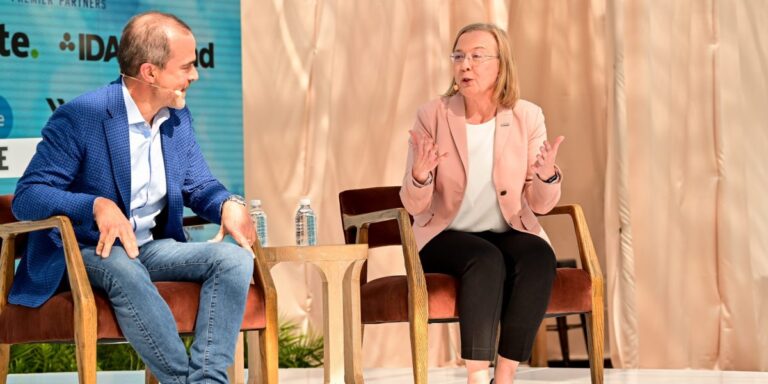
“It’s opened up some opportunity for us,” Chris Barman, CEO of the emerging EV company, said on stage on Tuesday at Fortune’s Brainstorm Tech conference in Park City, Utah. Slate Auto had been “very focused” on making sure it could offer that rebate, she said, which required the company to meet certain mineral and manufacturing location requirements. 

“What we’ve done is we’ve stepped back and surveyed multiple battery suppliers, and what we’re seeing is there are others in the industry that are pulling back as well on their EV launch plans—so it’s opening up capacity,” Barman said. “So we’re going out and seeing…taking survey on what’s there, and see what we can do to look at pricing.”

Of course, the elimination of the federal credit, which allowed buyers of qualifying new EVs to get a $7,500 tax credit, also means the Slate truck won’t look as inexpensive as it might have compared to similar sized gas-powered vehicles. The Slate truck will have a sticker price in the “mid-20s” Barman said on Tuesday, with deliveries to customers expected by the end of 2026.

Based in Troy, Mich., Slate Auto is a spin out of Re:Build, a combination investment fund and holding company dedicated to rekindling manufacturing in the U.S. 

“We think a strong thriving democracy depends critically on an industrial economy. I don’t think you can have a services-only base,” said Jeff Wilke, the former Amazon worldwide consumer CEO who cofounded Re:Build during the pandemic and is its chairman. 

Wilke, who spoke alongside Barman on-stage at Brainstorm Tech Tuesday, noted that the average price of a used car in the U.S. is $25,000, which will make a new Slate truck very competitive, even without the EV credit.

Slate Auto, which is also funded by Amazon founder Jeff Bezos and General Catalyst, aims to bring modular, fully customizable electric trucks to market. The truck, which will be manufactured at a plant in Indiana beginning next year, has only around 600 parts, versus what Wilke said was typically 4,000 parts of a typical car assembly operation. The “majority” of the Slate truck’s parts will be made in the U.S., according to a Slate spokesperson. 

Each Slate truck that rolls off the assembly line will be exactly the same, in slate gray color, with manual window openers, and no radio. The vehicle is intended to be a “blank slate,” that customers can customize to their tastes and specifications through a combination of Slate produced add-ons and third-party add-ons. Customers can wrap the truck’s exterior paneling in a color or print of their choosing, as well as customize lighting and tires, and even convert the two-passenger flat bed truck into a 5-person SUV.

Barman said that the company internally refers to their bare-bones truck as “FN,” which stands for “freaking nuts.”

But Barman and Wilke noted that despite the goal of creating a low-cost, customizable vehicle, the company did not want to compromise on value. To that end, the Slate will have an electronic key fob, even though an old-fashioned bladed key would have been the least expensive option. A lot of people would have felt unsafe at night with the old key, Barman said. 

And after an internal debate within the company, the Slate Truck will have air conditioning, she said.

More from Brainstorm Tech

Why Walmart’s U.S. CEO says staffing levels will remain steady even as A.I. becomes a bigger part of work

Lyft CEO says company will save $200M in insurance costs from California worker unionization deal

DoorDash CEO Tony Xu says path to autonomous deliveries filled with ‘lots of pain and suffering’ but company is nearing first inning of commercial progress

Fortune Global Forum returns Oct. 26–27, 2025 in Riyadh. CEOs and global leaders will gather for a dynamic, invitation-only event shaping the future of business. Apply for an invitation.

Trump denies signing birthday note to Jeffrey Epstein | Latest news on Donald Trump

0

US president’s denial comes after White House said it would support a forensic analysis of the signature.

US President Donald Trump has repeated his denial that he penned a lascivious birthday message to Jeffrey Epstein amid sustained scrutiny of his links to the convicted sex offender.

Speaking to reporters in Washington, DC, on Tuesday, Trump said the signature on the note to Epstein was not his.

Recommended Stories

list of 4 itemsend of list

“It’s not my signature, and it’s not the way I speak. And anybody that has covered me for a long time knows that’s not my language,” Trump said.

“It’s nonsense.”

Trump’s denial came after the White House said earlier that it would support a forensic analysis of the signature to prove it did not belong to the US president.

“The president did not write this letter. He did not sign this letter,” White House press secretary Karoline Leavitt said.

The release of the note, contained in a 238-page scrapbook compiled to commemorate Epstein’s 50th birthday in 2003, has reignited long-simmering controversy over Trump’s connections to the late financier, who died in a New York jail cell in 2019 while facing sex trafficking charges.

Democrats in the US House of Representatives published the suggestive letter on Monday after the scrapbook was turned over to lawmakers by Epstein’s estate.

The so-called “birthday book” also contains purported greetings from high-profile figures including former US President Bill Clinton, Apollo Global Management cofounder Leon Black, and former Harvard University law professor Alan Dershowitz.

A birthday letter that US President Donald Trump allegedly wrote to sex offender Jeffrey Epstein more than 20 years ago is seen as presented by the Democrats in the U.S. House of Representatives on their X account September 8, 2025. The letter, the existence of which was reported by the Wall Street Journal in July, appears to have been signed by Trump, but he has denied doing so and has said the card does not exist, and the White House has denied its authenticity. Handout via REUTERS
The birthday letter Trump allegedly wrote to sex offender Jeffrey Epstein more than 20 years ago, as presented by House Democrats on their X account on September 8, 2025 [Handout via Reuters]

Trump previously denied writing the letter, which features the sketched outline of a naked woman with the president’s purported signature in place of her pubic hair, after its existence was first reported by The Wall Street Journal in July.

Trump has sued the newspaper over the report, seeking at least $20bn in damages.

Trump has for months been dogged by questions about Epstein, including from some of his most ardent supporters.

Many members of his Make America Great Again (MAGA) movement reacted with outrage in July when a law enforcement review concluded that Epstein died by suicide and there was no credible evidence that he had kept a “client list” or blackmailed powerful figures.

Epstein, who had ties to some of the most prominent names in politics and business, has been the source of unproven theories for years, including that he was murdered to protect the existence of a sexual blackmail ring operated by US or foreign intelligence.

Many MAGA supporters had backed Trump’s re-election in the belief he would reveal Epstein’s involvement in a vast conspiracy implicating figures at the very highest levels of power.

Like many elite figures, Trump associated with Epstein during the 1990s and 2000s, once describing him as a “terrific guy” who liked women “on the younger side”.

Trump, who has denied having prior knowledge of Epstein’s crimes, has said the two men had a falling out more than two decades ago after the financier tried to hire young women away from his Mar-a-Lago resort.

Following the merger between Germany’s SPV Distribution and Membran, The Orchard introduces physical distribution network OPEN.

0

Two prominent physical music distribution companies, both headquarted in Germany, have merged – resulting in a new company under The Orchard.

SPV Distribution and Membran have united to form OPEN (Orchard Physical European Network GmbH), which The Orchard described in a press release as a “new best-in-class physical distribution entity” operating under its global umbrella.

Hard rock label Napalm Records previously owned SPV Distribution; it’s understood that The Orchard and Napalm will now co-own OPEN.

Austria-headquartered Napalm itself is a long-time client of The Orchard.

In June, Napalm appeared on a list of Sony Music‘s “select investments” from the past year, indicating that Sony/The Orchard had likely acquired a minority stake in the company.

(Last bit of housekeeping: SPV Distribution is separate to SPV’s recorded music labels, which remain fully owned by Napalm and will now be serviced by OPEN.)

In a media release announcing OPEN today (September 9), The Orchard said: “This strategic alliance [between SPV Distribution and Membran] significantly expands one of the world’s largest independent record distribution networks, bolstering scale and reach across the UK, Europe, and Asia for online retail, direct mail order, and brick-and-mortar outlets.”

Frank Uhle, currently Managing Director of SPV, will lead OPEN as Managing Director.

Michael Kirschnick, Senior Finance Director for The Orchard GmbH, will oversee finance and accounting operations for OPEN as part of his ongoing remit.

Manlio Celotti will continue his role as a key senior consultant to The Orchard, advising on strategic and operational issues and supporting high-level client and account relationships.

“The creation of OPEN marks a pivotal moment for independent physical distribution,” said Uhle.

“By bringing together the strengths of SPV and Membran, we are establishing a formidable network that ensures our artists and labels receive unparalleled content implementation, supply chain optimization, and expanded label services, all powered by The Orchard’s robust ecosystem.”

Added Kirschnick: “This alliance is a testament to our enduring commitment to the independent music sector.

“In an increasingly consolidated market, OPEN stands as a beacon for independent content, providing stability and expanded opportunities for our partners.”Music Business Worldwide

Israeli-Russian researcher Elizabeth Tsurkov released after abduction in Iraq

0

An Israeli-Russian researcher has been released after “being tortured for many months” by her Iraqi militia abductors, US President Donald Trump has announced.

In a post on Truth Social, Trump said: “I am pleased to report that Elizabeth Tsurkov, a Princeton student, whose sister is an American citizen, was just released by Kataib Hezbollah, and is now safely in the American embassy in Iraq”.

Iraqi Prime Minister Mohammed Shia al-Sudani confirmed Ms Tsurkov’s release shortly afterwards.

She had gone missing in Iraq during a research trip in March 2023 – Israeli Prime Minister Benjamin Netanyahu said several months later that she was being held by the Iran-backed Kataib Hezbollah.

In a post on X, Sudani said Ms Tsurkov’s release was “a culmination of extensive efforts exerted by our security services over the course of many months”.

He added that the security services on Tuesday were able to “uncover” the place the student had been held, before handing her over to the US embassy.

Ms Tsurkov entered Iraq on her Russian passport, Netanyahu’s office said at the time.

According to Ms Tsurkov’s website, her research focuses on the Levant – a historical term that refers to a large geographical region including present-day Israel, Syria and other areas – and “the Syrian uprising and civil war”.

Kataib Hezbollah (Brigades of the Party of God) is a powerful Iraqi Shia militia that gets financial and military support from Iran. It was designated by the US as a terrorist organisation in 2009.

In Tuesday’s post on Truth Social, Trump also said: “I will always fight for justice and never give up.

“Hamas, release the hostages, now!” he added, in a reference to those people seized by the Palestinian group during its deadly attack on Israel on 7 October 2023.

Challenging Client

0


Client Challenge


JavaScript is disabled in your browser.

Please enable JavaScript to proceed.

A required part of this site couldn’t load. This may be due to a browser
extension, network issues, or browser settings. Please check your
connection, disable any ad blockers, or try using a different browser.

Prime Minister Resigns in Nepal Due to Protests

0

new video loaded: Protests in Nepal Force Prime Minister to Resign

By Axel Boada

Young demonstrators, targeting symbols of Nepal’s governing elite, set fire to the Parliament building as a second day of unrest forced the prime minister to resign.

Legal Experts Analyze Viability of $800 Million Lawsuit Over Enhanced Games

0

By James Sutherland on SwimSwam

The Enhanced Games, the controversial start-up promoting an Olympic-style event without drug testing, filed an $800 million lawsuit in late August, claiming multiple organizations were illegally blocking athletes from participating in the event.

World Aquatics, USA Swimming and the World Anti-Doping Agency (WADA) were all listed as defendants in the case, accused of making a coordinated effort to target the Enhanced Games. The Games allege that the three organizations are breaking antitrust law by telling athletes not to participate in the competition and are seeking financial damages, along with a court order to halt the orchestrated effort.

In its press release announcing the suit, the Enhanced Games said it is seeking at least $200 million in actual damages, “increasing to at least $800 million after statutory trebling, punitive damages awards, and the recovery of attorneys’ fees.”

Front Office Sports spoke to several legal experts who believe the Enhanced Games may have a legitimate case.

World Aquatics has enacted a new bylaw that bars any Enhanced Games competitors from ever competing in an event sanctioned by World Aquatics, which Marc Edelman, an antitrust expert and sports law professor at Baruch College and Fordham University, said resembles what courts often call a group boycott.

“If the basis for disallowing the individual is that they have competed in a rival game, that sounds like a group boycott and a restraint of trade and a reasonably easy case for an antitrust violation,” Edelman told Front Office Sports.

Enhanced Games President and Founder Aron D’Souza said: “World Aquatics’ By-law 10 is a thinly veiled attempt to strong-arm the swimming community into boycotting the Enhanced Games. They’re holding elite swimmers and support staff hostage, threatening lifetime bans from Olympic events – all without a single anti-doping violation. To claim this is about protecting the ‘integrity’ or ‘health and safety’ of athletes is utter hypocrisy.”

D’Souza said in June that the Enhanced Games would cover the legal fees for any clean athletes who participate in the Games and are then banned from mainstream competition.

Christine Bartholomew, an antitrust law professor at the University at Buffalo School of Law, told Front Office Sports that the plaintiffs will likely have to prove that World Aquatics, USA Swimming and WADA worked together to get the group boycott claim.

“The case does present a viable antitrust theory,” Bartholomew told Front Office Sports. “Boycotts can be illegal under the Sherman Act. The tricky part for the [group boycott] claim is proving the defendants actually agreed rather than acted unilaterally. Whether there are sufficient allegations of an agreement is a frequent question on a motion to dismiss. I anticipate the defendants will raise that challenge as the case proceeds.”

Antitrust attorney Mark Levinstein said it’s a “powerful weapon” that federations like World Aquatics and USA Swimming have, referring to the fact that they ultimately have final say on whether or not an athlete is eligible to participate in the Olympic Games.

“If you control the Olympics and you control all the major competitions that feed to the Olympics, and all the events of the national governing bodies that are part of the Olympic movement, and you can say, ‘If you do whatever it is you’re going to do, you’ll be banned from all of that,’ that’s a powerful weapon,” Levinstein told Front Office Sports.

D’Souza also spoke to Front Office Sports, explaining how World Aquatics is acting in an anticompetitive manner.

“For elite international swimmers, they have the right to participate in multiple markets so they can maximize their compensation,” he said. “By foreclosing competition, (World Aquatics) is reducing the ability of elite swimmers to increase their compensation through fair and protective market competition.”

World Aquatics notably just reached a $4.6 million settlement with former International Swimming League (ISL) athletes in an antitrust case stemming from 2018. The global governing body still has a separate suit with the ISL scheduled to go to trial in early 2026.

The Enhanced Games has scheduled its first event for May 2026 in Las Vegas, with up to $7.5 million up for grabs in prize money across swimming, track and field and weightlifting events. Most notably, $1 million is on the line for breaking the world record in the 50-meter freestyle or the 100-meter dash.

Former Greek Olympian Kristian Gkolomeev has already gone under the world record in the men’s 50 free, doing so after joining the Enhanced Games earlier this year. Other notable swimmers committed to the Games thus far include Olympic medalist James Magnussen, world record holder Andrii Govorov and Bulgarian Olympian Josif Miladinov. American Megan Romano became the first female to join the organization in early August.

In addition to World Aquatics’ bylaw prohibiting Enhanced Games competitors from competing in any of their events, WADA has publicly condemned the Enhanced Games, while USA Swimming sent an email to National Team Athletes, Coaches, and Support Staff in May cautioning them against engaging with the Games.

Read the full story on SwimSwam: Law Experts Weigh In On Viability of Enhanced Games $800 Million Lawsuit

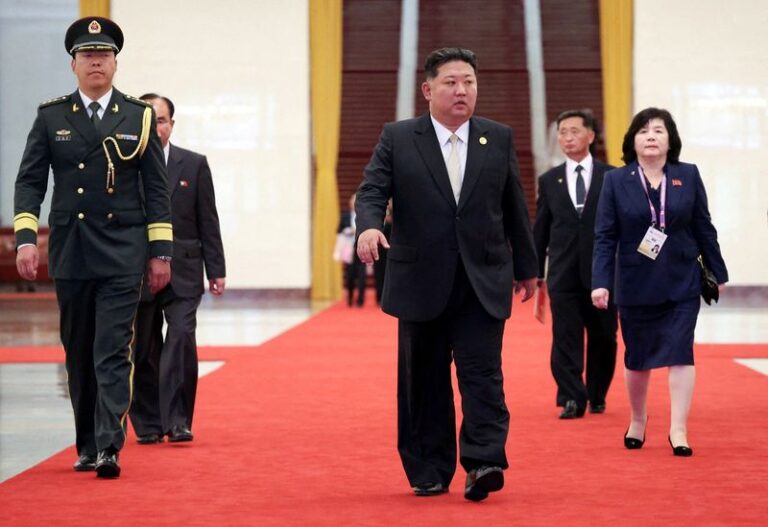
Kim Jong Un of North Korea welcomes troops abroad during founding day address.

0

North Korea's Kim Jong Un greets troops overseas on founding day speech

New Cotton Fabric Could Potentially Filter Out Carbon: A Novel Approach to Carbon Sequestration Methods

0

Until clean energies such as solar, wind, or green hydrogen become mainstream, a policy of environmental damage mitigation is needed. This includes strategies such as using bacteria to clean up oil spills or carbon sequestration methods2 such as mineralization.

One of the latest additions to the catalog of methods for carbon sequestration is a new type of fabric developed by the University of North Carolina, which also produces a substance that we use daily. To do so, they have used basic materials such as cotton or an extract of crustaceans with very positive results since more than 80% of the CO2 generated is eliminated.

A cotton filter, a new carbon sequestration method

When the team of U.S. scientists sat down to develop this innovative carbon sequestration method, their initial approach was to create a passive technology that would not require energy. So they turned their attention to developing a filter that could be easily installed. The result of their research is a cotton textile with a unique feature: the use of carbonic anhydrase, an enzyme ubiquitous in living organisms that allows Carbon dioxide to be transported in the blood or photosynthesis to be carried out in plants. But what were the stages of the development process?

  1. The first step was to use a double-layer cotton fabric soaked in a chitosan solution. This extract, from custacean shells, is composed of a polysaccharide called chitin, which is similar to cellulose and has absorbent effects.
  2. Carbonic anhydrase enzyme was added and remained attached to the chitosan.
  3. An environment similar to that of a thermal power plant was simulated with a jet of air containing carbon dioxide and nitrogen.
  4. The material was rolled into a tube through which air mixed with a water-based solution was passed.
  5. Carbon dioxide, upon reaction with water and anhydrase, was converted to bicarbonate.

The results were quite encouraging, with a double filter removing up to 81.7% of the carbon dioxide at a flow rate of four liters per minute. The amount of water is far from a real industrial environment. In real-world conditions, the figures are over ten million liters per minute.

However, the University of Carolina scientists believe that their method for carbon sequestration is scalable and will have commercial applications in the fight against climate change. In addition, they found that the filters maintained their properties after five washing cycles.

Another issue to be resolved is recycling the water solution with which the gas is mixed once it has passed through the filter. The idea is that this part of the process does not require much energy either.    

Carbonic anhydrase: the magic enzyme

The developers of the new filter have described it as “wonderful.” And, if it sounds familiar to you, maybe it is because you have already read some of our articles about it. We are talking about carbonic anhydrase. Numerous applications of this enzyme have been explored in recent years, many of them in medicine. However, one of the most striking is related to construction.

As noted in this article, its use is being investigated in new types of self-repairing bioconcrete, which also offers a new method for carbon sequestration. Anhydrase, being a catalyst that reacts in the presence of carbon dioxide and converts it into calcium carbonate (or bicarbonate), allows cracks in concrete to be sealed when the material is exposed to air and moisture. And it also removes carbon dioxide.

If you want to learn more about carbon sequestration methods to combat climate change, we recommend this article on artificial photosynthesis or this one on a prototype of tires with moss. Of course, you can also subscribe to our newsletter at the bottom of this page.          

Sources:

Second-largest mining deal ever announced: Anglo American and Teck Resources to merge | Mining News

0

London-listed miner Anglo American and Canada’s Teck Resources plan to merge, marking the sector’s second-biggest mergers and acquisitions deal ever and forging a new global copper-focused heavyweight.

Under the proposed deal, which will require regulatory approvals and was announced on Tuesday, Anglo American shareholders will own 62.4 percent of the new company, Anglo Teck, while shareholders in Teck would hold 37.6 percent.

Recommended Stories

list of 4 itemsend of list

Anglo Teck will be headquartered in Canada but have a primary stock listing in London, said the two companies whose combined market capitalisation exceeds $53bn.

The deal to form the world’s fifth-largest copper company is also a big bet on copper by Anglo. Glencore’s $90bn merger with Xstrata in 2013 remains the largest mining deal in history.

Copper, used in the power and construction sectors, is set to benefit from burgeoning demand spurred by electric vehicles and artificial intelligence.

Miners have raced to develop new projects, and there has been a flurry of takeover bids, though no major acquisition has so far succeeded.

Both Anglo and Teck have undergone significant restructuring in recent years, driven by external takeover attempts and strategic shifts within the mining industry.

On the potential of a bidding war for this deal, Teck CEO Jonathan Price told the Reuters news agency that the outcome was out of the company’s control.

Anglo faced a $53bn takeover bid from BHP last year that was ultimately rejected by its board. Teck rejected a $22.5bn takeover offer from Glencore in 2023, though it sold its steelmaking coal business to Glencore for $6.93bn.

“We cannot speculate on that [bidding war], and that is not something we can control. We are focused on getting approval for bringing Anglo and Teck together,” Teck’s Price said.

He said the deal creates “a much larger and much better, higher-quality copper, iron ore, and zinc business”, for shareholders.

“I think the deal itself is a very strong defence,” said one source with knowledge of the negotiations between Anglo and Teck.

The transaction has a zero-premium, all-share structure.

That lack of a premium could open the door to rival bids, but Anglo’s shareholders will receive a $4.5bn special dividend.

“Interloper risk will be a big question for the market on this deal,” Berenberg analysts wrote in a note, adding that Glencore and BHP, notably, could still step in.

While Anglo and Teck can still consider unsolicited acquisition proposals, a $330m break fee would apply.

“This is a consolidation that makes sense and brings complementary cultures together,” said Adam Matthews of the Church of England Pensions Board, an Anglo shareholder.

“Both companies are ones we hold high regard for, and the industry will be stronger for this move,” he said.

Anglo CEO Duncan Wanblad will retain that post in the new company, while Teck’s Jonathan Price will be deputy CEO.

Wanblad, speaking to journalists from Vancouver, called the deal a “true merger of equals”, adding that Anglo Teck’s board would be drawn equally from the two companies’ existing directors.

“We will have a stronger, more resilient financial platform with scale advantages, including greater flexibility to reallocate capital dynamically to the highest returning opportunities,” he said.

Cost savings

The tie-up is expected to generate annual cost savings and efficiency gains of $800m by the fourth year after completion, Anglo said.

“As a merger, we absolutely get to draw on the best of both, and we don’t really need to pay away anything on either side in terms of premium to get the full benefit,” Wanblad said.

The two companies operate adjacent copper mines in Chile – Quebrada Blanca and Collahuasi – which is expected to deliver further operational benefits.

Quebrada Blanca is Teck’s flagship mine, but a tailings issue that relates to the disposal of mine waste has seen it miss production guidance, dragging down the company’s shares.

Teck’s Price said securing the regulatory approvals for the deal could take between 12 and 18 months. He added that Canada’s Keevil family, which owns a majority of Teck’s A-class shares, backed the deal.

“We have irrevocable support from Dr. [Norman] Keevil and the other A-share voters,” he said.

A source close to the deal said that the decision to maintain the new company’s headquarters in Canada, safeguarding Teck’s “Canadian legacy”, would likely help ease the way for regulatory approval by authorities there.

Canadian officials had shown hostility to Glencore’s previous bid to acquire Teck, and the source said such concessions in the new deal could help fend off rival bids from companies unwilling to include similar proposals.