A required part of this site couldn’t load. This may be due to a browser
extension, network issues, or browser settings. Please check your
connection, disable any ad blockers, or try using a different browser.
Yogita LimayeSouth Asia and Afghanistan correspondent
Aakriti Thapar / BBC
When Shahnaz went into labour, her husband Abdul called a taxi to take them to the only medical facility accessible to them.
“She was in a lot pain,” he says.
A 20-minute drive away, the clinic was in Shesh Pol village in Afghanistan’s north-eastern Badakhshan province. It was where their two older children were born.
Abdul sat next to Shahnaz comforting her as they drove over gravel tracks to reach help.
“But when we reached the clinic, we saw that it was closed. I didn’t know it had shut down,” he said, his face crumpling with agony.
Warning: Readers may find some details in this article distressing.
The clinic in Shesh Pol is one of more than 400 medical facilities that closed down in Afghanistan, one of the world’s poorest countries, after the Trump administration cut nearly all US aid to the country earlier this year, in a drastic and abrupt move following the dismantling of the US Agency for International Development (USAID).
A single-storey structure with four small rooms, white paint peeling off its walls, the Shesh Pol clinic has USAID posters tacked up everywhere with information and guidance for pregnant women and new mothers.
Aakriti Thapar / BBC
Shesh Pol maternity clinic is one of hundreds of medical facilities forced to close as a result of US aid cuts in Afghanistan
It doesn’t look like much but in Badakhshan’s mountainous, unforgiving terrain, where a lack of access has been a major reason for historically high maternal mortality rates, the clinic was a critical lifeline, part of a wider programme implemented during the tenure of the US-backed government in the country, to reduce maternal and newborn deaths.
It had a trained midwife who assisted around 25-30 deliveries every month. It had a stock of medicines and injections, and it also provided basic healthcare services.
Other medical facilities are simply too far from Abdul’s village, and it was not without risk for Shahnaz to travel on bumpy roads. Abdul also didn’t have money to pay for a longer journey – renting the taxi cost 1,000 Afghani ($14.65; £12.70), roughly a quarter of his monthly income as a labourer. So they decided to return home.
“But the baby was coming and we had to stop by the side of the road,” Abdul said.
Shahnaz delivered their baby girl in the car. Shortly after, she died, bleeding profusely. A few hours later, before she could be named, their baby also died.
Aakriti Thapar / BBC
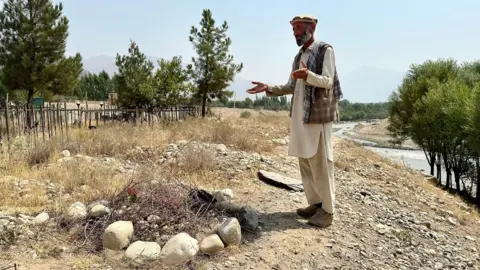
Abdul spoke to the BBC about the traumatic deaths of his wife and newborn baby, who are buried in Shesh Pol
“I wept and screamed. My wife and child could’ve been saved if the clinic was open,” said Abdul. “We had a hard life, but we were living it together. I was always happy when I was with her.”
He doesn’t even have a photo of Shahnaz to hold on to.
There’s no certainty the mother and baby would’ve survived if they’d been treated at the clinic, but without it, they didn’t stand a chance, underlining the undeniable impact of US aid cuts in Afghanistan.
For decades, America has been the largest donor to Afghanistan, and in 2024, US funds made up a staggering 43% of all aid coming into the country.
The Trump administration has justified withdrawing it, saying there were “credible and longstanding concerns that funding was benefiting terrorist groups, including… the Taliban”, who govern the country. The US government further added that they had reports stating that at least $11m were “being siphoned or enriching the Taliban”.
The Taliban government denies that aid money was going into their hands.
“This allegation is not true. The aid is given to the UN, and through them to NGOs in provinces. They identify who needs the aid, and they distribute it themselves. The government is not involved,” said Suhail Shaheen, the head of the Taliban’s political office in Doha.
BBC visits closed down US-backed clinic in Afghanistan after aid cuts
The Taliban government’s policies, especially its restrictions on women, the harshest in the world, have meant that after four years in power, it is still not recognised by most of the world. It’s also a key reason donors have been increasingly walking away from the country.
The US insists no one has died because of aid cuts. Shahnaz and her baby’s deaths are not recorded anywhere. Neither are countless others.
The BBC has documented at least half a dozen first-hand, devastating accounts in areas where USAID-supported clinics have shut down.
Right next to Shahnaz’s grave, villagers who had gathered around us pointed to two other graves. They told us both were of women who died in childbirth in the past four months – Daulat Begi and Javhar. Their babies survived.
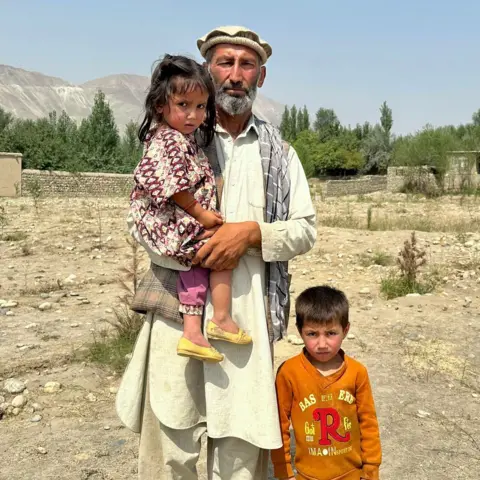
Not far from the graveyard, we met Khan Mohammad whose wife, 36-year-old Gul Jan, died in childbirth five months ago. Their baby boy Safiullah died three days later.
Aakriti Thapar / BBC
Khan Mohammad also lost his wife and newborn after the Shesh Pol clinic shut down, leaving his children without a mother
“When she became pregnant, she would go to the clinic for check-ups. But midway through her pregnancy it shut down. During the delivery she had a lot of pain and blood loss,” Khan Mohammad said. “My children are sad all the time. No one can give them the love of a mother. I miss her every day. We had a sweet and loving life together.”
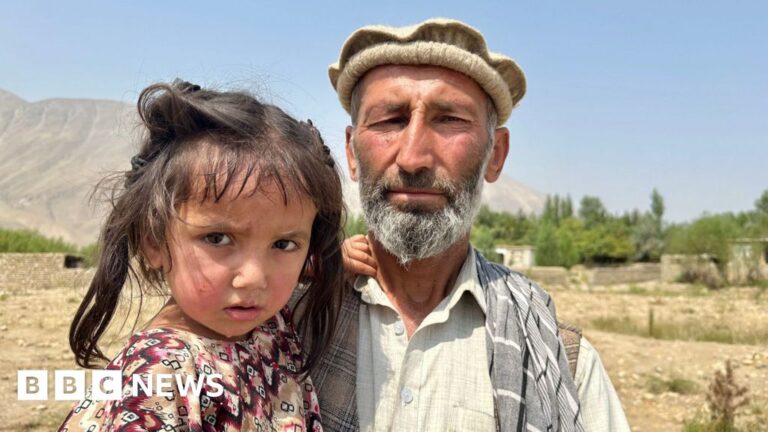
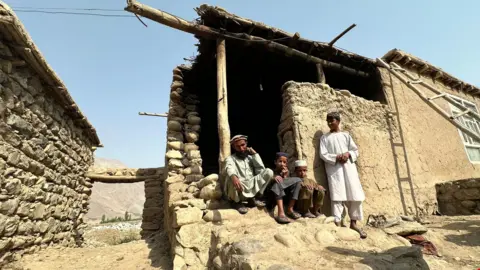
A roughly five-hour drive from Shesh Pol, inCawgani, another village where a USAID-backed clinic closed down, Ahmad Khan, the grief-stricken father of Maidamo showed us the room in their mud and clay home where she died giving birth to baby Karima.
Aakriti Thapar / BBC
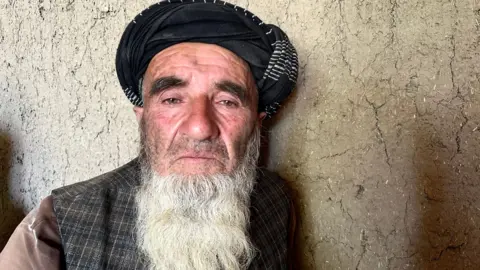
Ahmad Khan blames the US decision to pull funding after his daughter Maidamo died during childbirth
“If the clinic had been open, she might have survived. And even if she had died, we would not have had regrets knowing the medics tried their best. Now we’re left with regret and pain. America did this to us,” he said, tears rolling down his face.
In another home a few lanes away, Bahisa tells us how terrifying it was to give birth at home. Her three other children were born in the Cawgani clinic.
“I was so scared. In the clinic, we had a midwife, medicines and injections. At home I had nothing, no painkillers. It was unbearable pain. I felt like life was leaving my body. I became numb,” she said.
Her baby girl, named Fakiha, died three days after she was born.
Aakriti Thapar / BBC
Bahisa had to give birth without access to painkillers, a midwife or medicine after the Cawgani clinic closed
The closure of clinics in villages has resulted in a surge of patients at the maternity ward of the main regional hospital in the provincial capital Faizabad.
Getting to it, through Badakhshan’s treacherous landscape is risky. We were shown a horrifying photo of a newborn baby, who was delivered on the way to Faizabad, and whose neck snapped before he got to the hospital.
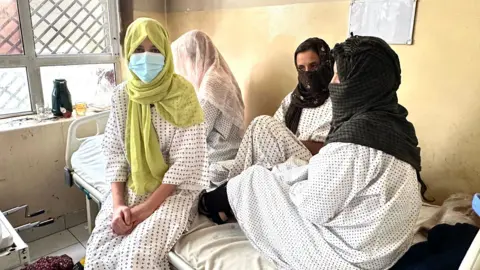
We had visited the hospital back in 2022, and while it was stretched then, the scenes we saw this time were unprecedented.
In each bed, there were three women. Imagine having gone into labour, or just having gone through a miscarriage, and not even having a bed to yourself to lie in.
Aakriti Thapar / BBC
Zuhra Shewan (left) suffered a miscarriage at Faizabad hospital, where patients severely outnumber beds
It’s what Zuhra Shewan, who suffered a miscarriage, had to endure.
“I was bleeding severely and didn’t even have a place to sit. It was really hard. By the time a bed is free, a woman could die bleeding,” she said.
Dr Shafiq Hamdard, the director of the hospital, said: “We have 120 beds in the hospital. Now we’ve admitted 300 to 305.”
While the patient load is swelling, the hospital, too, has faced sharp cuts in its funding.
“Three years ago our annual budget was $80,000. Now we have $25,000,” Dr Hamdard said.
By August this year, there had been as many maternal deaths recorded as there were for the whole of last year. Which means that at this rate, maternal mortality could increase by as much as 50% over last year.
Newborn deaths have already increased by roughly a third in the past four months, compared with the start of the year.
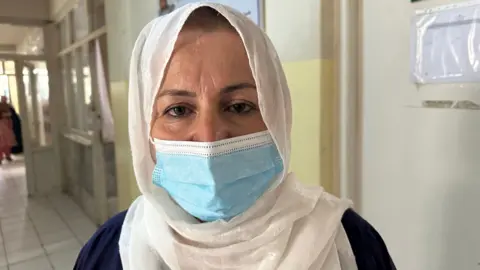
Razia Hanifi, the hospital’s head midwife, says she’s exhausted. “I have been working for the past 20 years. This year is the toughest, because of the overcrowding, the shortage of resources and the shortage of trained staff,” she said.
Aakriti Thapar / BBC
Midwifes like Razia Hanifi face extremely tough working conditions amid shortages of staff, which are likely to worsen after the Taliban banned midwifery training for women
But no reinforcements are coming because of the Taliban government’s restrictions on women. Three years ago, all higher education, including medical education was banned for women. Less than a year ago, in December 2024, training for midwives and female nurses was also banned.
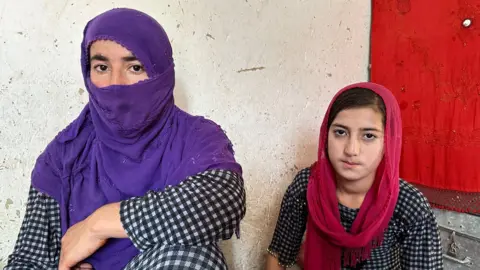
At a discreet location, we met two female students who were midway through the training when it was closed. They didn’t want to be identified for fear of reprisal.
Anya (name changed) said they both were in graduate courses at university when the Taliban took over. When those were closed in December 2022, they began midwife and nursing training, as it was the only path left to getting an education and a job.
“When that was also banned, I became depressed. I was crying day and night, and I wasn’t able to eat. It’s a painful situation,” she said.
Karishma (named changed) said: “There is already a shortage of midwives and nurses in Afghanistan. Without more being trained, women will be forced to give birth at home which will put them at risk.”
We asked the Taliban government’s Suhail Shaheen how they can justify bans which effectively curb access to health for half the population.
“It is our internal issue. These are our issues, how to handle them, how to consider them, how to take decisions, this is something internal. That is up to the leadership. Based on the needs of the society, they will take a decision,” he said.
With their access to medical services severely restricted, by wave after wave of crushing blows, for Afghanistan’s women, their right to health, and life itself, is at grave risk.
British boxing icon Ricky Hatton has died at 46, sparking tributes from across sport.
Published On 14 Sep 202514 Sep 2025
Share
Former boxing world champion Ricky Hatton has died aged 46, Greater Manchester Police in the United Kingdom have confirmed.
Hatton, who was known to fans as “the Hitman”, was discovered at his home in Hyde, near Manchester, early on Sunday morning. Police said: “Officers were called by a member of the public to attend Bowlacre Road, Hyde, Tameside, at 6:45am [05:45 GMT] today where they found the body of a 46-year-old man. There are not currently believed to be any suspicious circumstances.”
Recommended Stories
list of 3 itemsend of list
The Manchester-born fighter became one of Britain’s most celebrated boxers, winning world titles at light-welterweight and welterweight. During a 15-year professional career, he secured 45 wins from 48 bouts before retiring in 2012.
Hatton’s death prompted an outpouring of tributes from the sporting world.
Former England and Manchester United midfielder David Beckham posted on Instagram: “Ricky was one of a kind. Just heartbreaking.” Heavyweight champion Tyson Fury wrote: “RIP to the legend Ricky Hatton. There will only ever be one Ricky Hatton. Can’t believe this – so young.”
Football figures also paid respect to the lifelong Manchester City supporter. Before City’s Premier League match against Manchester United on Sunday, the Etihad Stadium held a minute’s applause, with fans chanting his name.
City manager Pep Guardiola described him as “a true champion” and “part of the Man City family”. Wayne Rooney, who once carried Hatton’s belts into the ring, said on X that he was “devastated”, calling him “a legend, a warrior and a great person”.
Hatton’s career featured memorable victories over Kostya Tszyu and Jose Luis Castillo, while his only defeats came against boxing greats Floyd Mayweather and Manny Pacquiao.
In recent years, Hatton remained close to the sport. He attempted a comeback in 2012, fought in an exhibition with Marco Antonio Barrera in 2022, and earlier this year announced plans to face Eisa Al Dah in Dubai. He also spoke openly about his battles with depression and featured in the 2023 documentary Hatton, which explored his personal struggles and mental health.
Fitter and Faster Swim Camps is the proud sponsor of SwimSwam’s College Recruiting Channel and all commitment news. For many, swimming in college is a lifelong dream that is pursued with dedication and determination. Fitter and Faster is proud to honor these athletes and those who supported them on their journey.
Peyton Kerby of Flower Mound, Texas, has committed to swim and study at Queens University, beginning in the 2026–2027 school year. She trains year-round with Lakeside Aquatic Club and attends Keller High School.
Kerby, who specializes in freestyle and IM, publicized the commitment on SwimCloud:
I am beyond thrilled to announce my verbal commitment to continue both my academic and athletic journey at Queens University of Charlotte! This is truly a dream come true, and I am so grateful for everyone who helped make this possible. To my amazing parents, your constant love, support, and sacrifices mean the world to me. I couldn’t do this without you. A huge thank you to Coach Jason, Coach Dan, and everyone at Lakeside for welcoming me and always pushing me to grow. Thank you to Coach Jeff and the entire Queens coaching staff for giving me this opportunity to be a part of building the Royals legacy! And above all, all glory to God for guiding me every step of the way. GO ROYALS!
The future Royal specializes in middle-distance freestyle as well as both IM events. Her lifetime bests all date back to 2023, when she posted times of 1:54.95, 5:02.93, and 17:19.00 in the 200, 500, and 1650 free, respectively, along with 2:12.31 in the 200 IM and 4:29.88 in the 400 IM.
She wrapped up this past short course season at Speedo Sectionals in Justin, which were both held in early March. Her top finish came in the 1000 free, where she placed 43rd in 10:52.27. She also took 57th in the 500 free (5:17.93), 80th in the 400 IM (4:44.08), 86th in the 200 free (1:59.47), and 87th in the 200 IM (2:14.87).
Many of Kerby’s top swims from the 2024–25 season came at the NT COPS 43rd Annual Greater Southwest Invitational in January, where she clocked a 5:12.38 in the 500 free and 4:39.15 in the 400 IM.
She owns season bests of 1:59.19 in the 200 free and 2:12.54 in the 200 IM, both from separate meets in December. Notably, she hasn’t raced the mile in over a year and a half.
Top SCY Times:
200 Freestyle: 1:54.95
500 Freestyle: 5:02.93
1650 Freestyle: 17:19.00
200 IM: 2:12.31
400 IM: 4:29.88
Queens University is a Division I school in North Carolina, is led by 16 year head coach Jeff Dugdale. At the 2025 ASUN Championships, the Queens women finished third out of seven teams
At the 2025 conference meet, which offered ‘A’ and ‘B’ finals, it took times of 1:52.08 and 5:04.88 to make the top 16 in the 200 and 500 free, while times of 2:05.97 and 4:32.88 were required in the IMs. This means she enters as an immediate scoring threat in the 500 free and 400 IM, assuming she is able to approach near her PBs.
In the 1650 free, her PB of 17:19.00 would have placed her sixth last year, garnering a whopping 13 points for the Royals. That event is where she will likely have the most impact when she arrives on campus next fall.
According to the team’s 2024–25 depth chart, Kerby’s bests would have situated her second in the 1650 free, fifth in the 400 IM, sixth in the 500 free, eighth in the 200 IM, and ninth in the 200 free. Junior Katherine Bailey was the swiftest miler with the 16:57.52 clocking that earned her bronze at the ASUN Championships.
Kerby joins Emily Heintz and Grace Marsaa in committing to the university’s recruiting class of 2030.
If you have a commitment to report, please send an email with a photo (landscape, or horizontal, looks best) and a quote to Recruits@swimswam.com.
About the Fitter and Faster Swim Tour
Fitter & Faster Swim Camps feature the most innovative teaching platforms for competitive swimmers of all levels. Camps are produced year-round throughout the USA and Canada. All camps are led by elite swimmers and coaches. Visit fitterandfaster.com to find or request a swim camp near you.
California’s intriguingly named Puckipuppy has unleashed a heavy hauling electric trike called the Rottweiler that boasts a 960-watt peak motor, torque sensor, 55-mile battery and full suspension.
The company says that the Rottweiler was designed to solve e-trike problems such as “weak power under load, bumpy rides, unstable turns, tricky reversing…”
Its 750-W motor peaks at 960 watts to deliver “plenty of power for hills and heavy loads” though the top pedal-assist speed is limited to 15 mph (25 km/h). This is pretty common for e-trikes, though we have seen models that crank up to 20 mph when unlocked.
The Rottweiler features a stop-and-hold parking brake
Puckipuppy
Riders benefit from a responsive torque sensor for power as soon as they pedal down, plus 7-speed Shimano shifting for more flexibility during the ride. A handy reverse button – an industry first – takes some of the stress out of backing into a garage or parking spot. And the trike’s 720-Wh battery is reported to offer between 40 and 55 miles (64 – 88.5 km) of per-charge range.
A low-step 6061 alloy frame makes for easy access, and a padded seat with backrest aims for rider comfort. Puckipuppy has paired a suspension fork with dual shocks to the rear to help smooth over bumps along the way, while chunky fat tires will see this beast tackle a variety of surfaces without grumbling.
The trike is rated for hauling a maximum payload of 500 lb (226.8 kg), including the rider and cargo – which could be groceries, kids or camping gear. It features a funky ‘butterfly’ handlebar with center dash that “better matches the natural angle of your arms and allows multiple grip positions” while promoting an upright riding stance. This dash area is home to a 4.7-inch color display for quick status checks on speed, battery level, PAS mode and lighting.
“The Rottweiler features an ergonomically designed butterfly-style handlebar. Compared to traditional straight or curved bars, it better matches the natural angle of your arms and allows multiple grip positions”
Puckipuppy
The Rottweiler rolls on 20-inch wheels wearing 4-inch fat tires, and rather than the rear wheels spinning at the same speed during turns – which can cause slipping or tipping – this model employs a rear differential for safer handling. Stopping power is provided by hydraulic disc brakes, plus there’s a one-touch parking brake as well. Rounding out the key specs are dual-beam front lights and rear lighting with turn signaling.
The Rottweiler is available now and carries a ticket price of US$3,349.99 – though there’s currently a promotion running that shaves a thousand bucks off. Either way, that’s a good deal more expensive than the similarly powered (but folding) XP Trike2 750 from Lectric, but in the same ball park as Velotric’s Triker model.
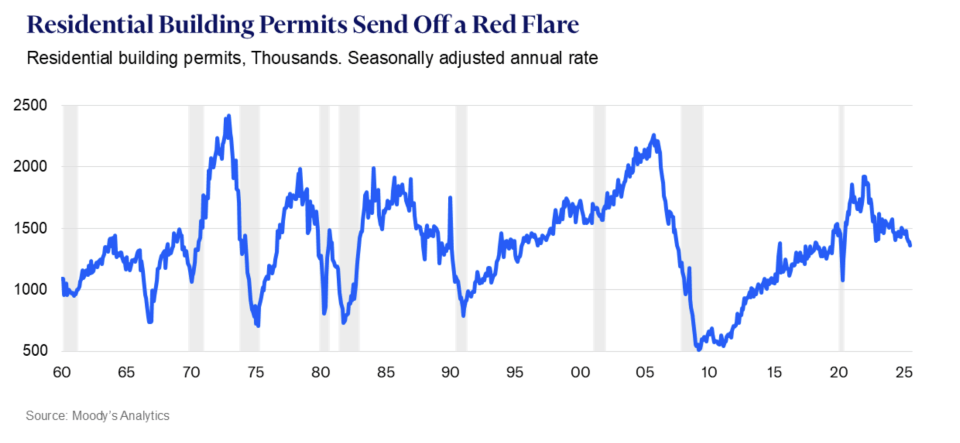
The housing market is long been seen as an early warning sign for recessions, and one data point in particular has caught the attention of Moody’s Analytics chief economist Mark Zandi.
Even though it’s less than 50%, Zandi pointed out that the probability has never been that high previously without the economy eventually slipping into a downturn.
A crucial component in the Moody’s indicator comes from the housing market.
“The algorithm has identified building permits as the most critical economic variable for predicting recessions. And while permits had been holding up reasonably well, as builders supported sales through interest rate buydowns and other incentives, inventories of unsold homes are now high and on the rise,” Zandi warned.
“In response, builders are pulling back, and permits have started to slump. They are now as low as they’ve been since the pandemic shutdowns.”
Last month, the Census Bureau reported that residential building permits in July were at a seasonally adjusted annual rate of 1.35 million, down 2.8% from the prior month and down 5.7% from a year ago.
In July, Zandi singled out the housing market for concern, escalating it to a “red flare” as home sales, homebuilding, and house prices were getting squeezed by elevated mortgage rates.
While the 30-year fixed rate has since come down from near 7% to about 6.3%, it’s not clear yet if that’s low enough to revive builders or how much it will continue to drop. On Sunday, Zandi said all eyes should be on August permit data, which will come out on Wednesday.
“They are sure to provide another reason why the Fed should and will announce a rate cut later that day,” he predicted.
And not only did housing show up on the Fed’s radar, officials flagged it as a potential risk to jobs, along with artificial intelligence technology.
“In addition to tariff-induced risks, potential downside risks to employment mentioned by participants included a possible tightening of financial conditions due to a rise in risk premiums, a more substantial deterioration in the housing market, and the risk that the increased use of AI in the workplace may lower employment,” the minutes said.
Permits aren’t the only housing market data point to follow. The economist Ed Leamer, who passed away in February, famously published a paper in 2007 that said residential investment is the best leading indicator of an oncoming recession.
On that score, the data doesn’t look good either. In the second quarter, residential investment tumbled 4.7%, accelerating from the first quarter’s 1.3% decline.
Fortune Global Forum returns Oct. 26–27, 2025 in Riyadh. CEOs and global leaders will gather for a dynamic, invitation-only event shaping the future of business. Apply for an invitation.
Riders have crashed as a result of the protests, with some saying they have been worried for their safety.
Last week, Israel-Premier Tech began racing in modified jerseys which did not display their team name.
Organisers said: “It is still unknown whether there will be a winning ceremony with the situation as it is, with thousands of protesters filling downtown Madrid.
“The race has been officially ended and Jonas Vingegaard is the winner.”
Clashes continued after the race was abandoned, with protesters throwing bottles of water and other objects at police.
Race organisers had already shortened the 21st and final stage of the Vuelta from 111.6km to 103.6km.
Organisers did not specify a reason for the section removed, which would have crossed the plush Madrid neighbourhood of Aravaca.
The protests come in the wake of the Israeli military launching a campaign in Gaza in response to the Hamas-led attack on southern Israel on 7 October 2023, in which about 1,200 people were killed and 251 others were taken hostage.
Speaking before Sunday’s final stage, Spanish Prime Minister Pedro Sanchez said he admired the protesters.
“Today marks the end of the Vuelta,” Sanchez told a socialist party rally in the southern city of Malaga. “Our respect and recognition for the athletes and our admiration for the Spanish people who are mobilising for just causes like Palestine.”
Five-time Grammy nominated singer-songwriter Shaboozey and his label EMPIRE have teamed up to establish an independent record label called American Dogwood.
The new label is described as “inspired by the culture and traditions of Virginia and the greater Mid-Atlantic“.
American Dogwood’s first signee is Nashville songwriter KevinPowers, whose co-writing credits include Shaboozey‘s recent collaboration with Jelly Roll on Amen. The track has accumulated over 50 million streams within three months of its release. Powers also has viral singles including Walked In and How You Been?
To mark the launch of American Dogwood, Shaboozey and Powers are releasing a new song called Move On on September 19. Powers will also serve as opener for Shaboozey’s upcoming 12-city The Great American Roadshow Tour, beginning September 22 in Indianapolis.
The launch of Shaboozey’s own label in partnership with EMPIRE follows his commercial breakthrough with A Bar Song (Tipsy), which achieved 8x RIAA-Platinum certification and was recognized as the longest-leading Hot 100 No. 1, while also topping Billboard’s Hot Country Songs, Country Airplay Chart, and Mediabase/Country Aircheck charts.
A Bar Song (Tipsy) also established Shaboozey as the first Black male artist to simultaneously top Billboard’s Hot Country Songs and Hot 100 charts. It rankedNo. 7 on PPL‘s ranking of the most-played track across UK radio, TV and public venues in 2024.
Shaboozey was also featured on Beyoncé’sCOWBOY CARTER. His latest record, Where I’ve Been, Isn’t Where I’m Going, debuted in the Top 5 of the Billboard 200.
Shaboozey co-founded American Dogwood with longtime collaborators JaredCotter and AbasPauti, who manage several multi-platinum artists. EMPIRE will provide global infrastructure and support to the partnership, building on a similar relationship with Shaboozey.
Credit: Daniel Prakopcyk;
“American Dogwood is a tribute to where we come from, and to the artists, storytellers, and creators who make this life remarkable.”
Shaboozey
Commenting on the launch, Shaboozey said: “American Dogwood is a tribute to where we come from, and to the artists, storytellers, and creators who make this life remarkable.
“Our mission is to nurture the next generation of voices and to give them a place to grow, connect, and create. This is the beginning of a new chapter – one I hope always feels like home.”
Powers added: “I couldn’t be more excited to join the American Dogwood family. My first release, Move On featuring Shaboozey, is about what happens when a relationship ends – how some people can let go, while others hold on longer than they should.
“It’s a story I think a lot of people will connect with, and I couldn’t imagine a better way to begin this journey than sharing it with Shaboozey by my side.”
For EMPIRE, the deal marks its latest partnership after teaming up with Cambodian music company BarameyProduction in April to break Cambodian artists globally.
In February, the San Francisco-based independent label, distribution and publishing company made a strategic investment in artist marketing platform un:hurd.
When children are deprived of sufficient food, a cascade of health failures can quickly follow. Critical illness and death threaten, and even those who survive may face a lifetime of health challenges.
Young Palestinians, particularly those under age 5, are especially vulnerable in the Gaza Strip, where Israel has imposed restrictions on the entry of aid throughout the war, at times shutting crossings entirely. The highest levels of malnutrition since the war began were reported this summer, and its largest city has been officially declared under famine by a panel of food-security experts.
Note: Children were between the ages of 6 months and 5 years and were screened by a group of aid agencies coordinated by UNICEF called the Nutrition Cluster. The I.P.C. analyzed that data. Data for Gaza City includes its surrounding region. More children may have malnutrition than are treated for it because of limited screening and treatment capacity.
Food and other critically needed supplies began trickling back into Gaza in May after an 11-week blockade imposed by Israel. It wasn’t enough. In July, food consumption hit its lowest point since the war began, according to the Integrated Food Security Phase Classification, a U.N.-backed group of experts who monitor world hunger.
More aid has gone into Gaza since then. But food shortages remain widespread, and for some of the most vulnerable Gazans, the damage may already have been done.
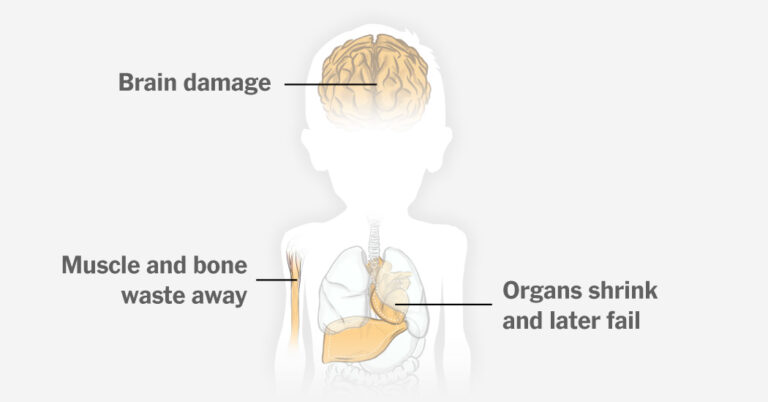
When children are severely malnourished, their bodies draw on reserves to wage a last-ditch battle for survival. Eventually, their organs begin to break down.
Sometimes they become skeletally thin. Other times they swell up. They can be lethargic to the point of motionlessness, and stop eating even if there is food, because eating takes energy they don’t have. As their defense systems begin to fail, they may die suddenly from common diseases that a healthier child might withstand.
This is what happens to a malnourished body.
When children are experiencing acute malnutrition, most regular foods won’t reverse the process.
The World Health Organization recommends that acutely malnourished children be fed energy-dense foods, such as nut butters and sweet potatoes, and sometimes these can be found locally.
But they are not always readily available in Gaza, where markets and farms have been destroyed. Children there need a specially formulated therapeutic food: an enriched milk, for very young children, or a peanut-based product packed with calories, vitamins and nutrients. The W.H.O. also recommends a broad-spectrum antibiotic to treat infections.
The most seriously malnourished children need to be treated in a hospital, in part because they have no appetite and their bodies are trying to conserve energy. These children are fed specially formulated milk, often through a nasal-gastric tube.
Sharif Matar, a pediatrician at al-Rantisi Children’s Hospital in northern Gaza, said doctors were struggling to cope with a shortage of that enriched milk. While more is available now than even a month ago, health workers still find themselves rationing it to make sure the most severe cases have enough, he said in an interview in late August.
“We are trying to do our best with what we can,” Dr. Matar said. “But in terms of the quality or quantity of what’s available, it’s not enough.”
A child being treated for malnutrition at al-Rantisi Children’s Hospital.
Saher Alghorra for The New York Times
Throughout the war, Israeli officials have consistently played down the severity of hunger in Gaza. Prime Minister Benjamin Netanyahu’s office called the recent Gaza City famine declaration “an outright lie,” and said the experts behind the famine report had overlooked Israeli efforts since late July to bring more food into the territory.
Aid officials, however, say those measures fall short of what is needed. During the first two weeks of August, the U.N. said nearly 6,000 children out of more than 58,000 screened were found to be acutely malnourished.
Gaza’s doctors are not used to handling such acute malnutrition, said Dr. Matar, as the enclave has never faced a crisis this severe. Some clinicians at his hospital have been taking emergency classes organized by the W.H.O., while others were trying to read whatever they could on how to treat it, he said.
Health officials in Gaza say dozens of children have died of malnutrition since June, but it is not clear how many of them were suffering from both malnutrition and other illnesses or preexisting conditions. Children suffering from malnutrition can be more susceptible to contracting other illnesses, and children with preexisting conditions can be more vulnerable to becoming malnourished, experts say.
Some of the children who get treatment have recovered, including one critically ill 5-year-old girl who was saved with therapeutic milk, Dr. Matar said.
For a child, food is not just energy for the day at hand. It’s the essential building block for a life ahead, needed for the development of muscle, bone and brain.
A nurse examining a child for malnutrition at Nasser Hospital in Khan Younis.
Ramadan Abed/Reuters
Even if children experiencing severe malnutrition receive effective treatment and survive, they may suffer from stunted growth, soft bones, liver and kidney problems and cognitive issues. Over the longer term, there may be increased risk of stroke, diabetes and heart disease.
Given the widespread lack of food in Gaza, treating even a single child can at times feel Sisyphean, said Jamil Suleiman, the director of al-Rantisi Children’s Hospital. Some have been released from care to tent encampments where their parents are still struggling to find enough food, Dr. Suleiman said.
“Some of the children we release come back with the same problems a week later,” he said.


 Aakriti Thapar / BBC
 Aakriti Thapar / BBC
 Aakriti Thapar / BBC
 Aakriti Thapar / BBC
 Aakriti Thapar / BBC
 Aakriti Thapar / BBC
 Aakriti Thapar / BBC
 Aakriti Thapar / BBC