-4.1 C
New York
Monday, March 2, 2026
Home Blog Page 392

Kashmir Growers Helplessly Watch Apples Rot as Key Highway Blockage Causes Waste | Agriculture News

0

Srinagar, Indian-administered Kashmir – A distraught Javid Ahmad Bhat fears he may lose the entire year’s earnings from the apples he grows.

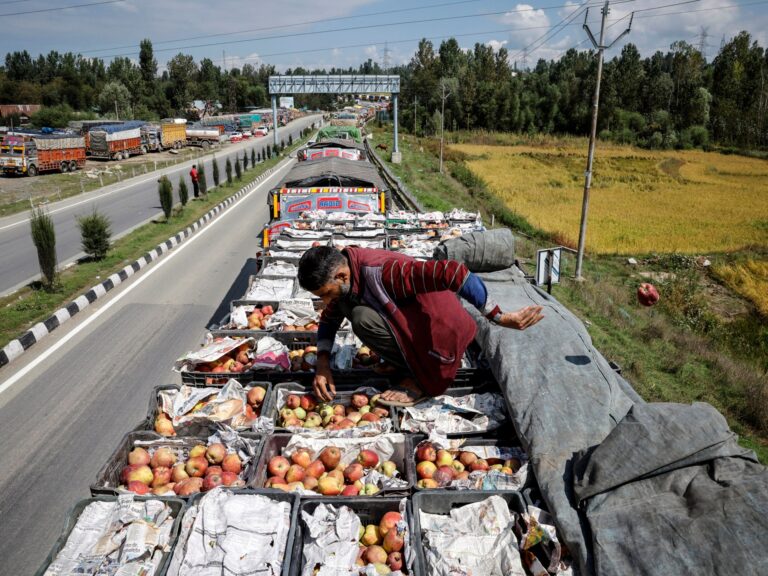
Two trucks bearing his apples worth more than $10,000 are among rows of stranded carriers that stretch for miles along a key highway connecting his city, Baramullah, in Indian-administered Kashmir to the remainder of India. Their tarpaulin covers bulge with crates of fruits that have begun to blacken and collapse under the weight of rot.

“All our hard work for the entire year has gone to waste. What we painstakingly nurtured since the spring is lost. No one will buy these rotten apples, and they will never reach New Delhi. We are left with no choice but to throw away both truckloads along the highway,” Bhat told Al Jazeera on Tuesday.

The Jammu–Srinagar national highway – the only all-weather road connection in the Himalayan region – has been repeatedly blocked since August 24 after rain-triggered landslides damaged a section of it. For more than a month, the region has been battered by a severe monsoon fury, killing at least 170 people and causing extensive damage to properties, roads, and other infrastructure.

A truck driver shows rotten apples in his vehicle stranded along the Jammu-Srinagar National Highway, after the highway road was closed following landslide and floods, in Qazigund town, Anantnag district, Indian Kashmir, September 10, 2025 [Sharafat Ali/Reuters]

Blockade during peak harvest season

Horticulture forms the backbone of Indian-administered Kashmir’s economy, with the valley producing about 20–25 million metric tonnes of apples every year – roughly 78 percent of India’s total apple output, according to data Al Jazeera collected from fruit growers’ associations.

The highway blockade coincides with the peak harvest season in Kashmir, locally called “harud”, during which apples, walnuts and rice are gathered from thousands of orchards and fields across the valley.

“It’s not just me or my village – this crisis [road closure] is hitting all of Kashmir’s apple growers. Our entire livelihood depends on this harvest,” said Bhat, calling it a second blow to the region’s economy this year after the Pahalgam attack in April, when suspected rebels killed 28 people, severely disrupting tourism – another key sector in the valley.

A local government official, speaking on condition of anonymity because he was not authorised to speak to the media, said about 4,000 trucks have been stranded on the highway at Qazigund area in southern Kashmir’s Anantnag district for two weeks, and the fruit loaded on them has begun to rot, resulting in estimated losses of nearly $146m.

In protest, growers shut down fruit markets across Kashmir on Monday and Tuesday as they condemned the government’s inability to clear the key road.

“If the highway stays blocked for even a few more days, our losses will skyrocket beyond imagination,” Ishfaq Ahmad, a fruit grower in Sopore town, told Al Jazeera.

Sopore in Baramulla district, about 45km (28 miles) from Srinagar, is home to Asia’s largest fruit market. But the sprawling complex was a scene of despair on Tuesday. Fresh apple crates remained piled up in an endless wait, as each passing day reduced their value, or worse, brought them closer to rotting. Some estimates said the price of an apple box had already fallen from 600 rupees ($7) to 400 rupees ($5).

“We have stopped bringing more apples to the market here. We are forced to leave them at the orchards because there is no space left, and the trucks that left earlier are still stranded on the highway,” said Ahmad.

Rotten apples lie on the ground near trucks stranded along the Jammu-Srinagar National Highway
Rotten apples lie on the ground near trucks stranded along the Jammu-Srinagar National Highway, after the highway road was closed following landslide and floods, in Qazigund town, Anantnag district, Indian Kashmir, September 10, 2025 [Sharafat Ali/ Reuters]

‘Nothing is moving’

Fayaz Ahmad Malik, president of the Kashmir fruit growers’ associationsaid about 10 percent of the trucks left for New Delhi on Tuesday after a 20-day standstill on the highway, but thousands remain stuck.

“Our preliminary estimates already run into crores [millions],” he said, adding that the government failed to take prompt action when the highway closure first began, worsening the crisis.

To address the crisis, Manoj Sinha, the region’s top official appointed by New Delhi, on September 15 launched a dedicated train from Budgam station in the central part of Indian-administered Kashmir to New Delhi to transport the fruit, claiming the move would “significantly reduce transit time, increase income opportunities for thousands of farmers, and boost the agricultural economy of the region”.

“It’s essentially a parcel coach linked to a passenger train, not a full-fledged goods train,” a railway official told Al Jazeera, on condition of anonymity because he was not authorised to speak to the media, adding that the train can carry about 23-24 tonnes of produce each day.

But farmers say the measure offers only limited relief to growers in Kashmir, who produce nearly two million tonnes of apples every year.

“It [the special train] is a positive move, but with such capacity, it will only carry roughly one truckload of apples per day, which is far less than what the growers need,” Shakeel Ahmad, an official at a fruit market in Shopian district, told Al Jazeera.

As anger and frustration over the stalled trucks mount, the region’s Chief Minister Omar Abdullah, who has limited administrative powers in a region controlled directly by New Delhi, on Tuesday said if the federal government cannot keep the highway operational, its control should be handed over to him.

“We have been patient, waiting for daily assurances that the restoration would be completed, but nothing has been done. Enough is enough,” Abdullah said, speaking to reporters on September 15 in Srinagar, the region’s largest city.

Meanwhile, in a post on X on September 16, Nitin Gadkari, the federal minister for road transport and highways, said more than 50 earthmovers have been deployed in a round-the-clock operation to clear and repair the Jammu-Srinagar highway.

“We are determined to restore this vital national highway to full strength at the earliest, ensuring safety and convenience for all road users,” he wrote.

But the minister’s assurances provide little comfort to Shabir Ahmad, a truck driver at Qazigund, who climbs into his van every morning to inspect the apple boxes.

“We have been stranded here for 20 days, and the government has shown no urgency in restoring the road. The losses are beyond imagination,” he told Al Jazeera, adding that the authorities should have understood it was the peak harvest season and acted swiftly.

He said the farmers who find their produce is rotten unload it silently and take the road back, looking for a place to dispose what once was their season’s hard work. “Nothing is moving, and with each passing day, our fruit is turning into waste.”

European companies continue to face challenges in accessing Chinese rare earths, according to business lobby

0

European firms still face challenges in securing access to crucial rare earths from China, a business lobby warned Wednesday, despite a July deal to speed up exports.

China dominates the global industry for extracting and refining the strategic minerals, giving it vital leverage in a renewed trade war this year with Washington.

Since April, Beijing has required licenses for certain exports, sending ripple effects across worldwide manufacturing sectors.

Following a tense summit in July hosted by Beijing, European Union chief Ursula von der Leyen said that leaders had agreed to an improved mechanism for Chinese exports of rare earth minerals to the bloc.

But in its annual position paper released Wednesday, the European Union Chamber of Commerce in China said that “many companies—particularly small and medium-sized enterprises (SMEs)—are still experiencing significant supply chain disruptions”.

“No long-term, sustainable solution has been put forward,” it said, adding that the Chamber is in “regular contact” with Chinese authorities on the matter.

“We have a number of members who are right now suffering significant losses because of these bottlenecks,” Chamber president Jens Eskelund told journalists.

“We have raised with our members more than 140 applications and it’s a fraction of these so far that have been resolved,” he said.

“So this has not gone away.”

In its latest publication, the lobby representing over 1,600 member companies put forward 1,141 recommendations to Chinese policymakers, aimed at smoothing over various obstacles faced by European firms in the country.

Chief among those hurdles this year, Eskelund said, is a wavering Chinese economy that has struggled to mount a robust rebound since the end of the COVID-19 pandemic.

Sluggish consumption, a manufacturing glut and prolonged woes in the country’s vast property sector are among the main challenges now vexing Beijing policymakers and businesses.

In a sign of entrenched woes facing the world’s second-largest economy, data released this week showed factory output and consumption rising in August at their weakest pace in around a year.

“I actually see a greater convergence in terms of the challenges Chinese companies have and the challenges foreign companies have,” said Eskelund.

“The big enemy here—that’s the state of the domestic economy and supply-demand balance,” he said.

“I think we see completely eye-to-eye with the vast majority of Chinese companies.”

Robert Munsch, Canadian author, granted approval for assisted dying

0

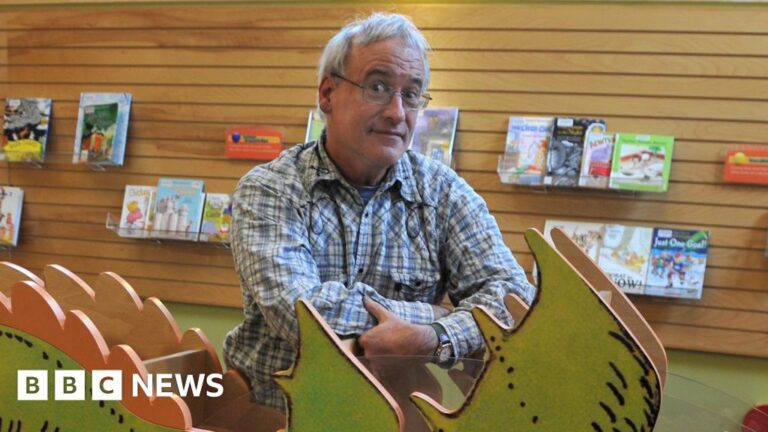
Celebrated children’s writer Robert Munsch has been approved for medically assisted dying in Canada.

Munsch, whose 85 published books include The Paper Bag Princess and Love You Forever, was diagnosed with dementia in 2021 and also has Parkinson’s disease.

The 80-year-old author told the New York Times Magazine that he had not decided a date for his death, but said he would go “when I start having real trouble talking and communicating. Then I’ll know.”

Canada first legalised euthanasia in 2016 for people with terminal illnesses. In 2021, the law was changed to include those with serious and chronic physical conditions, even in non-life threatening circumstances.

Munsch has sold more than 80 million copies of his books in North America alone and they have been translated into at least 20 language – including Arabic, Spanish and Anishinaabemowin, an indigenous North American language.

In 1999, Munsch was made a member of the Order of Canada. A decade later, he received a star of Canada’s Walk of Fame in Toronto.

In the interview with the New York Times Magazine, Munsch said his decision was influenced by watching his brother die from Lou Gehrig’s disease, also known as amyotrophic lateral sclerosis (ALS) – the most common form of motor neurone disease (MND).

Munsch said: “They kept him alive through all these interventions. I thought, let him die.”

In Canada, people over 18 must meet several requirements to be eligible for assisted dying.

They include having a “serious and incurable illness”, making a “voluntary request that is not the result of external pressure” and be in an “advanced state of irreversible decline in capability”.

Two independent doctors or nurse practitioners must then assess the patient to confirm that all of the eligibility requirements are met.

Scholastic, Munsch’s publisher, said in a statement on Instagram that his decision to speak publicly about medically assisted dying “reminds us, once again, why Robert’s work continues to touch many generations”.

Munsch’s daugher, Julie, posted on Facebook that her father’s decision to pursue medically assisted dying was made five years ago.

Julie called the New York Times Magazine interview “great”, but added that “nowhere does it say my dad isn’t doing well, nor that he’s going to die anytime soon”.

According to Canadian law, the person must be able to actively consent on the day of his death.

“I have to pick the moment when I can still ask for it,” he said in the interview.

Medically assisted dying accounted for 4.7% of deaths in Canada in 2023 – the most recent official government statistics.

Some 96% of the 15,300 people that underwent assisted dying in 2023 had a death deemed “reasonably forseeable”, due to severe medical conditions like cancer.

Spain’s recorded music market experienced a 10.4% growth in the first half of 2025, driven by a significant 18.9% year-over-year increase in subscription streaming revenues.

0

Thought double-digit growth in major European music markets was dead? Think again.

Spain’s recorded music industry maintained robust growth in the first half of 2025, with wholesale revenues reaching EUR €162.6 million (USD $178 million), up 10.4% YoY.

That’s according to new data published by Promusicae, the trade body representing over 85% of Spain’s digital recording market.

Spain’s growth stands in stark contrast to other major markets, whose YoY trade revenue growth has slowed to the low single digits this year.

Recorded music revenue in the United States increased by just 0.9% year-over-year in H1 2025, while Germany managed only 1.4% YoY growth. France recorded a 3.4% YoY increase.

Spain’s new figures are reported in wholesale “trade value” terms for the first time, representing actual revenue flowing to music companies rather than retail consumer spending. Previously, Promusicae published retail value figures.

At retail value, H1 2025 revenues would translate to €288.8 million ($316m).


Source: ProMusicae (note: ad-supported audio streaming revenues were actually down 15.4% YoY)

Spain’s overall wholesale music streaming revenues reached €144.2 million ($158m) in H1 2025, growing 10.2% YoY – but within that figure were mixed fortunes for subscription and ‘free’ streaming platforms.

Paid subscription streaming led the charge with €103.7 million ($113m) in wholesale revenue, up 18.9% YoY.

That’s doubly impressive considering Spotify did not raise prices in Spain during the comparative period. (According to local reports, Spain is getting a €1-per-month rise in the price of standard Spotify ‘Premium’ this month – September 2025 – to €11.99 per month.)

Meanwhile, ad-supported audio streaming revenues declined 15.4% YoY in H1 2025 to just €18.6 million ($20m).

And ad-supported video streaming revenues remained relatively flat, growing just 1.3% YoY to €21.8 million ($24m).

Total streaming revenues now represent 88.6% of Spain’s total recorded music market, says Promusicae.

The decline in ad-supported audio revenues may reflect deteriorating per-stream advertising rates, rather than just user migration.

Italy experienced a similar phenomenon in 2024, where ad-supported streaming volume surged 53.1% year-over-year but revenues grew just 0.4%, implying a significant decline in per-stream ad revenue.

“Although the adoption of subscription models continues to grow, we are still far from the penetration rates of paid subscriptions seen in neighbouring countries.”

Promusicae

Promusicae’s annual “Radiography of the Recorded Music Market 2024” report — published alongside the H1 2025 numbers — notes that Spain continues to lag behind neighboring countries in paid subscription penetration rates.

According to the report: “Although the adoption of subscription models continues to grow, we are still far from the penetration rates of paid subscriptions seen in neighbouring countries, which have proven to be the key to consolidating digital growth and ensuring a healthy and powerful industry at an international level.”

Spain’s physical market showed surprising strength in H1 2025, growing 14.8% YoY to €17.4 million ($19m) in the first half of 2025.

This growth was driven entirely by vinyl sales, which jumped 25.6% YoY to €12 million ($13m), representing 68.8% of all physical sales revenue.

CD sales declined 3.2% YoY to €5.34 million.

Spain’s physical market remains relatively small at just 10.7% of total market sales/streaming revenues.


Despite Spain’s strong H1 2025 growth figures, Promusicae President Antonio Guisasola highlighted ongoing challenges facing the Spanish market.

Guisasola said: “It is more than confirmed that streaming is currently the main form of consumption sustaining the music market, although we must not forget that the public continues to show great interest in physical products, especially vinyl records.”

Guisasola also addressed the challenges posed by artificial intelligence to the industry.

“We need, in addition to maintaining public support, the commitment of public authorities to support and implement measures to support the sector, such as tax incentives for Spanish phonographic production, or ensuring that legislation in defence of intellectual property is enforced in relation to the use of protected works by AI developers,” he said.


In February 2025, Promusicae reported that Spain’s recorded music market grew 9.4% YoY in full-year 2024 to €569 million (on a retail basis), with subscription streaming driving most of that growth.

According to the IFPI Global Music Report 2025, Spain ranked as the world’s 14th largest music market in 2024.

Partly thanks to digital piracy, the market has fallen from being the world’s 7th largest music market in 2001.Music Business Worldwide

Trump strikes deal with China to allow TikTok to keep operating in US | Latest news on President Trump

0

US President Donald Trump has announced a deal with China to allow the TikTok platform to continue operating in the United States.

Trump said he would speak to Chinese President Xi Jinping on Friday to confirm the details of an agreement to avoid a ban on the popular video-sharing app in the US.

Recommended Stories

list of 4 itemsend of list

“We have a group of very big companies that want to buy it. And you know, the kids want it so badly,” Trump told reporters on Tuesday.

“I had parents calling me up. They don’t want it for themselves, they want it for their kids. They say, if I don’t get it done, they are in big trouble with their kids. And I think it’s great. I hate to see value like that thrown out the window,” he said.

Trump signed an executive order later on Tuesday extending until December 16 a deadline for TikTok’s Chinese owner, ByteDance, to divest from the platform or face the promised ban.

Trump, who has credited TikTok with helping him win young voters in November’s presidential election, did not provide specific details on the nature of the deal.

The Wall Street Journal and The New York Times, citing people familiar with the matter, reported that the Chinese ownership stake in TikTok would be reduced to less than 20 percent under the proposed agreement.

China’s People’s Daily, the official newspaper of the Communist Party, hailed the deal as an example of “cooperation for mutual benefit”.

“China’s commitment to safeguarding national interests and the legitimate rights of Chinese enterprises remains unwavering,” the newspaper said in a commentary.

“It will lawfully process matters such as technology export approvals and intellectual property licensing rights related to TikTok,” the newspaper added.

Yan Liang, an economics professor at Willamette University in Salem, Oregon, said the reported details of the deal raised questions about what China would get in return for divesting.

“After all, Trump has the interest to keep TikTok running for his personal political gain,” Yan told Al Jazeera.

“Trump’s business clientele also has the interest to keep TikTok alive, even if they don’t hold a majority control of this lucrative company,” she said.

“I’d be surprised that China agrees with such a deal without [many] concessions from the US.”

The future of TikTok, which claims more than 170 million users in the US, has been in the balance since lawmakers in Washington last year passed legislation to force the platform to divest from its Chinese ownership.

Democrats and Republicans alike overwhelmingly supported the ban amid concerns the platform could be used by Beijing to spy on Americans and spread Chinese Communist Party propaganda.

Trump himself sought to ban TikTok in his first term as president, before doing a U-turn and pledging to “save” the platform during his re-election campaign.

Critics of the ban have argued that it infringes on US free speech rights and fails to address privacy concerns surrounding social media platforms in general.

“I never thought the United States should shut down TikTok over speculation that China might gather information about, or try to influence, Americans,” Ryan Calo, co-director of the Tech Policy Lab at the University of Washington, told Al Jazeera.

“So, from that perspective, striking a deal to preserve TikTok in the United States is a win,” Calo said.

But Calo said the Trump administration’s creation of its “own timetable” for reaching a deal had flouted the process outlined in the legislation passed by Congress.

“This is a blow to the rule of law, among many,” he said.

Anupam Chander, an expert in law and technology at Georgetown Law, said Trump’s announcement raised questions about potential political influence over TikTok’s content.

“Many Americans have been worried that the change in ownership of CBS might change the politics of the channel,” Chander said, referring to the major US broadcaster.

“I think it’s also fair for TikTok users in the US to wonder if we will see our TikTok content change to reflect the views of TikTok’s new owners, who may have a friendly relationship with the current Administration.”

Challenging Client

0


Client Challenge


JavaScript is disabled in your browser.

Please enable JavaScript to proceed.

A required part of this site couldn’t load. This may be due to a browser
extension, network issues, or browser settings. Please check your
connection, disable any ad blockers, or try using a different browser.

Those who are hungry cannot remain quiet

0

AFP via Getty Images A protester holds a placard that says "think about us" in English as demonstrators gather in Luanda. Some policemen with their backs to the camera can be seen in the foregound.AFP via Getty Images

People in parts of the Angolan capital, Luanda, are still afraid to talk openly about what happened in July when protests brought part of the city to a standstill and disturbances rocked other provinces too.

What began as a call among taxi drivers to come out against the jump in the price of fuel turned violent over three days with at least 30 people losing their lives and thousands subsequently arrested.

Roads were blocked with burning tyres, shops were looted and clashes erupted between demonstrators and police.

It was one of the most significant waves of protest since the end of the civil war in 2002.

In the run-up to oil-rich Angola marking 50 years of independence from Portugal on 11 November, the demonstrations highlighted continuing concerns about poverty and inequality.

In neighbourhoods where the demonstrations were strongest, few people are willing to speak openly, worried about reprisals or persecution in light of the numerous arrests during and after the protests.

“Things may have got a little out of control, but we needed to make that much noise to wake up those in power,” a 24-year-old Luanda street vendor, who wanted to remain anonymous, told the BBC.

Having left school before completing secondary education, he now sells soft drinks along Avenida Pedro de Castro Van-Dúnem Loy, one of the capital’s busiest thoroughfares, to help support his family.

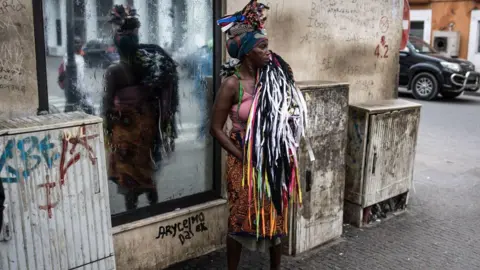
AFP via Getty Images A female vendor stands on a street corner in Luanda. She is wearing a headscarf and vest-top, plus an African-print skirt. She has assorted colourful shoe laces over her shoulder.AFP via Getty Images

Many Angolans have to try to make a living in the informal sector, through work like street vending

He is one of the millions here struggling to get by amid the gleaming skyscrapers built by oil money.

For the vendor, joining the first day of protests was a way of showing that “we have a voice” and that people like him deserve a share of the wealth of the country that is “rich for some, but miserable for so many of us”.

Youth unemployment has been a major driver of protests in this young country where the median average age is less than 16.

Unemployment among 15-to-24-year-olds stands at 54%, official figures show. Out of the 18 million young people of working age, only three million have jobs in the formal sector – meaning they get regular wages and pay taxes.

In Angola’s main cities, the many jobless young people, who are no longer in school, highlight the state’s difficulty in meeting their aspirations.

“I only sell on the street when I can get enough money to buy the soft drinks,” the street vendor said.

“There are months when I don’t sell anything at all because business is so slow. Me and so many other young people live like this and nobody pays attention to us. That’s why we can’t stay silent.”

Angolan sociologist Gilson Lázaro was not surprised by what happened in July. He believes that those at the heart of the protests were the “dispossessed”.

“These are young people, the majority, who have nothing left but their lives. That is why they took to the streets without fear,” he said.

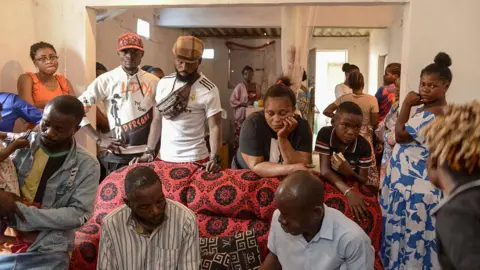
AFP via Getty Images A family group look mournful as they stand behind a coffin wrapped in a red patterned cloth.AFP via Getty Images

The family of Silvia Mubiala mourned her death – she was killed during July’s protests, allegedly shot by police

The protests emerged spontaneously in some of Luanda’s more populous and poorer neighbourhoods, where some residents lack access to basic sanitation as well as other essential infrastructure.

Gradually, demonstrators moved into the capital’s main avenues, causing chaos and “lifting the veil on a social problem that has long existed but which the political elite has preferred to ignore”, according to the sociologist.

“For some time now, Angola has been heading towards a deep social, economic and, above all, political legitimacy crisis. The root cause is the flawed way the country has been governed since the end of the civil war in 2002,” Dr Lázaro added.

The Popular Movement for the Liberation of Angola (MPLA) has been in charge of the country for the five decades of independence.

There had been some hope that João Lourenço, who in 2017 took over as president from José Eduardo dos Santos, 36 years in power, would change things.

He is now serving a second consecutive term following the 2022 election.

Lourenço promised to overhaul what he saw as the broken system inherited from his predecessor: tackling corruption, diversifying the economy and creating jobs.

Eight years on, critics argue he has failed to do so and is struggling to manage the cost-of-living crisis – and though falling slightly, the annual inflation rate remains high at around 18%. According to a 2024 Afrobarometer survey, 63% of Angolans say the country’s economic situation has worsened when compared to the previous year.

Young people have borne the brunt of the problems and have been at the forefront of most anti-government protests in recent years, on issues ranging from corruption and police brutality to demands for local elections, and against hunger and poverty.

Yet nothing matched the scale of July’s unrest.

Lea Komba, a 20-year-old political science student, says the fuel protests were “terrifying but somewhat expected” given the country’s current reality.

“We live in a country where young people are ignored by those in power. Protests are the only way to show dissatisfaction with the precarious conditions we face,” she said.

AFP via Getty Images A man in a baseball cap carries a large-screen television as he walks down a street in Luanda. There are people lining the pavement looking at him. AFP via Getty Images

In Luanda, shops were looted during the protests

The Angolan government has taken a different view.

A government official did not respond to a BBC request to comment on the demonstrations and their aftermath, but in a national address on 1 August, President Lourenço made his feelings clear.

He condemned the protests as “acts committed by irresponsible citizens, manipulated by anti-patriotic national and foreign organisations through social media, bringing mourning, destruction of public and private property, reduced access to essential goods and services, and job losses for Angolans”.

Despite repeated promises to diversify its economy, Angola remains dependent on oil and gas, which are by far the country’s main exports as well as the key source of government revenue.

“Natural resources are good, but the problem lies in how revenues are used,” Angolan economist Francisco Paulo said.

“If Angola followed models like Norway or Saudi Arabia, using oil wealth to strengthen non-oil sectors and develop its workforce, it would be a blessing. Unfortunately, revenues here are wasted on superficial expenses with no added value.”

Following Dos Santos’s departure, Angola endured five years consecutive years when the economy shrunk between 2017 and 2021.

AFP via Getty Images Joao Lourenco holding an inked finger up to the cameras after he voted. He is surrounded by journalists and is wearing a black open-necked shirt.AFP via Getty Images

When João Lourenço came to power after the 2017 election there were hopes that things would change in the country

Growth only returned in 2022, largely driven by non-oil sectors. But recent growth has had little impact on most Angolans’ lives.

In a report this year, the World Bank estimated that more than a third of the population live on less than $2.15 per day.

It said that while the economy was expanding it was not keeping up with population growth, meaning that, on average, people were getting poorer.

As independence celebrations approach, plans including music festivals, presidential medal ceremonies and a football match to include Argentinian Lionel Messi are in full swing.

But student Ms Komba questions the old socialist slogan “one people, one nation”, coined during the one-party Marxist-Leninist regime of the late 1970s.

“It’s simply not true that we all share the same reality. There is huge inequality. Young people in marginalised areas are almost condemned to extreme poverty, without quality education or decent jobs, even if they study hard and earn a degree,” she said.

“These young people think with their stomachs, because hunger leaves them with nothing to lose. They are the ones who filled the streets.”

Ms Komba added that “the authorities must look at root causes, not just consequences”.

“The looting was simply the way young people found to draw attention from those in power.”

She thinks that there could be more unrest.

“From now until the 2027 elections we will likely see more protests. Whether we like it or not, political awareness is growing in Angola, and elections are seen as a crucial moment for real change.”

More BBC stories about Angola:

Getty Images/BBC A woman looking at her mobile phone and the graphic BBC News AfricaGetty Images/BBC

BHP to Lay Off 750 Employees and Halt Operations at Queensland Coal Mine Due to Increased Royalties

0


BHP to cut 750 jobs, suspend Queensland coal mine over high royalties

Tate Bacon, 2024 ACC ‘A’ Finalist, to Transfer to SMU in Spring 2026

0

By Anya Pelshaw on SwimSwam

Tate Bacon has announced he will transfer to SMU for his final two seasons of eligibility after spending his undergraduate career at Notre Dame. Bacon arrived in fall 2022 and spent the 2022-2023 season and the 2023-2024 seasons with the Fighting Irish.

Bacon made a huge impact for the Fighting Irish at the 2024 ACC Championships as the men finished 2nd overall. He scored 46 individual points and was highlighted by a 4th place finish in the 200 fly (1:42.25) and a 9th place finish in the 100 fly (45.41).

He went on to qualify for 2025 NCAAs where he finished 33rd in the 100 fly (46.01) and 38th in the 200 fly (1:43.32). He also swam on Notre Dame’s 200 free and 400 medley relays.

Bacon’s Best SCY Times:

  • 100 fly: 45.41
  • 200 fly: 1:41.76
  • 100 free: 43.79

The SMU men joined the ACC this past season alongside Cal and Stanford. The SMU men finished 11th out of 15 teams while Notre Dame was 15th as its men’s swimming program was suspended this past season. Jack Hoagland, former Notre Dame swimmer, led the way for SMU with 35 individual points at ACCs and was the only individual swimmer at 2025 NCAAs.

Based on his best times, Bacon is a huge addition to SMU. He would have been the top butterflyer on the team this past season as Russell Exum led in the 100 fly with a 46.78 and Cotton Fields was the top 200 butterflyer with a 1:43.56. Both Exum and Fields just graduated this past spring so Bacon’s arrival comes at the perfect time.

Bacon’s best time in the 100 fly would have been 11th at 2025 ACCs while his 200 fly would have been 6th. SMU scored zero points in either event this past season.

Read the full story on SwimSwam: 2024 ACC ‘A’ Finalist Tate Bacon Transferring To SMU For Spring 2026

Exploring Sweden’s Coast: A 10-Day Itinerary

0

There’s nothing like Sweden in the summer. Light hangs in the air for hours, boats nose through island-studded bays, and cafés spill onto sidewalks as Swedes take advantage of the fleeting warm weather. 

With so much of the year spent in the cold and dark, the never-ending light that summer brings does not go to waste. Whether it’s on the many islands that dot the country’s coast, at their rustic cabins in the woods, or lounging in the city parks, Swedes flock outdoors.

I’ve been to Sweden many times (including spending an entire summer in Stockholm) but have always focused on the southern part of the country. However, with a desire to see something different this visit, I decided to explore the north, starting at the top in Luleå and working my day down. 

If you want to get off the beaten path in Sweden, this itinerary gets you out of the main tourist hubs and highlights the less-touristy side of the country. Here’s my suggested 10-day itinerary:

Day 1 & 2: Luleå

Luleå is home to just 50,000 people and is the last “big” city in the north before you get into Lapland (the northernmost region of the country and home to the indigenous Sami). The city doesn’t take long to see but the surrounding area is what most visitors come for. It’s known for the Gammelstad Church Town as well as its diverse and expansive landscape, ranging from dense forests and tranquil lakes to an archipelago that has over 1,300 islands!

Here’s my suggested things to see and do in Luleå:

The Archipelago – Luleå’s archipelago is a hotspot during the summer. Lots of people come from the south to stay here and you can lounge on beaches, go sea kayaking, boating, and hiking and area locals spend many weekends here to take advantage of the nice weather. The most popular islands are Kluntarna, Brändöskär, Junkön, and Småskär.

Gammelstad Church Town – Gammelstad Church Town has over 400 red wooden cottages surrounding 15th-century church. It was originally built as overnight lodging for parishioners who traveled long distances and offers a glimpse into Sweden’s rural past. You can wander through narrow lanes with well-preserved cottages, see the medieval stone church, and learn about the traditions of church towns.

Gammelstadsviken – Gammelstadsviken is a nature reserve with a large freshwater lake and vast marshlands and one of the best birdwatching spots in Sweden as over 80 different species live here. There’s lots of trails to choose from and it’s not too far from Lulea.

Norrbotten Museum – This museum showcases the region’s culture and history. It’s a small, free museum with displays from Sami culture to industrial heritage that gives you a well-rounded picture of northern Sweden.

Hike – Summer is the perfect season for hiking in and around Luleå. The area has numerous trails that are ideal for easy-going day hikes, and Visit Luleå provides an excellent hiking guide to help you choose a route. A few suggested hikes are Hertsöleden (easy, 8km), Fäbodaleden (intermediate, 10km), and Vitån (challenging, 12km).

The Ice Track – In winter, a six-kilometer ice track is made around the city center. You can skate or kicksled around it. The track is free to use and is carefully maintained throughout the winter. Kicksleds are free to borrow as well.

Where to Stay in Luleå Clarion Hotel Sense is an affordable hotel right in the center of town. The rooms are comfy, there’s lots of space, and the breakfast buffet has everything you could ever want. There’s even a gym too.

If you’re looking for a good place to eat, the harbor has a number of nice restaurants. I particularly enjoyed Bistron.

Day 3 & 4: Umeå

Head south four hours to Umeå. Founded in 1622 by Swedish King Gustav II Adolf, Umeå is the cultural capital of northern Sweden. It is now a city of 100,000 people known for its huge university (almost a third of the city’s population are students). With so many students here, the city has a young, vibrant feel and there’s lots of affordable restaurants and bars. (And, like everywhere on the coast, there’s easy access to nature.)

Here are my suggested things to see and do in Umeå:

Västerbottens Museum – Here you can explore the cultural and natural history of the Västerbotten region, from local traditions to its maritime heritage. There are documents, textiles, and over 8 million photographs here. The museum also features an open-air section with historic buildings from across the country.

Guitars the Museum – Guitars houses one of the world’s largest private collections of guitars and rock memorabilia, with an emphasis on the 1950s and 60s. Even if you don’t know a lot about guitars (I certainly don’t), it’s still a cool place to visit as you’ll learn a ton about the rock and roll scene. Guided tours are available, which I highly recommend as you’ll get much more out of the experience.

Kulturväven –Kulturväven is Umeå’s cultural hub, hosting everything from concerts and performances to art exhibitions and community events. Inside, you’ll find a library, cinema, and event spaces. Check the website to see what’s on during your visit as there is always tons happening.

Umedalens Skulpturpark – This is a vast outdoor art park featuring sculptures by renowned Swedish and international artists. The works are set against a serene backdrop of meadows, forests, and open landscapes. It’s free to visit.

Hike – From short woodland walks to longer routes along rivers and hills, there’s lots of hikes around the area. Popular hikes include sections of Isälvsleden, a 60-kilometer trail that follows an old glacier path (you can do it in sections); Tavelsjöleden, which boasts lots of caves and mountaintops; and Holmörundan, a 13-kilometer hike on the near island Holmön. To get these trails though, you’ll need to rent a car.

Strömbäck Kont – This nature reserve just south of Umeå is easily accessible by (infrequent) buses if you don’t have a car. The reserve blends smooth rock outcrops, sandy coves, and quiet pine forests, offering a mix of trails that range from rugged to stroller-friendly. There’s lots of bays around, you can go swimming, and, depending on the time of year, gorge on wild blueberries.

Strandpromenaden – Strandpromenaden is a relaxing riverside walkway perfect for a stroll, complete with benches and cafés along the way. The path connects several parts of Umeå, making it a pleasant way to get around the city on foot. I came here at sunset and it was especially pretty, with golden light reflecting off the river.

Where to Stay Hotell Björken is right next to the university and is just a five-minute drive to the central station. The rooms are stylish, modern, and well-lit and the hotel won’t break the bank either.

For places to eat, check out Bodegan and Eljest. Facit Bar is a great spot for inventive drinks.

Day 5: Örnsköldsvik
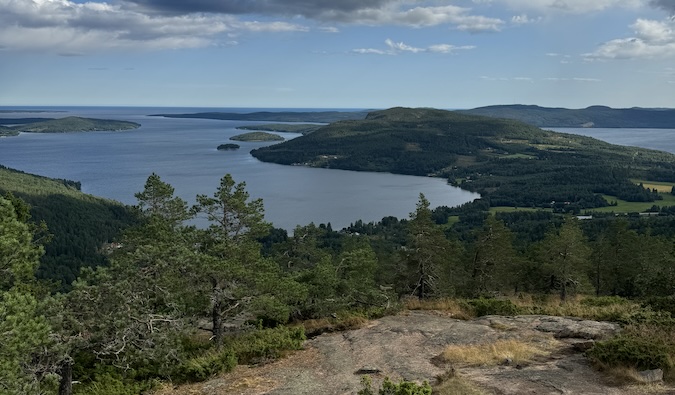
The view overlooking northern sweden on a bright and sunny summer dayThe view overlooking northern sweden on a bright and sunny summer day
Head south to Örnsköldsvik, the gateway to the High Coast. Called “Ö-vik” by locals, Örnsköldsvik is a coastal town known for its mix of outdoor adventure and modern industry, with hiking, kayaking, and skiing all within easy reach. There’s not a lot to do here so I recommend just spending one night in the town.

Here’s some suggested things to see and do during your visit:

High Coast Trail – This 130-kilometer trail takes 5–7 days to complete but covers the entire High Coast, making it an epic and incredibly scenic adventure over mountains, rugged coastlines, and forests. If you want a shorter hike, it’s possible to just hike sections of it. There’s lots of options.

Kayaking & Swimming – The waters here are calm and there’s lots to see around the archipelago. A two-hour rental is 300 SEK, while tandem kayaks cost 400 SEK. If you prefer to swim, Gullviks havsbad is the best beach in the area. It’s a sandy beach with volleyball nets, food nearby, and a BBQ area.

Where to Stay – If you’re staying in town, you can stay at Elite Plaza Hotel, which is a beautiful hotel on the harbor with a huge and delicious breakfast. If you want to stay out of town, FriluftsByn is an expansive campsite with a great restaurant and bar and a hot spot for campers and roadtrippers.

Day 6: Skuleskogen National Park

Skuleskogen National Park, set along Sweden’s High Coast, is a sprawling wilderness where ancient forests meet the rugged Baltic shoreline. Visiting here was easily the highlight of my recent trip. Located just thirty minutes south of Örnsköldsvik, this park spans over 7,400 acres and has birch and pine forests, marshes, coastal beaches, granite mountains, and awesome views of the Baltic.

The highlight of the park is Slåttdalsskrevan, a massive rock crevice that cuts through the bedrock. It’s around 200 meters long and 30 meters deep. For safety reasons, you can’t walk through it anymore but, if you come via the north side, you get a better view and can walk in a little bit. (The south entrance is completely closed off.)

You could easily spend a few days here if you like to hike and camp, but at a minimum you’ll want one full day. To help you make the most of your visit, here are a few tips and considerations:

  1. There are three entrances: South, North, and West, with the South gate being the busiest. Get there early if you’re driving as the parking lot is very small. To get to the park, you will definitely need a car. There are no other options.
  2. The South gate trail to Slåttdalsskrevan is the shortest, however, the West gate trail provides the best diversity of landscapes (and fewest crowds).
  3. If you want a relaxing hike, the coastal trail is not strenuous and has serene pebble beaches, rocky headlands, and quiet pine forests. It sees the fewest hikers too.
  4. Hiking north to south (or vice versa) takes about five hours. Doing the South Gate to the crevice and back takes around three hours. There and back on the West trail is about four hours. I’m pretty fit and hike a bit fast so take that into consideration but I found the trails a lot easier than the suggested times (I stopped a lot for photos and video content).
  5. Bring your own food and water as there are no facilities once you’re inside. Double check the weather too so you can dress appropriately.
  6. If you’re visiting in summer, bring bug spray as I found there to be loads of mosquitoes.

Day 7 & 8: Sundsvall

Home to just under 60,000 people, Sundsvall is just a 90-minute drive south of Skuleskogen National Park. After being devastated by fire in 1888, the city was rebuilt almost entirely in stone, earning its elegant nickname Stenstaden (“the Stone City”). Perched between forested hills and the Gulf of Bothnia (the northern part of the Baltic Sea), the city was historically a hub of the timber and paper industries. Today, it’s best known for its easy access to outdoor activities like hiking, skiing, and exploring the nearby High Coast.

Some things to see and do during your visit include:

Kulturmagasinet (The Culture Warehouse) – This cultural center is housed in old harbor warehouses that have been converted into a museum, library, and art space. Inside, visitors can explore exhibitions on Sundsvall’s history and local art, as well as take in temporary exhibitions and events. Be sure to check the website for the latest events. 

Norra Berget (The Northern Mountain) – This is an open-air museum and park located on a hill overlooking the city. It features 40 historic buildings from around the region, including wooden houses and farmsteads. There are lots of exhibits that showcase historic life and culture in northern Sweden. It’s a really good spot to bring kids.

Himlabadet Water Park – This family-friendly water park has indoor pools, saunas, and multiple water slides. There’s a small toddler area, a climbing wall that curves out over the pool, and even a surfing simulator that lets you try your hand at surfing real waves.

Sidsjön Lake – Just a 10-minute drive from the city center, Sidsjön is a peaceful lake surrounded by walking and cycling trails. In summer, you can swim, fish, and paddle here, making it the perfect place to lounge away an afternoon (if you’re visiting in winter, you can skate or cross-country ski here).

Alnön Island – Connected to Sundsvall by a bridge, Alnön is known for its sandy beaches and volcanic geology. The island is perfect for a day trip, offering swimming, small villages to explore, and scenic drives.

Where to Stay – Lilla Hotellet is an affordable locally-owned three-star hotel. It’s quiet, small, and has a cozy breakfast nook where you can fill up before you head out to explore.

Day 8 & 9: Uppsala

Uppsala, Sweden’s fourth-largest city, is just under four hours south of Sundsvall by car. It’s a lively, energetic city home to almost 250,000 people and is known for its big student population (Uppsala University is here, a prestigious university founded in the 15th century). Owing to its big student population (and larger population in general), there’s much more to see and do here beyond just enjoying nature and there’s a lot of affordable restaurants and bars.

Here are some of my favorite things to do:

Uppsala Cathedral (Domkyrkan) – Scandinavia’s largest church, this impressive Gothic structure dates back to the 13th century. It’s the final resting place of Swedish kings, scientists, and archbishops, with soaring spires that dominate the city’s skyline. Inside, visitors can explore ornate chapels, admire medieval frescoes, and see the tombs of King Gustav Vasa and Carl Linnaeus (a famous scientist known as “the father of modern taxonomy”).

Uppsala University & Gustavianum – Founded in 1477, this is Sweden’s oldest university. With over 50,000 students, it’s a massive institution with lots to see and do in its own right. The Gustavianum Museum, for example, showcases artifacts and Viking treasures. If you’re on a budget, this area of town is where you’re going to want to eat as all the cheapest bars and restaurants are here.

Uppsala Castle (Uppsala Slott) – A Renaissance-era castle overlooking the city, Uppsala Castle was once the site of royal coronations and political intrigue. The castle was actually built after a peasant uprising, as King Vasa I decided more fortifications were needed to prevent future uprisings. Today, it’s home to museums and exhibitions where you can explore the original remains of the first castle built here, learn about the castle’s history, and even admire historic art.

Botanical Garden & Linnaeus Garden – Dating back to the 18th century, this is the largest botanical garden of its kind in Sweden. The Linnaeus Garden, a reconstruction of famed botanist Carl Linnaeus’s own 18th-century teaching garden, offers insight into how he classified species during his time as a botanist. In spring and summer, these gardens are particularly lively and colorful, making for a calming place to relax with a book or take a stroll when the sun is shining.

Gamla Uppsala (Old Uppsala) – Just north of the city, this ancient site features massive Viking burial mounds, a museum, and a church that was once a pagan religious center. This was a key political and spiritual site during the Viking Age, with ties to Norse mythology and early Swedish kings. Visitors can climb the burial mounds for sweeping views of the landscape. If you want to dive deeper into Viking-era history, the small Gamla Uppsala Museum is a short but worthwhile stop.

Carolina Rediviva Library – The university’s main library, housing treasures like the Codex Argenteus (“Silver Bible”). Built in the 19th century, it is one of the largest research libraries in Scandinavia, with over five million volumes. Its exhibitions display rare manuscripts, maps, and early printed books. For anyone interested in history, literature, or rare artifacts, this library is a must-see (if you’re not a history buff, though, you can probably skip it).

Where to Stay – If you’re backpacking, Uppsala City Hostel is the best hostel in the city. While the bunks are basic, it’s in a great location so you can easily get around. If you prefer a hotel, Botanika Uppsala is located right next to the botanical garden, which is the oldest in the country.

***

This trip is best done by car, but it could also be done by train and bus if you don’t want to rent a car. And, depending how much you want to hike, you can easily add in more days (there are a ton of multi-day hikes here, after all). Plus, there’s plenty of islands in the archipelago to stop at, so you could really turn this itinerary into a multi-week trip if you wanted. It’s really up to you!


Get Your In-Depth Budget Guide to Europe!

Get Your In-Depth Budget Guide to Europe!Get Your In-Depth Budget Guide to Europe!

My detailed 200+ page guidebook is made for budget travelers like you! It cuts out the fluff found in other guides and gets straight to the practical information you need to travel while in Europe. It has suggested itineraries, budgets, ways to save money, on and off the beaten path things to see and do, non-touristy restaurants, markets, bars, safety tips, and much more! Click here to learn more and get your copy today.

Plan your trip to Europe like a pro

Get all my best Europe travel tips as well as free planning guides sent straight to you and see more of the country for less!

GET YOUR GUIDES HEREGET YOUR GUIDES HERE

Book Your Trip to Sweden: Logistical Tips and Tricks

Book Your Flight
Use Skyscanner to find a cheap flight. It is my favorite search engine because it searches websites and airlines around the globe, so you always know no stone is being left unturned!

Book Your Accommodation
You can book your hostel with Hostelworld as it has the biggest inventory and best deals. If you want to stay somewhere other than a hostel, use Booking.com as it consistently returns the cheapest rates for guesthouses and hotels.

For a list of my favorite hostels in Stockholm, check out this post. If you prefer hotels, this post has all my favorites.

And for my favorite parts of the city to stay in, you can check out this post.

Don’t Forget Travel Insurance
Travel insurance will protect you against illness, injury, theft, and cancellations. It’s comprehensive protection in case anything goes wrong. I never go on a trip without it, as I’ve had to use it many times in the past. My favorite companies that offer the best service and value are:

Looking for the Best Companies to Save Money With?
Check out my resource page for the best companies to use when you travel. I list all the ones I use to save money when I’m on the road. They will save you money too.

Want More Information on Sweden?
Be sure to visit my robust destination guide on Sweden for even more planning tips!