0.9 C
New York
Monday, March 2, 2026
Home Blog Page 389

‘Reshaping Geopolitics: Saudi-Pakistan Defense Pact Alters Regional Dynamics’ | Military News

0

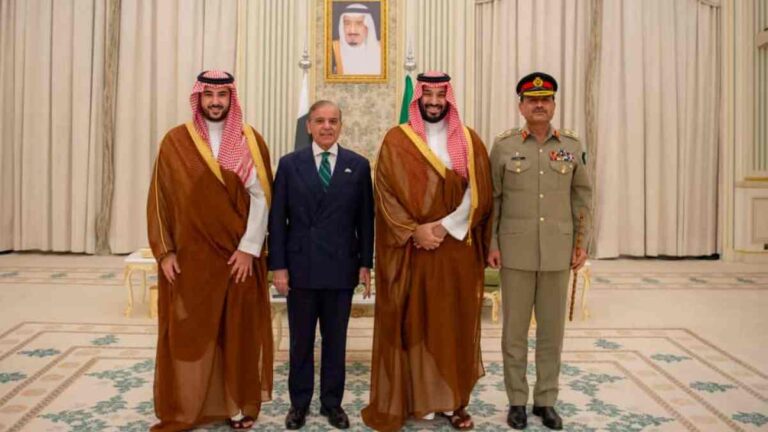
Islamabad, Pakistan – A beaming Pakistani Prime Minister Shehbaz Sharif – welcomed with Saudi F-15 fighter jets, a red carpet, and full royal protocol – joined Saudi Crown Prince Mohammed bin Salman on Wednesday to sign a “strategic mutual defence agreement” (SMDA).

Observers say it is a landmark moment in the decades-old alliance between the two nations whose ties stretch back nearly eight decades.

Recommended Stories

list of 4 itemsend of list

The signing ceremony at the Royal Court in Al-Yamamah Palace in Riyadh was witnessed by senior officials from Saudi Arabia, the custodian of two of Islam’s holiest sites, alongside representatives from Pakistan, the Muslim world’s only nuclear power.

The deal comes at a critical moment. Regional politics have been upended by two years of Israeli aggression – including its war on Gaza and strikes on neighbouring states – capped by last week’s Israeli attack on Doha, Qatar’s capital, which borders Saudi Arabia.

But it also comes amid heightened tensions between India and Pakistan, after a short but intense conflict in May in which they struck each other’s military bases over four days, taking South Asia to the brink of a full-fledged war between nuclear-armed neighbours.

Pakistan’s Ministry of Foreign Affairs said the agreement with Saudi Arabia reflects the “shared commitment” of both nations to strengthen security and promote regional peace, while also pledging to “strengthen joint deterrence against any aggression”.

“The agreement states that any aggression against either country shall be considered an aggression against both,” the ministry said.

Asfandyar Mir, a senior fellow at the Washington DC-based Stimson Center, described the pact as a “watershed” for both countries.

“Pakistan previously maintained mutual defence treaties with the United States during the Cold War, but they crumbled by the ’70s. Even with China, despite extensive defence cooperation, Pakistan lacks a formal mutual defence pact,” Mir told Al Jazeera.

Muhammad Faisal, a South Asia security researcher at the University of Technology Sydney, said the deal could serve as a template for Pakistan to engage in similar bilateral defence cooperation with the United Arab Emirates and Qatar, two key Gulf partners.

“In the immediate term, this agreement will consolidate and formalise multi-prong defence cooperation already under way, and new avenues to expand it via joint trainings, defence production and potential expansion of Pakistani troops contingent in Saudi Arabia will be explored,” Faisal said.

Historic bonds and military cooperation

Saudi Arabia was one of the first countries to recognise Pakistan after its independence in August 1947. In 1951, the two nations signed a “Treaty of Friendship,” laying the foundation for decades of strategic, political, military, and economic cooperation.

Over the years, Pakistani armed forces have deployed to the kingdom several times and trained Saudi personnel both in the Gulf and in Pakistan.

According to official records, Pakistan has trained more than 8,000 Saudis since 1967. An agreement signed in 1982 further cemented this cooperation by ensuring the “deputation of Pakistan Armed Forces personnel and military training” in Saudi Arabia.

But the latest pact arrives as the Middle East’s geopolitical chessboard is in flux. The fallout from Israel’s war on Gaza and its strikes on regional neighbours has made Gulf states uneasy, many of which still rely heavily on United States security guarantees, even as Washington remains Israel’s closest ally.

Qatar, attacked by Israel on September 9 for hosting Hamas leaders, serves as the forward headquarters for US Central Command (Centcom).

As of mid-2025, some 40,000–50,000 US troops are stationed across the Middle East, deployed in large bases and smaller forward sites – at least 19 of them – including Prince Sultan Air Base outside Riyadh.

While Saudi officials say the deal with Pakistan has been in the works for at least a year, Sahar Khan, an independent security analyst in Washington, DC, said its language will raise eyebrows in the US.

During its tenure from 2021 to 2025, President Joe Biden’s administration imposed sanctions on seven occasions targeting Pakistani individuals and firms over alleged ballistic missile development. Biden administration officials also publicly raised concerns over the range of missiles Pakistan was building, and whether they could carry nuclear weapons as far as the US.

“Pakistan already has a credibility problem in Washington, and this agreement won’t reduce it,” Khan told Al Jazeera.

Khan said that it is in Pakistan’s interest to clarify that its nuclear and missiles programme is India-centric, and while its bilateral relations with Saudi Arabia remain strong, “it will not fight Saudi wars but instead, will only provide relevant support”.

A region on edge

Earlier this year, in June, Israel waged a 12-day war with Iran, targeting nuclear facilities as well as senior civilian and military leaders. American bomber jets supported the assault, dropping massive bunker-buster bombs on Fordow, one of Iran’s key nuclear sites.

Three months later, Israel struck a building in a leafy Doha neighbourhood that is home to embassies, supermarkets and schools, killing at least five Hamas members and one Qatari security official.

The Doha attack triggered an emergency meeting of Arab and Islamic nations. Gulf Cooperation Council (GCC) states – Bahrain, Kuwait, Oman, Qatar, Saudi Arabia, and the UAE – said they would activate a joint defence mechanism.

Faisal said the Pakistan-Saudi pact should be viewed through the lens of these developments.

“These events have exacerbated security anxieties of the Gulf states while jeopardising confidence in the US security umbrella as the ultimate shield. As Gulf states look to bolster their security, regional countries such as Pakistan, Egypt and Turkiye emerge as natural partners,” he said.

Khan, however, said that while the timing of the pact does suggest a link with Israel’s recent attack on Qatar, “such kinds of agreements take months, if not years, to negotiate”.

Yet, the Stimson Center’s Mir pointed out that the agreement would also test how both Pakistan and Saudi Arabia manage their exposure to the other’s tensions with countries with which they have otherwise cautiously managed relations, or are even friends with.

“Pakistan now risks entanglement in Saudi Arabia’s regional rivalries, particularly with its neighbour Iran,” he said. “Saudi Arabia has committed itself to Pakistan’s disputes, notably with India, and potentially with the Taliban-led Afghanistan.”

The Indian question

The defence deal will also be watched closely in India, Pakistan’s nuclear-armed archrival.

Relations between India and Pakistan, already at a historic low, plummeted further in April after the Pahalgam attack, in which gunmen killed 26 civilians in Indian-administered Kashmir, for which India blamed Pakistan, which the latter rejected.

Days later, in May, the two countries fought a four-day skirmish, targeting each other’s military bases with missiles and drones in their most serious escalation in nearly three decades before a ceasefire on May 10 that US President Donald Trump claims he brokered.

On Thursday, during a weekly news briefing, Indian foreign ministry spokesperson Randhir Jaiswal said that the Indian government was aware of the signing of the pact.

“We will study the implications of this development for our national security as well as for regional and global stability. The government remains committed to protecting India’s national interests and ensuring comprehensive national security in all domains,” Jaiswal said.

But this agreement, says Sydney-based Faisal, could rebalance the Pakistan-Saudi relationship, which in recent years has been defined by Saudi financial bailouts for a struggling Pakistani economy, even as Riyadh cultivated closer ties with India.

“Pakistan’s relative position has improved,” he said, “and new space has opened for expanding the Pak-Saudi cooperation on both bilateral defence and regional security matters.”

With Pakistan’s economy faltering and increasingly dependent on Saudi aid during the last decade, India had been steadily deepening its own relationship with Riyadh. Indian Prime Minister Narendra Modi made his third visit to Saudi Arabia in a decade this April.

Mir said the new pact shows that Saudi Arabia still sees value in its relationship with Pakistan, and that Islamabad is not isolated in its extended neighbourhood – despite Indian attempts to get countries to distance themselves from Pakistan.

“At precisely the moment when Pakistan is faced with the threat of Indian military action,” he said, “Pakistan has secured a strong collective defence agreement from Saudi Arabia. So, it introduces a lot of complexity to future India-Pakistan dynamics.”

Pakistan’s nuclear shield over Saudi Arabia?

Saudi Arabia has long expressed interest in acquiring nuclear technology for civilian use, to diversify from fossil fuels.

In January, Saudi Energy Minister Prince Abdulaziz bin Salman Al Saud reiterated Riyadh’s readiness to enrich and sell uranium, a key component of nuclear programmes.

But Saudi Arabia has also repeatedly made clear that it does not seek to pursue nuclear weapons.

In his 2024 book War, American journalist Bob Woodward recounted a conversation in which Saudi Crown Prince Mohammed reportedly told US Senator Lindsey Graham that Riyadh planned to enrich uranium only for energy purposes.

When Graham expressed concern about the prospect of a Saudi bomb, Woodward wrote, Salman replied:

“I don’t need uranium to make a bomb. I will just buy one from Pakistan.”

Still, Khan, the analyst, said some things were unclear about the ambit of the agreement signed between Pakistan and Saudi Arabia.

“It is important to note that while Pakistan has made defence pacts before, none of those have led to nuclear assurances or a formation of a ‘nuclear umbrella’. There is nothing in this agreement that indicates a formation of a nuclear umbrella or any extended deterrence,” she said.

Mir warned that even robust alliances carry risks.

“The pact will trigger a new alliance politics around what it does or does not cover, deterrence, resource commitment, operational details, among others,” he said. However, he added, that does not diminish the political significance of this pact being struck.

“It’s a huge development for both countries.”

Faisal, too, agreed, pointing out that while the deal refers to treating an aggression against one country against both, that is perhaps more of a political statement, rather than an alliance or joint defence commitment, for now.

“Nonetheless, the political and defence coordination between the two sides will deepen, while strengthening respective military capabilities of both countries,” he said.

Sardar Biglari’s decade-long battle with Cracker Barrel results in $1 billion earnings

0

Cracker Barrel unveiled a sleek new logo this summer. Stripped of its folksy Uncle Herschel mascot—a denim-clad old man perched on a chair beside a barrel—the marque was replaced with a pared-down silhouette of a stylized barrel and the restaurant’s name in a simplified, modern typeface. It was the product of a $700 million push intended to refresh the Southern-themed chain for a new generation. 

Instead, the redesign detonated a culture war. It drew outrage from longtime diners. President Trump said “Cracker Barrel should go back to the old logo, admit a mistake based on customer response.” The conservative activist Robby Starbuck, writing in a post on X, said “Good morning @CrackerBarrel! You’re about to learn that wokeness really doesn’t pay.”

Oddly, it also attracted the fury of fellow dining chain Steak ‘n Shake.

In a series of posts on X, Steak ‘n Shake’s official account issued calls for Cracker Barrel CEO Julie Felss Masino to be fired. It mocked the rebrand, and posted images of red MAGA-style hats that read “Fire Cracker Barrel CEO” and “Biglari was right about everything.”

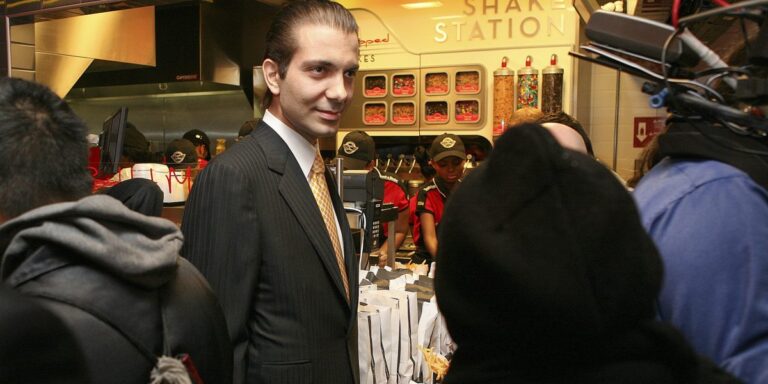
“Biglari” is a reference to activist investor (and Steak ‘n Shake owner) Sardar Biglari, who owns a $54.5 million stake in Cracker Barrel. He made a 120-page presentation to Cracker Barrel shareholders in 2024. His manifesto decried the Southern dining chain’s costly rebranding attempt as “obvious folly.” He pushed for board seats—he wanted to be chairman—and lampooned management’s “corporate myopia.” (Despite Biglari’s warnings, the board sided with Masino’s decision to modernize the brand.)

The redesigned Cracker Barrel logo that the company was immediately forced to ditch.

Photo Illustration by Avishek Das/SOPA Images/LightRocket via Getty Images

Within days of Cracker Barrel’s decision to ditch Uncle Herschel, the company’s market cap had shed $143 million, 15% of its value, forcing it to reinstate its old branding and pause plans to remodel Cracker Barrel locations. But for Biglari, one of the chain’s largest investors, the rollback merely stoked the flames of his 14-year insurgency against the company.

In fact, Bigalri has launched at least seven proxy battles at the company, most of which were unsuccessful. Cracker Barrel has previously dismissed Biglari’s motives as self-interested, accusing him of being an “activist shareholder” with a disruptive agenda, a reputation Biglari himself has cultivated throughout his storied career.

A taste for conflict

Biglari was born in Tehran in 1977. His father, a former military officer, was imprisoned following the Iranian revolution until his mother was able to negotiate his release with prison guards, according to reporting by the New York Times. The Biglari family then emigrated to the United States, settling in Texas in 1984, where they opened and operated a rug store. Biglari now resides in San Antonio, Texas.

In 1996, as a freshman at Trinity University in Hartford, Connecticut, Biglari got his first taste of running a business when—in the early days of the dot-com boom—he and a friend started a dial-up internet service provider called INTX Networking, after raising $15,000. The duo sold the business in 1999 for an undisclosed amount to Internet America, reportedly due to concerns about the tech bubble and the emergence of broadband technologies like cable and digital subscriber lines.

By this time, Biglari had become a fan of Warren Buffett, with whom he shares a birthday (August 30). Like Buffett, many of Biglari’s interests revolve around classic American brands that were neglected by their previous owners. “We view Biglari Holdings as a museum of businesses,” he wrote in a 2023 letter to shareholders. “The art we practice is that of collecting and building businesses.”
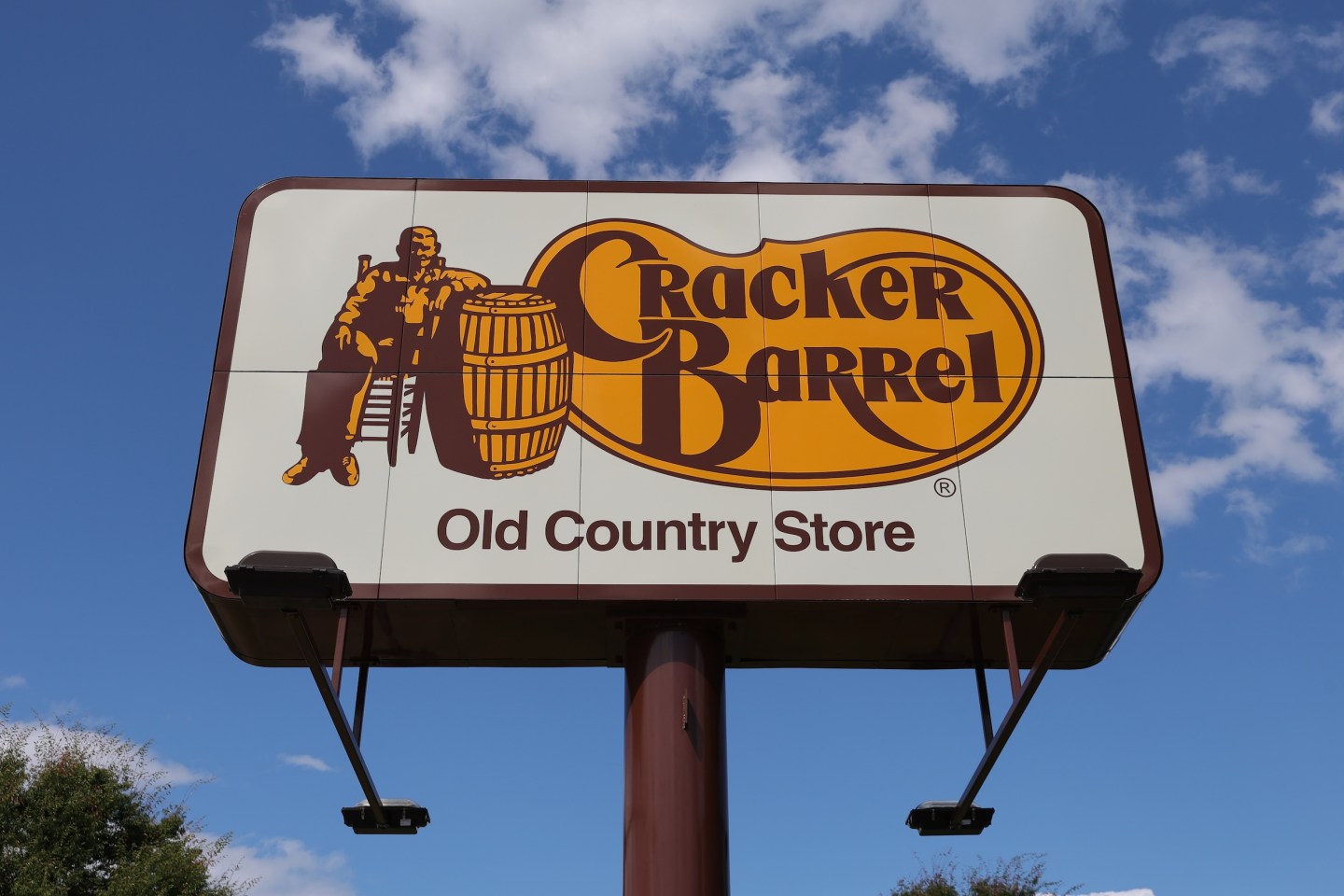
Photo: MUNCY, PENNSYLVANIA, UNITED STATES - 2025/09/07: The Cracker Barrel logo is seen on a billboard outside of one of its restaurants.
The Cracker Barrel logo outside of one of its restaurants in Muncy, Pennsylvania.

Photo by Paul Weaver/SOPA Images/LightRocket via Getty Images

After graduation, Biglari used the proceeds of the INTX sale to start a hedge fund, the Lion Fund, which would become his entry point into corporate warfare. It’s not clear how big a warchest Lioin wields, but by 2005 the fund bought a stake in a small steakhouse chain based in Roanoke, Virginia, called “Western Sizzlin.” As Biglari accumulated more shares, he began arguing the business was mismanaged and undervalued, and eventually became chairman of the board, in 2006. At the time, Western Sizzlin had long been in a period of decline, having filed for bankruptcy in 1992. The chain, however, was showing some signs of recovery under then-CEO James Verney.

Biglari went on to acquire and restructure Western Sizzlin by taking a page out of Warren Buffett’s book and creating a holding company that divided the chain into individual subsidiaries, each of which was treated as a separate business. Cash from each subsidiary was then redirected to the most beneficial investment within the holding company. The reorganization got clear results, with profits rising from under $1 million annually, pre-acquisition, to approximately $2.4 million by 2011. Rising profits occurred despite the number of open Western Sizzlin locations declining, going from 144 in 2005 to 94 in 2011.

“He’s whip smart. He’s very good at articulating his problems with corporate governance,” Jim Gillies, an analyst and advisor at the Motley Fool and longtime follower of Biglari, told Fortune. This ability to identify and address key operational issues, he said, has contributed to Biglari’s business wins. 

Having seen success in his investment strategy, Biglari turned his attention towards ice-cream chain Friendly’s, where he accused the company’s leadership of wasting money and promoting a “self-interested culture.” He argued that Friendly’s cash flow had generally been negative since its public offering in 1997, which he attributed to the company’s “enormous” debt, totalling $131 million. Biglari also focused on alleged mismanagement by Friendly’s then-CEO and board, whom he accused of neglecting their fiduciary obligations to shareholders to line their own pockets and ignoring conflicts of interests related to the CEO’s external business ventures, namely his significant stake in another restaurant company. To up the pressure in his pursuit of two Friendly’s board seats, he rented billboards near the chain’s headquarters directing passersby to a website, “Enhance Friendly’s,” that detailed his plans for the business.

Although Biglari was unsuccessful in his crusade for control of Friendly’s, he cashed out his 15% ownership of the chain when it was acquired by a private equity firm in 2007 for $337 million, equal to $15.50 per share, a 30% premium over its prior price.

Biglari’s unconventional tactics led to one of the ice-cream chain’s founders, Curtis Blake, calling him a “corporate raider.” This characterization has since prompted comparisons to famed interventionist Carl Icahn.

“He’s not a guy who’s afraid of picking a fight,” Zeke Ashton, managing partner of Centaur Capital Partners, which owns shares in Biglari Holdings, once told DealBook.

Despite his confrontational reputation, Biglari notably avoids media coverage and has not in recent years participated in interviews. He declined to comment when reached by Fortune. Instead, the Iranian investor’s public relations modus operandi consists of strongly worded letters to shareholders, SEC filings, provocative online campaigns, and, most recently, memes.

The most successful deployment of these methods was his takeover of Steak ‘n Shake,  in 2008. At the time, the chain was near insolvency, losing approximately $100,000 per day with only $1.6 million in cash against $27 million in debt. Biglari, who had purchased a 7% stake in the chain in 2007, became the company’s third-largest shareholder, owning more shares than all of Steak ‘n Shake’s then executive officers and directors combined.

Then, he replicated his Friendly’s strategy, buying “Enhance Steak ‘n Shake” billboards around the chain’s Indianapolis headquarters and railing against the chain’s years of financial decline to advocate for two board seats. During the 2008 financial crisis, Biglari seized on shareholder anger and economic uncertainty. He won a proxy contest with more than 70% of shareholder votes for two board seats, ousting then chairman Alan Gilman and former CEO James Williamson Jr. By August of that year, following a brief period of board infighting, Biglari was made CEO.

Biglari’s vision for Steak ‘n Shake was to revitalize the ailing brand by implementing tighter cost controls, improved service, and a more entrepreneurial mindset. He sought to improve customer experience in the company’s 500 restaurants in 19 states by adding background music and removing harsh fluorescent lighting that he felt made guests feel uncomfortable.

Under Biglari’s leadership, Steak ‘n Shake’s economic performance rebounded, with the stock price rising from around $5 when he became CEO to nearly $15 the following year. In 2010, that number reached approximately $50, and Steak ‘n Shake Company officially changed its name to Biglari Holding. In just three years, the chain went from losing around $30.8 million (as of 2009) to a gain of $41.2 million in operating earnings by 2011. Strong financial performance continued for Steak ‘n Shake into 2016 as the brand became Biglari’s cash cow, generating more than $250 million in total operational earnings and funding Biglari Holdings’ expansion into other business ventures. 

Biglari’s Steak ‘n Shake victory led to the birth of Biglari Holdings. He pitched the rebranded Steak ‘n Shake Company to investors as the next Berkshire Hathaway. He even changed the company’s ticker to “BH” to echo Buffett’s firm. Biglari has 70% voting control over BH.

The belly of Biglari Holdings

While Biglari Holdings’ roots are in classic American dining brands, its investments are now diversified. In 2014, as Steak ‘n Shake was thriving, Biglari bought the men’s magazine Maxim for an estimated $12 million. His plan for the publication was to “build the business on multiple dimensions, thereby energizing our readership and viewership.” He officially took over as the magazine’s editor-in-chief in 2016 and has since reportedly exercised complete editorial control over the publication, including the decision to endorse President Donald Trump in the 2024 presidential election and the inclusion of Biglari’s signature on every magazine edition. Maxim, under Biglari, has reported steady losses of approximately $37 million over the past decade. He acknowledged in Biglari Holdings’ 2024 annual report that 2025 would be a “pivotal” year for the magazine as every subsidiary must be a “long-term supplier of cash.”

Biglari expanded aggressively from there. He acquired First Guard Insurance Company, a commercial trucking underwriter, in 2014. In 2020, he added Southern Pioneer Property & Casualty Insurance Co. Then he went into oil and natural gas, acquiring Southern Oil of Louisiana Inc. for $51.5 million in 2019 and 90% control of San Antonio-based Abraxas Petroleum for $80 million in 2022. He also, as of 2023, owns 402,000 shares of Ferrari with a market value of $135 million.

But underperforming restaurant brands remain a special source of fascination for Biglari. By July 2025 he had a 9.98% stake in the Jack in the Box burger chain. (The company adopted a “poison pill” defense to ward him off.) And he is currently the largest shareholder of the El Pollo Loco chicken chain, owning 15.5%.

The investments made Biglari a wealthy man. But that wealth was generated by self-serving conflicts of interest, his critics say, and—ironically—it has hobbled his ability to move against Cracker Barrel.

When governance meets Goliath 

For more than a decade, Biglari Holdings and Biglari himself have been plagued by accusations of mismanagement due to ballooning executive pay, stock volatility, and a licensing deal that potentially advantages Biglari personally.

Between 2009 and 2015, Biglari took home nearly $76 million in compensation and bonuses, representing as much as 38% of Biglari Holdings’ operating income in that period. Until 2019, the pay package carried a cap of $10 million. That was quietly removed, allowing for far higher compensation depending on performance and acquisitions. His future net worth is secured by a 2013 licensing deal in which Biglari licensed the “Biglari” name to Steak ‘n Shake and Biglari Holdings for 20 years. If removed from his roles for anything other than malfeasance, or if the company were sold, he would be entitled to 2.5% of sales for five years—a payout potentially topping $100 million.

This deal got Biglari listed in the “Corporate Governance Hall of Shame” by the investor publication 13D Monitor, according to a copy seen by Fortune.

“Coming up in the first few years when he was gaining recognition, he very much sang from that hymnal of we’re all going to make money together. And then once he was in a position to put his thumb on the scale, he did,” Gillies said. 

These factors have sparked multiple proxy fights and repeated calls for reform from activist firms like Groveland Capital. They have also derailed Biglari’s attempt to gain control of Cracker Barrel. 

“The type of activism he conducts doesn’t really enrich corporate governance. It ingratiates himself more with shareholders and was easier to get away with years ago,” Ken Squire, founder and president of 13D Monitor, told Fortune. “Now that activists have become much more responsible and much more mainstream, the ones who haven’t evolved are finding it harder to get anything done.”

Throughout Biglari’s numerous attempts to secure board seats at the chain, executives at Cracker Barrel have cited his executive compensation as proof of his ill intentions for the brand. Others have pointed to Biglari’s practice of hanging his portrait in every Steak ‘n Shake location and the chain’s own financial struggles.

Steak ‘n Shake’s performance has been volatile over the past five years. It was especially affected by the COVID-19 pandemic, with periods of significant losses followed by a notable recovery in profitability driven by cost-cutting and a transition to franchising. The chain has shrunk to 426 Steak ‘n Shake locations as of 2024, from its peak of over 600.

Biglari—who once called himself “supremely insensitive to criticism”—is undeterred.

The case against Cracker Barrel

Biglari’s attack on Cracker Barrel began in the early 2010s when his reputation was bolstered by Steak ‘n Shake’s turnaround. Between May 2011 and December 2012, Biglari purchased 4,737,794 shares of Cracker Barrel for $241.1 million. By 2012, he held nearly 20% of Cracker Barrel’s outstanding stock. As with Steak ‘n Shake and Friendly’s, Biglari’s launched “EnhanceCrackerBarrel.com” as an investor-focused website. He began publishing press releases and shareholder letters criticizing management, and demanded board representation and strategic changes. 
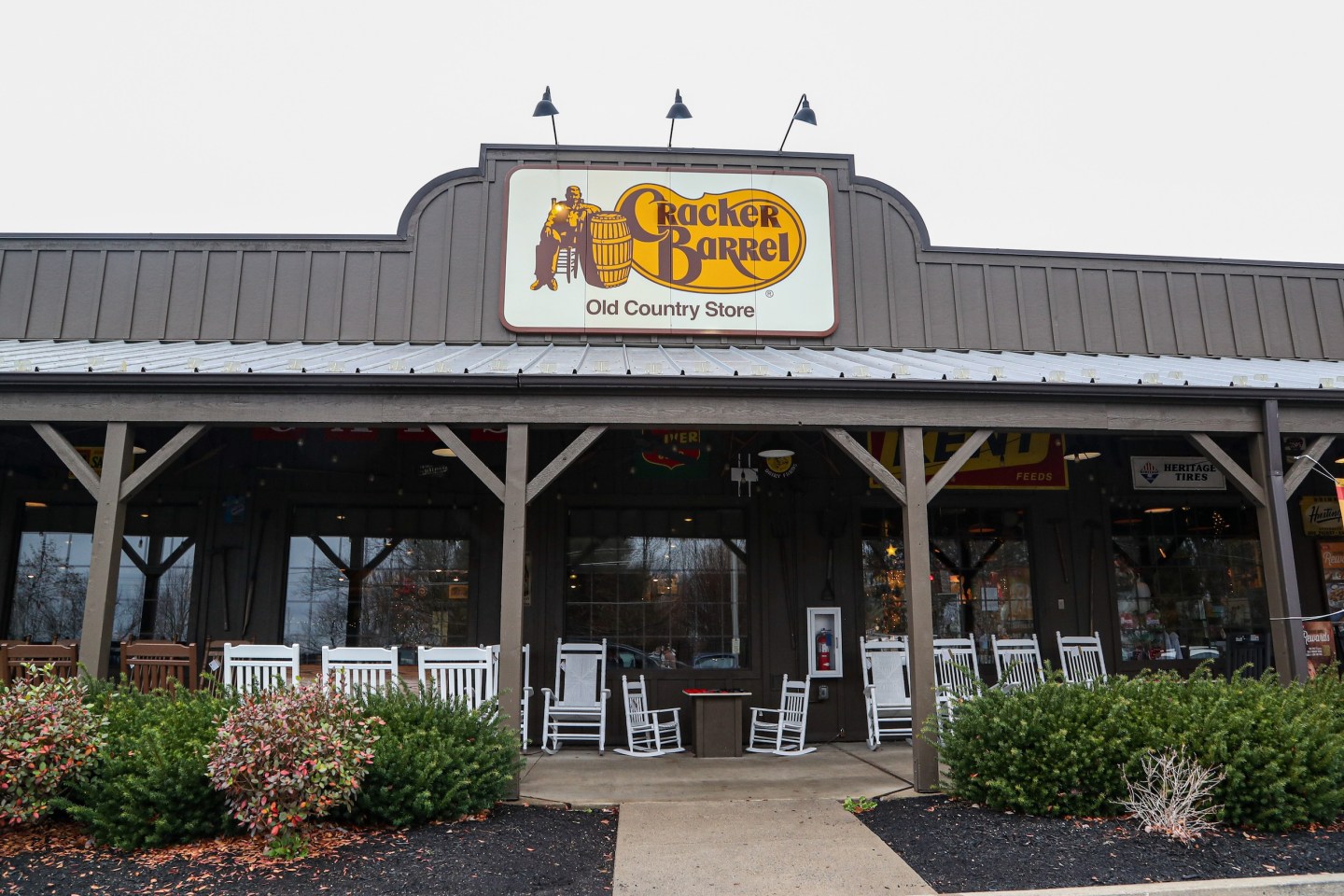
Photo: MUNCY, PENNSYLVANIA, UNITED STATES - 2023/11/22: An exterior view of a <a href="https://fortune.com/company/cracker-barrel-old-country-store/" target="_blank">Cracker Barrel Old Country Store</a>. Cracker Barrel Old Country announced that it is open on Thanksgiving and is offering a Thanksgiving Heat n' Serve Turkey Family Dinner, which serves four to six people for $104.99. (Photo by Paul Weaver/SOPA Images/LightRocket via Getty Images)
Part of Cracker Barrel’s folksy charm is a selection of rocking chairs on the front porch of every restaurant.

Photo by Paul Weaver/SOPA Images/LightRocket via Getty Images

Biglari’s core demands were to stop opening new stores entirely, eliminate the development team to save money, and focus exclusively on improving existing store operations rather than expansion. In his 2012 letter to shareholders, he criticized what he saw as Cracker Barrel’s fundamental failures, arguing that despite having “one of the greatest restaurant concepts ever created,” the company suffered from poor execution and misguided expansion strategies.

Biglari was particularly critical of the company’s store-level deterioration. In one analysis, he compared Cracker Barrel’s operating income of $164.9 million with 357 stores in fiscal 1998 ($462,000 per store) to 2012’s operating income of $181.3 million with 616 stores (only $294,000 per store). This declining per-unit profitability became a central theme in his critiques and proxy battles. 

His first proxy battle for board representation occurred in 2011. Despite receiving endorsement from Glass Lewis (one of the major proxy advisory firms), Biglari received only 6.5 million shareholder votes compared to 12 million for the incumbent director. This defeat was the closest he ever came to victory over Cracker Barrel. Although it did succeed in triggering the replacement of then CEO Michael Woodhouse with Sandra Cochran, the following year he launched another campaign, nominating himself and an ally, only to receive nearly 1 million fewer votes. 

In 2013, Biglari introduced a new strategy: demanding a special $20 per share dividend that would have been worth approximately $94.8 million to his holdings. To demonstrate the feasibility of this proposal, Biglari obtained a “highly confident letter” from Jefferies LLC confirming their ability to arrange up to $800 million in debt financing to fund such a dividend. Still, this proposal, board nominations, received only 5.9 million votes, with just 1.2 million coming from sources other than Biglari himself.

Biglari continued and failed to secure seats on the Cracker Barrel board through 2017 when he began quietly selling off shares. This strategic shift coincided with Cracker Barrel’s stock performance improving significantly, heading toward its eventual peak. Cracker Barrel’s stock reached its all-time high of $183.29 on November 27, 2018—a remarkable 234% return from Biglari’s initial investment price. 

In 2020, however, Biglari’s criticism of Cracker Barrel was reignited after the company’s $133 million investment in Punch Bowl Social, a bar and entertainment concept, in 2019, failed during the pandemic. Cracker Barrel was forced to write off the entire investment.

In a 2020 letter to shareholders, Biglari predicted the Punch Bowl investment would “go down as one of the worst business blunders in the annals of restaurant history.” The decision wiped out 50% of the company’s pre-tax earnings from 2019, he claimed. Guest traffic had also fallen 18.6% from 2005 to 2019. (Declining guest traffic remains a consistent trend at Cracker Barrel.)

Using this to fuel an aggressive push for reform at Cracker Barrel, Biglari nominated his own board candidate, arguing that “losing $137 million of shareholders’ money in eight months” was sufficient reason to add “one board member with restaurant experience.” He further argued that should Cracker Barrel focus on enhancing its core operations, it could unlock over $600 million in added annual revenue. 

CEO Cochran’s response was equally forceful. She characterized Biglari’s track record as having a “lagging performance and problematic governance practices at his own company.” She specifically cited Steak ‘n Shake’s same-store sales decline of 6.9% and foot-traffic decrease of 11.2% in 2019.

After more than a decade of proxy battles, 2022 brought a surprising truce when Cracker Barrel and Biglari entered into a Nomination and Cooperation Agreement. Under the agreement, Cracker Barrel expanded its board from 10 to 11 members and appointed Jody Bilney, one of Biglari’s preferred nominees, as an independent director. Bilney held significant credentials, having served as chief marketing officer for Humana and chief brand officer for Bloomin’ Brands. 
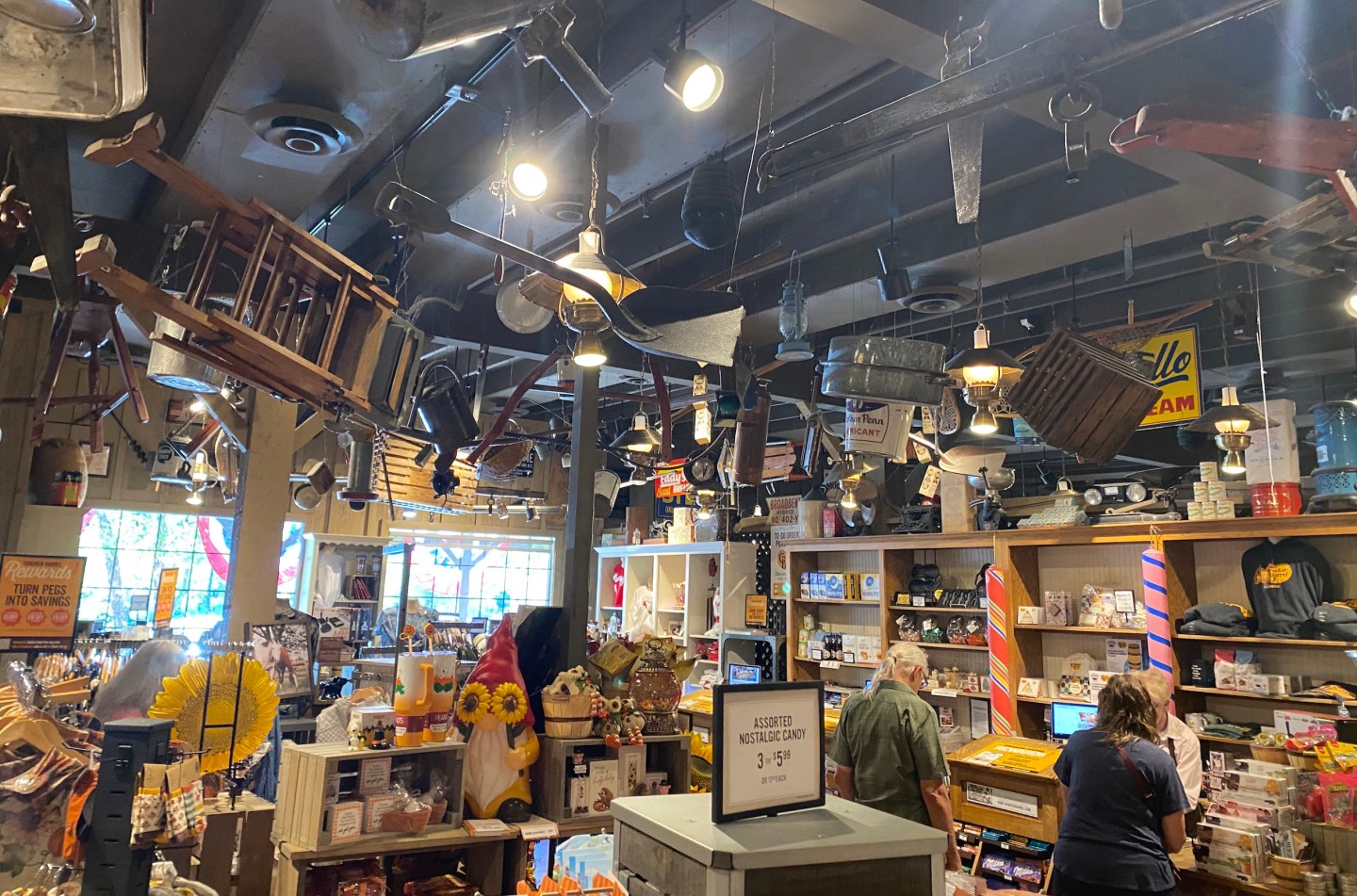
Photo: Customers browse inside the Cracker Barrel Old Country Store in Mount Arlington, New Jersey on August 22, 2025. Cracker Barrel has a special place in the hearts of many Americans, offering country cuisine in a folksy "Old Country Store" setting complete with rocking chairs and occasional country music performances. But an attempt to rebrand the storied US chain has sparked a firestorm of opposition online and opened a new front in the culture wars around legacy brands seeking to update their corporate images (Photo by Gregory WALTON / AFP) (Photo by GREGORY WALTON/AFP via Getty Images)
Inside the Cracker Barrel Old Country Store in Mount Arlington, New Jersey on August 22, 2025.

Photo by GREGORY WALTON/AFP via Getty Images

When the cooperation agreement expired, however, Biglari immediately returned to his old ways, announcing his intention to nominate five candidates to Cracker Barrel’s board. The 2024 battle centered on Cracker Barrel’s strategic transformation plan under new CEO Julie Masino, who had replaced Sandra Cochran in 2023.

In his October 2024 shareholder letter, Biglari wrote: “Since 2019, the shareholders of Cracker Barrel have collectively lost over $2.9 billion in market value … Neither the appointment of Julie Felss Masino as the Company’s CEO nor her new transformation plan has restored shareholder value.”

The chain’s market value fell by approximately $287 million, and the stock price decreased by nearly 20%, in the 14 months following Masino’s appointment. But aales performance at the company showed gradual recovery. All the while, Cracker Barrel’s CEO and board compensation rose sharply. CEO pay increased from around $1 million in 2011 to more than $7 million in 2025.

Biglari echoed his initial warning that November, saying that “If you had $100 in Cracker Barrel stock in January 2019, five years later it is worth about $30. Therefore, there is just $30 to go before the entire investment is lost.” He warned of “a significant risk of a 50% loss or more if we are not elected to the Board.”

Cracker Barrel shareholders once again rejected Biglari’s nominees. But the company agreed to add Biglari’s pick of Michael Goodwin, former PetSmart CTO, to the board as a compromise.

A Cracker Barrel spokesperson defended the chain’s decision to raise its executive compensation packages, telling Fortune, “For the last several years the company has directly engaged with many of its largest shareholders to discuss a variety of topics, including executive compensation, and no shareholder ever expressed any disagreement or concern with the company’s executive compensation plans or practices. More broadly, Cracker Barrel’s shareholders have evidenced their support for the company’s executive compensation plans and practices by voting in favor of the company’s say-on-pay proposals each year by significant margins.”

Cracker Barrel’s financial outlook remains unsavory. Chain traffic has declined, down 2.7% in Q2 of 2025. Its stock is down 9.6% year-to-date in 2025 in a market where shares have risen 12% year to date through mid September. The chain’s struggles, according to Gillies, are a “spectacular” failure on the part of Cracker Barrel management.

Cracker Barrel, however, pointed to improving revenue growth in 2025 in an interview with Fortune. The company has reported four consecutive quarters of positive restaurant sales growth. Its revenue is up 1.5% year to date and 2.84% year-over-year. (In 2024, the company’s revenue increased by only 0.8%) This growth remains significantly below industry averages. Cracker Barrel competitor IHOP reported an 11.9% increase in revenue in Q2 2025 from the same period in 2024. 

“Through his campaigns, Mr. Biglari has made numerous false and misleading claims about Cracker Barrel, its Board and management,” a Cracker Barrel spokesperson told Fortune. “We believe that Mr. Biglari’s unprecedented seven proxy solicitations against the Company in the past 14 years have been for purely self-interested reasons, and that his own actions and poor performance at Steak ‘n’ Shake and Western Sizzlin’ remain cautionary tales. We appreciate the support from our shareholders as they have consistently rejected his proposals and nominees by overwhelming margins each time.”

Biglari’s proxy battles stand as one of the longest and most contentious activist campaigns in restaurant industry history. Despite the defeats, his investment in Cracker Barrel has been extraordinarily profitable.

Biglari sold off much of his stake, beginning in 2020, and now controls less than 5% of Cracker Barrel. Yet his investment has generated nearly $1 billion in total gains through dividends, stock sales, and remaining holdings for Biglari.

“Cracker Barrel is painting Biglari as this short-term profiteer. It’s been 14 years. He’s still there,” Gillies said.


Australia to implement more ambitious emissions reductions by 2035

0

Australia, one of the world’s biggest polluters per capita, will aim to cut its carbon emissions by at least 62% compared to 2005 levels over the next decade.

The nation – which has faced global criticism for its continued reliance on fossil fuels – had previously pledged to reduce greenhouse gases by 43% by 2030.

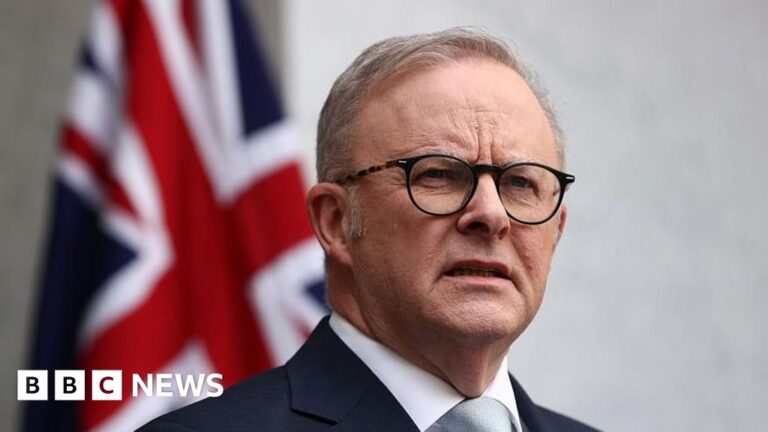
“This is a responsible target supported by science and a practical plan to get there, built on proven technology,” Prime Minister Anthony Albanese said when unveiling the new target on Thursday.

A landmark risk assessment commissioned by the government this week warned Australia faced a future of increasingly extreme weather conditions as a result of man-made climate change.

Setting a target to reduce emissions from 2005 levels is part of Australia’s obligation under the Paris Climate Agreement.

The new target is in line with an emission reduction benchmark – of between 62% and 70% – that was recommended by the Climate Change Authority, a government body which provides climate policy advice, Albanese said.

The prime minister will confirm the commitment at a meeting of the UN General Assembly in New York later this month.

The 2015 Paris Climate Agreement saw world leaders agree to keep global temperatures from rising 1.5C above those of the late 19th Century, which is seen as crucial to preventing the most damaging impacts of climate change.

Australia, like much of the world, has faced an increasing number of climate-related weather extremes in recent years including severe drought, historic bushfires and successive years of record-breaking floods.

Warmer seas have also caused mass bleaching at its world-famous Great Barrier Reef in Queensland and Ningaloo Reef in Western Australia.

On Monday, a report into the impact of climate change – the first of its kind in the country – found Australia had already reached warming of above 1.5C and that no community would be immune from “cascading, compounding and concurrent” climate risks.

It warned that if the government failed to take stronger action there would be more heatwave-related deaths, poorer water quality due to severe flooding and bushfires, and sea level rises that would threaten 1.5 million people. It also warned of a A$611bn ($406bn; £300bn) drop in property values as a result of such threats.

However, Australia’s climate agenda and its ambition to achieve net zero emissions by 2050 remain divisive political topics.

The country’s opposition party, the Liberal National coalition, is internally debating whether it should continue to support the net zero emissions goal, while other parliamentarians – including many independent and Greens MPs – are calling for faster cuts.

Opposition leader Sussan Ley on Thursday said the coalition was “dead against” the new target, saying that it failed on both “cost and credibility”.

Shortly after Albanese’s Labor government was elected in 2022 it set higher climate targets, up from the conservative coalition’s previous target of between 26% and 28%.

It has sought to make Australia a “renewable energy superpower”, but has also continued to approve fossil fuel projects.

Last week, one of the country’s largest gas projects – Woodside’s North West Shelf – was given the greenlight to keep operating for another 40 years until 2070, in a move that was widely condemned by climate experts and environmental advocates. Australian Greens Larissa Waters labelled the move a “betrayal” by Labor.

Platform reports that 1 out of every 3 chart-topping hits in Germany last year originated from TikTok viral trends

0

MBW’s Stat Of The Week is a series in which we highlight a data point that deserves the attention of the global music industry. Stat Of the Week is supported by music data analytics firm Chartmetric.


TikTok wants to remind you how important it is to the music business.

To that end, in the past few years the platform has started running analyses that compare music charts to viral trends on its platform.

And the latest data point from that effort shows that, in Germany, the world’s fourth-largest recorded music market, one in three tracks that hit the top position on the charts went viral first on TikTok in 2024.

Additionally, more than one in four of the songs that made it to the German Top 100 Singles Chart in 2024 were “first successful” on TikTok, on average 13 days before entering the chart, TikTok’s analysis found.

That includes not only well-known German artists like Ayliva, Shirin David and Helene Fischer, but international stars like Miley Cyrus and Disturbed as well, TikTok recently wrote on its German-language blog.

“The path to many chart successes begins on TikTok,” the ByteDance-owned platform boasted.

TikTok offered several examples of this, including Ayliva’s hit track Lieb mich.

“After video views and creations peaked in early February 2024, the song entered the charts shortly thereafter and immediately reached the top spot a week later,” TikTok said.

Earlier this year, Helene Fischer and Florian Silbereisen’s Schau mal herein entered the singles charts shortly after it became the most-heard piece of music among TikTok users in Germany, and 35,000 videos featuring the song were posted.

That’s not only true for current music; catalog music also gets plenty of attention on TikTok, and sometimes that virality propels a track back onto the charts years after its release.

“The path to many chart successes begins on TikTok.”

TikTok

“Over 50 catalog songs made their way onto the Billboard Global 200 via the platform in 2024, primarily hits from the 80s, 2000s, and 2010s,” TikTok said, citing data produced in partnership with market monitor Luminate.

“Songs like Ain’t No Sunshine by Bill Withers and Linger by The Cranberries celebrated their debut in the global top 200 after their viral success on TikTok.”

TikTok said the “best example” of this was Alphaville‘s Forever Young, which turned 40 years old in 2024. “The band was rewarded with the attention of the TikTok community, which viewed the video millions of times, incorporated it into their videos, and thus paved the way back into the charts,” TikTok said.


According to a survey of TikTok users in Germany, the favorite eras for catalog music are the 90s (48%), the 80s (41%), and the 2000s (41%).

Also last year, Peter Schilling’s Major Tom (völlig losgelöst), the official goal anthem of the German national team for the European football championship, became a hit again 42 years after its release. The track was used in more than 80,000 video creations before it entered the singles charts 42 years after its first appearance, setting a record, TikTok said.

“I’m overwhelmed that my song, in its original version from 1982, has experienced further success after more than 40 years, thanks to the TikTok community, and has entered the top 6 of the singles charts,” Schilling commented.

“Music knows no boundaries – it connects generations and always finds new ways to touch hearts.”

“TikTok’s influence goes far beyond simply discovering music – our new music chart analysis shows this.”

Charlotte Stahl, TikTok

Charlotte Stahl, Head of Music Partnerships EMEA at TikTok, added: “TikTok’s influence goes far beyond simply discovering music – our new music chart analysis shows this.

“The community decides which songs are shared, loved, and thus catapulted to the top of the charts. I’m particularly pleased that TikTok gives artists of all genres and generations the chance to be discovered and heard by a large audience.”

This is the latest in a series of data released by TikTok highlighting its central role in music discovery and taste-making.

Last December, TikTok released data showing that 13 of the 16 tracks that reached No. 1 on the US Billboard Hot 100 were in some way linked to a trend on TikTok. And in February, the platform said that 84% of the songs that reached the Billboard Global 200 in 2024 had gone viral on TikTok first.


The news of TikTok’s impact on the charts in Germany arrives alongside the expansion of the company’s SoundOn distribution service in the country.

TikTok recently cited SoundOn success stories from the German market, such as Austrian DJ Ely Oaks, who has accumulated 770,000 TikTok followers and saw his track Borderline reach No. 17 on German charts after going viral.

SoundOn has seen over 1.1 million artists register to access its services since launching in 2022.

According to its website, SoundOn currently counts 1.158 million “partners and growing”. MBW understands this to mean artists who have registered (i.e. signed up) on the platform.

Of these registered artists, TikTok noted today, SoundOn has seen “hundreds of thousands” of acts release music and generate revenue on the platform.

In other Europe-related TikTok news, the platform recently revealed it had reached the milestone of 200 million monthly users in Europe, up from 175 million a year earlier.


Chartmetric is the all-in-one platform for artists and music industry professionals, providing comprehensive streaming, social, and audience data for everyone to create successful careers in music.Music Business Worldwide

Palestinians Escaping Gaza City as Israel Increases Offensive Operations

0

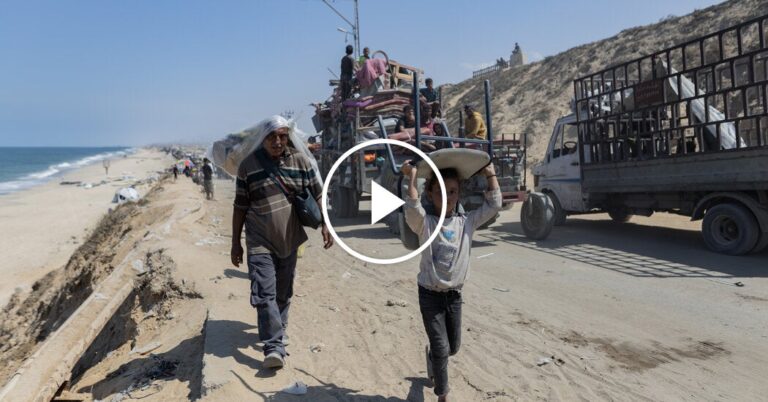
new video loaded: Palestinians Flee Gaza City as Israel Expands Its Offensive

By Axel Boada and Abeer Pamuk

Mohammed Al-Bayari packed up his belongings as he prepared to leave Gaza City after the Israeli military expanded its ground assault in the area.

National Invitational Tournament: Schedule, Scores, and Digital Program

0

The field is set for the 2025 MAX Field Hockey High School National Invitational at The Proving Grounds!

64 of the nation’s top teams from 12 different states will compete over 3 days in 70 official NFHS games, including 20 of the 2025 Preseason National Top 25 Teams and a total of 21 State Champions from 2024, including all 4 from Pennsylvania, New Jersey and New York.

Check out the final schedule below as well as complete event details now: [VIEW EVENT DETAILS]

***All National Invitational Games will be Live Streamed***

SCHEDULES/SCORES

-Team listed first is home/dark uniforms-

FRIDAY, SEPTEMBER 19TH

3PM
VU Field: Villanova University vs University of Connecticut
Field #1: Academy of Notre Dame de Namur (PA) vs The Kinkaid School (TX)
Field #2: Manheim Twp (PA) vs St. John’s School (TX)
Field #3: Penn Manor (PA) vs New Trier (IL)
Field #4: Mount Saint Joseph Academy (PA) vs Sacred Heart Academy (KY)
Field #5: Garrison Forest School (MD) vs Assumption (KY)

5PM
Field #1: Villa Maria Academy (PA) vs West Essex (NJ)
Field #2: Oak Knoll School (NJ) vs Warwick (PA)
Field #3: Conestoga (PA) vs North Hunterdon (NJ)
Field #4: Shore Regional (NJ) vs Springside Chestnut Hill Academy (PA)
Field #5: Moorestown (NJ) vs Guilderland (NY)
Field #6: Shawnee (NJ) vs Episcopal (TX)

7PM
VU Field: The Hill School (PA) vs Bryn Mawr School (MD)
Field #1: Greenwich Academy (CT) vs St. John’s School (TX)
Field #2: Kingsway Regional (NJ) vs New Trier (IL)
Field #3: Mamaroneck (NY) vs Assumption (KY)
Field #4: Loudoun Valley (VA) vs Smyrna (DE)
Field #5: Methacton (PA) vs Moses Brown (RI)
Field #6: Leonardtown (MD) vs Clearview Regional (NJ)

SATURDAY, SEPTEMBER 20TH

9AM
Field #1: Oak Knoll School (NJ) vs The Kinkaid School (TX)
Field #2: Conestoga (PA) vs Sacred Heart Academy (KY)
Field #3: Assumption (KY) vs West Perry (PA)
Field #4: Bishop O’Connell (VA) vs Episcopal (TX)
Field #5: Burnt Hills (NY) vs Stafford (VA)
Field #6: Notre Dame Prep (MD) vs East Greenwich (RI)

11AM
Field #1: New Trier (IL) vs The Hill School (PA)
Field #2: St. John’s School (TX) vs Norfolk Academy (VA)
Field #3: Academy of Notre Dame de Namur (PA) vs Christian Academy of Louisville (KY)
Field #4: John Burroughs School (MO) vs Garrison Forest School (MD)
Field #5: Crofton (MD) vs Moses Brown School (RI)
Field #6: Gwynedd Mercy Academy (PA) vs Severna Park (MD)

1PM
Field #1: West Essex (NJ) vs Lower Dauphin (PA)
Field #2: Manheim Twp (PA) vs Darien (CT)
Field #3: Warwick (PA) vs Greenwich Academy (CT)
Field #4: North Hunterdon (NJ) vs Mamaroneck (NY)
Field #5: Lackawanna Trail (PA) vs Leonardtown (MD)
Field #6: Seneca (NJ) vs Episcopal (TX)

3PM
VU Field: First Colonial (VA) vs Palmyra Area (PA)
Field #1: Bryn Mawr (MD) vs Norfolk Academy (VA)
Field #2: The Episcopal Academy (PA) vs Christian Academy of Louisville (KY)
Field #3: Notre Dame Prep (MD) vs Loudoun Valley (VA)
Field #4: Montclair (NJ) vs West Perry (PA)
Field #5: Ballard (KY) vs Moses Brown (RI)
Field #6: Stafford (VA) vs East Greenwich (RI)

5PM
VU Field: Kingsway Regional (NJ) vs Staples (CT)
Field #1: Bishop O’Connell (VA) vs Moorestown (NJ)
Field #3: Agnes Irwin School (PA) vs Shawnee (NJ)
Field #4: Oley Valley (PA) vs Severna Park (MD)
Field #5: Lackawanna Trail (PA) vs Crofton (MD)
Field #6: Cherokee (NJ) vs Springside Chestnut Hill (PA)

7PM
VU Field: Camden Catholic (NJ) vs Villa Maria Academy (PA)
Field #1: John Burroughs School (MO) vs Penn Manor (PA)
Field #2: Clearview Regional (NJ) vs Sacred Heart Academy (KY)
Field #3: Lakeland (NY) vs Methacton (PA)
Field #4: Lake-Lehman (PA) vs Whitney Point (NY)
Field #5: Ballard (KY) vs Kennett (PA)

SUNDAY, SEPTEMBER 21ST

9AM
Field #1: Lower Dauphin (PA) vs The Kinkaid School (TX)
Field #2: Norfolk Academy (VA) vs Agnes Irwin School (PA)
Field #3: Montclair (NJ) vs John Burroughs School (MO)
Field #4: The Episcopal Academy (PA) vs Sacred Heart Greenwich (CT)
Field #5: Guilderland (NY) vs Gwynedd Mercy Academy (PA)

11AM
Field #1: Palmyra Area (PA) vs Camden Catholic (NJ)
Field #2: Christian Academy of Louisville (KY) vs Shore Regional (NJ)
Field #3: Burnt Hills (NY) vs Oley Valley (PA)
Field #4: Ballard (KY) vs Lake-Lehman (PA)
Field #5: East Greenwich (RI) vs Kennett (PA)

12PM
VU Field: Villanova University vs Northwestern University

1PM
Field #1: Darien (CT) vs Mount Saint Joseph Academy (PA)
Field #2: First Colonial (VA) vs Staples (CT)
Field #3: Smyrna (DE) vs Lakeland (NY)
Field #4: Springside Chestnut Hill (PA) vs Sacred Heart Greenwich (CT)
Field #5: Whitney Point (NY) vs Cherokee (NJ)

The post National Invitational Details- Schedule, Scores & Digital Program appeared first on MAX Field Hockey.

Mahle’s Jet Ignition Range-Extender Engine Generator with 840-Mile Range

0

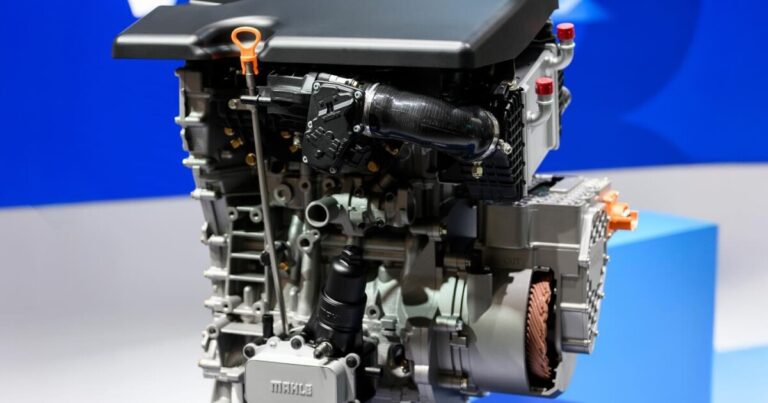
Horse Powertrain wasn’t the only automotive supplier showing an efficiently packaged range-extender engine system at this year’s IAA Mobility Munich show, which wrapped up over the weekend. German component builder Mahle took a short break from pushing out compact, torque-maximizing ebike motors to reveal a small, high-efficiency multi-fuel engine-generator it says is ready to deliver hybridized driving ranges up to 838 miles (1,350 km), about double that of some of today’s longest-range battery electric vehicles.

Mahle views its range-extenders as far more than simple independent add-on, looking at them as one component in a holistic driving architecture in which smaller batteries can replace larger ones while still alleviating, rather than intensifying, range anxiety. Those batteries will then lead to cost, weight and material savings, creating an attractive selection of affordable, efficient new-energy vehicles with more overall range, simple and flexible refueling options, and zero-emissions local driving.

Company CEO and board chairman Arnd Franz believes range-extended electric vehicles to be an important part of the auto market’s future and notes that Europe is lagging behind major global markets like China and North America. In his IAA Mobility press conference speech, Franz noted that political complications are holding Europe back from embracing range-extended electric vehicles as an emissions-cutting solution.

A hot topic of late, the European Union’s 2035 target for a 100% reduction in car and van CO2 emissions will mean the end of the road for combustion engines in new vehicles. The European auto industry has identified that goal as infeasible and has been ramping up pressure on the European Commission, the EU’s primary executive body, to withdraw the complete ban and instead work to encourage other emissions-cutting options beyond just battery-powered EVs, including hybrids, hydrogen engines and sustainable fuels.

Mahle CEO Arnd Franz gives a keynote at IAA Mobility and focuses on various efficiency-boosting initiatives, including the range extender to his right

Mahle

“Mahle is doing its homework and working on the decarbonization of road traffic in all areas of technology,” Franz said at the show. “Europe must now follow the other major world markets and allow competition between all technologies in its CO2 regulation. This is not just a matter of climate protection but also of Europe’s competitiveness.”

Those words came several days before a meeting between European Commission President Ursula von der Leyen and key EU auto industry executives last Friday. Following the meeting, Von der Leyen agreed to fast-track the review of the 2035 ban it had originally planned for 2026. It will now undertake that review before the end of 2025.

Assuming the EC works with the auto industry toward broadening out their CO2-cutting goals and means, range-extender systems are waiting in the wings as an immediate, ready-to-install solution. Mahle notes that the market for range-extended electric vehicles is expected to grow by 15% each year until 2030. It does not intend to miss out on that opportunity.

Mahle's range extender is designed to deliver total vehicle ranges up to 838 miles
Mahle’s range extender is designed to deliver total vehicle ranges up to 838 miles

Mahle

The all-in-one range-extender system Mahle revealed at IAA Mobility is ready for series production, the company says. The new unit builds on some of the pioneering work Mahle has done in developing next-gen electric technologies like magnet-free and ultra-high efficiency motors, incorporating an 800-V generator that can run without the use of rare-earth magnetic materials thanks in part to a direct rotor cooling system. The generator is designed to run at over 97% efficiency, producing a continuous output of 85 kilowatts to charge the electric vehicle’s onboard battery pack.

The small turbocharged engine part of the equation is also highly efficient, relying on Mahle’s Jet Ignition system to run at an impressive 42% efficiency, well higher than the 30% ICE average cited by both the American Automobile Association and the US Department of Energy. A feature we’ve seen previously in a very different style of engine – Zenvo’s 1,200-hp quad-turbo Mjølner V12 – the Jet Ignition replaces the common spark plug with a small pre-chamber that discharges fast heat jets through a series of nozzles, delivering rapid, stable combustion that ultimately increases compression ratio without knocking and reduces fuel consumption.

While total driving range will, of course, ultimately depend on the battery vehicle to which the range-extender is mated, Mahle’s estimated 838-mile (1,350-km, WLTP) range per charge/fill-up is more than three times the 249-mile (400-km) average range of EU electric vehicles in 2024 as cited by the International Energy Agency. The figure also doubles (or more) most of the rangiest EU-market electric cars listed in the EV Database.

Clearly an efficient, little range-extender could do a number on range anxiety.

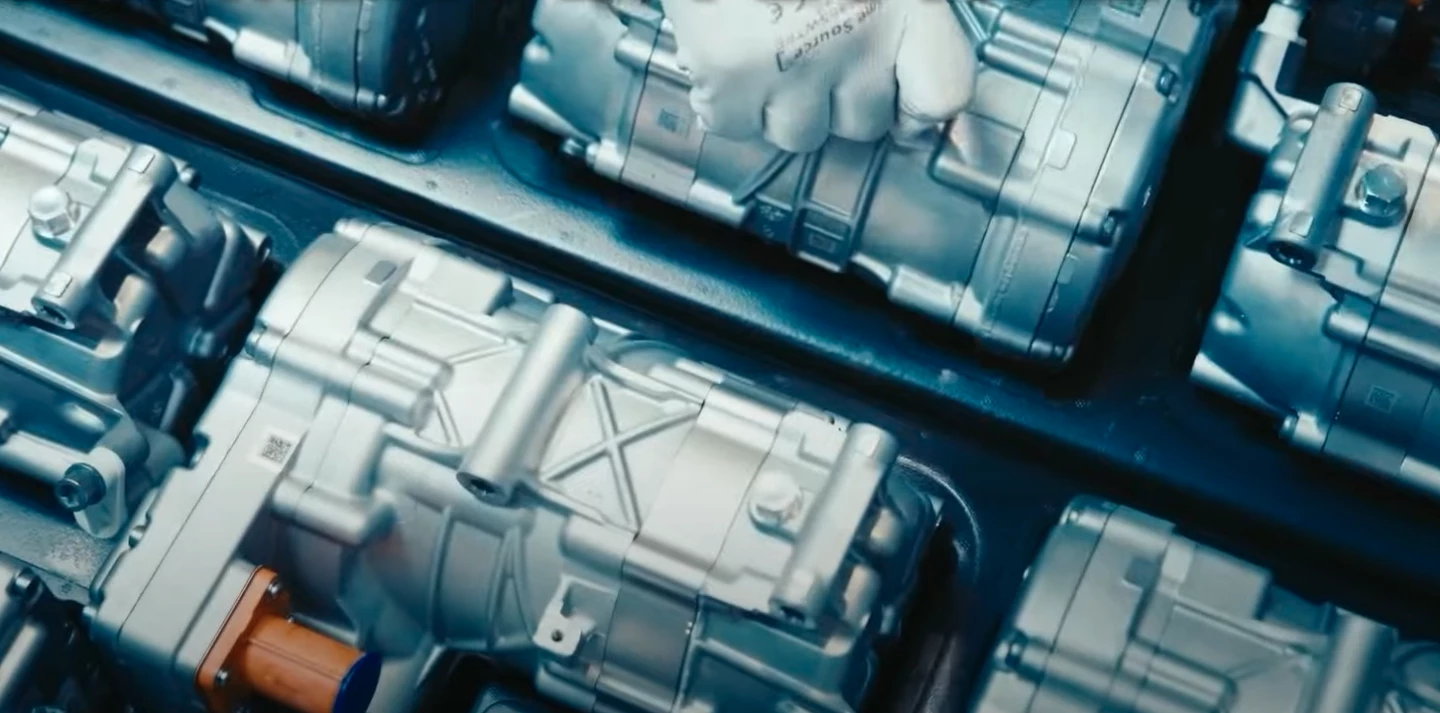
Mahle range extender component manufacturing

Mahle

Of course, most drivers don’t need close to 840 miles of range, particularly when they have a fuel-powered engine-generator on board for easy, flexible refueling. But by adding such a unit to their EV architecture, automakers gain serious flexibility in adjusting the size of the battery accordingly for the right balance of battery and engine-extended range and weight for the vehicle and price point in question.

Like Horse’s C15 engine-generator, Mahle’s range-extender is design to run on renewable biofuels, letting automakers better adapt it to their greater emissions-cutting strategy.

The 2035 engine ban review is one we’ll be watching with interest to gain a better understanding of how range-extender systems from the likes of Mahle and Horse will fit into the future European auto market.

Source: Mahle

Client Challenge: Overcoming Obstacles and Achieving Success

0


Client Challenge


JavaScript is disabled in your browser.

Please enable JavaScript to proceed.

A required part of this site couldn’t load. This may be due to a browser
extension, network issues, or browser settings. Please check your
connection, disable any ad blockers, or try using a different browser.

Russia-Ukraine conflict: Recap of major events on day 1,302 of the war | Latest updates on Russia-Ukraine conflict

0

Here are the key events on day 1,302 of Russia’s war on Ukraine.

Here is how things stand on Thursday, September 18:

Fighting

  • A Ukrainian drone has struck a car in Russia’s Belgorod border region, killing one person and injuring another, according to the region’s governor.

  • The Ukrainian army lost more than 1,500 troops during front-line fighting over the past day, reported Russia’s state TASS news agency, citing the Ministry of Defence. Ukraine has not confirmed the claim, and both sides have engaged in what independent analysts described as unsurprising narrative warfare aimed at projecting military gains.

  • The General Staff of the Ukrainian armed forces said Russia had lost an estimated 1,020 people, along with 360 unmanned aerial vehicles and 36 artillery systems, in the past day. Russia has not confirmed the claim.
  • Meanwhile, Russian forces also hit Ukrainian railway infrastructure facilities, “storage and launch sites for long-range unmanned aerial vehicles, as well as temporary deployment sites”, the Russian Defence Ministry said.
  • Ukrainian President Volodymyr Zelenskyy wrote on social media platform X that although Russia had prepared offensives in Sumy, Novopavlivka, Pokrovsk and Zaporizhzhia this year, Russia has lost “so much manpower” that “as of now, they lack the strength for large-scale offensives.”

Military

  • Speaking at a joint news conference with European Parliament President Roberta Metsola, Zelenskyy said missiles for Western air defence systems were among the first set of US weapons being sent under the Priority Ukraine Requirements List (PURL) mechanism, which allows NATO states to pay for the transfer of United States-sourced weapons and technology.
  • Ukraine has received more than $2bn so far as part of the PURL scheme, Zelenskyy said, with the total expected to rise to up to $3.6bn in October.
  • Lithuanian prosecutors charged 15 people in connection with detonations of DHL parcels at logistics depots in Europe last year, which prosecutors allege were organised by Russian citizens with ties to Russian military intelligence.

  • In what Danish Prime Minister Mette Frederiksen called “a paradigm shift”, Denmark will procure “long-range precision weapons” for the first time in response to the threat posed by Russia. Moscow’s ambassador to Copenhagen said the decision was “pure madness”.

Politics and diplomacy

  • After a birthday phone call from Putin, Indian Prime Minister Narendra Modi thanked the Russian president – who he referred to as “my friend” – on X, writing that India is “ready to make all possible contributions towards a peaceful resolution of the Ukraine conflict”.
  • King Charles seemed to gently nudge US President Donald Trump on standing firm in Ukraine’s corner, during a lavish ceremony for Trump during his visit to the United Kingdom, when the British monarch recalled the US-UK alliance during World Wars I and II. “Today, as tyranny once again threatens Europe, we and our allies stand together in support of Ukraine, to deter aggression and secure peace,” the king said. The comments came amid questions over whether Trump has put sufficient pressure on Putin to negotiate a peace deal.

  • Ahead of the 80th United Nations General Assembly “high-level” week, UN Secretary-General Antonio Guterres said he would meet with Russian and Ukrainian delegations but was “not optimistic about the short-term progress in the peace process in Ukraine”. The two sides’ positions are too different, he said, with Ukraine driven by “a legitimate interest to preserve its territory” and Russia “determined to [do] something that would mean the occupation of large parts of Ukraine”.

  • Russian nationalists and online bots moved quickly to sow division after the killing of conservative right-wing figure Charlie Kirk, The Associated Press news agency reported, tying his death to US support for Ukraine and even spreading the conspiracy theory that Ukraine was responsible for his death.
US President Donald Trump and King Charles speak on day one of Trump’s second state visit to the UK [Yui Mok/Reuters]

Economy and energy

  • Ukraine and the US International Development Finance Corporation said they would each commit $75m to a joint investment fund that is part of Kyiv’s minerals deal with Washington. The deal – which Trump has referred to as “payback” for Ukraine aid – was signed in May and will give the US preferential access to new Ukrainian minerals and natural resources licences in exchange for post-war financial and military assistance.
  • Ukraine has gas reserves to meet about 80 to 90 percent of its demand for the upcoming winter, but still needs up to $1bn in additional fuel stockpiled, data show.
  • Russia’s consumer price index rose by 0.04 percent in the week ending September 15, the state statistics agency said, compared with 0.1 percent growth in the previous week. Overall price growth in the year to date stands at 4.08 percent, compared with 5.78 percent for the same period last year.

Sangamo Therapeutics’ SWOT analysis: Gene therapy company encounters financial difficulties despite strong product pipeline

0


Sangamo Therapeutics’ SWOT analysis: gene therapy firm faces cash crunch amid promising pipeline