new video loaded: How Drones Changed the War in Ukraine
By David Guttenfelder, Rebecca Suner, David Seekamp, Estelle Caswell and James Surdam•
Drones have dramatically changed the Ukraine war over the past six months. David Guttenfelder, a New York Times visual journalist, shares his observations from the ground.
Tech leaders have been quick to squash claims that their AI firms could one day cause significant unemployment. But Goodwill’s CEO Steve Preston says it’s already happening.
The charity, which has over 650 job centers, saw over 2 million people use its employment services last year—and it’s getting ready for even more.
“We are preparing for a flux of unemployed young people—as well as other people—from AI,” the CEO exclusively told Fortune, adding that automation will hit low-wage and entry-level roles the worst.
The 65-year-old, who formerly served as the 14th United States secretary of housing and urban development, revealed that he’s already witnessing “large organizations beginning to make significant layoffs based on a move to AI.”
Call centers and sales roles are being particularly hard hit right now, he added. “I don’t know that it’ll be catastrophic, but I do think we’re going to see a significant reduction in a number of jobs. I think it’s going to hit low wage workers especially hard.”
Although people of all ages hold lower-paying jobs, they’re often a rite of passage for fresh-faced students starting out in the world of work.
“It’s much harder to find a job, Preston adds. “It’s really hitting college students right now in the marketplace. It’s really hitting young adults without college degrees.”
Gen Z non-grads are finding themselves worst hit by unemployment—but they won’t be the only ones impacted
Despite numerous reports warning that the higher education payoff is dead—essentially, thanks to more inclusive skills-based hiring, there’s no point getting a degree anymore and Gen Zers without one are winning the talent war—Preston is seeing the complete opposite.
“What I’m seeing is of the overall unemployment, people without college degrees have no jobs,” he said. Research has shown that the issue is even more acute for young men.
“That is a terrible thing,” Preston said, while sympathising with young people on how crucial it is to see a world where they can grow and thrive. “For young people at that point in their life, to attach to something where they can see a future is so important, where they can envision their lives going forward.”
And as AI and automation gets smarter, eventually those with degrees will also find landing that first job increasingly impossible—and according to Preston, that’ll have a knock-on effect on more senior roles too.
It’s not just AI could replace many of those mid-level roles, but also that there could be a lack of suitable talent coming up through the pipeline.
“Those entry-level roles were the places where they learned the foundations of a job—where they built core skills, where they had an opportunity to be mentored, and grew up in the organization,” he explained.
Gen Z students are already struggling with feeling unprepared for the world of work because of a lack of work experience opportunities available, like internships, and that issue will only get more exuberant thanks to AI.
The key skills needed for the next generation of job seekers
Instead of getting drowned out by the tech wave, Preston advises young people to ride it. He said that Goodwill is often talking to employers to find out which skills will actually be required tomorrow.
“Digital skills are really critical,” he added. “We often think that if somebody’s on their phone all day and has 15 apps open at all timeshas great digital skills, but it’s a very different thing.”
While you’re TikTok editing game might be strong, Preston said that young people really need to master the tech tools workplaces actually use, from Microsoft Excel to Google Docs.
“We consistently find that if people get a certain level of attainment with digital skills, the door is open wide—and many people that we assume have those skills, do not.” The next step is learning how to use the likes of ChatGPT and Gemini.
“Increasingly, no surprise, people who are proficient in using AI tools are beginning to leapfrog other people going into the marketplace.”
Meanwhile, for Gen Zers who don’t want to go down the corporate career path, he suggested learning clean tech skills, like solar panel installation and EV charging station maintenance, as they’re prime areas for growth without a degree needed.
And Preston has a stark warning for millennials who refuse to adapt: “If you are someone seeking a job in your 30s—or even 40s—and you haven’t acquired those skills, you’re pretty much locked out of a massive percentage of the jobs that are available in the marketplace”.
“When those people get those skills, we just see the doors busting open,” he added. “I can think of two women off the top of my head, who went from being homeless to jobs in Accenture and Google, after going through extensive digital boot camps…It’s never too late.”
Fortune Global Forum returns Oct. 26–27, 2025 in Riyadh. CEOs and global leaders will gather for a dynamic, invitation-only event shaping the future of business. Apply for an invitation.
More than 100 years after the Balfour Declaration backed “the establishment in Palestine of a national home for the Jewish people”, and 77 years after the creation of Israel in the British Mandate of Palestine, the United Kingdom is set to formally recognise a Palestinian state.
Prime Minister Keir Starmer is expected to make the announcement on Sunday, two days before the start of the 80th session of the United Nations General Assembly (UNGA), where Palestinian sovereignty after decades of occupation and apartheid by Israel will be in focus.
Recommended Stories
list of 4 itemsend of list
The move comes after the UK government said in July that it would shift its longstanding approach of holding off recognition until a supposed moment of maximum impact – unless Israel stops its genocidal war in Gaza, commits to a long-term sustainable peace process that delivers a two-state solution, and allows more aid into the enclave.
But the catastrophic situation in Gaza has only grown significantly more dire over the past few weeks, as the Israeli military continues to systematically destroy Gaza City to seize it, while continuing to starve and displace the famine-stricken population of the enclave.
Daily raids by Israeli soldiers and attacks by settlers are also ongoing across the occupied West Bank, with Israel advancing plans to annex the Palestinian territory and “bury” the idea of a contiguous Palestinian state with occupied East Jerusalem as its capital.
The Israeli government has blasted the UK allies as well as more than 75 percent of UN member states that formally recognise Palestinian sovereignty, claiming their stance “rewards terrorism”.
Conservative leader Kemi Badenoch claimed she wants to see a two-state solution in the region, but signalled she wants to move in lockstep with Israel and the United States, its ironclad military, financial and political backer.
“It is obvious, and the US has been clear on this, that recognition of a Palestinian state at this time and without the release of the hostages, would be a reward for terrorism,” she wrote in The Telegraph over the weekend.
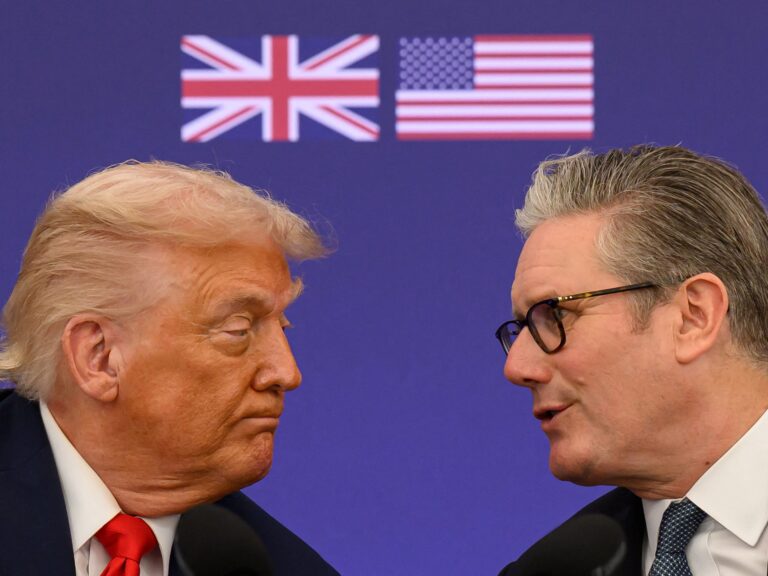
US President Donald Trump expressed his disagreement with recognition during a state visit to the UK last week and a meeting with Starmer.
Some of the family members of Israeli captives held in Gaza also pounced on the UK government for the decision, urging the prime minister in an open letter on Saturday not to take the step until the remaining 48 captives, about 20 of whom are believed to be alive, are returned.
The announcement had “dramatically complicated efforts to bring home our loved ones”, they wrote, adding that it is a “victory” for Hamas.
In a meeting in London earlier this month, Starmer and Palestinian Authority (PA) President Mahmoud Abbas emphasised that Hamas should have no place in the future leadership of Palestine. Israel has said it will stop both the PA and Hamas from having any future leadership role.
The UK government is also considering further steps to sanction Hamas in the coming weeks, according to British media. The group has long been formally considered a “terrorist” organisation in the UK and much of the West.
The government has continued to arm and fund Israel during the two-year war, even as an increasing number of credible international organisations and investigations, including a UN inquiry, confirmed that genocide is being carried out in Gaza.
More world powers recognise Palestine
The UK’s announcement means that 148 of the 193 member states of the UN recognise Palestinian statehood, and more will join soon.
Portugal is preparing to make a formal announcement, as is France. They join Spain, Ireland, Norway and others among the latest who have made the move in light of the war on Gaza, which has killed more than 65,000 Palestinians so far.
After the moves by the UK and France are finalised, the US will be left as the only permanent member of the UN Security Council that refuses to recognise Palestinian sovereignty.
Germany has also resisted making the move, arguing that the required conditions are not met at the moment.
On Monday, France and Saudi Arabia will jointly host a delayed one-day summit in New York at the UN on advancing a two-state solution for Israel and Palestine.
At least in the short term, the move to recognise a Palestinian state will be largely symbolic as all Palestinian territory is currently under deadly military occupation by Israel, which continues to emphasise the right to “defend” itself.
Stockholm-based music licensing platform Epidemic Sound has launched a new artificial intelligence-powered music editing tool that lets creators “reshape tracks made by real artists.”
The new feature, called Adapt, allows content creators to modify licensed tracks, such as extending songs, removing instruments or adjusting arrangements, while maintaining publishing rights and ensuring original artists receive compensation.
The tool only works with “human-made music” from Epidemic Sound’s existing catalog, avoiding the AI-generated content flooding other platforms.
Oscar Höglund, CEO of Epidemic Sound, said: “While many companies race to flood the market with AI-generated tracks, Epidemic Sound is charting a different path towards a future where human creativity is enhanced, not replaced, by AI.”
A study by Stability AI, published in August, suggested that AI is creating “potential” new music genres as artists adapt the technology. AI music generation platforms Suno and Udio already face lawsuits including from major music labels over the use of artists’ material without authorization to train their AI models.
“While many companies race to flood the market with AI-generated tracks, Epidemic Sound is charting a different path towards a future where human creativity is enhanced, not replaced, by AI.”
Oscar Höglund, Epidemic Sound
Meanwhile, Epidemic said its approach attempts to address these concerns by “using AI to amplify creativity and empower creators while keeping musicians’ human artistry at the center.”
Höglund added: “While we deeply believe in the power of AI to enhance creativity, our commitment remains to music made by real artists and ensuring that the value of human creativity is recognized and rewarded.”
According to Epidemic’s research, 94% of creators consider music critical to successful content, yet many struggle with the technical aspects of audio editing. Epidemic says its Adapt tool aims to address this by allowing real-time music customization without demanding multiple skills.
SamHall, Chief Product Officer at Epidemic Sound, said: “[W]e know soundtracking can be challenging, demanding multiple skills and significant time to get right. Adapt is the first in a series of releases rolling out in the coming weeks, designed to give creators tools to use the music that inspires them, adapt it in real time, and align it seamlessly with their vision. With trust at the core, creators can be confident that the artists behind these tracks are recognized and compensated.”
Steve Wright, a content creator with 1.6 million subscribers and a member of the Epidemic Sound Creator Council who tested the tool, said: “Adapt has completely changed how I approach music in my edits. Instead of wasting time cutting tracks to fit footage, I can now shape the music around my story, whether that’s dropping the intensity for dialogue or shifting the mood to match a scene.”
“Importantly, the tracks still come from real artists, who are rewarded every time I use their work. As a filmmaker, that balance of creative freedom and fair compensation is huge. Tools like Adapt are proof that AI can support creativity without replacing it.”
“Adapt is the first in a series of releases rolling out in the coming weeks, designed to give creators tools to use the music that inspires them, adapt it in real time, and align it seamlessly with their vision.”
Sam Hall, Epidemic Sound
Coinciding with the launch of the new AI tool, Epidemic announced a 43% increase in artist bonus payments beginning in 2026. The company will boost its annual SoundtrackBonus to $4.2 million from $3.7 million and establish a $1 million fund specifically for AI-related adaptations of artist works.
Epidemic’s business model splits royalties 50-50 with artists. Founded in 2009, the platform has built its catalog through partnerships with independent artists.
Ooyy, an artist who has worked with Epidemic Sound for eight years, said: “[T]he company has always prioritized artist payments so we can earn from our work. It’s harder than ever to make a living in music, so having that foundation gives me the freedom to focus on creating. I’m also really excited about Adapt, and it’s been great to have a voice in its development. I can see how it’ll help my music reach more people in new ways.”
Höglund said: “At Epidemic Sound, we strive to use technology to do right by both creators and artists, and AI is no different. With Adapt, we are giving creators a powerful new way to customize music, while ensuring artists are rewarded every time their tracks are used.”
“More freedom for creators, more visibility and income for artists, and stronger meaningful human connections—this is what a human-first approach to AI looks like, and it is the future of AI soundtracking.”
“[T]he company has always prioritized artist payments so we can earn from our work. It’s harder than ever to make a living in music, so having that foundation gives me the freedom to focus on creating.”
Ooyy, Artist
The launch of Adapt comes as short-form video platforms now drive music discovery and consumption. Epidemic says it powers “over 3 billion video views daily across TikTok andYouTube.”
Earlier this year, Epidemic acquired Song Sleuth, an AI music recognition startup, as it bets on AI to address the music industry’s challenges of tracking and monetizing songs used in user-generated content online.
Following the acquisition, Epidemic launched a new service called Aentidote aimed at identifying unclaimed and undistributed royalties from remixes, covers, and live recordings, part of what the industry calls the music “black box” of unattributed revenue.
Sir Keir Starmer is expected to announce the UK’s recognition of a Palestinian state in a statement on Sunday afternoon.
The prime minister said in July that the UK’s position would shift in September unless Israel met several conditions, including agreeing to a ceasefire in Gaza and committing to a long-term peace process that would lead to a two-state solution.
The UK has long called for an agreement that would see a Palestinian state co-exist alongside Israel – something Israeli leadership has desisted from since the start of its war with Palestinian armed group Hamas.
The PM’s move has drawn fierce criticism from the Israeli government, families of hostages held in Gaza and some Conservatives.
Israeli Prime Minister Benjamin Netanyahu previously said it “rewards terror”.
The decision to recognise a Palestinian state represents a major change in UK foreign policy, after successive governments said recognition should come as part of a peace process and at a time of maximum impact.
However, ministers argue there was a moral responsibility to act to keep hopes of a long-term peace alive.
Efforts to secure a ceasefire in Gaza – let alone a long-term solution to the Israel-Palestine conflict – have faltered. Israel recently sparked international outrage when it carried out an air strike on a Hamas negotiating team in Qatar.
Government sources said the situation on the ground had also worsened significantly in the last few weeks. They cited images showing starvation and violence in Gaza, which Sir Keir previously described as “intolerable”.
It is the latest Israeli offensive in the nearly two-year war that began with a Hamas-led attack on southern Israel – in which around 1,200 people were killed and 251 hostages taken back to Gaza – and has seen much of the Palestinian territory’s population displaced, its infrastructure destroyed, and at least 65,208 people killed, according to Hamas-run health ministry figures.
Ministers have also highlighted the continued expansion of Israeli settlements in the occupied West Bank, which are illegal under international law, as a key factor in the decision to recognise Palestinian statehood.
Justice Secretary David Lammy, who was foreign secretary when recognition was proposed, cited the controversial E1 settlement project – which critics warn would put an end to hopes for a viable, contiguous Palestinian state – as well as violence from Israeli settlers in the West Bank.
Palestinian Authority President Mahmoud Abbas welcomed the UK’s recognition pledge when he visited Sir Keir earlier this month, with Downing Street saying both leaders had agreed Hamas should play no role in the future governance of Palestine.
Conservative leader Kemi Badenoch said she wanted to see a two-state solution in the Middle East.
But she wrote in The Telegraph over the weekend: “It is obvious, and the US has been clear on this, that recognition of a Palestinian state at this time and without the release of the hostages, would be a reward for terrorism.”
Meanwhile, in an open letter to Sir Keir on Saturday, family members of some of the hostages taken by Hamas urged the prime minister not to take the step until the 48 still in Gaza, of whom 20 are thought to still be alive, had been returned.
The announcement of the forthcoming recognition had “dramatically complicated efforts to bring home our loved ones”, they wrote. “Hamas has already celebrated the UK’s decision as a victory and reneged on a ceasefire deal.”
Sources in government said ministers will be setting out next steps for sanctioning Hamas in the coming weeks.
During a state visit to the UK this week, US President Donald Trump also said he disagreed with recognition.
Sir Keir had set a deadline of the UN General Assembly meeting, which takes place this week, for Israel to take “substantive steps to end the appalling situation in Gaza, agree to a ceasefire and commit to a long-term, sustainable peace, reviving the prospect of a two-state solution”.
He said in July: “With that solution now under threat, this is the moment to act.”
A number of other countries including Portugal, France, Canada and Australia have also said they will recognise a Palestinian state, while Spain, Ireland and Norway took the step last year.
Palestine is currently recognised by around 75% of the UN’s 193 member states, but has no internationally agreed boundaries, no capital and no army – making recognition largely symbolic.
The two-state solution refers to the creation of a Palestinian state in the West Bank and Gaza Strip, with East Jerusalem as its capital. Israel currently occupies both the West Bank and Gaza, meaning the Palestinian Authority is not in full control of its land or people.
Recognising a Palestinian state has long been a cause championed by many within the Labour Party. The PM has been under mounting pressure to take a tougher stance on Israel, particularly from MPs on the left of his party.
Shortly before he gave his speech in July, more than half of Labour MPs signed a letter calling for the government to immediately recognise a Palestinian state.
EPA
Israel’s offensive on Gaza City, where one million people were living and famine was confirmed in August, has forced thousands to flee
However, critics questioned why the government had appeared to put conditions on Israel but not Hamas.
Britain’s Chief Rabbi, Sir Ephraim Mirvis, called on the government to pause its decision.
“The intended recognition is not contingent upon a functioning or democratic Palestinian government, nor even upon the most basic commitment to a peaceful future,” he said.
“Astonishingly, it is not even conditional upon the release of the 48 hostages who remain in captivity.”
Government sources insisted their demands for Hamas to release the hostages and agree to a ceasefire had not changed.
But officials in the Foreign Office argued statehood was a right of the Palestinian people and could not be dependent on Hamas, which the government considers a terrorist organisation.
A required part of this site couldn’t load. This may be due to a browser
extension, network issues, or browser settings. Please check your
connection, disable any ad blockers, or try using a different browser.
The 2025 World Para Swimming Championships get underway this evening (in the United States’ time zones at least), streaming on YouTube. After playing host to the World Championships this summer, the lights at the OCBC Aquatic Centre in Singapore will go up on a week of the top para swimmers in the world going head-to-head in the major senior international meet of the season.
Earlier this week, we highlighted five women to keep an eye on at the championships. Now, it’s the men’s turn.
Last summer, the then 22-year-old Gabriel dos Santos Araujowas one of the stars of the Paris Paralympics, winning triple gold (50 backstroke S2, 100 backstroke S2, 200m freestyle S2) at his second Games. It was the culmination of an incredibly successful Paralympic cycle for Araujo. After winning gold in the 50m backstroke S2 and 200m freestyle S2, as well as silver in the 100m backstroke S2 in Tokyo, he swept those events at the 2022 and 2023 World Championships.
He also broke multiple world records and was the overall male winner of the 2024 CITI Para Swimming World Series. He’s kept that momentum going at the 2025 Series as well, including his record-breaking habits. In April, he lowered his 150m IM SM2 world record by over a second (3:22.25).
Araujo will take aim at that world record again in his first event of the 2025 World Para Swimming Championships. Later in the meet, he’ll defend his Paralympic titles in the 50/100m backstroke S2 and the 200m freestyle S2.
Individual Event Schedule: Day 2 – 150m IM SM3; Day 3 – 100m backstroke S2; Day 4 – 200m freestyle S2; Day 5 – 50m freestyle S3; Day 6 – 50m backstroke S2
Italy sends a strong contingent to the 2025 Para Swimming World Championships, including four-time Paralympic Games champion Simone Barlaam. The S9 classification has provided some great racing between swimmers like Barlaam, Ugo Didier, and Timothy Hodgethe past few seasons—including at last summer’s Paralympic Games, where Barlaam successfully defended his 50m freestyle S9 gold from Tokyo. Barlaam also won gold in the 100m butterfly S9, helping Italy win the men’s 100m butterfly S8, S9, and S10 events.
Barlaam is also no stranger to World Championship gold. He owns 21 World Championship medals including 18 gold. At the last edition of the World Para Swimming Championships, he earned six golds (50m freestyle S9, 100m freestyle S9, 400m freestyle S9, 100m backstroke S9, 100m butterfly S9, and the mixed 4×100m freestyle relay 34 points). His standout swim was the 50 freestyle, where he took down his world record, breaking through the 24-second barrier with a 23.96.
This year, he’s not taking on as many individual events, but will be back in the water for the 50m freestyle S9 and 100m butterfly S9 (where he’s the reigning Paralympic champion) as well as the 100m and 400m freestyle S9 events.
Individual Event Schedule: Day 3 – 100 butterfly S9; Day 4 – 100 freestyle S9; Day 5 – 400 freestyle S9; Day 7 – 50 freestyle S9
Nicholas Bennett’s breakout on the international stage came two years ago at the last World Para Swimming Championships, winning two titles as a teenager. He backed up those performances a year later in Paris, winning gold in the 100m breaststroke SB14 and 200m IM SM14, as well as silver in the 200m freestyle S14. His effort made him the first male Canadian swimmer to win Paralympic gold since 2012. Not only that, but he was the first to win multiple golds at a single Paralympic Games since 2004, and the first to win three medals since 2012, for which he was one of Canada’s flagbearers at the Closing Ceremony.
After an incredible summer, Bennett took a break from swimming after the Games, like many Olympic and Paralympic swimmers. Though he didn’t make a coaching change as he started this season, he did change his training base, following his coach and sister Haley Bennett-Osborne to HPC-Quebec, where she is the new head coach.
This year, Bennett told Swimming Canada “of course I’d love to break my world record int he 200m IM. The ultimate goal is, you know, try to replicate the success we had last year. But showing up [at Worlds] is already an accomplishment, just with how stressful the past couple of months have been.”
Bennett’s slated for four events in Singapore, including the 200m IM SM14, where he’s looking for a third-straight gold at a senior international meet at 21-years-old.
Individual Event Schedule: Day 1 – 200m freestyle S14; Day 3 – 100m breaststroke SB14; Day 5 – 200m IM SM14; Day 7 – 100m butterfly S14
Bennett will clash with William Ellardin the 200m freestyle S14 in what could be one of the best races of the meet. Bennett and Ellard have been on a similar timeline–both broke out on the senior international stage at the 2023 World Para Swimming Championships, then won gold in their Paralympic debuts in Paris.
Ellard is a freestyle specialist, winning Paralympic gold in the 200m freestyle S14 and mixed 4×100 freestyle relay S14 but also earned silver in the 100m butterfly S14 last summer. It’s his sprinting that has shone this year; he tied his 100m freestyle S14 world record at the 2025 Aquatics GB Championships in April (51.07). However, Ellard isn’t on the entry list for that event in Singapore, instead taking on the 100m backstroke and 100m butterfly S14 in addition to the 200m freestyle.
Individual Event Schedule: Day 1 – 200m freestyle S14; Day 2 – 100m backstroke S14; Day 3 – 100m butterfly S14
Keiichi Kimuragot the rare experience of winning his first Paralympic gold in front of a home crowd at the 2021 Paralympics. It was his fourth Paralympic Games and he continued to excel at his fifth in Paris, defending his title in the 100m butterfly S11 and adding a gold in the 50m freestyle S11.
Now a ten-time Paralympic medalist, Kimura has also racked up an impressive medal haul of 19 at the World Championships. He was the silver medalist in both the events that he won in Paris, so he’ll be aiming to move to the top of the podium in Singapore. If he wins gold in the 50m freestyle S11, it will be his first World title in the event.
Retirement can boost mental health, but not for everyone. A new study shows that income, gender, and job type influence whose well-being flourishes and who struggles once the 9-to-5 workdays are ended.
Retirement generally signifies the end of full-time work and a transition to a more leisurely life. For many, it represents new opportunities, with time available to travel, start new hobbies, and spend time with family and friends – to take a well-earned break from the daily grind.
However, a new study by the University of Edinburgh in Scotland has found that the mental health benefits of retirement aren’t guaranteed to everyone who retires. There are factors that negatively influence post-retirement well-being.
“This study identified distinct mental health trajectories across different income groups,” said the study’s lead and corresponding author, Xuefei Li, from the University’s Department of Psychology. “We can assume that people’s immediate health changes at the year they retire and longer-term health changes are different. Understanding these phases sheds light on the adjustment processes that people undergo when faced with the internal and external challenges.”
The researchers analyzed 17 years of data from the Dutch Longitudinal Internet Studies for the Social Sciences (LISS), which follows households over time. A total of 1,538 participants who retired during the study window and had mental health, income, and job demand data available were included.
Mental health was measured with a five-item scale (MHI-5), capturing anxiety, depression, and well-being. Monthly income was grouped into three categories: low (< €1,500/month or US$1,770/month), middle (€1,501–3,000 or US$1,770–3,535), and high (> €3,000 or US$3,535). Pre-retirement job demands, both physical and mental, were self-reported. Demographic data included gender, marital status, education, and retirement age. The researchers used piecewise growth curve modeling, which allowed them to look at changes in mental health before, during, and after retirement, and compare whether those changes follow one, two, or three phases.
Income makes a difference to post-retirement well-being
Across all groups, retirement was linked with improved mental health, but the pattern differed by income. Those in the low-income group showed an initial improvement, but then a decline after about two-and-a-half years was seen, characterized by a “reverse U-shape” or what’s called the fading honeymoon effect. The middle-income group saw a two-phase model: improvement before retirement, followed by a more modest improvement after. In the high-income group, mental health didn’t change before and after retirement, but showed a positive spike during the retirement year. Middle- and high-income individuals with already high mental health improved less after retirement; that is, they had less “room to grow”. No such effect was found in the low-income group.
Jobs that were physically demanding before retirement had a negative effect on the mental health of those in the middle-income group – this effect persisted even after accounting for gender, education, marital status, and age. Mental job demands didn’t significantly affect outcomes. In the low-income group, women and unmarried retirees had notably poorer mental health. In the high-income group, retiring later in life was linked with slower improvements and sometimes worse mental health outcomes.
The study has limitations. The high-income group was relatively small, and the low-income group was disproportionately female, which could skew results. The study couldn’t distinguish whether participants chose to retire or were forced to, even though that likely impacts mental health. Findings are based on the Dutch pension system, which is relatively generous and collective; results may not generalize to countries with different retirement systems. Mental health was measured annually, which may miss short-term fluctuations. Finally, there were large individual variations in mental health that weren’t fully accounted for.
Regardless, the study has real-world implications across income brackets.
“All income groups showed a general improvement in mental health during the transition to retirement, yet there were multiple phases of development where mental health can take a dip,” said co-author Professor Aja Murray, PhD, a lecturer in psychology at the University of Edinburgh. “During these vulnerable times people may benefit from targeted support.”
The study highlights that while retirement generally improves mental health, the benefits aren’t equally distributed. Income, gender, marital status, and job type shape who gains the most and who struggles. Recognizing these differences can help design fairer retirement and pension policies, as well as targeted mental health interventions. Future studies should test voluntary vs involuntary retirement and longer follow-up periods.
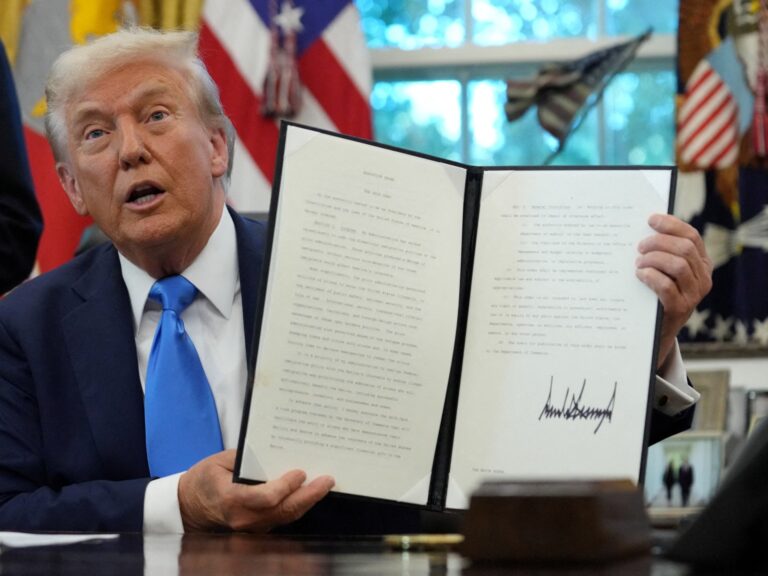
As Trump’s order stirs anxiety, White House clarifies that the fee only applies to new applicants and will be levied per petition.
The United States has issued a clarification to its new H-1B visa policy, saying that the new $100,000 fee for skilled workers will be levied per petition and will not apply to current visa holders.
The announcement on Saturday came a day after US Secretary of Commerce Howard Lutnick said it would be paid annually, and would apply to people seeking a new visa as well as renewals.
Recommended Stories
list of 4 itemsend of list
Lutnick’s comment prompted major tech firms, including Amazon, Microsoft, Meta and Alphabet, which is Google’s parent company, to warn employees with H1-B visas to stay in the country or return quickly.
White House press secretary Karoline Leavitt, however, clarified that the fee will only apply to new visas and that the rule “does not impact the ability of any current visa holder to travel to/from the US”.
“This is NOT an annual fee. It’s a one-time fee that applies only to the petition,” she wrote.
“Those who already hold H-1B visas and are currently outside of the country right now will NOT be charged $100,000 to re-enter… This applies only to new visas, not renewals, and not current visa holders,” she added.
The executive order imposing the new fee was signed by President Donald Trump on Friday night and is scheduled to take effect at 12:01am on (04:01 GMT) Sunday.
It is scheduled to expire after a year. But it could be extended if the Trump administration determines that is in the interest of the US to keep it.
H-1B visas allow companies to sponsor foreign workers with specialised skills – such as scientists, engineers and computer programmers – to work in the US, initially for three years, but extendable to six.
The visas are widely used by the tech industry and are doled out through a lottery system. Indian nationals account for nearly three-quarters of the permits.
Critics say the programme undercuts American workers, luring people from overseas who are often willing to work for as little as $60,000 annually. That is well below the $100,000-plus salaries typically paid to US technology workers.
India’s Ministry of External Affairs said on Saturday that Trump’s latest plan “was being studied by all concerned, including by Indian industry″. The ministry warned that “this measure is likely to have humanitarian consequences by way of the disruption caused for families. Government hopes that these disruptions can be addressed suitably by the US authorities”.
The US Chamber of Commerce also expressed worry.
“We’re concerned about the impact on employees, their families and American employers,” it said in a statement. “We’re working with the Administration and our members to understand the full implications and the best path forward.”
On the popular Chinese social media app Rednote, meanwhile, many H-1B holders shared stories of rushing back to the US — some just hours after landing abroad – fearing they would be subject to the new fee.
Some people who were already on planes preparing to leave the country on Friday de-boarded over fears they may not be allowed to re-enter the US, the San Francisco Chronicle reported.
Allen Orr, an immigration lawyer and immigration chair of the National Bar Association, told Al Jazeera that the latest order has caused “mass confusion”.
Workers who held new or renewed H-1B visas and who were outside the US were told not to come, delaying start dates and costing money due to the “cancellation of flights and housing”, Orr said.
The lawyer added that Trump’s order was sending the wrong message to talented workers living abroad.
“If it applies to next year, $100,000 for an H-1B worker just basically puts it out of the market, and many of these jobs will then just remain overseas,” he said.
“The American secret is that we’ve basically taken talent from around the world and colonised it and made of the United States a sort of stamp. When we stop letting that talent into the United States, we’re hurting our brand,” he added.




 PA Media
 EPA
EPA