
A required part of this site couldn’t load. This may be due to a browser
extension, network issues, or browser settings. Please check your
connection, disable any ad blockers, or try using a different browser.

A required part of this site couldn’t load. This may be due to a browser
extension, network issues, or browser settings. Please check your
connection, disable any ad blockers, or try using a different browser.
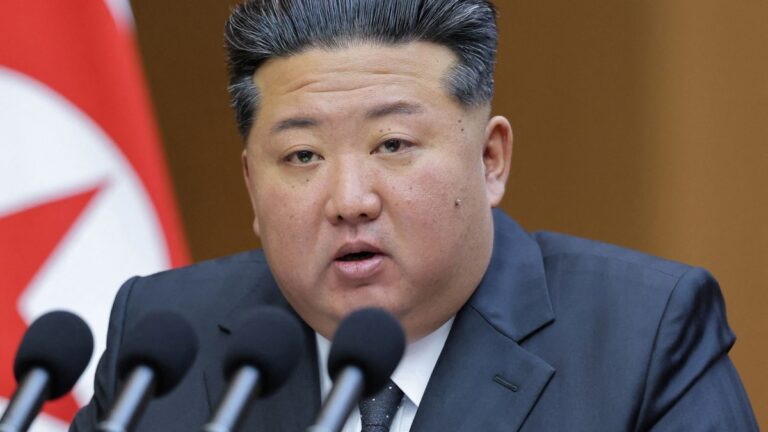
North Korean leader Kim Jong Un has suggested that he is open to talks with the US if Washington stops insisting that his country give up its nuclear weapons.
“If the United States drops the absurd obsession with denuclearising us and accepts reality, and wants genuine peaceful coexistence, there is no reason for us not to sit down with the United States,” Kim said in a speech at the Supreme People’s Assembly in Pyongyang on Sunday, according to the official Korean Central News Agency (KCNA).
list of 4 itemsend of list
The North Korean leader also commented on US President Donald Trump, whom he met three times during Trump’s first presidency, saying: “Personally, I still have fond memories of US President Trump.”
Kim’s comments come after both Trump and South Korean leader Lee Jae-myung expressed their willingness to meet with their North Korean counterpart at a meeting at the White House last month.
“Someday, I’ll see him. I look forward to seeing him. He was very good with me,” Trump said at the time, adding that he knew Kim, whose family has ruled North Korea for three generations, “better than anybody, almost, other than his sister”.
Lee, who has been vocally supportive of thawing relations with his country’s northern neighbour since taking office in June, said at the same meeting that he hoped the US president would “build a Trump Tower” in North Korea “so that I can play golf there”.
Despite overtures from Lee and Trump, North Korea has been critical of joint military drills between the US and South Korea, with Kim Jong Un’s sister, Kim Yo Jong, describing them as a “reckless” invasion rehearsal.
In recent interviews with the BBC and the Reuters news agency, Lee has also expressed an openness to negotiating his country’s stance on North Korea’s nuclear weapons.
Speaking to the BBC on Sunday, Lee said he would be open to a more “realistic” goal of North Korea agreeing to stop acquiring more nuclear weapons, rather than continuing with “fruitless attempts” at making it give up its existing arsenal.
“So long as we do not give up on the long-term goal of denuclearisation, I believe there are clear benefits to having North Korea stop its nuclear and missile development,” Lee said.
In an interview with Reuters, also published on Sunday, Lee acknowledged that sanctions had ultimately failed to deter Pyongyang, which today is adding an estimated 15 to 20 nuclear weapons to its arsenal every year.
“The reality is that the previous approach of sanctions and pressure has not solved the problem; it has worsened it,” Lee said.
Addressing the Supreme People’s Assembly in Pyongyang on Sunday, Kim also said that sanctions had only made his country stronger and more resilient, despite reports that the nation of some 26 million people has long suffered from a food crisis.
“There will never be, and will never ever be for eternity, any negotiations with enemies of exchanging some things out of some obsession with lifting sanctions,” Kim said.

The United Nations imposed sanctions on North Korea for pursuing its banned nuclear weapons and ballistic missile programmes close to 20 years ago.
But Kim Jong Un last year promised to “exponentially” boost his nation’s nuclear arsenal to defend itself against “hostile” forces.
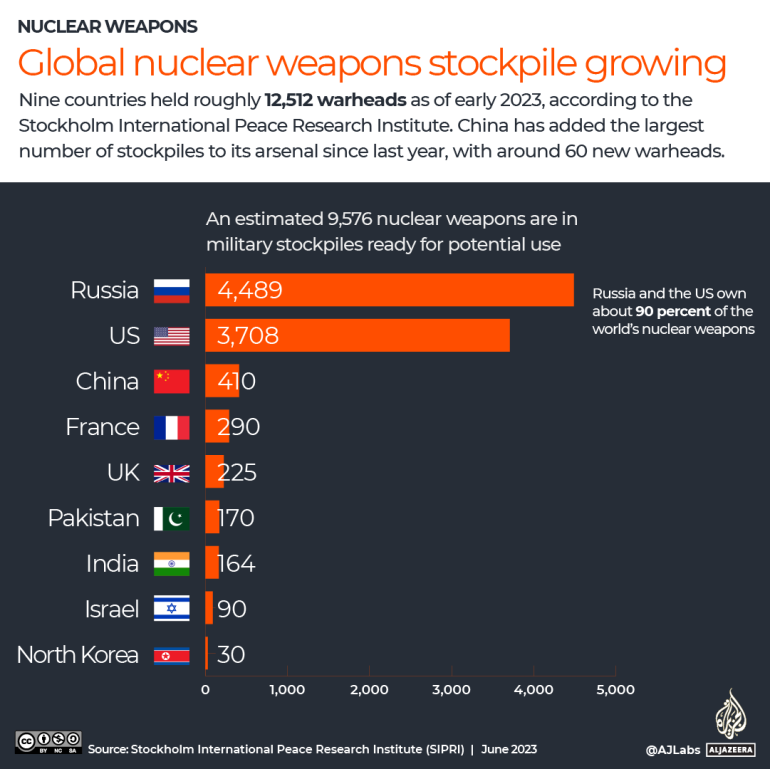
The push comes as the Stockholm International Peace Research Institute’s (SIPRI) Yearbook warned in its latest annual report that the world is at risk of a new arms race among the nine nuclear-armed states: China, France, Israel, India, North Korea, Pakistan, Russia, the United Kingdom and the US.
Meanwhile, Kim’s signalling of an openness to meeting with Washington comes after he met with China’s leader, Xi Jinping, and Russia’s leader, Vladimir Putin, in Beijing earlier this month for a military parade marking 80 years since the end of World War II.
In comments apparently addressed to Xi regarding the Beijing celebrations, Trump said on his Truth Social platform: “Please give my warmest regards to Vladimir Putin, and Kim Jong Un, as you conspire against the United States of America.”
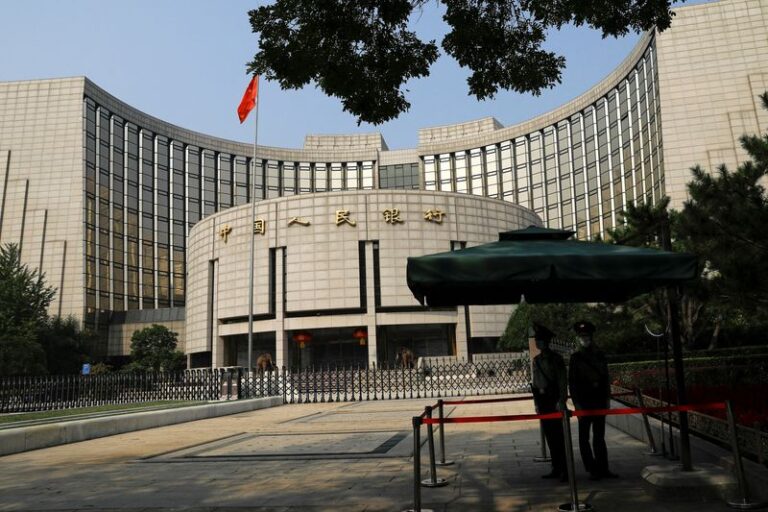
China leaves benchmark lending rates unchanged for fourth month in Sept

Padraig BeltonBusiness reporter
 Alina Kalcheva
With conflict continuing in Ukraine and the Middle East, a little-explored global industry has never been more in demand – the war risk insurance market.
When a Russian missile damaged Natalia Grishko’s apartment in a tower block on the outskirts of Kyiv last November she thankfully was not injured.
Mrs Grishko’s daughter, Alina Kalcheva, says the missile fell about 100m (328ft) from the building. “The blast wave damaged my mother’s balcony, windows, doors, and the interior of the apartment.”
While her mum was “of course very upset and cried” to begin with, Mrs Kalcheva says she ultimately felt calm because they had insured the flat against such an attack.
For while general household insurance doesn’t cover conflict damage – whether you live in Ukraine or a country not under attack – Mrs Kalcheva had had the foresight to take out specialist war risk insurance cover for her mother. And the insurer paid out $1,000 (£740) to help cover the repairs.
The annual premium or cost was $52, and the 33-year-old says she “didn’t hesitate to buy it. And as it turned out it was obviously the right decision.”
Fellow Ukrainian Ekaterina Vasylieva even took out a war risk policy for her car in April 2024. That was particularly timely, because only a day later her vehicle was damaged by Russian shrapnel when it was parked in a street in the coastal city of Odesa.
“Only the day before I extended the comprehensive insurance on the car, and the manager offered for me to get insurance against military risks,” she says. “The cover saved me a lot because after the Russian attack the car looked like a sieve.”
 Alina Kalcheva
War risk insurance is the general term for a sector that also offers cover against terrorism. Industry experts say it has grown exponentially since the September 11 attacks in the US back in 2001.
And while individuals can take out war risk cover, the vast majority of policies are bought by companies who wish to insure their operations, facilities and staff around the world. Especially in high-risk countries and regions.
Although data is hard to come by for an industry that doesn’t seek the limelight, one trade publication this year estimated that the global amount spent on taking out war risk insurance now totals about $1bn (£800m) per annum.
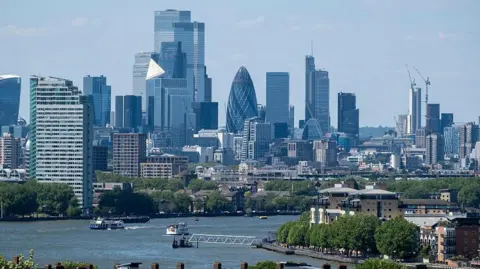
And £621m, or nearly 80%, of that figure is said to go to specialist insurers in the City of London, which is the centre of the international war risk insurance market.
Joanna Cousins heads a nine-person political violence and war team at one such London-based insurer – Westfield Speciality.
She cites the example of a large energy facility in Iraq, owned by a Western company, which has been attacked multiple times in recent years.
Mrs Cousins says that the owner ultimately bought more than £100m of war risk cover, without which it would have “ceased or greatly reduced” the operation of the site.
People in the war risk market are not normally very keen to talk about how much a policy costs. But for a British or American company operating in Lebanon or Israel, “currently, premiums are priced between 0.5% and 2% of the total cover they buy,” says a senior London war risk insurance underwriter who asked not to be named.
An underwriter is a finance professional who determines the level of risk of an insurance application, and then calculates what the cost of the cover will be.
The 0.5% to 2% range means that if a business wants £100m of annual cover it has to pay between £500,000 and £2m. However, these rates will “fluctuate significantly as the situation in different countries in the Middle East is volatile”, adds the unnamed underwriter.
Premiums in stable Gulf states are said to be much lower, from 0.025% to 0.05% of the total amount covered.
What is actually covered by a policy can vary. For example, a company can get cover for kidnappings and ransoms, treating serious injuries, or the cost of dealing with an “active assailant” situation.
“The market is growing in capacity and demand, ” says Daniel Hiller, underwriter, and group head of terrorism and political violence at insurer Munich Re Specialty.
“There are more perils customers can buy coverage for, especially around the active shooter product, but also strikes and riots.”
 Getty Images
 Getty Images
War risk cover is organised in seven “buckets” spanning different severities of conflict. Sabotage and terrorism are considered to be the lowest, while civil and interstate war are the highest.
“Many insurers try to offer all this coverage, since often it’s not clear where a situation has moved from risk of terrorism, to civil war, to even interstate war,” says Raveem Ismail, founder of specialist insurance firm London-based Trigger Parametric.
The war risk sector is centred on London due to the continuing strength of Lloyds of London, which has been a specialist insurance market since 1689.
Lloyds is also home to war risk insurance reinsurers – firms who buy and sell the cover.
Ms Cousins says this spreads out the possible exposure. “Each [reinsurer] covers a certain percentage of the risk, of anywhere between one and 10%,” she says.
Constantin Gurdgiev, a finance professor at the University of Northern Colorado, and an expert in the study of risk and conflict finance, says the challenge for the war risk sector is to work out what premium to charge for cover.
“Wars and conflicts more generally represent black swan [very rare] events,” he says. Because of this rarity, he adds that “historical data tends to be a weak basis for establishing any priceable insights”.
Yet Mr Ismail points out that war risk insurance can be very profitable, something he contrasts with the car insurance sector.
“As a car insurer, for every £1 of premiums you take in, you pay back almost £1.05 in claims,” he says. You might think that the maths doesn’t add up there, but Dr Ismail says that the car insurers make the 5p and more from investment income.
By contrast, war risk insurance funds can pay out as little as 2%. Put simply, car crashes remain far more common than war damage.
After President Donald Trump shocked global markets with his aggressive tariffs earlier this year, investors turned away from the U.S. and went elsewhere—but the scales are tilting back again.
U.S. stocks have made furious rebounds, setting fresh record highs and eroding the outperformance that European markets have enjoyed for much of this year.
The S&P 500 is now up 13% year to date and the Nasdaq is up 17%. As recently as late June, when the broad market index had retaken its prior all-time high, both were up 5%.
Meanwhile, the DAX stock market index in Germany is up 19% so far this year, down from 20% in June. Other gauges have gained ground, but not as much as U.S. stocks have. The FTSE 100 in the U.K. is up 13% versus 8% in June. And the MSCI Europe stock index has jumped 25% for the year, up from 21%.
(China is a different story. Hong Kong’s Hang Seng Index has soared 32% this year, up from its 21% year-to-date gain in June.)
Sentiment has shifted dramatically about Europe. Investors are getting more nervous about the deficit outlook in the U.K. and France, while economic growth remains subdued. And hopes for a burst of government spending and deregulation have failed to materialize so far.
“Outside Germany, investors appear frustrated with the lack of progress: there are no signs of the German government turning on the spending machine,” analysts at Deutsche Bank said in a note on Wednesday. “This has fuelled concerns that the government is dragging its feet, and perhaps wavering in its commitment, on implementing the promised defence and infrastructure spending spree.”
While they still see a “sugar rush” coming eventually, they are less upbeat about the long-term growth implications.
By contrast, U.S. markets have been turbocharged by continued bullishness on the AI revolution, moderation in Trump’s trade war, robust corporate earnings, continued GDP growth, resilience among consumers, tax cuts, and the Federal Reserve’s return to easing.
U.S. stocks stand to get a further lift from the central bank, and potentially close the gap even more with Europe.
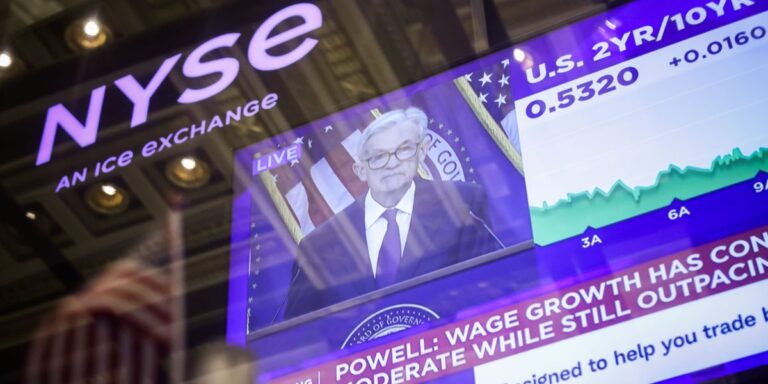
On Wednesday, the Fed lowered rates for the first time since December, though many on Wall Street read a hawkish message in Chairman Jerome Powell’s press conference.
In particular, he described the move as a “risk-management cut,” suggesting it wasn’t the start of an aggressive easing cycle. He also warned that there are no risk-free options and that it’s not obvious what will happen going forward.
But economists at Citi Research disagreed with the market’s interpretation that Powell was hawkish and instead read a more dovish message.
“Powell later clarified that the effectiveness of today’s cut was coming not from the effects of one 25bp rate cut, but from the market pricing-in further cuts — suggesting that in their base case Fed officials will follow markets and the dot plot and cut 75bp this year,” Citi said in a note on Wednesday.
Meanwhile, equity strategists at JPMorgan pointed out on Thursday that the S&P 500 has gained an average of 26.5% in the second year of an easing cycle, assuming no recession, compared to a 13.7% gain in the first year.
The Fed started its rate cuts last September, and the market has already outperformed its typical first-year gain by climbing 17.6% in that time, JPMorgan added.
“Rate cuts have historically provided meaningful support for earnings with a lift in consumer spending, investment spending (capex and R&D), M&A and buybacks,” strategists said.

By Terin Frodyma on SwimSwam

The opening day of the World Para Swimming Championships in Singapore featured 26 title races and a pair of world-record performances.
Prefixes Explanation:
The first world record of the meet came at the hands of Great Britain’s William Ellard in the men’s 200 freestyle S14. Ellard topped his own world record from Paris last summer of 1:51.30 with a final time of 1:51.08. In the same final, Brazil’s Gabriel Bandeira clocked a new Americas record in 1:52.03 to finish just behind Ellard for silver.
Brazil’s Alessandra Oliveira Dos Santos dominated the field in the women’s 100 breaststroke SB4. Her final time of 1:43.21 topped Norway’s Sarah Louise Rung’s 2014 world record time of 1:43.87, and Rung’s championship record of 1:44.83. Oliveira Dos Santos finished over 9 seconds ahead of silver medalist Giulia Ghiretti of Italy (1:52.47).
Italy’s Monica Boggioni nabbed two day one wins in the women’s 50 free S5 (38.37) and 50 breast SB3 (53.95). Boggioni is the only athlete to win multiple events so far at Para Worlds.
In the men’s 400 freestyle S8, reigning Paralympic and World Champion Alberto Amodeo defended his titles, with his gold medal winning performance of 4:23.27, just ahead of Andrei Nikolaev in 4:24.06 to set a new championship record. Both performers swam under the previous championship record time set by Oliver Hynd of 4:24.32 from 2015.
Grace Nuhfer earned the United States first gold medal of the meet in the women’s 100 butterfly S13, touching in 1:03.33, nearly a full second ahead of Carlotta Gilli (1:04.26).
Jiang Yuyan, who topped the individual medal total last summer in Paris with seven Paralympic Golds, topped all competitors in the women’s 100 backstroke S6 touching in a championship record time of 1:20.13. The time overtook Shelby Newkirk’s 2023 record of 1:20.62, but was just off of her world record of 1:19.44.
South Africa’s Christian Sadie clocked a new African record in the men’s 200 IM SM7, clocking 2:34.03 to finish 2nd behind Argentina’s Inaki Basilof (2:30.65).
Mallory Weggemann asserted her dominance in the women’s 200 IM SM7 taking gold in 2:54.75, well off of her world and championship record of 2:48.43, but she finished 1.75 seconds ahead of the field. Ukraine’s Veronika Korzhova took silver in 2:56.50, marking a new European record. Weggemann and Korzhova were the lone competitors to swim under the three minute mark.
Australia’s Rowan Crothers (23.21) and Thomas Gallagher (23.46) went 1-2 in the men’s 50 free S10 final. Crothers tied the Oceanian record and was .01 seconds off of the championships record, and .05 off of the world record.
Turkey’s Defne Kurt closed out day one with a championship record in the women’s 50 free S10 final. Kurt initially broke the championship record in prelims in 27.34, and backed up that early swim with her 27.21 to take gold and reset the championship record.
| Country | Gold | Slver | Bronze | Total |
| Great Britain | 3 | 3 | 3 | 9 |
| Italy | 3 | 3 | 3 | 9 |
| China | 3 | 0 | 0 | 3 |
| Brazil | 2 | 1 | 3 | 6 |
| United States | 2 | 0 | 1 | 3 |
| Australia | 1 | 1 | 1 | 3 |
| Czech Republic | 1 | 1 | 0 | 2 |
| France | 1 | 0 | 1 | 2 |
| Netherlands | 1 | 0 | 1 | 2 |
| Argentina | 1 | 0 | 0 | 1 |
| Azerbijan | 1 | 0 | 0 | 1 |
| Germany | 1 | 0 | 0 | 1 |
| Israel | 1 | 0 | 0 | 1 |
| Mexico | 1 | 0 | 0 | 1 |
| Turkey | 1 | 0 | 0 | 1 |
| Ukraine | 0 | 3 | 2 | 5 |
| Spain | 0 | 1 | 2 | 3 |
| Bosnia Heregovina | 0 | 1 | 0 | 1 |
| Colombia | 0 | 1 | 0 | 1 |
| Croatia | 0 | 1 | 0 | 1 |
| Cyprus | 0 | 1 | 0 | 1 |
| Japan | 0 | 1 | 0 | 1 |
| New Zealand | 0 | 1 | 0 | 1 |
| South Africa | 0 | 1 | 0 | 1 |
| Switzerland | 0 | 1 | 0 | 1 |
| Canada | 0 | 0 | 2 | 2 |
| Finland | 0 | 0 | 1 | 1 |
| Greece | 0 | 0 | 1 | 1 |
| Ireland | 0 | 0 | 1 | 1 |
Read the full story on SwimSwam: Ellard Lowers WR, Oliveira Dos Santos Tops Breaststroke Mark- Para Worlds Day 1 Recap

A fermented food that has been a staple on plates in Korea for thousands of years has gone global in the past decade, with new research revealing that kimchi can lower triglycerides and blood pressure and regulate fasting glucose levels.
Researchers from the University of Connecticut’s College of Agriculture, Health and Natural Resources (CAHNR) have assessed nine recent studies looking at the health benefits of kimchi, the traditional dish made of salted, fermented napa cabbage, gochugaru (Korean chili powder), garlic, ginger and scallions, and often fish sauce or fermented shrimp.
The studies, which span 2011 to 2023, largely focus on kimchi’s ability to lower blood pressure – which has surprised scientists, given that its often high in sodium – and boost metabolic function. One study found that people who regularly consumed kimchi had 1.93 mg/dL lower fasting glucose, 28.88 mg/dL lower triglyceride levels and reductions in systolic and diastolic blood pressure by 3.48 mmHg and 2.68 mmHg, respectively, compared to a control group.
“That’s a really good number,” said Ock Chun, professor of nutritional sciences at the University of Connecticut. “In clinical settings, even a reduction of 5 mmHg in systolic blood pressure is considered a meaningful improvement. So, seeing comparable reductions from a dietary intervention, not medication, is a very promising result.”
It’s believed that kimchi has a beneficial impact on blood pressure largely due to its high potassium content, which helps counteract the effects of sodium and regulates fluid balance. In addition to this, the lactic acid bacteria produced in the fermentation process may also help the body flush out sodium.
“This suggests that other components of kimchi, such as beneficial bacteria, offset the hypertensive effect of sodium,” said lead researcher Seoeun Ahn.
While the scientists were focused on recent studies relating to hypertension and blood glucose, broader research has found that kimchi is somewhat of a gut “superfood,” largely due to the probiotics produced as the cabbage ferments. These beneficial bacteria can help maintain a balanced gut microbiome, improve digestion, reduce bloating and constipation, and even alleviate symptoms of irritable bowel syndrome (IBS).
In a 2024 study involving 115,726 Korean men and women aged 40-69 years, people who ate one-to-three serves of kimchi a day had better metabolic health markers than those who didn’t eat it regularly. For men, eating traditional cabbage-based kimchi (baechu) was associated with lower prevalence of obesity, while consuming radish-based kimchi (kkakdugi) was tied to lower abdominal fat in both men and women.
However, the researchers compiling this latest meta-analaysis have also pointed out that, so far, nearly all studies have been conducted in Korea. More broader demographic studies are needed to better understand how kimchi impacts the health of non-Asian consumers.
“It would be very meaningful to conduct an intervention study in the US,” Ahn said. “That way we could see if the findings of this meta-nalysis can be generalized to more diverse populations.”
Kimchi is thought to date back thousands of years, when ancient Koreans used this fermentation method to preserve their salted and seasoned vegetables, beans and seafood in large earthenware jars (onggi), in order to keep foods edible throughout long, harsh winters. While China and Japan both have versions of kimchi, those nations’ dishes are more likely to be pickled, skipping the full fermentation process. There are now more than 200 variations of kimchi in Korea.
The rise in popularity of this staple dish has largely been attributed to the spread of Korean culture beyond the country’s borders, known as the “Hallyu” wave – where K-pop, K-dramas, films, food, beauty and fashion gained a huge following across Asia during the 1990s. Now, kimchi can be found on supermarket shelves across the globe, with the US market alone expected to be worth US$8.6 billion by 2035.
The research was published in the journal Nutrition Reviews.
Source: University of Connecticut

Protesters are angry over bills that could grant Bolsonaro amnesty after a coup attempt and give lawmakers immunity.
Published On 21 Sep 2025
Thousands of Brazilians have taken to the streets to protest against moves by the National Congress to boost lawmakers’ immunity and push for an amnesty that could include far-right former President Jair Bolsonaro, sentenced to 27 years and three months in prison on charges related to an attempted military coup.
Protesters in rallies in more than a dozen cities accused the conservative-majority Congress of putting its own interests above social and economic issues. Music legends Caetano Veloso, Chico Buarque and Gilberto Gil – who defied censorship during the military dictatorship of the 1960s – reunited in Rio de Janeiro’s Copacabana neighbourhood to perform a protest concert.
list of 3 itemsend of list
Aline Borges, a 34-year-old environmentalist who attended the protest in the capital, Brasilia, expressed her frustration at the political establishment. “We are here to protest this Congress, which is made up of criminals and corrupt people dressed as politicians, who are pushing for a law that protects them,” she told the AFP.
Calls for demonstrations grew after the lower house of parliament passed a constitutional amendment that would make it harder to arrest or launch criminal proceedings against lawmakers. Under the so-called “Shielding Bill”, lawmakers voting in a secret ballot must give the go-ahead for one of their own to be charged or arrested.
The following day, the lower house voted to fast-track a bill backed by right-wing opposition lawmakers – dubbed by critics as the “Bandit’s Bill” – that could grant amnesty to Bolsonaro, his closest allies and hundreds of supporters convicted for their roles in the January 2023 uprising.
Both bills face an uphill battle in the Senate. President Luiz Inacio Lula da Silva said he would veto the amnesty bill.
Ahead of Bolsonaro’s Supreme Court trial on September 11, thousands of his supporters had rallied in his defence. The former president, who has denied any wrongdoing, is the first to be convicted of trying to overturn an election in Latin America’s largest economy.
Polls show the country remains deeply divided over his fate. According to a recent Datafolha poll, 50 percent of 2,005 respondents said Bolsonaro should be jailed, while 43 percent disagreed and 7 percent declined to answer.
Currently under house arrest, Bolsonaro faces up to 40 years in prison after being found guilty on five charges, including leading a “criminal organisation” to conspire to overthrow Lula. A detailed operational plan called “Green and Yellow Dagger” was identified, which included a plan to assassinate Lula.
Bolsonaro has maintained he will run for president in 2026, despite Brazil’s top electoral court barring him from running in elections until 2030 for spreading unfounded claims about Brazil’s electronic voting system.
A required part of this site couldn’t load. This may be due to a browser
extension, network issues, or browser settings. Please check your
connection, disable any ad blockers, or try using a different browser.
 Getty Images
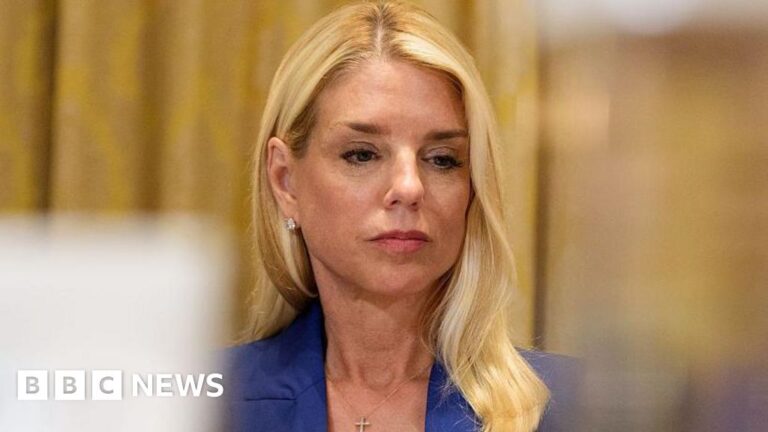
President Donald Trump has called on the country’s top law enforcement official, Attorney General Pam Bondi, to more aggressively investigate his political adversaries.
In a social media post addressed directly to Bondi, he said: “We can’t delay any longer, it’s killing our reputation and credibility.”
Trump expressed frustration that “nothing is being done”, before calling on Bondi to investigate former FBI director James Comey, New York Attorney General Letitia James and Democratic Senator Adam Schiff, who oversaw his first impeachment trial.
Shortly after, he posted again to praise Bondi who he said was “doing a great job”.
“I have reviewed over 30 statements and posts saying that, essentially, “same old story as last time, all talk, no action. Nothing is being done. What about Comey, Adam “Shifty” Schiff, Leticia??? They’re all guilty as hell, but nothing is going to be done,” Trump said on Saturday.
His statement was roundly criticised by Democrats, including Senate Minority Leader Chuck Schumer who said “this is the path to a dictatorship”.
“The justice department has always been a very, very strong civil service, no matter who was in charge, a Democrat or Republican. They went after law violators without fear or favour,” he told CNN on Sunday.
“He’s turning it into an instrument that goes after his enemies, whether they’re guilty or not,” he said of the president.
Asked about his comments on Sunday, Trump said: “They have to act. They have to act fast.”
“I think Pam Bondi is going to go down as one of the best attorney generals of the ages,” he said.
The president’s post came a day after federal prosecutor Erik Siebert left his post after Trump said he wanted him to resign for failing to prosecute New York Attorney General Letitia James over allegations of mortgage fraud.
The New York Times reported that Siebert had told senior justice department officials their investigations had not unearthed enough evidence to prosecute James.
James, a Democrat who won a civil fraud lawsuit against Trump in 2023, has denied the mortgage fraud allegations as “baseless” and motivated by “revenge”.
On Saturday, Trump said Siebert had been fired and did not quit.”I fired him, and there is a GREAT CASE, and many lawyers, and legal pundits, say so,” he said.
Trump also praised Bondi and said he had nominated a replacement for Siebert.
“She is very careful, very smart, loves our Country, but needs a tough prosecutor in the Eastern District of Virginia, like my recommendation, Lindsey Halligan, to get things moving,” he said.
During his election campaign, Trump promised to seek revenge against many of his perceived political enemies – including former President Joe Biden – and others who have opposed him.
He has revoked the security clearances – which allows people to access classified material – of several officials, including James and Manhattan District Attorney Alvin Bragg, who brought the criminal hush-money case,
He has fired several prosecutors who worked for special counsel Jack Smith on two criminal probes against him. He has also taken actions against law firms with attorneys who were involved in investigations into allegations against him, including the firm that employed former special counsel Robert Mueller.

Welcome to World Breaking News, your trusted source for fast, accurate, and impactful news coverage from around the globe. We are a dedicated team of journalists, editors, and news enthusiasts committed to delivering breaking stories, in-depth analysis, and real-time updates on politics, business, technology, sports, entertainment, and more.
© Copyright -World Breaking News -2025