
5 C
New York
Sunday, March 1, 2026
Home Blog Page 373

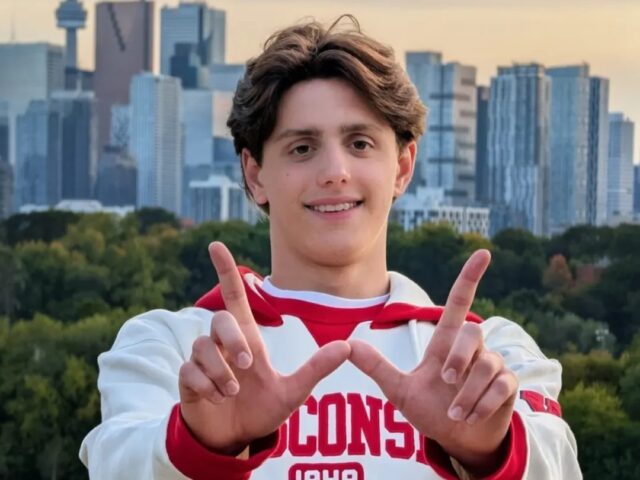
Benjamin Cescon, Canadian World Juniors Qualifier, Commits to Wisconsin for 2026

0

By Madeline Folsom on SwimSwam

Fitter and Faster Swim Camps is the proud sponsor of SwimSwam’s College Recruiting Channel and all commitment news. For many, swimming in college is a lifelong dream that is pursued with dedication and determination. Fitter and Faster is proud to honor these athletes and those who supported them on their journey.

Benjamin Cescon, a Canadian World Juniors Team Member, will be joining the Wisconsin Badgers in the fall of 2026.

“I am beyond excited to announce my verbal commitment to swim and study at the University of Wisconsin-Madison! Thank you to my parents who have supported me through my first decade in the sport, and to coaches Fred, AJ, and Che at CREST Swimming for helping me become the athlete and person I am today. Huge thanks to coaches Jack and Johno for their encouragement, their vision and this incredible opportunity. Go Badgers!!🦡🔴⚪

Cescon, from Toronto, was a member of Canada’s World Juniors team, swimming the 200 breaststroke in 2:17.04 to finish 18th overall. This was a little under a two second add from his previous best time of 2:15.33 from the Canadian Swimming Trials in June, where he won the 13-18 year-old final.

At the same meet, he swam the 100 breast, setting a new personal best of 1:03.88, and the 200 IM, swimming 2:08.82 for another lifetime best time.

He saw significant improvements last season, coming into the year at 2:19.68 in the 200 breast, 1:04.96 in the 100 breast, and 2:09.20 in the 200 IM.

Cescon’s Lifetime Best Times (converted)

Event LCM Best SCY (conversion)
100 breast 1:03.88 55.40
200 breast 2:15.33 1:57.87
200 IM 2:08.53 1:51.32

A member of the Big Ten conference, Wisconsin was 6th at last year’s Championships, scoring 735 points to come in almost 60 points behind Minnesota’s 794.5.

The Badgers are now led by Jack Brown after their previous head coach Yuri Suguiyama left to become the National Team Senior Director and Coach for USA swimming after seven years with Wisconsin.

Cescon’s converted times will add depth to the Badgers roster. In the  200 breast, his converted time would have been 6th on last year’s team, and in the 100 breast and 200 IM he would have been 7th with his conversions.

He will join Joshua Smith, Ashton Joswiak, and Max Stewart on campus in Madison for the class of 2030.

If you have a commitment to report, please send an email with a photo (landscape, or horizontal, looks best) and a quote to Recruits@swimswam.com.

About the Fitter and Faster Swim Tour 

Fitter & Faster Swim Camps feature the most innovative teaching platforms for competitive swimmers of all levels. Camps are produced year-round throughout the USA and Canada. All camps are led by elite swimmers and coaches. Visit fitterandfaster.com to find or request a swim camp near you.

FFT SOCIAL

Instagram – @fitterandfasterswimtour
Facebook – @fitterandfastertour
Twitter – @fitterandfaster

FFT is a SwimSwam partner.

Read the full story on SwimSwam: Canadian World Juniors Qualifier Benjamin Cescon Headed to Wisconsin for 2026


DJI introduces Osmo Nano, a small waterproof action camera

0

Drone manufacturer DJI continues its foray into the world of actioncams in a big way – or actually, in a small way – with its tiniest camera yet, the Osmo Nano. The 4K-shooting tyke can be magnetically mounted on shirts, hats or other clothing, and is waterproof down to 10 m (33 ft).

When we say the Osmo Nano is small, we aren’t kidding.

It measures just 57 x 29 x 28 mm, and reportedly tips the scales at 52 grams (1.8 oz). Among other features, it sports a 143-degree wide-angle lens, a 1/1.3-inch image sensor, 13.5 stops of dynamic range, and the ability to shoot up to 4K/60fps 10-bit video along with 4K/120fps slow motion.

A closer look at the Osmo Nano

DJI

It also offers electronic horizon leveling and image stabilization, it has dual built-in microphones and mic inputs (for stereo sound), plus it’s fully watertight without a housing down to a depth of 10 meters. One charge of its battery is claimed to be good for an hour of shooting at 4K/30fps, although that figure jumps to 200 minutes if shooting at 1080p/24fps.

Users can choose between horizontal and vertical shooting formats, plus they can set the camera to shoot clips of specific lengths at specific intervals, they can have it start recording in response to a gesture, and they can have it save footage from shortly before the record button is pressed.

The Osmo Nano with its Multifunctional Vision Dock

DJI

The camera comes with a separate component known as the Multifunctional Vision Dock.

It serves as an OLED display screen, a wireless touchscreen remote, a charging station, and a high-speed file transfer station. The camera can be clipped onto it facing forward or backward, facilitating selfies. Since the Dock is just IPX4 splash-resistant, however, it won’t be accompanying the camera on any of its underwater adventures.

The Osmo Nano is available now, with pricing starting at US$309 for a package that includes 64GB of internal storage, a magnetic hat clip, a lanyard, and a ball-joint adapter mount.

Meet DJI Osmo Nano – Own the Moment

Source: DJI

ElevenLabs receives investment from NVIDIA following launch of AI music platform aimed at Suno

0

AI music-making platforms are in a race for supremacy – and now the world’s most valuable company is backing a key player in this space.

In August, London and New York-headquartered AI audio startup ElevenLabs launched Eleven Music – a rival to Suno and Udio – marking its expansion beyond voice synthesis into full AI music generation.

Unlike Suno and Udio, however, Eleven Music has already inked licensing agreements with prominent rightsholders, including Merlin and a potentially precedent-setting deal with publisher Kobalt.

Now, AI unicorn ElevenLabs has secured strategic investment from chip maker NVIDIA, the world’s most valuable company by market cap, worth around $4.4 trillion as of Tuesday morning (September 23).

(NVIDIA has also just this week confirmed to be investing up to $100 billion in ChatGPT maker OpenAI.)

The new investment from NVIDIA (value undisclosed) was confirmed by ElevenLabs co-founder and CEO Mati Staniszewski today.

Eleven Labs previously raised a $180 million Series C funding round in January 2025, valuing it at $3.3 billion. Earlier this month, ElevenLabs launched a $100 million tender offer at a valuation of $6.6 billion to give its employees “an opportunity for liquidity”.

The tender was led by existing investors Sequoia and ICONIQ, with participation from others, including a16z, Smash Capital, World Innovation Lab, and “a number of other insiders”.

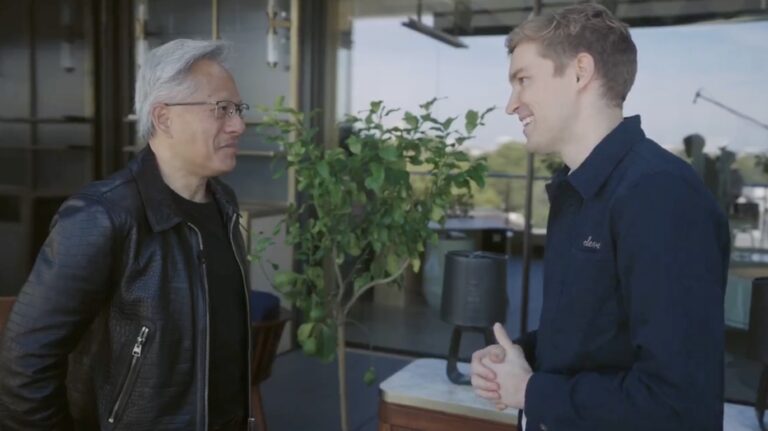
In a LinkedIn post sharing a video of a recent meeting with NVIDIA’s founder and CEO Jensen Huang, ElevenLabs’s Staniszewski wrote: “We’re excited to share that NVIDIA is investing in ElevenLabs, with Jensen Huang’s support.”

ElevenLabs’ video noted that it had previously partnered with NVIDIA in its “earliest days.”

Huang is also a long-time fan of ElevenLabs’ tech. This summer, he used an AI voice to narrate several chapters of his Computex keynote in both English and Mandarin.

According to ElevenLabs, he was “able to create the AI voice on ElevenLabs in under an hour with just seven minutes of recorded audio”.

“Whenever my voice is delivered digitally using artificial intelligence, it’s the ElevenLabs platform that I’m using.”

Jensen Huang, NVIDIA

“Whenever my voice is delivered digitally using artificial intelligence, it’s the ElevenLabs platform that I’m using,” said Huang in the latest video shared by Staniszewski.

He added: “Speech to text is just technology, right? Text to Speech is artistry; that craft that goes into a product that gets integrated with technology, and you guys are doing this at scale.”

News of the investment into ElevenLabs arrives a week after NVIDIA unveiled a lengthy list of UK-based partners during Jensen Huang’s visit to the country.

“We’re excited to share that NVIDIA is investing in ElevenLabs, with Jensen Huang’s support.”

Mati Staniszewski, ElevenLabs

ElevenLabs was identified by NVIDIA as one of its UK-based partners, noting in a blog post that ElevenLabs “develops AI voice technology that generates natural, ultrarealistic speech in over 70 languages using NVIDIA software and NVIDIA DGX B200 systems”.

NVIDIA added: “Its models power real-time conversational agents, localization, storytelling and accessibility tools for people who have lost their voices, in addition to voicing audiobooks and animating video game characters.”

ElevenLabs confirmed last week that it “has worked closely with NVIDIA in the UK and globally” and that “NVIDIA’s support has helped the company build faster and ship stronger products”.


Jensen Huang’s visit to the UK coincided with US President Donald Trump’s State visit to the UK, during which US firms committed to a £150 billion investment in the UK’s tech sector.

“Last week’s US state visit to the UK strengthened AI partnerships between the two countries and brought major new investments from American companies into the UK tech ecosystem,” wrote ElevenLabs co-founder Mati Staniszewski in his LinkedIn post.

“With our company’s roots growing deeper in both places, we couldn’t be more optimistic about the road ahead.”

In Staniszewski’s video of his meeting with Jensen Huang, NVIDIA’s boss tells ElevenLabs’ Co-founder to “take advantage of everything that NVIDIA has to offer”.

Huang added: ‘If there are any places in the world that you like to go to, but can’t, let us know. If there’s a company you want to get to that you’re not in [with] yet, let me know. We’ll just kind of get you everywhere.”


ElevenLabs launched publicly in January 2023.

The NVIDIA investment in ElevenLabs arrives as the latter company scales its UK and US operations. According to ElevenLabs, over the past year, its UK headcount grew from 18 to 68 and its US headcount from 10 to 61, while the company’s European workforce expanded from 25 to 91.

ElevenLabs has offices in New York, San Francisco, Warsaw, Bangalore, Tokyo, and London.

In December 2024, it announced a partnership with BMG’s parent company Bertelsmann, which included plans to add AI-generated music features.

ElevenLabs has also recently signed a training pact with SourceAudio, giving it access to millions of pre-cleared songs for AI training through SourceAudio’s dataset licensing program.

ElevenLabs’ proactive approach to music licensing currently stands in contrast to competitors Suno and Udio, both of which are facing lawsuits from major record labels over alleged copyright infringement in their training data.

While industry rumors suggest some major music companies are in licensing discussions with Suno and/or Udio, no official agreements have been confirmed to date.Music Business Worldwide

Countries that Acknowledge the Existence of a Palestinian State

0

Ashley Wu, a graphics reporter for The New York Times, walks us through the changing map of Palestinian recognition.

Challenge from the Client

0


Client Challenge


JavaScript is disabled in your browser.

Please enable JavaScript to proceed.

A required part of this site couldn’t load. This may be due to a browser
extension, network issues, or browser settings. Please check your
connection, disable any ad blockers, or try using a different browser.

Syrian President al-Sharaa meets with US general who once detained him

0

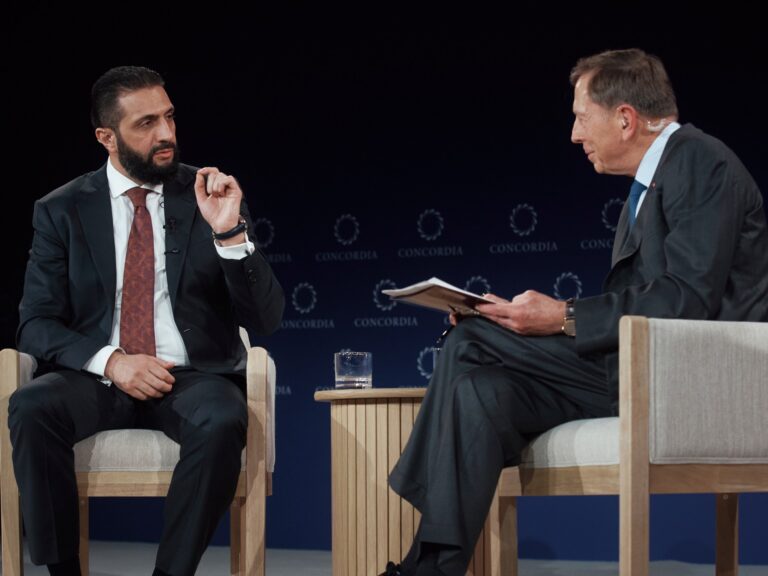
Taking the stage at a political forum in New York City for an interview, Syrian President Ahmed al-Sharaa and retired four-star United States General David Petraeus have acknowledged the peculiarity of the situation.

Al-Sharaa, who overthrew former President Bashar al-Assad and ended his family’s 50-year rule of Syria in a blazing military offensive late last year, has been president since January.

Recommended Stories

list of 3 itemsend of list

Petraeus commanded US forces during their invasion of Iraq – forces who captured and imprisoned al-Sharaa from 2006 to 2011 for fighting against the invasion. Petraeus later served as the director of the Central Intelligence Agency (CIA).

After his release, al-Sharaa established the al-Nusra Front in Syria in 2012 to fight al-Assad. Four years later, it severed its ties with al-Qaeda. A year later, al-Nusra merged with other groups to form Hayat Tahrir al-Sham (HTS), led by al-Sharaa.

HTS was designated a “terrorist organisation” by the US in 2018, citing past ties to al-Qaeda, a designation the US revoked in July as Washington softened its approach to post-Assad Syria.

The US had placed a $10m bounty on al-Sharaa’s head, lifting it only in late December.

Significance of timing and venue

Al-Sharaa arrived in New York on Sunday to attend the United Nations General Assembly, the first Syrian head of state to do so in almost six decades.

The president and his large delegation held meetings, including with US Secretary of State Marco Rubio, and the leader addressed events on the sidelines of the General Assembly on Monday.

Syrian President Ahmed al-Sharaa, left, greets US Secretary of State Marco Rubio on the sidelines of the UN General Assembly on September 22, 2025 [Bing Guan/Pool via Reuters]

With Petraeus, he then participated in the 2025 Concordia Annual Summit, a global affairs forum held alongside the General Assembly that brings together world leaders, business executives and NGO figures to foster public-private partnerships and dialogue.

Last year, Concordia said it had more than 300 speakers, including nine heads of state, and more than 3,600 attendees from 112 countries. Past participants include UN Secretary-General Antonio Guterres, US business titan Warren Buffett and former US President Joe Biden.

Why is Petraeus a ‘fan’ of al-Sharaa?

The former US general not only acknowledged the odd pairing but used it to praise al-Sharaa, who has set an October date for parliamentary elections in Syria.

“His trajectory from insurgent leader to head of state has been one of the most dramatic political transformations in recent Middle Eastern history,” Petraeus told the audience.

Later in the interview, he showed concern for the Syrian leader’s personal wellbeing, asking whether he is getting enough sleep. Petraeus said al-Sharaa has “many fans” and that he is one of them.

“At a time, we were in combat and now we move to discourse,” al-Sharaa said with a smile when asked about their history, adding that people who have gone through war know the importance of peace.

“We cannot judge the past based on the rules of today and cannot judge today based on the rules of the past,” the Syrian president said.

Talking about his time as an al-Qaeda commander, al-Sharaa said “maybe there were mistakes” before but what matters now is defending the Syrian people and the region from instability.

“Our commitment to that line is what brought us here today to [New York], sitting here among allies and friends.”

Al-Sharaa said he believed he was fighting for a “noble” cause that deserves support.

Asked about deadly sectarian violence in Syria this year, he said the al-Assad regime had left Syria in chaos and “all parties made mistakes, including parts of the government”, during the violence.

He added that a newly formed council is investigating and would prosecute all violators.

He said the Syrian people have rallied around the new government and the economic development and unification of Syria are the priorities now.

In this vein, he reiterated his request for the US Congress to revoke the Caesar Syria Civil Protection Act of 2019, which sanctions Syria.

The president reiterated his stance on protecting Syria’s minorities, including the Kurdish population in the north, whose rights must be protected in the constitution. However, he added, Kurdish armed forces must not operate outside the state’s auspices as the government and its army must be the only entity with guns.

The Syrian leader talked about Israel as well, pointing out that Israel has attacked Syria more than 1,000 times since al-Assad fell and continues to occupy the Golan Heights.

However, al-Sharaa said Syria is focused on rebuilding and avoiding another war, so security talks are under way with Israel to reach an agreement based on a 1974 disengagement deal that was mediated by the US.

Polish stocks end trading session higher; WIG30 increases by 0.53%

0


Poland stocks higher at close of trade; WIG30 up 0.53%

Palestinians in the West Bank worry that recognition alone may not be sufficient

0

Tom BennettRamallah, occupied West Bank

Getty Images An Israeli flag is planted into the ground, in a barren, hilly landscape in the occupied West BankGetty Images

Israel’s prime minister has insisted that “there will be no Palestinian state”

In Ramallah – the de facto Palestinian capital of the occupied West Bank – many fear Western recognition of Palestinian statehood is too little, too late.

“I’m really glad that there are people who can see our suffering in Palestine and understand the problems we’re going through,” says Diaa, 23, who did not want to give his full name.

“But while recognition is important, what we really need are solutions.”

This city is home to government buildings, diplomatic missions, and a sprawling presidential palace.

But for many Palestinians, the dream remains that East Jerusalem – just a few miles south but largely cut off by Israel’s separation barrier – could become their capital under a two-state solution, which would create an independent Palestine in the West Bank and Gaza Strip, alongside Israel.

It is with that stated goal that the UK, France, Australia, Canada, Portugal, Belgium, Malta, Luxembourg, Andorra, and Monaco announced formal recognition of the State of Palestine at the UN General Assembly in New York this week.

“Recognition is a positive after all this time,” says Kamal Daowd, 40, on a busy Ramallah street. “But without international pressure it will not be enough.”

“If recognition comes without giving us our rights,” he says. “Then it’s nothing more than ink on paper”.

Israel has labelled the Western move a “reward for terrorism”. Prime Minister Benjamin Netanyahu reiterated on Sunday “there will be no Palestinian state” – while ultranationalists in his governing coalition went further, repeating calls for Israel to annex the West Bank outright.

AFP via Getty Images A man walks through a checkpoint, holding an umbrella. AFP via Getty Images

Many Palestinians are forced to go through Israeli military checkpoints on a daily basis

“The only response,” wrote far-right Finance Minister Bezalel Smotrich, is “the removal of the foolish idea of a Palestinian state from the agenda forever.”

The UK and Germany say they have warned Israel against annexation, while UN Secretary General António Guterres told Monday’s conference it would be “morally, legally and politically intolerable”.

Israel has built about 160 settlements housing 700,000 Jews since it occupied the West Bank and East Jerusalem during the 1967 Middle East war. An estimated 3.3 million Palestinians live alongside them. The settlements are illegal under international law.

In the almost two years since the Hamas-led attack on southern Israel that killed about 1,200 people and saw 251 taken hostage, triggering the war in Gaza, Israel has tightened its control over the West Bank.

It has targeted pockets of armed Palestinian resistance at refugee camps in the north, carrying out major military operations and large-scale building demolitions, displacing many people from their homes.

Reuters A man in a suit holds a large map along with a woman. They are stood on a dusty barren hill. Reuters

Bezalel Smotrich (left), an ultranationalist settler, is in charge of West Bank planning

Up and down the territory, hundreds of new Israeli military checkpoints have sprung up, often accompanied by sudden road closures. Palestinians say short journeys can now last hours.

The Palestinian Authority (PA), which governs parts of the territory not under Israeli control, has been placed under a long-term economic siege, with Israel withholding the tax revenues it needs to pay teachers and police. Salaries have been halved, and some staff ordered to work only two days a week.

Jewish settlers have ramped up attacks against Palestinians, and established scores of new outposts without Israeli government authorisation.

And at the same time, the Israeli government has launched a major settlement push, including the vast E1 project near Jerusalem, which would build 3,400 homes for settlers. Rights groups say it would effectively split the West Bank in two, destroying hopes of a contiguous Palestinian state.

“Whoever in the world is trying to recognise a Palestinian state today will receive our answer on the ground,” Smotrich said last month. “Not with documents nor with decisions or statements, but with facts. Facts of houses, facts of neighbourhoods.”

Previous visions of a two-state solution have involved land swaps. In 2008, then-Israeli Prime Minister Ehud Olmert tabled a plan at talks with PA President Mahmoud Abbas that would see Israel cede control of 4.9% of its land in return for an equal amount of Palestinian land in the West Bank.

The plan was never agreed, and 17 years later settlements have spread so deep into the West Bank that Palestinians fear the map has become too fragmented for a viable state.

As for Gaza, the devastation is immense. More than 65,000 Palestinians have been killed during Israel’s military campaign, according to the territory’s Hamas-run health ministry, and most of the 2.1 million population has been displaced.

The UN estimates 92% of housing units have been damaged or destroyed, 91% of schools will require full reconstruction or major rehabilitation, and 86% of cropland is damaged. It is thought reconstruction of the territory would cost more than £45bn over the next 10 years.

“Everyone is tired, everyone is exhausted, everyone is losing hope that the international community is going to be influential in solidifying the recognition,” says Sabri Saidam, a senior member of Fatah, the PA’s largest faction.

But does he still believe a Palestinian state can come into existence?

“If I did not believe that, we would not have put so much energy into the recognition,” he says. “It is time to convince the American administration that history has changed.”

That may be difficult. The US state department barred more than 80 Palestinian officials – including President Abbas – from attending this week’s UN General Assembly, accusing them of “undermining prospects for peace” by seeking “the unilateral recognition of a conjectural Palestinian state”.

For ordinary Palestinians like Diaa, the situation feels increasingly bleak. “People feel that the national dream is almost impossible,” he says.

Former Facebook Intern Is Now TikTok’s CEO and a Major Competitor to Meta

0

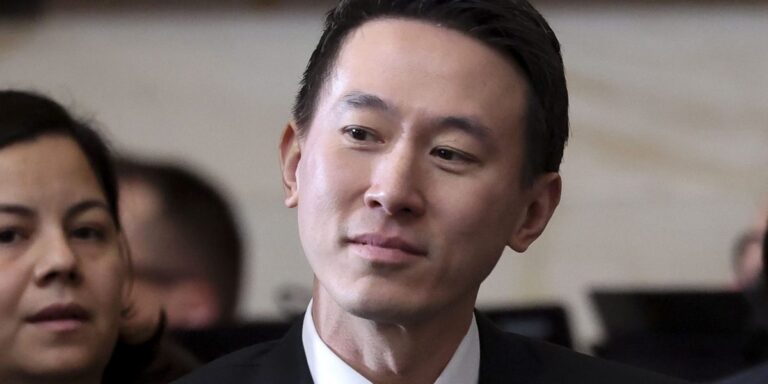
Shou Zi Chew may be the CEO of Mark Zuckerberg’s biggest competitor, TikTok, but at the start of his career, he worked for Zuckerberg as an intern at Facebook.

The Singapore native earned an economics degree from University College London before getting his MBA at Harvard Business School, where during the summer he interned at an up-and-coming company: “It was called Facebook,” Chew told Harvard’s Business School alumni website

Soon after he kicked off his tech career at Facebook in California, he moved abroad, stopping in London, Singapore, and Hong Kong, before ultimately landing in Beijing. Chew joined Chinese tech company Xiaomi in 2015, helping take the company public three years later as chief financial officer, according to the Harvard Business School alumni website. 

Then in 2021, Chew’s career once again crossed paths with Meta CEO Zuckerberg, this time as a competitor. Chew joined TikTok parent company ByteDance in 2021, first as CFO. Later that year, he became CEO of TikTok, and held both the CFO position at ByteDance and the CEO position at TikTok before ultimately focusing on the short-form video platform. 

With at least 150 million monthly active users in the U.S. and more than 1 billion globally, TikTok has become a mainstay of social media and a rare top platform that is not under the control of Zuckerberg. But just because he doesn’t own it, doesn’t mean he never tried.

Zuckerberg reportedly spent much of 2016 trying to acquire a key part of what would become TikTok—a lip syncing app popular with Americans called Musical.ly, Buzzfeed News reported. Yet, Zuckerberg lost out to ByteDance, which acquired the app for $800 million in 2017. ByteDance merged Musical.ly with the already existing TikTok platform, and the resulting social network took off. 

Meta tried to launch its own competitor to TikTok called Lasso in 2018, but it never caught on. Meta shut down the copycat app in 2020.

As efforts to ban TikTok from the U.S. have ramped up over the past few years, so have Zuckerberg’s criticisms of the app. Now, an emerging TikTok deal with China would ensure U.S. companies control the algorithm powering the app’s video feed and Americans will hold a majority of seats on a board overseeing U.S. operations. Zuckerberg has previously suggested TikTok could be a threat to global free expression on social media. In 2020, he said banning the app could set a bad precedent, but added he also sympathized with the national-security concerns.

“I certainly think that there are valid national security questions about having an app that has a lot of people’s data that follows the rules of another country, a government that is increasingly is kind of seen as a competitor,” Zuckerberg said in an internal meeting in 2020, according to BuzzFeed News

Chew has, in previous Congressional hearings, defended TikTok against accusations that it is a national-security threat. In a hearing before the House Energy and Commerce Committee in 2023, Chew took a dig at Facebook’s Cambridge Analytica scandal, and said TikTok didn’t collect more data than American social-media platforms.

“I don’t think ownership is the issue here,” he said during the hearing. “American social companies don’t have a good track record with data privacy and user security.”

A version of this story originally published on Fortune.com on January 15, 2025.

More on TikTok:

Fortune Global Forum returns Oct. 26–27, 2025 in Riyadh. CEOs and global leaders will gather for a dynamic, invitation-only event shaping the future of business. Apply for an invitation.

Egypt’s Leading Activist, Alaa Abd El Fattah, Released from Custody

0

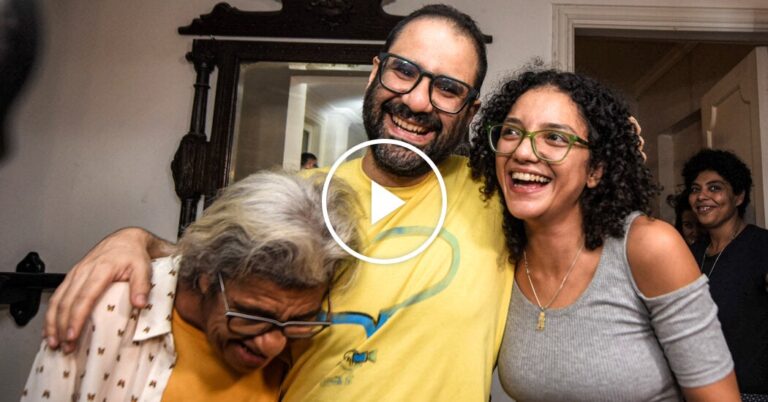
new video loaded: Alaa Abd El Fattah, Egypt’s Most Prominent Activist, Is Freed

By The New York Times

Alaa Abd El Fattah, a prominent pro-democracy Egyptian activist, returned home to his family after a presidential pardon. An Egyptian-British dual citizen, Mr. Abd El Fattah had spent most of the past 12 years in prison.