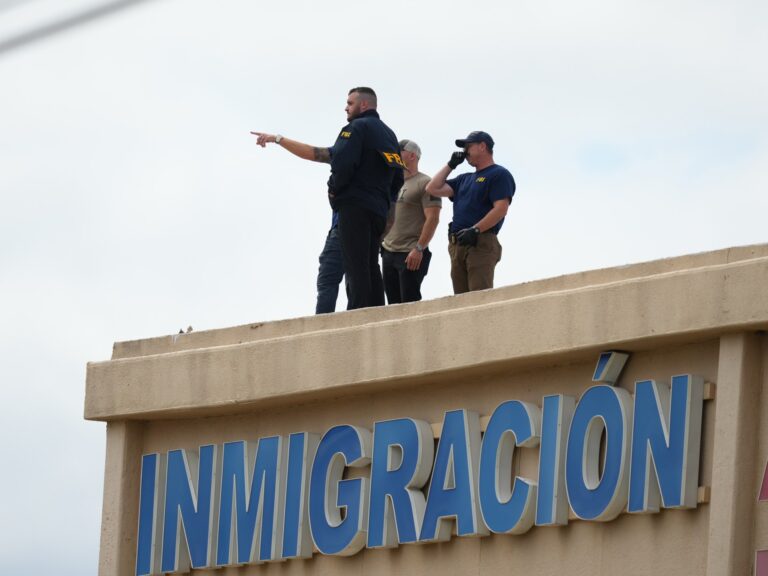
A gunman reportedly opened fired on a federal immigration facility in Dallas, Texas, killing at least two detainees and injuring another.
Published On 24 Sep 2025
A gunman reportedly opened fired on a federal immigration facility in Dallas, Texas, killing at least two detainees and injuring another.
Published On 24 Sep 2025
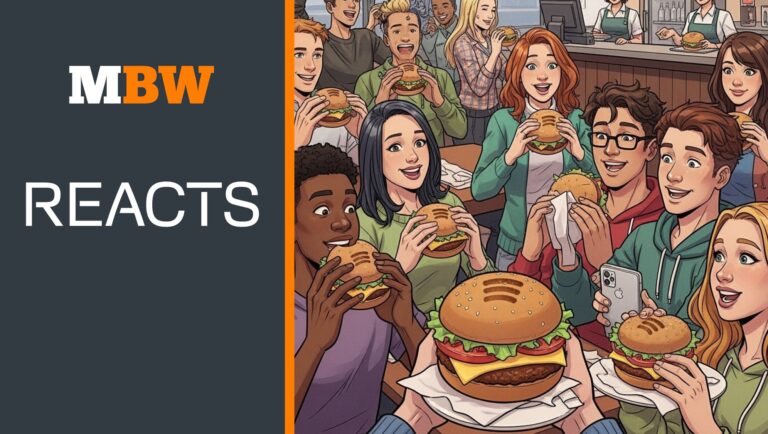
MBW Reacts is a series of analytical commentaries from Music Business Worldwide written in response to major recent entertainment events or news stories. Only MBW+ subscribers have unlimited access to these articles. The below article originally appeared in Tim Ingham’s latest ‘Tim’s Take’ email, issued exclusively to MBW+ subscribers.
I run a popular burger restaurant… with two types of customers.
The first pay proper money for proper burgers from our proper menu. They can design their own deluxe toppings, and their cash constitutes most of our profit.
The second get free mini-‘taster’ burgers with limited toppings, and have to sit in uncomfortable seats. They’re usually teenagers, and don’t have much cash to spend.
To date, our free burger strategy has kind of worked because:
In recent times, however, our ‘free burger’ ploy has started to falter.
Brands are questioning the effectiveness of burger restaurant advertising, and their ad spend is sinking as a percentage of our overall revenues.
Oh and these kids, they don’t know they’re born.
They’ve started flocking to TikTok’s ‘burger bites’ truck down the road. Also free, much quicker to eat, no need to sit down and actually spend three minutes consuming.
So… what should I do?
Our biggest suppliers say it’s finally time to make the ‘free burger’ people pay something. Giving away costly produce for an unlimited amount of time is economic insanity, they say.
After all, how can you expect people to actually pay for burgers when the next generation is becoming accustomed to getting them for free, whenever they like, forever?
My CEO argues different. Fixated on the potential for blue chip advertising, he says we now need to give the no-money burger crowd more choice, more comfort, more volume.
More free.
Keep them in the restaurant, he says – at all costs.
Welcome to McSpotify – the best analogy I have for the dilemma currently taxing the world’s largest subscription music platform.
Last week, Spotify announced that mobile users of its ‘free’ tier would be getting a more Premium-like experience, via manual search and the ability to press play on individual tracks.
Previously, free users were locked in to a ‘shuffle-only’ model that didn’t allow them to select songs they wanted to hear.
Spotify is making this ‘more free’ move following two related trends:
”Gen Z and teenagers… felt like the old Spotify free experience on mobile was almost broken, in the sense that they tried to tap on things and it didn’t work,” Gustav Gyllenhammar, Spotify’s VP of Markets and Subscriptions, told MBW.
He added: “We keep our finger on the pulse of young users… and we’ve seen user behavior, both on social media and other video streaming platforms, where consumers expect the ability to choose what they consume.”
Yet in some ways, Spotify’s latest move is the antithesis of the ‘music has value’ philosophy that underpins music rightsholders’ modern fixation with ‘superfans’ and potential ‘super-premium’ streaming tiers.
Spotify argues that its ad-supported tier remains a key conversion funnel for Premium subscriptions – and that keeping ‘free’ users on the platform is therefore essential to fuel tomorrow’s cohort of new Premium subscribers.
Indeed, the company claims that 60% of its Premium users today started life as ‘free’ users.
Other stats, however, suggest Spotify’s free tier is becoming increasingly bloated, user-wise, vs. those paying for its platform.
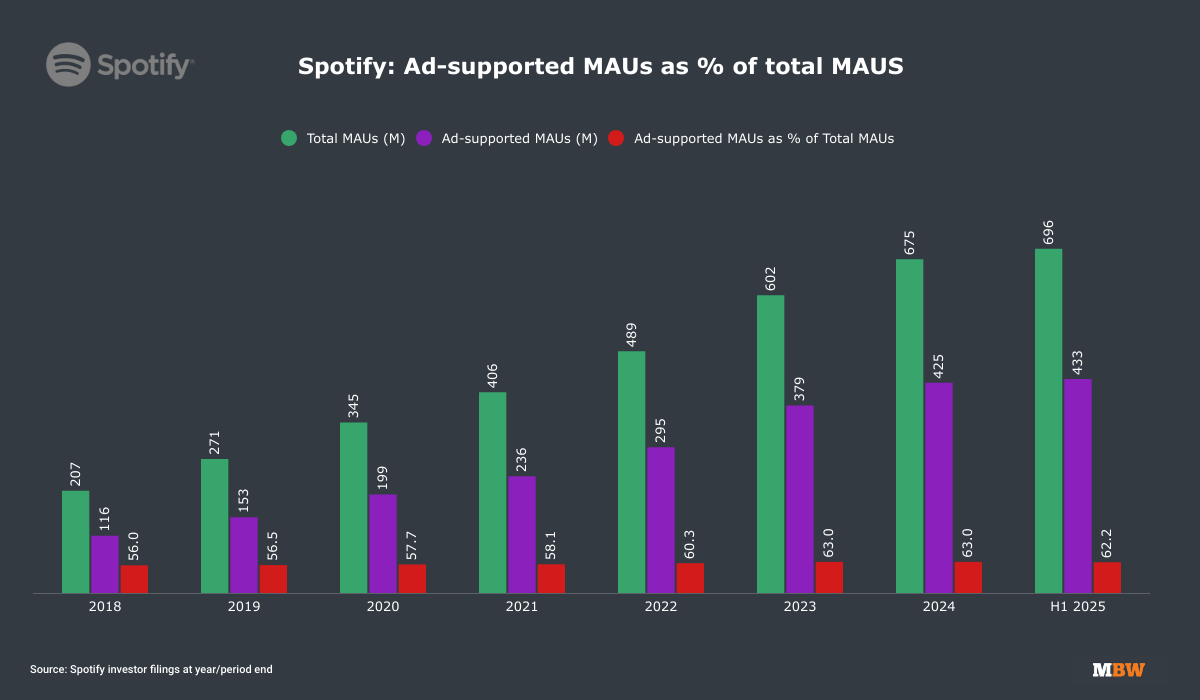
Look below: in the past seven years, the percentage of Spotify’s total active users not paying for Premium has gone up and up.
Various factors contribute to this, including SPOT’s rapid expansion into ‘emerging’ markets, plus subscription growth in mature markets like the US slowing down.
But the bottom line?
Today, nearly two-thirds of Spotify’s active users pay nothing to use the service.
And now the platform is giving them more, for no charge.
Instinctively, I find myself aligned with the view of Rob Stringer, Chairman of Sony Music Group, who last year suggested that the music business should “ask consumers using ad-supported services to additionally pay a modest fee”.
Stringer’s concern was a logical one: as services like Spotify continue to increase the price point of their Premium tiers, so the monetary gap between ‘free’ and ‘paid’ users also widens.
One way Spotify could “close that gap”, noted Stringer, is to follow Netflix and its ‘Standard With Ads’ offering.
In other words, Spotify could shut down its ‘free’ tier in markets like the US, and instead launch a budget subscription offering – one that cost significantly less than the main Premium tier, but carried ads.
Spotify’s ‘more free’ move suggests it never once countenanced this suggestion. If you want to know why, peruse this quote, from Spotify’s annual investor filings:
“Our ability to maintain and increase advertising revenue depends on a number of factors, including… increasing the number of Ad-Supported Users and the level of our users’ engagement with content.”
Spotify’s investor filings further note that “a large percentage” of its ad-supported users are “between 18 and 34 years old… a highly sought-after demographic that has traditionally been difficult for advertisers to reach.”
As such, Spotify has opted to remove friction from the user experience of its ad-supported tier to make it ‘stickier’ for younger listeners.
This is a shame, as adding friction for free users – with the target of force-upselling them to pay something – would likely be a lucrative move.
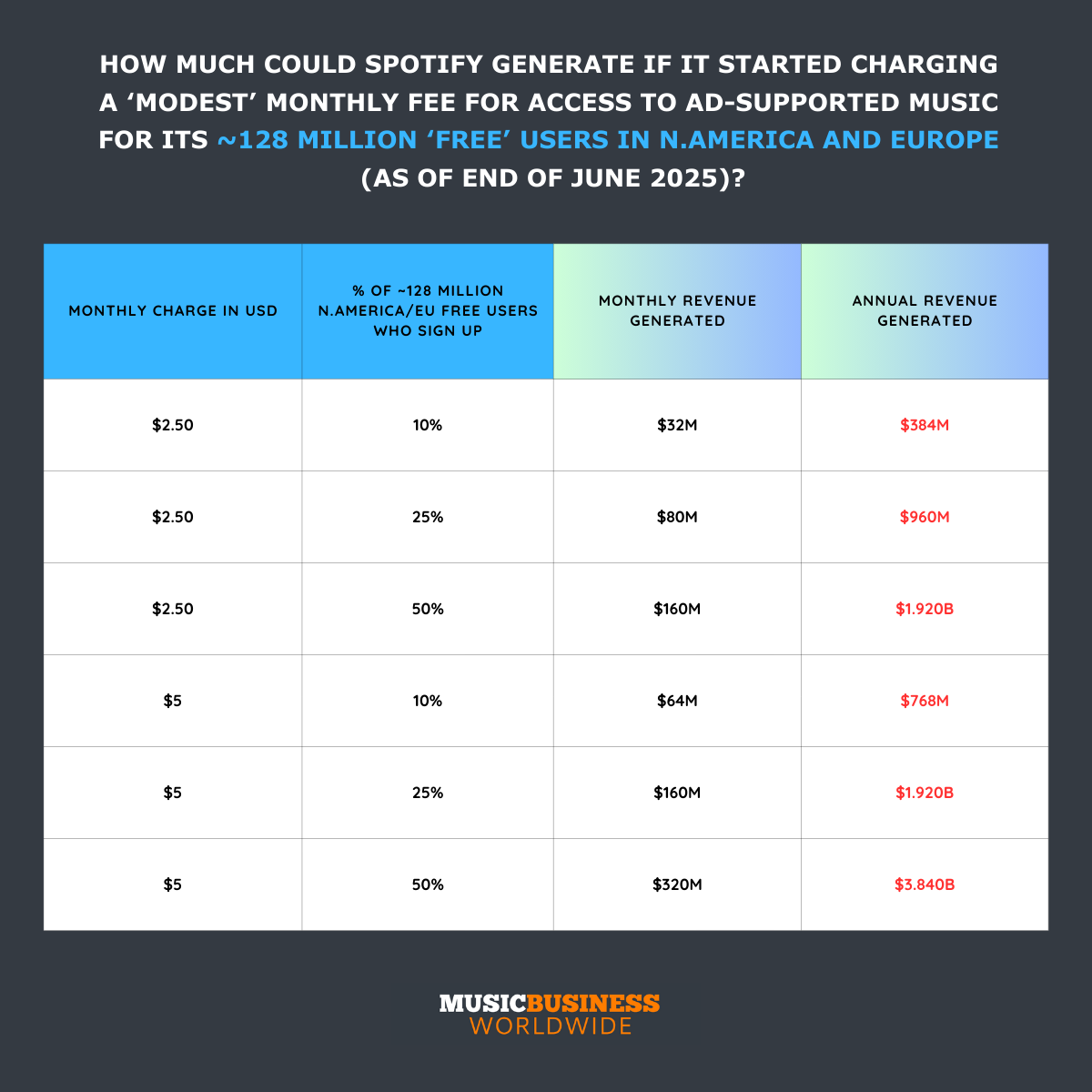
MBW analysis last year suggested that if Spotify followed Rob Stringer’s advice, it could add substantial heft to the streamer’s yearly revenues (the bulk of which, of course, would then get paid to music rightsholders).
Our conclusion: If Spotify dumped free and started charging $2.50 per month for access to ‘Premium with ads’ in just North America and Europe, and if just 25% of current ‘free’ users upgraded, it would result in a ~$1 billion annual windfall into Spotify’s coffers.
(See below, based on SPOT’s latest global investor data.)
Spotify has completed licensing renewal deals with all three major music companies this year, suggesting that its ‘more free’ strategy has been signed off by its biggest suppliers – no doubt in exchange for other rightsholder perks (baked-in price rises, ‘Super Premium’ guarantees etc.)
I do, though, have one suggestion.
When you buy certain new cars in the United States – a Mercedes Benz, for example – SiriusXM offers you six months of subscription for no charge.
The hope on Sirius’s part is that its product becomes so behaviorally innate in your every journey, that when your sub expires you’ll gladly pay not to live without it.
Why couldn’t Spotify try a similar time-based friction plan for its newly improved free tier?
Daniel Ek has just given more choice and more comfort to non-Premium users. Maybe a countdown clock for those same customers might be a smart move.
Everyone loves free burgers.
But there’s a difference between a restaurant that gives you six months to get hooked – and one in which you never have to reach for your wallet.
Music Business Worldwide

Two detainees have died and another is critically injured after a rooftop sniper opened fire at an Immigration and Customs Enforcement (ICE) centre in Dallas, Texas, officials say.
The gunman fired indiscriminately at the ICE facility and at a nearby unmarked van, law enforcement officials say, before dying from a self-inflicted gunshot wound.
No law enforcement were injured. FBI Director Kash Patel posted a photo on X of unused ammunition recovered from the scene. One casing has the phrase “ANTI-ICE” on it.
It is the latest in a string of attacks on ICE facilities in recent months as the agency ramps up efforts to deliver on US President Dobald Trump’s pledge for mass deportations.
 Kash Patel/FBI
“While the investigation is ongoing, an initial review of the evidence shows an ideological motive behind this attack,” Patel wrote on X.
“These despicable, politically motivated attacks against law enforcement are not a one-off.”
FBI special agent Joe Rothrock told a news conference that rounds found near the gunman contained “messages that are anti-ICE in nature”.
“This is just the most recent example of this type of attack,” he said. He said the FBI was investigating it as “an act of targeted violence”.
Dallas police said a preliminary investigation determined the suspect had opened fire from an adjacent building.
“The shooter fired indiscriminately at the ICE building, including at a van in the sallyport where the victims were shot,” the Department of Homeland Security (DHS) said in a statement.
Reuters news agency reported that the building targeted is an ICE field office used for short-term processing of recently arrested detainees, and is not used as a detention facility.
Acting director of the Dallas ICE office Joshua Johnson told the news conference it was the second time he has had to stand in front of the media and talk about a gunman at one of his facilities.
“The takeaway from all of this is that the rhetoric has to stop,” he said.
Texas Senator Ted Cruz also spoke at the news conference, condemning “politically motivated violence”.
“Your political opponents are not Nazis,” he said, urging people not to demonise each other for partisan reasons. “The divisive rhetoric, tragically, has real consequences.”

Homeland Security Secretary Kristi Noem said in a statement: “This shooting must serve as a wake-up call to the far-left that their rhetoric about ICE has consequences.
“Comparing ICE Day-in and day-out to the Nazi Gestapo, the Secret Police, and slave patrols has consequences.”
US Vice-President JD Vance posted on X: “The obsessive attack on law enforcement, particularly ICE, must stop. I’m praying for everyone hurt in this attack and for their families.”
Republican Governor of Texas Greg Abbott said on X the shooting would “NOT slow our arrest, detention, & deportation of illegal immigrants”.
The ICE field office in Dallas has been targeted by a series of protests this summer.
A man was arrested in August after he entered the facility claiming to have a bomb in his backpack, according to the DHS.
The 36-year-old US citizen, Bratton Dean Wilkinson, had shown the building’s security staff a device on his wrist that he described as a bomb “detonator,” the DHS said.
Last month shots were fired at ICE offices in San Antonio, Texas. No injuries were reported in that incident, which ICE blamed on “political rhetoric”.
Another shooting occurred on the 4 July public holiday at an ICE facility in Alvarado, Texas, after a protest escalated into a face-off with police. An officer was shot in the neck, and survived. Eleven people have been charged over that attack.

A required part of this site couldn’t load. This may be due to a browser
extension, network issues, or browser settings. Please check your
connection, disable any ad blockers, or try using a different browser.
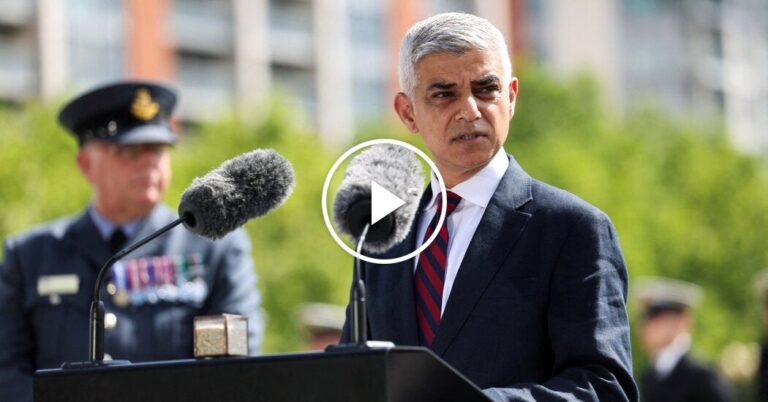
new video loaded: London’s Mayor Hits Back at Trump, Calling Him Islamophobic
transcript
transcript
“And I have to say, I look at London, where you have a terrible mayor, terrible, terrible mayor, and it’s been so changed, so changed. Now they want to go to Shariah law, but you’re in a different country. You can’t do that. Both the immigration and their suicidal energy ideas will be the death of Western Europe if something is not done immediately — they cannot — this cannot be sustained.” “I think President Trump has shown he is racist. He is sexist. He is misogynistic and he is Islamophobic.” Reporter: ”And he called you a terrible mayor as well. Are you a terrible mayor?” ”Well, listen, I’m just thankful that we have record numbers of Americans coming to London since records began. There’s not been a period where more Americans have come to London. There must be a reason for that.”

Canal+ launches new share buyback program worth £31 million
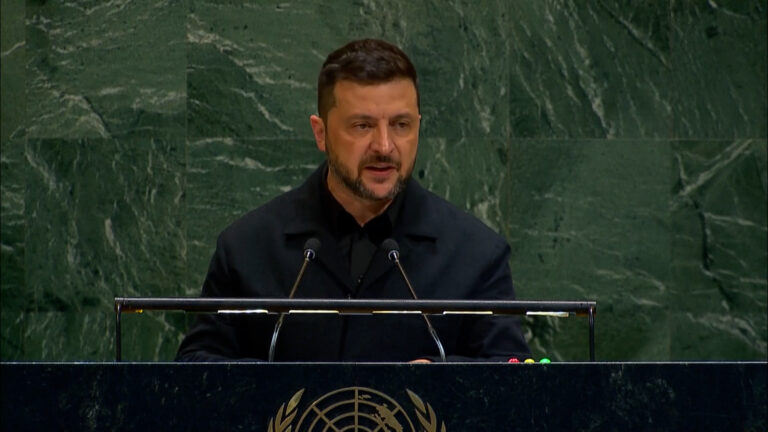
Ukrainian President Volodymyr Zelenskyy slammed the UN and other international institutions as being too weak to stop wars in Gaza, Sudan, Syria, and Ukraine during a speech at the UN General Assembly.
Published On 24 Sep 2025
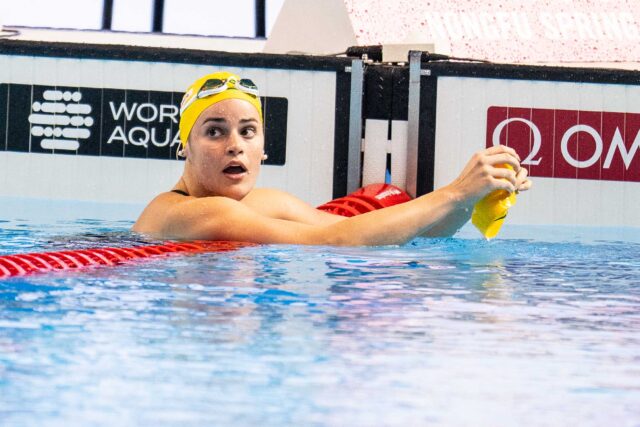
By Daniel Takata on SwimSwam

We are approaching the end of 2025. While the college season is about to kick off in the United States with several noteworthy meets, the international calendar also brings the World Cup in short course meters in October. This raises the question: What has been the frequency of world records in the final months of the year?
So far in 2025, we’ve seen 10 world records, all of them in long course. How many more can we expect before the year is over?
View this post on Instagram
Looking back at the 25 years between 2000 and 2024, some years saw a flurry of world records in the last quarter, while others barely registered any.
Naturally, years with a Short Course World Championship held in December saw an increase in records during the final three months. That was the case in 2021, 2022, and 2024 — and every two years since 2010, with the exception of 2020 due to the COVID-19 pandemic. Interestingly, 2020 still produced a high number of world records in November and December thanks to the International Swimming League (ISL) in SCM.
Overall, odd-numbered years tend to be quieter for world records late in the season. In 2023, there were three world records: two from Kaylee McKeown in LCM during the World Cup, and one from Daniel Wiffen at the European Short Course Championships. In 2019, there were five, all in SCM. A standout year was 2013, which saw 23 short course world records in the final months despite no Short Course Worlds being held. That was the year World Aquatics began recognizing mixed relay records — and no fewer than 12 mixed relay world records were established in the last quarter alone.
(Of course, not much explanation is needed for the 59 world records set in the final quarter of 2009, at the peak of the supersuit era.)
This year, the strongest opportunities for multiple world records come at the World Cup — held in North America in October — and the European Short Course Championships in December in Lublin, Poland.
But what about long course? History shows the odds are slim. Since 2000, only eight long course world records have been set in the last quarter of the year. Two of them, both from 2009 during the supersuit era, are still standing: Liu Zige in the women’s 200 butterfly and Cesar Cielo in the men’s 50 freestyle.
| Year | Athlete | Event | Time | Meet | City |
| 2002, Oct. 2 | Kosuke Kitajima (JPN) | Men’s 200 breast | 2:09.97 | Asian Games | Busan |
| 2007, Oct. 19 | Li Yang (CHN) | Women’s 50 back | 28.09 | World Military Games | Hyderabad |
| 2008, Dec. 5 | Randall Bal (USA) | Men’s 50 back | 24.33 | Eindhoven Cup | Eindhoven |
| 2009, Oct. 21 | Liu Zige (CHN) | Women’s 200 fly | 2:01.81 | CHN National Games | Jinan |
| 2009, Dec. 18 | Cesar Cielo (BRA) | Men’s 50 free | 20.91 | Brazil Open | Sao Paulo |
| 2020, Oct. 1 | China | Mixed 4×100 medley | 3:38.41 | CHN Nationals | Qingdao |
| 2023, Oct. 20 | Kaylee McKeown (AUS) | Women’s 50 back | 26.86 | World Cup | Budapest |
| 2023, Oct. 21 | Kaylee McKeown (AUS) | Women’s 100 back | 57.33 | World Cup | Budapest |
Read the full story on SwimSwam: How Many World Records Will Be Broken In The Last Quarter of 2025?
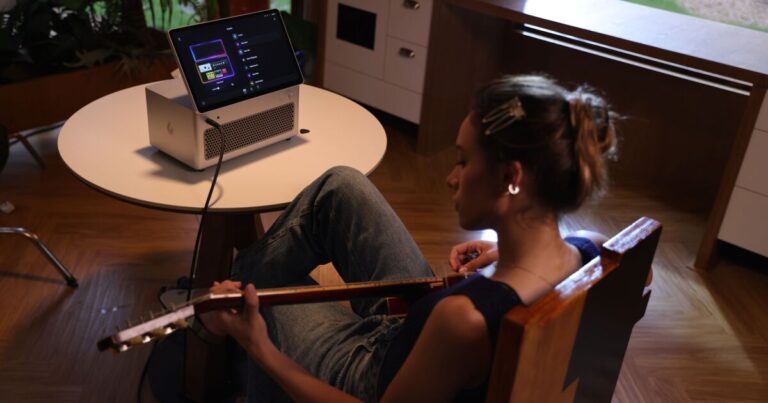
Lava Music caused a glitch in the Matrix a few years back with an oddball carbon-fiber acoustic guitar rocking built-in digital effects. Now the company is looking to reshape the amplification landscape with “the world’s most advanced amp.”
The Lava Studio follows the company’s Genie music maker onto Kickstarter, and was revealed back in July but only went live earlier this month. “With Lava Studio, we wanted to redefine what a desktop amp can be,” said company founder, Louis Lu. “To do so, we built in features to make it more than just a great-sounding amp – it’s a complete creative ecosystem for musicians of all levels. Whether you’re jamming, writing, or just enjoying music, everything you need is right here.”
It kind of combines a desktop guitar amp with digital modelers and multiFX units, along with an interactive learning platform, a recording studio, looper and jam box, and a whole lot more. We have seen similar before from the likes of Orange and Positive Grid, but this one can work all on its own – without you needing to plug in peripherals or squint at your smartphone.
Lava Music
The Studio’s Mac-like magnesium-alloy-clad chassis is home to a 2.1 sound system comprising a 1-inch carbon-fiber woofer and dual tweeters, plus low-latency audio processing thanks to an 800-MHz DSP. There’s an instrument input to the front, which sits next to a headphone jack for private practice, and should you wish to send the output to external gear, stereo line-out ports are included around back.
Things start to break away from your regular desktop modeling amp at the top, where you’ll find a 13.3-inch tablet-like display interface that pivots from flat to angled over 80 degrees for ease of use. The unit runs a proprietary operating system, and has 64 GB of onboard storage that holds the sounds, presets, patches and saved stuff. There’s no microSD expansion here, but we’d assume that the USB-C port could accommodate external SSD storage if needed.
Out of the box, the system boasts more than 30 amp models courtesy of the company’s own lavaAI neural brains –”each trained using advanced algorithms that replicate the tonal nuances of iconic vintage and modern amplifiers, cabinets, and effect pedals with over 99.9% accuracy.”
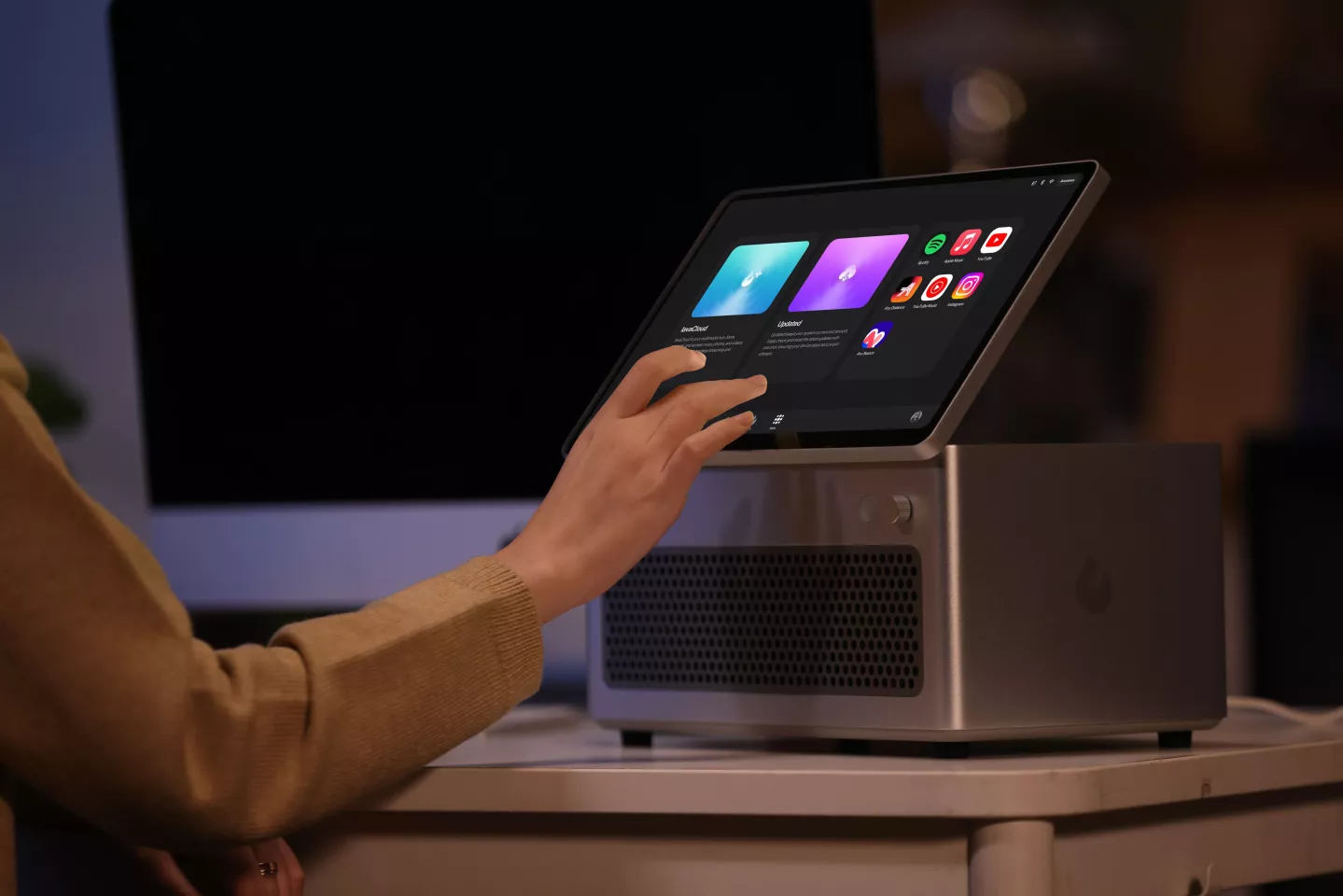
Lava Music
Musicians can also choose from over 40 effects – from overdrives, distortion/fuzz, analog and stereo delay modules, tremolo and filter wobble, chorus and reverb ambience and more. These virtual stomps and rack-mounts are designed to be tweaked like their real-world counterparts, and up to eight effects can be daisy chained in one go, with easy drag-and-drop repositioning.
If you find yourself needing some backing to get your creative juices flowing, an 8-track looper is included for layering rhythms and melodies. Lava has also baked in hundreds of backing tracks and drum patterns for jamming along to. And when you need to capture your genius, a multi-track digital audio workstation is on hand for your recording and mixing pleasure. The onboard AI can also split instrument and vocal stems from audio files.
Whether you’re new to guitar or just want to brush up your technique or theory, the Studio provides access to video tutorials from top-notch expert instructors as well as Guitar Pro-like interactive tab. Students can loop sections of a song to nail chops before moving on to conquer complete songs, the playback speed can be adjusted to suit, and a metronome is available to ensure you keep time.
This Lava Lesson platform is a subscription service but Kickstarter backers will get US$150 credit to use as they please. The learning library sports 112 courses at launch, with single packages available for $3.99 each and collections running from $9.99 up to $19.99.
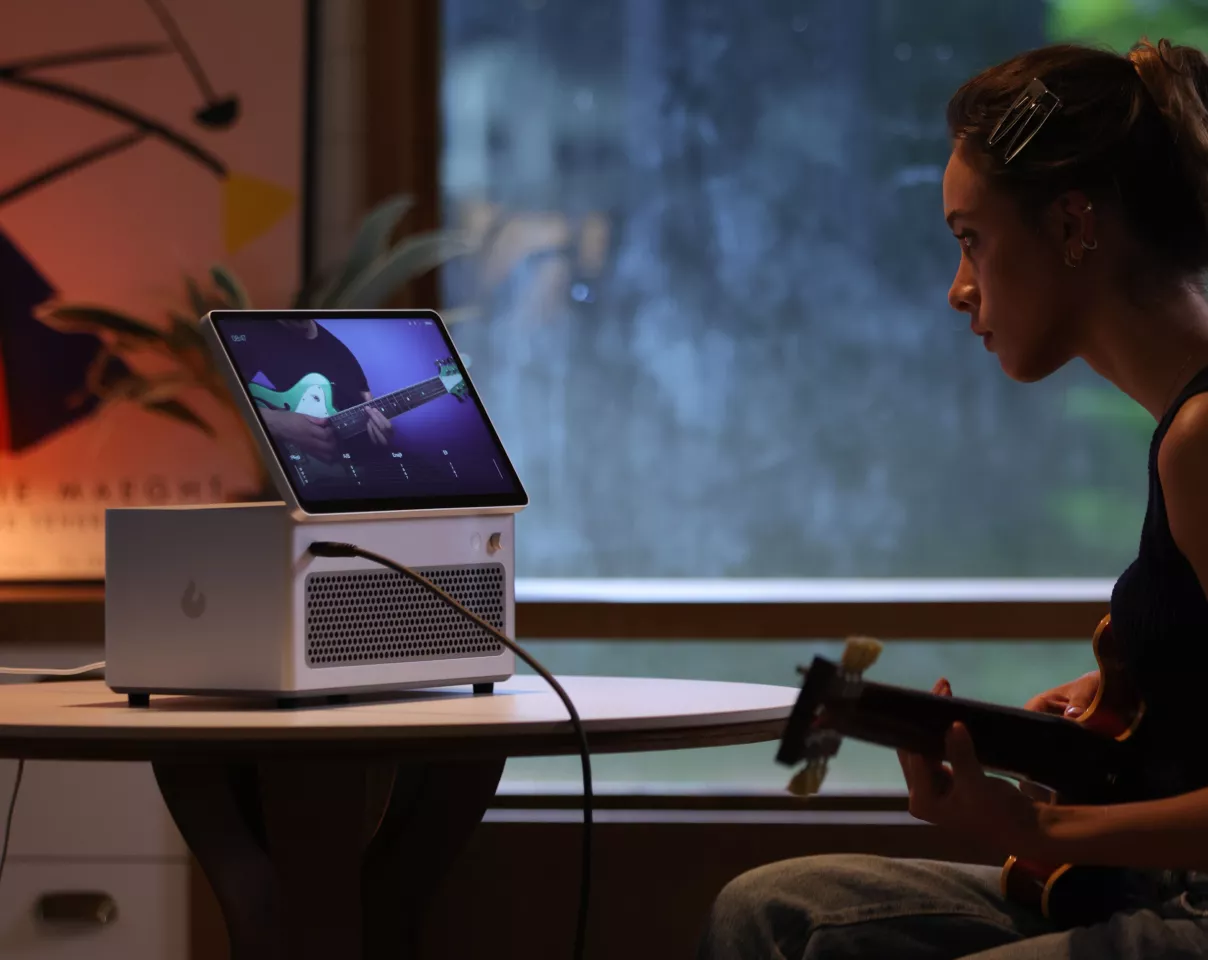
Lava Music
Of course, if you just want to sit back a listen to tunes at the end of your day, Bluetooth 5.0 and USC-C connectivity means you can feed in favorites from your go-to source devices.
The “all-in-one music creation and playback powerhouse” is raising funds on Kickstarter right now, where pledges currently start at HK$5,840 (which converts to around US$750) – including free shipping to many locations. An adjustable stand can be optioned in for an extra US$79.
All crowdfunding projects carry an element of risk, but Lava Music is an established company with distribution hubs in the US, Canada, the UK, Germany and Australia, and a reputation for delivering. If all goes to plan with this latest campaign, shipping is estimated to start from November.
Introducing LAVA STUDIO
Source: Kickstarter
New Atlas may receive commission if you purchase through our links.
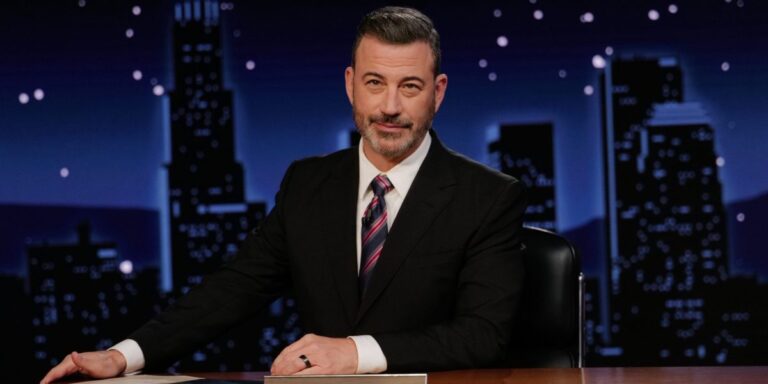
President Donald Trump launched a fresh attack on ABC and Jimmy Kimmel following the network’s decision to bring the late-night host back on air after a contentious six-day suspension, threatening new legal action against the Disney-owned broadcaster while referencing a previous settlement.
Writing on Truth Social just about an hour before Kimmel’s Tuesday night return, Trump said, “I can’t believe ABC Fake News gave Jimmy Kimmel his job back. The White House was told by ABC that his Show was cancelled!” The president went on to question the network’s decision, asking why they would “want someone back who does so poorly, who’s not funny, and who puts the Network in jeopardy by playing 99% positive Democrat GARBAGE.”
Most notably, Trump suggested potential legal action, stating, “I think we’re going to test ABC out on this. Let’s see how we do. Last time I went after them, they gave me $16 Million Dollars. This one sounds even more lucrative.”
The $16 million figure Trump referenced stems from ABC News’s December 2024 settlement of a defamation lawsuit involving anchor George Stephanopoulos. ABC agreed to pay $15 million to Trump’s presidential foundation and museum, plus $1 million in legal fees, after Stephanopoulos incorrectly stated on air that Trump had been found civilly liable for rape in the E. Jean Carroll case. A jury had actually found Trump liable for sexual abuse and defamation, but not rape as defined under New York law.
ABC suspended “Jimmy Kimmel Live!” indefinitely on September 17 following comments Kimmel made about the assassination of conservative activist Charlie Kirk. In his September 15 monologue, Kimmel criticized Trump supporters’ response to Kirk’s death, saying “The MAGA gang is desperately trying to characterize this kid who murdered Charlie Kirk as anything other than one of them, and they are doing everything they can to score political points from it.”
The suspension came after Federal Communications Commission Chairman Brendan Carr condemned Kimmel’s remarks during a YouTube appearance, suggesting that ABC and its affiliates should “take action” against the host. “We can do this the easy way or the hard way,” Carr warned, stating that companies could modify their conduct regarding Kimmel “or there’s going to be additional work for the FCC ahead.”
Following pressure from Carr, major broadcast station groups Nexstar Media Group and Sinclair Broadcast Group announced they would preempt Kimmel’s show on their ABC affiliates, citing strong disapproval of his comments. ABC then announced the indefinite suspension of the program.
Disney announced Kimmel’s return on Monday after what the company described as “thoughtful conversations” with the host. However, both Nexstar and Sinclair indicated they would continue to preempt the show even after its return, meaning approximately 20% of ABC’s affiliated stations would not air Kimmel’s comeback.
In his return monologue Tuesday night, Kimmel addressed the controversy with visible emotion, stating, “It was never my intention to make light of the murder of a young man. I don’t think there’s anything funny about it.” He also clarified it “was never my intention to blame any specific group for the actions of what was obviously a deeply disturbed individual.”
Trump’s threats against ABC represent part of a broader pattern of pressure on media companies. The president has previously suggested that broadcast networks critical of him should have their licenses revoked. Trump celebrated Kimmel’s initial suspension, calling it “great news for America” and suggesting other networks fire late-night hosts critical of his administration.
The suspension drew criticism from across the political spectrum. Republican Senator Ted Cruz, while expressing disdain for Kimmel’s comments, compared Carr’s threats to “mafioso” tactics and warned that such government pressure could backfire on conservatives. Democratic leaders called for Carr’s resignation and demanded investigations into potential First Amendment violations.
Over 430 entertainment industry figures, including Jennifer Aniston, Meryl Streep, and Tom Hanks, signed an open letter through the American Civil Liberties Union condemning the suspension as “a dark moment for freedom of speech in our nation”.
Despite Disney’s decision to bring Kimmel back, the host acknowledged the ongoing risk to the company, saying during his return, “I know that unfortunately and I think unjustly this puts them at risk. The president of the United States made it very clear he wants to see me and the hundreds of people who work here fired from our jobs.”
You can watch the full monologue from Kimmel’s return to late night below:
For this story, Fortune used generative AI to help with an initial draft. An editor verified the accuracy of the information before publishing.

Welcome to World Breaking News, your trusted source for fast, accurate, and impactful news coverage from around the globe. We are a dedicated team of journalists, editors, and news enthusiasts committed to delivering breaking stories, in-depth analysis, and real-time updates on politics, business, technology, sports, entertainment, and more.
© Copyright -World Breaking News -2025