9.8 C
New York
Saturday, February 28, 2026
Home Blog Page 368

Nicolas Sarkozy receives five-year sentence in Libyan campaign financing case

0

Former French president Nicolas Sarkozy has been sentenced to five years in jail after being found guilty of criminal conspiracy in a case related to millions of euros of illicit funds from the late Libyan leader Col Muammar Gaddafi.

The Paris criminal court acquitted him of all other charges, including passive corruption and illegal campaign financing.

The ruling means he will spend time in jail even if he launches an appeal, which Sarkozy says he intends to do.

Speaking after Thursday’s hearing, the 70-year-old, who was president from 2007-12, said the verdict was “extremely serious for rule of law”.

Sarkozy, who claims the case is politically motivated, was accused of using the funds from Gaddafi to finance his 2007 election campaign.

In exchange, the prosecution alleged Sarkozy promised to help Gaddafi combat his reputation as a pariah with Western countries.

Judge Nathalie Gavarino said Sarkozy had allowed close aides to contact Libyan officials with a view to obtaining financial support for his campaign.

But the court ruled that there was not enough evidence to find Sarkozy was the beneficiary of the illegal campaign financing.

He was also ordered to pay a fine of €100,000 ($117,000, £87,000).

There was a shocked intake of breath in court when the judge read out her sentence.

Sarkozy could be sent to prison in Paris in the coming days – a first for a former French president and a humiliating blow for a man who has always protested his innocence in this trial and the other legal cases against him.

“What happened today… is of extreme gravity in regard to the rule of law, and for the trust one can have in the justice system,” Sarkozy said outside the court building.

“If they absolutely want me to sleep in jail, I will sleep in jail, but with my head held high,” he said.

The investigation was opened in 2013, two years after Saif al-Islam, son of the then-Libyan leader, first accused Sarkozy of taking millions of his father’s money for campaign funding.

The following year, Lebanese businessman Ziad Takieddine – who for a long time acted as a middleman between France and the Middle East – said he had written proof that Sarkozy’s campaign bid was “abundantly” financed by Tripoli, and that the €50m (£43m) worth of payments continued after he became president.

Among the others accused in the trial were former interior ministers, Claude Gueant and Brice Hortefeux. The court found Gueant guilty of corruption, among other charges, and Hortefeux was found guilty of criminal conspiracy.

Sarkozy’s wife, Italian-born former supermodel and singer Carla Bruni-Sarkozy, was charged last year with hiding evidence linked to the Gaddafi case and associating with wrongdoers to commit fraud, both of which she denies.

Since losing his re-election bid in 2012, Sarkozy has been targeted by several criminal investigations.

He also appealed against a February 2024 ruling which found him guilty of overspending on his 2012 re-election campaign, then hiring a PR firm to cover it up. He was handed a one-year sentence, of which six months were suspended.

In 2021, he was found guilty of trying to bribe a judge in 2014 and became the first former French president to get a custodial sentence. In December, the Paris appeals court ruled that he could serve his time at home wearing a tag instead of going to jail.

Spotify removes over 75 million tracks in effort to crack down on ‘spammy’ AI-generated music

0

Spotify has removed more than 75 million “spammy tracks” from its platform over the past year, the streaming giant revealed today as it announced a suite of new policies for managing AI-generated content on its service.

The figure was disclosed during a press briefing where executives outlined a three-pronged approach to combat AI-enabled fraud while supporting legitimate artistic use of artificial intelligence tools.

“In the past 12 months alone, a period marked by the explosion of generative AI tools, we’ve removed over 75 million spammy tracks from Spotify,” the company confirmed in its official blog post announcing the measures.

The announcement comes as the streaming industry grapples with an unprecedented influx of AI-generated content.

Rival platform Deezer recently reported that it now receives over 30,000 fully AI-generated tracks daily, marking a sharp increase from the 20,000 figure it reported in April and the 10,000 it disclosed in January when it first launched its proprietary AI detection tool.

According to Deezer, up to 70% of plays for these fully AI-generated tracks have been detected as fraudulent, with the company filtering these streams out of royalty payments.

Spotify’s new framework comprises three key policies targeting different aspects of AI-related challenges, including:

  • Improved enforcement of impersonation violations
  • A new spam filtering system, and
  • AI disclosures for music with “industry-standard credits”.

Spotify explained the reasoning behind the introduction of these measures in the blog post published today: “At its best, AI is unlocking incredible new ways for artists to create music and for listeners to discover it,” the company said.

“The future of the music industry is being written, and we believe that aggressively protecting against the worst parts of Gen AI is essential to enabling its potential for artists and producers.”

Spotify

It added: “At its worst, AI can be used by bad actors and content farms to confuse or deceive listeners, push ‘slop’ into the ecosystem, and interfere with authentic artists working to build their careers. That kind of harmful AI content degrades the user experience for listeners and often attempts to divert royalties to bad actors.

“The future of the music industry is being written, and we believe that aggressively protecting against the worst parts of Gen AI is essential to enabling its potential for artists and producers.”

1. Improved enforcement of impersonation violations

Spotify is introducing a new impersonation policy that prohibits unauthorized AI voice clones, deepfakes, and any form of vocal replicas or impersonation. Spotify is also investing in preventing “content mismatches” – where fraudulent actors upload music to another artist’s profile across streaming services.

 “Vocal impersonation is only allowed in music on Spotify when the impersonated artist has authorized the usage,” said Spotify today.

“Unauthorized use of AI to clone an artist’s voice exploits their identity, undermines their artistry, and threatens the fundamental integrity of their work.”

“We’re also ramping up our investments to protect against another impersonation tactic, where uploaders fraudulently deliver music (AI-generated or otherwise) to another artist’s profile across streaming services. We’re testing new prevention tactics with leading artist distributors to equip them to better stop these attacks at the source.”

Spotify added:  “Unauthorized use of AI to clone an artist’s voice exploits their identity, undermines their artistry, and threatens the fundamental integrity of their work. Some artists may choose to license their voice to AI projects—and that’s their choice to make. Our job is to do what we can to ensure that the choice stays in their hands.”


2. A new spam filtering system

Second, Spotify is introducing a spam filter specifically designed to combat AI-enabled content manipulation.

The system will target accounts engaging in mass uploads, creating excessive duplicates with altered metadata, manipulating SEO, and uploading tracks just over 30 seconds to accumulate royalty-bearing streams.

“Our new spam filter will flag tracks and uploaders using these tactics and stop recommending them across Spotify programming,” said Sam Duboff, Global Head of Marketing and Policy for the Music Business during the press briefing.


3. AI disclosures for music with “industry-standard credits”.

Spotify also announced it is helping develop and will support “a new industry standard” for AI disclosures in music credits, developed through DDEX (Digital Data Exchange). This standard enables artists and rightsholders to clearly indicate where and how AI played a role in track creation – whether in AI-generated vocals, instrumentation, or post-production.

“As this information is submitted through labels, distributors, and music partners, we’ll begin displaying it across the app,” the company stated. “This change is about strengthening trust across the platform. It’s not about punishing artists who use AI responsibly or down ranking tracks for disclosing information about how they were made.”

The initiative has secured broad industry support, with Spotify working alongside partners including: Amuse, AudioSalad, Believe, CD Baby, DistroKid, Downtown Artist & Label Services, EMPIRE, Encoding Management Service – EMS GmbH, FUGA, IDOL, Kontor New Media, Labelcamp, NueMeta, Revelator, SonoSuite, Soundrop and Supply Chain.

“This industry standard will allow for more accurate, nuanced disclosures,” explained Duboff during the briefing. “It won’t force tracks into a false binary where a song either has to be categorically AI or not AI at all.”

The list of partners for the DDEX initiative published on Spotify’s blog post today doesn’t appear to include the names of the three majors, but MBW understands that Spotify is in talks with them about it, and that they are broadly supportive of Spotify’s new policies.

A UMG spokesperson told MBW in a statement that the company “welcome[s] Spotify’s new AI protections as important steps forward consistent with our longstanding Artist Centric principles”.

They added: “We believe AI presents enormous opportunities for both artists and fans, which is why platforms, distributors and aggregators must adopt measures to protect the health of the music ecosystem in order for these opportunities to flourish.

“These measures include content filtering; checks for infringement across streaming and social platforms; penalty systems for repeat infringers; chain-of-custody certification and name-and-likeness verification.  The adoption of these measures would enable artists to reach more fans, have more economic and creative opportunities, and dramatically diminish the sea of noise and irrelevant content that threatens to drown out artists’ voices.”

“We welcome Spotify’s new AI protections as important steps forward consistent with our longstanding Artist Centric principles.”

Universal Music Group

A Warner Music Group spokesperson also told us that “WMG has been working with our distribution partners to set the right environment and ecosystem for AI, where the value of artistic creativity is protected.

“We appreciate and support Spotify on taking these steps to do just that and look forward to working with them on further safeguarding the rights of artists, songwriters and copyright owners.”

“We appreciate and support Spotify on taking these steps to do just that and look forward to working with them on further safeguarding the rights of artists, songwriters and copyright owners.”

Warner Music Group

Mike Caren, music producer and CEO of Artist Partner Group, endorsed the measures: “It’s crucial for artists to know that their partners are contributing to the protection of their identity and repertoire. Transparency in the use of AI is key to building trust with fans. These developments are significant steps forward for Spotify.”

As did songwriter Justin Tranter: “Songs and songwriters are at the core of the entire music business,” Tranter said.

“If we aren’t protected, we can’t do our jobs and the whole business suffers. There is still a lot of work to be done; but, I am so grateful for these efforts to support and protect us. Thank you.”


The economics driving spam

Spotify’s total music payouts have grown from $1 billion in 2014 to $10 billion in 2024, creating significant incentives for bad actors to flood platforms with low-quality content.

“Big payouts entice bad actors,” the company acknowledged. “Left unchecked, these behaviors can dilute the royalty pool and impact attention for artists playing by the rules.”

The problem extends beyond Spotify. Although fully AI-generated music currently accounts for only around 0.5% of all streams on Deezer, the platform believes the primary purpose of uploading these tracks is fraudulent activity rather than genuine creative expression.

According to Spotify’s analysis, tracks that appear to be primarily prompt-generated currently represent what Duboff called a “de minimis level of engagement” on the platform. “When music doesn’t take much effort to create, it tends to be low quality, doesn’t tend to find an audience,” he noted.


Artist autonomy and transparency

Charlie Hellman, VP Global Head of Music Product, positioned these changes within the broader context of technological disruption in music history.

“Every time these new technologies [emerged], there were artists who embraced it and thought it was great, and other artists who didn’t,” he said. “But the common thread in each of those moments was that it was the artists that got to decide.”

The company emphasized it will not penalize artists for legitimate use of AI tools. “We’re not here to punish artists for using AI authentically and responsibly,” Hellman stated.

When questioned about the Velvet Sundowner case – where an AI-generated band gained traction on the platform earlier this year – Duboff suggested transparent disclosure would have changed the narrative. “If these AI credits had been available before the summer, I think the news cycle, the fan interest would have been really different,” he said.


Denying playlist manipulation

The briefing addressed rumors about Spotify allegedly adding AI-generated tracks to editorial playlists to reduce royalty payments.

“Those rumors are categorically and absolutely false,” Duboff stated. “Spotify doesn’t generate any music. We don’t own any music. All the music on Spotify, 100% of it, is created, owned, uploaded by licensed third parties.”


Implementation timeline

The new impersonation policy becomes effective immediately. The spam filter has begun its gradual rollout, which Spotify plans to implement carefully over coming weeks. The DDEX AI credits system, while announced today, will require additional time for formal certification and supply chain updates.

Music Business Worldwide

The Strategies Cities Are Using to Combat Heatwaves

0

The world is hot — and only getting hotter. We looked at what places around the globe are doing to keep cool.

Client Challenge – Finding Solutions for Clients’ Unique Needs

0


Client Challenge


JavaScript is disabled in your browser.

Please enable JavaScript to proceed.

A required part of this site couldn’t load. This may be due to a browser
extension, network issues, or browser settings. Please check your
connection, disable any ad blockers, or try using a different browser.

Scientists discover supermassive black holes are not as massive as previously thought | Science and Technology News

0

Study of galaxy more than 12 billion light years away shows black holes may be smaller than believed, challenging models of cosmic growth.

“Supermassive” black holes may not be as enormous as once assumed, scientists have reported.

Astronomers told the media on Thursday that, following a breakthrough study of a distant quasar, an extremely bright, active core of a very distant galaxy, the supermassive black hole at its heart has a mass that is equal to “only” about one billion suns, making it one-10th of what was assumed.

Recommended Stories

list of 3 itemsend of list

A team from the University of Southampton, working with European colleagues, observed the galaxy, more than 12 billion light years away, using state-of-the-art equipment at the European Southern Observatory (ESO) in Chile.

“Despite the quasar’s extreme luminosity, the black hole at its heart was found to have a mass equal to ‘only’ around one billion suns,” Associate Professor Christian Wolf told ANU Reporter.

He added that instead of spinning rapidly as expected, the black hole was “belching up” gas, driven outwards by the blinding intensity of light.

The black hole at the centre of this young galaxy was first detected in 2024 by Wolf and his colleagues at the Australian National University (ANU).

Professor Seb Hoenig of the University of Southampton said the discovery helps solve a longstanding mystery.

“We have been wondering for years how it’s possible we discovered all these fully grown supermassive black holes in very young galaxies shortly after the Big Bang. They shouldn’t have had the time to grow that massive,” he told the Press Association (PA).

The study, published in Astronomy and Astrophysics, used Gravity+, an instrument that combines light from four of the world’s largest telescopes at ESO’s Very Large Telescope in Chile. The team, which also included researchers from France, Germany, Portugal and Belgium, analysed the hot gas spiralling into the black hole.

Their results suggest that intense radiation is blasting most of the gas away, preventing the black hole from gaining mass as quickly as previously thought.

“Think of it like a cosmic hairdryer set to maximum power,” Hoenig explained to PA. “The intense radiation around it is blowing everything away that approaches it.”

The findings may lead scientists to reconsider the methods used to measure black holes and reshape models of cosmic evolution.

Texas Women Look to New Faces to Continue Top-Three Streak in 2026 College Swimming Season

0

By Madeline Folsom on SwimSwam

It’s that time of the year again. SwimSwam will be previewing the top 12 men’s and women’s teams (and then some) from the 2025 NCAA Championships. Follow along with the College Swimming Preview Channel. Want to read even more? Check out the latest edition of the SwimSwam magazine

Women’s #3: Texas Longhorns

Key Losses: Emma Sticklen (48 NCAA Points, 4 NCAA relays), Hailey Hernandez (21 NCAA Points), Abby Arens (13 NCAA Points, 3 NCAA relays), Olivia Bray (2 NCAA Points, 1 NCAA relay), Grace Cooper (2 NCAA relays), Ava Longi (2 NCAA relays)

Key Additions: #7 Haley McDonald (KY – back/IM), #20 Sarah Rodrigues (NJ–back/free), BOTR Avery Collins (TX – breast), Lucy Mehraban (Louisville Transfer – free), Eva Okaro (Great Britain – free), Inez Miller (Singapore – free), Nikolett Padar (Hungary – free)

GRADING CRITERIA

Over the years, we’ve gone back and forth on how to project points, ranging from largely subjective rankings to more data-based grading criteria based on ‘projected returning points.’ We like being as objective as possible, but we’re going to stick with the approach we’ve adopted post-Covid. The “stars” will rely heavily on what swimmers actually did last year, but we’ll also give credit to returning swimmers or freshmen who have posted times that would have scored last year.

Since we only profile the top 12 teams in this format, our grades are designed with that range in mind. In the grand scheme of college swimming and compared to all other college programs, top 12 NCAA programs would pretty much all grade well across the board. But in the interest of making these previews informative, our grading scale is tough – designed to show the tiers between the good stroke groups, the great ones, and the 2015 Texas fly group types.

  • 5 star (★★★★★) – a rare, elite NCAA group projected to score 25+ points per event
  • 4 star (★★★★) – a very, very good NCAA group projected to score 15-24 points per event
  • 3 star (★★★) – a good NCAA group projected to score 5-14 points per event
  • 2 star (★★) – a solid NCAA group projected to score 1-4 points per event
  • 1 star (★) –  an NCAA group that is projected to score no points per event, though that doesn’t mean it’s without potential scorers – they’ll just need to leapfrog some swimmers ahead of them to do it

We’ll grade each event discipline: sprint free (which we define to include all the relay-distance freestyle events, so 50, 100 and 200), distance free, IM, breaststroke, backstroke, butterfly and diving. Use these grades as a jumping-off point for discussion, rather than a reason to be angry.

Also, keep in mind that we are publishing many of these previews before teams have posted finalized rosters. We’re making our assessments based on the best information we have available at the time of publication, but we reserve the right to make changes after publication based on any new information that may emerge regarding rosters. If that does happen, we’ll make certain to note the change.

2024-25 Lookback

The Texas women had a strong year, and they made the most of their last season with a strong class of fifth-year swimmers.

They finished 3rd at the 2025 NCAA Championships after earning the runner-up spot three years in a row behind Virginia. Last year, they fell to Virginia and Stanford, coming in just over 20 points behind the Cardinal, who had their highest finish since 2019.

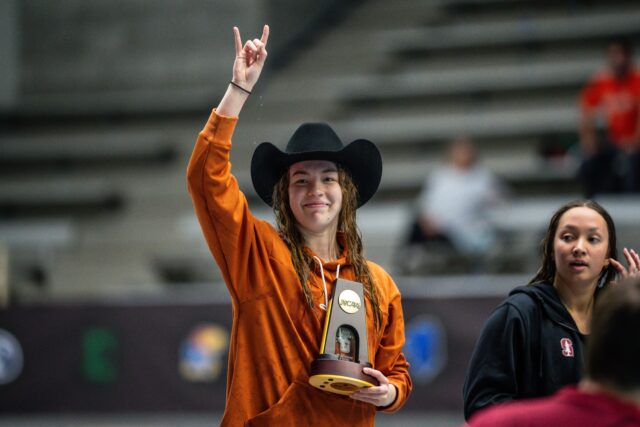
Graduate Student Emma Sticklen led the team in points, bringing in 48 individual points with her win (and NCAA record) in the 200 fly, 3rd place finish in the 100 fly, and 7th place finish in the 200 IM.

She was followed in the point totals by freshman diver Alejandra Estudillo Torres and sophomore Jillian Cox at 42 and 40 points, respectively.

Estudillo Torres finished 1st in the 3-meter, 6th in the 1-meter, and 9th in the platform events, and Cox won the 500 and 1650 freestyles (the only events she swam).

Joining Cox in the Longhorns Sophomore Class were diver Bayleigh Cranford (29 points), Campbell Stoll (24 points), and Erin Gemmell (12 points). There was also a quartet of freshmen who came in after Estudillo Torres in Piper Enge (14 points) and Kate Hurst, Lillian Nesty, and Campbell Chase, who all scored seven points.

Hailey Hernandez was the only senior individual point scorer with 21 total points, and Abby Arens (13) and Olivia Bray (2) were the final Longhorn point scorers at the meet.

Texas also won its first SEC Championship, taking home the trophy in its very first year in the conference and dethroning the defending champions, Florida.

The scores at that meet were also led by Sticklen, who scored 96 points by winning all three of her events. Campbell Stoll scored the 2nd most at 83.

Sprint Free: ★★★ ½

Last season, the Longhorns were weak in the 50 and 100 events. Grace Cooper was the highest finisher in the 50, touching in 18th at 21.91, and Erin Gemmell was the highest 100 freestyle finisher, tying for 16th before losing the swim-off to Georgia’s Helena Jones for the last spot in the final.

Their 200 freestyle was stronger, with Erin Gemmell bringing in 12 points with her 7th place finish at 1:43.52, and Lillian Nesty scoring 7 points after finishing 10th in 1:42.86, her lifetime best. Gemmell added about a second in the 200 free final, with her best time coming in at 1:42.32 from the SEC Championships in February. That time would have been 5th at last year’s Championships, which would have been 14 points for the team.

Nesty is another potential ‘A’ finalist if she can have a stronger prelim swim. Last season, it took 1:43.24 out of prelims to qualify for the ‘A’ final, and she touched 10th in 1:43.52.

Gemmell also added in the 100 freestyle. Her best time of 47.38 would have comfortably qualified for the ‘A’ final, where she would have finished 10th for 7 points.

This might be the area where Texas will see the most improvement this year, though. They are bringing in a major international sprinter in Great Britain’s Eva Okaro, the World Junior record holder in the SCM 50 freestyle. Her 50 free best time converts to 21.33, which would have finished 5th place, and her 100 free converts to 47.67, which would have been 12th.

They also picked up Louisville transfer Lucy Mehraban, who has best times of 22.05 and 47.81. She finished 16th in the 100 free at last year’s Championships, and she will help boost the 100 free points for Texas.

Nikolett Padar is also coming in as a freshman from Hungary, and her 200 freestyle best time converts to 1:42.55, which would have qualified for the ‘A’ final last year.

Distance Free: ★★★★★

Texas will return the reigning NCAA Champion in both distance events. Jillian Cox took home both golds last year, and she is one of the favorites to repeat that performance this year.

She won the 500 freestyle by more than two seconds over two seniors, touching in 4:31.58. The fastest returning swimmer is Katie Grimes, who comes in at 4:34.25 after finishing 4th overall. The 1650 is a similar story, with Cox winning the event by nearly seven seconds over Stanford’s Aurora Roghair.

While she will face a challenger in the form of Claire Weinstein, from Cal, it is safe to say she is an easy prediction for the top two at least.

The Longhorns will also return Kate Hurst, who finished 10th in the 1650 and 32nd in the 500 free. She swam 15:54.37 in the mile at NCAAs, but her lifetime best of 15:47.93 from SECs a month prior would have been 4th overall. She has an NCAA season and a double taper under her belt now, so she could be a serious point threat in the mile.

Her 500 is also a potential point event, with her best time of 4:37.59 putting her in ‘B’ finals position, where she would have finished 12th.

Erin Gemmell and Lillian Nesty also have lifetime best times in the 500 that would make them potential finalists. Nesty finished 30th in 4:40.44, a four-second add from the 4:36.72 she swam at SECs. That time would have made her a comfortable ‘A’ finalist, where she would have been 7th. Gemmell was 37th at NCAAs in 4:41.74, a three-second add from her best of 4:38.21, which would make the ‘B’ final.

Among incoming swimmers, they have Nikolett Padar, whose LC best converts to 4:37.95 in the 500 freestyle, another potential ‘B’ finalist.

If all the Texas pieces are on for NCAAs, they could easily end up with multiple top-eight finishers in both distance events, including the champion in Cox.

Backstroke: ★★

Texas did not have any point scorers in either backstroke event last season. Berit Berglund is their top returning backstroker, with her season best time sitting at 51.02 from the SEC Championships. She swam the event at NCAAs, finishing 43rd after a two-second add to touch in 52.41, but her season best time would have been 14th overall.

Berglund also swam the 200 backstroke, adding two-and-a-half seconds from her best of 1:52.97 to swim 1:55.22. Her best still sits just outside of scoring position in the event, with 1:51.75 earning the 16th place out of prelims.

Nesty was the fastest 200 backstroker for the Longhorns last season, coming in at 1:52.51, though she swam 1:53.47 at NCAAS to finish 31st.

They are bringing in two ranked backstrokers in the freshman class with our #7 recruit, Haley McDonald, and our #20 recruit, Sarah Rodrigues. McDonald’s 200 back best of 1:52.74 would sit just outside of scoring. She has been dealing with injury, so it isn’t clear what kind of form she will be in when she arrives in Austin, but she swam 2:13.17 in the long course 200 backstroke in July, which is a strong indication that she is returning to top form.

Rodrigues is also better at the 200, and her lifetime best of 1:51.14 would have been 10th last year. Her 100 back best time sits at 51.89, which would have been 30th, about seven tenths outside of scoring position.

Breaststroke: ★★ ½

The Longhorns only had two athletes in the women’s 100 breaststroke last year, Piper Enge and Abby Arens.

Enge will be returning this year after finishing 5th in the 100 breast as a freshman. Their final time of 58.19 was about four tenths off their best time of 57.69, which would have finished 4th in the event.

In the 200 breast, Enge finished 32nd, touching in 2:10.60, about three seconds off the 2:07.90 mark they set in January. That time would have comfortably been in the ‘B’ final out of prelims, where they would have finished 13th.

Texas also had Campbell Chase in the 200, where she finished 33rd in 2:10.74, a new personal best time.

They are bringing in BOTR recruit Avery Collins, who has best times of 1:00.47 and 2:10.42. These are over the NCAA cutlines of 59.51 and 2:09.58, but with slight drops, she could be a conference scorer.

Butterfly: ★★½

Texas has had one of the top butterflyers in the NCAA the last few years in the recently graduated Emma Sticklen. Last year, she was 3rd in the 100 fly and 1st in the 200 fly, setting a new NCAA record in the process.

On top of Sticklen, they also graduated NCAA scoring butterflyers in Abby Arens and Olivia Bray, quickly going from one of the top butterfly groups in the NCAA, earning five stars on this ranking last year, to a struggling one.

The fastest returning butterflyer this season is junior Campbell Stoll, who holds best times of 51.44 and 1:51.64. Stoll did not swim the 100 butterfly last season, opting for the 400 IM instead, where she was a finalist. It doesn’t seem likely that she will flip that event choice this season, but she will still be available for the medley relays.

Stoll did swim the 200 butterfly, earning a spot in the ‘A’ final, finishing 7th in 1:52.29. Her best time would have been 4th, just ahead of Virginia’s Tess Howley and behind two graduates.

The Longhorns are in a rough spot in the 100 fly individually. They had five swimmers in the event at SECs last year, and all five of them have graduated. Nesty (52.44), Angie Coe (53.06), Campbell Chase (53.54), and Emma Kern (53.78) are the next fastest flyers after Stoll, but all three swam other events last season. Only Nesty is under the 52.92 mark it took to score at SECs, and she likely will not drop the 200 freestyle.

Eva Okaro is the only butterflyer Texas is bringing in this season. Her best time converts to 51.95, which is in scoring position at conference, but is seven tenths over the 51.35 it took in the prelims to score.

IM: ★★★½

The Texas IM group will be led by a pair of Campbells this season, with Campbell Stoll returning as the top swimmer in both and Campbell Chase coming in just behind her.

While Stoll had the faster times last year, Chase came out on top in the 200 IM at NCAAs, finishing 10th overall in 1:53.90 to Stoll’s 1:54.78 for 12th. Both women added a bit with Chase coming in one-hundredth behind the 1:53.89 mark she set at the Eddie Reese Texas Showdown, which would not have changed her event finish.

Stoll added from the 1:53.37 she went at the SEC Championships. That time would have earned an ‘A’ finals swim, with the 8th place time out of prelims coming in at 1:53.72.

Angie Coe also swam the 200 IM, finishing 38th in 1:57.13. This was a three-second add from her best of 1:54.33, which would have been 10th out of prelims.

In the 400 IM, Stoll was the only Longhorn point scorer, finishing 10th in 4:04.55, a second-and-a-half add from her lifetime best of 4:03.11 from the SEC Championships. That time would have been 6th overall.

Chase finished 18th in 4:07.36, about a second off her best of 4:06.57, which would have been comfortably in the ‘B’ final.

Coe was 26th in 4:10.35. Her best of 4:08.63 would have sat just outside of finals position at 21st.

Haley McDonald is the top IMer, coming in at 1:55.90 in the 200 and 4:12.26 in the 400. Her 200 IM time is more than a second under the cutline, and she sits less than half a second outside the scoring position of 1:55.50.

Diving: ★★★★

The second-highest point scorer for the Longhorns at NCAAs was freshman diver Alejandra Estudillo Torres. She brought in 42 points with two top-eight finishes and one 9th-place finish, and she was only a freshman. Twenty of her 42 points came in the form of an event win on the 3-meter springboard.

Texas also has current junior Bayleigh Cranford, who brought in 29 points on the boards, also scoring in all three. Her highest finish was 6th on the platform.

Current sophomore Taylor Fox scored 51 points at SECs and is another potential conference point scorer.

Relays: ★★★★

Note that the grading system doesn’t align perfectly for relays as double points.

Relay grading system:

  • 5 star (★★★★★) – 31+ points per relay event
  • 4 star (★★★★) – 22-30 relay points per event
  • 3 star (★★★) – 12-21 relay points per event
  • 2 star (★★) – 5-11 relay points per event
  • 1 star () – 0-4 relay points per event

The relays will be an interesting position for the Texas team. They graduated a lot of their top relay swimmers, and they have a lot of room for improvement from last year. A huge space for improvement, though, will come in replicating their relay swims when it matters. Texas added time in all but one relay from SECs to NCAAs, and the one relay they did not add in was disqualified at the SEC Championships.

Their highest finish came in the 800 freestyle relay, where they finished 4th in 6:53.49. They will return three of the four athletes who swam on that relay ,with only Ava Longi graduating. Their only other top-five finish came in the 400 medley relay, where they finished 5th in 3:26.11, and two of the four swimmers, Olivia Bray and Emma Sticklen, will not return this season.

Their lowest finish came in the 200 freestyle relay, which placed 8th and will not return a single swimmer this year.

Here is a look at how the relays looked last season:

Relay NCAA Finish Lineup Losses Potential Adds Season Best
200 FR 8th (1:27.00) Cooper, Sticklen, Arens, Longi Cooper, Sticklen, Arens, Longi Okaro, Mehraban, Miller 1:25.90 (same lineup)
400 FR 7th (3:10.47) Gemmell, Sticklen, Nesty, Arens Sticklen, Arens Okaro, Mehraban 3:09.26 (same lineup)
800 FR 4th (6:53.49) Gemmell, Nesty, Chase, Longi Longi Padar 6:51.61 (same lineup)
200 MR 6th (1:34.00) Sticklen, Enge, Arens, Cooper Sticklen, Arens, Cooper Okaro, Rodrigues, Mehraban 1:33.84 (same lineup)
400 MR 5th (3:26.11) Bray, Enge, Sticklen, Nesty Bray, Sticklen Okaro, Rodrigues, Mehraban Same

The 200 freestyle relay will see a completely new team from last year, and Eva Okaro will be leading the charge with her time converting to the fastest 50 time on the team. She will likely be joined by Lucy Mehraban, who will come in with another one of the top times on the team. Other Longhorns who could step into relay positions include senior Sienna Schellenger, junior Alexa Fulton, and incoming freshman Inez Miller. With the addition of Okaro, it is not unlikely that the team does the same, if not better than last year.

The 400 freestyle relay seems like it will be a pretty basic swap of Sticklen and Arens for Okaro and Mehraban, which will likely make the relay faster, and could propel it to a top 5 finish.

Their best bet for a top-three finish looks like the 800 freestyle relay right now. Longi was their only graduate from the relay, and it was already their highest finish of the meet. Her leg on the relay will probably go to Nikolett Padar, whose time converts to 1:42.55, which would be a huge swim for the team, and would be a second-and-a-half faster than the 1:44.08 that Longi swam on the relay last year.

Some combination of Okaro, Sarah Rodrigues, and Mehraban will likely take over the medley relay spots vacated by Sticklen, Arens, Grace Cooper, and Olivia Bray. There is also a chance that Mehraban takes over the freestyle leg of the 400 medley relay from Lillian Nesty, depending on who is faster. The only lock on the Texas medley right now is Piper Enge on the breaststroke.

Total Stars: 27/40

2025-26 Outlook

Texas graduated a lot of its top scoring swimmers, and some huge relay contributors – 90 points, and at least half of most of their relays are gone, leaving last year’s freshmen and sophomores to lead the team since Texas had no juniors score points.

Jillian Cox is their highest returning point scorer, and her performance in the distance freestyle events will be crucial for the team, looking to maintain their position or move up from last year. The current junior class as a whole was the highest-scoring Texas class last year, bringing in 105 points for the team.

The new sprint freestyle core will make or break the Longhorns and their point totals this year. Eva Okaro and Lucy Mehraban will be significant relay swimmers, and their individual swims have the potential to fill Texas’ major gap last season.

Diving has buoyed the Texas point totals for years, and that doesn’t seem to be coming to a close this year. With Virginia cutting their diving program entirely, that is an excellent place to pick up crucial points for the team, and they have the talent on the roster to do it.

While they lost a lot, there are still a lot of weapons on the Longhorn team, and they will need to use all of them to their full potential if they want to maintain their top-three spot, or even challenge for the title.

They seem to be in a safe spot in the SEC, winning last year’s meet by almost 300 points, and we are likely looking at at least a few more years of Texas’ reign in the conference.

WOMEN’S 2025-26 COLLEGE PREVIEW INDEX

RANK (2024) TEAM SPRINT FREE DISTANCE FREE BACK BREAST FLY IM DIVING RELAY TOTAL
1 Virginia Cavaliers
2 Stanford Cardinal
3 Texas Longhorns ★★★½ ★★★★★ ★★ ★★½ ★★½ ★★★½ ★★★★ ★★★★ 27/40
4 Indiana Hoosiers ★★★½ ★★★★ ★★ ★★★★½ ★★½ ★★★ ★★★★★ 25.5/40
5 Tennessee Volunteers ★★★½ ★★★ ★★ ★★★★★ ★★★ ★★★ ★★★ 23.5/40
6 Florida Gators ★★★ ★★ ★★★ ★★ ★★★½ ★★★ ★★★ 20.5/40
7 Louisville Cardinals ★★★★ ★★ ★★½ ★★★ ★★★ ★★★ ★★★★ 22.5/40
8 Cal Golden Bears ★★★½ ★★★★ ★★★½ ★★★ ★★★★ ★★½ ★★★★ 25.5/40
9 Michigan Wolverines ★★★★ ★★★★ ★★★★ ★★★ ★★★ ★★½ ★★★★★ 26.5/40
10 NC State Wolfpack ★★★ ★★★★★ ★★★★ ★★★ ★★ ★★★★ 23/40
11 USC Trojans ★★★★ ★★★ ★½ ★★★½ ★★ ★★★ 19/40
12 Wisconsin Badgers ★★ ★★½ ★★ ★★ 12.5/40

Read the full story on SwimSwam: 2026 College Swimming Previews: #3 Texas Women Counting On New Faces To Extend Top-Three Run


WisdomTree Issuer ICAV declares quarterly dividend distributions

0


WisdomTree Issuer ICAV announces quarterly dividend payments

Study on Apple Cider Vinegar Retracted Due to Mistakes

0

A headline-grabbing study that helped fuel the apple cider vinegar (ACV) boom has now been pulled from the scientific record, striking a blow to the authors, the wellness community and journal publisher BMJ Group. The research, which claimed that a daily teaspoon or two of ACV could drive striking weight loss and metabolic improvements, was found to have “multiple errors” and results that couldn’t be proven.

After concerns about the oft-cited study escalated – from letters to the journal to a formal investigation by BMJ’s content-integrity team and independent statisticians – experts were unable to reproduce the sensational findings and flagged “implausible statistical values,” unreliable raw data, inadequate methods of reporting and a lack of prospective trial registration. The authors agreed to the retraction, calling the errors honest mistakes.

“The paper is being retracted because the authors’ analyses could not be replicated and multiple errors were identified,”a journal spokesperson said. “The authors supplied dataset also demonstrated patterns inconsistent with random allocation of participants to treatment groups, improbably small p-values given the limited number of participants included in the study.”

While the published study has been scrubbed from the journal BMJ Nutrition, Prevention & Health, details of the study are covered in this March 2024 news release. In a three-month trial investigating the weight-loss benefits of ACV, 120 participants were prescribed different daily doses, which, according to the authors, resulted in an average loss of 6–8 kg (13-17.6 lb) and a BMI drop of 2.7–3 points. While the researchers included the study’s limitations, the findings were remarkable and widely reported on.

It’s worth noting that at the time the study was published, BMJ Nutrition, Prevention & Health co-owner Shane McAuliffe commented: “Whilst in this study design the intervention has demonstrated feasibility and effectiveness serving to encourage further trials designed to assess scalability and wider applications, at this stage caution should be exercised regarding the generalisability of the conclusions drawn on the independent effects of apple cider vinegar on the outcomes observed … Further research in this area would need to include detailed reporting of dietary recall or nutritional intake to explain any potential confounders and future explanatory trials would further elucidate mechanisms of impact on biochemical markers (lipids and blood glucose) in addition to weight loss.”

BMJ Nutrition, Prevention & Health editor-in-chief Professor Martin Kohlmeier acknowledged the journal’s error in publishing a trial that had not been prospectively registered – an explicit breach of policy.

“In hindsight, this was the wrong decision to make,” he said. “But the authors come from a scientific environment that is underrepresented in nutritional research and the journal aims to prioritise high quality evidence, which usually comes from clinical trials. These are relatively unusual in nutritional research as they can be challenging to undertake because of the numbers of participants and time needed to obtain meaningful results.”

As such, nutritional research is often observational, with health records pulled from large datasets like the UK Biobank, where only correlation, not causation, can be demonstrated.

“Tempting though it is to alert readers to an ostensibly simple and apparently helpful weight loss aid, at present the results of the study are unreliable, and journalists and others should no longer reference or use the results of this study in any future reporting,” said Dr. Helen Macdonald, Publication Ethics and Content Integrity Editor at BMJ Group.

One of the key issues with the study was that attempts to replicate it failed. Replication is a critical and often overlooked side of research, helping to prove the validity of the initial findings. While not foolproof – replication failures can occur due to human error, inaccurate details of study design and many other variables that may be difficult to control for – results that remain unproven are a huge red flag.

In this study, scientists not involved in the research cited issues with data collection and transparency, as well as the ages of the participants.

“The problems I see with this paper are that these were young people with an average age of 17 ± 5 years,” said Dr Rosemary Stanton OAM, Nutritionist and Senior Visiting Fellow at the School of Medical Sciences, University of New South Wales. “That means some were as young as 12. Some may have still been growing and this would affect their weight. We are also told that ‘subjects consumed their normal diets throughout the study. The contents of daily meals and snacks were recorded in a diet diary,’ but no details are given so we have no idea whether some may have been consuming less – or changed the amount they were eating during the study.”

Professor Helen Truby from The University of Queensland agreed: “The subjects were not weight stable at the beginning of the study, so may have been on a weight-loss journey before they began taking the vinegar. Diet and activity were self-reported so we cannot be sure that these large weight losses were not due to lifestyle changes, plus the use of weight loss medications has not been reported.”

Other experts found fault in how the scientists handled their findings, suggesting that their analysis failed to fully represent the data.

“They only apparently use t-tests (a statistical tool for making comparisons) and they should have used other models that allow for the valuation of fixed and random components,” said Miguel Ángel Martínez González, Professor of Preventive Medicine and Public Health at the University of Navarra. “There are several repeated measures over time, but they don’t use the proper statistical methodology for repeated measures in a longitudinal design of this type. They also don’t describe the total diet of the participants and how their caloric intake changes, the consumption of fruits, vegetables, ultra-processed foods, and so on.”

Dr Evangeline Mantzioris, Program Director of Nutrition and Food Sciences at the University of South Australia, noted that while the research showed promise: “This study was undertaken in people between the ages of 12-25 years, so the results can not be generalized to everyone. Additionally, from the statistical analyses that were done we can’t be confident that everyone who tried this would lose this average amount of weight. While they kept records of the participants’ diet and exercise this was not published in the paper, which makes it more difficult to determine if the diet or exercise might have had an impact. For example, did they change the amount they ate or the types of food they ate? Another concern is that even though participants were blinded to the treatment they received, the researchers did not check afterwards whether the participants guessed correctly which group they were in. Furthermore, the authors did not report if anyone dropped out of the study.”

While this study has been discredited largely due to poor execution and detail, there are numerous papers that have investigated the potential health benefits of ACV. In 2009, a Japanese study sparked widespread interest in ACV, when researchers found that it could result in modest weight loss. In the decade following, many researchers attempted to replicate the findings, including the team behind this study, which is often cited in media. However, so far evidence is mixed – and no research supports the 6–8-kg (13-17.6-lb) weight loss that the retracted study claimed.

What’s more, as this 2014 review details, scientists remain divided on just how ACV interacts with glucose and lipid metabolic processes.

“Although some evidence supports the use of vinegar as a complementary treatment in patients with glucose and lipid abnormalities, further large-scale long-term trials with impeccable methodology are warranted before definitive health claims can be made,” the researchers noted.

Nonetheless, the global ACV market is now valued at more than US$1 billion (2023-2024) and continues to grow – something that one retracted study is unlikely to impact.

“While findings showed apple cider vinegar may offer some benefits for weight loss and for lowering blood sugar, cholesterol, and triglycerides, it is unlikely to be a silver bullet for health,” said Dr Daisy Coyle, an Accredited Practising Dietitian at The George Institute for Global Health.

“While a number of effects of acetic acid on the expression of genes involved in fatty acid oxidation have been reported in animal studies, the mechanism of any effect observed here is unclear,” added Margaret Morris, Professor of Pharmacology and Head of the Environmental Determinants of Obesity Group at the University of New South Wales. “This study provides some good evidence for future larger and longer studies to be conducted across a range of ages to provide more robust evidence to see if apple cider vinegar could be a useful aid for weight loss.”

Source: BMJ Journals

Is the Tipp-Ex President truly Malawi’s long-awaited saviour?

0

Bloomberg via Getty Images A close-up shot of Peter Mutharika wearing silver-rimmed glasses and a suitBloomberg via Getty Images

Just five years after being dramatically unseated by a court ruling, Peter Mutharika is set to return to power as the president of Malawi.

Mutharika, who held the top job from 2014 to 2020, triumphed in last week’s general election, usurping his long-time rival, President Lazarus Chakwera.

Mutharika told voters on the campaign trail that life was simply better under him – Malawi has experienced one of its worst ever economic downturns since Chakwera took office.

But the record of 85-year-old Mutharika has its own blemishes, from corruption allegations to the debacle that ended his first presidency.

This is the fourth time he has run for office, but initially, Mutharika did not intend to go into politics.

Born in 1940 in the tea-growing region of Thyolo, he was raised by two teachers and developed a love for education.

“I grew up in a family where my parents were educators, and myself I spent all my life in higher education, at seven universities on three continents,” Mutharika commented in 2017, during an address at the UK’s Oxford University.

He attended Dedza Secondary School, an institution in central Malawi known for nurturing notable politicians, and studied law in the 1960s at the prestigious Yale University in the US.

Mutharika went on to become a professor, building an expertise in international justice. He spent decades away from Malawi teaching at universities in the US, Tanzania, Uganda and Ethiopia.

Mutharika eventually pivoted to politics in 2004, when his older brother, Bingu, became Malawi’s president.

Mutharika returned home to serve as an adviser to the new president and in 2009, he was elected as an MP for the ruling Democratic Progressive Party (DPP).

He served in his brother’s cabinet as justice minister, education minister and then foreign minister.

WireImage via Getty Images Peter Mutharika, wearing a black suit, sits next Prince Harry, who wears a beige suit. They are both seated in red chairs  and figures stand behind them.WireImage via Getty Images

Mutharika went from students and lecture halls to dignitaries and state visits

Mutharika scaled the heights of power relatively peacefully, but tensions emerged in 2010, amid reports that Bingu planned to name his brother as the DPP’s presidential candidate for the 2014 elections.

“Every week, chiefs from all over the country are paraded on national television to sing praises of Peter Mutharika… Many of the public are outraged, considering this blatant nepotism,” Malawian journalist Francis Chuma wrote in The Guardian.

But the succession plans were abruptly interrupted in April 2012.

At the age of 78, the president suffered a cardiac arrest, and died. Mutharika paid a glowing tribute to the late leader at his funeral, describing him as “my brother, my friend and also my hero”.

With the presidency vacant, a power struggle ensued. Malawi’s constitution stipulated that if the head of state dies in office, the vice-president takes over, but Bingu had fallen out with his vice-president, Joyce Banda, over the controversial plans to install his brother.

The DPP had expelled Banda, who subsequently formed a new party, the People’s Party (PP), but refused to step down as vice-president.

When the president died, his supporters tried to install Mutharika as leader in defiance of the constitution, but ultimately Banda prevailed and became Malawi’s first female president.

Mutharika was charged with treason after being accused of being part of a plot to hide his brother’s death to give him time to manoeuvre to keep Banda out of the presidency.

He dismissed the charges as frivolous and politically motivated – and they were dropped after he was elected president in 2014, defeating Banda and Chakwera with just over 36% of the vote.

Mutharika’s supporters say his first stint in power uplifted Malawi, pointing to the billions of dollars of Chinese loans he secured in order to revamp the country’s infrastructure.

Inflation also dropped significantly during Mutharika’s first term. When he succeeded Banda, the inflation rate was at 24% percent – by the time he left, it had shrunk to single digits.

But Mutharika’s tenure also saw blackouts, food shortages and more of the corruption scandals that have long plagued Malawian politics.

In 2018, Malawi’s anti-corruption agency accused Mutharika of receiving a kickback from a 2.8bn kwacha ($1.6m; £1.2m) contract to supply food to the police.

Malawians took to the streets to protest but he was later cleared of any wrongdoing.

He has regularly defended himself as a proponent of the fight against corruption and extravagance, telling the BBC in 2015 that he was “the only president in Africa that travels commercial”.

Although Mutharika weathered the corruption allegations, he ended up losing the presidency in one of the most dramatic moments in Malawi’s political history.

Mutharika ran for a second term in 2019 and after the votes were counted, he was declared the victor.

However, the Constitutional Court later annulled the election, saying there had been widespread tampering, including the use of Tipp-Ex correction fluid on results sheets. Commentators mockingly referred to Mutharika as the “Tipp-Ex” president.

Judges ordered a re-run for 2020 and, astonishingly, Chakwera won with 59% of the vote.

Although Mutharika branded the re-run “unacceptable”, the Constitutional Court gained international acclaim for safeguarding democracy and refusing to be influenced by presidential power.

AFP via Getty Images Malawi's President elect Arthur Peter Mutharika is sworn in for his second term by Chief Justice Andrew Nyirenda (L) and Registrar of the high Court and Supreme Court Of appeal (2R) as First Lady Gertrude Mutharika looks onat Kamuzu Stadium in Blantyre on May 28, 2019, after a contentious election marred by allegations of fraud and vote-rigging. - The Malawi Electoral Commission announced on Monday that Mutharika, who heads the ruling Democratic Progressive Party (DPP), had narrowly won last week's vote after an injunction barring the release of the results was lifted. AFP via Getty Images

Peter Mutharika was sworn in for a second term in 2019, but the presidency would be pulled away from him following an unprecedented court ruling

He suggested he would not run for office again, but surprised many by entering this year’s presidential race, saying his supporters wanted him to save the country from Chakwera.

Since Mutharika left office, inflation has soared past 30%. Cyclone Freddy, a punishing drought, dwindling foreign reserves and other factors have pushed many Malawians into extreme poverty.

During campaign speeches this year, Mutharika asked the public in the local Chichewa language: “Munandisowa eti? Mwakhaula eti? (You miss me right? You have suffered, right?)”.

But Mutharika was rarely seen in public during the campaign, in contrast to Chakwera who held numerous rallies across Malawi.

As a result, speculation about Mutharika’s health is rife and there are questions about whether he has the stamina to lead Malawi again at the age of 85.

Regardless, voters have put their trust in him. He even triumphed in areas known to be Chakwera strongholds, such as the capital, Lilongwe, and Nkhotakota.

While his political career has been eventful, Mutharika’s personal life is relatively quiet. The AFP news agency describes him as “reserved” while South Africa’s Mail & Guardian wrote that “friends say he is a studious man, more at ease with books than political rallies”.

Mutharika has three children from his first wife Christophine, who died in 1990. In June 2014, he married former DPP parliamentarian Gertrude Maseko.

The couple are set to return to the presidential residence, but this time Mutharika’s in-tray will be far weightier.

Many Malawians have indeed suffered, as Mutharika noted in his campaign speeches. So once the dust from his unlikely comeback settles, the nation will be watching, keenly, to see if he makes good on his pledge to take them back to better times.

More about Malawi from the BBC:

Getty Images/BBC A woman looking at her mobile phone and the graphic BBC News AfricaGetty Images/BBC

The universal symbol of Gen Z revolutionaries: the pirate flag from ‘One Piece,’ the all-time best-selling manga

0

From Paris and Rome to Jakarta, Indonesia, and New York, a curious banner has appeared in protest squares. With hollow cheeks, a broad grin and a straw hat with a red band, the figure is instantly recognizable and has been hoisted by young demonstrators calling for change. In Kathmandu, Nepal, where anger at the government boiled over in September 2025, the flag became the defining image as flames spread through the gates of Singha Durbar, Nepal’s ornate palace complex and seat of power.

The image, usually adorning a flag with a black background, comes from “One Piece,” a much-beloved Japanese manga.

And what began as a fictional pirate crew’s emblem almost three decades ago has become a powerful symbol of youth-led resistance, appearing in demonstrations from Indonesia and Nepal to the Philippines and France.

As a scholar of media and democracy, I see the spread of the Jolly Roger of the Straw Hats Pirates — which has gone from manga pages to protest squares — as an example of how Gen Z is reshaping the cultural vocabulary of dissent.

Pop culture as political expression

“One Piece” arrived at the birth of Gen-Z, created in 1997 by Japanese manga artist Eiichiro Oda.

Since then, it has sold more than 500 million copies and has a Guinness World Record for its publishing success.

It has spawned a long-running TV series, live-action films and a more-than-$20 billion industry, with merchandise licensing alone generating about $720 million each year from Bandai Namco, the company best known for creating Pac-Man and Tekken.

At its core, “One Piece” follows Monkey D. Luffy and his crew, the Straw Hat Pirates, as they challenge a corrupt world government while seeking freedom and adventure.

For fans, the “One Piece” flag is not a casual decoration but an emblem of defiance and perseverance. Luffy’s ability to stretch beyond physical limits after consuming a magical fruit has become a powerful metaphor for resilience, while his unwavering quest for freedom against impossible odds resonates with young people navigating political environments marked by corruption, inequality and authoritarian excess.

When protesters adopt this flag, they are not simply importing an aesthetic from popular culture, but are drawing on a narrative already legible to millions.

The flag began cropping up in protests over the past few years. It was being waved at a “Free Palestine” protest in 2023 in Indonesia and in the same year in New York during a pro-Palestinian demonstration.

But it was in Indonesia in August 2025 that the flag’s political life truly took hold. There, protesters embraced it to voice frustration with government policies and mounting discontent over corruption and inequality. The timing coincided with government calls for patriotic displays during independence celebrations, sharpening the contrast between official nationalism and grassroots dissent.

The movement gained momentum when authorities responded with strong criticism of the flag’s use, inadvertently drawing more attention to the symbol. Government officials characterized the displays as threats to national unity, while protesters viewed them as legitimate expressions of political frustration.

Why the flag travels

The speed with which the “One Piece” Jolly Roger flag spread across borders reflects the digital upbringing of Gen Z. This is the first cohort to grow up fully online, immersed in memes, anime and global entertainment franchises. Their political communication relies on what scholars call “networked publics” — communities that form and act through digital platforms rather than formal organizations.

Solidarity in this setting does not require party membership or ideology. Instead, it depends on shared cultural references. A meme, gesture or flag can instantly carry meaning across divides of language, religion or geography. This form of connection is built on recognizable cultural codes that allow young people to identify with each other even when their political systems differ.

Social media gives this solidarity reach and speed. Videos of Indonesians waving the flag were clipped and reshared on TikTok and Instagram, reaching audiences far beyond their original context. By the time the symbol appeared in Kathmandu, the Nepalese capital, in September, it already carried the aura of youthful defiance.

Crucially, this was not simple imitation. In Nepal, the flag was tied to anger at youth unemployment and at the ostentatious wealth of political dynasties displayed online. In Indonesia, it reflected disillusionment with patriotic rituals that felt hollow against a backdrop of corruption. In both cases, the Jolly Roger flag worked like open-source code – adaptable locally but instantly legible elsewhere.

Part of the flag’s effectiveness comes from its ambiguity. Unlike a party logo, the “One Piece” Jolly Roger flag originates in popular culture, which makes it difficult for governments to suppress without appearing authoritarian. During the latest protests in Indonesia, authorities confiscated banners and labeled them treasonous. But such crackdowns only amplified public frustration.

Fiction as reality

The “One Piece” flag is not alone in being reimagined as a symbol of resistance.

Across movements worldwide, pop culture and digital culture have become a potent resources for activists. In Chile and Beirut, demonstrators wore Joker masks as a visual shorthand for anger at corruption and inequality. In Thailand, demonstrators turned to “Hamtaro,” a children’s anime about a hamster, parodying its theme song and waving plush toys to lampoon political leaders.

This blending of politics, entertainment and personal identity reflects a hybrid media environment in which symbols drawn from fandom gain power. They are easy to recognize, adapt and defend against state repression.

Yet cultural resonance alone does not explain the appeal. The “One Piece” flag caught on because it captured real-life grievances. In Nepal, where youth unemployment exceeds 20% and migration for work is common, protesters paired the emblem with slogans such as “Gen Z won’t be silent” and “Our future is not for sale.”

In Indonesia, some protesters argued that the national flag was “too sacred” to be flown in a corrupt system, using the pirate banner as a statement of disillusionment.

The spread of the flag also reflects a broader shift in how protest ideas move across borders. In the past, what tended to travel were tactics such as sit-ins, marches or hunger strikes. Today, what circulates fastest are symbols, visual references from global culture that can be adapted to local struggles while remaining instantly recognizable elsewhere.

The flag goes global

The flag’s journey from Asian streets to protests in France and Slovakia demonstrates how the grammar of dissent has gone global.

For today’s young activists, culture and politics are inseparable. Digital nativity has produced a generation that communicates grievances through memes, symbols and cultural references that cross borders with ease.

When protesters in Jakarta, Kathmandu or Manila wave the “One Piece” Jolly Roger flag, they are not indulging in play-acting but transforming a cultural icon into a living emblem of defiance.

Nuurrianti Jalli, Assistant Professor of Professional Practice, School of Media and Strategic Communications, Oklahoma State University

This article is republished from The Conversation under a Creative Commons license. Read the original article.