

10.1 C
New York
Saturday, February 28, 2026
Home Blog Page 367

Starbucks to Shut Down Underperforming Stores as Part of Restructuring Plan | Business and Economic Updates

0

Starbucks says it will close underperforming stores across North America as CEO Brian Niccol pushes ahead on a company restructuring effort, which is expected to cost $1bn in a bid to revive the company’s flagging sales.

The coffee chain announced the decision on Thursday.

Recommended Stories

list of 4 itemsend of list

Overall, store count in the United States and Canada is expected to drop by 1 percent, or several hundred stores, by the end of the 2025 fiscal year, including its iconic Seattle roastery.

Niccol is trying to restore the chain’s “coffeehouse” feel to bring customers back to its outlets after six consecutive quarters of declining US sales.

The cuts are expected to affect 900 workers and follow 1,100 corporate cuts earlier this year. But the cuts are underscored by Niccol’s compensation package valued at $95.8m last year, 6,666 times more than the average barista. It is the largest CEO-to-worker pay gap of any company in the S&P 500, according to the Institute for Policy Studies’s 2025 executive excess report.

Unionised stores hit

Among the closed stores was Starbucks’s flagship unionised location in Seattle, a large cafe with an in-house roastery, the company confirmed.

Talks between Starbucks and the Workers United union, which represents more than 12,000 baristas, began last April, but have hit a wall since.

In December, some members of the union walked off their jobs in multiple US cities in a strike that spanned several days during the peak holiday season.

Workers at the Seattle store, which is located near its headquarters, voted to unionise in 2022, and the union picketed the store on Monday over contract negotiation disputes.

A unionised store in Chicago, on Ridge Avenue, was also closed, the union confirmed. Baristas at the store were picketing on Thursday morning, in a plan made before the store’s closure was known, the union said.

Baristas on the picket line came from stores across the Chicago area. “We’re here to remind the company that it’s the workers who actually bring the people into the stores,” said Diego Franco, who came from a store in the Chicago suburb of Des Plaines.

A Starbucks spokesperson said the union status of stores was “not a factor in the decision-making process.”

In a statement, Starbucks Workers United criticised the closures. “It has never been more clear why baristas at Starbucks need the backing of a union,” the union said, adding that it planned to bargain for affected workers so they could be transferred to other stores.

Analysts at TD Cowen estimate that about 500 North American company-owned stores were affected by the restructuring.

Talks between Starbucks and the Workers United union, which represents more than 12,000 baristas, began last April, but have hit a wall since [File: Matt York/AP Photo]

A revamp attempt

In his first year on the job, Niccol has zeroed in on investing in Starbucks’s stores to reduce service times and restore a coffee-house environment, while also trimming management layers.

The company has posted a string of quarterly sales declines in the US as demand for its pricey lattes took a hit from consumers turning picky and competition ramping up.

“During the review, we identified coffeehouses where we’re unable to create the physical environment our customers and partners expect, or where we don’t see a path to financial performance, and these locations will be closed,” Niccol said in a letter to employees.

The CEO said the company would end the fiscal year with nearly 18,300 total Starbucks locations – company-operated and licensed – across the US and Canada. This compares to the 18,734 locations disclosed in a July regulatory filing.

Niccol has enjoyed the confidence of investors since taking over after his leadership at Chipotle Mexican Grill, where he is credited with leading a turnaround at the burrito chain.

“Starbucks is taking more aggressive actions within turnaround efforts. The store closures are more than we anticipated, while we believe the layoffs fit within management’s previously announced zero-based budgeting framework,” TD Cowen analyst Andrew Charles said.

Starbucks said on Thursday the job cuts would be in its support teams and added the company would also close many open positions.

The company employed about 10,000 people in non-coffee-house roles in the US, as of September 29, 2024.

“This is a more significant action that we understand will impact partners and customers,” Niccol said.

At the same time, Starbucks is investing in improving staffing and incorporating technology to more efficiently sequence orders at its coffee shops and enhance customer experience.

The company said earlier this year it would eliminate 1,100 corporate roles. In August, it also announced a modest 2 percent hike to all salaried employees in North America this year.

Suno unveils its new DAW and introduces its most advanced AI music model

0

Suno is forging on with significant product updates amid an ongoing copyright infringement battle with major record companies.

Today (September 25), the AI music platform has unveiled its own generative digital audio workstation (DAW), which is targeted at professional songwriters, producers, and engineers as well as aspiring artists.

The new DAW, called Suno Studio, combines the company’s AI music generation technology with professional multi-track editing tools, allowing users to create instrumental stems, arrange compositions and export audio files.

The platform supports uploads of existing audio samples, Suno said on Thursday (September 25).

The launch follows Suno’s release this week of v5, its updated AI music model that the company describes as its “most advanced music model yet.” According to Suno, the new version offers “composes like a musician, adapts like a collaborator, and creates like never before”.

The $500 million-valued company has been quietly testing the new DAW software with artists over recent weeks. Grammy-winning producer Om’Mas Keith, known for his work with Frank Ocean and Jay-Z, participated in a three-day creation session at Shangri-La studios.

He said: “The music creation camp I did with Suno at Shangri-La was a high-profile art meets science experiment.”

“For three days, we explored the frontier of harnessing new technology, weaving it into every layer of songwriting, production, and live recording. With seemingly limitless sounds and textures at hand, we were able to iterate with unprecedented speed and efficiency. My curation of masterful Creators ensured human touch and rigorous quality control – the very elements required for timeless recordings.”

“The process didn’t just expand our toolkit; it unlocked innumerable possibilities, injecting our sessions with clarity, optimism, and a sharper vision for every final work. It felt like we were mapping the future while never losing the groove.”

“The process didn’t just expand our toolkit; it unlocked innumerable possibilities, injecting our sessions with clarity, optimism, and a sharper vision for every final work.”

Om’Mas Keith, Producer

Suno Co-Founder and CEO Mikey Shulman described the developments as part of a broader transformation in music production. “We’re witnessing a paradigm shift taking place in studios right now as AI becomes a part of more artists’ creative process.”

He added: “Studio was built to expand the toolkit for musicians; it intentionally does not prescribe workflows so that human talent can remain front and center. What’s been most inspiring for us is putting the technology in the hands of artists and watching them experiment with what’s possible, all with their creativity, knowledge and talent remaining in the driver’s seat.”

Suno Studio includes features for generating musical elements like drums, vocals, and synthesizers that match existing audio tracks. Users can control BPM, volume, pitch and more.

“Studio was built to expand the toolkit for musicians; it intentionally does not prescribe workflows so that human talent can remain front and center.”

Mikey Shulman, Suno

The platform builds on Suno’s recent acquisition of WavTool, a browser-based digital audio workstation that incorporates AI features including stem separation and automated MIDI generation. The acquisition was announced on June 26, a day after Suno rival Udio released a visual editing workstation for AI-generated music.

Paul Sinclair, Chief Music Officer at Suno, said: “Every artist, producer, songwriter or engineer that’s exploring Suno Studio is having these beautiful ‘ah-ha’ moments, and we’re seeing firsthand how eager they are to create more.”

“It’s truly an imagination engine that is unlocking new possibilities even our team hasn’t yet dreamed up. We’re beyond excited to get Suno Studio in the hands of creatives with today’s launch, whether they’re a veteran songwriter, producer, or making their first track.”

The product launch comes as Suno confronts growing legal pressure from the music industry.

Major record labels recently filed an amended complaint  alleging the company engaged in “stream-ripping” to obtain copyrighted music for training its AI models. The labels claim Suno downloaded protected recordings from platforms like YouTube without permission.

“Every artist, producer, songwriter or engineer that’s exploring Suno Studio is having these beautiful ‘ah-ha’ moments, and we’re seeing firsthand how eager they are to create more.”

Paul Sinclair, Suno

A separate class-action lawsuit led by independent country artist Tony Justice also expanded its allegations Monday (September 22), with similar stream-ripping claims. The litigation threatens to complicate Suno’s expansion into the DAW market.

Suno Studio launches in beta for users with Premier Plan subscriptions, which had previously been waitlisted. The company hinted at additional features rolling out in the coming months.

Music Business Worldwide

Trump calls on Turkey to cease purchasing Russian oil while Erdogan pursues agreement on F-35s.

0

US President Donald Trump has urged Turkey to stop buying oil from Russia, part of a wider drive to cut off Moscow’s energy funding as the war in Ukraine rages on.

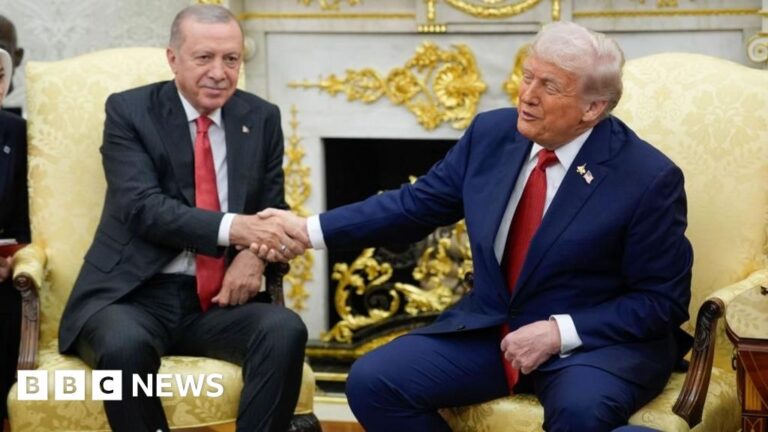
Speaking alongside President Recep Tayyip Erdogan at the White House, Trump said halting those imports would be “the best thing” his Turkish counterpart could do.

The Oval Office meeting ended without any firm commitments to lift US sanctions on Turkey or sell advanced F-35 fighter jets, although Trump expressed optimism about both issues.

Turkey has for years been prevented from buying US F-35s. In 2019 it was expelled from a programme where it produced parts for the warplane after it acquired air defence systems from Russia.

During a brief question-and-answer session alongside Erdogan in the Oval Office on Thursday, Trump said he would like Turkey to stop “buying any oil from Russia while Russia continues its rampage against Ukraine”.

“The best thing he could do is not buy oil and gas from Russia,” Trump said. “If he did that, that would be the best thing.”

Trump added that he believes Erdogan is respected both by Ukrainian President Volodomyr Zelensky and Russian President Vladimir Putin, meaning that he could “have a big influence” on the war “if he wants to”.

Alongside India and China, Turkey is among Moscow’s biggest customers for oil and gas exports, and data shows that the volume of Russian gas that reached Europe through Turkey rose by over 26% earlier this year.

The US president’s comments come just weeks after he said he stood poised to impose tougher sanctions on Russia if Nato countries met conditions that included halting imports of Russian oil.

Earlier this week – during a lengthy speech at the UN General Assembly – Trump also accused Nato allies of “funding the war against themselves” through their purchases of energy from Moscow.

During Trump’s first term in office, the US removed Turkey from the F-35 programme after it purchased S-400 surface-to-air missile systems from Russia.

A US defence bill passed in 2020 included an amendment that prevented Turkey from acquiring F-35s, unless – and only if – the US government is able to certify that it has given up on the Russian S-400.

Some US lawmakers have expressed concerns about the potential sale over Turkish military incursions into Syria and past violations of Greek airspace.

Earlier this week, the bipartisan Hellenic Caucus in the US Congress warned against allowing Turkey to buy F-35s, citing its military co-operation with Russia and a “disregard for international norms and democratic principles”.

In the Oval Office, however, Trump told Erdogan that he would “be successful” with buying the things he would “like to buy”.

“He needs certain things, and we need certain things,” he said. “And we’re going to come to a conclusion. You’ll know by the end of the day.”

In an interview with Fox News on Monday, Erdogan said of the F-35 ban: “I don’t think it is very becoming of a strategic partnership.”

Trump also said that sanctions against Turkey – implemented in 2020 following the S-400 purchase – could be lifted “very soon”.

“If we have a good meeting, almost immediately”, he added.

The meeting between Trump and Erdogan is their second this week, following a brief discussion they had about Gaza at the UN General Assembly, alongside leaders from several Arab and Muslim nations.

In his interview with Fox, Erdogan also accused US ally Israel of committing a “complete genocide” in Gaza and blamed Israeli Prime Minister Benjamin Netanyahu – a position starkly different from Trump’s public remarks.

In the Oval Office on Thursday, however, the US and Turkish presidents avoided public disagreement on the issue. Israel denies it is committing genocide in Gaza.

Client’s Challenge

0


Client Challenge


JavaScript is disabled in your browser.

Please enable JavaScript to proceed.

A required part of this site couldn’t load. This may be due to a browser
extension, network issues, or browser settings. Please check your
connection, disable any ad blockers, or try using a different browser.

German Swimming Federation Criticizes Enhanced Games for Undermining Fairness, Health, and Integrity of Sport

0

By Madeline Folsom on SwimSwam

The German Swimming Federation posted a statement yesterday condemning the Enhanced Games following the news of German Olympian Marius Kusch joining.

The Federation did not mention Kusch by name, but they made their stance on the competition clear.

“The Enhanced Games are diametrically opposed to everything the sport stands for. They mock fairness, health, and the very raison d’être (reason or purpose for existence) of sport by not only tolerating doping but by presenting it as a supposedly autonomous option for self-optimization. The German Swimming Association condemns this in the strongest possible terms.

“For us, fairness, equal opportunities, and the clear rejection of any form of doping are unshakable fundamental values. Athletes — whether active or retired — have a special role model function.

“Anyone who consciously turns away from these values is saying goodbye to our sport of swimming. And: They are exposing themselves to serious health risks that can never be fully foreseen.”

Kusch was the latest in a growing list of athletes to join the Enhanced Games citing monetary benefits of the competition. The inaugural event will be held next May in Las Vegas with $1 million up for grabs for breaking the world record in the 50 free or 100-meter dash. World Records in other events, the 50 free and 100 fly for Kusch, will pay $250,000.

Read the full story on SwimSwam: German Swimming Federation Says “Enhanced Games Mock Fairness, Health, and Reason of Sport”

Sarkozy Sentenced to Five Years in Trial Involving Conspiracy with Libyan Money

0

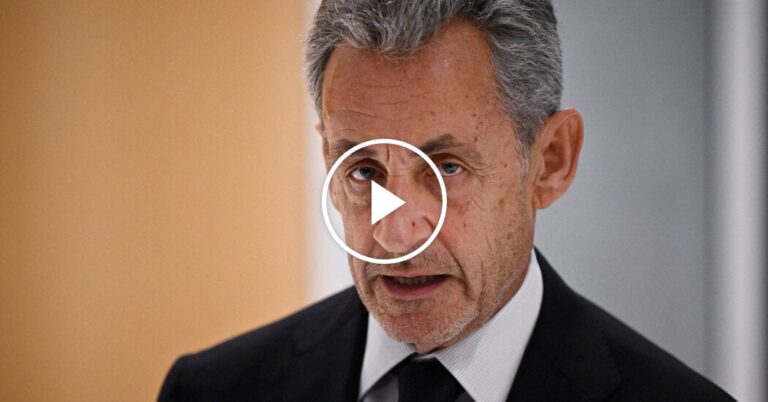
new video loaded: Sarkozy Sentenced to Five Years in Libyan Money Conspiracy Trial

A Paris court found the former French president Nicolas Sarkozy guilty of criminal conspiracy for using money from Col. Muammar el-Qaddafi’s government in his 2007 campaign. The court sentenced him to five years in prison and a fine of about $117,000.

By Nader Ibrahim

September 25, 2025

Promising Big Savings, Airless Wheels for Mining Trucks

0

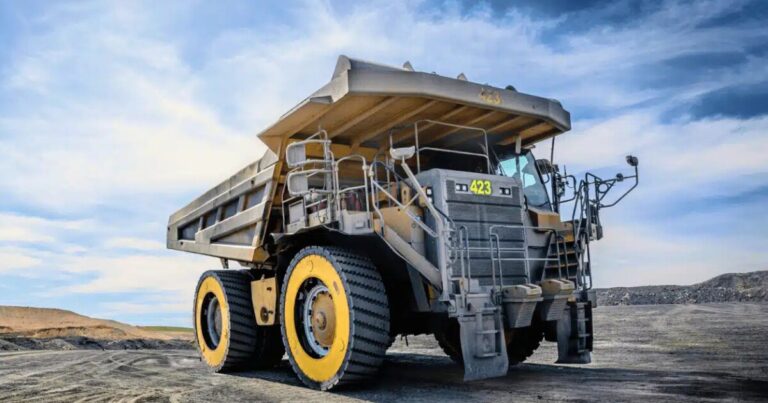
For nearly a decade, a Phoenix, Arizona-based outfit has been working on a smart replacement for the giant rubber tires that go on heavy mining vehicles – think haul trucks, excavators, and bulldozers that can weigh dozens of tons. The descriptively named company, Global Air Cylinder Wheels (GACW), is inching towards a commercial launch of its airless wheels, and it might be on to something big.

The trouble with rubber tires, especially on heavy vehicles that operate in harsh conditions, is that they wear out quickly. In the case of working mining vehicles, that means replacing tires every 6-9 months, and GACW estimates this can work out to as much as US$7 million in tire costs for a single mining truck over its lifetime.

Those tires account for a large amount of the microplastics that end up in oceans worldwide, and many of them aren’t properly recycled. GACW takes a totally different approach to getting these mighty vehicles rolling, that could potentially put less of a strain on the environment while also reducing the cost of operating them.

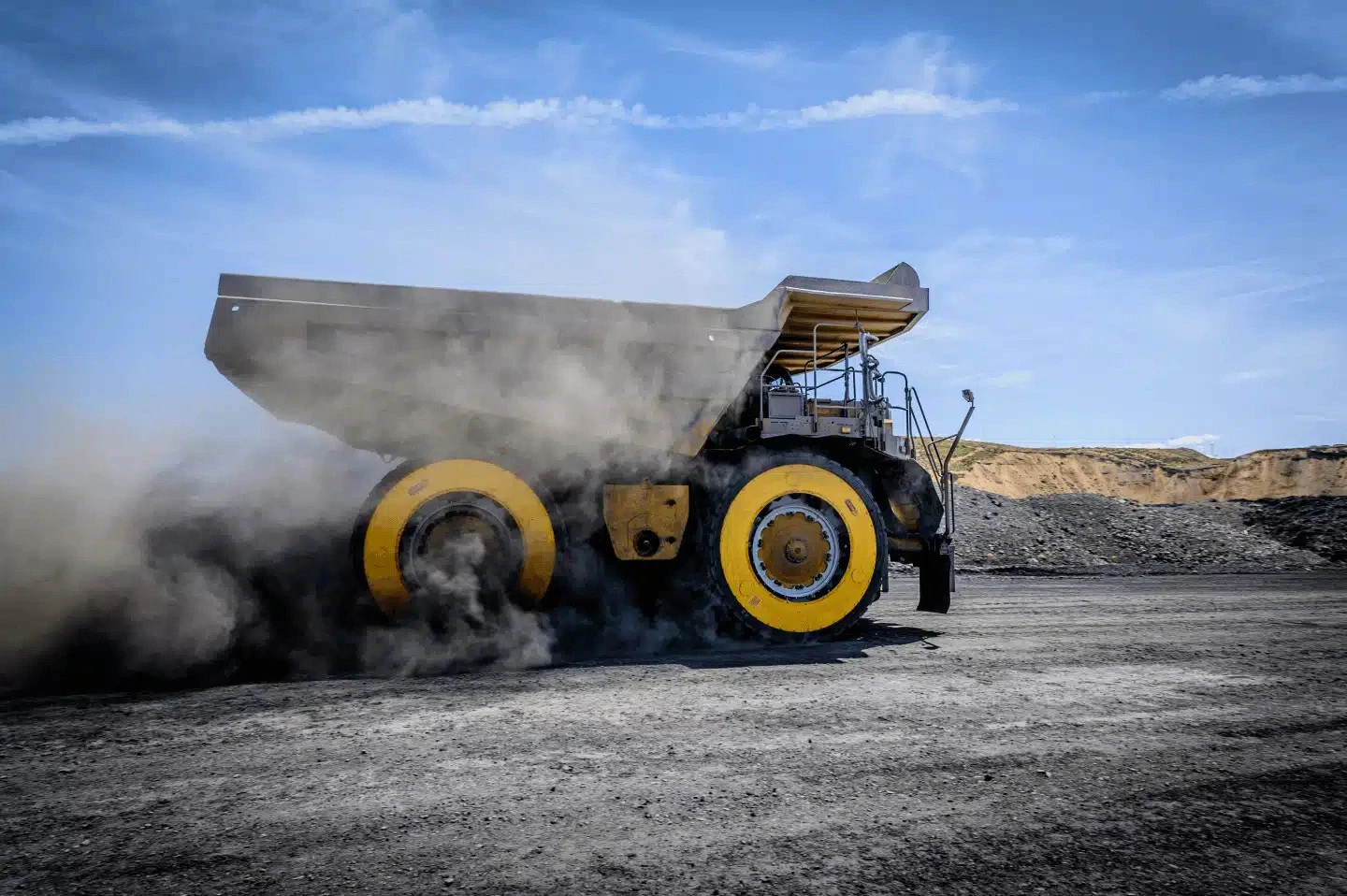
The company’s Air Suspension Wheel (ASW), which has been in the works since 2016, features an inner steel hub connected to an impact-resistant outer steel drum by a bunch of nitrogen-filled cylinders and oil dampers. The cylinders allow for progressively stiffening deflection to dampen vibrations. The outer drum, meanwhile, is wrapped with solid polyurethane or steel treaded ‘shoes’ that are designed to last up to five times longer than regular tires, and to not overheat or deform.

The steel wheels use a polyurethane or steel tread on the outside, which can be replaced without removing the wheel from the vehicle

Global Air Cylinder Wheels

GACW says this makes for a more responsive driving experience, and negates the chance of having to deal with tires blowing out. CEO Harmen van Kamp noted in a recent interview that while the upfront cost of an ASW may be more than a regular rubber tire (the ones that go on a Caterpillar 797F mining truck go for $38,000 each, last time we checked), the total cost of ownership is “ridiculously low,” as ASWs are designed to last as long as the vehicle they’re fitted on, and can be maintained over time with bolt-on parts. The tread, in fact, can be swapped out for a new one without removing the wheel first.

The company says it’s racked up some 75 patents, and has been testing its wheels with promising results in the US, Australia, Chile, and South Africa. It’s raised more than US$7 million thus far, has nearly $6 million in purchase orders, and is currently crowdfunding its next round as it gears up for a commercial launch of its mining truck wheels during the last quarter of 2025.

The wheels feature an inner hub and outer drum made of steel, with nitrogen-filled cylinders for suspension connecting the two

Global Air Cylinder Wheels

GACW says it will make money through royalties from issuing manufacturing licenses to suppliers, as well as selling subcomponents. It also notes that its tech can be applied to cars, bicycles, buses and trucks, and even wheelchairs.

Entering the $262 billion global tire industry means that it will go up against massive incumbents in the business with everything from production to distribution worked out, so GACW will have its work cut out for it taking them on. It’s already raised $1 million through its latest funding campaign, so the firm’s certainly got momentum. Now to see if it can get its airless wheels onto vehicles and keep this ball rolling.

Italy’s stocks finish lower at the end of trading; Investing.com Italy 40 index drops by 0.36%

0


Italy stocks lower at close of trade; Investing.com Italy 40 down 0.36%

Former French President Sarkozy Sentenced to Five Years in Jail

0

NewsFeed

Former French President Nicolas Sarkozy has been jailed for 5 years after being found guilty of criminal conspiracy over alleged funding from Libya for his 2007 election campaign. Al Jazeera’s Natacha Butler was at the court.

Apple is postponing its live translation feature for Europeans due to regulatory obstacles

0

Apple wants the European Union to repeal its digital competition rule book, saying the regulations are cumbersome and are delaying new features for Europeans such as live translation for AirPods.

The European Commission, the 27-nation bloc’s executive branch, said Thursday that’s not going to happen.

“There is absolutely no intention from the Commission’s side to repeal the DMA,” said Commission spokesman Thomas Regnier, referring to the Digital Markets Act.

The iPhone maker outlined its complaints the day before in a response to a consultation on the DMA, a sweeping set of rules designed to stop Big Tech companies from dominating markets.

The company said “the DMA should be repealed” or scaled back, saying it’s undermining innovation and eroding privacy and security.

Apple has long opposed the law and was one of the first companies to be fined after the rules took effect last year, with a 500 million euro ($587 million) penalty in an app store case.

Apple said Europeans are being left behind the rest of the world because it has to spend more time trying to figure out how to get new features to comply with the rule book.

“The DMA requires Apple to make certain features work on non-Apple products and apps before we can share them with our users,” the company said in a blog post. “Unfortunately, that requires a lot of engineering work, and it’s caused us to delay some new features in the EU.”

For example, under the DMA, the live translation feature that Apple unveiled earlier this month for use with AirPods would also have to work with wireless earbuds from other brands. The feature uses an iPhone’s on-device AI to translate when other languages are spoken around the person using them. Apple says it needs more work to make sure conversations, which are processed on the device, stay private if used with non-Apple products.

Other features affected include iPhone Mirroring with Mac computers, and Apple Maps’ Visited Places and Preferred Routes.

Apple also said EU requirements to allow alternative app marketplaces and payment systems onto iOS expose users to security risks such as online scams and malware disguised as games.

And DMA provisions requiring Apple to comply with rivals’ request to access “user data and core technologies” creates “serious risk” for its users, it said.

Apple said it’s complying with the regulations but asked regulators to take a closer look at how they’re affecting Europeans.

At a regular European Commission press briefing in Brussels, Regnier pushed back against Apple’s complaints.

“Nothing in the DMA requires companies to lower their privacy standards, their security standards,” Regnier said. “To the opposite, it’s just about giving our users more choice.”

Fortune Global Forum returns Oct. 26–27, 2025 in Riyadh. CEOs and global leaders will gather for a dynamic, invitation-only event shaping the future of business. Apply for an invitation.