The suspect in the attack on the Church of Jesus Christ of Latter-day Saints in Grand Blanc, Mich., appeared to use a multiple tactics designed to increase chaos and create a “fatal funnel,” according to a security analyst.
Donell Harvin, a homeland security and public health emergency expert at Georgetown University, told CNN on Sunday that the attacker may have conducted pre-operational surveillance and come up with a plan that maximizes fatalities and damage.
“This looks like a relatively new type of what we call hybrid threat where not only you’re vehicle-ramming to maybe get some chaos but you’re also shooting into a crowd—and may have, it seems, potentially started the fire,” he added.
According to local law enforcement, the suspect crashed a pickup truck through the front door of the church, then got out of the vehicle and started shooting with an assault rifle.
Minutes later, police arrived on the scene and shot the man, who died and was later identified as Thomas Jacob Sanford, a 40-year-old from the nearby city of Burton.
The church was also set on fire, and U.S. law enforcement officials told NBC News that as many as three improvised devices were found at the scene. Michigan State Police bomb squad also responded to the attack.
“That all creates chaos,” Harvin told CNN. “It could create what we call a fatal funnel trying to drive people towards one location.”
According to the New York Post, Sanford was a Marine Corps veteran who had served in Iraq. Police have not yet determined a motive or if he was connected to the church.
So far, at least two people have died from the attack, excluding Sanford, and several more are injured. Police said hundreds of people were in the church at the time.
It was the latest attack on houses of worship recently. Earlier this month, a suspect set fire to a synagogue in Florida. In August, two children were killed during Mass at the Church of the Annunciation in Minneapolis. In July, two women were fatally shot at a church in Lexington, Ky.
“PRAY for the victims, and their families. THIS EPIDEMIC OF VIOLENCE IN OUR COUNTRY MUST END, IMMEDIATELY!” Trump wrote on social media on Sunday.
Fortune Global Forum returns Oct. 26–27, 2025 in Riyadh. CEOs and global leaders will gather for a dynamic, invitation-only event shaping the future of business. Apply for an invitation.
Varma hits 69 not out after coming in to bat at 10-2 as India chase 146 in a nervy end to the Asia Cup 2025 in Dubai.
Tilak Varma has held his nerve with an unbeaten innings of 69 runs as he has steered India home in a five-wicket win over Pakistan in a gripping and controversial final of the Asia Cup 2025 in Dubai.
Coming in to bat with India two wickets down for 10 runs in the third over, Varma weathered the storm while wickets fell at the other end as India chased 147 in the politically charged tournament decider on Sunday, after which the champions refused to accept the winner’s trophy from Asian Cricket Council (ACC) Chairman Mohsin Naqvi.
Recommended Stories
list of 3 itemsend of list
It was the third India vs Pakistan match of the tournament and once again, the fixture was marred by controversy as the post-match presentation was delayed by more than an hour due to unexplained reasons as players and tournament organisers waited on the ground.
Once the ceremony got under way, it was revealed by presenter Simon Doull that the Indian cricket team had refused to attend it and would not collect their medals or the Asia Cup trophy, ostensibly from Naqvi, who is also chairman of the Pakistan Cricket Board and Pakistan’s interior minister.
“Indian team refuses to accept Asia Cup winners’ trophy from Pakistan minister and ACC head Mohsin Naqvi,” the Press Trust of India reported after the ceremony concluded.
However, India’s player of the final Varma, top batter Abhishek Sharma and bowler Kuldeep Yadav did walk up to the presentation area to collect their cheques, albeit not from Naqvi.
Minutes later, India captain Suryakumar Yadav and his teammates cheered with a mock trophy as they celebrated their ninth Asia Cup title.
India captain Suryakumar Yadav pretends to hold the Asia Cup trophy as he walks over to his teammates to celebrate winning all their matches in the tournament [Raghed Waked/Reuters]
India’s win was built around their 22-year-old batter Varma’s measured innings, which came off 53 balls and included four sixes and three fours.
The run chase was dented in the second over when their star batter and the tournament’s leading run scorer, Abhishek, was dismissed for five runs by Pakistan’s medium-pace bowler Faheem Ashraf on the first ball of India’s second over. He fell to a mistimed attempt at a six and was caught at mid-on.
Suryakumar followed soon after when Shaheen Shah Afridi dismissed him for one run as the Indian captain hit his fifth ball straight to mid-off, where his Pakistani counterpart, Salman Agha, took a diving catch.
It was then up to Varma and opener Gill to steady the ship for India, but Gill departed nine balls later to Ashraf. Wicketkeeper Sanju Samson chipped in with an innings of 24 off 21 before falling to leg-spin bowler Abrar Ahmed.
New batter Shivam Dube, who had earlier taken on the responsibility of opening the bowling for India in the absence of Hardik Pandya, played a supporting role to Varma’s innings.
While Pakistan bowled well, they were not fully supported by the fielders as two catches were dropped and a crucial run-out chance was missed by wicketkeeper Mohammad Haris, who was slow to remove the bails as Varma dived in.
Varma made Pakistan pay as he and Dube took India on the verge of victory, only for Dube to fall with six balls and nine runs left.
Rinku Singh, who replaced Pandya in the final, faced one ball and hit the winning runs off it to spark celebrations in the Indian camp.
India’s Tilak Varma celebrates his team’s victory against Pakistan at the end of the Asia Cup 2025 final at the Dubai International Stadium [Sajjad Hussain/AFP]
Earlier, Pakistan began their innings brightly as Sahibzada Farhan and Fakhar Zaman gave them an opening stand of 84 before Farhan was dismissed for 57 off 38 in the 10th over.
Zaman (46 off 35) then formed a brief partnership with Saim Ayub, who scored 14 runs, but once they were dismissed, none of the Pakistan batters could post more than nine runs.
The team in green crashed from 113-2 to 146 all out in 38 balls as they finished their innings in 19.1 overs.
Yadav was the pick of the bowlers for India as he picked up four wickets for 30 runs in his four overs. Axar Patel, Jasprit Bumrah and Varun Chakravarthy took a wicket apiece.
Yadav ended the tournament as its leading wicket-taker with 17 while Sharma was the top batter with 314 runs.
Today, MBW unveils the full list of finalists for voted categories at the upcoming Music Business UK Awards.
Taking place on the evening of Tuesday, November 4 in London, the Music Business UK Awards 2025 is presented by MBW in association with the event’s partner, YouTube.
It recognizes success across all areas of the UK music business, with a particular focus on those servicing UK-signed talent.
Our shortlists below have been chosen by a behind-closed-doors panel of music business leaders, participants, and experts.
Voting will commence in early October, across a wider panel of industry experts.
In addition to our voted categories, the Music Business UK Awards 2025 will also present several special awards.
These will include International Executive Of The Year, supported by PRS For Music, which will be collected by a non-British executive who has gone above and beyond for UK and Irish talent in the past 12 months.
Other tentpole awards will include the Trailblazer: Richard Antwi Award and the night’s closer, The Sir George Martin Award.
Two new awards are being introduced in 2025: Breakthrough Artist Manager Of The Year (decided by a closed panel) and Business Manager of the Year (voted).
Diamond tables for the awards have now completely sold out.
Sarah Rainsford, Eastern and Southern Europe correspondentIn Chisinau and
Paul KirbyEurope digital editor in London
Anadolu via Getty Images
Moldovan President Maia Sandu warned voters their democracy was young and fragile and Russia endangered it
Moldovans have voted in parliamentary elections seen as critical for their future path to the European Union amid allegations of “massive Russian interference” before the vote.
The claims, first made by Moldova’s security forces, were repeated by pro-EU President Maia Sandu, who told reporters outside a polling station in the capital Chisinau the future of her country, flanked by Ukraine and Romania, was in danger.
Partial results will emerge in the coming hours, and the electoral commission said turnout was just over 52% – higher than in recent years.
Two political forces are seen as almost neck and neck in the race: Sandu’s Party of Action and Solidarity (PAS) and the pro-Russian Patriotic Electoral Bloc.
Another important factor is the more than 270,000 voters who turned out in the largely pro-Western diaspora. In a measure of the tension surrounding the vote, bomb scares were reported at polling stations in Italy, Romania, Spain and the US.
Similar scares were reported in Moldova itself.
Moldova also has a pro-Russian breakaway enclave called Transnistria along its border with Ukraine, complete with a Russian military presence.
Residents in this sliver of land have Moldovan passports but they have to cross the Dniester river to vote. Many are strongly pro-Moscow and one of the leaders of the Patriotic Electoral Bloc, Igor Dodon, said there had been “all sorts of harassment, stopping them from voting”.
Sarah Rainsford reports from Moldova’s administrative border with Transnistria
Moldovans have been buffeted by Russia’s full-scale war in neighbouring Ukraine, but they are also grappling with spiralling prices and high levels of corruption.
President Sandu, 53, won a second term of office last November and warned Moldovans the future of their democracy was in their hands: “Don’t play with your vote or you’ll lose everything!”
If her PAS party loses its majority in the 101-seat parliament, it will have to look for support from two of the other parties expected to get into parliament, the Alternativa bloc or the populist Our Party.
Socialist leader Igor Dodon, who is one of President Sandu’s main rivals, went on national TV as soon as polls closed to claim his pro-Russian allies in the Patriotic Electoral Bloc had won the election, despite there being no exit polls and before any early results were declared.
Thanking Moldovans for voting “in record numbers”, he called on the PAS government to leave power, and for supporters of all opposition parties to take to the streets on Monday to “defend” their vote outside parliament at midday.
“We will not allow destabilisation,” he promised. “The citizens have voted. Their vote must be respected even if you don’t like it,” he added, addressing President Sandu and her party.
One of the parties in Dodon’s bloc was barred from running two days ago because of alleged illicit funding.
In the run-up to the vote, police reported evidence of an unprecedented effort by Russia to spread disinformation and buy votes. Dozens of men were also arrested, accused of travelling to Serbia for firearms training and co-ordinating unrest. A BBC investigation uncovered a network promising to pay participants if they posted pro-Russian propaganda and fake news.
Parties sympathetic to Moscow rejected the police claims as fake and a show – created by the government to scare people into supporting them. Russia’s embassy in the UK rejected the BBC’s allegations, accusing Moldova and its “Western sponsors” of seeking to divert attention from Chisinau’s “internal woes”.
Inside all the polling stations visited by the BBC a small camera had been placed on a tripod overlooking the transparent ballot boxes.
Election monitors said they were recording everything, to be checked if there were any reports of violations.
Dan Spatar, who was at one polling station in the capital with his young daughter said he was choosing a European future over a Russian past: “We voted for this four years ago and deserve to continue with it. We see what happens every day in Ukraine and we worry about that.”
Marina said she was voting “for peace in Moldova, for a better life, for growing our economy” and felt it would be very hard for her country to continue its path to Europe with a pro-Russian government.
At the edge of Moldova’s separatist enclave of Transnistria on Sunday, a long queue of cars waited to cross the river to register their vote at 12 polling stations opened beyond the administrative border, some of them more than 20km (12 miles) away.
The number of voters was down on recent years, at just over 12,000, an indication of the struggle many faced.
Moldovan police checked documents and car boots before letting them pass. Most cars had several people inside, often whole families.
By mid-afternoon, the queue stretched into the distance beyond a kiosk with a Soviet-style hammer-and-sickle emblem on top, and the green-and-red striped flag of Transnistria.
Speaking to drivers, most seemed unconcerned by the inconvenience, and the atmosphere was relatively relaxed.
One man told the BBC in Russian that he was voting for change because the PAS government had “promised paradise and delivered nothing”. No-one would be more specific than that, insisting their voting preference was “secret”.
A required part of this site couldn’t load. This may be due to a browser
extension, network issues, or browser settings. Please check your
connection, disable any ad blockers, or try using a different browser.
new video loaded: Inside Venezuela After U.S. Strikes Boats
The United States has blown up several boats in the Caribbean Sea and is now increasing its military presence off the coast of Venezuela. Julie Turkewitz, reporting from Caracas, explains how Venezuelans are reacting.
On Friday, the San Diego State women defeated the University of San Diego women in a dual meet featuring off-distance events with a score of 81-67.
Only eight events were contested on the day: the 200 medley relay, 150 freestyle, 150 butterfly, 150 backstroke, 150 breaststroke, 400 freestyle, 300 IM, and 200 free relay.
The SDSU women swept 1-2-3 in all of the individual events minus the 400 free, dominating the field throughout the session.
USD’s team of Penelope Leonard (28.41), Elise Sullivan (31.28), Ava Delaney (26.19), and Ally Diehl (24.70) hit the wall in 1:50.31 for third.
SDSU sophomore Allison Mann won the 150 free by just under a second at 1:21.03, as teammates junior Nyiradi (1:22.01) and freshman Melanie Quinto (1:23.10) followed right behind. Nyiradi led through the first 100 by a few tenths, but Mann blasted home in 27.93 to Nyiradi’s 28.98 to grab a decisive victory.
Mann tripled up with two more wins, with the first coming in the 150 fly. She took an early lead, holding just under a two-second cushion at the 100. Her teammate, Sevin, charged home in 31.52 to Mann’s 32.95 to nearly clip her at the finish, ultimately falling 0.55 short at 1:31.58 to Mann’s 1:31.03. Freshman Sierra Tallman notched 1:32.83 for third.
Mann logged 4:04.32 to win the 400 free over USD freshman Sydney Wilson. She swam stroke for stroke with Wilson until the final 50, where she split 29.14 to Wilson’s 29.81 to win by just under a second. Mann’s sophomore teammate Bispo was not far behind at 4:05.46. Bispo had the lead after the first 50 and stayed within striking distance the rest of the way, lurking just a few tenths behind the leaders.
The 150 back saw senior Abby Storm clear the field from the very first stroke with the only sub-1:30 outing of 1:29.79. The sophomore duo of Peebles (1:31.07), who helped the medley relay win earlier in the session, and Alex Downing (1:32.98) were the next quickest to the wall.
Senior Moa Bergdahl and the aforementioned Black were in a tight battle in the 150 breast, with Black taking the lead by four tenths at the 50 turn before taking a two-tenth lead at the 100. Bergdahl ultimately closed three tenths swifter to take the win at 1:40.07, with Black touching the wall at 1:40.63 for runner-up status. Sophomore Elisa Branca took a comfortable third in a time of 1:44.02.
Nyiradi secured the final individual win of the meet in the 300 IM with a time of 3:13.31, well clear of the field. Black (3:19.62) and Branca (3:19.72) were in a deadlocked battle for second and third for most of the race.
The Aztecs ended the day with a sweep of the 200 free relay, with the ‘A’ team of Nyiradi (24.95), Bispo (23.75), Mann (23.35), and Reed (24.46) stopping the clock at 1:36.51 to seal the victory. The ‘D’ team of Peebles (24.72), Black (24.93), Sevin (24.82), and Schiller (23.27) finished at 1:37.74, while the ‘B’ team of Grace Mering (25.89), Quinto (24.04), Amber Janky (24.44), and Masen Karsten (24.51) hit the wall in 1:38.88.
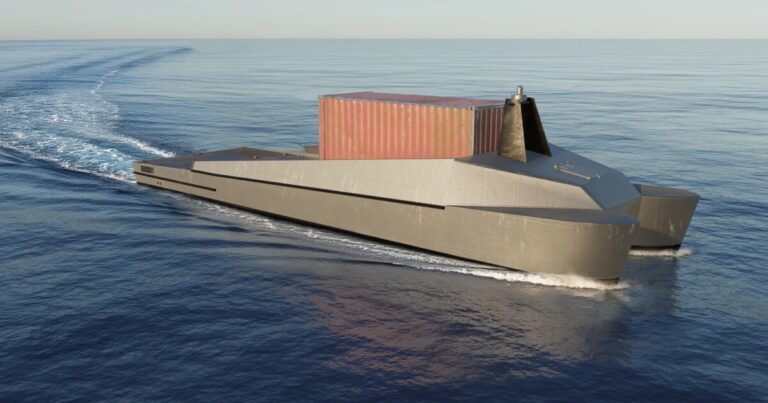
It may resemble a minimalist aluminum catamaran with Cybertruck overtones, but BlackSea Technologies’ Modular Attack Surface Craft (MASC), being offered to the US Navy as a multi-mission autonomous warship, has more to it than meets the eye.
Autonomous boats, ships, submarines, and miscellaneous watercraft for naval service have been popping with a certain regularity in recent years, with many of them retrofitted into commercial hulls or built along the lines of conventional warships. However, The BlackSea MASC shows what can be done when autonomy is fully embraced.
Based on the company’s Global Autonomous Reconnaissance Craft (GARC), with which it shares a 75% commonality, the MASC is designed to meet or exceed the Navy’s requirements for large and medium-sized Unmanned Surface Vessels (UAV) as set down in its July 2025 solicitation for designs. This includes using the Navy’s Unmanned Maritime Autonomy Architecture (UMAA) to make it a plug-and-play modular design.
The MASC
BlackSea Technologies
The result is what seems to be a cross between a catamaran and a giant fishing pontoon with a large open deck measuring 900 ft² (83 m²) that can handle standard shipping containers weighing up to 30 tonnes. Below deck, the power plant can crank out 198 kWe for sensors and weapon systems – that’s twice the payload space and electrical power of a comparable autonomous vessel.
What all this means is that it’s very easy to modify the MASC for specific missions simply by bolting a suitable container or module to the deck and hooking up the power. Currently, the craft is geared toward seven different missions, including Anti-Submarine Warfare (ASW), Anti-Surface Warfare (ASuW), electronic warfare, Intelligence, Surveillance, and Reconnaissance (ISR), logistics, infrastructure monitoring, combat strikes, and mine warfare.
To aid in carrying these out, the MASC has two thin hulls for seakeeping and speed. The dual Volvo Penta D8-IPS600 integrated propulsion units give it a top speed of 25 knots (46.3 km/h, 28.8 mph), an endurance speed of 10 knots (18.5 km/h, 11.5 mph) and an operational range of 3,000 nautical miles (3,452 miles, 5,556 km), with a 10,000-nautical-mile (11,507-mile, 18,520-km) extended self-deployment range.
“Our approach starts with the mission, not the platform,” said Todd Greene, Deputy Director of Advanced Technology at BlackSea. “We designed a flexible, modular combatant that can evolve with the Fleet and be built at scale today, not years from now.”
A year on from Israel’s assassination of Hassan Nasrallah, reports say Hezbollah, the Lebanese group he led, is regrouping.
Analysts believe that while a weakened Hezbollah can no longer pose a significant threat to Israel, it can still create chaos and challenge opponents domestically as it tries to find a political footing to preserve its clout.
Recommended Stories
list of 3 itemsend of list
Long viewed as the strongest nonstate armed actor in the region, Hezbollah found its star waning in the past year, culminating in an international and domestic push for it to disarm entirely.
Handled recklessly, analysts believe, pressures to disarm the group could lead it to lash out and create internal strife that could outweigh international and regional pushes.
Hezbollah’s rhetoric remains defiant, and it has promised to reject Lebanese government efforts to disarm it – as its current leader, Naim Qassem, reiterated on Saturday to a crowd of thousands of people who had gathered at Nasrallah’s tomb to commemorate his assassination.
“We will never abandon our weapons, nor will we relinquish them,” he said to the crowd, adding that Hezbollah would continue to “confront any project that serves Israel”.
No action yet
Hezbollah started trading attacks with Israel on October 8, 2023, the day after the latter launched its war on Gaza. This continued until September 2024 when an Israeli military intensification and subsequent invasion killed about 4,000 people in Lebanon, injured thousands more and displaced hundreds of thousands.
By the time a ceasefire was announced on November 27, much of Hezbollah’s senior military leadership, including Nasrallah, the group’s secretary-general, had been killed by Israel.
The terms of the ceasefire were poorly defined, according to diplomatic sources with knowledge of the agreement, but the public understanding was that both sides would cease attacks, Hezbollah would disarm in southern Lebanon and Israel would withdraw its forces from the south. But soon after, Israel and the United States argued that Hezbollah must disarm entirely.
Seeing it weakened, Hezbollah’s domestic and regional opponents began calling for the group to give up its weapons. Sensing the changing regional winds, many of Hezbollah’s domestic allies jumped ship and voiced support for full disarmament.
The Lebanese government, under pressure from the US and Israel, announced on September 5 that the Lebanese armed forces have been tasked with forming a plan to disarm Hezbollah.
In the meantime, Israel has continually violated the ceasefire, bombing southern Lebanon. UNIFIL, the UN peacekeeping force in the south, said Israel is committing “continuous violations of this [ceasefire] arrangement, including air and drone strikes on Lebanese territory”.
Despite media speculation that Hezbollah is regrouping in southern Lebanon, particularly in anti-Hezbollah media outlets, it has only claimed one attack since the ceasefire was announced in November.
Analysts believe Hezbollah is no longer in a position to threaten Israel, meaning that any decision by the latter to expand attacks in Lebanon would be for considerations other than Hezbollah’s current capabilities.
Hezbollah and its supporters argue that Israel’s threats and continued violations as well as its continued presence occupying five points on Lebanese territory justify the need for resistance.
“The continued existence of a real threat justifies the maintenance of deterrence and defence capabilities because deterrence is not a one-time event but rather a cumulative process that requires a stable and integrated power structure within a broader political context,” Ali Haidar, a columnist with the pro-Hezbollah newspaper Al-Akhbar, wrote recently.
Al Jazeera reached out to Hezbollah for comment but did not receive a response before publication.
What does ‘regrouping’ mean?
“No military or political military force [will not] regroup after suffering a major defeat as [Hezbollah] did last year,” Michael Young, a Lebanese analyst and writer, said.
“But are they in a position to mount rockets and bomb northern Israel along the border? No. Are they in a position to fire missiles at towns and cities? No.
“So what does [regrouping] mean?”
Lebanese political scientist Imad Salamey told Al Jazeera: “Hezbollah is significantly degraded – leadership attrition, [communications] penetrations and blows to command and control have been real. They will try to recover, but the plausible path is a smaller, cheaper, more agile Hezbollah.
“Israeli assessments themselves note both the damage done and Hezbollah’s attempts to regenerate via smuggling/self-production under intense intelligence pressure, suggesting any rebound will be partial and tactical rather than structural in the near term,” Salamey added.
In early December, the regime of Hezbollah ally Bashar al-Assad was toppled in Syria, another blow to the group, as it cut off a direct land route for weapons and financing to reach the group from Iran.
In the meantime, however, analysts said Hezbollah has been trying to use its remaining leverage through diplomacy, even sending signals to longtime foes like Saudi Arabia.
“We assure you that the arms of the resistance are pointed at the Israeli enemy, not Lebanon, Saudi Arabia or any other place or entity in the world,” Qassem said in a speech on September 19.
The message to Saudi Arabia, which has previously funded Hezbollah’s opponents in Lebanon, is part of a shift in the group’s strategy, analysts said.
“There’s a hint that they feel they can deal with things politically,” Young said. “They may feel they don’t need to resort to force or weapons if they can get more out of the system.”
It is also a reflection of the new political reality in Lebanon and the region, where Israel and the US have ascended in power and Iran, Hezbollah’s close ally, has faltered.
“Hezbollah is starting to realise that it is entrapped,” Lebanese political analyst Karim Emile Bitar told Al Jazeera.
Before the war, Hezbollah had the ability to make or break governments. But President Joseph Aoun and Prime Minister Nawaf Salam were elected in early 2025 despite neither being Hezbollah’s preferred candidate.
Still, Hezbollah was either unwilling or unable to disrupt the formation of Salam’s government. Analysts said the group is in dire need of foreign aid that the government could secure to help rebuild its constituencies damaged by Israeli attacks.
But that money has yet to arrive as there is regional and domestic debate over whether the government should receive reconstruction funds before Hezbollah’s disarmament and other banking or political reforms.
Analysts and diplomats told Al Jazeera Hezbollah is still capable of raising tensions but has avoided fanning any flames due to the Lebanese state’s rising support as well as the fatigue and trauma Hezbollah members and supporters have due to last year’s war and continuing Israeli attacks on Lebanon.
Still, on Thursday, Hezbollah supporters flocked to Beirut’s seaside in remembrance of Nasrallah. Supporters projected their late leader’s image onto the Raouche Rocks, defying orders from the prime minister’s office that banned the act.
The event was seen as an expression of love for Nasrallah by his supporters and a provocation by Hezbollah’s opponents. But the group, which has threatened violence to get its way in the past, has largely avoided provocations since the war, apart from occasional attempts to block roads that were quickly reopened by the Lebanese military.
If Hezbollah is pursuing military regrouping, a senior Western diplomat with knowledge of the issue said, it would be more likely in the Bekaa Valley than in the south, where the ceasefire mechanism had been largely effective at supervising Hezbollah’s withdrawal.
The group, however, does appear to be altering its political strategy, Young said, adding that Hezbollah, via instructions from Iran, may eventually be looking for certain compromises.
He pointed out proposals by parliamentarians Ali Hassan Khalil, a Hezbollah ally, and Ali Fayyad, a Hezbollah MP, in their subcommittees, where they spoke about implementing the 1989 Ta’ef Accord, an agreement that ended the civil war, declared all militias should give up their arms and Lebanon should transition to a nonsectarian system of power.
“Their implicit point is that ‘If we implement Ta’ef in its entirety, then that can give us a greater role with better representation, and then we can talk about weapons,’” Young said.
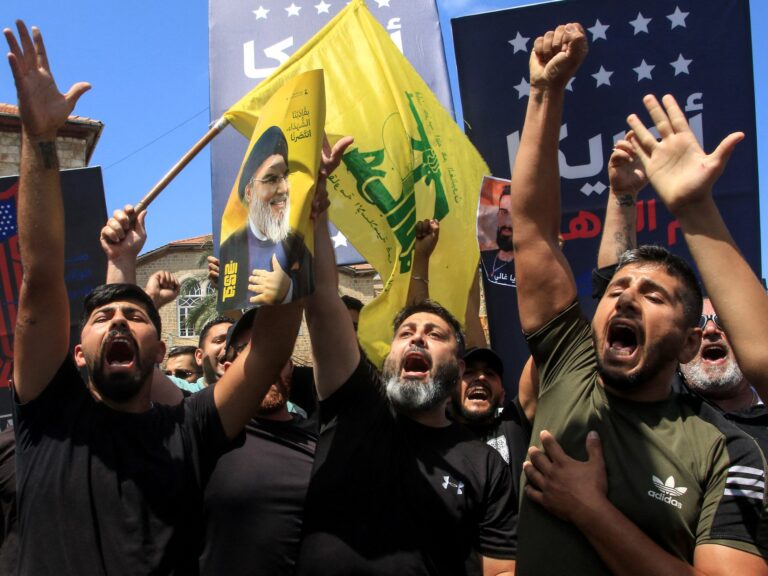
Hezbollah supporters hold pictures of longtime leader Hassan Nasrallah in Beirut’s southern suburbs on September 27, 2025, during a ceremony marking the first anniversary of his assassination by Israel [AFP]
‘Time for Hezbollah to go’?
Amid the intensifying pressure to disarm Hezbollah, analysts and diplomats fear that if pressed too hard, the group could lash out.
The US has announced a $14.2m aid package for the Lebanese military to help it disarm Hezbollah, and visits by US officials – including Republican Senator Lindsey Graham, deputy special envoy Morgan Ortagus and special envoy Tom Barrack – have intensified pressure on Lebanon.
“It’s time for Hezbollah to go,” Graham said during his visit in late August.
But Lebanon’s military has rejected setting a strict timetable for Hezbollah’s disarmament over fears the tense situation in Lebanon could descend into violence.
Special envoy Tom Barrack has been part of a US contingent applying pressure on Lebanon to disarm Hezbollah [AFP]
And news of the US aid has been received poorly in parts of Lebanon, where it is seen as part of a US effort to use Lebanon’s military to execute Israeli interests.
“[The Lebanese army] will never serve as a border guard for Israel. Its weapons are not weapons of discord, and its mission is sacred: to protect Lebanon and the Lebanese people,” Parliament Speaker Nabih Berri, who is a Hezbollah ally, said in a statement on Tuesday.
The fears of diplomats and analysts are that a confrontation between the army and Hezbollah could lead to internal strife and a potential fracturing of the army along confessional lines – similar to what happened in the early days of the 1975-1990 Lebanese Civil War.
“[Disarming Hezbollah by force] is the worst possible option, but obviously, this is how the Americans are increasingly pressuring the Lebanese government to resolve this,” Young told Al Jazeera.
“The Lebanese army is not willing to resolve it through the use of force because they don’t want to be pushed into conflict with Hezbollah.”