0.6 C
New York
Thursday, February 26, 2026
Home Blog Page 333

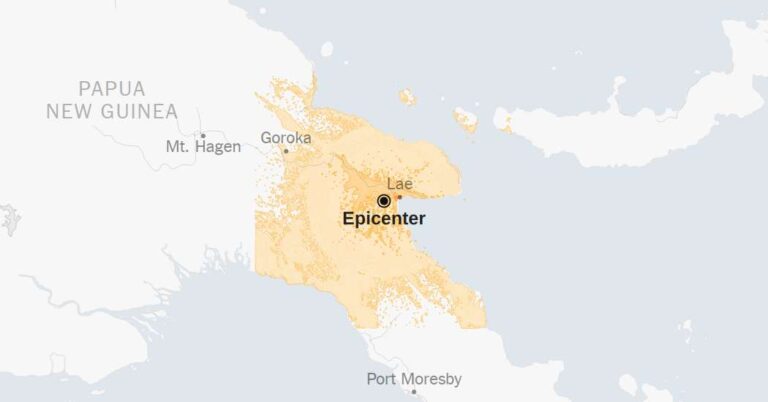
Map shows epicenter of 6.6-magnitude earthquake in Papua New Guinea

0

Note: Map shows the area with a shake intensity of 4 or greater, which U.S.G.S. defines as “light,” though the earthquake may be felt outside the areas shown.  All times on the map are Papua New Guinea time. The New York Times

A strong, 6.6-magnitude earthquake struck in Papua New Guinea on Tuesday, according to the United States Geological Survey.

The temblor happened at 9:05 p.m. Papua New Guinea time about 16 miles southwest of Lae, Papua New Guinea, data from the agency shows.

As seismologists review available data, they may revise the earthquake’s reported magnitude. Additional information collected about the earthquake may also prompt U.S.G.S. scientists to update the shake-severity map.

Source: United States Geological Survey | Notes: Shaking categories are based on the Modified Mercalli Intensity scale. When aftershock data is available, the corresponding maps and charts include earthquakes within 100 miles and seven days of the initial quake. All times above are Papua New Guinea time. Shake data is as of Tuesday, Oct. 7 at 7:24 a.m. Eastern. Aftershocks data is as of Tuesday, Oct. 7 at 9:36 a.m. Eastern.

Maps: Daylight (urban areas); MapLibre (map rendering); Natural Earth (roads, labels, terrain); Protomaps (map tiles)

PULSE Music Group and Mark Ronson’s Zelig Music Join Forces in Publishing Venture

0

Los Angeles-based PULSE Music Group has teamed up with Mark Ronson’s Zelig Music to form a joint venture focused on music publishing.

Swedish artist-producer Thea Gustafsson, known professionally as Becky and the Birds, is their first signing. Gustafsson secured a worldwide publishing deal through the partnership.

Gustafsson studied at Musikmakarna Songwriters Academy of Sweden after training as a violinist in childhood. She handles writing, recording, and production duties under her stage name. This year, she secured four nominations at the Swedish Grammis awards, including Album of the Year and Alternative Pop Record of the Year for Only Music Makes Me Cry Now, plus Newcomer of the Year. She won Producer of the Year.

The joint venture reunites PULSE co-CEO Josh Abraham with Ronson, whom he’s known since the 1990s New York club scene. Ronson founded Zelig Records in 2018 as a joint venture with Sony Music. Its clients include King Princess, Eli, Tiberius b, Raissa and Issy Wood.

Abraham said: “I have known Mark since the early 90’s in the New York club scene and Brandon [Brandon Creed, Good World Management] back since his A&R days. Recently, I was talking to Brandon and we knew the timing was right for this joint venture.”

Working together to help launch the next generation of talent, our JV platform provides a creative community that these songwriters/producers will thrive in.”

Josh Abraham, Pulse music group

Added Abraham: “Mark is an exceptional partner that knows how to cultivate culture-defining moments for songwriters, producers, and artists. He has a lot of integrity, creativity, and is effective in the way that he works to build the careers for others. Working together to help launch the next generation of talent, our JV platform provides a creative community that these songwriters/producers will thrive in. We’re thrilled to be in partnership with Zelig and to welcome Becky and the Birds to the PULSE Music Group / Zelig Music family.”

The deal marks another venture for Ronson, whose production credits span some of pop music’s most popular records over the past three decades. The nine-time Grammy, Academy Award, and Golden Globe-winning producer and songwriter produced Amy Winehouse‘s Back to Black, and Bruno Mars’ global smash hit Uptown Funk. His work on Shallow for A Star Is Born brought him an Oscar, Golden Globe and Grammy Award. Ronson has also worked with artists like Lady Gaga, Adele, Paul McCartney, Miley Cyrus, and Dua Lipa.

“I’ve been a fan of Josh as a producer since I was a teen. I’m so excited to discover and develop some incredible talent together.”

Mark Ronson, Zelig Music

In 2020, Ronson sold a 70% stake in the publishing and writer’s share interest in his catalog which comprises 315 songs to Hipgnosis Songs Fund.

More recently, Ronson served as executive producer for Barbie The Album and its score in 2023, earning another Grammy. He executive produced SNL50: The Homecoming Concert with Lorne Michaels earlier this year.

Ronson’s influence extends beyond the recording studio. His memoir Night People: How to Be a DJ in ’90s New York City reached the New York Times bestseller list and Sunday Times Top 10 following its September release. Brad Pitt‘s production company Plan B acquired film rights to the book.

The joint venture will be managed by teams from both companies. At PULSE, Abraham works alongside co-CEO Scott Cutler, President Ashley Calhoun, Senior Vice President/Head of Creative Annie Aberle, and Senior Director of Creative Quinn Slattery. Rachel Helman serves as General Manager of Zelig Music and will oversee A&R for the partnership. Gustafsson is managed by Alyssa DeBonis of Moth Management.

Commenting on the partnership, Ronson said: “I’m so in admiration of what PULSE has built. And I’ve been a fan of Josh as a producer since I was a teen. I’m so excited to discover and develop some incredible talent together. Becky and the Birds couldn’t be a better artist/producer example to start with.”

Music Business Worldwide

Japanese football official receives sentence for viewing child pornography images | Soccer News

0

Masanaga Kageyama was on a flight to Chile for the Under-20 World Cup when the crew raised the alarm.

A senior Japanese Football Association official has been sentenced to an 18-month suspended jail term in France for “viewing child pornography images” during a plane journey.

Masanaga Kageyama, the association’s technical director, was arrested during a stopover at Charles de Gaulle airport in Paris on the way to Chile last week, according to Le Parisien newspaper.

Recommended Stories

list of 4 itemsend of list

It is believed he was heading to Chile for the Under-20 World Cup.

“The facts were discovered by the plane’s flight crew, who raised the alarm after noticing that the convicted man was viewing child pornography images on the plane,” the court prosecutor’s office in Bobigny, north of Paris, said on Tuesday.

The court sentenced the 58-year-old on Monday to a suspended jail term of 18 months and a fine of 5,000 euros ($5,830) for importing, possessing, recording or saving pornographic images of a minor below the age of 15.

His sentence includes a ban on working with minors for 10 years and a ban on returning to France for the period.

Kageyama will also be added to the French national sex offenders’ register.

Le Parisien reported that flight attendants caught him viewing the images on his laptop in the business class cabin of an Air France flight.

He claimed to be an artist and insisted the photos had been generated by artificial intelligence.

During his court appearance, the report said, Kageyama admitted viewing the images, saying he did not realise it was illegal in France and that he was ashamed.

He was held in police custody over the weekend until his court appearance on Monday. He was released after the hearing.

Kageyama is responsible for implementing measures to strengthen Japan’s football teams, including the national team, as well as educating coaches and nurturing youth players.

He was a professional J-League footballer himself and also coached several J-League clubs. He had also managed Japan’s under-20, under-19 and under-18 teams.

Challenging the Client

0


Client Challenge


JavaScript is disabled in your browser.

Please enable JavaScript to proceed.

A required part of this site couldn’t load. This may be due to a browser
extension, network issues, or browser settings. Please check your
connection, disable any ad blockers, or try using a different browser.

Man on trial shoots Albanian judge dead in court

0

A judge in Albania has been shot dead after a man opened fire during a trial at the Court of Appeal in the capital Tirana.

Judge Astrit Kalaja died en route to hospital, officials said, while two others involved in the hearing over a property dispute – a father and son – were shot but sustained injuries that were not life-threatening.

Police said they had arrested a 30-year-old male suspect who they identified by the initials “E Sh”, but Albanian media have named as Elvis Shkëmbi.

Albania’s Prime Minister Edi Rama offered his condolences to Judge Kalaja’s family, adding: “The criminal aggression against the judge undoubtedly requires the most extreme legal response toward the aggressor.”

He also called for stricter security within the country’s courts and harsher punishments for the illegal possession of weapons.

Sali Berisha, leader of the opposition Democratic Party, said Judge Kalaja’s murder was the first time in 35 years a judge had been killed “while doing his duty”, adding: “Today is the day for a deep reflection by all Albanian society.”

The suspect in Judge Kalaja’s killing had opened fire because he expected to lose the case, according to local media reports.

Mr Shkëmbi’s uncle and the court’s security guard have also reportedly been arrested over the shooting.

Albania’s general prosecutor Olsian Çela said in the wake of the incident that the security of judges needed enhancing “in every respect”.

“Beyond the heartbreaking loss of one life and the injury of two others, this event strikes at the very foundation of justice and the functioning of the legal system,” he said.

Firearm attacks on judges in the courtroom are rare but they do happen. A decade ago, a judge in Milan’s Palace of Justice was shot and killed by a man on trial in a bankruptcy case.

The gunman also killed a lawyer and his co-defendent before escaping, but was later arrested.

Judge Kalaja was a lawyer for more than 30 years. He initially worked in a district court before being appointed to Tirana’s Court of Appeal in 2019.

Among Balkan nations, Albania had the highest number of firearm incidents linked to public disputes in the first six months of this year, according to a UN-backed regional monitor.

Between January and June, there were 43 instances in which a firearm was involved in a public dispute in Albania, out of a total of 213 firearm-related incidents.

However, that is less than the number recorded in the same period last year, and less than the number of incidents reported in Kosovo, Montenegro, and Bosnia and Herzegovina in the first half of 2025.

Goldman Sachs increases its gold price prediction to $4,900 by the end of 2026

0


Goldman Sachs raises its gold price target to $4,900 by end-2026

Scientists reveal the impact of glioblastoma on the skull

0

For the first time, scientists have detailed how a deadly brain cancer has a unique path of progression, aggressively eating away at the skull itself – and how drugs to impede this end up making it worse.

Researchers at Albert Einstein College of Medicine and Montefiore Einstein Comprehensive Cancer Center (MECCC) made their discovery looking at two different types of glioblastomas in mice. Further investigation of human brain scans found that skull thickness had been altered by the tumors, particularly where bones fuse.

“Our discovery that this notoriously hard-to-treat brain cancer interacts with the body’s immune system may help explain why current therapies – all of them dealing with glioblastoma as a local disease – have failed, and it will hopefully lead to better treatment strategies,” said corresponding author Jinan Behnan, an assistant professor at Albert Einstein College of Medicine.

Glioblastoma, the most common type of brain cancer, is particularly aggressive, with less than 7% of patients living beyond five years after diagnosis. In adults, the median survival rate is just 14.6 months.

The researchers found that, in the mice, the erosion of the skull increased the number and size of skull-to-bone channels present, which they believed could be allowing tumor cells to impact marrow, affecting the body’s immune system. Through single-cell RNA sequencing, the team indeed saw that glioblastoma upended the skull bone marrow’s environment – filling it with pro-inflammatory neutrophils while decimating cancer-fighting antibody-producing B cells.

“The skull-to-brain channels allow an influx of these numerous pro-inflammatory cells from the skull marrow to the tumor, rendering the glioblastoma increasingly aggressive and, all too often, untreatable,” said study co-author E. Richard Stanley, professor of developmental and molecular biology at Albert Einstein College of Medicine. “This indicates the need for treatments that restore the normal balance of immune cells in the skull marrow of people with glioblastoma. One strategy would be suppressing the production of pro-inflammatory neutrophils and monocytes while at the same time restoring the production of T and B cells.”

Until now, treatment has generally considered glioblastoma a localized cancer, rather than a systemic disease. Further evidence that suggests it’s not local is that it affects genes in the skull marrow differently to those in femur marrow, suppressing some that boosted inflammatory cells and suppressing others that muted their ability to make immune cells.

The researchers then administered the anti-osteoporosis drugs zoledronic acid and denosumab to the mice, to see if they would also prevent skull-bone loss as well as affect the glioblastoma. Both stopped bone loss, but zoledronic acid also accelerated growth in one type of tumor. And both blocked the positive effects of the immunotherapy drug anti-PD-L1, which ordinarily boosts the production and activity of tumor-fighting T cells.

While early days, the discovery advances our knowledge on just why current treatments for glioblastoma have a low success rate and opens the door to new non-localized approaches in tackling this deadly brain cancer.

The study was published in the journal Nature Neuroscience.

Source: Albert Einstein College of Medicine

The Journey of a Hostage Towards Healing and Advocacy

0

new video loaded: One Hostage’s Path to Healing and Advocacy

Emily Damari spent 471 days in captivity in Gaza. Since being released, Ms. Damari, a British Israeli, has become a symbol of resilience and a voice for the release of all remaining hostages held by Hamas. Avishag Shar-Yashuv, a photographer for The New York Times, has been following Ms. Damari’s journey.

By Avishag Shaar-Yashuv, Nikolay Nikolov and Stephanie Swart

October 7, 2025

KPMG CEO discusses CEOs’ concerns about tariffs, the rise of AI ‘hourglass’ organizational structure, and his biggest worry.

0

KPMG’s CEO Outlook survey offers an annual look behind the curtain at the issues keeping the top business leaders up at night. Every year, hundreds of leaders answer the call from the Big 4 accounting firm to speak frankly and anonymously about key issues that need to solved, and 400 participated in the 2025 edition. CEOs have a message for America: they just aren’t sure of, well, anything.

Business leaders told KPMG—and its recently anointed chair and CEO, Timothy Walsh—that they’re wrestling with uncertainty across several different areas of their work. This is well documented and is to be expected, Walsh told Fortune in an interview. “There’s this general, as you would expect, general conversation around business uncertainty,” Walsh said, adding that he was encouraged at least to see the “alignment” in terms of topics coming up in C-suite conversations.

Peeling back the survey data, Walsh revealed that an unsurprisingly sizable majority (89%) say tariffs will “significantly impact” their business’ performance and operations over the coming three years. And nearly as many, 86%, said their firm will increase prices as needed. They are working hard to get around this, with 85% saying their company will strive to shift its sourcing strategies to minimize the impact as much as possible. The landscape is so uncertain that nearly every CEO says they need to make some kind of change: 79% said they’ve adapted their growth plans.

Walsh talked to Fortune about uncertainty on tariffs and AI, and the importance of trust in a climate of such uncertainty. CEOs are concerned with another advancing technology with terrifying capabilities, Walsh said: cyber and quantum. “That honestly keeps me up at night.”

Cybersecurity’s quantum challenge

Cybersecurity risks remain elevated, especially as quantum computing approaches. As for advances in quantum computing, Walsh said it could one day soon be capable of breaking all encryption, and companies tell him that they’re doing full assessments. It’s a “massive effort” to ensure that they’re not exposed when that quantum computing capability arrives, Walsh warned.

Adding into the mix the capabilities of AI agents and, Walsh said, “in many cases, a nation-state-type investment,” he’s very concerned about malware and deepfake-type technologies escalating in danger. Over the next three years, 82% of CEOs polled said cybercrime and cyber insecurity was a top trend that could hurt their organization. Cyber risk was overall the second-highest cited pressure behind CEOs’ short-term decisions. CEOs are most concerned about fraud detection and prevention (65%) and identity theft (52%), but they also said they have plans in place to mitigate.

All that being said, Walsh said CEOs are “feeling optimistic because they see so many growth opportunities.” The economy has been surprisingly strong despite all the uncertainty, the tech sector is driving a very strong stock market, and he even noted some “large deals and transactions” are coming through when it comes to M&A. “Capital flows are starting to move and [be] a bit more liquid.”

Tariffs and the AI element

Walsh told Fortune that tariffs are obviously the number-one thing on every CEO’s mind. And it’s not only the fact of tariffs but potential changes to tariffs, and “the uncertainty around whether those tariffs will continue to change.” There’s an overwhelming need for businesses to not only consider what will change but to get agile enough to work on their supply chains to be prepared for future, still uncertain, changes to come. To that end, 34% of CEOs said in the survey that supply chain resilience is the top pressure driving short-term decisions, followed by cyber security risks (29%) and global economic uncertainty (25%).

Walsh emphasized that tariffs are introducing a multi-dimensional challenge for CEOs. “The CEOs I speak with are addressing tariff impacts in three areas: cost take-out, supply chain optimization including reshoring, onshoring considerations, and ultimately pricing.” He said KPMG is actively working with clients in all of those areas and yes, AI is part of this transformation, too. The prominence of AI is another layer of uncertainty being added to the picture, but Walsh said it’s helping a lot of CEOs: “AI is not just an efficiency play, CEOs are focused on innovating their business models and introducing new revenue streams and products.”

The AI hourglass to come?

Walsh said AI capabilities are changing quickly, and he acknowledged that companies are starting to restructure in response. The survey found that CEOs “mostly see an hourglass shape” to their organizations in next three years, Walsh said, noting that’s typical with every new technology deployment. He added that “no one knows exactly where [workforce shape] is headed … It’s a challenge to forecast as AI advances rapidly.” In the survey, 35% said they are planning for workforce reductions in some areas over the next two to five years due to AI, and 69% see an hourglass with higher numbers of senior leaders and early-career workers and fewer in the middle (another 16% said a vertical triangle, 13% a triangle and 2% an inverted pyramid).

Managers are facing new responsibilities, managing teams with integrated AI agents, for instance. Walsh said some CEOs describe teams with both people and AI agents on them, “and managers of those teams have to ensure [that] agents complete steps in the workflow process, that agents have good data inputs so that their outputs can be relied upon, and continuously review those outputs.” CEOs surveyed said 86% of them see AI agents becoming embedded team members next year, and half think managers will be primarily responsible for managing AI agents’ performance as opposed to, say, HR or IT.

Walsh agreed with Fortune‘s reporting that “human skills” still matter as AI implementation shows the necessity of reviewing AI outputs. “Human skills are critically important,” Walsh said. Even though KPMG invests in and spends time upskilling its workers on AI and providing them with tools and licenses, he said he continues to remind leaders that “human-to-human relationships are critical … both internally and externally. Trust is more important than ever. Building trust with our teams, clients and ensuring we can trust outputs of technology like AI.” Given the uncertain climate, he added, trust is at a premium. The top change that CEOs see coming is retaining and re-training high-potential talent (75%), followed by redesigning roles to reflect AI collaboration (65%) and hiring AI-capable talent (64%).

Fortune Global Forum returns Oct. 26–27, 2025 in Riyadh. CEOs and global leaders will gather for a dynamic, invitation-only event shaping the future of business. Apply for an invitation.

Israel’s Ability to Wage Wars on Gaza, Lebanon, and Iran Dependent on US Support, Reports Say – Israel-Palestine Conflict

0

Israel would not have been able to sustain its wars across the Middle East without the United States’s significant financial backing of more than $21bn since October 2023, according to a pair of new reports.

The reports, which were released by the Costs of War Project at Brown University, found that: without US weapons and money, Israel wouldn’t have been able to sustain its genocidal war on Gaza, start a war with Iran, or repeatedly bomb Yemen.

Recommended Stories

list of 3 itemsend of list

The report’s findings are also backed up by analysts who said Israel’s wars in Gaza and in the wider region could not have continued without US financial and diplomatic support.

“US support for Israel at all levels is indispensable to the prosecution of Israel’s war both in Gaza and across the region,” Omar H Rahman, a fellow at the Middle East Council on Global Affairs, told Al Jazeera.

Israel’s war on Gaza alone has killed at least 67,160 people and wounded another 169,679 since October 2023.

Thousands are still believed to be under the Gaza Strip’s ruins, while Israel has killed dozens in strikes on Yemen and killed more than 1,000 people when it attacked Iran in June.

Israel needs US financing for war

Two years ago, 1,139 people died during a Hamas-led attack on Israel, and more than 200 were taken captive.

Israel’s response was to devastate Gaza and to wage a wider war against any group it considered hostile in the region.

It increased raids in the occupied West Bank and Jerusalem; killed over 4,000 people in Lebanon while eviscerating swaths of villages; invaded and occupied Lebanese and Syrian land; bombed Iran’s consulate in Damascus and started a 12-day war with Iran; and traded attacks with Yemen’s Houthis.

But Israel couldn’t have maintained these wars without constant US support, researchers found.

“Given the scale of current and future spending, it is clear the [Israeli army] could not have done the damage they have done in Gaza or escalated their military activities throughout the region without US financing, weapons, and political support,” read the report – US Military Aid and Arms Transfers to Israel, October 2023–September 2025 – by William D Hartung, a senior research fellow at the Quincy Institute for Responsible Statecraft.

Hartung’s report was jointly released by the Costs of War and the Quincy Institute, which describes itself as promoting “ideas that move US foreign policy away from endless war, toward military restraint and diplomacy in the pursuit of international peace”.

Hartung’s findings and a companion report by Linda J Bilmes, an expert on budgeting and public finance at the Harvard Kennedy School, found that the US spent “a total of $31.35 – $33.77 billion and counting” since October 7, 2023 in military aid to Israel and in “US military operations in the region”.

They show how US support for Israel has helped it continue to wage war on multiple fronts for two years, and analysts backed up the reports’ conclusions.

“Israel needs US arms in order to do what it is doing,” Rahman said.

“It has dropped an excessive amount of ordinance on Gaza and elsewhere. It produces certain weapons and technology, but it doesn’t manufacture the bombs, so without the US, it couldn’t drop those bombs.”

Bipartisan support

The US has long been Israel’s most fervent backer. When it comes to US foreign aid, Israel is the largest annual recipient (at around $3.3bn yearly) and the largest cumulative one (more than $150bn until 2022).

Over decades and despite the changing of administrations, US support for Israel was constant.

Hartung’s report specifically mentions that the administrations of both US President Joe Biden and his successor, Donald Trump, committed tens of billions of dollars in arms sales agreements, including services and weapons that will be paid for in the coming years.

[EMBARGO] INTERACTIVE-US military aid to Israel (1959-2025)-COST OF WAR-Oct6, 2024-1759763094

“[This] bipartisan support … allowed a serial violator of international law for pretty much its entire existence with the support of the democratic West without being questioned in a significant way in the political and social mainstream,” Rahman said.

However, many Americans have started to move away from the mainstream position on Israel. In recent months, as scholars declared Israel’s actions in Gaza a genocide, public perception of Israel in the US has severely degraded.

This drop is also true among American Jews. According to a recent Washington Post poll, four in 10 US Jews believe Israel is committing genocide, while more than 60 percent say Israel has committed war crimes in Gaza.

US always finds billions to assist Israel

And analysts believe that could have a big impact going forward for anyone in US politics.

“Some former Biden administration officials may hope that they won’t have to deal with this, but they are living in a fantasy world,” Matt Duss, executive vice president at the Center for International Policy in Washington, DC, told Al Jazeera.

“I don’t think any Democrat can win a primary in 2028 without acknowledging the Biden administration inflicted and helped perpetrate a genocide,” he said.

In addition to US public criticism of Israel’s actions in the Middle East, analysts say figures like the ones shown by the Costs of War Project’s reports may also draw ire from Americans frustrated by where their tax dollars are going.

“Budgets are about priorities, but even though Americans have the thinnest social safety net of any modern country, somehow we always seem to find billions upon billions of dollars to assist Israel in its various wars,” Duss said.

“Anyone who has ever tried to do a household budget can see how absurd it is, but it is also reflective of the broader corruption of American politics.

“It’s not just Israeli interests, it’s also the US industrial complex, who are making money hand over fist, because so much of this aid and assistance is not just arms sales but granting of assistance that’s going to a lot of US companies.”