0.6 C
New York
Thursday, February 26, 2026
Home Blog Page 331

Reports: Dozens killed in Myanmar following armed paraglider attack

0

Amnesty International says the military launched a paraglider attack on a nighttime civilian gathering.

More than 20 people were killed in central Myanmar after the military launched motorised paraglider attacks during an antigovernment candlelight vigil, according to Amnesty International and media reports.

The attacks hit a village in Myanmar’s Sagaing Region twice on Monday night as community members gathered to mark a Buddhist festival and call for the release of political prisoners, among other demands, the reports said.

Recommended Stories

list of 4 itemsend of list

“This would be the latest in a long line of attacks that stretch back almost five years to the start of the 2021 military coup,” said Amnesty International Myanmar Researcher Joe Freeman.

“As the military attempts to solidify power with a stage-managed election later this year, it is intensifying an already brutal campaign against pockets of resistance,” he said.

The attacks on Chaung-U Township came in two waves at 8pm (13:30 GMT) and then again at 11pm (16:30 GMT), killing between 20 and 32 people and injuring dozens more, according to The Irrawaddy, an independent news outlet based in Thailand.

The official death toll has not been confirmed, but the use of motorised paragliders is a known tactic from Myanmar’s military to drop munitions on civilian locations, according to the UN Human Rights Office.

Myanmar has been torn by civil war since 2021 between the military-led government, armed opposition groups, and ethnic armed organisations following a military coup that removed a democratically elected leadership.

The conflict has killed more than 75,000 people and displaced more than 3 million, according to UN estimates.

The military has frequently attacked ethnic minority civilians or communities like Chaung-U Township that are near strongholds of armed groups, according to rights groups.

A 2024 BBC investigation estimated that the military only controlled about 20 percent of the country, while armed opposition and ethnic armed groups controlled about 40 percent of Myanmar’s territory, with the rest territory contested by the various forces.

The military government lifted a long-running state of emergency in July and called for elections at the end of the year, but critics, like the government of Japan, say a peace process is first needed before Myanmar can restore a “democratic political system”.

Amnesty International’s Freeman called for more action from international groups like the Association of Southeast Asian Nations (ASEAN) and the UN.

“[ASEAN] must increase pressure on the junta and revise an approach that has failed the Myanmar people for almost five years, since the coup deposed the country’s democratically elected government,” he said. “The UN Security Council should also refer the situation in Myanmar as a whole to the International Criminal Court.”

Hawkeye Music, led by Richard Stumpf, partners with Tesseract and secures $50 million to purchase music rights.

0

Hawkeye Music Publishing, the company launched last year by music industry veteran Richard Stumpf, has partnered with Tesseract Music to acquire music rights, including artist catalogs and name, image and likeness (NIL) rights.

The partnership aims to bring together Stumpf’s expertise in catalog acquisitions with Tesseract’s expertise in the merchandise licensing business.

In an announcement on Tuesday (October 7), the companies said they have “access” to $50 million in equity capital to execute on their plan, raised from family offices and “high net worth individuals.” They didn’t identify any specific investors.

Additionally, the companies are in talks to supplement their capital with debt financing, and acquisition conversations with music catalog owners have begun.

Stumpf launched Hawkeye Music Publishing in 2024, a company that had thus far focused on assisting music rights funds like Round Hill Music Partners, Domain Capital, Goldstate Music Capital, Harbour View Equity Partners, Elliot Investment Management, CatchPoint Rights Partners, and Pythagoras Music Fund.

Stumpf had previously founded Atlas Music Publishing, which in 2019 was acquired by Scooter Braun’s Ithaca Holdings. Ithaca was in turn acquired by Korean music giant HYBE in 2021. Stumpf also served as President of Imagem Music and SVP at BMG’s Cherry Lane Music.

Over the course of his career, Stumpf’s clients have included the likes of Van Halen, Quincy Jones, John Legend, The Black Eyed Peas, Ludacris, Mark Ronson, Swizz Beatz and The Counting Crows, along with the estates of Elvis Presley, John Denver and Sammy Cahn.

“This compliment to my expertise in maximizing value for songs and creators provides a special offering for those we bring into the family.”

Richard Stumpf, Hawkeye Music Publishing

Stumpf has raised more than $58 million in private investment from both family offices and VC firms and has played key roles in investment exits amounting to over $750 million.

Tesseract Music is an IP management company focused on music and artist NIL rights founded by Richard Seet and Charles Riotto. Seet is a serial entrepreneur who has been backed by investors like United Business Media, Angelo Gordon & Company, and Brookfield. Riotto is a former president of the International Licensing Industry Merchandisers’ Association (LIMA).

“Where Tesseract differentiates themselves and what really excites me is the expertise embodied in Charles [Riotto],” Stumpf said.

“As the former President of LIMA, he knows all the major players in the merchandise licensing business, he helped the industry develop into a $340 billion-plus behemoth, and he knows how to maximize the value of NILs. This compliment to my expertise in maximizing value for songs and creators provides a special offering for those we bring into the family.”

“It is… not a surprise that we have received the investor interest we have.”

Richard Seet, Tesseract Music

For his part, Riotto noted that Stumpf’s “success managing music copyrights and creators has been well proven. Licensees are keen on brands with passionate followers and music artists are often defined by the fervor of their fans. From my discussions with licensees, they are very excited for the potential NIL rights resulting from our partnership.”

“While Rich Stumpf’s expertise in managing catalogs is unquestioned, his success at acquiring catalogs at the right prices and then increasing their enterprise value has been demonstrated in his outsized returns for investors,” Seet added.

“Through our partnership, we believe that we can acquire music catalogs successfully and increase their royalty payouts. With Charles’ expertise in licensing and merchandising, this partnership presents a synergistic pairing of distinct expertises in music publishing acquisition and management and licensing and merchandising – all to the benefit of our artist collaborators. It is thus not a surprise that we have received the investor interest we have.”Music Business Worldwide

Five key points from Pam Bondi’s contentious, politically charged Senate testimony

0

Anthony ZurcherNorth America correspondent

Watch: Key moments from Pam Bondi’s tense Senate hearing

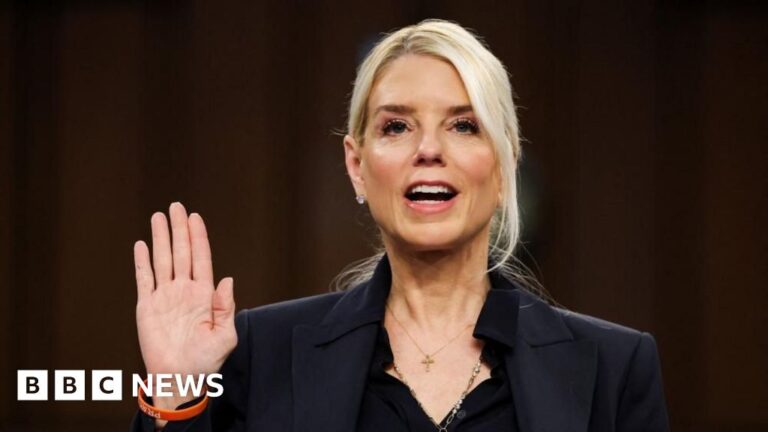
Pam Bondi’s testimony before the Senate Judiciary Committee was expected to be a contentious, partisan affair. It lived up to that billing.

The attorney general was making her first appearance at a congressional oversight hearing – and it was a timely one.

Two weeks ago, her justice department indicted former FBI Director James Comey, triggering an outcry from Democratic politicians.

Her testimony on Tuesday also came just a day after a group of former justice department employees released a letter accusing Bondi of helping to take a “sledgehammer” to “longstanding work the department has done to protect communities and the rule of law”.

Nerves were raw, and Bondi was clearly ready for a fight. Here are five takeaways from the hearing.

1. Bondi goes on the attack

Recent Trump administration officials, including Health Secretary Robert F Kennedy Jr and FBI Director Kash Patel, have relied on a clear playbook for testimony before hostile congressional committees.

Go on the attack early and often.

That strategy was on display throughout Bondi’s testimony. When pressed on National Guard deployments, she said she wished Illinois Senator Dick Durbin and California Senator Alex Padilla loved their states “as much as they hate Donald Trump”.

When questioned about Jeffrey Epstein, she noted that several Democratic senators had taken money from deep-pocketed donors who had ties to the late convicted sex trafficker.

Bondi launched a series of pointed attacks on senators as they questioned her.

And when it was time for junior Vermont Senator Peter Welch to ask questions, he began by observing Bondi’s penchant for launching personal attacks.

“I’ll be waiting for my turn,” the soft-spoken New Englander said. “But you don’t have to do it now”.

Watch: Trump says “there will be others” after Comey indictment

2. Lots of questions, few answers

When Bondi wasn’t going on the attack, she frequently declined to comment on questions from both Democrats and Republicans.

She said she wouldn’t discuss “personnel matters” when questioned about the spate of senior level justice department firings, including top FBI officials and a US lawyer who had recommended against the Comey indictment.

She wouldn’t comment on “ongoing investigations” and legal proceedings – including the Comey case. She also wouldn’t shed light on conversations she has had with the president or other White House aides.

When presented with a large photograph of her sitting at a table with the president the day after Trump had penned a Truth Social post calling for her to indict Comey, her only remark was that she loved the picture.

“This is supposed to be an oversight hearing where members of Congress can get serious answers to serious questions,” California Senator Adam Schiff said, after listing all the questions that Bondi had refused to answer.

“I think you owe the president an apology for your entire career,” Bondi replied.

3. Bondi keen to focus on crime

Bondi appeared determined to focus on what she said was the Trump administration’s goal of reducing crime in the US.

She was quick to cite statistics that she said showed the successes they have had so far – the number of arrests in Washington DC, the drug crackdowns and illegal firearm confiscations in Chicago, the drug seizures at the border.

“We are returning to our core mission of fighting real crime,” Bondi said.

Democrats may have had other ideas, but Bondi – and the White House – likely feel they are on the safest political ground when they talk about crime-fighting.

It is an issue that, according to the polls, many Americans care about – and one that has the potential to appeal not just to die-hard conservative partisans, but to independent and Democratic voters as well.

4. But Democrats focus on Epstein

A source of particular heat for Bondi over the past few months has been the justice department’s handling of its investigation into Epstein, who before his death had well documented ties to many rich and powerful Americans.

For most of the hearing, Democrats were the ones peppering Bondi with Epstein-related questions.

Senator Sheldon Whitehouse wanted to know if the FBI had discovered pictures of Trump and “half-naked young women”, and whether the justice department had looked into “suspicious activity reports” about Epstein’s finances.

Bondi wouldn’t answer.

Dick Durbin asked about claims that the justice department had flagged anything in its Epstein documents related to Trump to the president.

“I’m not going to discuss anything about that with you, senator,” Bondi replied.

The attorney general was asked why her department now says there is no list of Epstein’s clients after she earlier claimed to have that information on her desk.

Bondi responded by citing the department’s previous finding that there was no evidence of conspiracy or a cover-up surrounding the investigation.

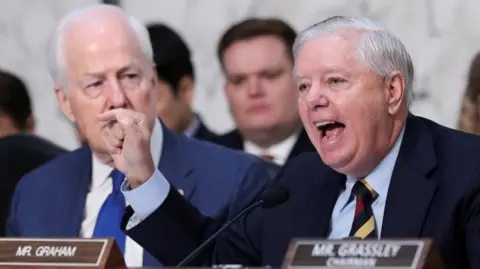
Reuters U.S. Senator Lindsey Graham (R-SC), member of the Senate Judiciary Committee, speaks as he attends an oversight hearing of U.S. Attorney General Pam Bondi on Capitol Hill in WashingtonReuters

The hearing was testy – with both parties attacking the other in their questioning

The questions still swirling around the Epstein investigation have been a rare source of bipartisan interest, with some Republicans joining Democrats to call for more transparency. It took a while, but this Senate hearing finally gave some indication of that.

Republican Senator John Kennedy of Louisiana recounted recent comments by Commerce Secretary Howard Lutnick that Epstein was “the greatest blackmailer ever”.

The Louisiana senator suggested Lutnick, who owned a home near Epstein in Palm Beach Florida, should testify before Congress and speak to the FBI.

Bondi continued her Epstein dance, saying it was up to Lutnick and FBI Director Kash Patel to decide if a meeting was necessary.

5. Republicans look back in anger

If Democrats were focused on what they view as the unprecedented weaponisation of the justice department under Trump, most of the Republican senators were more interested in fighting battles from the Biden presidency – or earlier.

Iowa Senator Chuck Grassley spent much of the hearings interjecting on how Democrats had, in his view, stonewalled investigations into the Biden family’s business dealings.

South Carolina Senator Lindsey Graham condemned the FBI’s Russia investigation following the 2016 presidential election. Ted Cruz of Texas focused on protests outside the homes of conservative Supreme Court justices in the wake of their 2021 decision overturning abortion rights.

Eric Schmidt of Missouri filled out a veritable bingo card of right-wing complaints directed at the justice department.

Bondi, for her part, wholeheartedly agreed with the Republican chorus.

When the five-hour hearing finally concluded, the event had the feeling of a partisan house of mirrors, with each side accusing the other of political weaponisation and partisan prosecutions.

“The Department of Justice is supposed to be the nation’s guardian of fairness and the rule of law,” Senator Alex Padilla said during his questioning. “When the public trust breaks down, then justice itself is at risk.”

It is the kind of comment that both Republicans and Democrats on the committee could agree with – before casting the other side as the source of the nation’s ills.

Challenging the Client

0


Client Challenge


JavaScript is disabled in your browser.

Please enable JavaScript to proceed.

A required part of this site couldn’t load. This may be due to a browser
extension, network issues, or browser settings. Please check your
connection, disable any ad blockers, or try using a different browser.

Minnesota Secures Commitment From 2027 Futures Finalist Ryan Wanner

0

By Madeline Folsom on SwimSwam

Fitter and Faster Swim Camps is the proud sponsor of SwimSwam’s College Recruiting Channel and all commitment news. For many, swimming in college is a lifelong dream that is pursued with dedication and determination. Fitter and Faster is proud to honor these athletes and those who supported them on their journey.

Minnesota snags verbal commitment from Wisconsin native and Futures finalist Ryan Wanner, who will be joining his sister Livi on the team in the fall of 2027.

I’m thrilled to announce my commitment to continue both my academic and athletic journey at the University of Minnesota! Above all else, I thank God for this amazing opportunity and His guidance throughout my process. A huge thank you to my family, teammates, and coaches who have supported me every step of the way. I’m also incredibly grateful to the coaching staff at Minnesota for believing in me and welcoming me to the team. Go Gophers! 〽

Wanner just started his junior year at Waukesha West High School in Waukesha, Wisconsin. At the 2025 WIAA Boys Division I State Championship, he finished 5th in the 100 breast (56.43), and 4th in the 200 IM (1:50.63) as a sophomore.

In March, he swam at the NCSA Spring Championships for his club team Waukesha Express Swim Team. There, he finished 89th in the 100 free (46.73), 75th in the 200 free (1:42.25), 75th in the 50 breast (26.98), and 74th in the 200 IM (1:55.31). He qualified for finals in the 100 breast (38th– 56.82), 200 breast (33rd– 2:01.49), and 400 IM (3:55.25).

At the USA Swimming Futures Championships in Madison in July, Wanner finaled in the 100 breast (17th– 1:03.98), 200 breast (10th– 2:18.92), and 200 IM (8th– 2:09.88).

Best Times SCY:

  • 100 breast- 56.43
  • 200 breast- 2:01.49
  • 200 IM- 1:50.63
  • 400 IM- 3:55.25

The University of Minnesota Golden Gophers compete in the Big Ten, where the men finished 5th last year, scoring 794.5 points to come in almost 100 points behind USC’s 878 points for 4th. The men’s program lost head coach Mike Joyce after last season, but they hired Michael Hampel to fill his vacant position. Both the men’s and women’s programs are run by director Kelly Kramer who is entering his 27th season with the team.

Wanner will join a strong breaststroke legacy at Minnesota, most recently headed by four-time NCAA Champion Max McHugh. Wanner is only a junior in high school and has two more seasons before he will swim his first meet with the Gophers, but he would already rank in the top 10 on the Minnesota team in four different events.

His highest ranking comes in the 400 IM, where his best time of 3:55.25 would have been 7th last season.

Wanner will join his sister Livi in Minneapolis, where she will have one more season with the team before she graduates.

If you have a commitment to report, please send an email with a photo (landscape, or horizontal, looks best) and a quote to Recruits@swimswam.com.

About the Fitter and Faster Swim Tour 

Fitter & Faster Swim Camps feature the most innovative teaching platforms for competitive swimmers of all levels. Camps are produced year-round throughout the USA and Canada. All camps are led by elite swimmers and coaches. Visit fitterandfaster.com to find or request a swim camp near you.

FFT SOCIAL

Instagram – @fitterandfasterswimtour
Facebook – @fitterandfastertour
Twitter – @fitterandfaster

FFT is a SwimSwam partner.

Read the full story on SwimSwam: Minnesota Picks Up Verbal From Futures Finalist Ryan Wanner For 2027

Electric Track Bikes from Lightfighter Deliver Stunning Performance

0

When you take your street bike out for a spin at a racetrack, if you’re smart, you don’t fill it to the top with gas. You put just enough in the tank for the half-dozen laps that you’ll do each session. More than that is simply unhelpful ballast.

California-based start-up Lightfighter has extended that principle to the development of two electric motorcycles aimed squarely at track use. It’s given them just enough range to satisfy the club-level racers and track-day enthusiasts that it hopes to sell bikes to – and with that restraint, it has brought jaw-dropping performance.

The most powerful of Lightfighter’s two prototypes is the fully faired V3-RS. It produces 154 hp (115 kW) and weighs just 399 lb (181 kg), the company says. And that’s the ready-to-race weight, fully … umm … charged.

For a gas-fueled comparison, Ducati’s latest V-twin superbike, the Panigale V2, is claimed to weigh just 4 lb (1.8 kg) less – but that’s with no fuel in the tank. And it makes only 120 hp (88 kW). Ducati’s four-cylinder equivalent, the Panigale V4, is much stronger than either, but it’s also heavier, at 421 lb (191 kg), and again, that’s before you add fuel.

The Lightfighter V3-RS silhouette looks like a cross between a Kramer and a KTM RC8

Lightfighter

The Lightfighter is as powerful, while much lighter than the 575-lb (260-kg) behemoths raced in the MotoE World Championship (the premier international series for electric bikes) – and the 489-lb (225-kg) e-Ducati that would have replaced them had the class not been mothballed from next year.

More on point, the Lightfighter looks to be quick and light enough to give a non-pro as much speed and finesse as they’d ever get from any road-going superbike on the track. And that’s without the other advantages of an electric powerplant – like always being in the right gear.

Lightfighter’s CEO, Brian Wismann, says its superior specs are underpinned partly because of a more energy-dense battery pack, and partly by a focus on minimizing weight – helped by US circuits generally being tighter and less energy-demanding than the high-speed tracks used in the MotoE series.

The battery pack, sourced from Farasis Energy’s research hub in California, can store just 12.5 kWh – enough to power the bike at full throttle for about seven minutes.

The trellis frame peeks out from above while even the rearsets looks ultra light

Lightfighter

If you’re thinking that’s scanty, you’ve grossly underestimated the performance of a 400-lb, 150-hp motorbike, even on a big circuit like Australia’s famed Phillip Island, one of the fastest grand prix tracks in the world.

There, a skilled rider might hold full throttle for about eight seconds on the main straight each lap, and another few seconds on the downhill straight to Stoner Corner – a shallow left-hander that can be taken at 150 mph (240 km/h) if you’re game. On several visits to the track, I never have been. Then you’re counting gears as you downshift while braking for the near-hairpin right-hander that follows.

On the Lightfighter, of course, there are no gears to change – its 120 lb-ft (162 Nm) of torque is available from zero rpm, pulling you out of the hairpin in the same gear that gets you to maximum speed on the straight.

The Motec dash has every piece of information you could ever want

Lightfighter

That easy rideability is part of why Wismann thinks the Lightfighter could be not only a competitive electric racer against its gasoline-fueled alternatives, but also the best bike available for anyone riding for fun rather than profit.

There are also weight-distribution advantages from the compact powerplant, along with what Wismann describes as great handling in transitions – the rider doesn’t have to battle the gyroscopic resistance of an internal combustion engine’s heavier rotating parts.

A Lightfighter’s battery, he says, can be recharged in an hour from the power available at typical US racetracks. “For a track day, it is possible for the rider to recharge between sessions. We have the ability to swap batteries, but have never done this at the track days or race events we’ve competed in,” Wissman told New Atlas.

Among those events was an eight-lap AFM-sanctioned race at the 2.9-mile (4.67-km) Thunderhill Raceway East in Willows, California, in June. Brenden Ketelsen expertly rode the V3-RS and won – stretching the Lightfighter’s endurance to the limit while turning a 1:50.026 time in the process.

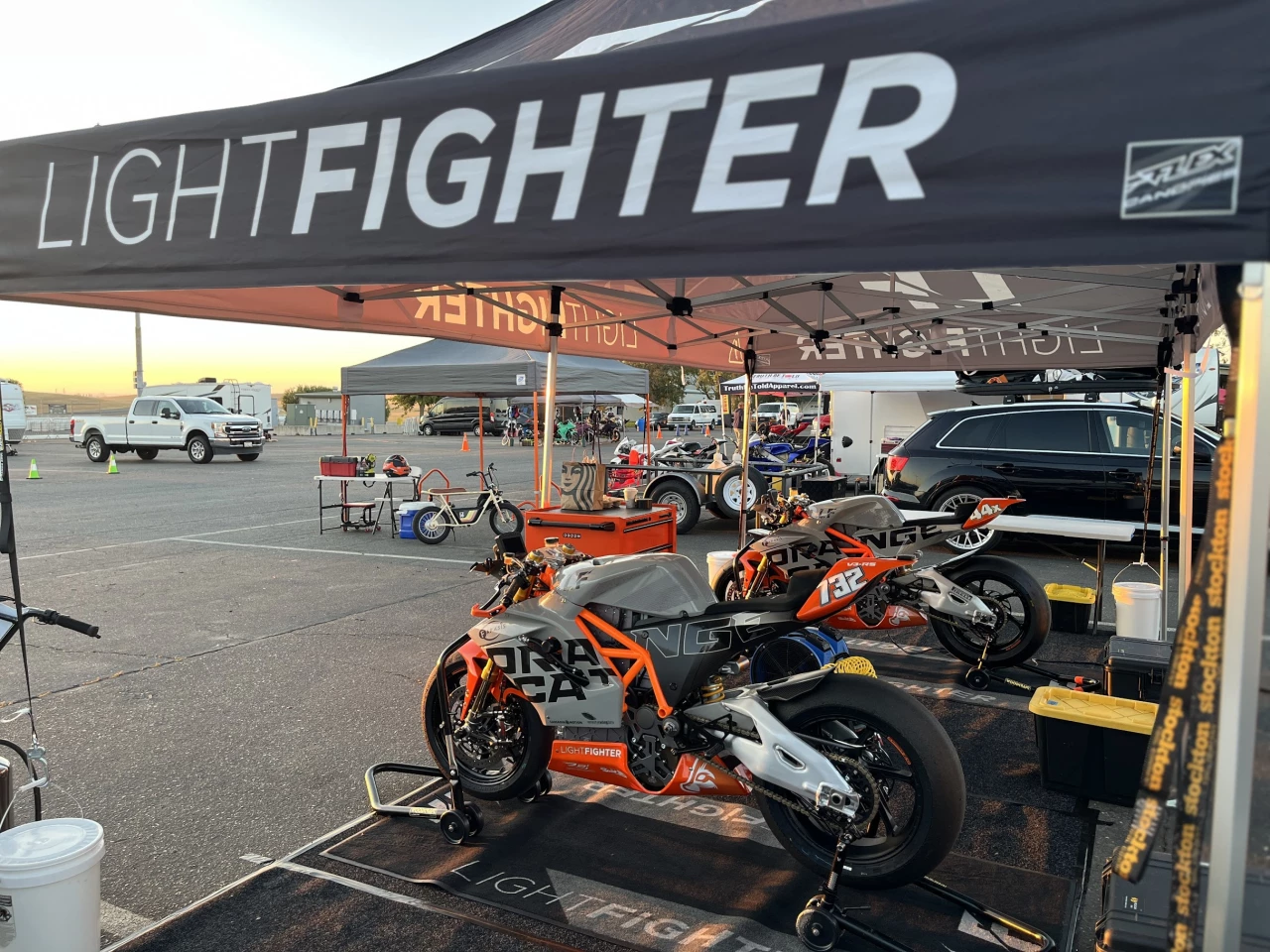
The Lightfighter pits at Thunderhill Raceway

Lightfighter

Lightfighter’s other prototype, labeled the V3-RH, is a 135-hp (100-kW) super-naked with higher handlebars and no fairing, built for acceptance into the professional MotoAmerica Super Hooligan series next year.

The water-cooled motor for both bikes has been developed in collaboration with Ohio-based Parker Hannifin. It’s set in a custom-built casing that also houses a 2:1 reduction gearset, which doubles its torque output before it reaches the drive sprocket.

The chassis and body parts will look familiar to motorcycle enthusiasts, with Oz Racing wheels, high-end Ohlins suspension, and Brembo brakes, all tied together by a tubular steel trellis frame drawn up by Lightfighter fabrication lead Ely Schless – who says he took a Yamaha R1 superbike as his starting point.

Rake and trail figures are an unexceptional 24.5 degrees and 100 mm, with a wheelbase of 56.5 inches (1,435 mm). Tires are 120/70-17 front and 200/60-17 rear, while the custom bodywork combines carbon fiber and fiberglass.

The Lightfighter V3-RH (left) and V3-RS

Lightfighter

The third of Lightfighter’s co-founders is chief technology officer Nick Lambert, whose background includes electric motor technology and nine years overseeing quality control and new-model introductions at Tesla.

Wismann left electric bike maker Zero Motorcycles in May after nine years supervising product development to devote himself to what began as a passion project.

He says the team is dedicated to raising the company’s profile through racing while working toward a limited-production debut in 2027 – likely at a premium price. More powerful versions are in the pipeline.

As a long-time motorcyclist who has competed at club level, I find the prospect of such an electric racer enticing – partly because it sharpens the focus on exploring the limits of handling and grip, and partly because it would need a lot less TLC between outings than a gas-fueled track bike, a point Wismann readily endorses.

Lightfighter V3-RS at the slowest point of the turn at COTA

Lightfighter

Could Lightfighter – and the imitators likely to follow – even raise interest in track riding, in a world where modern sportbike performance long ago outpaced what could be exploited prudently on public roads?

While acknowledging that some riders will always prefer the engagement that comes from clutching and shifting, Wismann believes an EV powertrain is the ideal solution for a track-focused motorcycle.

“The power delivery is smoother than any combustion engine, and the act of piloting the bike is much simpler and more confidence-inspiring,” he told New Atlas.

“The Lightfighter is infinitely tunable to be the bike you want it to be. We can program it to behave like a 400, a 650 twin, a 600 four or a liter bike. It’s a bike that can meet the rider where they are in their journey.

“We can clearly see that the next generation of motorcyclist will have learned to ride on e-bikes and small electric motorcycles. I think there is strong potential to expand interest in road racing by appealing to this younger generation of rider.”

Yep, and they may pull in some older riders as well.

Source: Lightfighter

Insights from Gaza Residents: Reflections on Two Years of War

0

In the two years since Hamas militants attacked Israel, we’ve interviewed more than 700 people in Gaza. Their stories stayed with us. So we tried to find them again.

By Vivian Yee, Saher Alghorra, Laura Boushnak, Nader Ibrahim, Rebecca Suner, June Kim, Christina Shaman, James Surdam, Jon Hazell and Nikita Pavlov

October 7, 2025

Trump’s warning to invoke Insurrection Act heightens tension with Democratic cities

0

Trump's threat to invoke Insurrection Act escalates showdown with Democratic cities

Solving France’s Escalating Political Crisis: Strategies and Updates in Politics

0

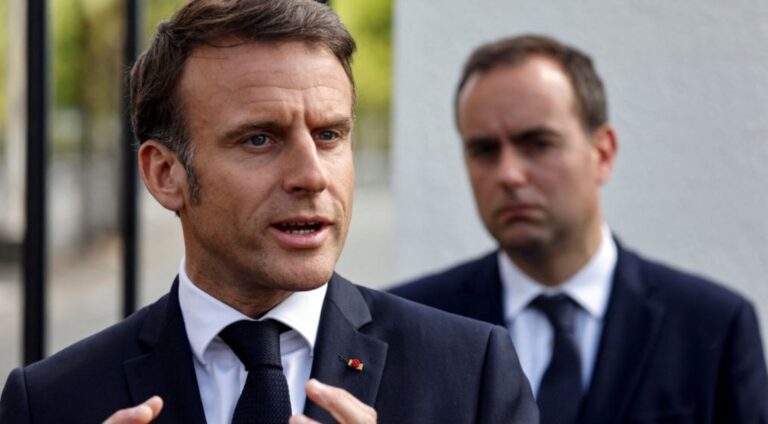
President Macron under pressure as parliamentary paralysis persists.

France is facing political turmoil after President Emmanuel Macron’s fifth prime minister in less than two years quit after just 27 days.

There are growing calls for new elections and Macron is facing increasing pressure to resign.

So, what’s next for France?

Presenter: Nick Clark

Guests:

Thierry Mariani – Member of the European Parliament for the far-right National Rally Party

Eleonore Caroit – Member of Macron’s centrist Renaissance party and French National Assembly deputy

Eric Bocquet – Mayor of Marquillies and a member of the French Communist Party

Analyst Warns of Nvidia Fueling AI Bubble: Drawing Parallels to Enron and Tyco

0

A top Wall Street analyst has sounded an alarm over the U.S. equity bull market, warning that its remarkable run is built on a precariously narrow foundation: a surge in spending on, and optimistic assumptions about, infrastructure for artificial intelligence (AI). This spending has fueled a boom in the shares of most of the so-called Magnificent 7 and a few dozen related businesses, which have now come to account for roughly 75% of the S&P 500’s returns since the rally of the last few years began.

The commentary on September 29 by Morgan Stanley Wealth Management’s chief investment officer, Lisa Shalett, frames the current market boom as a “one-note narrative” almost entirely dependent on massive capital expenditures in generative AI, raising questions about its durability as economic and competitive risks start to mount. Shalett’s critique came squarely in the middle of some people in the AI field — and many financial commentators around Wall Street —fretting at market exuberance and beginning to talk openly about a bubble.

In an interview with Fortune, Shalett said she was “very concerned” about this theme in markets, saying her office had broadened from a belief that the market would only bid up seven or 10 stocks to roughly 40. “At the end of the day … this is not going to be pretty” if and when the generative AI capital expenditure story falters, she said.

Shalett said she’s worried about a “Cisco moment” like when the dotcom bubble burst in 2000, referring to the company that was briefly the most valuable company in the world before an 80% stock plunge. [By “Cisco moment” did she mean a whole bunch of circular financing coming back to bite the company? If so, that would be worth adding/briefly explaining.] When asked how close we are to such a moment, Shalett said probably not in the next nine months, but very possibly in the next 24. When you look at the actual spending and the amount of capital coming into the space, “we’re a lot closer to the seventh inning than the first or second inning,” she said.

‘Starting to do what all ultimate bad actors do’

Shalett’s comments centered on several recent multibillion-dollar deals to scale up data-center infrastructure. As notable substacker and former Atlantic writer Derek Thompson recently noted in a post titled “This is how the AI bubble will pop,” so much money is being spent to support AI’s energy-consumption needs that it’s the equivalent of a new Apollo space mission every 10 months. (Tech companies are spending roughly $400 billion this year alone on data-center infrastructure, while the Apollo program allocated about $300 billion in today’s dollars to get to the moon from the 1960s to the ’70s.)

What’s more than a little concerning to Shalett is that one company alone, Nvidia—the most valuable company in the history of the world, with an over $4.5 trillion market cap—is at the center of a significant number of these deals. In September alone, Nvidia invested $100 billion in OpenAI in a massive deal, just days after pledging $5 billion to Intel (the Intel agreement was tied to chips, not data-center infrastructure, per se).

Fortune‘s Jeremy Kahn reported in late September on significant concerns about “circular” financing, or Nvidia’s cash essentially being recycled throughout the AI industry. Shalett sees this as a major concern and a major sign that the business cycle is headed toward some kind of endgame. “The guy at the epicenter, Nvidia, is basically starting to do what all ultimate bad actors do in the final inning, which is extending financing, they’re buying their investors.”

Shalett expanded on her concerns by saying that companies around Nvidia “are starting to become interwoven.” She noted that OpenAI is partially owned by Microsoft, but now Nvidia has also made an investment in the startup, while Oracle and AMD each have their own purchasing agreements with OpenAI. But OpenAI also has a data-center deal with tech giant Oracle, with the “bad news,” Shalett notes, that this deal is “totally debt-financed.” OpenAI also struck a deal in October with chip-maker AMD that allows OpenAI to buy up to 10% of AMD. “Essentially, Nvidia’s main competitor is going to be partially owned by OpenAI, which is partially owned by Nvidia. So, Nvidia can ‘own’ a piece of its largest competitor. It is totally circular and increases systemic risk.”

When reached for comment, a spokesperson for Nvidia said, “We do not require any of the companies we invest in to use Nvidia technology.”

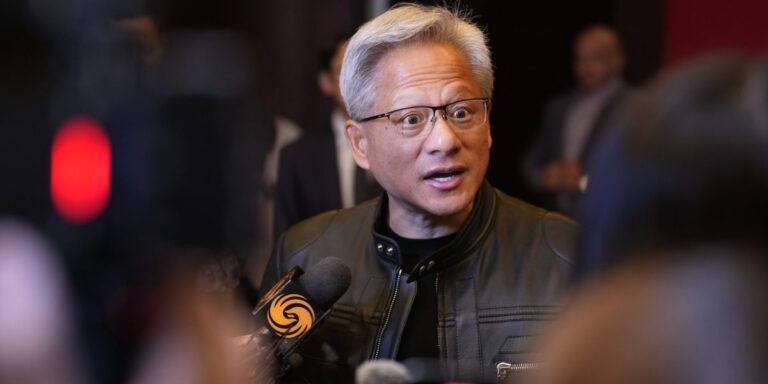
Nvidia CEO Jensen Huang discussed the OpenAI investment in an appearance on the Bg2 podcast with Brad Gerstner and Clark Tang on September 25, calling it an “opportunity to invest” and part of a partnership geared toward helping OpenAI build their own AI infrastructure. When asked about the allegation of circular financing in general and the Cisco precedent in particular, Huang talked about how OpenAI will fund the deal, arguing that it will have to be funded by OpenAI’s future revenues, or “offtake,” which he pointed out are “growing exponentially,” and by its future capital, whether it’s raised by a sale of equity or debt. That will depends on investors’ confidence in OpenAI, he said, and beyond that, it’s “their company, it’s not my business. And of course, we have to stay very close to them to make sure that we build in support of their continued growth.”

Shalett said that she and her team were “starting to watch” for signs of a bubble popping, highlighting the deal announced roughly a week before OpenAI struck its $100 billion data-center deal with Nvidia, when it struck another with Oracle worth $300 billion. Analysts at KeyBanc Capital Markets estimated that Oracle will have to borrow $100 billion of that amount—$25 billion a year for the next four years.

“Every morning the opening screen on my Bloomberg is what’s going on with CDS spreads on Oracle debt,” Shalett said, referring to credit default swaps, the financial instrument that was obscure before the Great Financial Crisis, but infamous for the role it played in a global market meltdown. CDSs essentially serve as insurance to investors in case of insolvency by a market entity. “If people start getting worried about Oracle’s ability to pay,” Shalett said, “that’s gonna be an early indication to us that people are getting nervous.” She added that all the indications to her speak of the end of a cycle and history is littered with cautionary tales from such times.

Oracle did not respond to requests for comment.

90% growth since the last bear market

Since the October 2022 bear market bottom and the launch of ChatGPT, according to Shalett’s calculations, the S&P 500 has soared 90%, but most of these gains have come from a small group of stocks. The so-called “Magnificent Seven”—including high-profile names like Nvidia and Microsoft—plus another 34 AI data-center ecosystem companies, are responsible for, as cited by Shalett and separately by JP Morgan Asset Management’s Michael Cembalest, about three-quarters of overall market returns, 80% of earnings growth, and a staggering 90% of capital spending growth in the index. Comparatively, the other 493 names in the S&P 500 are up just 25%—showing just how concentrated the rally has become.

The so-called “hyperscaler” companies alone are now spending close to $400 billion annually on capex supporting AI infrastructure, Morgan Stanley Wealth Management calculated. The economic influence of AI capex is now immense, contributing an estimated 100 basis points—fully one percentage point—to second-quarter GDP growth, according to Morgan Stanley’s research. This pace outstrips the rate of underlying consumer spending growth by tenfold, underscoring its centrality to both market performance and broader economic data.

“People conflate AI adoption, which is in the first inning, with the capex infrastructure buildout, which has been going full-out since 2022,” Shalett told Fortune. She cited concerns about the prominence of private equity and debt capital coming into play, as that “tends to produce bubbles, because it may be unspoken-for capacity.” In other words, people have money to burn and they’re throwing it at things that may not pay off.

Shalett waved away macro theories about the labor market or the Federal Reserve. “We think that’s missing the forest for the trees because the forest is entirely rooted in this one story” about AI infrastructure. Morgan Stanley’s bull-case mid-2026 price target for the S&P 500 is an eye-popping 7,200, but Shalett highlights that even the most optimistic outlook admits that risk premiums, credit spreads, and market volatility do not seem to fully account for the vulnerabilities lurking beneath the AI-fueled advance.

Shalett’s analysis suggests that AI capex maturity is approaching and some possible slowdowns are already visible. For instance, hyperscalers have already seen free-cash-flow growth turn negative, a sign that investment may have outpaced underlying technology returns. Strategas, an independent research firm, estimates that hyperscaler free cash flow is set to shrink by more than 16% over the next 12 months, putting pressure on lofty valuations and forcing investors to demand more discipline in how these funds are deployed.

Shalett was asked about data centers’ disproportionate impact on GDP throughout 2025, which media blogger Rusty Foster of Today in Tabs described as: “Our economy might just be three AI data centers in a trench coat.” The Morgan Stanley exec said “That’s what makes this cycle so fragile,” adding that at some point, “we’re not gonna be building any data centers for a while.” After that, it’s just a question of whether you crash: “Do you have a mild 1991-92-style recession or does it really become bad?”

A more bullish case

Bank of America Research weighed in on the semiconductors sector in a Friday note, writing that vendor financing in the space, especially Nvidia’s $100 billion commitment to OpenAI, has been “raising eyebrows.” Nevertheless, the team, led by senior analyst Vivek Arya, argued that the deal is structured by performance and competitive need, rather than pure speculative frenzy.

In an interview with Fortune, Arya explained why he wasn’t worried despite the “optics” being pretty obviously bad. “It’s very easy to say, ‘Oh, Nvidia is giving [OpenAI] money and they are buying chips with that money” and so on, but he argued the headlines are misleading about how much money is actually being spent and the $100 billion sticker price on the OpenAI deal “scared everyone.” Noting that the deal has multiple tranches that will play out over several years to come, he said it’s not like Nvidia is “just handing a $100 billion check to OpenAI [and saying] you know, go have fun.”

“Nvidia didn’t fund all of it,” Arya said of the wider generative AI capex boom. Citing public filings, Arya argued that Nvidia’s entire investment in the AI ecosystem is in fact less than $8 billion or so over the last 12 months, not such a large figure after all. And he’s still bullish on Nvidia and OpenAI, he added, because he sees them as the winners of this particular story. “We think they are going to be among the four or five ecosystems that come up. It’s not like Nvidia is going and investing in every one of those ecosystems, right? They’re only investing in one of those five, which is, of course, the most disruptive,” that being OpenAI.

When asked about his own fears of a bubble, Arya actually sounded a calmer but strikingly similar tune to Shalett. “I’m extremely comfortable with what will happen in the next 12 months,” Arya said, “And I have high sense of optimism about what will happen in the next five years. But can there be periods of digestion in between? Yeah.” Explaining that this is the nature of any infrastructure cycle, “it’s not always up and to the right.” In other words, after the next nine months in Shalett’s opinion and the next year in Arya’s, the data-center buildout endgame could be in play. “When these data centers are built,” Arya said, “they are not built for today’s demand. They’re built with some anticipation of demand that will develop in the next, you know, 12 to 18 months. So, are they going to be 100% utilized all the time? No.”

Rising worries about a bubble

Some of the biggest names in tech and Wall Street offered were hedging hard about the possibility of a bubble on Friday. Goldman Sachs CEO David Solomon and Jeff Bezos, both speaking at a tech conference in Turin, Italy, said they were seeing the same patterns as Shalett. Solomon said the massive amounts of spending weren’t fundamentally different from other booms and busts. “There will be a lot of capital that was deployed that didn’t deliver returns,” he said. That’s no different from how investment works. “We just don’t know how that will play out.”

Bezos characterized it as “kind of an industrial bubble,” arguing that the infrastructure would pay off for many years to come.

OpenAI CEO Sam Altman, who got markets jittery in late August when he mentioned the B-word, was asked again to comment on the subject while touring (what else?) a giant new data center in Texas. “Between the 10 years we’ve already been operating and the many decades ahead of us, there will be booms and busts,” Altman said. “People will overinvest and lose money, and underinvest and lose a lot of revenue.”

For his part, Cisco CEO John Chambers, one of the faces of the dotcom bubble, told the Associated Press on October 3 that he sees “a lot of tremendous optimism” about AI that is similar to the “irrational exuberance on a really large scale” that marked the internet age. It indicates a bubble to him, but only “a future bubble for certain companies. Is there going to be train wreck? Yes, for those that aren’t able to translate the technology into a sustainable competitive advantage, how are you going to generate revenue after all the money you poured into it?”

When asked whether the size of this potential bubble represents uncharted waters for the economy, especially considering the one-note nature of the long bull market, Shalett said Wall Streeters are always evaluating risk. But putting on her “American citizen hat,” she warned about the media consolidation that sees Oracle’s founder Larry Ellison also now playing a major role in TikTok (as part of a buying consortium of Trump-friendly billionaires) and Paramount in Hollywood and CBS News in New York (through his son, David Ellison, the media company’s new owner). Shalett said she’s worried about “groupthink” filtering into the functioning of markets. “That is not something that most of us have experienced in our lifetimes,” she said. “You stop factoring in risk premiums into markets, there is no bear case to anything.”