0.2 C
New York
Wednesday, February 25, 2026
Home Blog Page 319

Impact of RSF drone strike that resulted in the deaths of dozens in Sudan’s el-Fasher | Conflict in Sudan

0

NewsFeed

Video shows the aftermath of drone and artillery strikes on a shelter in the besieged city of el-Fasher in Sudan’s North Darfur state, which killed at least 60 people. The attack was carried out by the paramilitary Rapid Support Forces (RSF), according to a Sudanese medical advocacy group.

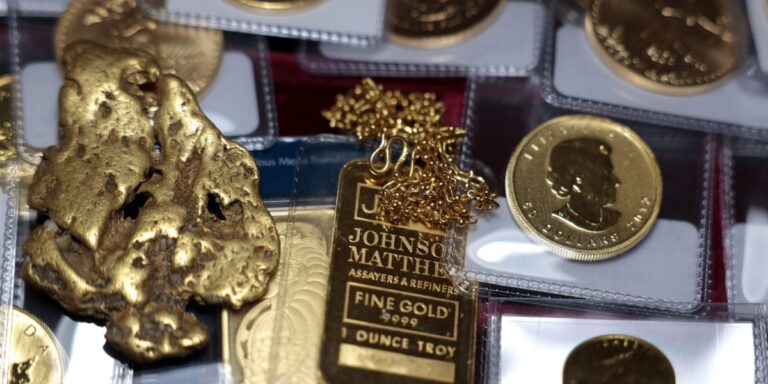
Gold prices may reach $10,000 per ounce within the next three years

0

After surging nearly 50% so far this year, gold could skyrocket 150% as early as 2028 if its current pace keeps up.

The precious metal topped $4,000 per ounce for the first time ever earlier this week, then got another jolt Friday, when President Donald Trump said he will impose an additional 100% tariff on China and limit U.S. exports of software.

Stocks suffered their worst loss since the height of Trump’s trade war chaos in April. The dollar fell while gold jumped 1.5%, reinforcing its status as a safe haven asset as investors lose confidence in the greenback.

In a note on Monday, market veteran Ed Yardeni, president of Yardeni Research, went over his earlier bullish calls on gold, which has repeatedly reached his forecasts ahead of schedule.

During that time, he cited gold’s traditional role as a hedge against inflation, central banks de-dollarizing after Russia’s assets were frozen, the bursting of China’s housing bubble, as well as Trump’s trade war and his attempts to upend the world’s geopolitical order.

“We are now aiming for $5,000 in 2026,” Yardeni added. “If it continues on its current path, it could reach $10,000 before the end of the decade.”

Based on gold’s trajectory since late 2023, the price could reach the $10,000-per-ounce milestone sometime between mid-2028 and early 2029.

Gold has also gotten a lift recently from the Federal Reserve’s pivot back to rate cuts last month, with policymakers shifting more attention to the stagnating labor market and away from fighting inflation, which has remained stubbornly above their 2% target amid Trump’s tariffs.

While the Fed hasn’t signaled an aggressive easing cycle, the prospect of more rate cuts while GDP growth remains strong has added to inflation concerns.

At the same time, soaring debt among top developed economies, including the U.S., has turned investors skittish on global currencies. That’s fueled a so-called debasement trade that bets on precious metals and bitcoin assuming governments let inflation run hotter to ease debt burdens.

In a note on Wednesday, Capital Economics climate and commodities economist Hamad Hussain said “FOMO” is creeping into the gold trade, making it harder to objectively value the metal. He expects prices to continue rising, though the pace of gains will slow as key tailwinds weaken.

On the bullish side, Hussain pointed to Fed rate cuts, geopolitical uncertainty, and fiscal sustainability concerns. On the other hand, he noted the recent gold rally came as the dollar was stable (until Friday) with inflation-protected bond yields higher—telltale signs of market exuberance.

“As ever, the lack of an income stream makes it notoriously hard to value gold objectively,” he said. “On balance, we think that gold prices will probably grind higher in nominal terms over the next couple of years.”

Fortune Global Forum returns Oct. 26–27, 2025 in Riyadh. CEOs and global leaders will gather for a dynamic, invitation-only event shaping the future of business. Apply for an invitation.

Oscar-winning actress passes away at age 79, according to US media sources

0

Noor NanjiCulture reporter

Oscar-winning actress Diane Keaton through the years

Oscar-winning actress Diane Keaton has died at the age of 79.

Keaton, who was born in Los Angeles, shot to fame in the 1970s through her role as Kay Adams-Corleone in The Godfather films.

She was also known for starring roles in films including Father of the Bride, First Wives Club and Annie Hall, which won her the Academy Award for Best Actress in 1978.

Producer and friend of Keaton, Dori Rath, confirmed the actress’s death to CBS News, the BBC’s US partner.

Silver Screen Collection via Getty Images Woody Allen talking to Diane Keaton as she gets into a tax on a New York City street in the film Annie HallSilver Screen Collection via Getty Images

Woody Allen directed and starred alongside Diane Keaton in Annie Hall, one of the most famous films Keaton appeared in

For Annie Hall, Keaton also won the Golden Globe Award for Best Actress in a Comedy or Musical Motion Picture and the BAFTA Award for Best Actress in a Leading Role.

Throughout her more than five-decade career, Keaton starred in dozens of other films including The Family Stone, Because I Said So, And So It Goes, as well as a number of other Woody Allen films, like Play It Again, Sam, Sleeper, Love and Death and Manhattan.

Keaton made her film debut in the 1970 romantic comedy Lovers and Other Strangers. Her most recent film was the 2024 comedy Summer Camp where she starred alongside Eugene Levy and Kathy Bates.

Keaton also directed several films, the first of which was a 1987 documentary, Heaven, chronicling people’s beliefs about the afterlife. Her 1995 film Unstrung Heroes – a comedy-drama starring Andie MacDowell, John Turturro and Michael Richards – was selected for Cannes Film Festival’s Un Certain Regard, which showcases unique stories by emerging directors.

Most recently, Keaton directed Hanging Up in 2000, a comedy-drama starring herself, Meg Ryan and Lisa Kudrow.

Both in her film roles and in her personal life, Keaton was known for her unique style, which often featured menswear and a wide-brimmed hat.

Columbia/Tristar via Getty Images image of Meg Ryan and Diane Keaton holding a door and shrieking as Lisa Kudrow looks on, stone-facedColumbia/Tristar via Getty Images

Lisa Kudrow, Meg Ryan and Diane Keaton in “Hanging Up”, a film about three sisters bonding over the imminent death of their grumpy father

Keaton died in California on Saturday, a family spokesperson told People magazine, which first reported the news.

Paying tribute, her First Wives Club co-star Bette Midler wrote on Instagram: “The brilliant, beautiful, extraordinary Diane Keaton has died. I cannot tell you how unbearably sad this makes me.”

“She was hilarious, a complete original, and completely without guile, or any of the competitiveness one would have expected from such a star. What you saw was who she was … oh, la, lala!”

Fellow First Wives Club co-star Goldie Hawn said Keaton left “a trail of fairy dust, filled with particles of light and memories beyond imagination”.

Writing on Instagram, Hawn said: “How do we say goodbye? What words can come to mind when your heart is broken? You never liked praise, so humble, but now you can’t tell me to ‘shut up’ honey. There was, and will be, no one like you.”

Getty Images First Wives Club co-stars Goldie Hawn, Diane Keaton and Bette Midler rehearse at the Academy Awards in LA in 1997Getty Images

First Wives Club co-stars Goldie Hawn, Diane Keaton and Bette Midler

Steve Martin, who starred with Keaton in Father of the Bride alongside Martin Short, reposted part of a magazine article where Short asks: “Who’s sexier, me or Steve Martin?”

Keaton replies: “I mean, you’re both idiots.”

Martin said: “Don’t know who first posted this, but it sums up our delightful relationship with Diane.”

Actor Ben Stiller paid tribute on X, writing: “Diane Keaton. One of the greatest film actors ever. An icon of style, humor and comedy. Brilliant. What a person.”

Keaton was nominated for three further Oscars – all in the best actress category – for her work in Something’s Gotta Give, Marvin’s Room and Reds.

Getty Images Diane Keaton sitting on a sofa in The Godfather Part II film, wearing a white long-sleeve shirt, holding a small girl against her chest.Getty Images

Seen here in The Godfather Part II, Diane Keaton starred in the trilogy as Kay Corleone

She never married and had two adopted children – a daughter, Dexter, and a son, Duke.

In her 2011 autobiography, titled Then Again, Keaton wrote: “I have assessed my happiness ratio and this is the result. I am totally content whenever the ones I love are happy about something little, big, insignificant, whatever.

“I just don’t think anyone could possibly have the same wonderful, intense, compelling feelings that I have for this family of mine.”

Indiana Wins USC Invite as Zalan Sarkany Sets Pool Record with 14:29.87 in the 1650-Yard Freestyle

0

By Madeline Folsom on SwimSwam

USC Invite

  • October 11, 2025
  • Los Angeles, California
  • SCY (25 Yards)
  • Full Meet Results
  • Team Scores:
    • Women
      • Indiana 190 — USC 162
      • Indiana 235 — UCLA 112
      • Indiana 238 — A&M 108
      • USC 245 — UCLA 107
      • USC 245 — A&M 107
      • UCLA 185 — A&M 151
    • Men
      • Indiana 257 — USC 95
      • Indiana 278 — A&M 74
      • USC 197 — A&M 155

The 2nd day of the USC Invite followed a similar pattern to the first with the Indiana Hoosiers winning most of the events as they swept all five dual meets across both sides of the meet. The highlight of the day was Indiana junior Zalan Sarkany setting a new pool record in the mile.

Men’s Recap

Zalan Sarkany, two-time NCAA Champion in the 1650, won the event at the USC Invite on Saturday in a blistering fast time of 14:29.87. Not only was this a new Uytengsu Aquatics Center Record, but it was also the top time in the country this year, though most teams have not swum a meet with the mile yet, it is also faster than anyone swam during the fall semester last season, including midseason Invites.

At the end of the 2024 calendar year, the fastest mile time in the NCAA was Rex Maurer‘s 14:30.47 from the Texas Invite. Sarkany is already faster than that, and it is only the 2nd weekend in October.

Most of the remaining men’s events followed a similar pattern of Indiana dominance with the Hoosier men winning all but one event.

They started the session with a win in the 200 medley relay with their team of Miroslav Knedla (21.13), Alexei Avakov (23.99), Owen McDonald (20.27), and Mikkel Lee (19.19) touching in 1:34.58 to come in ahead of Indiana’s ‘B’ team who swam 1:35.94

The relay swimmers continued to perform well after that event. Knedla went on to win the 200 back in 1:40.44 and Lee won the 100 free with his time of 43.31. Both were just over a second off their lifetime best times in the event.

The men’s 200 breaststroke also went to Indiana with Noah Cakir, the runner-up in the 100 breaststroke on Friday, winning the event in 1:54.19, just ahead of Texas A&M’s Roberto Bonilla Flores.

The Hoosiers finished the meet off with a win in the 400 freestyle relay. Raekwon Noel led off the ‘A’ in 43.42, and Lee swam 42.25 in the 2nd leg. Dylan Smiley swam 43.01 at 3rd and Owen McDonald brought the team home in 42.30. Notably, Miroslav Knedla led off the ‘B’ relay with a new personal best time in the 100 of 42.48.

The only event that Indiana did not win was the men’s 200 fly, which went to USC’s Krzysztof Chmielewski, who came in at 1:41.16 to win by nearly two seconds over Owen McDonald. This is the 2nd fastest time in the country this season.

Women’s Recap

The women’s meet was, again, led by Indiana freshman Liberty Clark who swam on both winning relays, and won the women’s 100 freestyle in a new personal best time and the 2nd fastest 100 freestyle time in the nation this season.

She touched in 47.39 to come in just three tenths behind Virginia’s Anna Moesch who swam 47.05 at the Virginia vs Florida meet. This was almost exactly a second faster than her preseason best of 48.48 from the Winter Junior Nationals last December. It also makes her three-for-three with lifetime best swims and wins at this meet.

Clark started the session with a win in the 200 medley relay as she anchored the team of Mya DeWitt (24.26), Jonette Lagried (28.02), and Miranda Grana (23.20) in 21.62 to touch in 1:34.58 and win the event.

She also led off the winning 400 freestyle relay in 47.42, just three hundredths off her individual swim. Macky Hodges swam 2nd in 48.12. Miranda Grana was 3rd in 48.44, and Kristina Paegle anchored in 48.20. They swam 3:12.20 to win by nearly two seconds over the USC ‘A’ team.

Miranda Grana was also on both relays, and she had a perfect meet as well. She won both her events on Friday and then won the 200 backstroke by more than four seconds, swimming 1:49.85, which is the top time in the country this season. This swim was about a second off her lifetime best of 1:48.73 from NCAAs last season.

USC won the other three individual events of the day. Justina Kozan took her 3rd individual event win in the 200 butterfly, touching in 1:54.63 to beat A&M’s Ava Whitakers swim of 1:56.09. Her lifetime best in the event stands at 1:54.28 from December of 2021.

Ashley McMillan won the 200 breaststroke in 2:10.33, and she was followed by freshman teammate Bella Brito, who swam 2:11.10 for 2nd place.

Claire Tuggle won the first event of the session for the Trojans, the women’s 1650 in 16:34.79. This is also the top time in the country this season, and it marks only her 4th time swimming the event. Her best time is 16:03.08 from the Big Ten Conference Championships last February.

Read the full story on SwimSwam: Zalan Sarkany Sets Pool Record With 14:29.87 In the 1650, Indiana Wins USC Invite


Japan leads the way in premium streaming, driving change in APAC region, according to Luminate report

0

Japan has emerged as the APAC region’s clear winner in premium entertainment subscriptions, market monitor Luminate says.

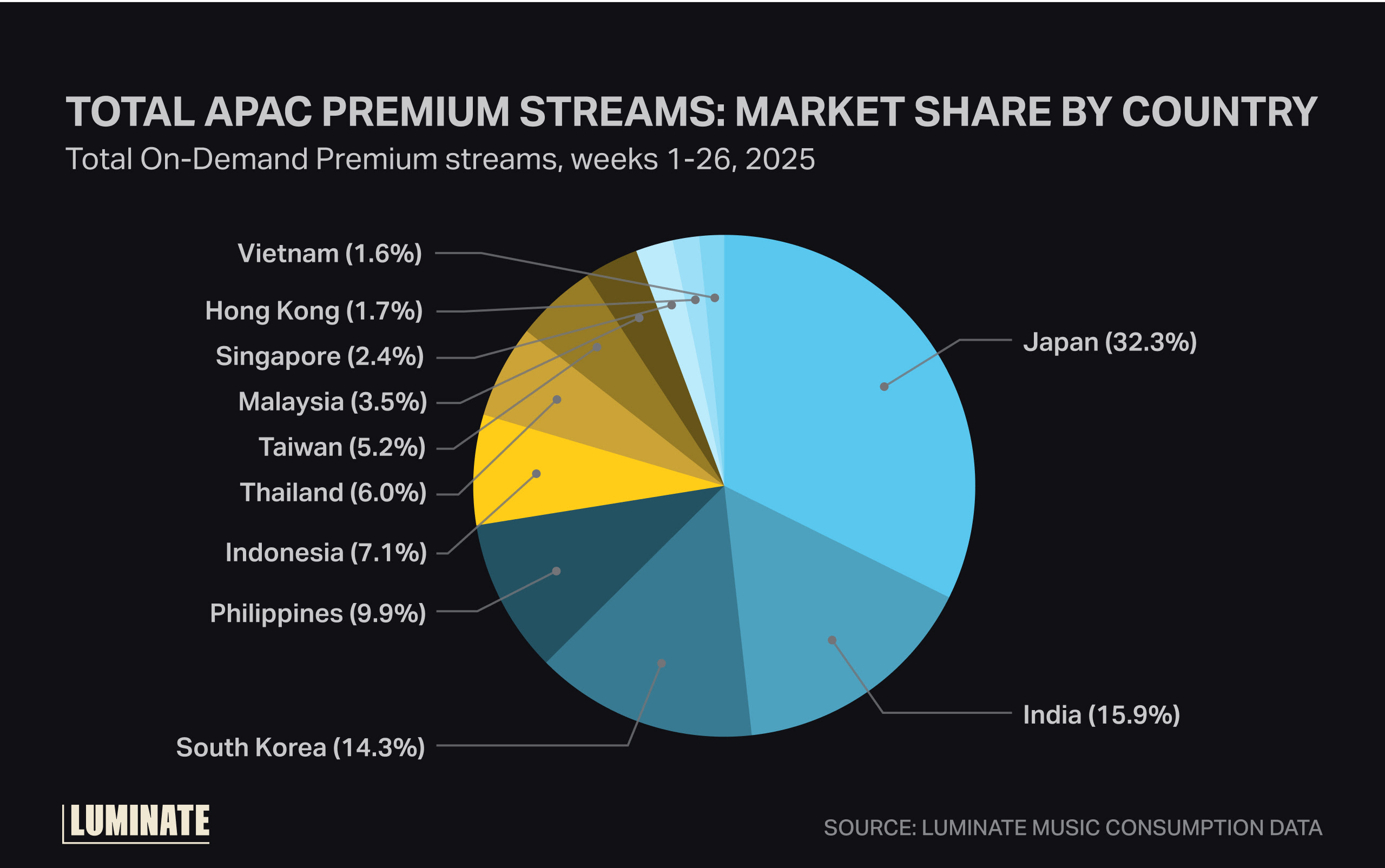
In a region known for lagging much of the world in subscription-based entertainment, Japan stands out, accounting for nearly one-third of all premium streams in the Asia-Pacific and Australia/NZ regions in the first half of 2025, Luminate’s VP of Music Insights & Industry Relations, Jaime Marconette, wrote in a new blog post.


Source: Luminate

“Japan has historically valued physical music formats such as CDs. And while they are still very popular and command significant spend, younger audiences are increasingly gravitating toward streaming platforms,” Marconette wrote.

“Concurrently, reports of free streaming usage have decreased slightly since 2023, indicating a successful conversion rate from free to Premium services.”

Marconette drew on data from a new Luminate report on streaming in the APAC region, which showed that Japan’s youth are leading the way in adoption of subscription streaming, with the percentage of Japanese Gen Z who are premium music streamers rising to 42% this year, from 36% in 2023.

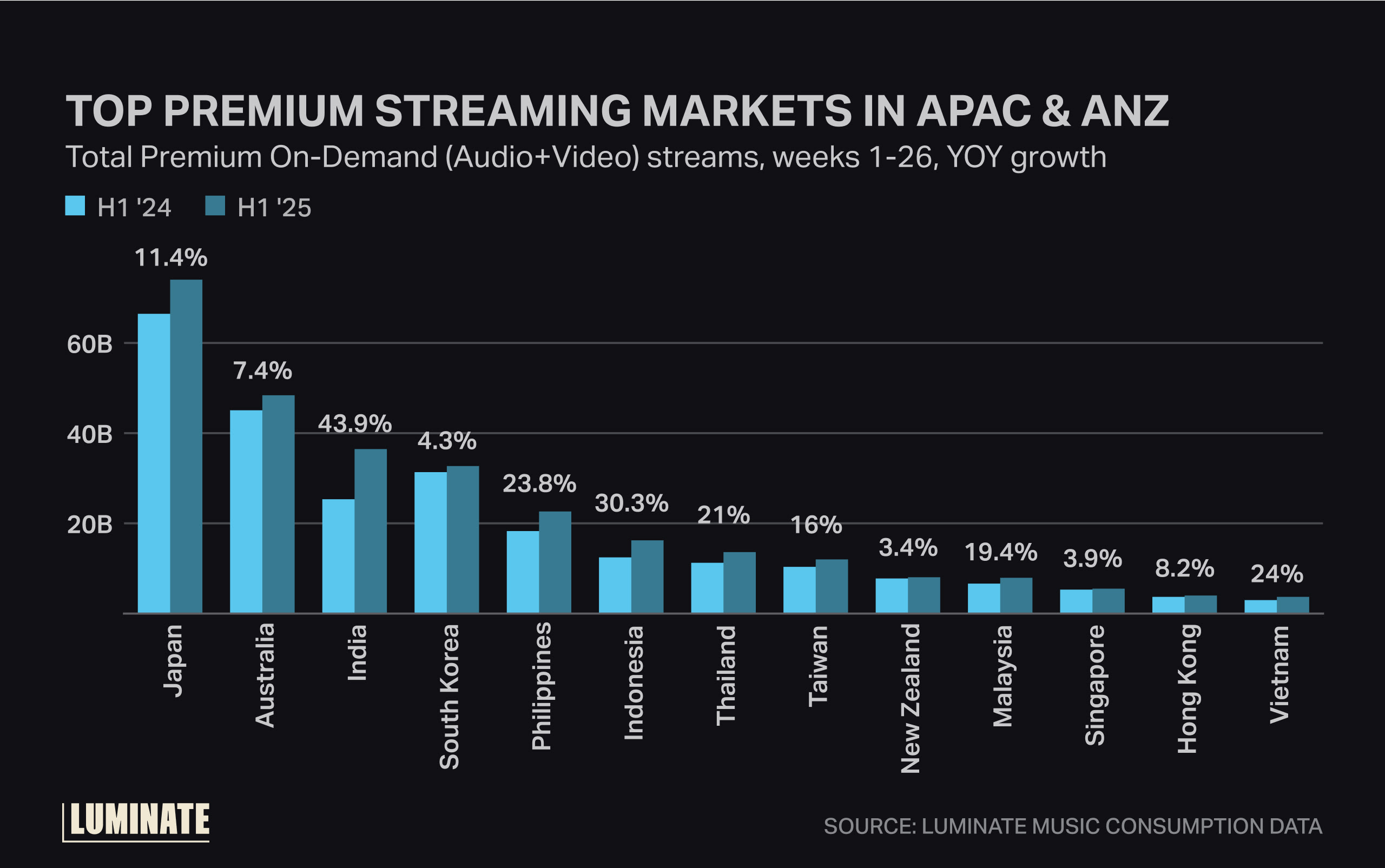
The report found premium streams of music, film and TV content in Japan shot up 11.4% YoY in Japan, passing the 70-billion mark. Australia came in second, with around 50 billion, followed by India, which overtook South Korea for third place, with streams up 43.9% YoY to nearly 40 billion.


Source: Luminate

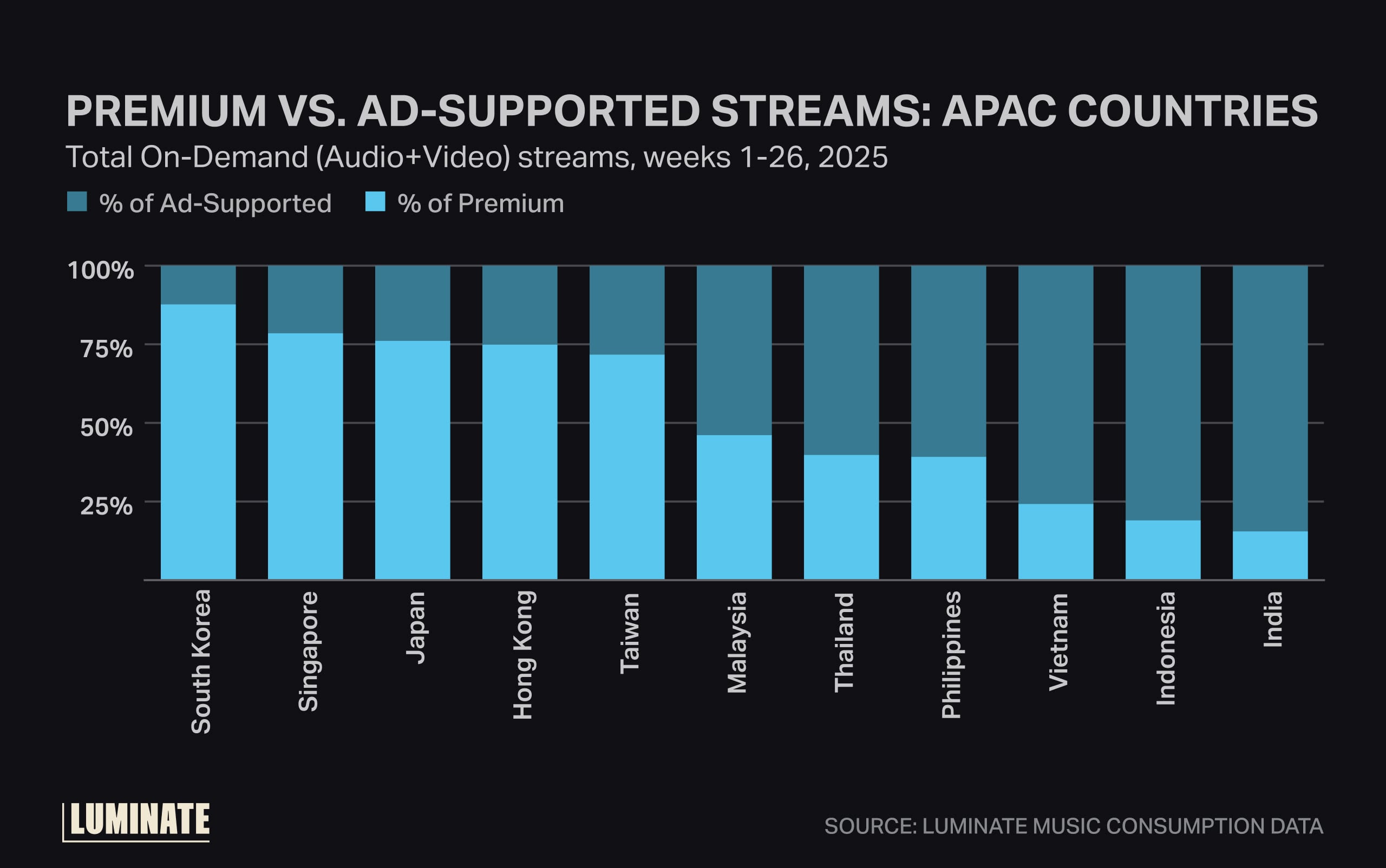
In terms of total streams, including ad-supported, India remains in first place, with Japan in second and Indonesia in third. However, India and Indonesia have the lowest share of premium streams among the countries surveyed, with fewer than 20% of streams coming via paid accounts.

That compares with rates at or above 75% in South Korea, Singapore, Japan and Hong Kong.


Source: Luminate

That places these countries near the global average of 82% of streams coming from premium accounts. That compares to just 62% in the APAC region.

This gap illustrates both the challenge and opportunity for the region,” Marconette wrote.

“Japan has historically valued physical music formats such as CDs. And while they are still very popular and command significant spend, younger audiences are increasingly gravitating toward streaming platforms.”

Jamie Marconette, Luminate

He sees promise in Japan’s leading role in paid streaming adoption.

“The clear leadership of Japan has ripple effects across the global music economy. By driving Premium volume in a region still catching up to global norms, the country is shaping consumption patterns, licensing models and fan expectations,” Marconette wrote.

“Its role ensures artists and labels alike see meaningful revenue returns in a part of the world where ad-supported and free streaming have historically been more common.”Music Business Worldwide

Bike Brake Technology Using Recycled Aluminum

0

You don’t become one of the world’s top motorcycle component manufacturers for nothing. For the past five years, Brembo has been working to improve the environmental impact of its manufacturing processes – and now, it’s claiming a breakthrough.

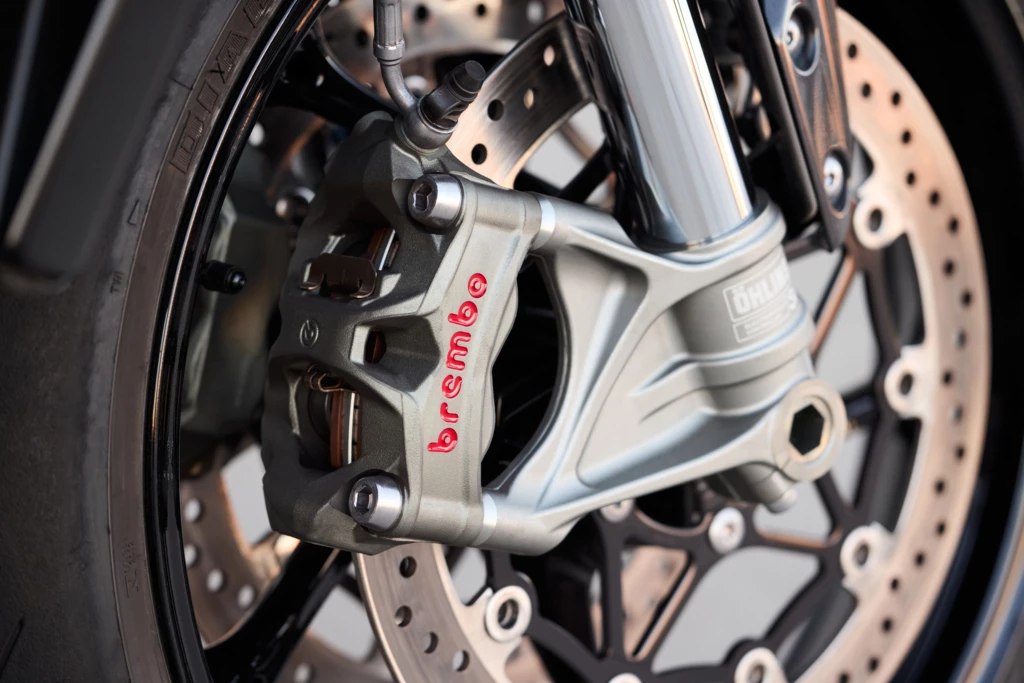
Brembo has developed a brake caliper made from an alloy composed entirely of 100% recycled aluminum. According to the company, this new alloy reduces life cycle emissions per caliper by up to 70%, without compromising performance or design.

Aluminum was chosen for its ability to be infinitely recycled without any loss in quality. To pinpoint where changes could make the biggest difference, Brembo began by evaluating its entire caliper production cycle.

The new alloy is claimed to reduce brake caliper life-cycle emissions by up to 70%

Brembo

Once that analysis was complete, the next step was to select a material available in all regions where Brembo operates production plants. That includes Europe, the US, Brazil, Mexico, China, India, Japan, and Thailand. That decision makes sense, as it avoids adding logistical complexity or cost.

Switching to the new alloy required updates to both the manufacturing process and product evaluation. Brembo reindustrialized and revamped existing designs to ensure the new system could be implemented across all plants.

Importantly, the new components retain all the stylistic elements that distinguish the Italian brand, including its signature use of color. Calipers built with the new recycled alloy will also carry a new “ALU” trademark emblem to make them visually identifiable.

Brembo ensured that the new components retain all the stylistic elements that distinguish the Italian brand

Brembo

While Brembo’s claim of a 70% CO2 reduction per caliper is impressive, the broader question is how much that truly shifts the needle across its total operations. A single component – even one as crucial as a caliper – represents just a fraction of a vehicle’s overall environmental footprint. The real win will come when this innovation scales across Brembo’s full catalog and ideally sets a new standard for the industry supply chain.

That, of course, depends on how quickly and cost-effectively Brembo can roll it out. Transitioning every component to a new material spec isn’t a flick-of-a-switch decision; it involves retooling, validation, and supplier alignment. Maintaining cost parity will be key, because if prices rise too sharply, OEMs may hesitate, especially in more price-sensitive product ranges.

For calipers that are presently in production, Brembo will prioritize the usage of aluminum made using renewable energy

Triumph Motorcycles

Brembo says it has already begun supplying one of its major customers, meaning calipers made from the new alloy could already be appearing on production motorcycles. Given that Brembo supplies braking systems for many of the world’s largest manufacturers of cars, commercial vehicles, motorcycles, and mountain bikes, it’s unclear who that “major customer” might be.

For calipers already in production, Brembo will continue using conventional aluminum until the end of their product life, while prioritizing the usage of aluminum made using renewable energy.

For now, this marks a significant step toward a future where “premium performance” and “sustainability” are no longer at odds. The new ALU emblem could eventually become a symbol of where the industry is headed – toward cleaner engineering that doesn’t need to make compromises.

Source: Brembo

What Comes After the Israel-Hamas Cease-Fire: Addressing Gaza Aid, Hostages, and Other Issues

0

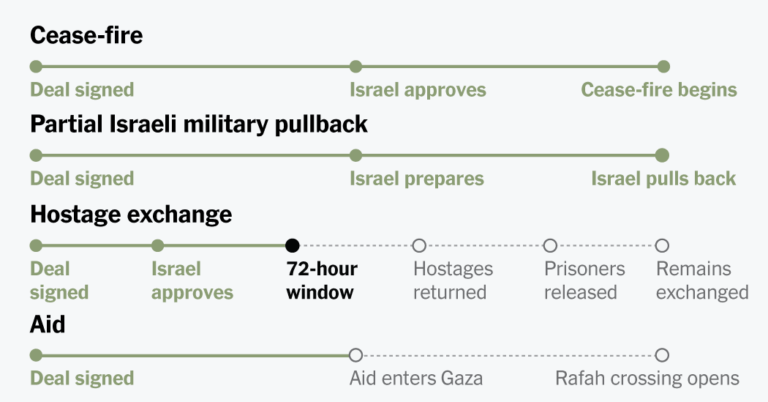
Cease-fire

  • Deal signed
  • Israel approves
  • Cease-fire begins

Partial Israeli military pullback

  • Deal signed
  • Israel prepares
  • Israel pulls back

Hostage exchange

  • Deal signed
  • Israel approves
  • 72-hour window begins
  • Hostages returned
  • Prisoners released
  • Remains exchanged

Aid

  • Deal signed
  • Aid enters Gaza
  • Rafah crossing opens

Israel and Hamas have signed a cease-fire agreement to free the remaining hostages in Gaza. Mediators hope that the deal will finally bring an end to two nightmarish years of war that have killed tens of thousands and laid waste to the Gaza Strip.

The agreement is based on the first stage of a detailed plan put forward by President Trump. But the future is murky: Many of the plan’s ambitious ideas for postwar Gaza have yet to be negotiated.

Here’s the progress of the deal so far.

Cease-fire

Israel and Hamas agreed to an open-ended cease-fire after two years of war, which the United States and other mediators hope will finally end the conflict.

  • Broad agreement Negotiators from both sides sign the deal in Egypt
  • Israeli cabinet approval Israel’s government formally votes on the agreement
  • Beginning of cease-fire Both sides suspend military operations

Partial Israeli military pullback

Israeli forces are expected to partially withdraw from the Gaza Strip while remaining deployed there.

  • Broad agreement Israel and Hamas agree on maps for Israeli troop withdrawal
  • Preparation by Israeli military to pull back to agreed line Israeli forces scale down their operations to prepare
  • Withdrawal by Israeli military to agreed line Soldiers withdraw to an agreed-upon “yellow line” in Gaza

Hostage exchange

Hamas is expected to free the 20 living hostages in Gaza and to turn over the bodies of 28 others. Israel is to release nearly 2,000 Palestinian prisoners and the bodies of 360 Palestinians.

  • Broad agreement Negotiators from both sides sign the deal in Egypt
  • Israeli cabinet approval Israel’s government formally votes on the agreement
  • Beginning of 72-hour window Hamas has 72 hours to return living Israeli hostages and remains
  • Return of hostages Hamas turns over 20 living hostages and the bodies of those it can find
  • Release of Palestinian prisoners Israel releases about 2,000 Palestinian prisoners
  • Exchange of deceased hostages and prisoners Hamas returns the bodies of the remaining Israeli hostages in exchange for the remains of Palestinian detainees

Aid

Restrictions on the delivery of desperately needed food, medicine and other relief are to be lifted. The Rafah crossing with Egypt should also open.

  • Broad agreement Israel and Hamas sign off on humanitarian conditions for Gaza
  • Start of additional aid entering Gaza Aid groups begin bringing in hundreds more trucks of relief per day
  • Reopening of Rafah crossing Gaza’s border crossing with Egypt reopens, allowing more aid and some people to leave

The issues below aren’t covered by the current cease-fire deal, and could be sticking points in future negotiations.

Gaza governance

Mr. Trump’s plan stipulates that postwar Gaza be governed by a technocratic Palestinian committee, not Hamas. Hamas says it is open to the idea, but many of the details still need to be worked out.

Disarmament

Under Mr. Trump’s plan, Hamas would have to lay down its weapons. Its members would seek amnesty or leave Gaza for exile abroad. It’s a key demand for Israel, but Hamas officials have expressed serious reservations about this in the past.

International security mission

The U.S. framework calls for an “international stabilization force” to handle security in postwar Gaza. That’s not in the current agreement. But even the prospect raises huge questions: which countries would send troops, how they would do their jobs and whether they would be effective.

Full Israeli withdrawal

The current agreement leaves Israeli forces deployed through the Gaza Strip. It is far from clear when, or under what conditions, Israel would finally agree to withdraw its forces from Gaza.

Challenging the Client

0


Client Challenge


JavaScript is disabled in your browser.

Please enable JavaScript to proceed.

A required part of this site couldn’t load. This may be due to a browser
extension, network issues, or browser settings. Please check your
connection, disable any ad blockers, or try using a different browser.

Heavy gunfire exchanged between Taliban and Pakistani forces along Afghanistan border | Border Conflict Escalates

0

Clashes come as tensions escalate over an air strike on Kabul that the Taliban blames on Islamabad.

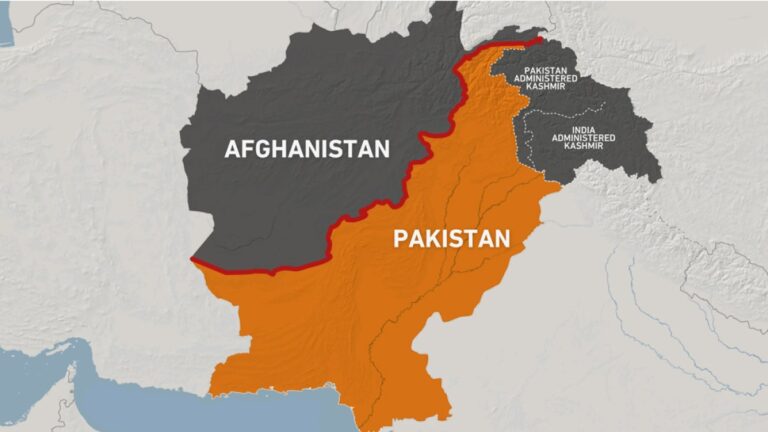
Taliban and Pakistani forces have exchanged fire across the Afghanistan-Pakistan border, prompting calls for restraint from Iran, Qatar and Saudi Arabia, as tensions escalate following an air strike on the Afghan capital, Kabul, earlier this week.

Enayatullah Khwarizmi, the spokesperson for the Afghan Ministry of Defence, said late on Saturday that Taliban forces had carried out “successful retaliatory” attacks against Pakistani soldiers in response to the neighbouring country’s “repeated violations” of, and air strikes on, Afghan territory.

Recommended Stories

list of 3 itemsend of list

He said on X that the operation had ended at midnight.

Pakistani Minister of Interior Mohsin Naqvi called the Afghan attacks “unprovoked” and said that Pakistani forces were responding “with a stone for every brick”.

“Firing by Afghan forces on civilian population is a blatant violation of international laws. Pakistan’s brave forces have given a prompt and effective response that no provocation will be tolerated,” he said in a post on X.

Radio Pakistan, citing security sources, said the Afghan attacks took place at some six locations along the border.

It said the attacks prompted a “strong, intense response” from the Pakistan Army, and shared video footage of gun and artillery fire that lit up the night sky.

It did not say whether the clashes had ended.

The fighting comes days after explosions rocked the Afghan capital, Kabul, in an air strike that the Taliban blamed on Pakistan.

Islamabad did not claim responsibility for Thursday’s attacks.

However, it accused the Afghan Taliban administration of harbouring fighters of the Pakistani Taliban who attack Pakistan, with the support of its adversary, India.

New Delhi denies the charge, while the Taliban says it does not allow its territory to be used against other countries.

The escalating tensions have prompted regional concern.

Iranian Minister of Foreign Affairs Abbas Araghchi called on his country’s two neighbours “to exercise restraint”.

“Our position is that both sides must exercise restraint,” Araghchi said during a live interview with state television, according to the AFP news agency, adding that “stability” between the countries “contributes to regional stability”.

Qatar expressed “deep concern” over the tensions and the “potential tensions these may have on the security and stability of the region”.

Qatar’s Ministry of Foreign Affairs also urged “both sides to prioritise dialogue and diplomacy, exercise restraint, and work to contain the disputes in a way that helps reduce tension, avoids escalation, and contributes to regional peace and stability”.

Saudi Arabia, too, expressed concern.

“The kingdom calls for restraint, avoiding escalation, and embracing dialogue and wisdom to contribute to reducing tensions and maintaining security and stability in the region,” the Saudi Foreign Ministry said.

“The kingdom affirms its support for all regional and international efforts aimed at promoting peace and stability, and its continued commitment to ensuring security, which will achieve stability and prosperity for the brotherly Pakistani and Afghan peoples,” it added.

Gazans return home as Israel-Hamas ceasefire remains in place

0

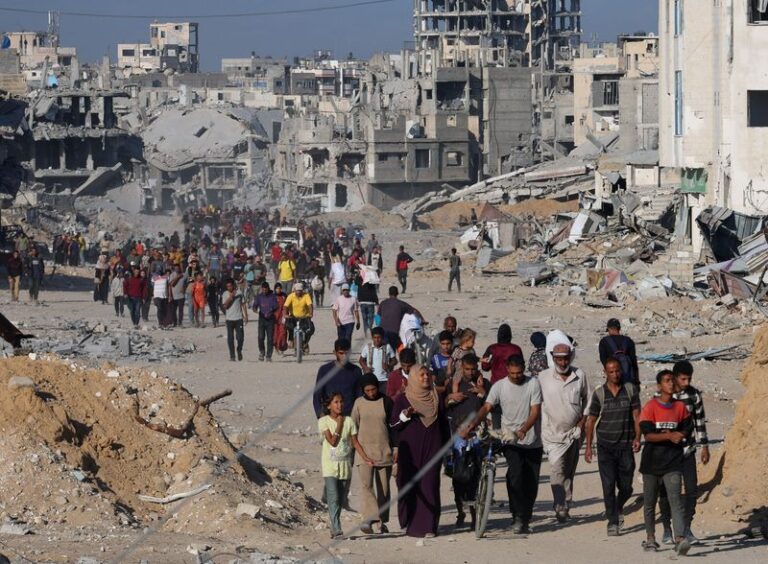
Gazans stream back home as Israel-Hamas ceasefire holds