-0 C
New York
Wednesday, February 25, 2026
Home Blog Page 315

Shane Ryan, a three-time Irish Olympian, will be joining the Enhanced Games.

0

By Nicole Miller on SwimSwam

Yet another athlete has announced their commitment to join the Enhanced Games.

In a post on Instagram, the Enhanced Games (@enhanced_games) shared that 3-time Irish Olympian Shane Ryan will be joining the games set to occur next year.

Ryan, 31, most recently competed at the 2025 World Championships in Singapore where he was one of several swimmers to fall ill with a stomach bug during the meet. Following the World Championships, Ryan remained out of competition for several months before announcing his retirement from competitive swimming last week. In his retirement post, Ryan noted that he wasn’t planning on stepping away from the pool completely, but did not mention the Enhanced Games. “Though I’m stepping away from competition, my love for the sport remains as strong as ever – and I look forward to giving back in new ways, mentoring the next generation and staying involved in the swimming community.”

Ryan, a backstroke specialist, has picked up several minor international medals throughout his career including bronze medals in the 50 backstroke at both the 2018 and 2024 SC World Championships. He has also represented Ireland at three Olympic Games, including the 2016, 2021, and 2024 Games, becoming the first Irish-man to do so. At the Olympics, he never made an individual final, with his highest finish coming in the 100 backstroke in 2016 where he placed 16th in the semi-finals of the event.

Prior to switching to Irish sporting cititizenship in 2016, Ryan was a member of the US Junior National Team. He was born-and-raised in Pennsylvania and attended Penn State, where he competed for the Natty Lions between 2012 and 2017 (with a redshirt year for the 2016 Olympic Games). He remains one of the only swimmers in school history to have competed at the Olympics.

Ryan also competed for the Toronto Titans in the now-defunct International Swimming League (ISL) back in 2020. The league was known for its strict anti-doping policies, a stark comparison to the Enhanced Games.

Despite his speciality being the backstroke events, the Enhanced Games clarified in their Instagram post that Ryan will contest the 50m freestyle and 100m sprint at the games. While the latter of the two events was previously listed as the 100m freestyle, it is unclear whether the games will shift to include additional strokes in the event. Currently, the only other swimming events on the schedule are the 50m and 100m butterfly.

With this announcement, Ryan joins a growing list of accomplished swimmers who have joined the Games, joining male sprinters Ben Proud, Kristian Gkolomeev, James Magnussen, Andrii Govorov, Marius Kusch, and Josif Miladinov, while American Megan Romano became the first female to join the organization in early August.

The controversial organization is hosting its inaugural event next May in Las Vegas with $1 million on the line for going under the existing  the world record in the 50 free or the 100-meter dash. Other events are slated to pay out $250,000 for dipping under the existing mark.


Read the full story on SwimSwam: 3-Time Irish Olympian Shane Ryan To Join the Enhanced Games

Emergency Supply Delivery to Orbit in Less than an Hour

0

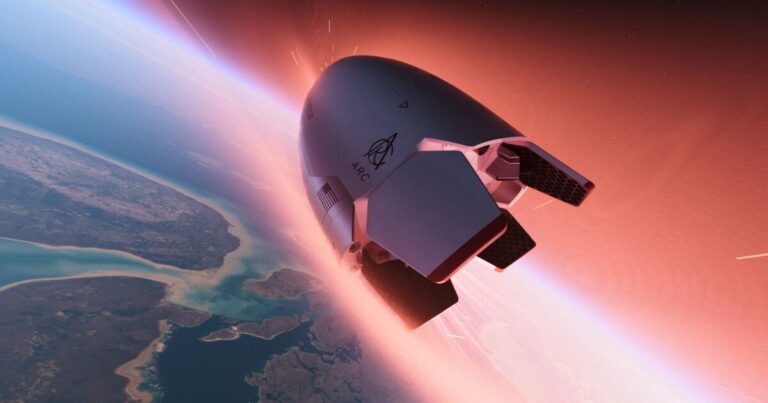
Aerospace and defense company Inversion is showing off its solution to getting emergency supplies anywhere on Earth in under an hour. It’s a constellation of the company’s Arc orbital supply craft, fully stocked and ready to drop at a moment’s notice.

As technology progresses, so does the pace with which things operate or are expected to operate. There was a time when military and humanitarian missions on the other side of the globe would take months, even years – and might even begin or end before anyone back home was even aware of them.

Today, emergency responses are becoming increasingly fast. Being on-site within a day to counter aggression or provide disaster relief isn’t good enough. Even proposed subsonic orbital craft that can touch down in two hours don’t come up to scratch.

Arc

Unless someone invents a teleportation device, immediate responses aren’t going to happen, but Inversion is aiming for the next best thing by prepositioning supplies where they can get anywhere in the world when needed. The idea isn’t new. For decades, major military powers and humanitarian agencies have established forward bases and supply depots from which materials can be quickly deployed.

However, these have obvious limitations. There are many regions where it simply isn’t possible to set up depots, such a network can only be so large, and getting from the depot to where help is needed can still take an unacceptably long time.

Inversion’s answer to this is based on its reusable Arc orbital reentry vehicle, which is an aerodynamic capsule capable of carrying up to 500 lb (225 kg) of cargo. Based on the company’s Ray vehicle, which flew in January 2025, Arc is designed to sit in low-Earth orbit until needed and then reenter autonomously to land by steerable parachute to a desired location inside an hour.

The Arc orbital cargo transport

Inversion

The idea is that to support military and humanitarian missions, constellations of Arc vehicles would be loaded up and launched into space. There they would park with a small service module docked to each one to provide propulsion and support systems, as well as power through solar panels. On command, the Arc would detach from the service module and reenter the atmosphere at Mach 20+ with a high sustained g-load to arrive at any location within its orbital inclination zone.

According to the company, such a capability can not only allow Arc to supply areas lacking transport infrastructure, but also locations where hostile forces might try to deny access. In addition to emergency supply missions, Inversion claims that Arc could be used as an advanced hypersonic test platform.

“With massive cross-range to cover great distances during reentry, and high maneuverability throughout every phase of flight, Arc delivers a transportation capability that has never existed before,” said Justin Fiaschetti, Co-Founder and CEO of Inversion. “We see a future where thousands of Arc spacecraft form a logistics network that provides transformative reach, resilience, and deterrence for the United States and its allies.”

Source: Inversion

Trump Speaks to Israeli Parliament Regarding Gaza Cease-Fire

0

new video loaded: Trump Addresses Israel’s Parliament About Cease-Fire in Gaza

transcript

transcript

Trump Addresses Israel’s Parliament About Cease-Fire in Gaza

President Trump was given a standing ovation before a speech in the Israeli Parliament in which he claimed a cease-fire was “the historic dawn of a new Middle East.”

This is not only the end of a war, this is the end of a age of terror and death and the beginning of the age of faith and hope and of God. This is the historic dawn of a new Middle East. … over and over again. [gavel bangs] [shouting in Hebrew] Translator: “Please expel this Knesset member. Please expel this Knesset member.” Hey, I have an idea. Mr. President, why don’t you give him a pardon? [audience applauds and cheers] Give him a pardon. Mr. President, today we welcome you here to thank you for your pivotal leadership in putting forward a proposal that got the backing of almost the entire world. Donald Trump is the greatest friend that the state of Israel has ever had in the White House.

President Trump was given a standing ovation before a speech in the Israeli Parliament in which he claimed a cease-fire was “the historic dawn of a new Middle East.”

By Monika Cvorak

October 13, 2025

JPMorgan pledges $10 billion investment in US national security as part of $1.5 trillion commitment

0

JPMorgan to invest up to $10 billion in US national security as part of $1.5 trillion pledge

The history of US trade measures against China and Trump’s threat of a 100% tariff | Latest updates on Donald Trump

0

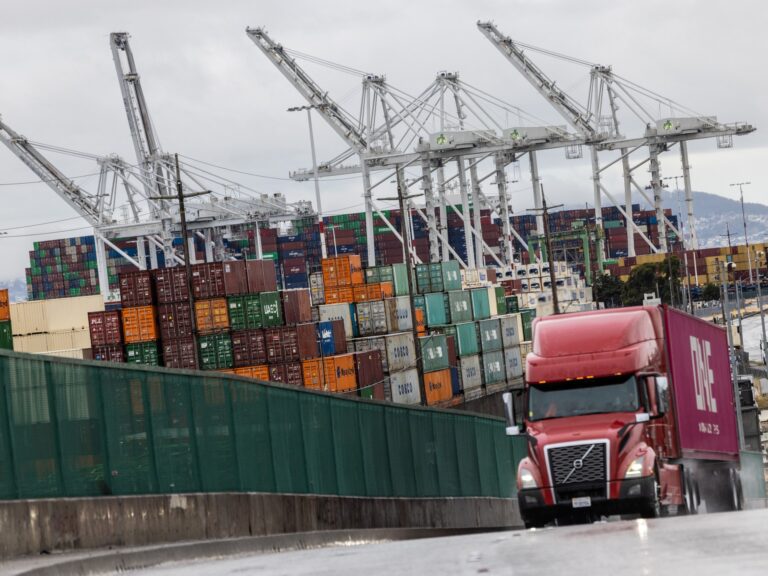
China has accused the United States of “double standards” after US President Donald Trump threatened to impose an additional 100 percent tariff on Chinese goods in response to Beijing’s curbs on exports of rare earth minerals.

China says its export control measures announced last week were in response to the US restrictions on its entities and targeting of Beijing’s maritime, logistics and shipbuilding industries.

Recommended Stories

list of 4 itemsend of list

Trump’s tariff threats, which come weeks ahead of the likely meeting between the US president and his Chinese counterpart Xi Jinping, have the potential to reignite a trade war months after Washington lowered the China tariffs from 125 to 30 percent.

The actions by the world’s two largest economies threaten to ignite a new trade war, adding further uncertainty to global trade. So what’s the recent history of US trade measures against China, and will the two countries be able to resolve their differences?

Why did China tighten export controls on rare earths?

On October 9, China expanded export controls to cover 12 out of 17 rare-earth metals and certain refining equipment, effective December 1, after accusing Washington of harming China’s interests and undermining “the atmosphere of bilateral economic and trade talks”.

China also placed restrictions on the export of specialist technological equipment used to refine rare-earth metals on Thursday.

Beijing justified its measures, accusing Washington of imposing a series of trade curbs on Chinese entities despite the two sides being engaged in trade talks, with the last one taking place in Madrid, Spain last month.

Foreign companies now need Beijing’s approval to export products containing Chinese rare earths, and must disclose their intended use. China said the heightened restrictions come as a result of national security interests.

China has a near monopoly over rare earths, critical for the manufacture of technology such as electric cars, smartphones, semiconductors and weapons.

The US is a major consumer of Chinese rare earths, which are crucial for the US defence industry.

At the end of this month, Trump and Xi are expected to meet in South Korea, and experts speculate that Beijing’s move was to gain bargaining advantage in trade negotiations with Washington.

China’s tightening of restrictions on rare earths is “pre-meeting choreography” before Trump’s meeting with Xi, Kristin Vekasi, the Mansfield chair of Japan and Indo-Pacific Affairs at the University of Montana, told Al Jazeera.

How did Trump respond?

On October 10, Trump announced the imposition of a 100 percent tariff on China, effective from November 1.

“Based on the fact that China has taken this unprecedented position … the United States of America will impose a Tariff of 100 percent on China, over and above any Tariff that they are currently paying,” Trump wrote in a post on his Truth Social platform.

He added that this would come into effect on November 1 or before that. Trump added that the US would also impose export controls on “any and all critical software”.

Earlier on October 10, Trump accused China of “trade hostility” and even said he might scrap his meeting with Xi. It is unclear at this point whether the meeting will take place.

“What the United States has is we have a lot of leverage, and my hope, and I know the president’s hope, is that we don’t have to use that leverage,” US Vice President JD Vance told Fox News on Sunday.

How did China respond to that?

China deemed the US retaliation a “double standard”, according to remarks by the Chinese Ministry of Commerce spokesperson on Sunday.

China said that Washington had “overstretched the concept of national security, abused export control measures” and “adopted discriminatory practices against China”.

“We are living in an era of deeper intertwining of security and economic policies. Both the US and China have expanded their conceptions of national security, encompassing a range of economic activities,” Manoj Kewalramani, chairperson of the Indo-Pacific Studies Programme at the Takshashila Institution in Bangalore, India, told Al Jazeera.

“Both have also weaponised economic interdependence with each other and third parties. There are, in other words, no saints in this game.”

Kewalramani said that China started expanding the idea of “national security” much earlier than others, especially with its “comprehensive national security concept” introduced in 2014.

Through this, China began to include many different areas, such as economics, technology, and society, under the term “national security”. This shows that China was ahead of other countries in broadening what counts as a national security issue.

China threatened additional measures if Trump went ahead with his pledge.

“Willful threats of high tariffs are not the right way to get along with China. China’s position on the trade war is consistent: we do not want it, but we are not afraid of it,” the Chinese Commerce Ministry spokesperson said in a statement.

“Should the US persist in its course, China will resolutely take corresponding measures to safeguard its legitimate rights and interests,” the statement said.

What trade measures has the US taken against China in recent history?

2025: Trump unleashes tariff war

A month after taking office for his second term, Trump signed an executive order imposing a 10 percent tariff on all imports from China, citing a trade deficit in favour of China. In this order, he also imposed tariffs on Mexico and Canada. China levied countermeasures, imposing duties on US products in retaliation.

In March, the US president doubled the tariff on all Chinese products to 20 percent as of March 4. China imposed a 15 percent tariff on a range of US farm exports in retaliation; these took effect on March 10.

Trump announced his “reciprocal tariffs,” imposing a 34 percent tariff on Chinese products. China retaliated, also announcing a 34 percent tariff on US products. This was the first time China announced export controls on rare earths.

Hours after the reciprocal tariffs went into effect, Trump paused them for all his tariff targets except China. The US and China continued to hike tit-for-tat levies on each other.

Trump slapped 145 percent tariffs on Chinese imports, prompting China to hit back with 125 percent tariffs. Washington and Beijing later cut tariffs to 30 percent and 10 percent, respectively, in May, then agreed to a 90-day truce in August for trade talks. The truce has been extended twice.

December 2024: The microchip controls are tightened

In December 2024, Trump’s predecessor, former US President Joe Biden, tightened controls on the sale of microchips first introduced on October 2022.

Under the new controls, 140 companies from China, Japan, South Korea and Singapore were added to a list of restricted entities. The US also banned more advanced chip-making equipment to certain countries. Even products manufactured abroad with US technology were restricted.

April 2024: Biden signs the TikTok ban

Biden signed a bill into law that would ban TikTok unless it was sold to a non-Chinese buyer within a year. The US government alleged that TikTok’s Chinese parent company ByteDance was linked to the Chinese government, making the app a threat to national security.

ByteDance sued the US federal government over this bill in May 2024.

In September this year, Trump announced that a deal was finalised to find a new owner of TikTok.

October 2023: Biden introduces more restrictions on chips

In October 2023, Biden restricted US exports of advanced computer chips, especially those made by Nvidia, to China and other countries.

The goal of this measure was to limit China’s access to “advanced semiconductors that could fuel breakthroughs in artificial intelligence and sophisticated computers that are critical to [Chinese] military applications,” Gina Raimondo, who was secretary of the US Department of Commerce during the Biden administration, told reporters.

Prior to this, Biden signed an executive order in August 2023, creating a programme that limits US investments in certain high-tech areas, including semiconductors, quantum computing, and artificial intelligence, in countries deemed to be a security risk, like China.

October 2022: Biden restricts Chinese access to semiconductors

Biden restricted China’s access to US semiconductors in October 2022. The rules further expanded restrictions on chipmaking tools to include industries that support the semiconductor supply chain, blocking both access to American expertise and the essential components used in manufacturing the tools that produce microchips.

Semiconductors are used in the manufacturing of artificial intelligence (AI) technologies. The US government placed these restrictions back then to limit China’s ability to acquire the ability to produce semiconductors and advance in the technological race.

The restrictions made it compulsory for entities within China to apply for licences to acquire American semiconductors. Analysis by the US-based Carnegie Endowment for International Peace described these licences as “hard to get” back then.

Recently, some US lawmakers are calling for even more restrictions, warning that China could quickly reverse-engineer advanced semiconductor technologies on its own, outpace the US in the sector, and gain a military edge.

May 2020: Trump cracks down on Huawei

In May 2020, the US Bureau of Industry and Security intensified rules to stop Huawei, the Chinese tech giant, from using American technology and software to design and make semiconductors in other countries.

The new rules said that semiconductors are designed for Huawei using US technology or equipment, anywhere in the world, would need US government approval before being sent to Huawei.

May 2019: Trump bans Huawei

Trump signed an executive order blocking Chinese telecommunications companies like Huawei from selling equipment in the US. The Shenzhen-based Huawei is the world’s largest provider of 5G networks, according to analysis by the New York City-based think tank the Council on Foreign Relations (CFR).

Under this order, Huawei and 114 related entities were added to a list that requires US companies to get special permission (a licence) before selling certain technologies to them.

The rationale behind this order was the allegation that Huawei threatened US national security, had stolen intellectual property and could commit cyber espionage. Some US lawmakers alleged that the Chinese government was using Huawei to spy on Americans. The US did not publicise any evidence to back these allegations.

Other Western countries had also cooperated with the US.

March 2018: Trump imposes tariffs on China

During his first administration, Trump imposed sweeping 25 percent tariffs on Chinese goods worth as much as $60bn. In June of 2018, Trump announced more tariffs.

China retaliated by imposing tariffs on US products. Beijing deemed Trump’s trade policies “trade bullyism practices”, according to an official white paper, as reported by Xinhua news agency.

In September 2018, Trump issued another round of 10 percent tariffs on Chinese products, which were hiked to 25 percent in May 2019.

During the Obama administration (2009-2017)

In 2011, during US President Barack Obama’s tenure, the US-China trade deficit reached an all-time high of $295.5bn, up from $273.1bn in the previous year.

In March 2012, the US, European Union, and Japan formally complained to China at the World Trade Organization (WTO) about China’s limits on selling rare earth metals to other countries. This move was deemed “rash and unfair” by China.

In its ruling, the world trade body said China’s export restraints were breaching the WTO rules.

In 2014, the US indicted five Chinese nationals with alleged ties to China’s People’s Liberation Army. They were charged with stealing trade technology from American companies.

What’s next for the US-China trade war?

Trump and Xi are expected to meet in South Korea on the sidelines of the Asia-Pacific Economic Cooperation (APEC), which is set to begin on October 31.

But the latest trade dispute has clouded the Xi-Trump meeting.

On Sunday, Trump posted on his Truth Social platform, downplaying the threat: “Don’t worry about China, it will all be fine! Highly respected President Xi just had a bad moment. He doesn’t want Depression for his country, and neither do I. The U.S.A. wants to help China, not hurt it!!!”

In an interview with Fox Business Network on Monday, US Treasury Secretary Scott Bessent said, “President Trump said that the tariffs would not go into effect until November 1. He will be meeting with [Communist] Party Chair Xi in [South] Korea. I believe that meeting will still be on.”

When it comes to which of the two players is more affected by the trade war, Kewalramani said that he thinks “what matters is who is willing to bear greater pain, endure greater cost”.

“This is the crucial question. I would wager that Beijing is probably better placed because Washington has alienated allies and partners with its policies since January. But then, China’s growing export controls are not simply aimed at the US. They impact every country. So Beijing has not also endeared itself to anyone,” Kewalramani said, pointing out how Trump’s tariffs and China’s rare earth restrictions target multiple countries.

“The ones affected the most are countries caught in the midst of great power competition.”

On Sunday, US VP Vance told Fox News about China: “If they respond in a highly aggressive manner, I guarantee you, the president of the United States has far more cards than the People’s Republic of China.”

Kewalramani said that so far, Beijing has been more organised, prepared and strategic than the US in its policies.

“That said, it has overreached with the latest round of export controls. US policy, meanwhile, has lacked strategic coherence. The US still is the dominant global power and has several cards to play. What matters, however, is whether it can get its house in order.”


Traders left reeling as crypto markets rebound following $19 billion wipeout

0

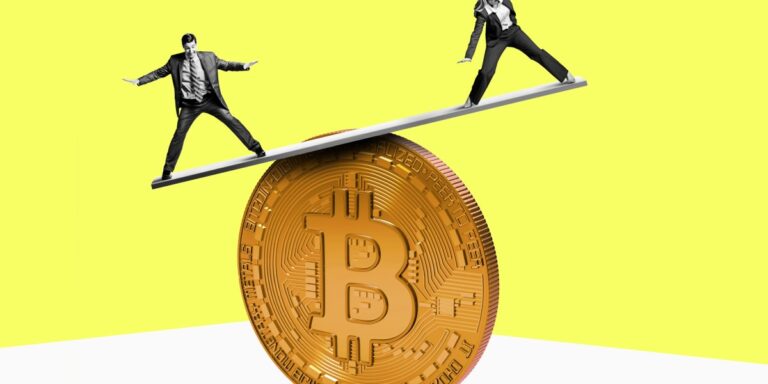
The crypto market bounced back on Monday, just days after traders experienced the worst crypto liquidation event in history. Bitcoin is up 3% over the past 24 hours to now near $115,00, according to data from Binance. Ethereum, the world’s second largest cryptocurrency by market capitalization, is up even more, gaining almost 9% to hover near $4,130. After dipping below the $4 trillion mark on Friday, the total market capitalization of all cryptocurrencies have swung back nearly 5% over the past day to $4.01 trillion.

The ricochet in crypto prices follows a disastrous Friday that saw more than $19 billion in traders’ positions evaporate. It was the largest one-day liquidation event ever tracked by the crypto analytics company CoinGlass. In less than 24 hours, Bitcoin shed more than $200 billion in market capitalization and dropped nearly 10% in price. And Ethereum was hit even harder, dropping almost 14%.

The market chaos even affected stablecoins, or cryptocurrencies pegged to the U.S. dollar. USDe, one of the largest stablecoins by market capitalization, depegged to 65 cents on the crypto exchange Binance before quickly rebounding back to $1. The depegging event was only connected to Binance, not other exchanges, Guy Young, founder of Ethena Labs, the developer behind USDe, said Sunday.

The market turbulence follows a Friday social media post from President Donald Trump in which he threatened the People’s Republic of China with a 100% tariff “over and above” existing tariffs levied against the country. “It has just been learned that China has taken an extraordinarily aggressive position on Trade in sending an extremely hostile letter to the World,” claimed Trump on Truth Social, the social media website his family owns.

Trump’s post came in response to recent trade restrictions imposed by the People’s Republic on rare earth metals and related technologies. The country is the largest producer of rare earths in the world, which include metals needed for production of everyday technologies like batteries, flat-screen TVs, and even fighter jets.  

But, shortly after Trump issued his trade threats against China on Friday, he and his administration walked back some of his most aggressive rhetoric.”Don’t worry about China, it will all be fine!” he posted Sunday on Truth Social. “The U.S.A. wants to help China, not hurt it!!!”

U.S. Treasury Secretary Scott Bessent echoed Trump in a Monday morning interview with Fox Business. While Bessent criticized China’s rare earth restrictions, he said that the administration has “substantially deescalated” trade tensions with China since Trump’s threats and that there’s been “substantial communication” over the weekend.

“I believe China is open to discussion on this,” Bessent added.

The stock market has responded favorably. After tanking 3% on Friday, the S&P 500 opened Monday up 1%.

On the new Fortune Crypto Playbook vodcast, Fortune’s senior crypto experts decode the biggest forces shaping crypto today. Watch or listen now

Canadian Foreign Minister meets with Indian Prime Minister Modi as relations improve

0

India and Canada have agreed a host of steps at talks between their foreign ministers in Delhi aimed at restoring ties that plummeted after a Sikh separatist leader was assassinated on Canadian soil.

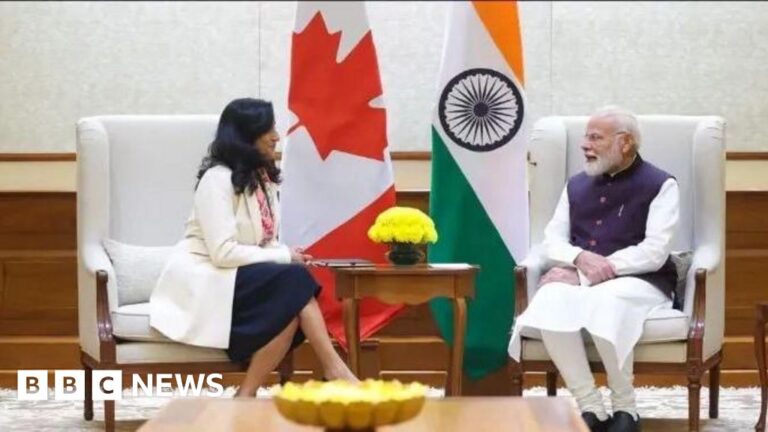
Canada’s Foreign Minister Anita Anand, making her first official visit to India, met her counterpart S Jaishankar and Prime Minister Narendra Modi.

Modi told her the visit would strengthen “efforts to impart new momentum” to the two countries’ partnership.

Relations hit rock bottom in 2023 when Canada’s then PM Justin Trudeau accused India of being linked to the killing of Hardeep Singh Nijjar, claims Delhi denied. Both countries suspended visa services and expelled each other’s top diplomats.

Canada is home to nearly 1.7 million people of Indian origin and the developments were being watched anxiously in both countries.

After the meeting of their foreign ministers in Delhi, the two sides announced a series of measures, including starting ministerial-level discussions on bilateral trade and investment.

“Reviving this partnership will not only create opportunities for enhanced economic cooperation but also help mitigate vulnerabilities arising from shifting global alliances,” a joint statement said.

Signs of a thaw have appeared this year since Mark Carney took over as Canadian prime minister.

In June, Carney and Modi held a bilateral meeting on the sidelines of the G7 summit in Canada. Two months later, the countries appointed new high commissioners to each other’s countries.

Anand and Jaishankar also met each other on the sidelines of the United Nations General Assembly session in New York in September.

On Monday, Jaishankar said that India-Canada bilateral relations have been steadily progressing in the last few months.

“When we look at Canada, we see a complementary economy. We see another open society. We see diversity and pluralism,” he said, adding that this was “the basis for a close sustainable and long-term co-operative framework”.

“We are collectively committed to advancing this relationship now and in the long term, particularly when it comes to our mutual priorities in the Indo-Pacific,” Anand said.

The two countries will resume the Canada–India CEO Forum, which brings together executives from both countries to increase bilateral trade and investment. The announcement comes as Delhi deals with a punitive 50% tariff imposed by US President Donald Trump on Indian goods.

Anand is also set to meet India’s Commerce Minister Piyush Goyal to discuss boosting trade ties, before visiting Mumbai to speak to business leaders about investments and economic opportunities.

She will then travel to China and Singapore as part of Canada’s Indo-Pacific strategy that focuses on deepening the country’s engagement in the region.

Follow BBC News India on Instagram, YouTube, Twitter and Facebook

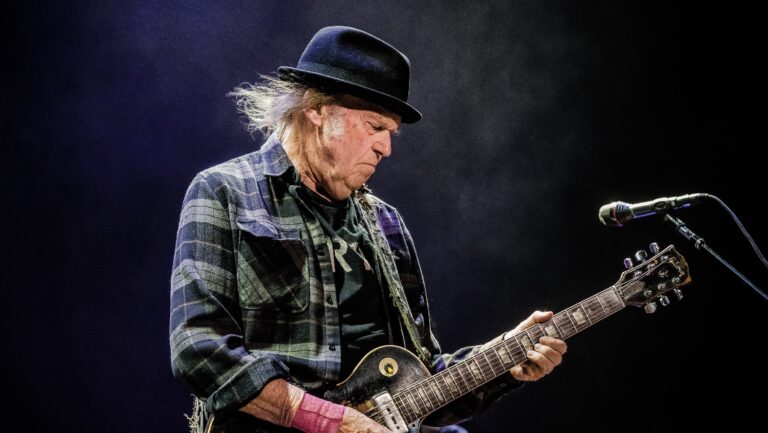
Neil Young intends to remove his music from Amazon

0

Neil Young said he will remove his songs from Amazon Music over economic and political concerns, marking his latest campaign against a major tech company.

The Canadian and American singer-songwriter disclosed his decision in an October 8 post on his website, urging fans to abandon Amazon and its subsidiaries including Whole Foods Market.

The removal of his music from Amazon Music would affect subscribers’ access to a catalog of work spanning six decades, including solo hits like Old Man and Harvest Moon.

Young criticized Amazon founder Jeff Bezos for supporting the Trump administration, while also referencing a government shutdown that he said affected income, safety, and healthcare security for families.

He wrote: “Forget Amazon and Whole Foods. Buy local. Buy direct. Bezos supports this government. It does not support you or me.”

He added: “The time is here. Forget Amazon. Soon my music will not be there. It is easy to buy local. Support your community. Go to the local store. Don’t go back to big corporations who have sold out America.”

“Forget Amazon and Whole Foods. Buy local. Buy direct. Bezos supports this government. It does not support you or me.”

Neil Young

He continued: “We all have to give up something to save America from the Corporate Control Age it is entering. They need you to buy from them. Don’t.”

Young did not specify whether his move would affect only Amazon Music’s streaming service or extend to physical albums and merch sold through Amazon’s marketplace.

The artist has repeatedly withdrawn his music or abandoned social media platforms over political and ethical disagreements. In early 2022, he pulled his catalog from Spotify after accusing the streaming giant of allowing podcaster Joe Rogan to spread misinformation about COVID-19 vaccines.

“The time is here. Forget Amazon. Soon my music will not be there. It is easy to buy local. Support your community. Go to the local store. Don’t go back to big corporations who have sold out America.”

Neil Young

After an absence of more than two years, his music returned to Spotify, writing in March 2024: “My decision comes as music services Apple and Amazon have started serving the same disinformation podcast features I had opposed at Spotify.”

He added at the time: “I cannot just leave Apple and Amazon, like I did Spotify, because my music would have very little streaming outlet to music lovers at all, so I have returned to Spotify, in sincere hopes that Spotify sound quality will improve and people will be able to hear and feel all the music as we made it.”

Most recently in August, Young announced that he was leaving Facebook, citing objections to the Meta-owned platform’s AI chatbot. The Neil Young – Reprise Records page on Facebook wrote: “At Neil Young’s request, we are no longer using Facebook for any Neil Young-related activities. Meta’s use of chatbots with children is unconscionable. Mr. Young does not want a further connection with Facebook.”

He also abandoned X or Twitter in late 2023 after Elon Musk was reported to have endorsed an anti-Semitic conspiracy theory. He wrote at the time: “We are stopping all use of X we can control. For reasons that should be obvious to the richest man on Earth, we are taking this action against his company.”

Young’s move against Amazon marks the latest in the growing boycott of music streaming platforms. In August, Canadian post-rock band Godspeed You! Black Emperor pulled nearly their entire discography from major streaming services including Spotify, Tidal and Amazon Music, without providing a reason. The band’s music remains available for purchase and streaming through direct-to-fan platform Bandcamp.

In July, Australian rock band King Gizzard & The Lizard Wizard withdrew their music from Spotify in protest over CEO Daniel Ek‘s investment in European defense technology company Helsing, founded in 2021, which specializes in AI defense software but also makes drones like the HX2.

San Francisco-based Indie rock band Deerhoof started the wave of departures, writing on their website on June 30: “We don’t want our music killing people. We don’t want our success being tied to AI battle tech.”

On Sunday, The Guardian reported that indie musicians in Oakland, California, held a series of talks called Death to Spotify, where they discussed “what it means to decentralize music discovery, production and listening from capitalist economies.”

Music Business Worldwide

Exchange of Israeli Captives and Palestinian Detainees Commences

0

new video loaded: Swap of Israeli Hostages and Palestinian Prisoners Begins

Hamas began releasing some of the 20 living Israeli hostages held in Gaza on Monday as part of a cease-fire deal in exchange for nearly 2,000 Palestinian prisoners held in Israel.

By Shawn Paik

October 13, 2025

Challenge from the Client

0


Client Challenge


JavaScript is disabled in your browser.

Please enable JavaScript to proceed.

A required part of this site couldn’t load. This may be due to a browser
extension, network issues, or browser settings. Please check your
connection, disable any ad blockers, or try using a different browser.