
Live updatesLive updates,
Israel continues to restrict aid entering Gaza, saying Hamas has not met its end of deal to release all bodies of captives.
Published On 16 Oct 2025

Israel continues to restrict aid entering Gaza, saying Hamas has not met its end of deal to release all bodies of captives.
Published On 16 Oct 2025

A required part of this site couldn’t load. This may be due to a browser
extension, network issues, or browser settings. Please check your
connection, disable any ad blockers, or try using a different browser.

Hamas says it has handed over the bodies of two more Israeli hostages under the terms of the US-brokered ceasefire deal, but says it needs time and specialised equipment to recover the rest of the deceased from the ruins of Gaza.
The group’s armed wing said in a statement it was committed to the deal but had returned all the bodies of hostages it was able to reach.
US President Donald Trump has said Israeli forces could resume fighting in Gaza if Hamas does not uphold the agreement.
In a statement, the Israeli PM’s office said Israel had received – through the Red Cross – coffins containing the bodies of hostages which were now awaiting official identification.
“The IDF urges the public to act with sensitivity and wait for official identification, which will first be communicated to the families of the deceased hostages,” the statement said.
Senior US advisors providing an update on the implementation of the 20-point peace plan said that the US government did not so far believe Hamas had broken the agreement by not retrieving the remains of remaining deceased hostages.
The advisors argued that Hamas had acted in good faith by returning the live hostages and was working with various interlocutors to find and return the remains of hostages.
If the two bodies returned on Wednesday night are confirmed to be hostages, that would mean 19 are still unaccounted for in Gaza. Hamas is required to return all 28 dead hostages as part of the first phase of the Gaza peace plan.
But Hamas’s armed wing said in a statement “the remaining bodies require significant efforts and specialised equipment to search for and retrieve, and we are making a great effort to close this file”.
Earlier, Israel said it would “not compromise” on hostage returns, saying “the mission is not complete”.
Israel’s defence minister said he had instructed the IDF to prepare a “comprehensive plan” to defeat Hamas in Gaza in the event of a renewal of the war.
After meeting senior generals on Wednesday, Israel Katz said the military must be prepared to act if Hamas refuses to implement the peace plan.
The latest repatriations came after Israel said one of four bodies returned by Hamas on Tuesday was not one of the missing hostages.
The other three deceased were identified as Tamir Nimrodi, 20, Eitan Levy, 53, and Uriel Baruch, 35, the Hostages Families Forum said.
Earlier on Wednesday UN humanitarian chief Tom Fletcher urged Israel to immediately open all crossings into Gaza for humanitarian aid, as called for in the ceasefire plan.
In a post on X, Fletcher said Hamas must “make strenuous efforts to return all the bodies of the deceased hostages”.
He added: “As Israel has agreed, they must allow the massive surge of humanitarian aid – thousands of trucks a week – on which so many lives depend, and on which the world has insisted.”
He called for “more crossings open and a genuine, practical, problem-solving approach to removing remaining obstacles” and said “withholding aid from civilians is not a bargaining chip”.
Trump’s ceasefire plan, which both Israel and Hamas accepted, envisaged the handover of all 48 hostages would be completed by noon on Monday. Hamas returned all the 20 living hostages on Monday.
But the US-brokered ceasefire agreement appears to acknowledge that Hamas and other Palestinian factions may not have been able to find all hostage remains before the initial deadline on Monday.
Under the agreement, Israel also agreed to hand over the bodies of 15 Palestinians in return for every deceased Israeli hostage.
Israel has returned the bodies of a further 45 Palestinians, the Hamas-run health ministry confirmed on Wednesday, bringing the total number of bodies released by Israel to 90.
Meanwhile in Gaza, residents report growing concern about the durability of the ceasefire – and food prices have surged as Palestinians stockpile food.
Traders and suppliers in the enclave have been hoarding food items to create shortages and drive up profits, fearing that the war could resume, local residents told the BBC.
“Every time we start to feel safe, new threats appear, and we fear the war will start all over again,” says mother-of-six Neven Al-Mughrabi, a displaced resident from Gaza who lives in Khan Younis.
“I lost my house in Gaza City, I decided to stay here with my family because I don’t trust the ceasefire and we’re sick of displacement.”
She added that a trader in Khan Younis’s main market said demand for flour, oil and sugar had surged within hours. “Despite the sudden rise of prices by about 30%, people are buying as if they don’t trust the calm will last long, everyone is afraid aid will stop,” Neven says.
The US advisors also said the US was working with Israel to create “safe spaces” behind the yellow-line for people to flee if they feel under threat from Hamas.
In the longer-term, the advisors said they did not see a future for Hamas to govern parts of Gaza.
The current focus, according to the advisors, is on “de-confliction” that would allow aid to flow into Gaza and reconstruction to begin, with an international security force still in its early stages.

Japan urges G7 to stay vigilant to excessive FX volatility

By Madeline Folsom on SwimSwam

Australian World Record Holder and Olympic Champion Ariarne Titmus announced her retirement this afternoon via an Instagram post.
Titmus, 25, has been one of the top swimmers in the world over the last few years. She last competed at the 2024 Olympic Games in Paris where she won the 200 freestyle and finished 2nd in the 400 free and 800 free events. She also won gold as a member of the 4×200 freestyle relay that broke the Olympic Record.
She currently holds the World Record in the women’s 200 freestyle at 1:52.23 from the 2024 Australian Olympic Trials, and she is also a member of Australia’s World Record 800 freestyle relay from the 2023 World Championships which stands at 7:37.50.
In the Instagram video, Titmus discussed how she has been dealing with some health issues and how she has spent her career doing it “all or nothing”. She discussed how she has always had goals outside of swimming and how in taking time off after Paris, she discovered that these were more important to her.
She also talked about her first Olympic gold, which came at the 2020 Olympics when she won the 400 freestyle, beating World Record Holder Katie Ledecky as the “underdog”. She went on to win another gold in the women’s 200 free final in a new Olympic record time of 1:53.50 and finish 2nd in the 800 free final.
“My life is restarting at 25 years old.” She said she wants to give back to younger athletes in the sport who might not have the best resources and she mentioned that she enjoyed the broadcasting experiences she has had, and that could be a potential path for her.
In her Instagram caption she said “Dear seven year old Ariarne, Today you retire from competitive swimming… The dreams you had…they all came true.”
She will retire as a four-time Olympic champion and four 0ime World champion. She also has three Olympic silver medals, two World Championship silver medals, one Olympic bronze, and three World Championships bronze medals.
Read the full story on SwimSwam: World Record Holder Ariarne Titmus Retires From Competitive Swimming
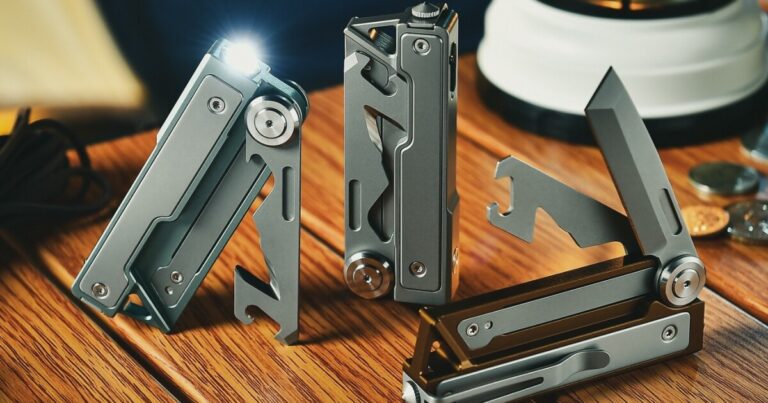
Designed to give you more of what you’ll use and less of the tagalong bulk you won’t, the new Tacray MT1 multitool leaves behind the beefy, flip-out-stuffed body in favor of a thin open chassis carrying a pair of implements. And it adds a much-desired feature that most multitool manufacturers leave behind: an integrated flashlight that works on its own or lights the way for the other tools. Forget mere EDC; the MT1 is also an ENC (every night carry) essential.
Based in China, Tacray has been building multitools, knives and other pieces of EDC kit for over a decade. The MT1 is a response to feedback it’s received during that time. In the company’s own words, three sentiments in particular have echoed again and again: “My multitool is too heavy.” “I never use half these functions.” “Why doesn’t it have a flashlight?”
Tacray
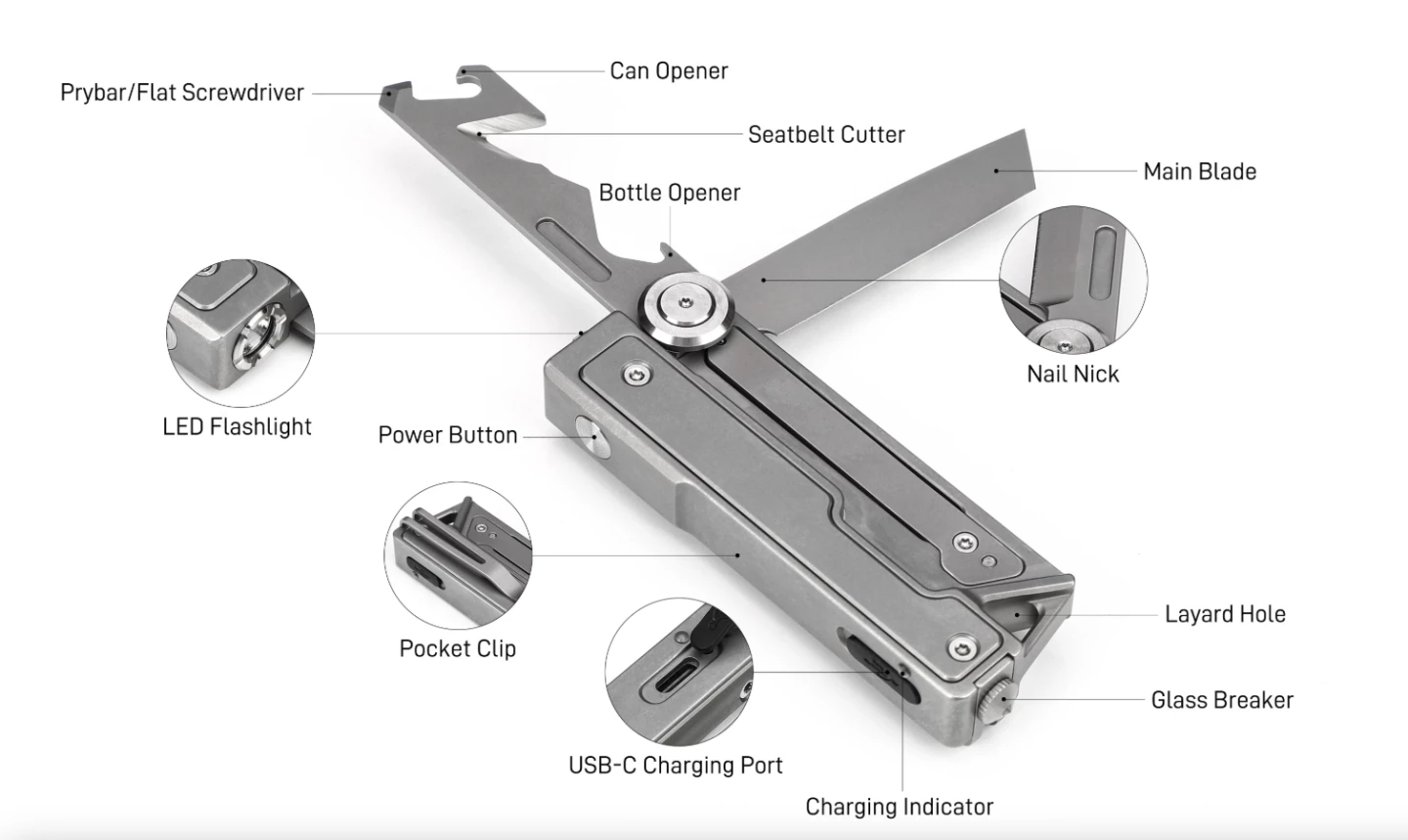
Tacray makes its official response by capping the slim MT1 with a small 6000K LED flashlight on the tip, right next to where the two flip-out implements deploy. With multiple modes up to 260 lumens, the light can serve as a nimble, ultralight flashlight on its own or work with the other implements toward getting things done in the dark – no need to hold a smartphone flashlight awkwardly with the other hand.
It’s hard to picture a light working naturally with the curved nose or multi-directional tool deployment common on Swiss Army knives and other multitools, but Tacray has designed the MT1 light and tools to work seamlessly together. Its slim, rectangular chassis is essentially divided in half down its length, with one half dedicated to the light, 250-mAh battery and USB-C charging port, the other to the flip-out tools.
Tacray appears to successfully integrate the light in such a way that it’s useful and intuitive to use, whether or not you’re also using one of the MT1’s other tools. It certainly appears far sleeker and more user-friendly than many previous attempts at multitools with integrated flashlights or flashlights with integrated multitools.
From there, Tacray keeps things simple and doesn’t attempt to stuff a bunch of folded tools inside the MT1 chassis, like traditional multitool designs. Instead, it secures them outside a thin central chassis beam.
On one side, it installs the primary feature: a tanto blade made from buyer’s choice of M390 or 10Cr15MoV stainless steel. A liner lock secures the blade in place for use.
The side opposite the blade features a second deployable implement with liner lock. This one brings multiple functions: a bottle opener, can opener, seatbelt cutter and pry bar/slotted screwdriver.
There’s also a tungsten steel glass breaker tip at the end opposite the flashlight head.
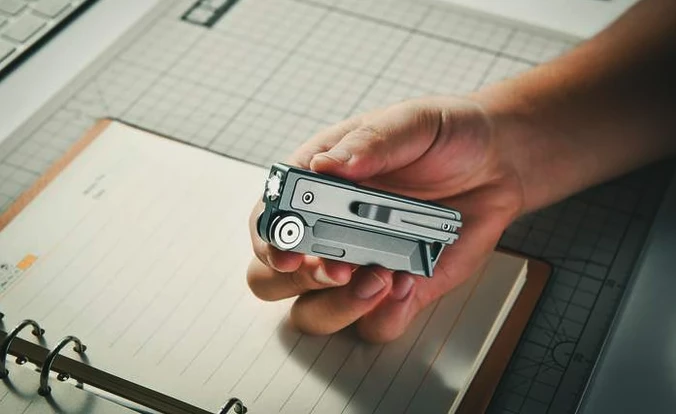
The MT1 measures in at just 3.4 x 1.2 x 0.5 in (85 x 30 x 13 mm) when packed, making it easy to carry in any pocket. Weight slides in at 2.9 oz (82 g) for the aluminum-body version and 3.2 oz (90 g) for the titanium model.
Tacray
While we love the concept of a lightweight, skeletonized multitool that cuts out the extraneous tools “you won’t use,” the execution here lands well off the mark. The knife blade is, of course, a useful staple, but the multifunctional implement on the other side is the embodiment of “I never use half these functions.” Or any of them.
The bottle opener might prove useful enough, though it might very well be redundant if you already carry one on your keychain, smartphone case, belt loop, backpack, shoe, or all of the above.
And the rest? Good luck using those any day, let alone every day.
A can opener could potentially be useful for opening up a can while tailgating or camping, but how often do you really find yourself carrying around canned goods without a dedicated can opener that works better than the tiny one on the MT1?
A seatbelt cutter and glass breaker strike us as the type of narrow-use emergency items toolmakers throw in simply because they fit where other tools don’t, basically a means of upping the total “X-in-1” tally. Not only will you not be using them every day, you’ll be hoping to never use them, period.
Then there’s the combo pry bar/screwdriver that’s miniaturized in order to accommodate all the other functions crammed onto one chaotic strip of metal. That thing seems very unlikely to become your go-to choice for prying or driving.
We think Tacray would be much better served going the modular route with this one. The open chassis would allow for very easy swapping of different implements, and users could personalize their own version of “only [the functions] that earn their keep, nothing you won’t use” – because Tacray seems a little confused there.
Tacray
We have our reservations, but the crowd has opened up its arms to the MT1. Tacray has surpassed its modest US$1,285 Kickstarter goal 18 times over, with a full month left to go. The titanium-body MT1 starts at the $80 pledge level for the 10Cr15MoV steel blade variant and $100 for the M390 blade model. The aluminum-body version is only available with the 10Cr15MoV steel blade and slides in at the $50 pledge level. Shipping will begin in January 2026 if everything runs to plan.
Source: Tacray
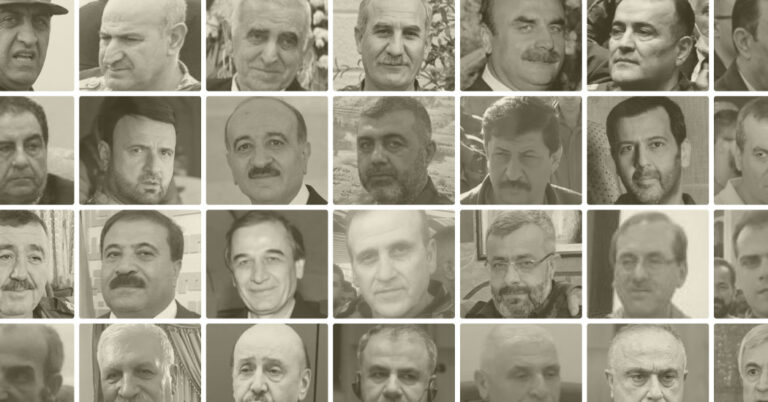
The Syrian strongman Bashar al-Assad was the face of the regime, but he was far from alone. During his two decades in power — and over the course of a 13-year civil war that left half a million people dead — Mr. al-Assad’s many enforcers oversaw the torture of political prisoners. They developed and deployed chemical weapons. They ran illicit drug trades to fund the dictatorship.
When the Assad regime fell in December 2024, many of those enforcers disappeared without a trace. Some are believed to have fled to Libya or Russia or the United Arab Emirates. The picture is murky. Rumors swirl. Trails go cold. One thing is clear: These are not people who want to be found — or held accountable for the regime’s brutality.
The inner structures of dictatorships are opaque by design. Many of these men had limited public profiles, and even finding photos of some of them is a challenge.
The aim of the reporting project is to reveal the most critical high-level officials who powered Mr. al-Assad’s violent reign, uncover evidence of their alleged crimes, and find out where they may be now.
To zero in on a core group of enforcers, The Times compiled the names of every individual who had been sanctioned by the U.S. or European Union for their connection to the Assad regime. That extensive list was winnowed down by cross-referencing it with Syrian and international human rights investigators, internal regime documents and other open-source evidence culled from across the internet.
The Times then selected nine of the deadliest or most revelatory flash points in the war, and was able to link specific officials at the highest levels to those events.
The end result is a list of 55 Assad enforcers who did the bidding of the regime, and vanished when it was overthrown.
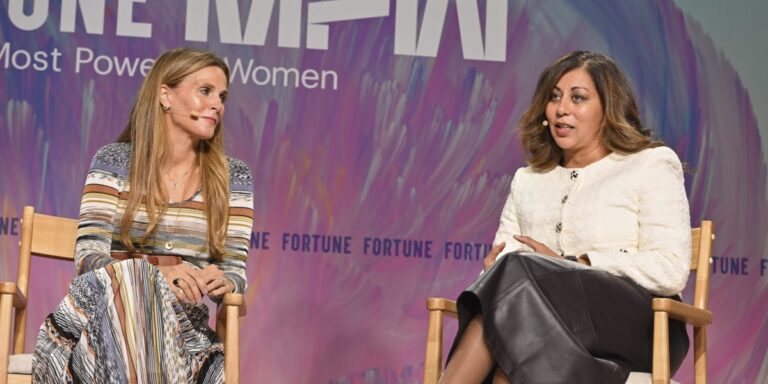
Long known for its massive scale and bureaucratic complexity, the Pentagon is slowly transforming itself into a more streamlined organization, much like a Silicon Valley company.
The “fail fast” mentality, once confined to startups, is taking root in the Department of War, previously known as the Department of Defense, thanks to AI and other systems that are revolutionizing the way the U.S. approaches global conflicts, speakers at the Fortune Most Powerful Women conference said on Tuesday.
Radha Iyengar Plumb, a former chief digital and AI intelligence officer at the Pentagon who is now the vice president of AI-first transformation at IBM said the Pentagon is in some ways similar to a $1 trillion business. It has about three million employees, more ground vehicles than FedEx, and a supply chain three times larger than that of Walmart. Yet, for years, the massive amount of data linked to its operations was handled manually and inefficiently.
Analysts would “literally swivel chair between multiple different computers” to gather intelligence and paste it into PowerPoint slides, she noted.
“When it is the world around you that is changing over time, that swivel chair just gets updated slowly,” Plumb said. “People don’t have full information about the world around them and that makes it harder to make good decisions.”
However, the government’s more recent efforts are slowly improving this situation. Shannon Clark, a former Pentagon analyst and current head of defense growth at Palantir, cited Project Maven, a Pentagon initiative launched in 2017 to consolidate data and integrate AI into battlefield operations, as a key driver of improvements. Palantir is a government contractor assisting the Pentagon in executing Project Maven.
Still, modernization also requires a new mindset, said Clark. The government and Congress need to take more risks, although they are already making strides, thanks in part to some outside influence, she added.
“They’ve seen what the companies in Silicon Valley are doing,” said Clark. “I think they’re seeing that that’s the only way that we’re going to be able to forge forward faster, is by watching and failing and then learning from those mistakes, just as much as learning from success.”
Incorporating AI into government has already helped drive results in part by speeding up how fast the Pentagon can buy and deliver things, said Plumb.
Another positive development over the years has been the emergence of numerous defense technology companies that are helping the U.S. gain an edge over its adversaries, said Clark.
“All of this technology was used for the 12-day war. All this technology was used for the conflict with Russia and Ukraine, and it’ll be used for whatever the next conflict is as well,” she said. “We really need America’s best and brightest to be working on this.”

Stellantis announced a $13bn investment in the US, which will see production of the Jeep Compass move to the US from Canada.
Published On 15 Oct 2025
Canada has threatened legal action against carmaker Stellantis NV over what Ottawa says is the company’s unacceptable plan to shift production of one model to a United States plant.
On Wednesday, Minister of Industry Melanie Joly sent a letter to Stellantis CEO Antonio Filosa noting that the company had agreed to maintain its Canadian presence in exchange for substantial financial support.
list of 4 itemsend of list
“Anything short of fulfilling that commitment will be considered a default under our agreement,” she said. If Stellantis did not live up to its commitment, Canada would “exercise all options, including legal”, she said.
Stellantis announced a $13bn investment in the US on Tuesday, a move that it said would bring five new models to the market. As part of the plan, production of the Jeep Compass will move to the US state of Illinois from a facility in Brampton in the Canadian province of Ontario.
A copy of the letter was made available to the Reuters news agency. The existence of the letter was first reported by Bloomberg.
Stellantis had paused retooling of the Brampton plant in February, shortly after US President Donald Trump announced tariffs against Canadian goods, upending the highly integrated North American auto industry.
In a statement on Tuesday night, Canada’s Prime Minister Mark Carney said Ottawa had made clear it expected Stellantis to fulfil the undertakings it had made to the workers at the plant.
“We are working with the company to develop the right measures to protect Stellantis employees,” he said.
Ontario is Canada’s industrial heartland and accounts for about 40 percent of its national gross domestic product (GDP).
“I have spoken with Stellantis to stress my disappointment with their decision,” Ontario Premier Doug Ford said on social media on Wednesday.
Stellantis spokesperson LouAnn Gosselin said the company was investing in Canada and noted plans to add a third shift to a plant in Windsor, Ontario.
“Canada is very important to us. We have plans for Brampton and will share them upon further discussions with the Canadian government,” she said in an emailed statement.
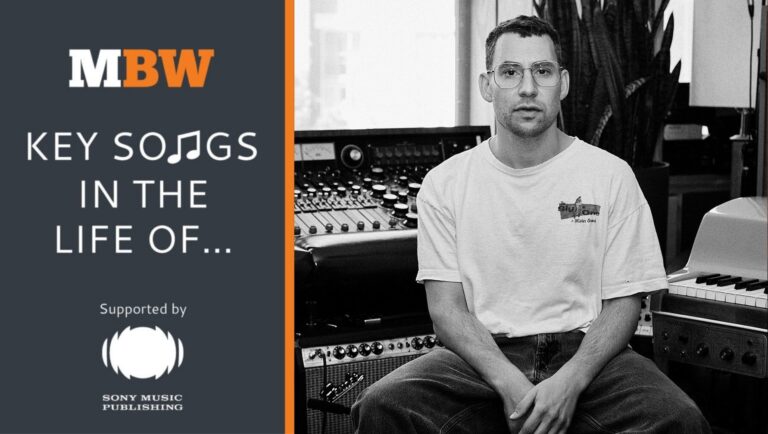
MBW’s Key Songs In The Life Of… is a series in which we ask influential music industry figures about the tracks that have defined their life and career so far. Here, multi-Grammy-winning songwriter and producer, Jack Antonoff, unveils his musical autobiography. The Key Songs… series is supported by Sony Music Publishing.
He’s been a defining influence on the sound of 2025, co-writing and producing most of Kendrick Lamar’s GNX and Sabrina Carpenter’s Man’s Best Friend – with his fingerprints on chart-topping smashes Luther and Manchild.
But when MBW catches up with Jack Antonoff, speaking from a studio in Portugal, it’s not to discuss the hits of today. It’s to talk about the music that made him who he is.
Throughout our discussion of his Key Songs playlist, Antonoff repeatedly returns to themes of authenticity, restraint, and the mysterious alchemy of perfect production.
He’s particularly animated when discussing AI’s limitations in creative fields, likening its ability/inability to write a joke or a moving song to “asking a clown to come over and fix the electricity – two entirely different things”.
“A great joke is in some ways very similar to a great song,” he continues. “Both play with everything happening in your past, present, and future, creating a visceral reaction, something you cannot control.
“People can lie to themselves in politics, in society, about who they are and what they feel – they can put on all these different masks. But you can’t lie to yourself about music and comedy.
“Comedy doesn’t just make you laugh; comedy reveals what you think is funny, whether you like it or not. It’s the same with music. It’s the great revealer of people’s hearts and souls.”
“People can lie to themselves in politics, in society, about who they are and what they feel – they can put on all these different masks. But you can’t lie to yourself about music and comedy.”
These aren’t just abstract theories for Antonoff. His approach to production – whether working with pop superstars or indie darlings – is rooted in a deep respect for the listener.
“There’s zero part of me that thinks ill of the public’s intelligence when it comes to music,” he tells MBW of his approach in the studio, even when sculpting pop hits that stream in their billions.
“I don’t see my work in pop music as being in any sort of service industry,” he adds. “I’m not trying to please. It’s about making something that feels incredible, honest, and worth putting out.”
He’s equally thoughtful about the music industry’s snowballing obsession with artist visibility.
Discussing Fiona Apple‘s genius, he suggests that viewing her quiet public profile as an anomaly in modern music “speaks to how marketing-obsessed we’ve gotten. All that matters is your songs, the way you record them, and the way you perform them.”
Here, in his own words, are the seven tracks that have shaped Jack Antonoff’s journey — from a middle-class childhood in New Jersey through teenage angst, devastating personal loss, and ultimately becoming one of music’s most sought-after hitmakers…
1) The Beatles, Happiness Is A Warm Gun (1968)
When I was young, my parents just played tons of music in the house. My dad is this brilliant ragtime guitar player who grew up in New Jersey and somehow ended up taking guitar lessons from Reverend Gary Davis.
There was really eclectic music in the house, everything from ragtime to British music, music from every generation. Happiness Is A Warm Gun is particularly significant because it’s the first production memory I ever had: I hear everything, and I’m utterly fascinated as to why these choices were made.
I’d always remembered hearing music, loving music, loving melodies and instruments, all these things about songs. But this was the first time thinking: ‘Holy shit, why is that voice coming from this speaker? Why is the time signature changing? Why does the guitar sound like it’s melting?’
“The Beatles were just like a fact. You didn’t fuck with it. It was a fact.”
Obviously, Happiness Is A Warm Gun is one of the greatest productions ever, but all of that jumped out at me – partially because of its brilliance, partially because of its panning, partially because of its oddity in general.
I’m probably nine at this time, becoming acquainted with the popular music of the era – Nirvana, Smashing Pumpkins, things like that.
But in my house, The Beatles were just a fact. You didn’t fuck with it. It was a fact.
My mother was a nurse who’d stopped working to raise us kids, and my father had a company that did carpet cleaning. It was a very normal, middle-class American existence.
The way they raised me, there was everything, and then there was The Beatles.
2) NOFX, The Decline (1999)
I always loved NOFX growing up. But when they put out The Decline… it’s basically like a rock opera. It’s 40 or so minutes, it’s one song and never stops.
At that time, in mainstream culture, politics were [treated as] separate. So a lot of things I was learning about — global politics, race politics, veganism – came much more from underground music. I loved bands like Bad Brains and Propagandhi and things like that.
The Decline connected a lot of interests for me, because there was a theater to it. I still think it would make one of the greatest plays or musicals of all time. I studied it from beginning to end — the way they sewed it together.
“The biggest takeaway from The Decline is the intention for serious listening.”
Listening to The Decline, that’s my root of throwing rules out [in the studio], making really harsh changes this way and that way. I guess that started with Happiness Is A Warm Gun too, but The Decline is a very large-scale version of it.
I guess the biggest takeaway from The Decline is the intention for serious, serious listening. It was almost decidedly fan-only.
Its architecture makes it impossible to have a casual listen, and I think that’s a really important thing for artists.
There’s zero part of me that thinks ill of the public’s intelligence when it comes to music. I don’t know where this narrative [of pop fans not listening as intently as fans of other genres] comes from, but I’m never interested in making anything immediate.
Music and songwriting, recorded music, is a very precious thing and meant to be expressed only at the highest level – even the simplest song. I’ve never understood how anyone could [enter the studio with the intent] to dumb anything down.
Music comes from the heart and the soul; I don’t know how you would even begin to dumb that down. It would be like trying to dry out an ocean; it makes no sense to me.
3) Air, La Femme D’Argent (1998)
This was a time in my life of attempting to escape a very acute state of grief. I started taking drugs, I was on tour a lot, and I was looking for things that really took me away from myself.
My younger sister died of brain cancer when I was 18. It happened around the exact same time that I started to leave home and tour as a musician.
When I think back on it, it was miraculous that I was able to move, let alone tour. But I was living in this very compartmentalized emotional space, trying to live a life on the road while grounded in this grief.
What I know now, that I didn’t know then, is that some things are just too big. I was trying to hold it all in, rapidly moving between complete breakdown and utter escapism.
“In the eye of the storm, I couldn’t articulate it. It was too big.”
Someone put on Moon Safari, which is undeniably a great album, all of its own genre.
As soon as I heard this first song – this plucked bass, very Beatles-esque, but with this ambient thing – I got totally lost in it. This music really transported me.
But the biggest thing, which I think about every day when I’m in the studio: There’s a moment in this song, towards the end, the whole thing is building and building, climaxing, and then right at the tip of the climax, when it’s just about to completely explode, a tambourine enters, doing 16th notes. One instrument. And this tambourine, doing 16th notes, is bigger, more impactful, and more euphoric than a 5,000-piece orchestra.
Whether I’m consciously thinking about it or not, that moment, this song, is such a part of my DNA when it comes to thinking about restraint, moving mountains with something tiny.
Interestingly enough, during that time, I wasn’t able to write very well. In the depths of the grief, the eye of the storm, I couldn’t articulate it. It was too vast.
I had to distance myself from it; time needed to exist before I could express it in songs. Now it’s in all of my writing.
4) Tom Waits, I Never Talk To Strangers (1977)
I love Tom Waits. He’s in my top five favorite songwriters, and he’s lived many different lives.
He’s a great inspiration to try new things. He obviously had his more working-class songwriter phase, then almost like a pirate-sounding phase, a spooky phase.
But it’s when he goes so far into this crooner jazz place… that’s this song – a duet with Bette Midler.
“It reminds me of thinking that I can make a jazz record at the same time I’m making a hardcore record, which is something I still think.”
It’s just amazing that he can do songs like this and do songs like Hold On, do songs like Time, and do songs like Singapore. It gives me a lot of faith.
It reminds me of being young and in love and thinking I could make a jazz record at the same time as making a hardcore record, which is something I still think.
I listened to this a lot in my late teens; a girl I was dating at the time would play it a lot. It’s just one of those pieces of work that reminds you of a person and a place in time.
5) OutKast, Babylon (1996)
With OutKast, it’s impossible to pick anything, because it’s all so brilliant. But for some reason, this song is at the core of their spirit to me.
When I heard it, when I got this album [ATLiens], it was life-changing.
“OutKast and Tom Waits kind of live in the same part of my brain.”
To me, OutKast, much like Tom Waits, treat genre as a jacket to throw on. It’s in no way the centerpiece. The centerpiece is just the heart and soul of what they’re doing.
OutKast and Tom Waits kind of live in the same part of my brain.
6) Fiona Apple, Paper Bag (1999)
In my late 20s, I started to think about engineering and recording on a different level. Sometimes you just hear something that you never forget, and it changes you forever. This is one of those sonic moments.
The song is incredible. The recording is incredible. Obviously, she’s as good as anyone can possibly get.
But when the two drums come in, the panning left and right, the way they bounce off each other, they’re pulling forward, but they’re also so warm. Like that tambourine on Moon Safari, it’s just with me all the time, whether I know it or not. One of those deep sonic references.
“I don’t know anyone who doesn’t listen to Fiona Apple.”
It’s weird [that some people] see Fiona Apple as operating on the periphery of the music business. That’s only out of her choice not to be very present in public promotion, and it’s a view that speaks to how marketing-obsessed we’ve gotten.
Her music couldn’t be less peripheral. It’s front and center – I don’t know anyone who doesn’t listen to Fiona Apple.
To me, she’s an artist who makes brilliant things and needs her space, and that’s not weird. It’s only weird through the lens of everyone being constantly visible.
There’s nothing wrong with being constantly visible, by the way, but you should only do that if that’s something that you don’t mind.
Fiona Apple is just a great inspiration of somebody where all that matters is your songs, the way you record them, and the way you perform them.
7) TLC, Unpretty (1999)
Unpretty is perfect. The recording, the way it kind of moves and floats, I find it very uplifting. It almost feels like a meditation.
I don’t really know why I connect with it so much. The sprinkly, high-end nature of the guitars and the beat – it’s just doing this bizarre, magical thing, and I feel like I’m floating when I listen to it.
“It’s just doing this bizarre, magical thing, and I feel like I’m floating when I listen to it.”
It has a sonic quality that you can’t really dissect.
I don’t remember the first time I heard it, but it’s just always been there. It’s a constant in my life.
Partner message: At Sony Music Publishing (SMP), we believe every voice matters. We are the #1 global music publisher, advancing the artistry of the world’s greatest songwriters and composers for over 25 years. We keep songwriters at the forefront of everything we do, and design our suite of services to amplify opportunities, build connections, and defend their rights. Our roster benefits from an international team committed to providing support at every career stage. From classic catalogues to contemporary hitmakers, history is always being written. We are a part of the Sony family of global companies. Learn more about SMP here.Music Business Worldwide

Welcome to World Breaking News, your trusted source for fast, accurate, and impactful news coverage from around the globe. We are a dedicated team of journalists, editors, and news enthusiasts committed to delivering breaking stories, in-depth analysis, and real-time updates on politics, business, technology, sports, entertainment, and more.
© Copyright -World Breaking News -2025


