
-0.4 C
New York
Monday, February 23, 2026
Home Blog Page 286

Triller Group at risk of Nasdaq delisting due to failure to submit required filings

0

Triller Group received a delisting determination letter from the Nasdaq Stock Market on October 14, setting up its potential removal from the exchange as soon as today (October 23) after it failed to file required financial reports on time.

The Los Angeles-based viral music video app operator, dubbed as a TikTok rival, missed the deadline to submit its annual 10-K report for the year ended December 31, 2024, along with quarterly 10-Q reports for the periods ending March 31 and June 30, 2025.

Under Nasdaq’s listing rules, companies have to file these reports on schedule with the Securities and Exchange Commission.

Nasdaq Listing Qualifications staff notified Triller that its common stock would be suspended and delisted when trading opens today unless the company requested a hearing before the Nasdaq Hearings Panel.

Triller said it intends to request such a hearing, which would automatically stay any delisting action for 15 days from the request date, pending further review by the panel. The company’s stock trades under the ticker ILLR. Its shares closed 12% lower on Wednesday (October 22).

The company had already received an extension. On August 19, Nasdaq granted Triller additional time to file the delinquent reports by October 13. The company failed to meet that deadline.

Triller operates two business segments: a social media platform that uses AI for content related to music, fashion, sports and pop culture, and AGBA Group, a Hong Kong-based fintech unit that provides consumer finance and healthcare services to over 400,000 clients across Asia.

In the first half of 2024, AGBA reported a 55.8% YoY drop in revenues, weighed down by a steep drop in commissions, which it attributed to “the economic recession [in China] and outward migration in Hong Kong.”

The filing delays add to mounting pressures on the company. Merlin, which represents independent labels and distributors, sued Triller in March over allegedly unpaid licensing fees. The complaint claims Triller violated a 2020 licensing agreement that included a “most favored nation (MFN)” clause that requires Triller to make up the difference to Merlin if it offered higher licensing fees to another music company.

Merlin said it discovered through a separate 2022 lawsuit that Triller had paid another music company more favorable rates. The licensing group is seeking $2.55 million in unpaid fees plus interest.

On Monday (October 20), a federal judge approved Merlin’s request to dismiss part of the lawsuit against Triller Hold Co LLC, a subsidiary, while keeping the case active against Triller Group Inc., the publicly traded parent company. The dismissal was filed without prejudice, allowing Merlin to refile against that entity later.

Following the partial dismissal of Triller Hold Co, Judge Jeannette Vargas instructed the court clerk not to close the case, keeping the pressure on the publicly traded parent company.

Judge Jeannette Vargas instructed the court clerk to keep the case open. Triller had until yesterday (October 22) to file opposition to a motion for default judgment that Merlin submitted on September 10. A hearing on that motion is scheduled for November 17, delayed one week from the original date due to a scheduling conflict.

Aside from Merlin, Triller was also sued by Sony Music Entertainment in 2022 and by Universal Music Group in 2023 over unpaid licensing fees. In late 2024, a hedge fund owned by investment manager Yorkville Advisors sued Triller over an allegedly unpaid debt of $33.5 million. That debt had been taken on by AGBA, which merged with Triller in October 2024, making Triller a publicly traded company on the Nasdaq.Music Business Worldwide


Rubio cautions against West Bank annexation following Israel’s parliament’s advancement of the move

0

The US secretary of state has said a move by Israel’s parliament towards annexation of the occupied West Bank would threaten Washington’s plan to end the conflict in Gaza.

“That’s not something we can be supportive of right now,” Marco Rubio said before leaving for Israel as part of US efforts to shore up a fragile ceasefire deal.

In an apparent attempt to embarrass Israel’s prime minister, far-right politicians took the symbolic step of giving preliminary approval to a bill granting Israel authority to annex the West Bank.

At the end of his own trip to Israel, US Vice-President JD Vance said: “If it was a political stunt, it was a very stupid political stunt and I personally take some insult.”

“The West Bank is not going to be annexed by Israel. The policy of the Trump administration is that the West Bank will not be annexed by Israel,” he told reporters at Tel Aviv’s Ben Gurion airport on Thursday.

“That will continue to be our policy. If people want to take symbolic votes, they can do that. But we certainly weren’t happy about it.”

The Palestinians claim the West Bank – occupied by Israel since 1967 – as part of a hoped-for independent state.

Last year, the International Court of Justice – the UN’s top court – said Israel’s occupation was illegal under international law.

Prime Minister Benjamin Netanyahu has previously spoken in support of annexing West Bank land but has not advanced this due to the risk of alienating the US – Israel’s most important ally – and Arab countries which have built relations with Israel after decades of enmity.

Ultra-nationalists in Netanyahu’s governing coalition have repeatedly called for Israel to annex the West Bank outright, though the bill was put forward by MPs outside the government.

The bill passed in a 25-24 vote. It is unclear whether it has support to win a majority in the 120-seat Knesset (parliament), and there are ways the prime minister can delay or defeat it.

The bill will now be discussed by the Knesset Foreign Affairs and Defence Committee and would have to pass three more readings to become law.

The Palestinian foreign ministry condemned the Knesset’s move, saying Israel would have no sovereignty over Palestinian land.

Israel has built about 160 settlements housing 700,000 Jews during its occupation of the West Bank and East Jerusalem. An estimated 3.3 million Palestinians live alongside them.

The settlements are illegal under international law – a position supported by an advisory opinion of the International Court of Justice last year.

As he boarded the plane to Israel, Rubio said annexation would be “counterproductive” and “threatening” for the peace deal – reiterating US opposition to annexation.

His visit on Thursday comes hot on the heels of trips by Vance and two US special envoys, as the Trump administration attempts to push for the start of talks on the second critical phase of his 20-point Gaza peace plan.

The first phase – which includes a ceasefire, the partial withdrawal of Israeli forces and an influx of aid – came into effect earlier this month.

Both Israel and Hamas have accused each other of breaching the agreement over deadly incidents, but it has so far held.

Rubio voiced similar optimism to that of Vance for preserving the ceasefire.

“Every day there’ll be threats to it, but I actually think we’re ahead of schedule in terms of bringing it together, and the fact that we made it through this weekend is a good sign,” he said.

The second phase of the peace plan would involve setting up an interim government in Gaza, deploying an international stabilisation force, the withdrawal of Israeli troops, and the disarmament of Hamas.

The war in Gaza began with the Hamas-led attack on southern Israel on 7 October 2023, in which around 1,200 people were killed and 251 taken hostage.

In the ensuing conflict, more than 68,000 Palestinians have been killed in Gaza, according to the territory’s Hamas-run health ministry, whose figures are seen by the UN as reliable.

Durant Assumes Responsibility for Rockets’ Defeat against Thunder

0

A Tough Debut for Houston’s New Star

Kevin Durant’s Houston Rockets debut ended in heartbreak Tuesday night, as the defending champion Oklahoma City Thunder edged out a 125–124 win in double overtime. After the game, Durant was quick to shoulder the blame.

“I missed the free throws, and I fouled somebody at the end,” he said. “I think those two plays are the reason we lost.”

On a night when Oklahoma City celebrated its championship banner and ring ceremony, Durant scored 23 points on 9-of-16 shooting but committed two costly mistakes. With 11 seconds left in the second overtime, Shai Gilgeous-Alexander baited Durant into his sixth foul, then sank both free throws to win the game.

“Fouled Shai, put them up one,” Durant said. “I’ve got to stay down, be more disciplined.”


Missed Chances and Close Calls

Durant’s struggles began earlier. With nine seconds left in regulation and Houston up 103–102, he missed the first of two free throws. Gilgeous-Alexander responded with a jumper that forced overtime.

The first extra period nearly ended in disaster when Durant appeared to signal for a timeout that the Rockets didn’t have. “I think definitely he called timeout about three times — verbally and physically,” Gilgeous-Alexander said. Crew chief Zach Zarba later confirmed that officials didn’t see the signal and therefore didn’t assess a technical foul.

Durant Takes Responsibility After Rockets’ Double-OT Loss to ThunderDurant Takes Responsibility After Rockets’ Double-OT Loss to Thunder


Bright Spots Amid the Chaos

Despite the missteps, Durant showed flashes of brilliance. He hit 5-of-6 two-point jumpers, all within the final eight seconds of the shot clock — his most in a game since the 2013–14 season, according to GeniusIQ.

Center Alperen Sengun carried Houston offensively, posting a career-high 39 points, 11 rebounds, and seven assists while drilling five three-pointers. “It’s incredible,” Durant said. “We’re going to need that from him as much as we can.”


Looking Ahead

The Rockets’ starting lineup was the tallest in any season opener since 1970–71, averaging 82.2 inches. Durant started at guard for the first time since 2009, alongside Amen Thompson, Jabari Smith Jr., Sengun, and Steven Adams.

“We make plays as a team,” Durant said. “Some nights it’s my night. Some nights it’s Alpi’s. We just have to be ready.”

Retina E-Paper Screens are Virtually Indistinguishable from Real Life Visuals

0

In what could be an industry shifting breakthrough, researchers have created a screen about the size of a human pupil with a resolution that breaks through the limits of pixels. The invention could radically change virtual reality and other applications.

While most video screens such as those on our phones, TVs, and stadium jumbotrons seem to improve in resolution on a monthly basis, there has been an issue in improving the resolution of the tiny screens required in virtual reality apps. The problem is that as the screen moves closer to the human eye, the pixels that comprise it need to get smaller and smaller. Yet, if pixels get too small, their function starts to degrade and the image suffers. On a micro-LED screen, for example, pixels can’t get much smaller than one micrometer wide before losing their ability to render a clear, crisp image.

So instead of relying on pixels, researchers from Chalmers University of Technology, the University of Gothenburg and Uppsala University in Sweden turned to a different technique. They created what they’ve termed “metapixels” out of tungsten oxide, a material that can switch from being an insulator to a metal based on its electrical state. The metapixels reflect light differently based on their size and how they’re arranged, and can be manipulated by an electrical current. In a way, they function much like the pigments in bird’s feathers, which can take on different colors based on how the light is hitting them.

The fact that metapixels don’t need a light source eliminates the problems that video pixels take on when they get too small such as color bleeding and issues with uniformity.

Indistinguishable

The result is that the team was able to create a screen that’s about the size of a human pupil packed with pixels measuring about 560 nanometers wide. The screen, which has been dubbed retinal e-paper, has a resolution beyond 25,000 pixels per inch. “This breakthrough paves the way for the creation of virtual worlds that are visually indistinguishable from reality,” says a Chalmers news release about the breakthrough.

“This means that each pixel roughly corresponds to a single photoreceptor in the eye, i.e. the nerve cells in the retina that convert light into biological signals,” adds Andreas Dahlin, Professor at the Department of Chemistry and Chemical Engineering at Chalmers. “Humans cannot perceive a higher resolution than this.”

To demonstrate the efficacy of the tiny screen, the researchers reproduced The Kiss, a famous artwork painted by Gustav Klimt. The image was shown in perfect resolution on the screen, which at approximately 1.4 x 1.9 mm was 1/4000th that of a standard smartphone.

“The technology that we have developed can provide new ways to interact with information and the world around us,” says Uppsala’s Kunli Xiong, who conceived the project and is the lead author of the study. “It could expand creative possibilities, improve remote collaboration, and even accelerate scientific research.”

The researchers are now working on refining their invention further, but they believe it could have a dramatic impact on the world of tiny optics.

“This is a major step forward in the development of screens that can be shrunk to miniature size while improving quality and reducing energy consumption,” says Giovanni Volpe, from the University of Gothenburg. “The technology needs to be fine-tuned further, but we believe that retina e-paper will play a major role in its field and will eventually have an impact on us all.”

The research has been published in the journal Nature.

Source: Chalmers

Challenging the Client

0


Client Challenge


JavaScript is disabled in your browser.

Please enable JavaScript to proceed.

A required part of this site couldn’t load. This may be due to a browser
extension, network issues, or browser settings. Please check your
connection, disable any ad blockers, or try using a different browser.

Multiple Unidentified Palestinians Laid to Rest in Mass Burial Site in Gaza

0

new video loaded: Dozens of Unidentified Palestinians Buried in Mass Grave in Gaza

The bodies of 54 unidentified Palestinians were laid to rest at a mass burial site in Gaza. The bodies were returned by Israel to Gaza as part of the cease-fire deal.

By Jorge Mitssunaga and Saher Alghorra

October 22, 2025

CenterPoint Energy surpasses earnings expectations by $0.06, revenue slightly below estimates

0


CenterPoint Energy earnings beat by $0.06, revenue fell short of estimates

Palestinians in Gaza resort to using graveyards as shelters amidst destruction | Gaza News

0

‘Even the land for the dead is now the only refuge for the living,’ one Gaza resident says.

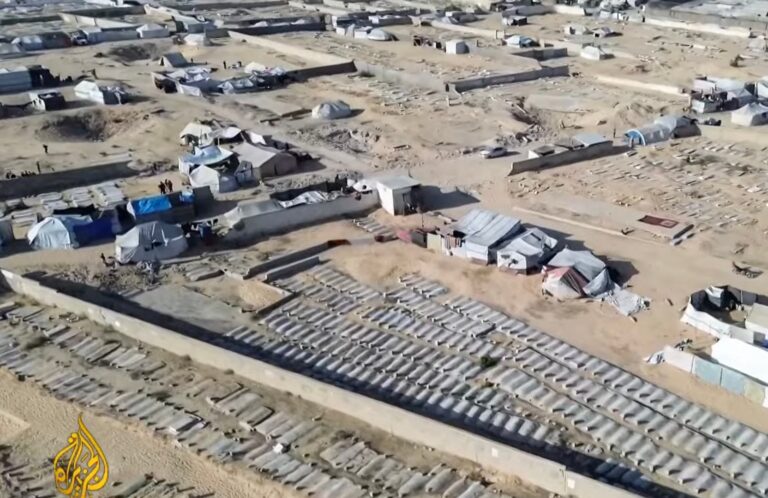
Tens of thousands of displaced Palestinians who lack shelter or a home to return to after Israel destroyed their residences across Gaza are pitching tents in graveyards as a last resort, as the humanitarian catastrophe in the enclave remains acute despite a fragile ceasefire deal.

“This graveyard wasn’t meant for the living,” Al Jazeera’s Hind Khoudary said, reporting from the southern city of Khan Younis. “But today, it’s home to dozens of families who have nowhere else to go.”

Recommended Stories

list of 3 itemsend of list

Khoudary said Palestinians were camping at the site “not because they want to, but because it’s the last free space available”.

“Graveyards have become shelters not out of choice, but out of desperation,” she added.

Rami Musleh, a father of 12 who was displaced from the northern Gaza town of Beit Hanoon, could not find any viable option other than the graveyard.

“For parents, the emotional toll is heavy. The psychological trauma of war is made worse by having to raise children among tombstones,” Musleh told Al Jazeera.

Graveyards are now last option shelters in Gaza for Palestinians amid ruins
With no safe shelter left and no land to return to, many families in Gaza are now pitching tents inside graveyards [Screen grab/Al Jazeera]

Another resident, Sabah Muhammed, said the cemeteries have now lost all their sacredness.

“Graveyards, once sacred spaces for the dead, are now silent witnesses to a living crisis. No water, no electricity, and no privacy … only the bare minimum to survive,” she told Al Jazeera.

“In Gaza, even the land for the dead is now the only refuge for the living.”

According to the United Nations, at least 1.9 million people – or about 90 percent of the population – across the Gaza Strip have been displaced during the war. Many have been displaced repeatedly, some 10 times or more.

Palestinians in southern Gaza are squeezed into overcrowded shelters as Israel issued forced orders for residents of northern Gaza and Gaza City to evacuate and then bombarded many as they fled south.

The price of renting even a square metre of land to pitch a tent is prohibitive for many displaced Palestinians, who lack a stable income and are dependent on scarce humanitarian assistance.

UNRWA, the UN agency for Palestinians, said 61 million tonnes of debris now cover Gaza and entire neighbourhoods have been erased. It said families were searching the ruins for shelter and water.

While a fragile ceasefire has been in effect since October 10, Israel is continuing to heavily restrict humanitarian aid into Gaza. The International Court of Justice on Wednesday ruled Israel must allow aid into Gaza, stating it cannot use starvation “as a method of warfare”.

Aid is mainly being channelled into the central and southern parts of the Gaza Strip through the Karem Abu Salem (Kerem Shalom) crossing, while none of the crossings in the north have been opened.

Dubai-based real estate developer fuels Beyond Meat’s 250% stock surge, sending the company into meme-stock territory

0

Reddit investors are still chasing the high of locking in and driving up GameStop stock four years ago. This time, their meme stock of choice is Beyond Meat. The company behind the plant-based meat you briefly glance at before settling for cheaper ground chuck is the focus of another social-media-driven short squeeze that has helped push the stock up ~250% this week, alongside news of an expanded distribution deal with Walmart.

The stock pop was spurred by Dubai-based real estate developer Dimitri Semenikhin, who goes by Capybara Stocks on social media. His original Reddit post hyping up Beyond Meat was removed, but he told Business Insider that he bought 4% of its stock and concluded that the company’s most recent debt deal could be a better sign than most investors thought:

  • Last week, Beyond completed a convertible debt swap that quadrupled its share count, resulting in a significant drop in share price from just above $2 to around 50 cents per share.
  • The stock closed at $3.62 per share yesterday.

Big picture: The rally came after years of Beyond losing steam. The company led a fake meat revolution to its 2019 IPO, wielding a $230 price per share, before the entire market seemed to stagnate as consumers lost their appetite for alternative protein.—MM

This report was originally published by Morning Brew.

Belgorod in Russia faces blackouts due to increasing Ukrainian drone attacks

0

Olga Ivshina, Anastasia Platonova & Yaroslava KirykhinaBBC News Russian

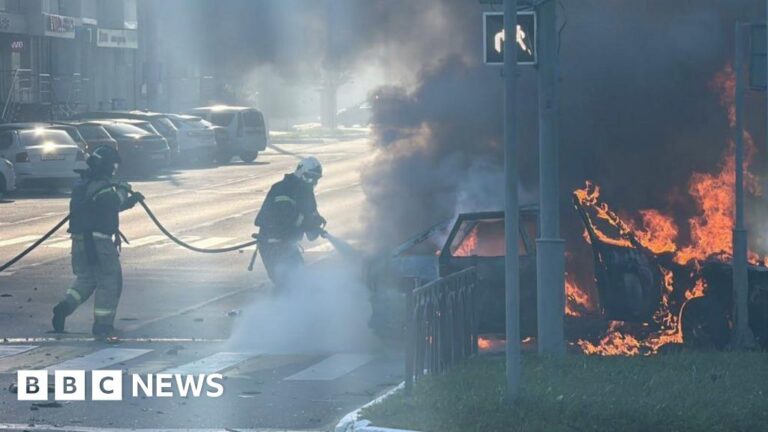
Head of Belgorod region press office Firefighters trying to put down fire after strike on Belgorod, RussiaHead of Belgorod region press office

Firefighters trying to put out a vehicle fire after a drone strike on Belgorod, Russia

Residents of Russia’s Belgorod region say blackouts, air-raid sirens and the sound of gunfire aimed at incoming Ukrainian drones are becoming increasingly common, as Kyiv retaliates against repeated bombardments of its cities with cross-border strikes of its own.

“It’s so loud and so terrifying,” says Nina, a Belgorod resident who asked us to change her name.

“I was coming back from the clinic when a siren went off. As usual, I received Telegram alerts about a drone attack. Then bursts of automatic gunfire broke out, I ran into a nearby courtyard and tried to hide under an arch,” she recalls.

“The next day it all happened again – air defence fire, automatic gunfire, explosions.”

The number of Ukrainian drone attacks on the Belgorod region has increased nearly fourfold since the start of 2025, according to BBC News Russian analysis based on data from local authorities.

In September, more than 4,000 Ukrainian drones were recorded in the Belgorod region, compared with around 1,100 in January 2025. In one of the biggest strikes last month, the region was attacked with more than 260 drones, according to the governor. There has also been an increase in missile attacks since the summer.

Ukraine continues to suffer far greater losses from Russia’s near-daily missile and drone strikes, which routinely kill civilians and leave cities across the country without power and heat.

At least seven people were killed, including two children, in Russian attacks on Ukrainian cities overnight into Wednesday, and there are fears that the coming winter may be the harshest yet for Ukraine.

DSNS Ukraine A rescuer stands at the top of a ladder propped against a building in Kyiv which has smoke rising from the windows after a strike. DSNS Ukraine

Several people were killed on Wednesday in Russian strikes on Kyiv and the surrounding region

Ukrainian authorities say the recent surge of attacks on Belgorod, some of which have caused huge blackouts, is a direct result of Russia’s latest onslaught on Ukraine’s energy infrastructure.

“Maybe they should stop being too comfortable there in Belgorod?” Zelensky said earlier this month. “They must understand: if they want to leave us without power, then we will do the same”.

Belgorod region is a key logistics corridor and staging hub for Russian forces near the border with Ukraine. It is also a regular point of origin for artillery and short-range drone strikes.

Although there were local electricity outages in smaller towns in the region earlier in the war, the city of Belgorod was largely unaffected by power cuts until this autumn.

Local student Ekaterina (not her real name) told the BBC she was at home in the city on the evening of 28 September, when notifications started appearing on her phone: “Missile alert! Take shelter!”

The sound of howling sirens followed, and the lights in her flat started flickering.

“We ran to the corridor, because the explosions started almost immediately. They were very loud. The lights blinked and went out,” Ekaterina recalls.

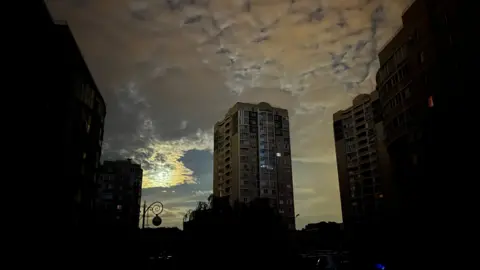
Dark neighbourhoods of Belgorod after power cutt-off in October

Neighbourhoods of Belgorod lost power after a missile strike and power cut in October

Missiles had hit the main Belgorod heat and power plant and a substation, local Telegram channels reported.

And while the city centre had its electricity back relatively quickly, some in the suburbs were left without power until morning. Across the region, around 77,000 people, or 5% of the population, still had no electricity the next day.

“While you’re in the office in the centre, you wouldn’t necessarily notice that there was a blackout. But when you’re going home it’s like entering a whole different world,” another Belgorod resident Natalya (not her real name) tells the BBC.

“Complete darkness outside. Apartment blocks are without power, the shops are dark too. As you ride through the darkness, it’s hard to tell where your stop is – you can’t see anything”.

Another big blackout came less than a week later.

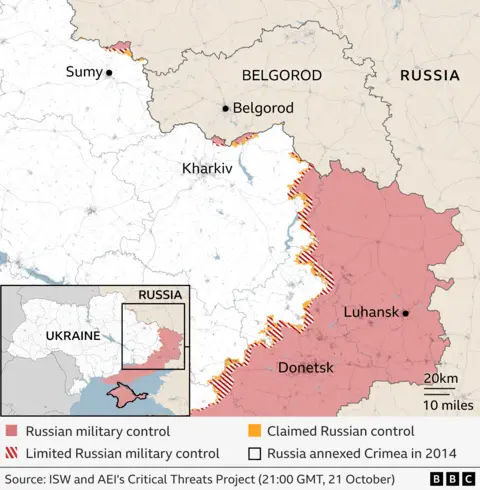
Map showing eastern Ukraine and the Belgorod region, which borders Ukraine to the north east. . The city of Belgorod is also marked on the map. Areas of Ukraine controlled by Russia are marked in red, and areas of limited Russian military control are in red and white stripes. Small areas of yellow mark areas of claimed Russian control. Crimea, which was annexed by Russia in 2014, is also marked in red on the map.

Authorities admit they do not have the capacity to provide everyone with back-up generators and have called on residents to buy their own.

“But what are we suppose to fuel them with, given the fuel crisis?” Maria, an elderly resident who also asked to change her name, tells the BBC.

More than half of Russia’s regions, including Belgorod, have been affected by petrol and diesel shortages, due to increased Ukrainian attacks on Russian oil refineries.

“And the prices for generators have shot up as well,” Maria says.

Ukraine has increased production of its “Darts” drone – lightweight and cheap models that can carry a 4kg (9lb) warhead – and many Belgorod residents say this is the reason the strikes have become more frequent. The drones are effective both for single and mass launches which can potentially overload air defence systems.

But the recent strikes on energy infrastructure that caused the blackouts in Belgorod are more likely to have involved heavier weapons. Reports say long-range Himars rockets or Morok drones with larger warheads might have been used.

Head of Belgorod region press office Belgorod has introduced mobile armed units tro try to shot down dronesHead of Belgorod region press office

Belgorod has introduced mobile armed units to try to shoot down drones

And while for many in Russia the war still seems far away, residents of Belgorod region now feel its impact daily, like Ukrainians over the border.

“Until September, the war seemed to have faded into the background again. But now we are getting constant reminders – through power outages, fuel shortages, and a general sense of anxiety”, says Yakov, who declined to give his real name.

“I personally have a strong feeling that, by continuing the war, Russia is racing headlong toward the abyss”.

Additional reporting by Ilya Abishev