


Form 8K LB Pharmaceuticals Inc For: 6 November
LB Pharmaceuticals Inc files Form 8K for November 6th
Hope Found by Students in Gaza’s Makeshift School

new video loaded: Students Find Hope at This Makeshift School in Gaza

In central Gaza, a makeshift school called Hope Makers is providing their young students, aged from five to twelve years old, psychological support to cope with the trauma from a two-year war in Gaza.
By Ang Li, Nader Ibrahim, Saher Alghorra, Meg Felling and Jon Hazell
November 6, 2025
Delta CEO Ed Bastian disregards mentor’s advice on managing $38 billion airline

Don’t expect to spot Delta Air Lines CEO Ed Bastian lingering at the front of the boarding line—he’s usually nowhere near it.
“I’m terrible,” Bastian admitted during an offstage interview last week at the Fortune Global Forum in Riyadh, Saudi Arabia. “I’m one of the last people to get on board the flight, and our team’s always rushing to make sure that I’m there because planes will not wait for me.”
Bastian, 68, has spent nearly a decade at the helm of America’s most profitable airline, steering the Fortune 500 giant through crises from 9/11 and bankruptcy to the COVID-19 pandemic. After joining Delta in 1998, Bastian rose through six leadership roles before becoming CEO in 2016, but did not observe all of the advice he received for how to be the top boss.
“The worst advice I ever received was [from] a former mentor who told me when I became CEO, I needed to create a unique identity, something that people couldn’t find me,” Bastian said. “He told me I’ll never have a moment of peace because I was too public.”
Bastian listened, but chose not to follow the recommendation: “I thanked him for that, and I did not do that.”
Now, Bastian says his inbox is flooded with thousands of emails per day, and he often spends flights reading through customer feedback. He likens himself to a “point guard” directing traffic to resolve issues.
“I only have one email, only have one phone, and as a result of that, I’m always in touch with our people, our customers, our community,” he said. However, customers often don’t believe they’re actually communicating with the real Bastian himself.
“They’ll think I’m some kind of fancy bot, and they’ll respond, ‘Wow, you’ve got a great agentic device there,’” he joked. “I say, ‘No, it’s me. I’m bored on a Saturday afternoon, just clearing out my inbox.’”
Even in person, Delta passengers are often surprised to see the chief executive seated in economy, eagerly awaiting Biscoff cookies and a Coke Zero from the snack cart.
“Many times when I travel, I’m sitting in coach,” Bastian said. “It’s always interesting because customers come back and say, ‘Why are you back here?’ And I say, ‘That’s about what my ticket could afford,’ and [I’m] usually next to the restroom.” To be sure, Bastian’s current compensation package is about $27 million, but airline executives do sometimes have to travel coach when premium seats are sold out.
Delta’s people-first strategy
Fresh off a strong third-quarter earnings release with $15.2 billion in record September revenue, Bastian told Fortune Editor-in-Chief Alyson Shontell on stage Delta’s success hinges not on planes or technology, but on its people.
“In our business, everyone focuses on the airline, the aircraft, the technology, the airports, the amazing destinations we get to,” he said. “But it’s the staff that bring it to life.”.
After announcing the Atlanta-based carrier’s first-ever direct flights between the U.S. and Riyadh alongside Riyadh Air CEO Tony Douglas, Bastian added he “obsesses” over his 100,000 employees “so that they can then go do the amazing work that our customers deserve.”
“If your people don’t feel that love and respect and care, they’re never going to be able to give you the service that you expect,” Bastian said.
The strategy has paid off: Delta ranks No. 15 on the Fortune 100 Best Companies to Work For, and No. 70 on this year’s Fortune 500 list as the most profitable U.S. airline, ahead of peers like American, United, and Southwest.
But Bastian’s people-first approach extends beyond philosophy. Long before he became CEO, the former chief financial officer helped design one of corporate America’s most generous profit-sharing programs in 2007. After emerging from a 19-month bankruptcy, Delta pledged to distribute billions of dollars in bonuses back to its workforce for every year that it hit its targets. In 2024, the employee share totaled $1.4 billion, amounting to around 10% of base pay.
“Rewarding our people is fundamental to who we are at Delta,” Bastian wrote in a February statement announcing the payouts. “It’s always my No. 1 priority to take care of the Delta team.”
Stuart Isett for Fortune
Delta CEO’s leadership advice
Offstage at the Fortune Global Forum, Bastian, the longest-serving chief executive among major U.S. airlines, also reflected on his career journey and offered advice for the next generation of leaders: “Leadership is not a popularity contest.”
“We all want to be liked, we all want to be loved,” he said. “But leadership involves also making hard choices, hard decisions with a lot of respect and confidence.”
Earlier this year, Bastian confirmed to Fortune’s Shawn Tully that Delta’s board has named an internal candidate as his successor, marking the first time he publicly disclosed this contingency plan, but emphasized he still has “a number of years to go,” adding, “This is not a swan song.”
But of all the business advice he’s received over the years, Bastian says his most impactful wisdom came from his late mother: “She told us, growing up, you’ve got two ears and one mouth, use them accordingly.”
He explained that in business, leaders often focus on sending messages rather than listening: “We don’t take enough time to learn, to listen, to be able to make sure we understand each other.”
For Bastian, it’s a vital skill to form better relationships and fuel personal and professional growth.
“You learn a lot more,” he said. “That curiosity really is one of the hallmarks, I believe, of my career.”
Tony Bellew gives his blunt assessment of Usyk vs Moses Itauma: “It’s a terrible fight for him”


You won’t find many boxing fans who doubt Moses Itauma is the heir to the heavyweight throne, but does he have it in his locker to take it from Oleksandr Usyk now? Former world cruiserweight champion, Tony Bellew, has weighed in.
Itauma is 13 wins into his professional campaign with 11 coming by stoppage. Possessing speed, power and angles, all from the southpaw stance, the 20 year old continues to impress with each outing.
Following a first round knockout win over former world title challenger Dillian Whyte in August, Itauma could not avoid questions about the ultimate step up to face current undisputed ruler Usyk.
Usyk, 18 years Itauma’s senior, has cleared out both the cruiserweight and heavyweight divisions in 24 fights. He represents a different challenge entirely, and while it is one some want to see play out inside the ropes, others have strongly warned against it.
Speaking to Sporting Talk, Bellew – who was stopped by the Ukrainian in his final professional fight back in 2018 – said that it was a bad move making the fight just now.
“I think that’s a dreadful fight for Moses Itauma. I just think to throw this kid in to the wolves at this stage, so early in his career, I just don’t get what for? He’s a young man. Let him develop. Let him learn his trade.”
Itauma’s team has struggled to match him following the statement victory over Whyte, which took him just two minutes, with many top heavyweights reportedly outright turning down the fight or asking for unrealistic purses.
Huge Spider Colony Found in Distinctive Chemoautotrophic Cave

Deep underground in a dark, sulfuric cave on the border between Albania and Greece, scientists have made an incredible discovery – a giant communal spider web spanning more than 100 square meters (1,000 sq ft), dense enough to resemble a living curtain, home to an estimated 110,000 spiders. In other words, an arachnophobe’s living nightmare.
An international team of European researchers, including scientists from the Czech Speleological Society, came across it while undertaking a wildlife survey in 2022, and were not just taken aback by the size of the multilayered web but what it housed: around 69,000 Tegenaria domestica and 42,000 Prinerigone vagans spiders living side by side in this massive silk structure with an estimated surface area of 106 sq m (1,141 sq ft)
It’s the first time either species has ever been seen living cooperatively, and the first recorded instance of colonial web-building in what’s known as a chemoautotrophic cave.
Urák I, et al./Subterranean Biology/(CC By 4.0)
This cavern, known as Sulfur Cave, houses a chemoautotrophic ecosystem sustained not by sunlight but chemosynthesis – or the process of converting chemical energy into organic matter. Here, sulfur-oxidizing bacteria grow in thick white biofilms on wet rock and sediment. These microbes are then eaten by small invertebrates such as midge larvae and isopods, which are in turn preyed on by larger insects like spiders, beetles, and centipedes. The entire ecosystem is self-contained and independent of external input, running on the energy released when bacteria convert toxic hydrogen sulfide into sulfate.
This remarkable life support system is all thanks to a warm toxic stream that runs through it, with its water a constant temperature of about 26 °C (79 °F) and loaded with dissolved hydrogen sulfide – which gives it its distinctive rotten-egg odor.
Be it the smell or the spiders, Sulfur Cave is unlikely to be landing on anyone’s itinerary for their next Greek vacation, but you can bet this is a big deal in the world of entomology. Normally, T. domestica – also known as the common house spider – is a solitary hunter that spins a private funnel web under rocks or in the corners of basements. Here, thousands of those funnels merge into a single, multilayered structure draped across the cave’s walls, where thousands of individuals live peacefully side by side in overlapping webs. What’s more, the researchers were surprised to find no evidence of the spiders’ usual cannibalistic aggression.
Even more incredible was the discovery of another species – P. vagans, a smaller, sheet-web builder – also calling this mega-structure home. In other circumstances, T. domestica would prey on the smaller spider, but here they were also co-existing in harmony.
Understanding how more than 110,000 spiders can live in peace on this huge web tells us a lot about the roles of competition and resource availability in an ecosystem. in the cave, the air close to the stream is packed with tiny Tanytarsus albisutus midges, whose larvae feed on the bacterial biofilms at the water’s edge. Their density – 45,000 per sq m (about 4,180 per sq ft) – provides an all-you-can-eat buffet for the spider colony, which essentially eradicates any food competition that would normally exist. Further analysis confirmed that the spiders’ carbon and nitrogen signatures traced back to sulfur-oxidizing microbes, not plants that underwent photosynthesis like those above ground.
Researchers conducted further genetic testing and found that the Sulfur Cave spiders shared unique DNA not found in populations outside, suggesting they’ve been evolving in isolation, and their microbial makeup was also much simpler. The scientists also discovered that the T. domestica spiders laid significantly fewer eggs in clutches than above-ground individuals, which they believe is a mix of the high-energy demands of the dark, low-oxygen environment and the fact there are no predators so they don’t need to produce as many eggs to maintain a stable population.
“Our findings unveil a unique case of facultative coloniality in this cosmopolitan spider, likely driven by resource abundance in a chemoautotrophic cave, and provide new insights into the adaptation and trophic integration of surface species in sulfidic subterranean habitats,” the researchers noted.
Recently, scientists found that the microbes living on cheese had also evolved different strategies to exist in darkness, revealing how rapidly life can adapt in challenging environments.
Sulfur Cave may sound like Hell to humans, but it provides a rare glimpse into how flexible life can be when conditions change. Cut off from sunlight, these common surface spiders have flipped the script on their behavior and biology to not just survive but thrive in this extreme and hostile habitat.
The research was published in the journal Subterranean Biology.
Source: Czech Speleological Society via Phys.org
Aid reaching Gaza post-ceasefire labeled as “completely inadequate” – Al Jazeera
Shaina Low on aid entering Gaza since the ceasefire being far below what’s needed to meet the desperate needs.
Shaina Low, communications adviser at the Norwegian Refugee Council, says aid entering Gaza since the ceasefire remains far below what’s required to meet the desperate needs there.
Published On 6 Nov 2025
SM Entertainment’s operating profit increases by 261% due to successful K-pop albums and growth at fan platform DearU

South Korea’s SM Entertainment, known for K-pop acts such as NCT 127, EXO, Riize, and aespa, has reported a massive increase in revenue and profit, driven by a streak of hit albums, rising concert revenue and growth at fan platform DearU.
The company reported a 261.6% year-over-year increase in operating profit for the third quarter of 2025, to 48.2 billion won, or USD $34.8 million at the average exchange for the quarter.
Revenue came in at KRW 321.6 billion ($232 million), up 32.8% YoY. The higher revenue, combined with gains in non-operating income and lower corporate taxes, propelled the company to a 1,107.0% YoY increase in net income, to KRW 44.7 billion ($32.3 million).
Excluding subsidiaries, digital and physical music sales at the parent company grew 32.7% YoY to 96.7 billion ($69.8 million), driven by a string of million-selling albums, including NCT WISH’s mini-album Color (1.48 million album equivalents sold), aespa’s mini-album Rich Man (1.13 million) and NCT DREAM’s Go Back to the Future (1 million).
Concert revenue rose 37.5% YoY to KRW 52.5 billion ($37.9 million). Despite a decrease in the total number of shows, revenue grew thanks to an “expansion in scale of SM artists’ performances,” Chief Financial Officer Jeongmin Jang said on the company’s earnings call Wednesday (November 5).
The company posted solid growth in merchandising and licensing revenue, up 32.8% YoY to KRW 50.3 billion ($36.3 million), which Jang attributed to sales of aespa merch and pop-up stores for NCT WISH and Super Junior. SM also saw 6.7% YoY growth in revenue from appearances (TV, advertising and events) to KRW 24.1 billion ($17.4 million).
“Our leading artists have continued to prove their solid capabilities while new IPs are growing rapidly and adding fresh energy to the company,” CEO Cheol-hyuk Jang said on the call.
“This generational synergy further reinforces the foundation of our IP portfolio, exemplifying the virtuous cycle of a sustainable IP ecosystem that SM Entertainment aims to build.”
“Our leading artists have continued to prove their solid capabilities while new IPs are growing rapidly and adding fresh energy to the company.”
Cheol-hyuk Jang, SM Entertainment
One new earnings driver at the company is fan platform DearU, which operates Bubble, a messaging service that connects artists with fans. SM consolidated DearU into its balance sheet earlier this year after taking a larger stake in the platform. SM now controls 45.1% of DearU.
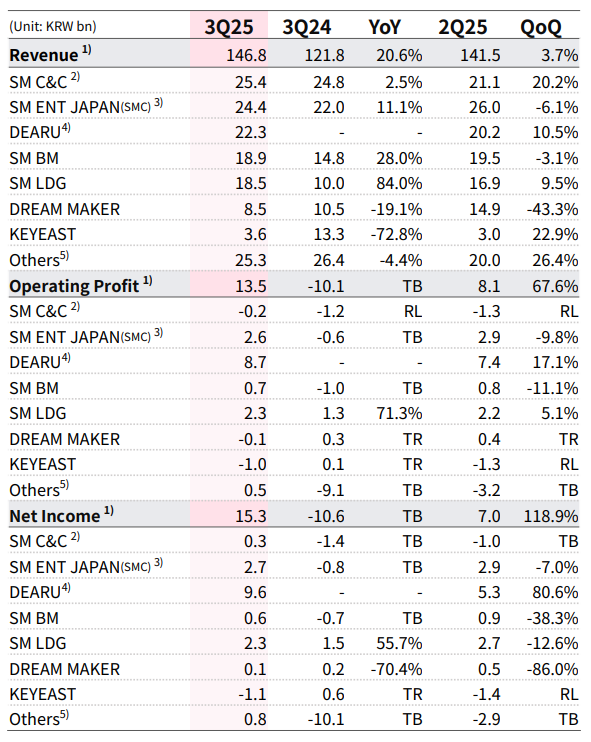
DearU accounted for KRW 22.3 billion of SM’s revenue, up 10.5% from the second quarter, when the platform first appeared in SM’s earnings. Growth was driven by an increase in subscribers and a subscription price hike in July, CFO Jang said.
The company’s subsidiaries are experiencing a significant turnaround, swinging to a positive operating profit of KRW 13.5 billion ($9.7 million), compared to an operating loss of KRW 10.1 billion a year earlier.
Net income came in at KRW 15.3 billion ($11.0 million), compared to a loss of KRW 10.6 billion a year earlier.
That came on the back of a 20.6% YoY increase in revenue at the subsidiaries, to KRW 146.8 billion ($105.9 million).
Talent agency, TV production company and travel agency SM C&C, the company’s largest subsidiary by revenue, reported a 2.5% YoY increase in sales to KRW 25.4 billion ($18.3 million), which the company attributed to an increase in advertising revenue.
SM Entertainment Japan posted an 11.1% YoY jump in revenue to KRW 24.4 billion ($17.6 million) on the back of larger-scale concerts in the Japanese market. SM Brand Marketing (SM BM) posted revenue of KRW 18.9 billion ($13.6 million), driven by stronger album and merch sales.
On the earnings call, CEO Jang focused on SM Entertainment’s new IP development initiatives, including a “next-generation artist incubation project” dubbed SMTR25. Among its projects is a new in-production reality series, Reply High School, which features 15 K-pop trainees as they prepare for their public debut. The show is expected to premiere in the first half of 2026.
SMTR25 is also producing W.O.W! (Way Outta Walls), a hybrid travel series produced with support from the Korea Tourism Organization, which premiered in September via SM’s SMTOWN Channel.
“Through these initiatives, SM Entertainment is reinforcing its content-driven storytelling approach, expanding connections with fans even prior to debut, and enhancing the completeness of our IPs from the earliest stage,” Jang said.Music Business Worldwide
17 South African citizens stranded in Donbas after participating in Russia-Ukraine conflict
 Reuters
South Africa’s government says it has received distress calls from 17 citizens who have joined mercenary forces in the Russia-Ukraine conflict.
The men are between the ages of 20 and 39 years and are trapped in Ukraine’s war-torn Donbas region.
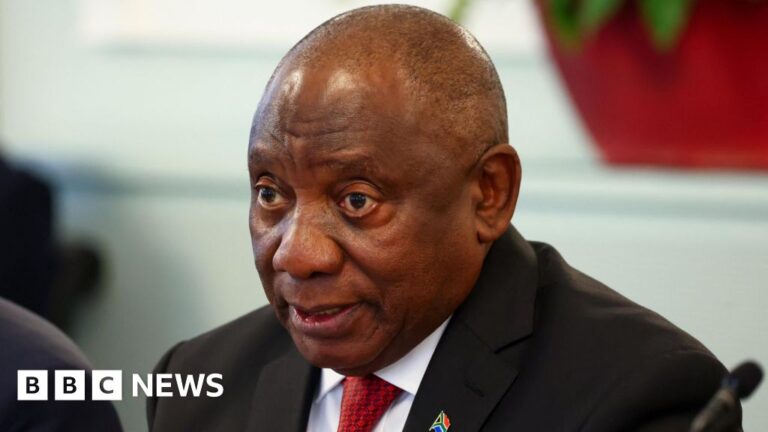
President Cyril Ramaphosa has “ordered an investigation into the circumstances that led to the recruitment of these young men into these seemingly mercenary activities,” a government spokesman said. The statement did not say which side of the conflict the South Africans were fighting for.
Working as a mercenary or fighting on behalf of another government is illegal in South Africa, unless the government authorises it.
The men were lured to join the mercenary forces under the pretext of lucrative contracts, the government said.
Spokesman Vincent Magwenya added the South African government is working through “diplomatic channels” to secure their return.
Magwenya said 16 of the men are from KwaZulu-Natal and one is from the Eastern Cape.
“President Ramaphosa and the South African government strongly condemn the exploitation of young vulnerable people by individuals working with foreign military entities,” he added.
The BBC has found evidence to suggest the Kremlin is working to expand its sphere of influence in Africa.
Africa Corps, a Russian mercenary group controlled by the Russian Ministry of Defence, has effectively replaced the rival military group Wagner in West Africa, after its leader Yevgeny Prigozhin was killed in a plane crash.
In August, the South African government issued a warning to young women not to fall for social media recruitment opportunities promoting jobs abroad, particularly in Russia.
A BBC investigation found young women had been taken to the Alabuga Special Economic Zone in the Republic of Tatarstan in Russia to work in a drones factory.
It is estimated more than 1,000 women have been recruited from across Africa and South Asia to work in Alabuga’s weapons factories.
Challenging Client Situation

A required part of this site couldn’t load. This may be due to a browser
extension, network issues, or browser settings. Please check your
connection, disable any ad blockers, or try using a different browser.
New details emerge about UPS cargo plane crash in Louisville and its victims | Aviation News
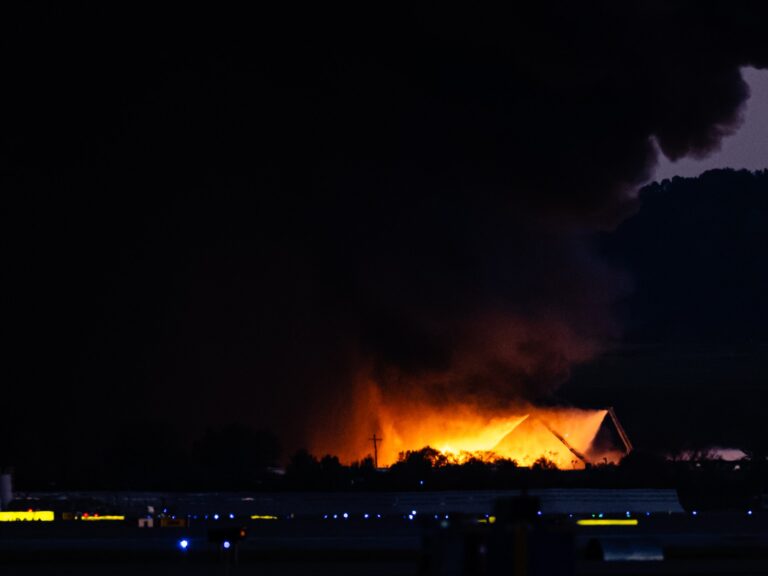
A UPS cargo plane crashed just seconds after taking off from Louisville, Kentucky, on Tuesday, erupting into a fireball that swept across an industrial area near the airport.
The aircraft was bound for Hawaii when it went down. Officials confirmed that at least 12 people died, while Kentucky’s governor warned that the death toll is expected to rise.
The MD-11 freighter was bound for Honolulu, Hawaii, with three crew members on board.
Here is what we know:
What happened at Louisville?
UPS Flight 2976 crashed shortly after taking off from Louisville’s Muhammad Ali International Airport at about 5:20 pm (22:20 GMT) on Tuesday.
It climbed to an altitude of just 50 metres (164ft) before crashing less than 2km (1.2 miles) from the airport’s boundary and into an industrial area.
According to reports, the aircraft veered off the runway and collided with several nearby structures. It was carrying 144,000 litres (38,000 gallons) of fuel when it crashed.
“There’s very little to contain the flames, and really the plane itself is almost acting like a bomb because of the amount of fuel,” aviation lawyer Pablo Rojas told The Associated Press news agency.
UPS and FedEx still use several MD-11 cargo jets, a model last built in 2000. The companies are gradually retiring the planes as they shift to newer, more efficient aircraft.
Where did the UPS flight crash?
Louisville Muhammad Ali International Airport sits about 11 km (7 miles) south of downtown Louisville, near the Indiana state border.
The airport is surrounded by residential neighbourhoods and is only a short distance from several local landmarks.
The plane struck two businesses near the airport – Kentucky Petroleum Recycling and Grade A Auto Parts, an auto salvage yard. The nearby Ford Motor assembly plant, where thousands of workers build SUVs, was not directly hit but experienced a temporary power outage.
The airport resumed operations on Wednesday, with at least one runway open.

How did the plane crash?
The plane rose to about 53 metres (175 feet) and reached a speed of 184 knots before suddenly dropping, according to Flightradar24 data.
During the takeoff roll or soon thereafter, surveillance footage and initial investigations showed that the left engine detached from the wing. A fire erupted in the left wing region, likely triggered or exacerbated by the engine separation.
The plane lifted off and cleared the end of the runway fence, but then crashed into nearby industrial buildings off airport property, creating a fireball and debris field stretching about 0.8km (0.5 miles).
The engine was found on the ground at the airport, the National Transportation Safety Board (NTSB) officials said in a news briefing on Wednesday.
“We have viewed airport CCTV security coverage, which shows the left engine detaching from the wing during the takeoff roll,” NTSB member Todd Inman said during a news conference Wednesday afternoon.
According to local media reports, the crash caused a devastating chain reaction, triggering smaller explosions at Kentucky Petroleum Recycling.

Flightradar24 said the plane, which began operations with UPS in 2006, had flown from Louisville to Baltimore earlier on Tuesday before returning to Louisville.
Jeff Guzzetti, a former federal crash investigator, told The Associated Press it’s still too soon to determine whether the issue during the crash originated in the engine itself, the structure supporting it, or another part of the aircraft.
“It could have been the engine partially coming off and ripping out fuel lines. Or it could have been a fuel leak igniting and then burning the engine off. It’s just too soon to tell,” he said.
Investigators said they had located the aircraft’s flight data recorder and cockpit voice recorder, or so-called black boxes, and would be taking the devices to Washington, DC, for analysis.
What do we know about the victims?
Kentucky’s Governor Andy Beshear confirmed that 12 people have died so far, but warned that 16 families had reported loved ones who remain unaccounted for.
Beshear said he did not know the status of the three UPS crew members on board the cargo plane. It was not clear if they were being counted among the dead.
Eleven other people have been injured and are being treated in hospital – but local officials say that figure is also likely to rise.
At a news briefing, Beshear said authorities were still searching for missing people but no longer expected to find survivors. He added that a young child was believed to be among the victims.
I’m deeply saddened to share that the death toll has risen to 12, with several individuals still unaccounted for.
No one should face tragedy alone. Please take a moment to hug your loved ones and check on your neighbors. We will continue providing resources and support to…
— Mayor Craig Greenberg (@LouisvilleMayor) November 6, 2025